1 Chronicles 26:14

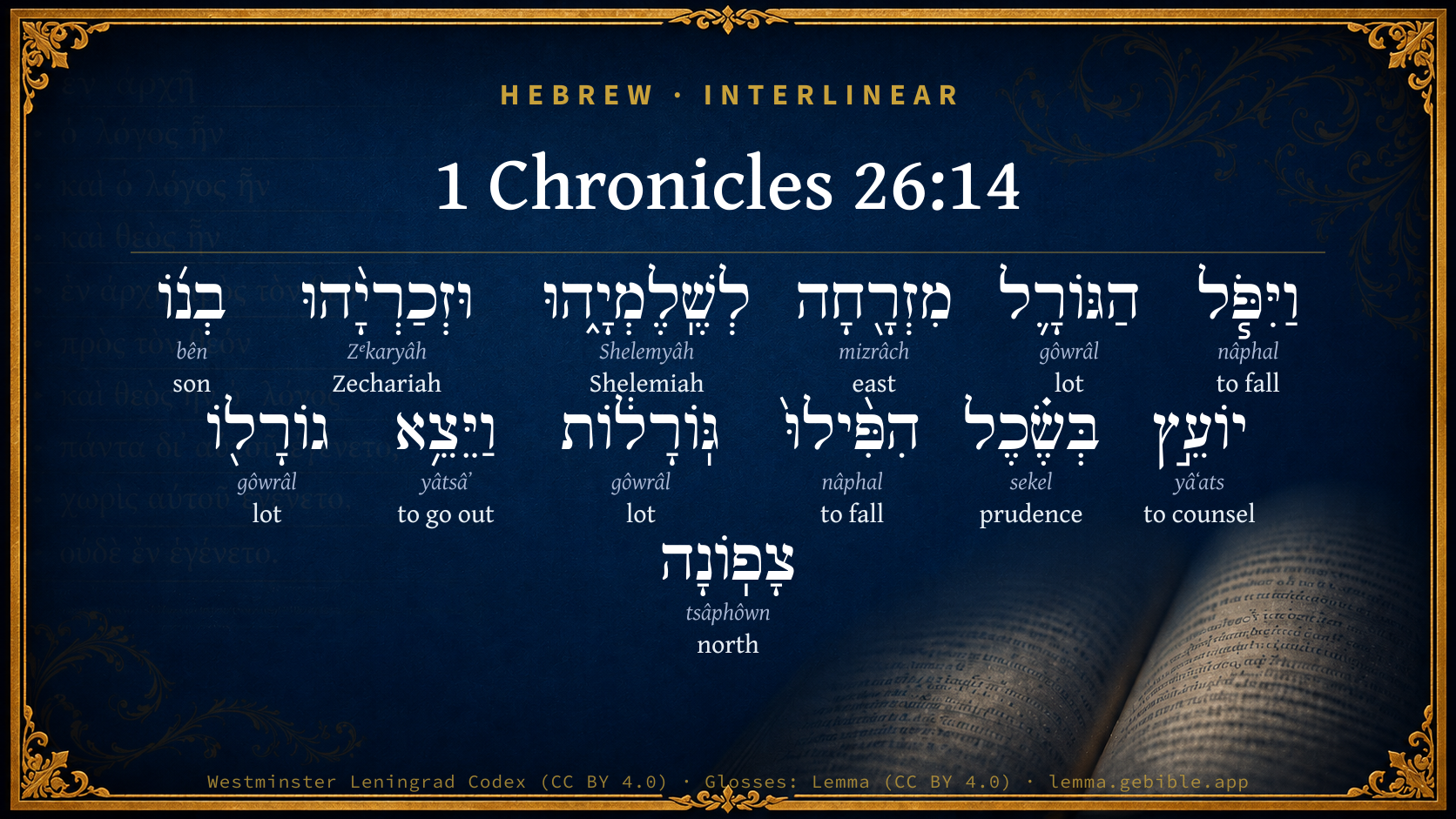
Hebrew (Westminster Leningrad Codex) 1 Chronicles 26:14 appears in the Hebrew Old Testament. The text above is from the Westminster Leningrad Codex. Each word links to its Strong’s number, a concise gloss, and parsing drawn from the Open Scriptures Hebrew Bible morphology. Click any word for its full Brown-Driver-Briggs (BDB) entry.
Download image
Cite this verse

1 Chronicles 26:14 (World English Bible). Public Domain. Lemma interlinear Bible study tool, https://lemma.gebible.app/v/1-chronicles/26/14.

Show BibTeX & RIS
BibTeX
RIS
English Translation
The lot eastward fell to Shelemiah. Then for Zechariah his son, a wise counselor, they cast lots; and his lot came out northward.
World English Bible · Public Domain
Highlights
  • 1 first appearance in the Hebrew Bible
Full analysis ↓
Download a study sheet

One document with this verse’s original text, its word-by-word gloss line, the meaning frame, cross-references with their text, attributed commentary, and full source and license credits — printable, and it pastes into notes with its structure intact.

This verse Autodidact and up

Study sheet (.html) Plain text (.txt)

A passage Seminary Student

Up to 50 verses in one chapter. A passage sheet keeps up to 6 commentary sources and 12 cross-references per verse, in the order this page ranks them, and says so on the sheet whenever that leaves anything out. Ask for a single verse and you get the Autodidact verse sheet above.

Everything on this page stays free to read, with no account — the sheet is a download of what is already on screen, not access to it.

Want to remove ads? Support Godless Engineer
Compare translations 3

The same verse in 3 English versions, stacked beneath the original-language interlinear above. Click any original word for its lexicon entry.

Each is an independent rendering of the whole verse — the interlinear is not word-aligned to these translations.

Highlighted words mark where these versions differ — a whole-verse word diff, not a word-by-word alignment.

  • World English Bible Public Domain
    The lot eastward fell to Shelemiah. Then for Zechariah his son, a wise counselor, they cast lots; and his lot came out northward.
  • King James Version Public Domain
    And the lot eastward fell to Shelemiah. Then for Zechariah his son, a wise counselor, they cast lots; and his lot came out northward.
  • unfoldingWord Literal Text CC BY-SA 4.0
    And the eastward lot fell to Shelemiah. And Zechariah his son a counselor with insight; they cast lots, and his lot came out northward.

unfoldingWord Literal Text — © unfoldingWord, licensed CC BY-SA 4.0. Word-aligned USFM3 via Door43 (git.door43.org/unfoldingWord/en_ult).

Versions to compare (up to 4)

3 of 4 selected

Show all 18 translations

Every available English version of this verse, each an independent rendering of the whole verse.

  • World English Bible Public Domain
    The lot eastward fell to Shelemiah. Then for Zechariah his son, a wise counselor, they cast lots; and his lot came out northward.
  • Berean Standard Bible Public Domain
    The lot for the East Gate fell to Shelemiah. Then lots were cast for his son Zechariah, a wise counselor, and the lot for the North Gate fell to him.
  • Majority Standard Bible Public Domain
    The lot for the East Gate fell to Shelemiah. Then lots were cast for his son Zechariah, a wise counselor, and the lot for the North Gate fell to him.
  • King James Version Public Domain
    And the lot eastward fell to Shelemiah. Then for Zechariah his son, a wise counselor, they cast lots; and his lot came out northward.
  • American Standard Version (1901) Public Domain
    And the lot eastward fell to Shelemiah. Then for Zechariah his son, a discreet counsellor, they cast lots; and his lot came out northward.
  • Revised Version (1885) Public Domain
    And the lot eastward fell to Shelemiah. Then for Zechariah his son, a discreet counsellor, they cast lots; and his lot came out northward.
  • Geneva Bible (1599) Public Domain
    And the lot on the East side fel to Shelemiah: then they cast lottes for Zechariah his sonne a wise couseller, and his lot came out Northward:
  • Douay-Rheims (1899) Public Domain
    And the lot of the east fell to Selemias. But to his son Zacharias, a very wise and learned man, the north gate fell by lot.
  • Young's Literal Translation Public Domain
    And the lot falleth eastward to Shelemiah; and `for' Zechariah his son -- a counsellor with understanding -- they cause to fall lots, and his lot goeth out northward:
  • Literal Standard Version CC BY-SA 4.0
    And the lot falls eastward to Shelemiah; and [for] his son Zechariah, a counselor with understanding, they cause lots to fall, and his lot goes out northward;
  • Unlocked Literal Bible CC BY-SA 4.0
    When the lot was cast for the east gate, it fell to Shelemiah. They then cast lots for Zechariah his son, a prudent advisor, and his lot came out for the north gate.
  • unfoldingWord Literal Text CC BY-SA 4.0
    And the eastward lot fell to Shelemiah. And Zechariah his son a counselor with insight; they cast lots, and his lot came out northward.
  • Darby Bible Public Domain
    And the lot eastward fell to Shelemiah; and they cast lots for Zechariah his son, a wise counsellor, and his lot came out northward;
  • World Messianic Bible Public Domain
    The lot eastward fell to Shelemiah. Then for Zechariah his son, a wise counselor, they cast lots; and his lot came out northward.
  • Webster's Bible Public Domain
    And the lot eastward fell to Shelemiah. Then for Zechariah his son, a wise counselor, they cast lots; and his lot came out northward.
  • Free Bible Version CC BY-SA 4.0
    The lot for the east gate fell to Meshelemiah. Then they cast lots for his son Zechariah, a wise counselor with insight, and the lot for the north gate fell to him.
  • Bible in Basic English Public Domain
    And the care of the door on the east came out for Shelemiah. Then the name of Zechariah his son, a man wise in discussion, came out, and the door on the north was given to him.
  • JPS Tanakh (1917) Public Domain
    And the lot eastward fell to Shelemiah. Then for Zechariah his son, a discreet counsellor, they cast lots; and his lot came out northward.

Literal Standard Version (2020), Covenant Press — licensed CC BY-SA 4.0. Text via the HelloAO Bible API (eBible.org). Unlocked Literal Bible (unfoldingWord) — licensed CC BY-SA 4.0. Text via the HelloAO Bible API (eBible.org). unfoldingWord Literal Text — © unfoldingWord, licensed CC BY-SA 4.0. Word-aligned USFM3 via Door43 (git.door43.org/unfoldingWord/en_ult). Free Bible Version, Dr. Jonathan Gallagher — licensed CC BY-SA 4.0. Text via the HelloAO Bible API (eBible.org).

Word by word

More ways to search: Search by grammar → Find every occurrence → Compare this word →

Practice this passage: Drill this verse → Learn its vocabulary →

לְשֶֽׁלֶמְיָ֑הוּ
Shelemyâh
H8018
“to/for · Shelemiah”
Preposition + Noun, Proper
Part of Speech
Preposition + Noun
Type
Proper
Full BDB Definition

Origin: from H8002 and H3050

TWOT: None

Shelemiah = "repaid by Jehovah" - a son of Bani who put away his foreign wife in the time of Ezra - another son of Bani who put away his foreign wife in the time of Ezra - father of Hananiah who repaired part of the wall of Jerusalem in the time of Nehemiah - a priest in the time of Nehemiah in charge of the treasury - father of Jehucal or Jucal in the time of Zedekiah - Levite upon whom the lot for the East Gate fell; in the time of David - also 'Meshelemiah' and 'Shallum' - father of Nethaniah and grandfather of Jehudi, who was the messenger sent to Baruch the scribe of Jeremiah - son of Abdeel and one the men commanded by king Jehoiakim of Judah to seize the prophet Jeremiah and his scribe Baruch - father of Irijah, the captain of the guard who arrested Jeremiah
  1. וַיִּפֹּ֧ל nâphal H5307 “and · to fall” Conjunction + Verb, Qal, Sequential Imperfect, 3rd Person, Masculine, Singular
  2. הַגּוֹרָ֛ל gôwrâl H1486 “the · lot” Particle, Definite Article + Noun, Common, Masculine, Singular, Absolute
  3. מִזְרָ֖חָה mizrâch H4217 “east · toward” Noun, Common, Masculine, Singular, Absolute + Suffix, Demonstrative
  4. וּזְכַרְיָ֨הוּ Zᵉkaryâh H2148 “and · Zechariah” Conjunction + Noun, Proper
  5. בְנ֜וֹ bên H1121 “son · his” Noun, Common, Masculine, Singular, Construct + Suffix, Personal, 3rd Person, Masculine, Singular
  6. יוֹעֵ֣ץ yâʻats H3289 “counseling” Verb, Qal, Participle Active, Masculine, Singular, Absolute
  7. בְּשֶׂ֗כֶל sekel H7922 “in/at · prudence” Preposition + Noun, Common, Masculine, Singular, Absolute
  8. הִפִּ֨ילוּ֙ nâphal H5307 “to fall” Verb, Hiphil, Perfect, 3rd Person, Common, Plural
  9. גּֽוֹרָל֔וֹת gôwrâl H1486 “lots” Noun, Common, Masculine, Plural, Absolute
  10. וַיֵּצֵ֥א yâtsâʼ H3318 “and · to go out” Conjunction + Verb, Qal, Sequential Imperfect, 3rd Person, Masculine, Singular
  11. גוֹרָל֖וֹ gôwrâl H1486 “lot · his” Noun, Common, Masculine, Singular, Construct + Suffix, Personal, 3rd Person, Masculine, Singular
  12. צָפֽוֹנָה tsâphôwn H6828 “north · toward” Noun, Common, Feminine, Singular, Absolute + Suffix, Demonstrative

About this verse

These counts appear in no published source. They are computed here, from the morphology-tagged text and Lemma’s own curated glosses. What Lemma adds →

13
words
10
distinct lemmas
Historical
section

Notable vocabulary

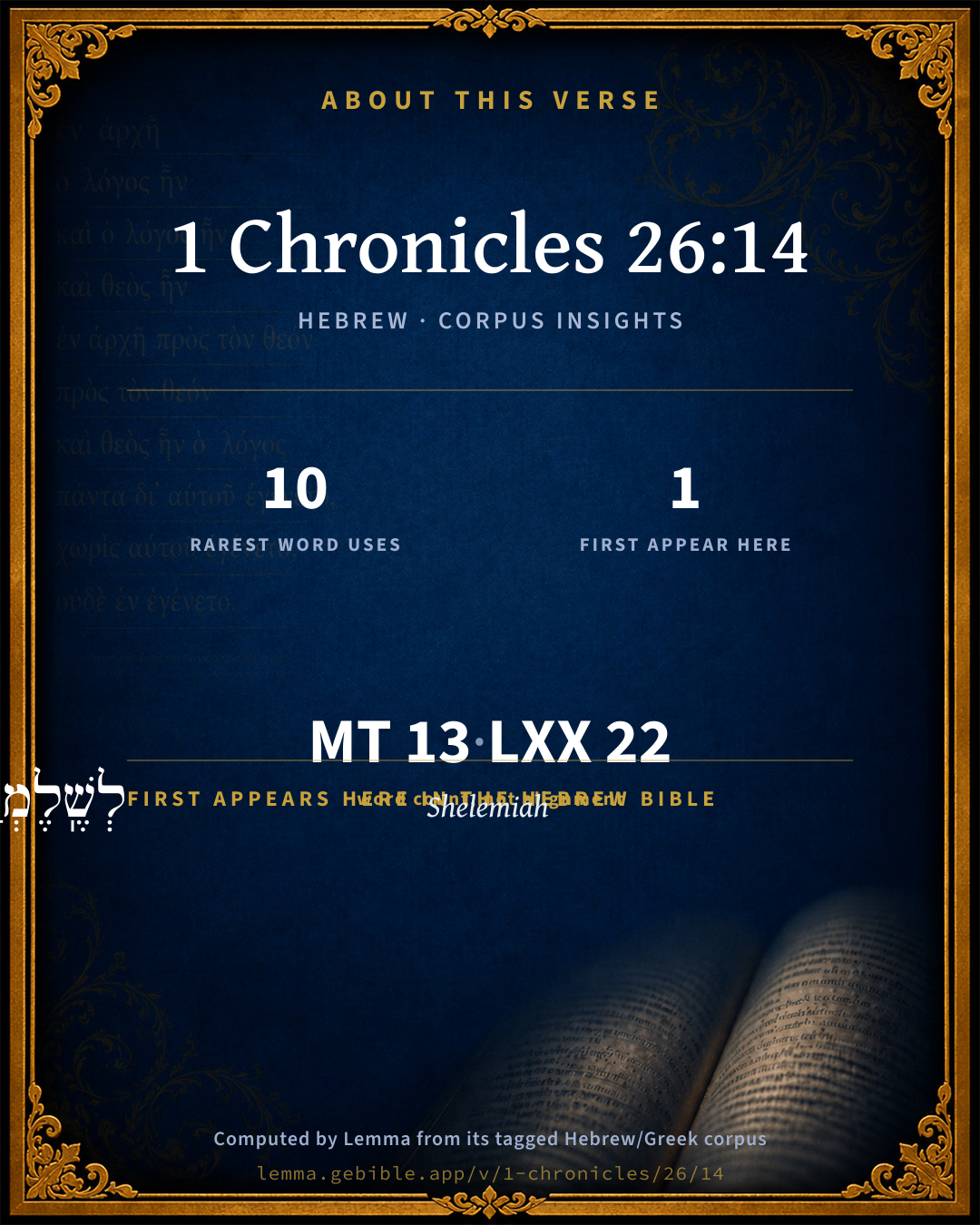
The rarest word here is לְשֶֽׁלֶמְיָ֑הוּ Shelemiah H8018 — appearing just 10 times in the whole Hebrew Bible.

First appearance in Scripture

This word makes its first canonical appearance in the Hebrew Bible here:

  • לְשֶֽׁלֶמְיָ֑הוּ Shelemiah H8018

Shared distinctive vocabulary

לְשֶֽׁלֶמְיָ֑הוּ Shelemiah H8018 occurs in 10 verses of the Hebrew Bible. Also found in:

Grammatical profile

  • 4 verbs
  • 9 nouns

Verb forms

  • וַיִּפֹּ֧ל Qal · Sequential Imperfect
  • יוֹעֵ֣ץ Qal · Participle Active
  • הִפִּ֨ילוּ֙ Hiphil · Perfect
  • וַיֵּצֵ֥א Qal · Sequential Imperfect

Repetition

Words recur within this verse — often emphatic in Hebrew:

  • הַגּוֹרָ֛ל lot H1486 ×3
  • וַיִּפֹּ֧ל to fall H5307 ×2

Hebrew & Septuagint length

In English translation the verse runs 23 words from the Hebrew and 26 from the Septuagint (LXX English) — closely comparable.

A rough comparison of the two English renderings, which tokenize alike — not a word-level alignment.

Word counts can differ between the Hebrew and the Greek without any difference in meaning — e.g. the Hebrew direct-object marker אֵת has no separate Greek word, and Greek often adds the article ὁ.

In the original languages it is 13 Hebrew tokens and 22 Greek tokens — but the two are counted differently (Hebrew bundles its prefixes and suffixes into one token; the Greek is in lemma form), so that isn’t a like-for-like length.

Hebrew and Greek witnesses Masoretic Hebrew ↔ Greek Septuagint

The same verse in the two great witnesses to the Old Testament, shown verse-for-verse.

These are two independent witnesses, not word-aligned to each other, and the Septuagint is shown in lemma (dictionary) form.

Hebrew 1 Chronicles 26:14 Masoretic · Westminster Leningrad Codex

וַיִּפֹּ֧ל הַגּוֹרָ֛ל מִזְרָ֖חָה לְשֶֽׁלֶמְיָ֑הוּ וּזְכַרְיָ֨הוּ בְנ֜וֹ יוֹעֵ֣ץ בְּשֶׂ֗כֶל הִפִּ֨ילוּ֙ גּֽוֹרָל֔וֹת וַיֵּצֵ֥א גוֹרָל֖וֹ צָפֽוֹנָה

The lot eastward fell to Shelemiah. Then for Zechariah his son, a wise counselor, they cast lots; and his lot came out northward.

World English Bible · Public Domain

Greek LXX 1 Chronicles 26:14 Septuagint · lemma form

καί πίπτω ὁ κλῆρος ὁ πρός ἀνατολή ὁ σαλαμια καί ζαχαριας υἱός ιωας ὁ μελχια βάλλω κλῆρος καί ἐκἔρχομαι ὁ κλῆρος βορέας

And the lot of the east gates fell to Selemias, and Zacharias: the sons of Soaz cast lots for Melchias, and the lot came out northward.

LXX2012 (modern English Septuagint) · Public Domain

On this verse, The Pulpit Commentary discusses the Septuagint’s reading. Read the note in Commentary ↓

Hebrew: Westminster Leningrad Codex (CC BY 4.0). Greek: Septuagint (public domain); English from LXX2012 (modern English Septuagint) (Public Domain). How the Septuagint differs from the Hebrew →

Commentary

Notes on 1 Chronicles 26:14 from classic Christian and Jewish commentators (each source and its license shown beneath its notes). The classic Christian expositions comment on the surrounding passage and are grouped to its opening verse, so a note may address several verses; the Jewish commentaries on the Tanakh (Rashi and others) are per-verse, so they appear only where the commentator wrote on this verse.

Lemma curates 59 commentaries, every one of them public domain or Creative Commons licensed, each selected and text-cleaned for this edition rather than reprinted as found. About our sources →

Trapp's Complete Commentary

John Trapp

1Ch 26:14 And the lot eastward fell to Shelemiah. Then for Zechariah his son, a wise counsellor, they cast lots; and his lot came out northward.

Ver. 14. Fell to Shelemiah.] Alias Meshelemiah. {1Ch 26:1} So Jehoshuah the high priest is called Joshua. It is lawful to abbreviate names.

A wise counsellor.] Heb., A giver of counsel with wisdom. This is a high commendation.

John Trapp, A Commentary or Exposition upon All the Books of the Old and New Testament (1647–1656) — public domain. Text from a community e-Sword module.

Joseph Benson's Commentary

1Ch 26:14-15. Zechariah his son, a wise counsellor — Which is noted as an excellent and useful accomplishment for his office, in which there was need of wisdom as well as courage, as may appear by the description of their work, 1Ch 26:20, &c. See the note on 1Ch 26:6. The house of Asuppim — Or, of gatherings; probably so named from the assembly of the elders, who met there to consult about the affairs of the temple.

Joseph Benson's Commentary on the Old and New Testaments (1811–1818) — public domain. Text from a community e-Sword module.

Geneva Bible (1599)

Geneva Bible translators

Or, Meshelemiah.

One expert and meet to keep that gate.

Geneva Bible (1599) marginal notes — public domain. Text via Bolls.life.

Ellicott's Commentary for English Readers

(14) And the lot eastward fell to Shelemiah.—The courses of the sons of Shelemiah (Meshelemiah 1Ch_26:1; 1Ch_26:9, and Shallum 9:19) received by lot the post of honour on the east side of the Sanctuary.

Then for Zechariah his son.—Heb., And Zechariah his son, counselling with sagacity, they cast lots. The preposition for may have fallen out before Zechariah; or perhaps Zechariah is the real subject of the verb “cast lots,” which is plural, because Zechariah is the name of a clan or guild. (Comp. 1Ch_24:31; xxv, 8). Zechariah, the firstborn of Meshelemiah (1Ch_26:2), obtained the charge of the north side “They cast lots” may mean drew a lot from the urn.

A wise counsellor.—This little touch is obviously a mark of truth. The chronicler could have had no motive for so characterising a warder of the Temple, unless he had found it in some older source, of which he has only given extracts.

A Bible Commentary for English Readers, edited by Charles John Ellicott (1878–1897) — public domain. Text from a community e-Sword module.

The Cambridge Bible for Schools and Colleges

gen. ed. J. J. S. Perowne

14. Shelemiah] i.e. Meshelemiah, 1Ch_26:1-2.

wise counseller] R.V. discreet counsellor.

The Cambridge Bible for Schools and Colleges (gen. ed. J. J. S. Perowne; Cambridge University Press, 1878–1918) — public domain. Text from a community e-Sword module.

John Gill's Exposition

To Shuppim and Hosah the lot came forth westward,.... Of Shuppim no mention is before made; of Hosah, see Ch1 26:10 their lot was to be placed at the gates on the western wall, where were four; the two more southward being assigned to the sons of Obededom, whose lot also was southward, are taken notice of under the division in the preceding verse; Parbar was another, Ch1 26:18, and another follows here:

with the gate Shallecheth, by the causeway of the going up; this gate was in later times called Coponius, from the name of a Roman commander, in the times of Herod, who might give it this name on his account; it might have the name of Shallecheth either from "sending out", or carrying out the filth of the temple through it; or rather from "casting up the causeway", as here expressed, which was the going up, or ascent, Solomon made, by which he went up to the temple, Kg1 20:5 and which agrees with the description Josephus (a) gives of one of the gates on the western wall, that it led to the royal palace, the valley between being filled up for the passage; on each side of which causeway, it is said, grew oaks and teil trees, see Isa 6:13 which served both to keep up the causeway, and to make a fine, pleasant, shady walk for the king to pass through to the temple; all which are observed by Dr. Lightfoot (b):

ward against ward; for as the gates answered one another, so the wards or watches at them.

(a) Antiqu. l. 15. c. 11. sect. 5. (b) Ut supra, (Prospect of the Temple), c. 5. sect. 1.

John Gill's Exposition of the Whole Bible (1746–1763) — public domain (CC PDM 1.0). Text via the HelloAO Bible API.

Haydock's Catholic Bible Commentary

CHAPTER XXVI.

Selemias: the first syllable is frequently neglected in Hebrew, chap. iv. 24. (Tirinus) --- Zacharias was the first-born of Meselemia, ver. 2. (Haydock) --- A very. Hebrew, "a wise counsellor." (Calmet)

George Leo Haydock (1774–1849), Haydock's Catholic Family Bible and Commentary, 1859 edition — public domain. Excludes Psalms (Douay-Rheims chapter numbering differs from Protestant) and Deuterocanonical books (Catholic canon only).

Matthew Poole's English Annotations

A wise counsellor; which is noted as an excellent and useful accomplishment for his office, in which there was need of wisdom as well as courage, as may appear by the description of their work, 1Ch 26:20, &c. See Poole "1Ch 26:6".

Matthew Poole's English Annotations on the Holy Bible (1683–1685) — public domain. Text from a community e-Sword/MySword module.

The Pulpit Commentary

Vers. 14-16. The casting of lots for the four chief names and the four chief aspects of gates, now proceeds. A special note is made of the care taken for the house of Asuppim; i.e. of "gatherings" or "stores." For all that we know of this "house," we seem to be left to the verses (15, 17) of this passage, and to the expression, (Neh_12:25) "the storehouses, or stores of the gates" (though the Authorized Version, the "thresholds" of the gates), which would have been more intelligible had it been reversed, "the gates of the stores." Presumably it was a building for keeping safe certain of the sacred property, and was situated south of the temple, and, judging from ver. 17, had two doorways. The Vulgate translates seniorum concilium. To Shuppim. Nothing can be made of this word in this connection, as a proper name, though we have it (1Ch_7:12, 1Ch_7:15) as such. It is now generally rejected, as probably duo to the error of some transcriber, whose eye may have been caught again by the last tee syllables of the closely preceding "Asuppim." But some would place it as the last word of the previous verse, and make it amplify the meaning of Asuppim, e.g. "gatherings for stores." Shallecheth. By derivation, this word means "sending or throwing down." Hence some call it, "the refuse gate." The situation of it is, however, defined here, as by the causeway of the going up, and would seem to render such an interpretation less likely. According to Grove (in Smith"s "Bible Dictionary"), this causeway is still traceable: it runs up from the central valley of the town to the sacred site west of the temple (1Ki_10:5; 2Ch_9:4) and Grove would identify the "gate of Shallecheth" with the present Bab Silsileh. The Septuagint translates hJ pulhou, i.e. the gate of the temple-cell, which word they could get from the inverting of the order of the first two letters of the Hebrew Shallecheth. The Septuagint then mutts the following word, hLsim, Ward against ward; i.e. watch with watch. The expression appears to refer to the fact that Hosah"s lot threw to him the charge of a double position.

HOMILIES BY J.R. THOMSON Ver. 14.

A wise counsellor.

Nothing more is told us of this person than is contained in these words; but how much does even so brief a record imply!

I THE EVENTS OF HUMAN LIFE OFTEN CALL FOR THE EXERCISE OF WISDOM IN COUNSEL. It is SO in the Church, in order that provision may be made for spiritual wants, that employment may be found for spiritual gifts, that differences may be composed and strength consolidated, It is so in the world; for human society presents so many difficult problems, and folly and ignorance are so general, that only a leaven of wisdom can preserve mankind from corruption and dissolution.

II THOSE NOT PERSONALLY CONCERNED IN ANY BUSINESS ARE SOMETIMES MOST FITTED TO ADVISE, A wise man is not only wise for himself; his wisdom is intended by Providence to be placed at the service of others. And the impartiality of an onlooker often enables him to take a wider view and to form a fairer judgment than can be possible to others more interested and excited.

III THERE ARE QUALITIES WHICH ARE SPECIALLY CONTRIBUTIVE TO WISDOM. These may be enumerated natural sagacity, prolonged experience, knowledge, impartiality of mind, sympathy with human feelings, insight into character, etc. Such gifts and acquirements make a man "a wise counsellor.

IV GOD, IN HIS PROVIDENCE, IS EVER RAISING UP SUCH COUNSELORS FOR THE SERVICE OF MANKIND. It has often been observed that, in the conduct of great movements, Providence employs men of impulse and energy, and conjoins with them in service men of deliberate, calm, sagacious judgment. And it is not only in what are called great affairs that this arrangement is observable. Wise men may be found in all conditions of life.

V THE HAPPIEST RESULTS FOLLOW THE COUNSELS OF THE WISE. They are the means of directing the young, of succouring the tempted, of guiding the affairs of state, of promoting the peace of Churches, of advancing the gospel of Christ. T.

The Pulpit Commentary (1880–1919), ed. H.D.M. Spence-Jones & Joseph S. Exell — public domain. Text from a community e-Sword module.

Keil & Delitzsch

C. F. Keil & F. Delitzsch

To Shuppim and Hosah the lot came forth westward,.... Of Shuppim no mention is before made; of Hosah, see Ch1 26:10 their lot was to be placed at the gates on the western wall, where were four; the two more southward being assigned to the sons of Obededom, whose lot also was southward, are taken notice of under the division in the preceding verse; Parbar was another, Ch1 26:18, and another follows here:

with the gate Shallecheth, by the causeway of the going up; this gate was in later times called Coponius, from the name of a Roman commander, in the times of Herod, who might give it this name on his account; it might have the name of Shallecheth either from "sending out", or carrying out the filth of the temple through it; or rather from "casting up the causeway", as here expressed, which was the going up, or ascent, Solomon made, by which he went up to the temple, Kg1 20:5 and which agrees with the description Josephus (a) gives of one of the gates on the western wall, that it led to the royal palace, the valley between being filled up for the passage; on each side of which causeway, it is said, grew oaks and teil trees, see Isa 6:13 which served both to keep up the causeway, and to make a fine, pleasant, shady walk for the king to pass through to the temple; all which are observed by Dr. Lightfoot (b):

ward against ward; for as the gates answered one another, so the wards or watches at them.

(a) Antiqu. l. 15. c. 11. sect. 5. (b) Ut supra, (Prospect of the Temple), c. 5. sect. 1.

Keil & Delitzsch — Biblical Commentary on the Old Testament (1861–1891) — public domain (CC PDM 1.0). Text via the HelloAO Bible API. (Old Testament only.)

Lesson kit

Teaching starters — assembled from the data on this page, not authored interpretation. Every prompt links to the verse data it draws on. Edit before teaching.

1 Chronicles, in the Historical, opens this verse with 13 words (10 distinct Hebrew lemmas). Its most distinctive word is Shelemyâh (“Shelemiah”). A historical commentator’s framing appears above. Read the whole chapter for the surrounding context.

Discussion questions

  1. What does “Shelemiah” (Shelemyâh) contribute to the verse as a whole?
  2. The word “Shelemiah” first appears here in Scripture. What is being introduced at this debut?
  3. Ezra 10:39 shares the word «Shelemiah» with this verse. How do the two illuminate each other?
  4. “lot” occurs 3× in this one verse. What is the effect of the repetition?
  5. These translations render this verse differently; the difference is in the English rendering, not the original. What questions does that raise?
  6. The verb «וַיִּפֹּ֧ל» is Qal Sequential Imperfect. How does its form color the action?
  7. Reading how Trapp's Complete Commentary and Joseph Benson's Commentary read this verse, where do the two commentators agree and where do they part?

Things to notice

Reading settings

Reading text

Shown beneath each verse's original-language words.

Old Testament
Old Testament edition

Read the OT as the Masoretic Hebrew (MT) or the Greek Septuagint (LXX).

English shown for the Greek Septuagint (in the Hebrew ↔ Greek comparison).

Comparing translations? Open the Compare panel on any verse page to stack up to four side by side.