Ezekiel 35:8

Hebrew (Westminster Leningrad Codex) Ezekiel 35:8 appears in the Hebrew Old Testament. The text above is from the Westminster Leningrad Codex. Each word links to its Strong’s number, a concise gloss, and parsing drawn from the Open Scriptures Hebrew Bible morphology. Click any word for its full Brown-Driver-Briggs (BDB) entry.
Download image
Cite this verse

Ezekiel 35:8 (World English Bible). Public Domain. Lemma interlinear Bible study tool, https://lemma.gebible.app/v/ezekiel/35/8.

Show BibTeX & RIS
BibTeX
RIS
English Translation
I will fill its mountains with its slain: in your hills and in your valleys and in all your watercourses shall they fall who are slain with the sword.
World English Bible · Public Domain
Download a study sheet

One document with this verse’s original text, its word-by-word gloss line, the meaning frame, cross-references with their text, attributed commentary, and full source and license credits — printable, and it pastes into notes with its structure intact.

This verse Autodidact and up

Study sheet (.html) Plain text (.txt)

A passage Seminary Student

Up to 50 verses in one chapter. A passage sheet keeps up to 6 commentary sources and 12 cross-references per verse, in the order this page ranks them, and says so on the sheet whenever that leaves anything out. Ask for a single verse and you get the Autodidact verse sheet above.

Everything on this page stays free to read, with no account — the sheet is a download of what is already on screen, not access to it.

Want to remove ads? Support Godless Engineer
Compare translations 3

The same verse in 3 English versions, stacked beneath the original-language interlinear above. Click any original word for its lexicon entry.

Each is an independent rendering of the whole verse — the interlinear is not word-aligned to these translations.

Highlighted words mark where these versions differ — a whole-verse word diff, not a word-by-word alignment.

  • World English Bible Public Domain
    I will fill its mountains with its slain: in your hills and in your valleys and in all your watercourses shall they fall who are slain with the sword.
  • King James Version Public Domain
    And I will fill his mountains with his slain men: in thy hills, and in thy valleys, and in all thy rivers, shall they fall that are slain with the sword.
  • unfoldingWord Literal Text CC BY-SA 4.0
    I will fill its mountains with those who were killed; on your high hills and valleys and in all your streams those who were killed by the sword will fall.

unfoldingWord Literal Text — © unfoldingWord, licensed CC BY-SA 4.0. Word-aligned USFM3 via Door43 (git.door43.org/unfoldingWord/en_ult).

Versions to compare (up to 4)

3 of 4 selected

Show all 18 translations

Every available English version of this verse, each an independent rendering of the whole verse.

  • World English Bible Public Domain
    I will fill its mountains with its slain: in your hills and in your valleys and in all your watercourses shall they fall who are slain with the sword.
  • Berean Standard Bible Public Domain
    I will fill its mountains with the slain; those killed by the sword will fall on your hills, in your valleys, and in all your ravines.
  • Majority Standard Bible Public Domain
    I will fill its mountains with the slain; those killed by the sword will fall on your hills, in your valleys, and in all your ravines.
  • King James Version Public Domain
    And I will fill his mountains with his slain men: in thy hills, and in thy valleys, and in all thy rivers, shall they fall that are slain with the sword.
  • American Standard Version (1901) Public Domain
    And I will fill its mountains with its slain: in thy hills and in thy valleys and in all thy watercourses shall they fall that are slain with the sword.
  • Revised Version (1885) Public Domain
    And I will fill his mountains with his slain: in thy hills and in thy valleys and in all thy watercourses shall they fall that are slain with the sword.
  • Geneva Bible (1599) Public Domain
    And I will fill his mountaines with his slayne men: in thine hilles, and in thy valleys and in all thy riuers shall they fall, that are slayne with the sworde.
  • Douay-Rheims (1899) Public Domain
    And I will fill his mountains with his men that are slain: in thy hills, and in thy valleys, and in thy torrents they shall fall that are slain with the sword.
  • Young's Literal Translation Public Domain
    And filled his mountains with his wounded, Thy hills, and thy valleys, and all thy streams, The pierced of the sword fall into them.
  • Literal Standard Version CC BY-SA 4.0
    And filled his mountains with his wounded, || Your hills, and your valleys, and all your streams, || The pierced of the sword fall into them.
  • Unlocked Literal Bible CC BY-SA 4.0
    I will fill its mountains with those who were killed; on your high hills and valleys and in all your streams those who were killed by the sword will fall.
  • unfoldingWord Literal Text CC BY-SA 4.0
    I will fill its mountains with those who were killed; on your high hills and valleys and in all your streams those who were killed by the sword will fall.
  • Darby Bible Public Domain
    and I will fill his mountains with his slain. In thy hills, and in thy valleys, and in all thy water-courses shall they fall that are slain with the sword.
  • World Messianic Bible Public Domain
    I will fill its mountains with its slain. The slain with the sword will fall in your hills and in your valleys and in all your watercourses.
  • Webster's Bible Public Domain
    And I will fill his mountains with his slain men: in thy hills, and in thy valleys, and in all thy rivers, shall they fall that are slain with the sword.
  • Free Bible Version CC BY-SA 4.0
    I will fill its mountains with the dead. Those killed by the sword will fall in your hills, valleys, and all your ravines.
  • Bible in Basic English Public Domain
    I will make his mountains full of those who have been put to death; in your valleys and in all your water-streams men will be falling by the sword.
  • JPS Tanakh (1917) Public Domain
    And I will fill his mountains with his slain; in thy hills and in thy valleys and in all thy streams shall they fall that are slain with the sword.

Literal Standard Version (2020), Covenant Press — licensed CC BY-SA 4.0. Text via the HelloAO Bible API (eBible.org). Unlocked Literal Bible (unfoldingWord) — licensed CC BY-SA 4.0. Text via the HelloAO Bible API (eBible.org). unfoldingWord Literal Text — © unfoldingWord, licensed CC BY-SA 4.0. Word-aligned USFM3 via Door43 (git.door43.org/unfoldingWord/en_ult). Free Bible Version, Dr. Jonathan Gallagher — licensed CC BY-SA 4.0. Text via the HelloAO Bible API (eBible.org).

Word by word

More ways to search: Search by grammar → Find every occurrence → Compare this word →

Practice this passage: Drill this verse → Learn its vocabulary →

אֲפִיקֶ֔יךָ
ʼâphîyq
H650
“channels · your”
Noun, Common, Masculine, Plural, Construct + Suffix, Personal, 2nd Person, Masculine, Singular
Part of Speech
Noun
Type
Common
Gender
Masculine
Number
Plural
State
Construct
Full BDB Definition

Origin: from H622

TWOT: 149a

channel - ravine - of hollow bones (figuratively)
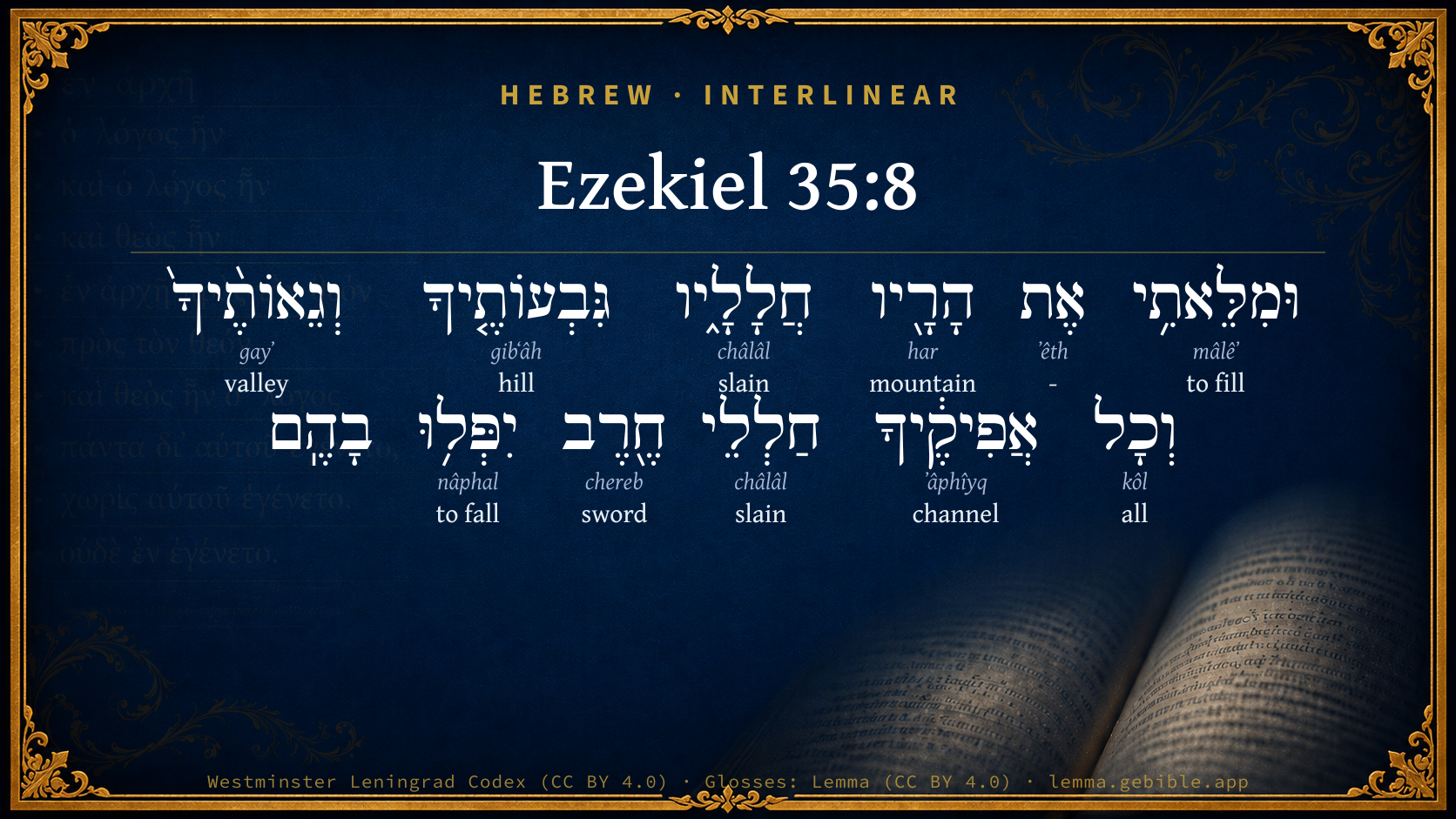
  1. וּמִלֵּאתִ֥י mâlêʼ H4390 “and · to fill” Conjunction + Verb, Piel, Sequential Perfect, 1st Person, Common, Singular
  2. אֶת ʼêth H853 “-” Particle, Direct Object
  3. הָרָ֖יו har H2022 “mountains · his” Noun, Common, Masculine, Plural, Construct + Suffix, Personal, 3rd Person, Masculine, Singular
  4. חֲלָלָ֑יו châlâl H2491 “slain · his” Adjective, Adjective, Masculine, Plural, Construct + Suffix, Personal, 3rd Person, Masculine, Singular
  5. גִּבְעוֹתֶ֤יךָ gibʻâh H1389 “hills · your” Noun, Common, Feminine, Plural, Construct + Suffix, Personal, 2nd Person, Masculine, Singular
  6. וְגֵאוֹתֶ֨יךָ֙ gayʼ H1516 “and · valleys · your” Conjunction + Noun, Common, Both, Plural, Construct + Suffix, Personal, 2nd Person, Masculine, Singular
  7. וְכָל kôl H3605 “and · all of” Conjunction + Noun, Common, Masculine, Singular, Construct
  8. חַלְלֵי châlâl H2491 “slain of” Adjective, Adjective, Masculine, Plural, Construct
  9. חֶ֖רֶב chereb H2719 “sword” Noun, Common, Feminine, Singular, Absolute
  10. יִפְּל֥וּ nâphal H5307 “to fall” Verb, Qal, Imperfect, 3rd Person, Masculine, Plural

About this verse

These counts appear in no published source. They are computed here, from the morphology-tagged text and Lemma’s own curated glosses. What Lemma adds →

12
words
10
distinct lemmas
Prophets
section

Notable vocabulary

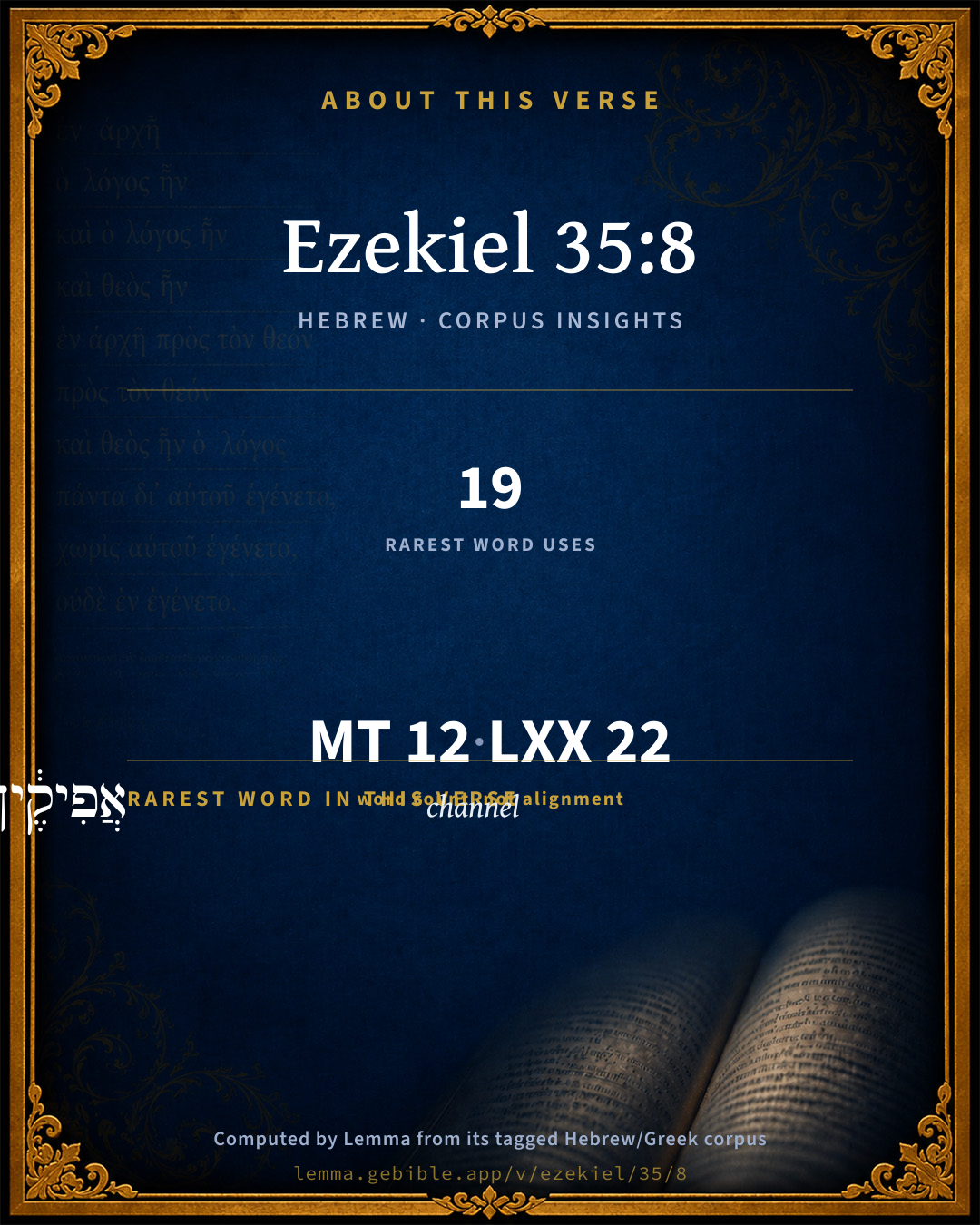
The rarest word here is אֲפִיקֶ֔יךָ channel H650 — appearing just 19 times in the whole Hebrew Bible.

Shared distinctive vocabulary

אֲפִיקֶ֔יךָ channel H650 occurs in 19 verses of the Hebrew Bible. Also found in:

Grammatical profile

  • 2 verbs
  • 6 nouns
  • 2 adjectives
  • 1 preposition
  • 1 particle

Verb forms

  • וּמִלֵּאתִ֥י Piel · Sequential Perfect
  • יִפְּל֥וּ Qal · Imperfect

Repetition

A word recurs within this verse — often emphatic in Hebrew:

  • חֲלָלָ֑יו slain H2491 ×2

Hebrew & Septuagint length

In English translation the verse runs 29 words from the Hebrew and 27 from the Septuagint (LXX English) — closely comparable.

A rough comparison of the two English renderings, which tokenize alike — not a word-level alignment.

Word counts can differ between the Hebrew and the Greek without any difference in meaning — e.g. the Hebrew direct-object marker אֵת has no separate Greek word, and Greek often adds the article ὁ.

In the original languages it is 12 Hebrew tokens and 22 Greek tokens — but the two are counted differently (Hebrew bundles its prefixes and suffixes into one token; the Greek is in lemma form), so that isn’t a like-for-like length.

Cross-references

4

Topical passages linked to Ezekiel 35:8 in the Treasury of Scripture Knowledge — connected by theme and wording, ordered by reader-vote popularity; previews shown in the World English Bible.

  • Ezekiel 31:12 Strangers, the terrible of the nations, have cut him off, and have left him: on the mountains and in all the valleys his branches are fallen, and his boughs are broken by all the watercourses of the land; and all the peoples of the earth are gone down from his shadow, and have left him.
  • Ezekiel 32:4–5 I will leave you on the land, I will cast you forth on the open field, and will cause all the birds of the sky to settle on you, and I will satisfy the animals of the whole earth with you.
  • Ezekiel 39:4–5 You shall fall on the mountains of Israel, you, and all your hordes, and the peoples who are with you: I will give you to the ravenous birds of every sort, and to the animals of the field to be devoured.
  • Isaiah 34:2–7 For Yahweh has indignation against all the nations, and wrath against all their host: he has utterly destroyed them, he has delivered them to the slaughter.

Cross-references courtesy of OpenBible.info (CC BY 4.0).

Hebrew and Greek witnesses Masoretic Hebrew ↔ Greek Septuagint

The same verse in the two great witnesses to the Old Testament, shown verse-for-verse.

These are two independent witnesses, not word-aligned to each other, and the Septuagint is shown in lemma (dictionary) form.

Hebrew Ezekiel 35:8 Masoretic · Westminster Leningrad Codex

וּמִלֵּאתִ֥י אֶת הָרָ֖יו חֲלָלָ֑יו גִּבְעוֹתֶ֤יךָ וְגֵאוֹתֶ֨יךָ֙ וְכָל אֲפִיקֶ֔יךָ חַלְלֵי חֶ֖רֶב יִפְּל֥וּ בָהֶֽם

I will fill its mountains with its slain: in your hills and in your valleys and in all your watercourses shall they fall who are slain with the sword.

World English Bible · Public Domain

Greek LXX Ezekiel 35:8 Septuagint · lemma form

καί ἐνπίμπλημι ὁ τραυματίας σύ ὁ βουνός καί ὁ φάραγξ σύ καί ἐν πᾶς ὁ πεδίον σύ τραυματίζω μάχαιρα πίπτω ἐν σύ

and I will fill your hills and your valleys with slain men, and in all your plains there shall fall in you men slain with the sword.

LXX2012 (modern English Septuagint) · Public Domain

Hebrew: Westminster Leningrad Codex (CC BY 4.0). Greek: Septuagint (public domain); English from LXX2012 (modern English Septuagint) (Public Domain). How the Septuagint differs from the Hebrew →

Targum (Aramaic paraphrase)

1

The Targum is the ancient Jewish Aramaic paraphrase of the Hebrew Scriptures — an interpretive translation, not the Hebrew text itself. Onkelos (literal) and Pseudo-Jonathan (expansive) render the Torah, and Jonathan the Prophets. Coverage is partial: where no permissively-licensed English translation exists for a verse, only the Aramaic is shown. This is verse-level text, not a word-by-word alignment to the Hebrew.

  1. Targum Jonathan Prophets (Joshua–Malachi)
    וַאֲמַלֵי יַת טוּרוֹהִי קְטִילוֹהִי רָמָתֹהִי וְחֵילוֹהִי וְכָל פַּצִידוֹהִי קְטִילֵי חַרְבָּא יִתְרְמוּן בְּהוֹן:

    (no public-domain English translation for this verse)

    Targum Jonathan — Aramaic: “Mikraot Gedolot” (public domain). English: “Sefaria Community Translation” (CC0 1.0 (public-domain dedication)); “London "Chaldee Paraphrase," 1871” (public domain). Text via Sefaria.

Commentary

Notes on Ezekiel 35:8 from classic Christian and Jewish commentators (each source and its license shown beneath its notes). The classic Christian expositions comment on the surrounding passage and are grouped to its opening verse, so a note may address several verses; the Jewish commentaries on the Tanakh (Rashi and others) are per-verse, so they appear only where the commentator wrote on this verse.

Lemma curates 59 commentaries, every one of them public domain or Creative Commons licensed, each selected and text-cleaned for this edition rather than reprinted as found. About our sources →

Trapp's Complete Commentary

John Trapp

Eze 35:8 And I will fill his mountains with his slain [men]: in thy hills, and in thy valleys, and in all thy rivers, shall they fall that are slain with the sword.

Ver. 8. And I will fill his mountains.] Oh the woe of war! The Greek word {a} for it signifies much blood.

{a} πολεμος q. πολυαιμος. Bellum a belluis. War from wild beasts.

John Trapp, A Commentary or Exposition upon All the Books of the Old and New Testament (1647–1656) — public domain. Text from a community e-Sword module.

The Biblical Illustrator

Joseph S. Exell

Eze_35:8-15

But ye . . . shall shoot forth your branches.

The Divine benison

When does God give short measure? When did He give otherwise than pressed down, heaped up, running over? This is the consolation of heaven; this is the measure of the Divine benison.

1. That blessing is to be physical: Ye shall shoot forth your branches, and yield your fruit. God is not ashamed to have His name connected with the daily loaf and with the daily goblet of water. When we go to the harvest field we should think we ace going to church; when we go to the well of springing water we should think we are going to a fountain rising in heaven. Your harvests are Gods; your fields are the green ways leading up to His sanctuary.

2. Not only physical, but social: I will multiply men upon you . . . and the wastes shall be builded. God would have all the earth inhabited. He would build men into organisations and brotherhoods; He would establish fraternities of souls. The Lord is never ashamed to associate Himself with social economy, social purity, social progress.

3. Not only physical and social, but municipal: And the cities shaft be inhabited. Cities have not a good history; cities had a bad founder. The foundations of cities were laid by a murderer. But it hath pleased God to accept many human doings, and to purify them and ennoble them and turn them to purposes sanctified and most beneficial. The Lord never set king over anybody with His own real consent. He gave the people the desire of their hearts, and plagued them every day since they got the answer. So He accepts the city, and He will do what He can with the municipalities, to inhabit them, and direct them, and purify them.

4. The Lord never concludes simply within the letter. At, the last the invariably says something that opens up a distant and ever-receding because ever-enlarging horizon. He says in this instance, I will do better unto you than at your beginnings. He is able, let us say again with rising thankfulness, to do exceeding abundantly above all that we ask or think. The Church constantly exclaims, Thou hast kept the good wine until now! We never can get in advance of God. When we have reaped our most abundant harvest He says, This is only an earnest of the harvest you shall one day possess; I will do more for you and better unto you than at your beginnings.

5. Then let us grow in grace and in the knowledge of our Lord Jesus Christ. Let us he no longer thoughtless; let us no longer limit the Holy One of Israel, saying, The Lord hath made an end of His revelation, the Lord hath no more grace to give, no more love to show; He has given us the Cross. Paul says, If He has freely given us the Cross,--it is not an end, it is a beginning,--with the Cross He will also freely give us all things. The Lord cannot be exhausted. His providence is ascending, expanding, deepening. (J. Parker, D. D.)

The Biblical Illustrator, edited by Joseph S. Exell (c. 1880s–1900s) — public domain. Text from a community e-Sword module.

Ellicott's Commentary for English Readers

(8) Rivers.—As elsewhere = river-courses, in which water was found only at times.

A Bible Commentary for English Readers, edited by Charles John Ellicott (1878–1897) — public domain. Text from a community e-Sword module.

John Gill's Exposition

And I will fill his mountains with his slain men,.... Not only Mount Seir, but all the rest of the mountains, in Idumea; where they shall flee for refuge, and the enemy shall pursue them, and slay them; and where their carcasses will fall in such numbers, as to cover the mountains with them; compare with this Rev 19:18,

in thy hills, and in thy valleys, and in all thy rivers, shall they fall that are slain with the sword: expressive of the greatness and universality of the slaughter, that it should be a general one everywhere; hence rivers and fountains are said to become blood, through the number of the slain, Rev 16:3.

John Gill's Exposition of the Whole Bible (1746–1763) — public domain (CC PDM 1.0). Text via the HelloAO Bible API.

Matthew Poole's English Annotations

His mountains; there they will fortify, or thither they will flee, and there the enemy shall take and slay his men every where, as it follows in the words; slaughter shall be made of his men, pursued by the eager Chaldean, but more by the vengeance of God. So this phrase Eze 30:11, but explained Eze 32:5.

Matthew Poole's English Annotations on the Holy Bible (1683–1685) — public domain. Text from a community e-Sword/MySword module.

The Pulpit Commentary

And I will fill his mountains with his slain; literally, pierced through; hence mortally wounded. Then Edom"s desolation would result from an exterminating war, which should fill its hills, valleys, and rivers, or rather, water-courses, with slaughtered men. (cf. Eze_31:12 Eze_32:5) The physical features of Edom here specified by the prophet have often been attested by travelers. "Idumea embraces a section of a broad mountain range, extending in breadth from the valley of the Arabah to the desert plateau of Arabia. The ravines which intersect these sandstone mountains are very remarkable. Take them as a whole, there is nothing like them in the world, especially those near Petra. The deep valleys and the little terraces along the mountain-sides, and the broad downs upon their summits, are covered with rich soil, in which trees, shrubs, and flowers grow luxuriantly" (Porter, in Kitto"s "Cyclopaedia," art. "Idumea").

The Pulpit Commentary (1880–1919), ed. H.D.M. Spence-Jones & Joseph S. Exell — public domain. Text from a community e-Sword module.

Lesson kit

Teaching starters — assembled from the data on this page, not authored interpretation. Every prompt links to the verse data it draws on. Edit before teaching.

Ezekiel, in the Prophets, opens this verse with 12 words (10 distinct Hebrew lemmas). Its most distinctive word is ʼâphîyq (“channel”). A historical commentator’s framing appears above. Read the whole chapter for the surrounding context.

Discussion questions

  1. What does “channel” (ʼâphîyq) contribute to the verse as a whole?
  2. How does 2 Samuel 22:16, which shares the word «channel», read alongside this verse?
  3. What does the repetition of “slain” (2× in this one verse) do in this verse?
  4. These translations render this verse differently; the difference is in the English rendering, not the original. What questions does that raise?
  5. «וּמִלֵּאתִ֥י» is a Piel Sequential Perfect verb. How does that grammatical form shape the action described?
  6. Compare how Trapp's Complete Commentary and The Biblical Illustrator read this verse. Where do they agree or differ?

Things to notice

Reading settings

Reading text

Shown beneath each verse's original-language words.

Old Testament
Old Testament edition

Read the OT as the Masoretic Hebrew (MT) or the Greek Septuagint (LXX).

English shown for the Greek Septuagint (in the Hebrew ↔ Greek comparison).

Comparing translations? Open the Compare panel on any verse page to stack up to four side by side.