
Esther 6:10

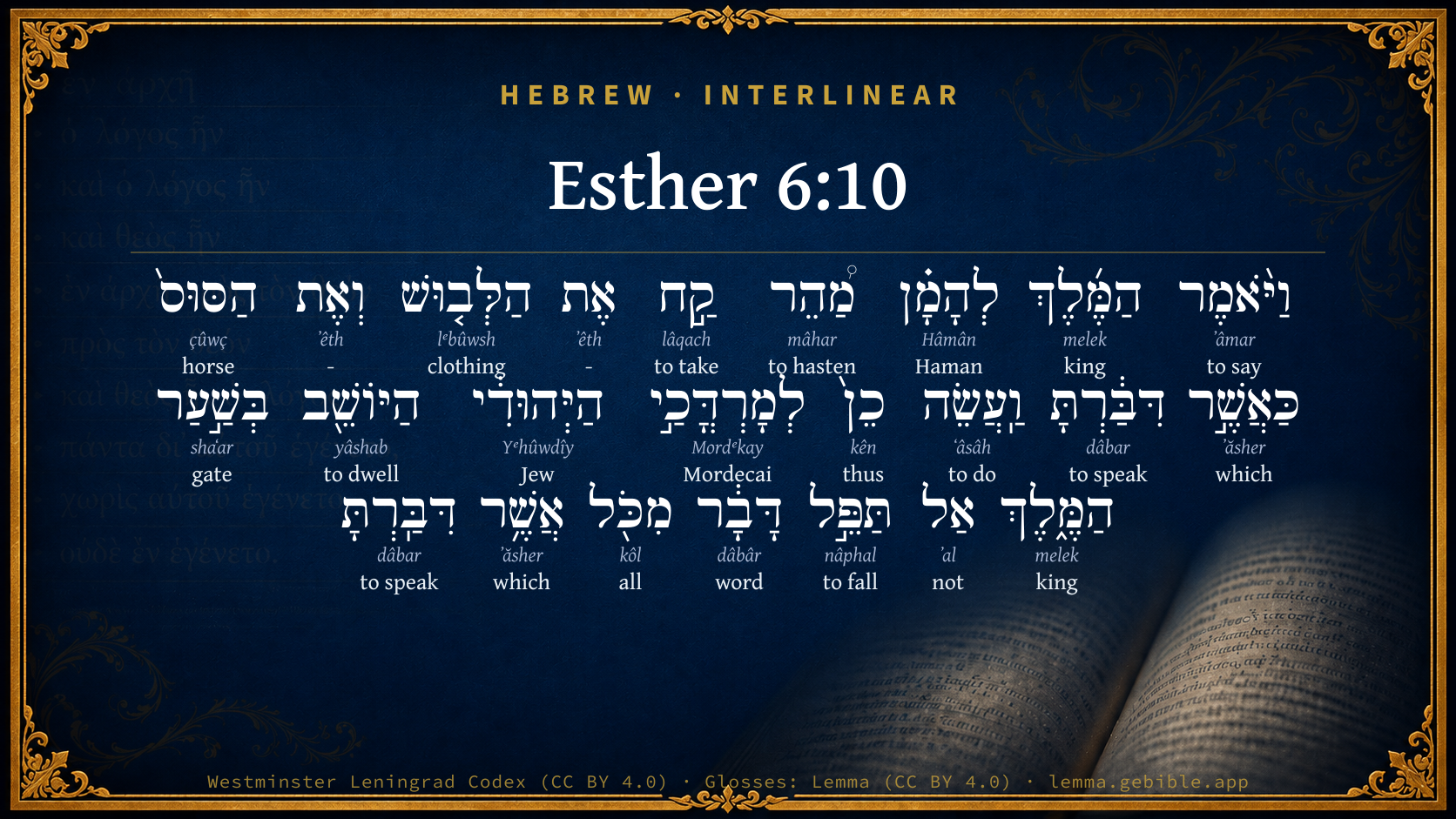
Hebrew (Westminster Leningrad Codex) Esther 6:10 appears in the Hebrew Old Testament. The text above is from the Westminster Leningrad Codex. Each word links to its Strong’s number, a concise gloss, and parsing drawn from the Open Scriptures Hebrew Bible morphology. Click any word for its full Brown-Driver-Briggs (BDB) entry.
Download image
Cite this verse

Esther 6:10 (World English Bible). Public Domain. Lemma interlinear Bible study tool, https://lemma.gebible.app/v/esther/6/10.

Show BibTeX & RIS
BibTeX
RIS
English Translation
Then the king said to Haman, Make haste, and take the clothing and the horse, as you have said, and do even so to Mordecai the Jew, who sits at the king's gate: let nothing fail of all that you have spoken.
World English Bible · Public Domain
Download a study sheet

One document with this verse’s original text, its word-by-word gloss line, the meaning frame, cross-references with their text, attributed commentary, and full source and license credits — printable, and it pastes into notes with its structure intact.

This verse Autodidact and up

Study sheet (.html) Plain text (.txt)

A passage Seminary Student

Up to 50 verses in one chapter. A passage sheet keeps up to 6 commentary sources and 12 cross-references per verse, in the order this page ranks them, and says so on the sheet whenever that leaves anything out. Ask for a single verse and you get the Autodidact verse sheet above.

Everything on this page stays free to read, with no account — the sheet is a download of what is already on screen, not access to it.

Want to remove ads? Support Godless Engineer
Compare translations 3

The same verse in 3 English versions, stacked beneath the original-language interlinear above. Click any original word for its lexicon entry.

Each is an independent rendering of the whole verse — the interlinear is not word-aligned to these translations.

Highlighted words mark where these versions differ — a whole-verse word diff, not a word-by-word alignment.

  • World English Bible Public Domain
    Then the king said to Haman, Make haste, and take the clothing and the horse, as you have said, and do even so to Mordecai the Jew, who sits at the king's gate: let nothing fail of all that you have spoken.
  • King James Version Public Domain
    Then the king said to Haman, Make haste, and take the apparel and the horse, as thou hast said, and do even so to Mordecai the Jew, that sitteth at the king's gate: let nothing fail of all that thou hast spoken.
  • unfoldingWord Literal Text CC BY-SA 4.0
    And the king said to Haman, “Hurry, take the garment and the horse, according to how you have spoken, and do thus for Mordecai the Jew, the man who sits at the gate of the king. Do not allow a word to fall of all that you have spoken.”

unfoldingWord Literal Text — © unfoldingWord, licensed CC BY-SA 4.0. Word-aligned USFM3 via Door43 (git.door43.org/unfoldingWord/en_ult).

Versions to compare (up to 4)

3 of 4 selected

Show all 18 translations

Every available English version of this verse, each an independent rendering of the whole verse.

  • World English Bible Public Domain
    Then the king said to Haman, Make haste, and take the clothing and the horse, as you have said, and do even so to Mordecai the Jew, who sits at the king's gate: let nothing fail of all that you have spoken.
  • Berean Standard Bible Public Domain
    “Hurry,” said the king to Haman, “and do just as you proposed. Take the robe and the horse to Mordecai the Jew, who is sitting at the king’s gate. Do not neglect anything that you have suggested.”
  • Majority Standard Bible Public Domain
    “Hurry,” said the king to Haman, “and do just as you proposed. Take the robe and the horse to Mordecai the Jew, who is sitting at the king’s gate. Do not neglect anything that you have suggested.”
  • King James Version Public Domain
    Then the king said to Haman, Make haste, and take the apparel and the horse, as thou hast said, and do even so to Mordecai the Jew, that sitteth at the king's gate: let nothing fail of all that thou hast spoken.
  • American Standard Version (1901) Public Domain
    Then the king said to Haman, Make haste, and take the apparel and the horse, as thou hast said, and do even so to Mordecai the Jew, that sitteth at the king's gate: let nothing fail of all that thou hast spoken.
  • Revised Version (1885) Public Domain
    Then the king said to Haman, Make haste, and take the apparel and the horse, as thou hast said, and do even so to Mordecai the Jew, that sitteth at the king’s gate: let nothing fail of all that thou hast spoken.
  • Geneva Bible (1599) Public Domain
    Then the King said to Haman, Make haste, take the rayment and the horse as thou hast said, and doe so vnto Mordecai the Iewe, that sitteth at the Kings gate: let nothing fayle of all that thou hast spoken.
  • Douay-Rheims (1899) Public Domain
    And the king said to him: Make haste and take the robe and the horse, and do as thou hast spoken to Mardochai the Jew, who sitteth before the gates of the palace. Beware thou pass over any of those things which thou hast spoken.
  • Young's Literal Translation Public Domain
    And the king saith to Haman, `Haste, take the clothing and the horse, as thou hast spoken, and do so to Mordecai the Jew, who is sitting in the gate of the king; there doth not fall a thing of all that thou hast spoken.'
  • Literal Standard Version CC BY-SA 4.0
    And the king says to Haman, “Hurry, take the clothing and the horse, as you have spoken, and do so to Mordecai the Jew, who is sitting in the gate of the king; there does not fall a thing of all that you have spoken.”
  • Unlocked Literal Bible CC BY-SA 4.0
    Then the king said to Haman, “Hurry, take the robes and the horse, as you have said, and do this for Mordecai the Jew who sits at the king's gate. Do not fail in a single matter of what you have said.”
  • unfoldingWord Literal Text CC BY-SA 4.0
    And the king said to Haman, “Hurry, take the garment and the horse, according to how you have spoken, and do thus for Mordecai the Jew, the man who sits at the gate of the king. Do not allow a word to fall of all that you have spoken.”
  • Darby Bible Public Domain
    And the king said to Haman, Make haste, take the apparel and the horse, as thou hast said, and do so to Mordecai the Jew, who sits at the king's gate: let nothing fail of all that thou hast said.
  • World Messianic Bible Public Domain
    Then the king said to Haman, “Hurry and take the clothing and the horse, as you have said, and do this for Mordecai the Jew, who sits at the king’s gate. Let nothing fail of all that you have spoken.”
  • Webster's Bible Public Domain
    Then the king said to Haman, Make haste, and take the apparel and the horse, as thou hast said, and do even so to Mordecai the Jew, that sitteth at the king's gate: let nothing fail of all that thou hast spoken.
  • Free Bible Version CC BY-SA 4.0
    Then the king told Haman, “Right! Off you go! Quickly get the royal robes and the horse, and do just what you've said for Mordecai the Jew sitting at the palace gate. Don't leave out anything that you mentioned.”
  • Bible in Basic English Public Domain
    Then the king said to Haman, Go quickly, and take the robes and the horse, as you have said, and do even so to Mordecai the Jew, who is seated at the king's doorway: see that you do everything as you have said.
  • JPS Tanakh (1917) Public Domain
    Then the king said to Haman: 'Make haste, and take the apparel and the horse, as thou hast said, and do even so to Mordecai the Jew, that sitteth at the king's gate; let nothing fail of all that thou hast spoken.'

Literal Standard Version (2020), Covenant Press — licensed CC BY-SA 4.0. Text via the HelloAO Bible API (eBible.org). Unlocked Literal Bible (unfoldingWord) — licensed CC BY-SA 4.0. Text via the HelloAO Bible API (eBible.org). unfoldingWord Literal Text — © unfoldingWord, licensed CC BY-SA 4.0. Word-aligned USFM3 via Door43 (git.door43.org/unfoldingWord/en_ult). Free Bible Version, Dr. Jonathan Gallagher — licensed CC BY-SA 4.0. Text via the HelloAO Bible API (eBible.org).

Word by word

More ways to search: Search by grammar → Find every occurrence → Compare this word →

Practice this passage: Drill this verse → Learn its vocabulary →

הַלְּב֤וּשׁ
lᵉbûwsh
H3830
“the · clothing”
Particle, Definite Article + Noun, Common, Masculine, Singular, Absolute
Part of Speech
Particle + Noun
Type
Common
Gender
Masculine
Number
Singular
State
Absolute
Full BDB Definition

Origin: from H3847

TWOT: 1075a

clothing, garment, apparel, raiment
  1. וַיֹּ֨אמֶר ʼâmar H559 “and · to say” Conjunction + Verb, Qal, Sequential Imperfect, 3rd Person, Masculine, Singular
  2. הַמֶּ֜לֶךְ melek H4428 “the · king” Particle, Definite Article + Noun, Common, Masculine, Singular, Absolute
  3. לְהָמָ֗ן Hâmân H2001 “to/for · Haman” Preposition + Noun, Proper
  4. מַ֠הֵר mâhar H4116 “hasten” Verb, Piel, Imperative, 2nd Person, Masculine, Singular
  5. קַ֣ח lâqach H3947 “take” Verb, Qal, Imperative, 2nd Person, Masculine, Singular
  6. אֶת ʼêth H853 “-” Particle, Direct Object
  7. וְאֶת ʼêth H853 “and · -” Conjunction + Particle, Direct Object
  8. הַסּוּס֙ çûwç H5483 “the · horse” Particle, Definite Article + Noun, Common, Masculine, Singular, Absolute
  9. כַּאֲשֶׁ֣ר ʼăsher H834 “like/as · which” Preposition + Particle, Relative
  10. דִּבַּ֔רְתָּ dâbar H1696 “to speak” Verb, Piel, Perfect, 2nd Person, Masculine, Singular
  11. וַֽעֲשֵׂה ʻâsâh H6213 “and · do” Conjunction + Verb, Qal, Imperative, 2nd Person, Masculine, Singular
  12. כֵן֙ kên H3651 “thus” Adverb
  13. לְמָרְדֳּכַ֣י Mordᵉkay H4782 “to/for · Mordecai” Preposition + Noun, Proper
  14. הַיְּהוּדִ֔י Yᵉhûwdîy H3064 “the · Jew” Particle, Definite Article + Noun, Gentilic, Masculine, Singular, Absolute
  15. הַיּוֹשֵׁ֖ב yâshab H3427 “the · dwelling” Particle, Definite Article + Verb, Qal, Participle Active, Masculine, Singular, Absolute
  16. בְּשַׁ֣עַר shaʻar H8179 “in/at · gate of” Preposition + Noun, Common, Masculine, Singular, Construct
  17. הַמֶּ֑לֶךְ melek H4428 “the · king” Particle, Definite Article + Noun, Common, Masculine, Singular, Absolute
  18. אַל ʼal H408 “not” Particle, Negative
  19. תַּפֵּ֣ל nâphal H5307 “to fall” Verb, Hiphil, Jussive, 2nd Person, Masculine, Singular
  20. דָּבָ֔ר dâbâr H1697 “word” Noun, Common, Masculine, Singular, Absolute
  21. מִכֹּ֖ל kôl H3605 “from · all” Preposition + Noun, Common, Masculine, Singular, Absolute
  22. אֲשֶׁ֥ר ʼăsher H834 “which” Particle, Relative
  23. דִּבַּֽרְתָּ dâbar H1696 “to speak” Verb, Piel, Perfect, 2nd Person, Masculine, Singular

About this verse

These counts appear in no published source. They are computed here, from the morphology-tagged text and Lemma’s own curated glosses. What Lemma adds →

24
words
20
distinct lemmas
Historical
section

Shared distinctive vocabulary

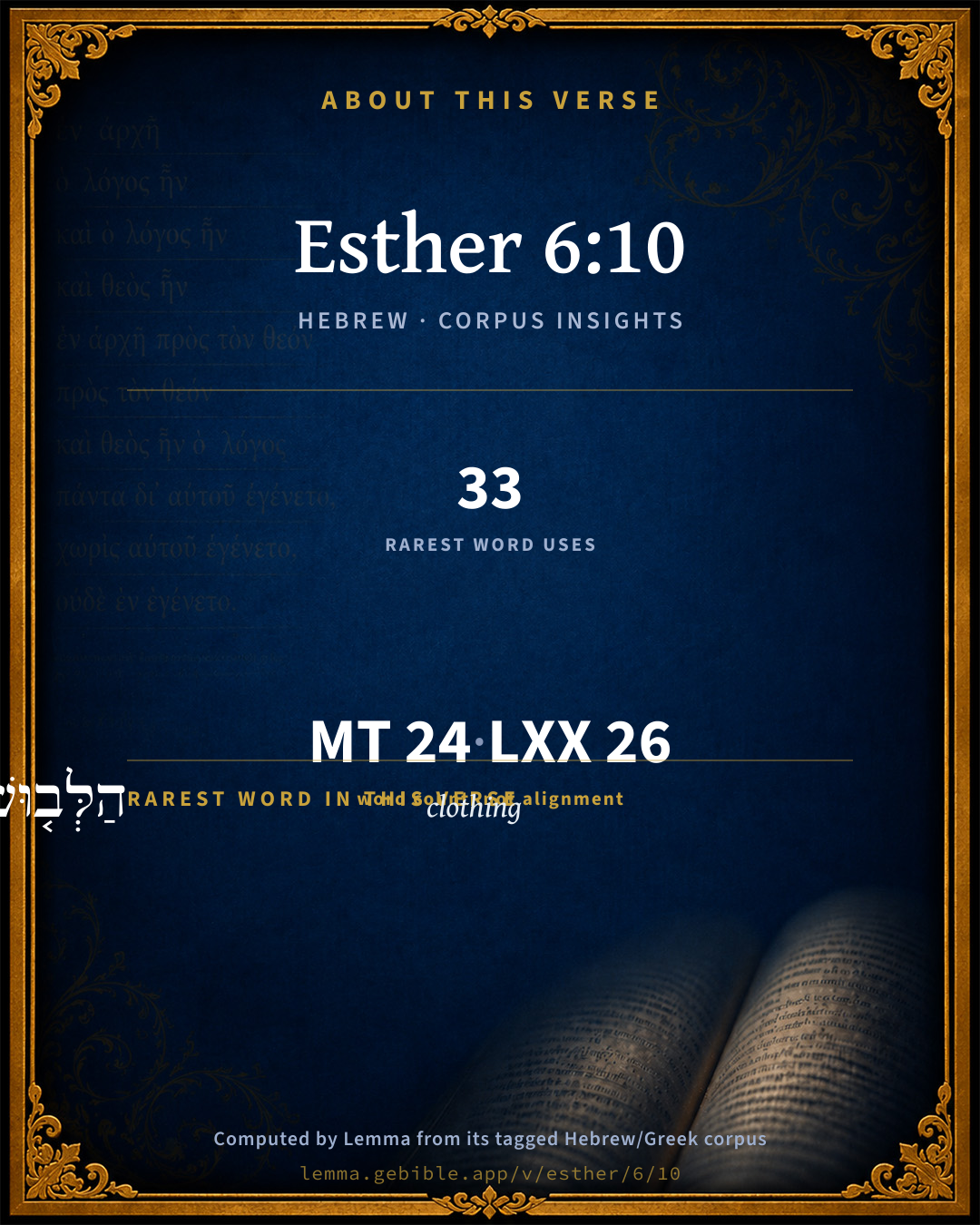
הַלְּב֤וּשׁ clothing H3830 occurs in 33 verses of the Hebrew Bible. Also found in:

Grammatical profile

  • 8 verbs
  • 10 nouns
  • 1 adverb
  • 5 particles

Verb forms

  • וַיֹּ֨אמֶר Qal · Sequential Imperfect
  • מַ֠הֵר Piel · Imperative
  • קַ֣ח Qal · Imperative
  • דִּבַּ֔רְתָּ Piel · Perfect
  • וַֽעֲשֵׂה Qal · Imperative
  • הַיּוֹשֵׁ֖ב Qal · Participle Active
  • תַּפֵּ֣ל Hiphil · Jussive
  • דִּבַּֽרְתָּ Piel · Perfect

Repetition

Words recur within this verse — often emphatic in Hebrew:

  • הַמֶּ֜לֶךְ king H4428 ×2
  • דִּבַּ֔רְתָּ to speak H1696 ×2
  • כַּאֲשֶׁ֣ר which H834 ×2

Hebrew & Septuagint length

In English translation the verse runs 42 words from the Hebrew and 33 from the Septuagint (LXX English) — closely comparable.

A rough comparison of the two English renderings, which tokenize alike — not a word-level alignment.

Word counts can differ between the Hebrew and the Greek without any difference in meaning — e.g. the Hebrew direct-object marker אֵת has no separate Greek word, and Greek often adds the article ὁ.

In the original languages it is 24 Hebrew tokens and 26 Greek tokens — but the two are counted differently (Hebrew bundles its prefixes and suffixes into one token; the Greek is in lemma form), so that isn’t a like-for-like length.

Cross-references

4

Topical passages linked to Esther 6:10 in the Treasury of Scripture Knowledge — connected by theme and wording, ordered by reader-vote popularity; previews shown in the World English Bible.

  • Daniel 4:37 Now I, Nebuchadnezzar, praise and extol and honor the King of heaven; for all his works are truth, and his ways justice; and those who walk in pride he is able to abase.
  • 2 Kings 10:10 Know now that there shall fall to the earth nothing of the word of Yahweh, which Yahweh spoke concerning the house of Ahab: for Yahweh has done that which he spoke by his servant Elijah.
  • Revelation 18:7 However much she glorified herself, and grew wanton, so much give her of torment and mourning. For she says in her heart, 'I sit a queen, and am no widow, and will in no way see mourning.'
  • Luke 14:11 For everyone who exalts himself will be humbled, and whoever humbles himself will be exalted."

Cross-references courtesy of OpenBible.info (CC BY 4.0).

Hebrew and Greek witnesses Masoretic Hebrew ↔ Greek Septuagint

The same verse in the two great witnesses to the Old Testament, shown verse-for-verse.

These are two independent witnesses, not word-aligned to each other, and the Septuagint is shown in lemma (dictionary) form.

Hebrew Esther 6:10 Masoretic · Westminster Leningrad Codex

וַיֹּ֨אמֶר הַמֶּ֜לֶךְ לְהָמָ֗ן מַ֠הֵר קַ֣ח אֶת הַלְּב֤וּשׁ וְאֶת הַסּוּס֙ כַּאֲשֶׁ֣ר דִּבַּ֔רְתָּ וַֽעֲשֵׂה כֵן֙ לְמָרְדֳּכַ֣י הַיְּהוּדִ֔י הַיּוֹשֵׁ֖ב בְּשַׁ֣עַר הַמֶּ֑לֶךְ אַל תַּפֵּ֣ל דָּבָ֔ר מִכֹּ֖ל אֲשֶׁ֥ר דִּבַּֽרְתָּ

Then the king said to Haman, Make haste, and take the clothing and the horse, as you have said, and do even so to Mordecai the Jew, who sits at the king's gate: let nothing fail of all that you have spoken.

World English Bible · Public Domain

Greek LXX Esther 6:10 Septuagint · lemma form

εἶπον δέ ὁ βασιλεύς ὁ αμαν καθώς λαλέω οὕτως ποιέω ὁ μαρδοχαῖος ὁ ἰουδαῖος ὁ θεραπεύω ἐν ὁ αὐλή καί μή παραπίπτω σύ λόγος ὅς λαλέω

Then the king said to Aman, You have well said: so do to Mardochaeus the Jew, who waits in the palace, and let not a word of what you have spoken be neglected.

LXX2012 (modern English Septuagint) · Public Domain

Hebrew: Westminster Leningrad Codex (CC BY 4.0). Greek: Septuagint (public domain); English from LXX2012 (modern English Septuagint) (Public Domain). How the Septuagint differs from the Hebrew →

Commentary

Notes on Esther 6:10 from classic Christian and Jewish commentators (each source and its license shown beneath its notes). The classic Christian expositions comment on the surrounding passage and are grouped to its opening verse, so a note may address several verses; the Jewish commentaries on the Tanakh (Rashi and others) are per-verse, so they appear only where the commentator wrote on this verse.

Lemma curates 59 commentaries, every one of them public domain or Creative Commons licensed, each selected and text-cleaned for this edition rather than reprinted as found. About our sources →

Trapp's Complete Commentary

John Trapp

Est 6:10 Then the king said to Haman, Make haste, [and] take the apparel and the horse, as thou hast said, and do even so to Mordecai the Jew, that sitteth at the king’s gate: let nothing fail of all that thou hast spoken.

Ver. 10. Then the king said to Haman] The king had no intent herein to ensnare Haman, or cross his humour, but God had a hand in it for the effecting of his own ends, which cannot but be ever exceeding good, since his will is not only recta, right but regula the rule.

Make haste, and take the apparel, and the horse, &c.] Here was no time left him of deliberation or liberty of contradiction; dispute he must not, but despatch what was given him in charge. Had he had but the least time, that, stepping out of the presence, he might have considered with himself or consulted with his friends, he would either have feigned himself sick, or found some other excuse, that he might not have done his enemy this honour. But God had so ordered it, and the king commanded it to be done forthwith; it was not, therefore, for Haman, vel responsare, vel repugnare, to chat or chaff, unless he would run the hazard of all; for, where the word of a king is, there is power; and who may say unto him, What dost thou?

And do even so to Mordecai the Jew] This word stabbed Haman to the heart, who had run many great hazards doubtless to domineer in his undeserved dignities; and now must perforce honour him whom he had hoped to have hanged; clothe him whom he hoped to have stripped; help him up to his horse, upon whose grave he hoped to have danced; prepare a triumph for him for whom he had prepared a tree; make proclamation before him as a crier, lead his horse as a lacquey, do all offices for him as a slave or underling; oh what a cut, what a cordolium was this to a man of his mettle and making! It was a wonder his heart burst not, as did Ahitophel’s, for pride so swelleth the soul many times, that it breaketh the case, the body, I mean, and endeth the life; but this had been here to have saved the hangman a labour. But base spirits will buckle and fall down to rise, crouch and creep to mount, &c.

That sitteth at the king’s gate] There you shall have him, and see that you mistake him not. Haman knew him well enough by his stiffness and stoutness, and wished him, of all the men in the world, out of the world.

Let nothing fail of all that thou hast spoken] Perquam hoc durum est, sed ita lex scripta est, This is extremely hard, but so the law was written, saith the civil lawyer. This was a hard saying, and as hard meat to Haman’s stomach, that would ill go down, but there was no help for it, himself had advised it, and must therefore speedily execute it. Lata negligentia dolus est, This ignored is grief. says the lawyer; remissness is a kind of perfidiousness. Excuses would have been construed for refusals, delays for denials, &c.

John Trapp, A Commentary or Exposition upon All the Books of the Old and New Testament (1647–1656) — public domain. Text from a community e-Sword module.

Joseph Benson's Commentary

Est 6:10. The king said, Do even so to Mordecai the Jew — If the king had but said as Haman expected, Thou art the man, what a fair opportunity would be have had to perform the errand he came on, and to have requested, that, to grace the solemnity of his triumph, Mordecai, his sworn enemy, might be hanged at the same time; but how is he thunderstruck when the king bids him, not to order all this to be done, but to do it himself to Mordecai the Jew, the very man he hated above all men, and whose ruin he was seeking, and now came to solicit! He saw it was now to no purpose to think of moving any thing to the king against Mordecai, since he is the man whom the king delights to honour.

Joseph Benson's Commentary on the Old and New Testaments (1811–1818) — public domain. Text from a community e-Sword module.

Tyndale Open Study Notes

Tyndale Open Resources

6:10-12 do just as you have said for Mordecai the Jew: With utter shock at this complete reversal, Haman could do nothing but obey the king’s command, right down to the last detail.

Tyndale Open Study Notes — © Tyndale Open Resources, licensed CC BY-SA 4.0. Text via the HelloAO Bible API.

Adam Clarke's Commentary

Verse 10. Make haste, and take the apparel - and do even so to Mordecai] O mortifying reverse of human fortune! How could Haman bear this? The Targumist might speak according to nature when he said that "Haman besought the king to kill him rather than degrade him so." How astonishing is the conduct of Divine providence in all this business! From it we plainly see that there is neither counsel nor wisdom against the Lord; and that he who digs a pit for his neighbour, is sure to fall into it himself.

Adam Clarke's Commentary on the Bible (1810–1826) — public domain. Text from a community e-Sword/MySword module.

Ellicott's Commentary for English Readers

(10) The Jew.—Mordecai’s nationality would doubtless be given in the book of records. Thus Esther, in urging her petition by-and-by, has already on her side the king’s good-will to one prominent member of the proscribed race.

A Bible Commentary for English Readers, edited by Charles John Ellicott (1878–1897) — public domain. Text from a community e-Sword module.

The Cambridge Bible for Schools and Colleges

gen. ed. J. J. S. Perowne

10. Mordecai the Jew] We may assume that his nationality was stated in the chronicles which had been read to the king. The latter seems to have forgotten that he had delivered over the Jews into Haman’s hands without reserve.

The Cambridge Bible for Schools and Colleges (gen. ed. J. J. S. Perowne; Cambridge University Press, 1878–1918) — public domain. Text from a community e-Sword module.

John Gill's Exposition

Then the king said to Haman, make haste,.... And without delay go into the royal treasury, or wardrobe, as the Targum adds: "and take the apparel"; the royal robe, the purple one, or one of the precious purple robes; and then, as the same Targum, go to the king's stable, and take thence the king's "horse", that stands in the chief place in the stable, whose name is "Shiphregaz"; but how the Targumist came by the name of it, I know not; however it was not unusual for kings to give a name to their favourite horse, as Alexander the great did to his called Bucephalus and even for all kings of Persia, as Darius Hystaspis (b):

as thou hast said, and do even so to Mordecai the Jew, that sitteth at the king's gate; the person he meant this honour for he describes by name, by nation, and by office, that there might be no mistake:

let nothing fail of all that thou hast spoken; the king objected not to anything that had been proposed, and insisted on it that every thing be done punctually by Haman as he had advised, and from which he could not with honour recede; though nothing could be more mortifying to him to do, to a man he came to court to get a grant to hang on a gallows he had prepared.

(b) Herodot. Thalia, sive, l. 3. c. 88.

John Gill's Exposition of the Whole Bible (1746–1763) — public domain (CC PDM 1.0). Text via the HelloAO Bible API.

Haydock's Catholic Bible Commentary

Spoken. The distinction was not for one day only. Mardochai might afterwards wear the tiara, &c. God thus clearly manifested that he would resist the proud, and give grace to the humble. (St. James iv. 6.) The exaltation of Joseph in Egypt, (Calmet) and lately of Daniel at the court at Babylon, (Tirinus) was hardly less wonderful, Genesis xli., and Daniel vi. (Calmet) --- We may easily conceive the astonishment which would fill the breast of Aman, as well as of Mardochai, on this occasion. The Greek published by Usher, has expressed these sentiments; (Haydock) and the Chaldean has added many embellishments, which are of no authority. (Calmet)

George Leo Haydock (1774–1849), Haydock's Catholic Family Bible and Commentary, 1859 edition — public domain. Excludes Psalms (Douay-Rheims chapter numbering differs from Protestant) and Deuterocanonical books (Catholic canon only).

Whedon's Commentary on the Bible

Daniel D. Whedon

10. Do even so to Mordecai — How must Haman’s countenance have fallen at these words, and with what chagrin must he have gone forth to execute the king’s command! This was the beginning of his fall.

Daniel D. Whedon (gen. ed.), Commentary on the Old and New Testaments (1874–1909) — public domain. Text from a community e-Sword module.

The Pulpit Commentary

Make haste. The king will have no more delay in a matter which has been delayed far too long. Haman is to "hasten, and confer the honour at once. Mordecai the Jew, that sitteth in the king"s gate. Mordecai"s nationality and his employment were probably mentioned in the book of the chronicles. From these the king has learnt them, and he uses probably the very phrase of the records. Let nothing fail. Observe every particular of honour that you have mentioned; let there be no omission of one jot or tittle.

The Pulpit Commentary (1880–1919), ed. H.D.M. Spence-Jones & Joseph S. Exell — public domain. Text from a community e-Sword module.

Kretzmann's Popular Commentary

Paul E. Kretzmann

Mordecai Honored

v. 10. Then the king said to Haman, who himself was a prince of the realm, Make haste and take the apparel and the horse, as thou hast said, and do even so to Mordecai, the Jew, that sitteth at the king’s gate, whose nationality was hereby openly stated, in spite of the decree which looked toward the destruction of the Jews, the hand of Providence thus appearing throughout the story. Let nothing fail of all that thou hast spoken, not a single point was to be omitted in all the excessive show of honor which Haman had sought for his own person.

v. 11. Then took Haman the apparel and the horse, surely with inexpressible bitterness in his heart, and arrayed Mordecai, and brought him on horseback through the street of the city, and proclaimed before him, Thus shall it be done unto the man whom the king delighteth to honor. The humiliation was all the greater, so far as Haman was concerned, because he now had to act as servant to the despised and hated Jew.

v. 12. And Mordecai came again to the king’s gate, the entire city knowing of the honor which had been bestowed upon him. But Haman hasted to his house mourning and having his head covered, in token of the deep shame and disgrace which, he felt, was resting upon him.

v. 13. And Haman told Zeresh, his wife, and all his friends, the men who usually hover about a powerful person while he is in the good graces of the sovereign, everything that had befallen him, the report differing materially from that made the day before. Then said his wise men and Zeresh, his wife, unto him, if Mordecai be of the seed of the Jews before whom thou hast begun to fall, namely, by being obliged to act as his servant, thou shalt not prevail against him, but shalt surely fall before him. This conclusion they drew from the trend of circumstances, for they could not be blind to the fact that the Jews were under special divine protection.

v. 14. And while they were yet talking with him, came the king’s chamberlains and hasted to bring Haman unto the banquet that Esther had prepared, for the Oriental custom required a special message to be sent to the guests just before the hour appointed for a feast to announce that all things were now ready. Cf Mat 22:3-4; Luk 14:17. That is the final reward of the unbelievers, particularly of those who persecute the Church of God: they fall before His might and will finally sink into everlasting destruction.

Paul E. Kretzmann, Popular Commentary of the Bible (1921–1924) — public domain. Text from a community e-Sword module.

unfoldingWord translationNotes

Door43 World Missions Community

Do not fail in a single matter of what you have said

The phrase "a single matter" emphasizes that he must do absolutely everything he said. It can be stated positively. AT: "Be sure to do absolutely everything you have said"

translationWords

Mordecai

Jew

gate

preach

unfoldingWord translationNotes — © Distant Shores Media and the Door43 World Missions Community, licensed CC BY-SA 4.0. Source: git.door43.org/Door43/en_tn.

Lesson kit

Teaching starters — assembled from the data on this page, not authored interpretation. Every prompt links to the verse data it draws on. Edit before teaching.

Esther, in the Historical, opens this verse with 24 words (20 distinct Hebrew lemmas). Its most distinctive word is lᵉbûwsh (“clothing”). A historical commentator’s framing appears above. Read the whole chapter for the surrounding context.

Discussion questions

  1. How does “clothing” (lᵉbûwsh) shape what this verse is saying?
  2. Genesis 49:11 shares the word «clothing» with this verse. How do the two illuminate each other?
  3. “king” occurs 2× in this one verse. What is the effect of the repetition?
  4. These translations render this verse differently; the difference is in the English rendering, not the original. What questions does that raise?
  5. The verb «וַיֹּ֨אמֶר» is Qal Sequential Imperfect. How does its form color the action?
  6. Reading how Trapp's Complete Commentary and Joseph Benson's Commentary read this verse, where do the two commentators agree and where do they part?

Things to notice

Reading settings

Reading text

Shown beneath each verse's original-language words.

Old Testament
Old Testament edition

Read the OT as the Masoretic Hebrew (MT) or the Greek Septuagint (LXX).

English shown for the Greek Septuagint (in the Hebrew ↔ Greek comparison).

Comparing translations? Open the Compare panel on any verse page to stack up to four side by side.