
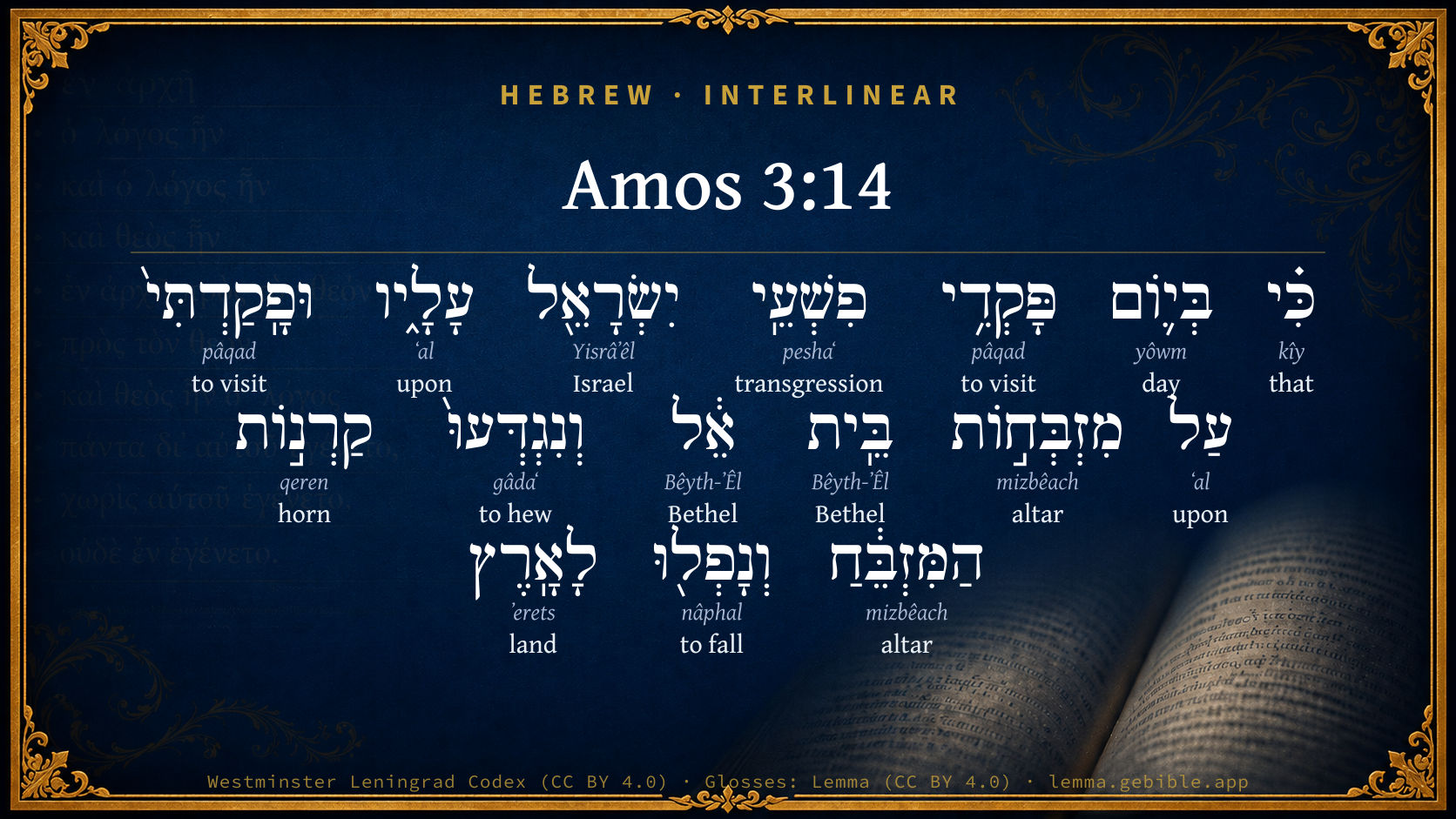
Amos 3:14

Hebrew (Westminster Leningrad Codex) Amos 3:14 appears in the Hebrew Old Testament. The text above is from the Westminster Leningrad Codex. Each word links to its Strong’s number, a concise gloss, and parsing drawn from the Open Scriptures Hebrew Bible morphology. Click any word for its full Brown-Driver-Briggs (BDB) entry.
Download image
Cite this verse

Amos 3:14 (World English Bible). Public Domain. Lemma interlinear Bible study tool, https://lemma.gebible.app/v/amos/3/14.

Show BibTeX & RIS
BibTeX
RIS
English Translation
"For in the day that I visit the transgressions of Israel on him, I will also visit the altars of Bethel; And the horns of the altar will be cut off, And fall to the ground.
World English Bible · Public Domain
Download a study sheet

One document with this verse’s original text, its word-by-word gloss line, the meaning frame, cross-references with their text, attributed commentary, and full source and license credits — printable, and it pastes into notes with its structure intact.

This verse Autodidact and up

Study sheet (.html) Plain text (.txt)

A passage Seminary Student

Up to 50 verses in one chapter. A passage sheet keeps up to 6 commentary sources and 12 cross-references per verse, in the order this page ranks them, and says so on the sheet whenever that leaves anything out. Ask for a single verse and you get the Autodidact verse sheet above.

Everything on this page stays free to read, with no account — the sheet is a download of what is already on screen, not access to it.

Want to remove ads? Support Godless Engineer
Compare translations 3

The same verse in 3 English versions, stacked beneath the original-language interlinear above. Click any original word for its lexicon entry.

Each is an independent rendering of the whole verse — the interlinear is not word-aligned to these translations.

Highlighted words mark where these versions differ — a whole-verse word diff, not a word-by-word alignment.

  • World English Bible Public Domain
    "For in the day that I visit the transgressions of Israel on him, I will also visit the altars of Bethel; And the horns of the altar will be cut off, And fall to the ground.
  • King James Version Public Domain
    That in the day that I shall visit the transgressions of Israel upon him I will also visit the altars of Bethel: and the horns of the altar shall be cut off, and fall to the ground.
  • unfoldingWord Literal Text CC BY-SA 4.0
    “For on the day that I bring punishment for the sins of Israel on her, I will also bring punishment on the altars of Bethel. The horns of the altar will be cut off and fall to the ground.

unfoldingWord Literal Text — © unfoldingWord, licensed CC BY-SA 4.0. Word-aligned USFM3 via Door43 (git.door43.org/unfoldingWord/en_ult).

Versions to compare (up to 4)

3 of 4 selected

Show all 18 translations

Every available English version of this verse, each an independent rendering of the whole verse.

  • World English Bible Public Domain
    "For in the day that I visit the transgressions of Israel on him, I will also visit the altars of Bethel; And the horns of the altar will be cut off, And fall to the ground.
  • Berean Standard Bible Public Domain
    On the day I punish Israel for their transgressions, I will visit destruction on the altars of Bethel; the horns of the altar will be cut off, and they will fall to the ground.
  • Majority Standard Bible Public Domain
    On the day I punish Israel for their transgressions, I will visit destruction on the altars of Bethel; the horns of the altar will be cut off, and they will fall to the ground.
  • King James Version Public Domain
    That in the day that I shall visit the transgressions of Israel upon him I will also visit the altars of Bethel: and the horns of the altar shall be cut off, and fall to the ground.
  • American Standard Version (1901) Public Domain
    For in the day that I shall visit the transgressions of Israel upon him, I will also visit the altars of Beth-el; and the horns of the altar shall be cut off, and fall to the ground.
  • Revised Version (1885) Public Domain
    For in the day that I shall visit the transgressions of Israel upon him, I will also visit the altars of Beth-el, and the horns of the altar shall be cut off, and fall to the ground.
  • Geneva Bible (1599) Public Domain
    Surely in the day that I shall visit the transgressions of Israel vpon him, I wil also visite the altars of Beth-el, and the hornes of the altar shall be broken off, and fall to the ground.
  • Douay-Rheims (1899) Public Domain
    That in the day when I shall begin to visit the transgressions of Israel, I will visit upon him, and upon the altars of Bethel: and the horns of the altars shall be cut off, and shall fall to the ground.
  • Young's Literal Translation Public Domain
    For in the day of My charging the transgressions of Israel on him, I have laid a charge on the altars of Beth-El, And cut off have been the horns of the altar, And they have fallen to the earth.
  • Literal Standard Version CC BY-SA 4.0
    “For in the day of My charging the transgressions of Israel on him, I have laid a charge on the altars of Beth-El, || And the horns of the altar have been cut off, || And they have fallen to the earth.
  • Unlocked Literal Bible CC BY-SA 4.0
    “For in the day that I punish the sins of Israel, I will also punish the altars of Bethel. The horns of the altar will be cut off and fall to the ground.
  • unfoldingWord Literal Text CC BY-SA 4.0
    “For on the day that I bring punishment for the sins of Israel on her, I will also bring punishment on the altars of Bethel. The horns of the altar will be cut off and fall to the ground.
  • Darby Bible Public Domain
    that in the day that I shall visit the transgressions of Israel upon him, I will also punish the altars of Bethel; and the horns of the altar shall be cut off, and fall to the ground.
  • World Messianic Bible Public Domain
    “For in the day that I visit the transgressions of Israel on him, I will also visit the altars of Bethel; and the horns of the altar will be cut off, and fall to the ground.
  • Webster's Bible Public Domain
    That in the day that I shall visit the transgressions of Israel upon him, I will also visit the altars of Beth-el: and the horns of the altar shall be cut off, and fall to the ground.
  • Free Bible Version CC BY-SA 4.0
    For on that day I will punish Israel for their sins. I will destroy the altars of Bethel: the corners of the altar will be cut off and fall to the ground.
  • Bible in Basic English Public Domain
    For in the day when I give Israel punishment for his sins, I will send punishment on the altars of Beth-el, and the horns of the altar will be cut off and come down to the earth.
  • JPS Tanakh (1917) Public Domain
    For in the day that I shall visit the transgressions of Israel upon him, I will also punish the altars of Beth-el, and the horns of the altar shall be cut off, and fall to the ground.

Literal Standard Version (2020), Covenant Press — licensed CC BY-SA 4.0. Text via the HelloAO Bible API (eBible.org). Unlocked Literal Bible (unfoldingWord) — licensed CC BY-SA 4.0. Text via the HelloAO Bible API (eBible.org). unfoldingWord Literal Text — © unfoldingWord, licensed CC BY-SA 4.0. Word-aligned USFM3 via Door43 (git.door43.org/unfoldingWord/en_ult). Free Bible Version, Dr. Jonathan Gallagher — licensed CC BY-SA 4.0. Text via the HelloAO Bible API (eBible.org).

Word by word

More ways to search: Search by grammar → Find every occurrence → Compare this word →

Practice this passage: Drill this verse → Learn its vocabulary →

וְנִגְדְּעוּ֙
gâdaʻ
H1438
“and · to hew”
Conjunction + Verb, Niphal, Sequential Perfect, 3rd Person, Common, Plural
Part of Speech
Conjunction + Verb
Stem
Niphal
Form
Sequential Perfect
Person
3rd Person
Gender
Common
Number
Plural
Full BDB Definition

Origin: a primitive root

TWOT: 316

to cut, hew, chop, cut down, hew down, hew off, cut off, cut in two, shave off - (Qal) to hew, chop in two - (Niphal) to be chopped off, be hewn off - (Piel) to cut off or down in two, hew off or down in two - (Pual) to chop down, hew down
  1. כִּ֗י kîy H3588 “that” Conjunction
  2. בְּי֛וֹם yôwm H3117 “in/at · day of” Preposition + Noun, Common, Masculine, Singular, Construct
  3. פָּקְדִ֥י pâqad H6485 “to visit · me” Verb, Qal, Infinitive Construct + Suffix, Personal, 1st Person, Common, Singular
  4. פִשְׁעֵֽי peshaʻ H6588 “transgressions of” Noun, Common, Masculine, Plural, Construct
  5. יִשְׂרָאֵ֖ל Yisrâʼêl H3478 “Israel” Noun, Proper
  6. עָלָ֑יו ʻal H5921 “upon · him” Preposition + Suffix, Personal, 3rd Person, Masculine, Singular
  7. וּפָֽקַדְתִּי֙ pâqad H6485 “and · to visit” Conjunction + Verb, Qal, Sequential Perfect, 1st Person, Common, Singular
  8. עַל ʻal H5921 “upon” Preposition
  9. מִזְבְּח֣וֹת mizbêach H4196 “altars of” Noun, Common, Masculine, Plural, Construct
  10. בֵּֽית Bêyth-ʼÊl H1008 “Bethel” Noun, Proper
  11. אֵ֔ל Bêyth-ʼÊl H1008 “Bethel” Noun, Proper
  12. קַרְנ֣וֹת qeren H7161 “horns of” Noun, Common, Both, Plural, Construct
  13. הַמִּזְבֵּ֔חַ mizbêach H4196 “the · altar” Particle, Definite Article + Noun, Common, Masculine, Singular, Absolute
  14. וְנָפְל֖וּ nâphal H5307 “and · to fall” Conjunction + Verb, Qal, Sequential Perfect, 3rd Person, Common, Plural
  15. לָאָֽרֶץ ʼerets H776 “to/for the · land” Preposition, Determined + Noun, Common, Both, Singular, Absolute

About this verse

These counts appear in no published source. They are computed here, from the morphology-tagged text and Lemma’s own curated glosses. What Lemma adds →

16
words
12
distinct lemmas
Prophets
section

Notable vocabulary

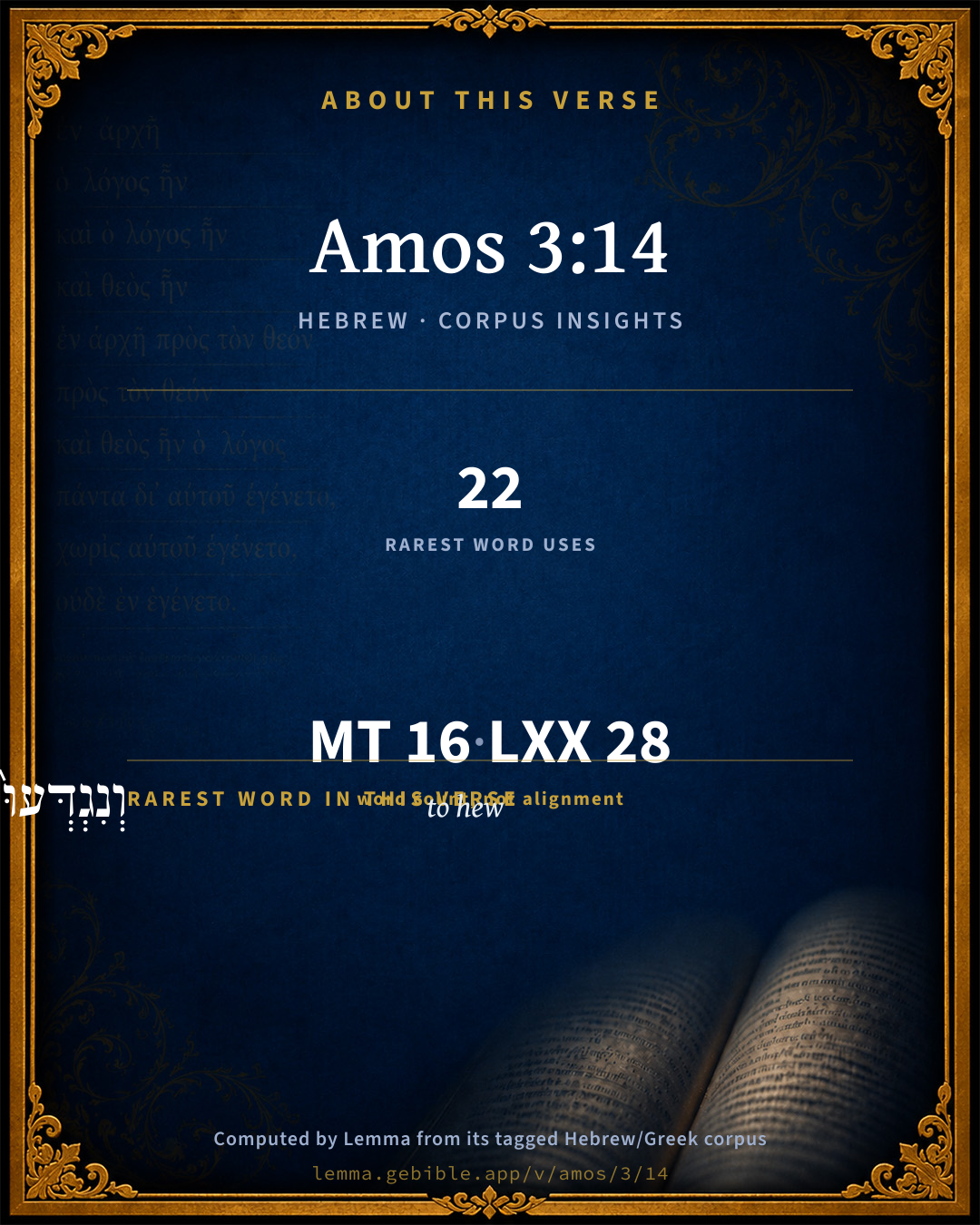
The rarest word here is וְנִגְדְּעוּ֙ to hew H1438 — appearing just 22 times in the whole Hebrew Bible.

Shared distinctive vocabulary

וְנִגְדְּעוּ֙ to hew H1438 occurs in 22 verses of the Hebrew Bible. Also found in:

Grammatical profile

  • 4 verbs
  • 9 nouns
  • 2 prepositions
  • 1 conjunction

Verb forms

  • פָּקְדִ֥י Qal · Infinitive Construct
  • וּפָֽקַדְתִּי֙ Qal · Sequential Perfect
  • וְנִגְדְּעוּ֙ Niphal · Sequential Perfect
  • וְנָפְל֖וּ Qal · Sequential Perfect

Repetition

Words recur within this verse — often emphatic in Hebrew:

  • פָּקְדִ֥י to visit H6485 ×2
  • עָלָ֑יו upon H5921 ×2
  • מִזְבְּח֣וֹת altar H4196 ×2
  • בֵּֽית Bethel H1008 ×2

Hebrew & Septuagint length

In English translation the verse runs 36 words from the Hebrew and 43 from the Septuagint (LXX English) — closely comparable.

A rough comparison of the two English renderings, which tokenize alike — not a word-level alignment.

Word counts can differ between the Hebrew and the Greek without any difference in meaning — e.g. the Hebrew direct-object marker אֵת has no separate Greek word, and Greek often adds the article ὁ.

In the original languages it is 16 Hebrew tokens and 28 Greek tokens — but the two are counted differently (Hebrew bundles its prefixes and suffixes into one token; the Greek is in lemma form), so that isn’t a like-for-like length.

Cross-references

10

Topical passages linked to Amos 3:14 in the Treasury of Scripture Knowledge — connected by theme and wording, ordered by reader-vote popularity; previews shown in the World English Bible.

  • 2 Kings 23:15 Moreover the altar that was at Bethel, and the high place which Jeroboam the son of Nebat, who made Israel to sin, had made, even that altar and the high place he broke down; and he burned the high place and beat it to dust, and burned the Asherah.
  • Hosea 10:5–8 The inhabitants of Samaria will be in terror for the calves of Beth Aven; For its people will mourn over it, Along with its priests who rejoiced over it, For its glory, because it has departed from it.
  • 2 Chronicles 34:6–7 [So did he] in the cities of Manasseh and Ephraim and Simeon, even to Naphtali, in their ruins round about.
  • Hosea 10:14–15 Therefore a battle roar will arise among your people, And all your fortresses will be destroyed, As Shalman destroyed Beth Arbel in the day of battle. The mother was dashed in pieces with her children.
  • Amos 5:5–6 But don't seek Bethel, Nor enter into Gilgal, And don't pass to Beersheba: For Gilgal shall surely go into captivity, And Bethel shall come to nothing.
  • Exodus 32:34 Now go, lead the people to the place of which I have spoken to you. Behold, my angel shall go before you. Nevertheless in the day when I punish, I will punish them for their sin."
  • 1 Kings 13:2–5 He cried against the altar by the word of Yahweh, and said, altar, altar, thus says Yahweh: Behold, a son shall be born to the house of David, Josiah by name; and on you shall he sacrifice the priests of the high places who burn incense on you, and men's bones shall they burn on you.
  • 2 Chronicles 31:1 Now when all this was finished, all Israel who were present went out to the cities of Judah, and broke in pieces the pillars, and hewed down the Asherim, and broke down the high places and the altars out of all Judah and Benjamin, in Ephraim also and Manasseh, until they had destroyed them all. Then all the children of Israel returned, every man to his possession, into their own cities.
  • Amos 9:1 I saw the Lord standing beside the altar, and he said, "Strike the tops of the pillars, that the thresholds may shake; and break them in pieces on the head of all of them; and I will kill the last of them with the sword: there shall not one of them flee away, and there shall not one of them escape.
  • Micah 1:6–7 Therefore I will make Samaria like a rubble heap of the field, Like places for planting vineyards; And I will pour down its stones into the valley, And I will uncover its foundations.

Cross-references courtesy of OpenBible.info (CC BY 4.0).

Hebrew and Greek witnesses Masoretic Hebrew ↔ Greek Septuagint

The same verse in the two great witnesses to the Old Testament, shown verse-for-verse.

These are two independent witnesses, not word-aligned to each other, and the Septuagint is shown in lemma (dictionary) form.

Hebrew Amos 3:14 Masoretic · Westminster Leningrad Codex

כִּ֗י בְּי֛וֹם פָּקְדִ֥י פִשְׁעֵֽי יִשְׂרָאֵ֖ל עָלָ֑יו וּפָֽקַדְתִּי֙ עַל מִזְבְּח֣וֹת בֵּֽית אֵ֔ל וְנִגְדְּעוּ֙ קַרְנ֣וֹת הַמִּזְבֵּ֔חַ וְנָפְל֖וּ לָאָֽרֶץ

"For in the day that I visit the transgressions of Israel on him, I will also visit the altars of Bethel; And the horns of the altar will be cut off, And fall to the ground.

World English Bible · Public Domain

Greek LXX Amos 3:14 Septuagint · lemma form

διότι ἐν ὁ ἡμέρα ὅταν ἐκδικέω ἀσέβεια ὁ ἰσραήλ ἐπί αὐτός καί ἐκδικέω ἐπί ὁ θυσιαστήριον βαιθηλ καί κατασκάπτω ὁ κέρας ὁ θυσιαστήριον καί πίπτω ἐπί ὁ γῆ

For in the day wherein I shall take vengeance of the sins of Israel upon him, I will also take vengeance on the altars of Bethel: and the horns of the altar shall be broken down, and they shall fall upon the ground.

LXX2012 (modern English Septuagint) · Public Domain

Hebrew: Westminster Leningrad Codex (CC BY 4.0). Greek: Septuagint (public domain); English from LXX2012 (modern English Septuagint) (Public Domain). How the Septuagint differs from the Hebrew →

Targum (Aramaic paraphrase)

1

The Targum is the ancient Jewish Aramaic paraphrase of the Hebrew Scriptures — an interpretive translation, not the Hebrew text itself. Onkelos (literal) and Pseudo-Jonathan (expansive) render the Torah, and Jonathan the Prophets. Coverage is partial: where no permissively-licensed English translation exists for a verse, only the Aramaic is shown. This is verse-level text, not a word-by-word alignment to the Hebrew.

  1. Targum Jonathan Prophets (Joshua–Malachi)
    אֲרֵי בְּיוֹם אַסְעֲרוּתִי חוֹבֵי יִשְׂרָאֵל עֲלוֹהִי וְאַסְעַר עַל דְפָלְחִין לֶאֱגוֹרַיָא בְּבֵית אֵל וְיִתְקַטְפָן קַרְנַת אֱגוֹרָא וְיִפְּלוּן לְאַרְעָא:

    (no public-domain English translation for this verse)

    Targum Jonathan — Aramaic: “Mikraot Gedolot” (public domain). English: “Sefaria Community Translation” (CC0 1.0 (public-domain dedication)); “London "Chaldee Paraphrase," 1871” (public domain). Text via Sefaria.

Commentary

Notes on Amos 3:14 from classic Christian and Jewish commentators (each source and its license shown beneath its notes). The classic Christian expositions comment on the surrounding passage and are grouped to its opening verse, so a note may address several verses; the Jewish commentaries on the Tanakh (Rashi and others) are per-verse, so they appear only where the commentator wrote on this verse.

Lemma curates 59 commentaries, every one of them public domain or Creative Commons licensed, each selected and text-cleaned for this edition rather than reprinted as found. About our sources →

Trapp's Complete Commentary

John Trapp

Amo 3:14 That in the day that I shall visit the transgressions of Israel upon him I will also visit the altars of Bethel: and the horns of the altar shall be cut off, and fall to the ground.

Ver. 14. That in the day that I shall visit, &c.] Tell them so from me, saith God: say to these wicked, Woe be unto them, it shall be ill with them! Isa 3:11. The jealous Lord of hosts will surely visit the iniquity of idolatrous fathers upon their children to the third and fourth generation, Exo 20:5. See Jer 3:21-22 Eze 16:21; Eze 16:36 Hos 2:4. As they have their day of defection, so hath he of visitation; his season, his harvest for judgment, Mat 13:30. What then will they do when God riseth up: and when he visiteth, what will they answer him? Job 31:14.

I will also visit the altars of Bethel] At first there was but one altar, 1Ki 12:32-33; 1Ki 13:2, but afterwards they multiplied, as in Peter’s at Rome there are said to be now over one hundred altars, Hos 8:11; Hos 10:1 : there is no end of will worship; but, like the Jerusalem artichoke, plant it where you will, it overruns the ground and chokes the heart. Now as God "loved the gates of Zion," where he was solemnly worshipped, "more than all the dwellings of Jacob," Psa 87:2, and as the walls of good people (whose houses are little churches) are continually before him, Isa 49:16, so he heartily hateth places and monuments of idolatry; and layeth them waste as he hath done our abbeys and monasteries. Zisca overthrew three hundred of them in Bohemia; and among the rest the famous monastery called the King’s Court, a mile from Prague; in the walls whereof the whole Bible was most exquisitely written in letters of gold; but little read or regarded by those filthy abbey lubbers, of whom Luther testifieth that they were tam desperatae malitiae, &c., so desperately debauched that they dared adventure upon any villany whatsoever.

And the horns of the altar, &c.] Which were held the holier parts thereof. This was fulfilled by good Josiah many years after, 2Ki 23:15 2Ch 34:4; 2Ch 34:6. Nullum tempus occurrit Regi. Time can be no prejudice to God’s proceedings; neither is his forbearance any quittance.

John Trapp, A Commentary or Exposition upon All the Books of the Old and New Testament (1647–1656) — public domain. Text from a community e-Sword module.

Tyndale Open Study Notes

Tyndale Open Resources

3:14 pagan altars at Bethel: The shrine at Bethel, built by Jeroboam I shortly after his inauguration (1 Kgs 12:26-33), continued through the dynasty of Jehu (2 Kgs 10:29), from whom Jeroboam II descended. This shrine merged worship of Yahweh (the Lord) with the pagan symbol of a bull. When the altars were destroyed, the Bethel shrine, the king’s official sanctuary (Amos 7:13), and the northern kingdom would also be ruined.

Tyndale Open Study Notes — © Tyndale Open Resources, licensed CC BY-SA 4.0. Text via the HelloAO Bible API.

Jamieson, Fausset & Brown

Robert Jamieson, A. R. Fausset & David Brown

That--rather, "since," or "for." This verse is not, as English Version translates, the thing which the witnesses cited are to "testify" (Amo 3:13), but the reason why God calls on the heathen to witness Samaria's guilt; namely, in order to justify the punishment which He declares He will inflict.

I will also visit . . . Beth-el--the golden calves which were the source of all "the transgressions of Israel" (Kg1 12:32; Kg1 13:2; Kg2 23:15-16), though Israel thought that by them their transgressions were atoned for and God's favor secured.

horns of the altar--which used to be sprinkled with the blood of victims. They were horn-like projecting points at the corners of ancient altars. The singular, "altar," refers to the great altar erected by Jeroboam to the calves. The "altars," plural, refer to the lesser ones made in imitation of the great one (Ch2 34:5, compare with Kg1 13:2; Hos 8:11; Hos 10:1).

Jamieson, Fausset & Brown — Commentary Critical and Explanatory on the Whole Bible (1871) — public domain (CC PDM 1.0). Text via the HelloAO Bible API.

Adam Clarke's Commentary

Verse 14. In the day that I shall visit] When Josiah made a reformation in the land he destroyed idolatry, pulled down the temples and altars that had been consecrated to idol worship, and even burnt the bones of the priests of Baal and the golden calves upon their own altars. See 2Kg 23:15-16, &c.

Adam Clarke's Commentary on the Bible (1810–1826) — public domain. Text from a community e-Sword/MySword module.

John Calvin's Commentaries

Amos, I have no doubt, added this passage, to show that the superstitions, in which he knew the Israelites falsely trusted, would be so far from being of any help to them, that they would, on the contrary, lead them to ruin, because the people were by them provoking God’s wrath the more against themselves. When the Israelites heard that God was offended with them, they looked on their sacrifices and other superstitions, as their shield and cover: for thus do hypocrites mock God. But we know that the sacrifices offered at Bethel were mere profanations; for the whole worship was spurious. God had indeed chosen to himself a place where he designed sacrifices to be offered. The Israelites built a temple without any command, nay, against the manifest prohibition of God. Since then they had thus violated and corrupted the whole worship of God, strange was their madness to dare to obtrude on God their superstitions, as though they could thus pacify his displeasure! The Prophet then rebukes now this stupidity and says, In the day when God shall visit the sins of Israel, he will inflict punishment on the altars of Bethel By the sins, which the Prophet mentions, he means plunder, unjust exactions, robbery, and similar crimes; for there prevailed then, as we have seen, among the people, an unbridled cruelty, avarice, and perfidiousness.

Hence he says now, When God shall visit the sins of Israel; that is, when he shall punish avarice, pride, and cruelty; when he shall execute vengeance on pillages and robberies, he shall then visit also the altars of Bethel. The Israelites thought that God would be propitious to them while they sacrificed though they were wholly abandoned in their lives: they indeed thought that every uncleanness was purified by their expiations; and they thought that God was satisfied while they performed an external worship. Hence, when they offered sacrifices, they imagined that they thus made a compact with God, and presented such a compensation, that he dared not to punish their sins. Their own fancy greatly deceives them,” says Amos. For, as we know, this was, at the same time, their principal sin, — that they rashly dared to change the worship of God, that they dared to build a temple without his command; in short, that they had violated the whole law. God then will begin with superstitions in executing judgment for the sins of the people. We now then understand the Prophet’s design in saying, that God would visit the altars of Bethel when inflicting punishment on the sins of Israel.

But as it was difficult to produce conviction on this subject, the Prophet here invites attention, Hear ye, and testify, he says, in the house of Jacob. Having bidden them to hear, he introduces God as the speaker: for the Israelites, as we know they were wont to do, might have pretended that Amos had, without authority, threatened such a punishment. “Nothing is mine,” he says. We then see the design of this address, when he says, Hear: he shows God to be the author of this prophecy, and that nothing was his own but the ministration. Hear ye, then, and testify in the house of Jacob By the word testify, he seals his prophecy that it might have more weight, that they might not think that it was a mere mockery, but might know that God was dealing seriously with them, Then testify ye in the house of Jacob. And for the same purpose are the titles which he ascribes to God, The Lord Jehovah, he says, the God of hosts He might have used only one word, “Thus saith Jehovah,” as the prophets mostly do; but he ascribes dominion to him, and he also brings before them his power, — for what end? To strike the Israelites with terror, that vain flatteries might no longer, as heretofore, take possession of them; but that they might understand, that so far were they from doing anything towards pacifying God’s wrath by their superstitions, that they thereby the more provoked him.

John Calvin's Commentaries (1540-1563) — public domain. Text from the Calvin Translation Society English edition (1840s-50s) via the Christian Classics Ethereal Library (ccel.org). Calvin's coverage is partial (roughly two-thirds of the Bible); uncommented books and verses are honest gaps, never fabricated. The 19th-century editor's footnotes and remarks are omitted so the notes are faithfully Calvin's own voice.

The Cambridge Bible for Schools and Colleges

gen. ed. J. J. S. Perowne

14. visit] Cf. on Amo_3:2.

I will also visit] I will visit: there is no ‘also’; the וְ, by a common Hebrew idiom, merely introduces the verbal predicate.

the altars of Beth-el] Beth-el, now Beitin, was in Amos’s day the principal sanctuary of the northern kingdom. It lay on the sloping side of a low hill about 10 miles N. of Jerusalem, on the right hand of the great route leading northwards to Shechem and Samaria. It must have been regarded as a sacred spot from very early times: its maẓẓçbâh, or sacred stone pillar, was connected by tradition with a memorable occasion in the life of the patriarch Jacob (Gen_28:10-22; cf. Gen_35:1-8; Hos_12:4; it is alluded to as a sanctuary in 1Sa_10:3); and its time-honoured sanctity, taken in conjunction with its situation at the extreme south of Jeroboam’s kingdom, on the immediate route to Jerusalem, no doubt led him to select it as one of his chief sanctuaries (1Ki_12:28-33). Here he established one of the two calves of gold, erected an altar, and instituted a priesthood to serve it (ib.: cf. Amo_7:10). Amos represents Beth-el as being the most popular sanctuary of the northern kingdom: it was under the special patronage of the king (Amo_7:13); altars (in the plural) had taken the place of the single altar of Jeroboam I. (1Ki_13:1); the sanctuary was crowded with worshippers (Amo_9:1); an elaborate ritual was observed there (Amo_4:4-5), and the houses of the wealthy were numerous (Amo_3:15). Comp. also Amo_3:5; Hos_4:15; Hos_10:5; Hos_10:8; Hos_10:15. The altar and sanctuary of Beth-el were finally destroyed by Josiah (2Ki_23:15). At present Beth-el is nothing more than a poor village, containing, it is said, about 400 persons. See Rob. B.R[148] i. 448 f.; Stanley, S. and P. pp. 217–223; Memoirs of the P. E. F. Survey, ii. 295 f.; Moore, Comm. on Judges, pp. 40, 42, 433.

[148] .R. … Edw. Robinson, Biblical Researches in Palestine (ed. 2, 1856).

the horns of the altar] which conferred the right of asylum upon those who laid hold of them (see 1Ki_1:50-51; 1Ki_2:28): but even this refuge should fail Israel in the day of visitation, which Amos here foresees. On the ‘horns’ of the altar, see also Jer_17:1; Eze_43:15; Eze_43:20; Exo_27:2 (on the altar of burnt-offering); Exo_30:2 (on the altar of incense); Psa_118:27. They were an important adjunct to the altar: and at least in the ritual of the Temple at Jerusalem the ceremonial of atonement could in many cases only be completed upon them (Lev_4:7; Lev_4:18; Lev_4:25; Lev_4:30; Lev_4:34). A stelè from Teima (S.E. of Edom), containing an interesting Aramaic inscription, shews the ‘horns’ rising from the corner of an altar, and curved like those of an ox (Perrot and Chipiez, Hist. of Art in Sardinia, Judaea, &c., i. 304).

14–15. The thought of Amo_3:11 is further developed. The ruin will be complete: the idolatrous altars, and the sumptuous palaces, will alike be involved in it.

The Cambridge Bible for Schools and Colleges (gen. ed. J. J. S. Perowne; Cambridge University Press, 1878–1918) — public domain. Text from a community e-Sword module.

John Gill's Exposition

And I will smite the winter house with the summer house,.... Both the one and, the other shall fall to the ground, being beat down by the enemy, or shook and made to fall by the earthquake predicted, Amo 1:1; as Kimchi thinks: kings and great personages had houses in the city in the winter season, in which they lived for warmth; and others in the country in the summertime, to which they retired for the benefit of the air; or they had, in one and the same house, a summer and a winter parlour; see Jdg 3:20; it signifies that the destruction should reach city and country, and deprive them of what was for their comfort and pleasure:

and the houses of ivory shall perish; or "of the tooth" (l); the elephant's tooth, of which ivory is made. Ahab made a house of ivory; and perhaps more were made by others afterwards, following his example, Kg1 22:39; not that these houses were made wholly of ivory, only "covered" with it, as the Targum here paraphrases it; or they were cieled or wainscotted with it, or were inlaid and covered with it, and were reckoned very curious work; but should be demolished, and perish in the general ruin:

and the great houses shall have an end, saith the Lord; the houses of princes, nobles, and other persons of figure and distinction; houses great in building, or many in number, as Kimchi observes, and as the word (m) will bear to be rendered; these, which the builders and owners of them thought would have continued many ages, and have perpetuated their names to posterity, should now be thrown down, and be no more; of which they might assure themselves, since the Lord had said it.

(l) "domus dentis", Montanus, Mercerus, Vatablus. (m) "aedes multi", V. L. "domus multae", Pagninus, Montanus, Mercerus, Cocceius, Burkius.

Next: Amos Chapter 4

John Gill's Exposition of the Whole Bible (1746–1763) — public domain (CC PDM 1.0). Text via the HelloAO Bible API.

Albert Barnes' Notes on the Bible

In the day that I shall visit the transgression of Israel upon, him, I will also visit (upon) the altars of Bethel - Israel then hoped that its false worship of “nature” would avail it. God says, contrariwise, that when He should punish, all their false worship, so far from helping them, should itself be the manifest object of His displeasure. Again God attests, at once, His long-suffering and His final retribution. Still had He foreborne to punish, “being slow to anger and of great goodness;” but when that day, fixed by the divine Wisdom, should come, wherein He should vindicate His own holiness, by enduring the sin no longer, then He would “visit their transgressions,” that is, all of them, old and new, forgotten by man or remembered, “upon them.” Scripture speaks of “visiting offences upon” because, in God’s Providence, the sin returns upon a man’s own head. It is not only the cause of his being punished, but it becomes part of his punishment.

The memory of a man’s sins will be part of his eternal suffering. Even in this life, “remorse,” as distinct from repentance, is the “gnawing” of a man’s own conscience for the folly of his sin. Then also God would visit upon the false worship. It is thought that God visits less speedily even grave sins against Himself, (so that man does not appeal falsely to Him and make Him, in a way, a partner of his offence,) than sins against His own creature, man. It may be that, All-Merciful as He is, He bears the rather with sins, involving corruption of the truth as to Himself, so long as they are done in ignorance, on account of the ignorant worship Act 17:23, Act 17:30; Act 14:16 of Himself, or the fragments of truth which they contain, until the evil in them have its full sway in moral guilt Rom. 1. Montanus: “Wonderful is the patience of God in enduring all those crimes and injuries which pertain directly to Himself; wonderful His waiting for repentance. But the deeds of guilt which violate human society, faith, and justice, hasten judgment and punishment, and, as it were, with a most effectual cry call upon the Divine Mind to punish, as it is written, “The voices of thy brother’s blood crieth unto Me from the ground, And now cursed art thou, ...” Gen 4:10-11.

If then upon that very grave guilt against God Himself there be accumulated these other sins, this so increases the load, that God casts it out. However long then Israel with impunity, given itself to that vain, alien worship, this evinced the patience, not the approval, of God. Now, when they are to be punished for the fourth transgresston, they will be punished for the first, second and third, and so, most grievously; when brought to punishment for their other sins, they should suffer for their other guilt of impiety and superstition.”

And the horns of the altar - This was the one great “altar” 1Ki 12:32-33; 1Ki 13:1-5 for burnt-offerings, set up by Jeroboam, in imitation of that of God at Jerusalem, whose doom was pronounccd in the act of its would-be consecration. He had copied faithfully outward form. At each corner, where the two sides met in one, rose the “horn,” or pillar, a cubit high , there to sacrifice victims, Psa 118:27, there to place the blood of atonement Exo 29:12. So far from atoning, they themselves were “the” unatoned “sin” of “Jeroboam whereby 2Ki 17:21 he drove Israel from following the Lord, and made them sin a great sin. These were to be cut off; hewn down, with violence. A century and a half had passed, since the man of God had pronounced its sentence. They still stood. The day was not yet come; Josiah was still unborn; yet Amos, as peremptorily, renews the sentence. In rejecting these, whereon the atonement was made, God pronounced them out of covenant with Himself. Heresy makes itself as like as it can to the truth, but is thereby the more deceiving, not the less deadly. Amos mentions the altars of Bethel, as well as the altar. Jeroboam made but one altar, keeping as close as he could to the divine ritual. But false worship and heresy ever hold their course, developing themselves. They never stand still where they began, but spread, like a cancer 2Ti 2:17. It is a test of heresy, like leprosy, that it spreads abroad Lev. 13, preying on what at first seemed sound. The oneness of the altar had relation to the Unity of God. In Samaria, they worshiped, they know not what Joh 4:22, not God, but some portion of His manifold operations. The many altars, forbidden as they were, were more in harmony with the religion of Jeroboam, even because they were against God’s law. Heresy develops, becoming more consistent, by having less of truth.

Albert Barnes' Notes on the Bible (1834–1885) — public domain. Text from a community e-Sword/MySword module.

Haydock's Catholic Bible Commentary

CHAPTER III.

Bethel. Manahem seems to have sent one of the calves to engage Phul to come to his assistance, Osee x. 5., and 4 Kings xv. 19. Salmanasar had both, Osee viii. 5. Josias afterwards defiled the profane altars, 4 Kings xxiii. 15. --- Horns, made of brass, which the Assyrians carried off. (Calmet) --- The fairest possessions of sinners will at last perish. (Worthington)

George Leo Haydock (1774–1849), Haydock's Catholic Family Bible and Commentary, 1859 edition — public domain. Excludes Psalms (Douay-Rheims chapter numbering differs from Protestant) and Deuterocanonical books (Catholic canon only).

Matthew Poole's English Annotations

In the day; in the appointed time, and within compass of a little time too; God will in his set time make quick work with them.

Visit the transgressions of Israel upon him; the many and great transgressions of the ten tribes, these God will, as he hath foretold by his prophets, severely punish, and in particular their idolatry.

The altars, erected unto the calves, and on which they Offered sacrifices to those idols by Jeroboam’s appointment at first, and by the continued commands of their idolatrous governors. It is possible there might be altars to other idols too: see 2Ch 34:4; Hos 8:11; 10:1.

Beth-el; anciently called Luz, but afterwards Jacob, on his comfortable vision, did change its name into Beth-el; it was in the tribe of Benjamin, and one of the two places Jeroboam first set up his idolatry in.

The horns of the altar; whether a more sacred part in their account I know not, but who fled to the altar, and laid hold on the horns of it, found them a sanctuary, 1Ki 2:28; but these now should not be safety to themselves.

Shall be cut off, the altars shall be pulled down,

and fall to the ground; be cast out as common, and trodden under foot with contempt.

Matthew Poole's English Annotations on the Holy Bible (1683–1685) — public domain. Text from a community e-Sword/MySword module.

The Pulpit Commentary

That in the day, etc. This verse is rightly joined to the preceding, as it particularizes the threats which the heathen are summoned to testify. Visit upon; equivalent to "punish". (Zep_1:8) Altars of Bethal. We read of one altar being set up by Jeroboam I, (1Ki_12:29, 1Ki_12:33) but doubtless others had been added in the course of time. The denunciation of 1Ki_13:2, 3 is here repeated. The horns of the altar. These were certain projections at the four angles of the altar, perhaps in the form of an ox"s horn, on which the blood of the sin offering was smeared, and which therefore were considered the holiest part of the altar. (see Exo_27:2 Exo_29:12; Lev_16:18) The instruments of idolatry or impure worship should share the destruction of the idolaters.

The Pulpit Commentary (1880–1919), ed. H.D.M. Spence-Jones & Joseph S. Exell — public domain. Text from a community e-Sword module.

John Wesley's Explanatory Notes

Of Israel - The many and great transgressions of the ten tribes.

John Wesley, Explanatory Notes Upon the Whole Bible (1754–1765) — public domain. Text via the GEBible commentary corpus.

Lesson kit

Teaching starters — assembled from the data on this page, not authored interpretation. Every prompt links to the verse data it draws on. Edit before teaching.

Amos, in the Prophets, opens this verse with 16 words (12 distinct Hebrew lemmas). Its most distinctive word is gâdaʻ (“to hew”). A historical commentator’s framing appears above. Read the whole chapter for the surrounding context.

Discussion questions

  1. The word gâdaʻ carries the sense “to hew.” How does it shape the verse?
  2. Deuteronomy 7:5 shares the word «to hew» with this verse. How do the two illuminate each other?
  3. “to visit” occurs 2× in this one verse. What is the effect of the repetition?
  4. These translations render this verse differently. What is at stake in choosing one wording over another?
  5. The verb «פָּקְדִ֥י» is Qal Infinitive Construct. How does its form color the action?
  6. Reading how Trapp's Complete Commentary and Tyndale Open Study Notes read this verse, where do the two commentators agree and where do they part?

Things to notice

Reading settings

Reading text

Shown beneath each verse's original-language words.

Old Testament
Old Testament edition

Read the OT as the Masoretic Hebrew (MT) or the Greek Septuagint (LXX).

English shown for the Greek Septuagint (in the Hebrew ↔ Greek comparison).

Comparing translations? Open the Compare panel on any verse page to stack up to four side by side.