
Judges 15:18

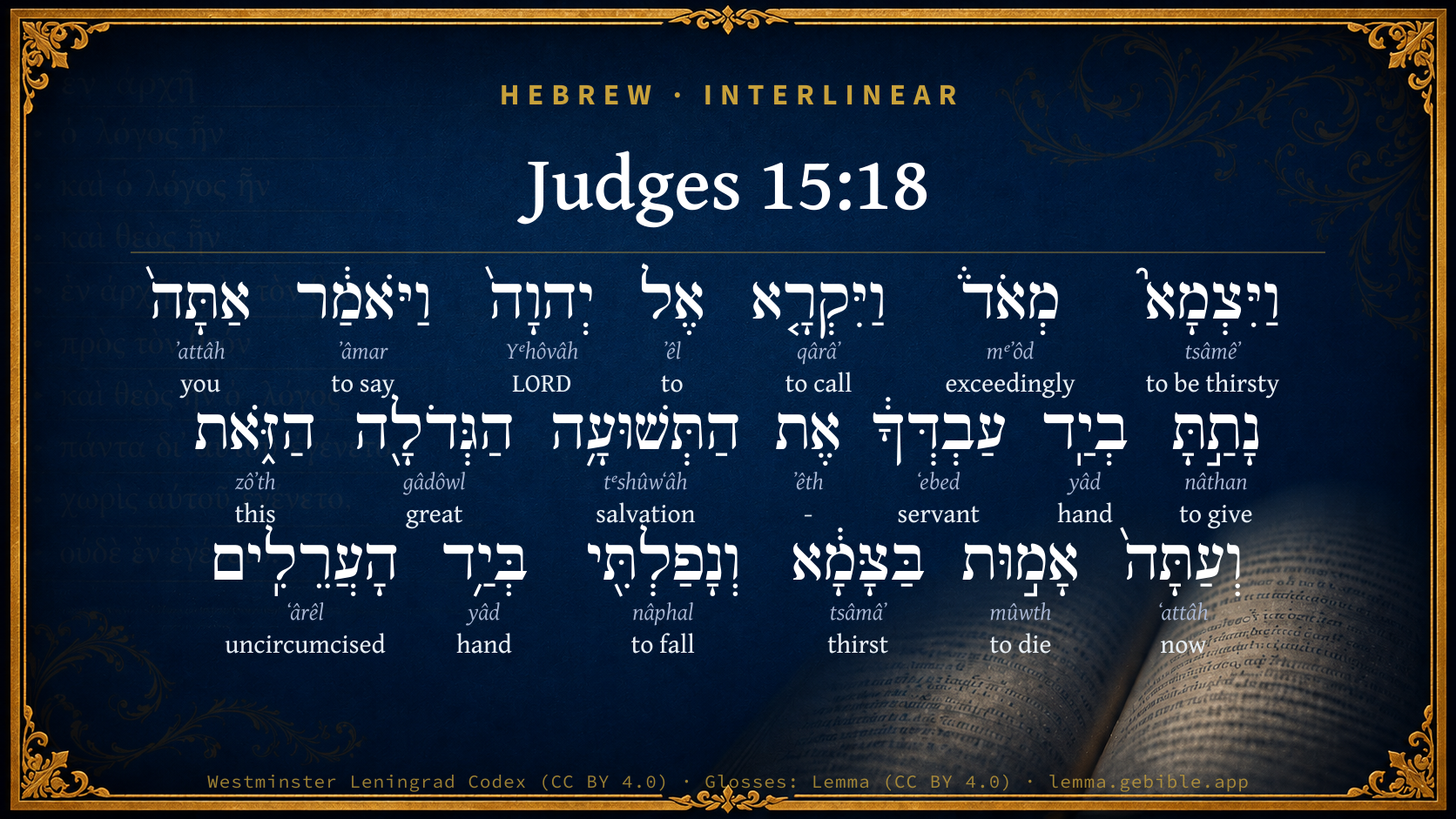
Hebrew (Westminster Leningrad Codex) Judges 15:18 appears in the Hebrew Old Testament. The text above is from the Westminster Leningrad Codex. Each word links to its Strong’s number, a concise gloss, and parsing drawn from the Open Scriptures Hebrew Bible morphology. Click any word for its full Brown-Driver-Briggs (BDB) entry.
Download image
Cite this verse

Judges 15:18 (World English Bible). Public Domain. Lemma interlinear Bible study tool, https://lemma.gebible.app/v/judges/15/18.

Show BibTeX & RIS
BibTeX
RIS
English Translation
He was very thirsty, and called on Yahweh, and said, You have given this great deliverance by the hand of your servant; and now shall I die for thirst, and fall into the hand of the uncircumcised.
World English Bible · Public Domain
Highlights
  • 1 first appearance in the Hebrew Bible
Full analysis ↓
Download a study sheet

One document with this verse’s original text, its word-by-word gloss line, the meaning frame, cross-references with their text, attributed commentary, and full source and license credits — printable, and it pastes into notes with its structure intact.

This verse Autodidact and up

Study sheet (.html) Plain text (.txt)

A passage Seminary Student

Up to 50 verses in one chapter. A passage sheet keeps up to 6 commentary sources and 12 cross-references per verse, in the order this page ranks them, and says so on the sheet whenever that leaves anything out. Ask for a single verse and you get the Autodidact verse sheet above.

Everything on this page stays free to read, with no account — the sheet is a download of what is already on screen, not access to it.

Want to remove ads? Support Godless Engineer
Compare translations 3

The same verse in 3 English versions, stacked beneath the original-language interlinear above. Click any original word for its lexicon entry.

Each is an independent rendering of the whole verse — the interlinear is not word-aligned to these translations.

Highlighted words mark where these versions differ — a whole-verse word diff, not a word-by-word alignment.

  • World English Bible Public Domain
    He was very thirsty, and called on Yahweh, and said, You have given this great deliverance by the hand of your servant; and now shall I die for thirst, and fall into the hand of the uncircumcised.
  • King James Version Public Domain
    And he was sore athirst, and called on the LORD, and said, Thou hast given this great deliverance into the hand of thy servant: and now shall I die for thirst, and fall into the hand of the uncircumcised?
  • unfoldingWord Literal Text CC BY-SA 4.0
    But he was very thirsty, so he called to Yahweh and said, “You have given this great salvation by the hand of your servant, and now shall I die of thirst and fall into the hand of the uncircumcised?”

unfoldingWord Literal Text — © unfoldingWord, licensed CC BY-SA 4.0. Word-aligned USFM3 via Door43 (git.door43.org/unfoldingWord/en_ult).

Versions to compare (up to 4)

3 of 4 selected

Show all 18 translations

Every available English version of this verse, each an independent rendering of the whole verse.

  • World English Bible Public Domain
    He was very thirsty, and called on Yahweh, and said, You have given this great deliverance by the hand of your servant; and now shall I die for thirst, and fall into the hand of the uncircumcised.
  • Berean Standard Bible Public Domain
    And being very thirsty, Samson cried out to the LORD, “You have accomplished this great deliverance through Your servant. Must I now die of thirst and fall into the hands of the uncircumcised?”
  • Majority Standard Bible Public Domain
    And being very thirsty, Samson cried out to the LORD, “You have accomplished this great deliverance through Your servant. Must I now die of thirst and fall into the hands of the uncircumcised?”
  • King James Version Public Domain
    And he was sore athirst, and called on the LORD, and said, Thou hast given this great deliverance into the hand of thy servant: and now shall I die for thirst, and fall into the hand of the uncircumcised?
  • American Standard Version (1901) Public Domain
    And he was sore athirst, and called on Jehovah, and said, Thou hast given this great deliverance by the hand of thy servant; and now shall I die for thirst, and fall into the hand of the uncircumcised.
  • Revised Version (1885) Public Domain
    And he was sore athirst, and called on the LORD, and said, Thou hast given this great deliverance by the hand of thy servant: and now shall I die for thirst, and fall into the hand of the uncircumcised.
  • Geneva Bible (1599) Public Domain
    And he was sore a thirst, and called on the Lord, and sayde, Thou hast giuen this great deliuerance into the hand of thy seruaunt: and nowe shall I dye for thirst, and fall into the handes of the vncircumcised?
  • Douay-Rheims (1899) Public Domain
    Arid being very thirsty, he cried to the Lord, and said: Thou hast given this very great deliverance and victory into the hand of thy servant: and behold I die for thirst, and shall fall into the hands of the uncircumcised.
  • Young's Literal Translation Public Domain
    and he thirsteth exceedingly, and calleth unto Jehovah, and saith, `Thou -- Thou hast given by the hand of Thy servant this great salvation; and now, I die with thirst, and have fallen into the hand of the uncircumcised.'
  • Literal Standard Version CC BY-SA 4.0
    and he thirsts exceedingly, and calls to YHWH, and says, “You have given this great salvation by the hand of Your servant; and now, I die with thirst, and have fallen into the hand of the uncircumcised.”
  • Unlocked Literal Bible CC BY-SA 4.0
    Samson was very thirsty and called on Yahweh and said, “You have given this great victory to your servant. But now will I die of thirst and fall into the hands of those who are uncircumcised?”
  • unfoldingWord Literal Text CC BY-SA 4.0
    But he was very thirsty, so he called to Yahweh and said, “You have given this great salvation by the hand of your servant, and now shall I die of thirst and fall into the hand of the uncircumcised?”
  • Darby Bible Public Domain
    And he was very thirsty, and he called on the LORD and said, "Thou hast granted this great deliverance by the hand of thy servant; and shall I now die of thirst, and fall into the hands of the uncircumcised?"
  • World Messianic Bible Public Domain
    He was very thirsty, and called on the LORD and said, “You have given this great deliverance by the hand of your servant; and now shall I die of thirst, and fall into the hands of the uncircumcised?”
  • Webster's Bible Public Domain
    And he was very thirsty, and called on the LORD, and said, Thou hast given this great deliverance into the hand of thy servant: and now shall I die by thirst, and fall into the hand of the uncircumcised?
  • Free Bible Version CC BY-SA 4.0
    Samson was now extremely thirsty, and he called out to the Lord, saying, “You have achieved this amazing victory through your servant, but now do I have to die of thirst and be captured by the heathen?”
  • Bible in Basic English Public Domain
    After this, he was in great need of water, and crying out to the Lord, he said, You have given this great salvation by the hand of your servant, and now need of water will be my death; and I will be given into the hands of this people who are without circumcision.
  • JPS Tanakh (1917) Public Domain
    And he was sore athirst, and called on the LORD, and said: 'Thou hast given this great deliverance by the hand of Thy servant; and now shall I die for thirst, and fall into the hand of the uncircumcised?'

Literal Standard Version (2020), Covenant Press — licensed CC BY-SA 4.0. Text via the HelloAO Bible API (eBible.org). Unlocked Literal Bible (unfoldingWord) — licensed CC BY-SA 4.0. Text via the HelloAO Bible API (eBible.org). unfoldingWord Literal Text — © unfoldingWord, licensed CC BY-SA 4.0. Word-aligned USFM3 via Door43 (git.door43.org/unfoldingWord/en_ult). Free Bible Version, Dr. Jonathan Gallagher — licensed CC BY-SA 4.0. Text via the HelloAO Bible API (eBible.org).

Word by word

More ways to search: Search by grammar → Find every occurrence → Compare this word →

Practice this passage: Drill this verse → Learn its vocabulary →

וַיִּצְמָא֮
tsâmêʼ
H6770
“and · to be thirsty”
Conjunction + Verb, Qal, Sequential Imperfect, 3rd Person, Masculine, Singular
Part of Speech
Conjunction + Verb
Stem
Qal
Form
Sequential Imperfect
Person
3rd Person
Gender
Masculine
Number
Singular
Full BDB Definition

Origin: a primitive root

TWOT: 1926

(Qal) to be thirsty
  1. מְאֹד֒ mᵉʼôd H3966 “exceedingly” Adverb
  2. וַיִּקְרָ֤א qârâʼ H7121 “and · to call” Conjunction + Verb, Qal, Sequential Imperfect, 3rd Person, Masculine, Singular
  3. אֶל ʼêl H413 “to” Preposition
  4. יְהוָה֙ Yᵉhôvâh H3068 “LORD” Noun, Proper
  5. וַיֹּאמַ֔ר ʼâmar H559 “and · to say” Conjunction + Verb, Qal, Sequential Imperfect, 3rd Person, Masculine, Singular
  6. אַתָּה֙ ʼattâh H859 “you” Pronoun, Personal, 2nd Person, Masculine, Singular
  7. נָתַ֣תָּ nâthan H5414 “to give” Verb, Qal, Perfect, 2nd Person, Masculine, Singular
  8. בְיַֽד yâd H3027 “in/at · hand of” Preposition + Noun, Common, Both, Singular, Construct
  9. עַבְדְּךָ֔ ʻebed H5650 “servant · your” Noun, Common, Masculine, Singular, Construct + Suffix, Personal, 2nd Person, Masculine, Singular
  10. אֶת ʼêth H853 “-” Particle, Direct Object
  11. הַתְּשׁוּעָ֥ה tᵉshûwʻâh H8668 “the · salvation” Particle, Definite Article + Noun, Common, Feminine, Singular, Absolute
  12. הַגְּדֹלָ֖ה gâdôwl H1419 “the · great” Particle, Definite Article + Adjective, Adjective, Feminine, Singular, Absolute
  13. הַזֹּ֑את zôʼth H2063 “the · this” Particle, Definite Article + Pronoun, Demonstrative, Feminine, Singular
  14. וְעַתָּה֙ ʻattâh H6258 “and · now” Conjunction + Adverb
  15. אָמ֣וּת mûwth H4191 “to die” Verb, Qal, Imperfect, 1st Person, Common, Singular
  16. בַּצָּמָ֔א tsâmâʼ H6772 “in/at the · thirst” Preposition, Determined + Noun, Common, Masculine, Singular, Absolute
  17. וְנָפַלְתִּ֖י nâphal H5307 “and · to fall” Conjunction + Verb, Qal, Perfect, 1st Person, Common, Singular
  18. בְּיַ֥ד yâd H3027 “in/at · hand of” Preposition + Noun, Common, Both, Singular, Construct
  19. הָעֲרֵלִֽים ʻârêl H6189 “the · uncircumcised” Particle, Definite Article + Adjective, Adjective, Masculine, Plural, Absolute

About this verse

These counts appear in no published source. They are computed here, from the morphology-tagged text and Lemma’s own curated glosses. What Lemma adds →

20
words
19
distinct lemmas
Historical
section

Notable vocabulary

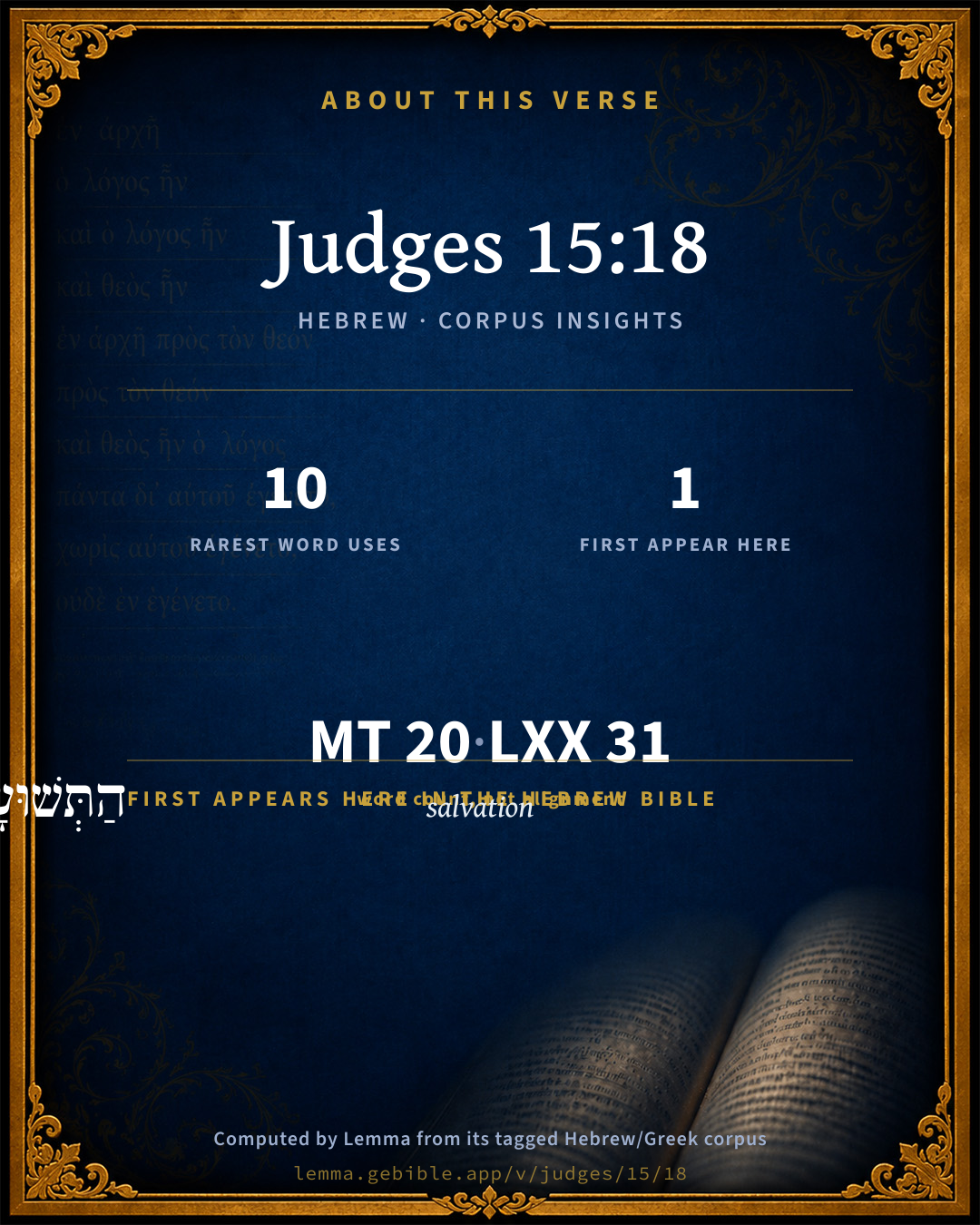
The rarest word here is וַיִּצְמָא֮ to be thirsty H6770 — appearing just 10 times in the whole Hebrew Bible.

First appearance in Scripture

This word makes its first canonical appearance in the Hebrew Bible here:

  • הַתְּשׁוּעָ֥ה salvation H8668

Shared distinctive vocabulary

וַיִּצְמָא֮ to be thirsty H6770 occurs in 10 verses of the Hebrew Bible. Also found in:

Grammatical profile

  • 6 verbs
  • 6 nouns
  • 2 adjectives
  • 2 pronouns
  • 1 preposition
  • 2 adverbs
  • 1 particle

Verb forms

  • וַיִּצְמָא֮ Qal · Sequential Imperfect
  • וַיִּקְרָ֤א Qal · Sequential Imperfect
  • וַיֹּאמַ֔ר Qal · Sequential Imperfect
  • נָתַ֣תָּ Qal · Perfect
  • אָמ֣וּת Qal · Imperfect
  • וְנָפַלְתִּ֖י Qal · Perfect

Repetition

A word recurs within this verse — often emphatic in Hebrew:

  • בְיַֽד hand H3027 ×2

Hebrew & Septuagint length

In English translation the verse runs 37 words from the Hebrew and 43 from the Septuagint (LXX English) — closely comparable.

A rough comparison of the two English renderings, which tokenize alike — not a word-level alignment.

Word counts can differ between the Hebrew and the Greek without any difference in meaning — e.g. the Hebrew direct-object marker אֵת has no separate Greek word, and Greek often adds the article ὁ.

In the original languages it is 20 Hebrew tokens and 31 Greek tokens — but the two are counted differently (Hebrew bundles its prefixes and suffixes into one token; the Greek is in lemma form), so that isn’t a like-for-like length.

Cross-references

17

Topical passages linked to Judges 15:18 in the Treasury of Scripture Knowledge — connected by theme and wording, ordered by reader-vote popularity; previews shown in the World English Bible.

  • Psalms 3:7–8 Arise, Yahweh! Save me, my God! For you have struck all of my enemies on the cheek bone. You have broken the teeth of the wicked.
  • Psalms 22:14–15 I am poured out like water. All my bones are out of joint. My heart is like wax; It is melted within me.
  • 2 Corinthians 12:7–8 By reason of the exceeding greatness of the revelations, that I should not be exalted excessively, there was given to me a thorn in the flesh, a messenger of Satan to buffet me, that I should not be exalted excessively.
  • Genesis 12:12–13 It will happen, when the Egyptians will see you, that they will say, 'This is his wife.' They will kill me, but they will save you alive.
  • Genesis 20:11 Abraham said, "Because I thought, 'Surely the fear of God is not in this place. They will kill me for my wife's sake.'
  • Genesis 32:31 The sun rose on him as he passed over Peniel, and he limped because of his thigh.
  • Judges 8:4 Gideon came to the Jordan, [and] passed over, he, and the three hundred men who were with him, faint, yet pursuing.
  • Judges 16:28 Samson called to Yahweh, and said, Lord Yahweh, remember me, Please, and strengthen me, Please, only this once, God, that I may be at once avenged of the Philistines for my two eyes.
  • 1 Samuel 17:26 David spoke to the men who stood by him, saying, What shall be done to the man who kills this Philistine, and takes away the reproach from Israel? for who is this uncircumcised Philistine, that he should defy the armies of the living God?
  • 1 Samuel 17:36 Your servant struck both the lion and the bear: and this uncircumcised Philistine shall be as one of them, seeing he has defied the armies of the living God.
  • 1 Samuel 27:1 David said in his heart, I shall now perish one day by the hand of Saul: there is nothing better for me than that I should escape into the land of the Philistines; and Saul will despair of me, to seek me any more in all the borders of Israel: so shall I escape out of his hand.
  • 2 Samuel 1:20 Don't tell it in Gath, Don't publish it in the streets of Ashkelon; Lest the daughters of the Philistines rejoice, Lest the daughters of the uncircumcised triumph.
  • Psalms 18:31–40 For who is God, except Yahweh? Who is a rock, besides our God,
  • John 19:28 After this, Jesus, seeing that all things were now finished, that the Scripture might be fulfilled, said, "I am thirsty."
  • 2 Corinthians 1:8–9 For we don't desire to have you uninformed, brothers, concerning our affliction which happened to us in Asia, that we were weighed down exceedingly, beyond our power, so much that we despaired even of life.
  • 2 Corinthians 4:8–9 We are pressed on every side, yet not crushed; perplexed, yet not to despair;
  • Hebrews 11:32 What more shall I say? For the time would fail me if I told of Gideon, Barak, Samson, Jephthah, David, Samuel, and the prophets;

Cross-references courtesy of OpenBible.info (CC BY 4.0).

Hebrew and Greek witnesses Masoretic Hebrew ↔ Greek Septuagint

The same verse in the two great witnesses to the Old Testament, shown verse-for-verse.

These are two independent witnesses, not word-aligned to each other, and the Septuagint is shown in lemma (dictionary) form.

Hebrew Judges 15:18 Masoretic · Westminster Leningrad Codex

וַיִּצְמָא֮ מְאֹד֒ וַיִּקְרָ֤א אֶל יְהוָה֙ וַיֹּאמַ֔ר אַתָּה֙ נָתַ֣תָּ בְיַֽד עַבְדְּךָ֔ אֶת הַתְּשׁוּעָ֥ה הַגְּדֹלָ֖ה הַזֹּ֑את וְעַתָּה֙ אָמ֣וּת בַּצָּמָ֔א וְנָפַלְתִּ֖י בְּיַ֥ד הָעֲרֵלִֽים

He was very thirsty, and called on Yahweh, and said, You have given this great deliverance by the hand of your servant; and now shall I die for thirst, and fall into the hand of the uncircumcised.

World English Bible · Public Domain

Greek LXX Judges 15:18 Septuagint · lemma form

καί διψάω σφόδρα καί κλαίω πρός κύριος καί εἶπον σύ εὐδοκέω ἐν χείρ δοῦλος σύ ὁ σωτηρία ὁ μέγας οὗτος καί νῦν ἀποθνήσκω ὁ δίψος καί ἐνπίπτω ἐν χείρ ὁ ἀπερίτμητος

And he was very thirsty, and wept before the Lord, and said, You have been well pleased to grant this great deliverance by the hand of your servant, and new shall I die for thirst, and fall into the hand of the uncircumcised?

LXX2012 (modern English Septuagint) · Public Domain

Hebrew: Westminster Leningrad Codex (CC BY 4.0). Greek: Septuagint (public domain); English from LXX2012 (modern English Septuagint) (Public Domain). How the Septuagint differs from the Hebrew →

Targum (Aramaic paraphrase)

1

The Targum is the ancient Jewish Aramaic paraphrase of the Hebrew Scriptures — an interpretive translation, not the Hebrew text itself. Onkelos (literal) and Pseudo-Jonathan (expansive) render the Torah, and Jonathan the Prophets. Coverage is partial: where no permissively-licensed English translation exists for a verse, only the Aramaic is shown. This is verse-level text, not a word-by-word alignment to the Hebrew.

  1. Targum Jonathan Prophets (Joshua–Malachi)
    וּצְחִי לַחֲדָא וְצַלִי קֳדָם יְיָ וַאֲמַר אַתְּ עֲבַדְתָּ עַל יַד עַבְדָךְ יַת פּוּרְקָנָא רַבָּא הָדָא וּכְעַן אֵימוּת בְּצָחוּתָא וְאִתְמְסַר בִּידָא דַעֲרֵלַיָא:

    (no public-domain English translation for this verse)

    Targum Jonathan — Aramaic: “Mikraot Gedolot” (public domain). English: “Sefaria Community Translation” (CC0 1.0 (public-domain dedication)); “London "Chaldee Paraphrase," 1871” (public domain). Text via Sefaria.

Commentary

Notes on Judges 15:18 from classic Christian and Jewish commentators (each source and its license shown beneath its notes). The classic Christian expositions comment on the surrounding passage and are grouped to its opening verse, so a note may address several verses; the Jewish commentaries on the Tanakh (Rashi and others) are per-verse, so they appear only where the commentator wrote on this verse.

Lemma curates 59 commentaries, every one of them public domain or Creative Commons licensed, each selected and text-cleaned for this edition rather than reprinted as found. About our sources →

Matthew Henry's Commentary

Here is, I. The distress which Samson was in after this great performance (Jdg 15:18): He was sore athirst. It was a natural effect of the great heat he had been in, and the great pains he had taken; his zeal consumed him, ate him up, and made him forget himself, till, when he had time to pause a little, he found himself reduced to the last extremity for want of water and ready to faint. Perhaps there was a special hand of God in it, as there was in the whole transaction; and God would hereby keep him from being proud of his great strength and great achievements, and let him know that he was but a man, and liable to the calamities that are common to men. And Josephus says, It was designed to chastise him for not making mention of God and his hand in his memorial of the victory he had obtained, but taking all the praise to himself: I have slain a thousand men; now that he is ready to die for thirst he is under a sensible conviction that his own arm could not have saved him, without God's right hand and arm. Samson had drunk largely of the blood of the Philistines, but blood will never quench any man's thirst. Providence so ordered it that there was no water near him, and he was so fatigued that he could not go far to seek it; the men of Judah, one would think, should have met him, now that he had come off a conqueror, with bread and wine, as Melchizedek did Abram, to atone for the injury they had done him; but so little notice did they take of their deliverer that he was ready to perish for want of a draught of water. Thus are the greatest slights often put upon those that do the greatest services. Christ on the cross, said, I thirst.

II. His prayer to God in this distress. Those that forget to attend God with their praises may perhaps be compelled to attend him with their prayers. Afflictions are often sent to bring unthankful people to God. Two things he pleads with God in this prayer, 1. His having experienced the power and goodness of God in his late success: Thou hast given this great deliverance into the hand of thy servant. He owns himself God's servant in what he had been doing: "Lord, wilt thou not own a poor servant of thine, that has spent himself in thy service? I am thine, save me." He calls his victory a deliverance, a great deliverance; for, if God had not helped him, he had not only not conquered the Philistines, but had been swallowed up by them. He owns it to come from God, and now corrects his former error in assuming it too much to himself; and this he pleads in his present strait. Note, Past experiences of God's power and goodness are excellent pleas in prayer for further mercy. "Lord, thou hast delivered often, wilt thou not deliver still? Co2 1:10. Thou hast begun, wilt thou not finish? Thou hast done the greater, wilt thou not do the less?" Psa 56:13. 2. His being now exposed to his enemies: "Lest I fall into the hands of the uncircumcised, and then they will triumph, will tell it in Gath, and in the streets of Ashkelon; and will it not redound to God's dishonour of his champion become so easy a prey to the uncircumcised?" The best pleas are those taken from God's glory.

III. The seasonable relief God sent him. God heard his prayer, and sent him water, either out of the bone or out of the earth through the bone, Jdg 15:19. That bone which he had made an instrument of God's service God, to recompense him, made an instrument of his supply. But I rather incline to our marginal reading: God clave a hollow place that was in Lehi: the place of this action was, from the jaw-bone, called Lehi; even before the action we find it so called, Jdg 15:9, Jdg 15:14. And there, in that field, or hill, or plain, or whatever it was, that was so called, God caused a fountain suddenly and seasonably to open just by him, and water to spring up out of it in abundance, which continued a well ever after. Of this fair water he drank, and his spirits revived. We should be more thankful for the mercy of water did we consider how ill we can spare it. And this instance of Samson's relief should encourage us to trust in God, and seek to him, for, when he pleases, he can open rivers in high places. See Isa 41:17, Isa 41:18.

IV. The memorial of this, in the name Samson gave to this upstart fountain, Enhakkore, the well of him that cried, thereby keeping in remembrance both his own distress, which occasioned him to cry, and God's favour to him, in answer to his cry. Many a spring of comfort God opens to his people, which may fitly be called by this name; it is the well of him that cried. Samson had given a name to the place which denoted him great and triumphant - Ramath-lehi, the lifting up of the jaw-bone; but here he gives it another name, which denotes him needy and dependent.

V. The continuance of Samson's government after these achievements, Jdg 15:20. At length Israel submitted to him whom they had betrayed. Now it was past dispute that God was with him, so that henceforward they all owned him and were directed by him as their judge. The stone which the builders refused became the head-stone. It intimates the low condition of Israel that the government was dated by the days of the Philistines; yet it was a mercy to Israel that, though they were oppressed by a foreign enemy, yet they had a judge that preserved order and kept them from ruining one another. Twenty years his government continued, according to the usages of the judges' administration; but of the particulars we have no account, save of the beginning of his government in this chapter and the end of it in the next.

Matthew Henry's Commentary on the Whole Bible (1708–1710) — public domain (CC PDM 1.0). Text via the HelloAO Bible API.

Trapp's Complete Commentary

John Trapp

Jdg 15:18 And he was sore athirst, and called on the LORD, and said, Thou hast given this great deliverance into the hand of thy servant: and now shall I die for thirst, and fall into the hand of the uncircumcised?

Ver. 18. And he was sore athirst.] To keep him humble after so notable an exploit, and to make him pray, ascribing kingdom, power, and glory to God alone.

And now shall I die for thirst?] Which is a most grievous kind of death, worse than that by hunger, which yet is worse than to die by the sword. {Lam 4:9}

And fall into the hands of the uncircumcised?] This will much reflect upon thee, Lord, and redound to thy dishonour. Viderit Christus, said Luther, nam si ego causa excidero, ipse solus ignorainiam reportabit. Let Christ provide for his own great name.

John Trapp, A Commentary or Exposition upon All the Books of the Old and New Testament (1647–1656) — public domain. Text from a community e-Sword module.

Geneva Bible (1599)

Geneva Bible translators

Whereby appeareth that he did these things in faith, and so with a true zeal to glorify God, and deliver his country.

Geneva Bible (1599) marginal notes — public domain. Text via Bolls.life.

Adam Clarke's Commentary

Verse 18. I die for thirst] The natural consequence of the excessive fatigue he had gone through in this encounter.

Adam Clarke's Commentary on the Bible (1810–1826) — public domain. Text from a community e-Sword/MySword module.

Ellicott's Commentary for English Readers

(18) He was sore athirst.—It was in the heat of harvest time, and he had pursued the Philistines till he was exhausted.

Into the hand.—Rather, by the hand.

A Bible Commentary for English Readers, edited by Charles John Ellicott (1878–1897) — public domain. Text from a community e-Sword module.

The Cambridge Bible for Schools and Colleges

gen. ed. J. J. S. Perowne

18. Samson becomes religious when he is in straits; cf. Jdg_16:28.

great deliverance] Cf. 1Sa_19:5, 2Sa_23:10; 2Sa_23:12.

The Cambridge Bible for Schools and Colleges (gen. ed. J. J. S. Perowne; Cambridge University Press, 1878–1918) — public domain. Text from a community e-Sword module.

John Gill's Exposition

And he was sore athirst,.... Which Josephus (n) thinks came upon him as a rebuke unto him, for ascribing the victory he had obtained to his own strength, and not to the Lord, whereby he was shown his own weakness, and how easily his strength could be reduced; but for this there seems to be no foundation; it is not to wondered at, in a natural way, that he should be athirst after he had been bound with cords, after he had so exerted himself, and slain 1000 men with his own hand, and after he had celebrated this victory with a triumphant song; and it may also be observed, that it was so ordered in Providence, that he might in this be a type of the Messiah, who on the cross, as he was spoiling principalities and powers, and triumphing over them in it, said, "I thirst", Joh 19:28.

and called on the Lord, and said; in prayer to him:

thou hast given this great deliverance into the hand of thy servant; he owns the deliverance to be great, as indeed, it was, and that it was of the Lord, and he only his servant and instrument in it:

and now shall I die for thirst; when my life has been saved in so wonderful a manner, and so great a salvation has been wrought by my hands, as an instrument:

and fall into the hands of the uncircumcised? which would be matter of joy and triumph to them, and mar the glory of the deliverance wrought.

(n) Antiqu. l. 5. c. 8. sect. 9.

John Gill's Exposition of the Whole Bible (1746–1763) — public domain (CC PDM 1.0). Text via the HelloAO Bible API.

Haydock's Catholic Bible Commentary

Thirsty. St. Ambrose (ep. 19 or 70) follows Josephus, (Menochius) is supposing that the arrogance of Samson, in attributing the victory to his own strength, was thus punished. But others are more favourable to the hero, (Calmet) and suppose that his thirst was occasioned by the extraordinary fatigue. He sufficiently testifies that he had received all from God, (Menochius) and he is immediately favoured with another miracle. (Haydock) --- God is able to grant victory by the most feeble instruments, and he is never wanting when his presence is requisite. (St. Augustine, Doct. iv. 15.) (Tirinus)

George Leo Haydock (1774–1849), Haydock's Catholic Family Bible and Commentary, 1859 edition — public domain. Excludes Psalms (Douay-Rheims chapter numbering differs from Protestant) and Deuterocanonical books (Catholic canon only).

Matthew Poole's English Annotations

He was sore athirst, so as he was ready to faint and die with thirst; which was partly natural, from his excessive toil and heat; partly sent by God, that by the experience of his own impotency he might be forced to ascribe the victory to God only, and not to himself.

Now shall I die for thirst? Wilt thou not finish what thou hast begun? Wilt thou undo what thou hast done?

Matthew Poole's English Annotations on the Holy Bible (1683–1685) — public domain. Text from a community e-Sword/MySword module.

Whedon's Commentary on the Bible

Daniel D. Whedon

18. Sore athirst — Having become exhausted by his fierce conflict with the enemy.

Called on the Lord — With all his wit and humour he did not forget the source of his strength, nor fail to understand that he was fighting for Jehovah.

Daniel D. Whedon (gen. ed.), Commentary on the Old and New Testaments (1874–1909) — public domain. Text from a community e-Sword module.

The Pulpit Commentary

He was sore athirst. The incredible exertions which he had made in pursuing and slaying the Philistines put him in danger of his life from thirst. He thought he should die, and be found and abused by his uncircumcised foes. His only resource was prayer to God, who had helped him hitherto, We may note by the way that the more God gives, the more he encourages us to ask.

Vers. 18, 19. Distress after triumph.

I ONE GREAT DELIVERANCE IS NO SECURITY AGAINST ALL FUTURE TROUBLE. Samson is surprised and vexed that a new trouble should fall upon him after his great victory. There is a danger lest we should rest contented with past triumphs. The Christian warfare can only end with the final victory over death. Till then we are in the enemy"s land, and must expect that one battle will only be succeeded by another. Though we may have a season of calm, an oasis in the desert, a quiet resting-place, this is not our rest." Let us beware of the confident self-elation which often follows the conquest of a temptation; it may be an introduction to a new and more dangerous one.

II SLIGHT EVILS MAY PROVE MORE DANGEROUS THAN GREAT ONES. Samson feels it humiliating to be in danger of dying of thirst after his victory over a much more imposing enemy; but he had means to meet the greater foe, and none with which to face the smaller one. Evils are injurious not so much in proportion to their simple magnitude as in proportion to our susceptibility to them. The force of a particular temptation depends on a man"s special disposition and peculiarity of character, not simply on its inherent alarming or alluring qualities. It should humble us to learn that after escaping the greatest dangers by the help of God we may succumb to very small dangers if left to ourselves.

III SEASONS OF TRIUMPH ARE OFTEN FOLLOWED BY SEASONS OF DEPRESSION. Samson is despondent and querulous after his victory. So was Elijah. (1Ki_19:4) No doubt this common experience is partly the result of nervous reaction. Excitable people oscillate between the extremes of ecstasy and despair. It has also moral grounds. We grow over-confident, we expect too much, we forget that life cannot always be pitched in the heroic mood. The career of the loftiest souls is not one unbroken epic; even this has its seamy side, its stale and unprofitable moments. There is a Divine purpose of discipline in this painful experience to keep us humble and in trustful submission.

IV GOD HELPS US IN OUR DEPRESSION AS WELL AS IN OUR ELATION. God came to the rescue of Samson. Though he murmured, God had compassion on him. God understands our weakness, and, understanding, pities it. He does not treat his servants as heroes, but as children. (Psa_103:13) The depression of feeling which destroys our consciousness of assurance does not destroy God"s grace. It is important to observe that the faith which is the condition of God"s help is not our confidence in our own salvation, but the simple trusting of ourselves to God"s care, so that when we least expect his help this may come upon us and surprise us, if only we thus cast ourselves upon his mercy. A.

The Pulpit Commentary (1880–1919), ed. H.D.M. Spence-Jones & Joseph S. Exell — public domain. Text from a community e-Sword module.

John Wesley's Explanatory Notes

Sore a thirst - A natural effect of the great pains he had taken. And perhaps there was the hand of God therein, to chastise him for not making mention of God in his song, and to keep him from being proud of his strength. One would have thought that the men of Judah would have met him with bread and wine: but they so little regarded him, that he is fainting for want of a draught of water! Thus are the greatest slights often put upon those that do the greatest services! Shall I die - Wilt thou not finish what thou hast begun? Wilt thou undo what thou hast done.

John Wesley, Explanatory Notes Upon the Whole Bible (1754–1765) — public domain. Text via the GEBible commentary corpus.

Keil & Delitzsch

C. F. Keil & F. Delitzsch

The pursuit of the Philistines, however, and the conflict with them, had exhausted Samson, so that he was very thirsty, and feared that he might die from exhaustion; for it was about the time of the wheat-harvest (Jdg 15:1), and therefore hot summer weather. Then he called to the Lord, "Thou hast through (בּיד) "Thy servant given this great deliverance; and now I shall die for thirst, and fall into the hand of the uncircumcised!" From this prayer we may see that Samson was fully conscious that he was fighting for the cause of the Lord. And the Lord helped him out of this trouble. God split the hollow place at Lechi, so that water came out of it, as at Horeb and Kadesh (Exo 17:6, and Num 20:8, Num 20:11). The word מכתּשׁ, which is used in Pro 27:22 to signify a mortar, is explained by rabbinical expositors as denoting the socket of the teeth, or the hollow place in which the teeth are fixed, like the Greek ὁλμίσκος, mortariolum, according to Pollux, Onom. ii. c. 4, 21. Accordingly many have understood the statement made here, as meaning that God caused a fountain to flow miraculously out of the socket of a tooth in the jaw-bone which Samson had thrown away, and thus provided for his thirst. This view is the one upon which Luther's rendering, "God split a tooth in the jaw, so that water came out," is founded, and is has been voluminously defended by Bochart (Hieroz. l. ii. c. 15). But the expression בּלּחי אשׁר, "the maktesh which is at Lechi," is opposed to this view, since the tooth-socket in the jaw-bone of the ass would be simply called הלּחי מכתּשׁ or בּלּחי מכתּשׁ; and so is also the remark that this fountain was still in existence in the historian's own time. And the article proves nothing to the contrary, as many proper names are written with it (see Ewald, 277, c.). Consequently we must follow Josephus (Ant. v. 8), who takes המּכתּשׁ as the name given to the opening of the rock, which was cleft by God to let water flow out. "If a rocky precipice bore the name of jaw-bone (lechi) on account of its shape, it was a natural consequence of this figurative epithet, that the name tooth-hollow should be given to a hole or gap in the rock" (Studer). Moreover, the same name, Maktesh, occurs again in Zep 1:11, where it is applied to a locality in or near Jerusalem. The hollow place was split by Elohim, although it was to Jehovah that Samson had prayed, to indicate that the miracle was wrought by God as the Creator and Lord of nature. Samson drank, and his spirit returned, so that he revived again. Hence the fountain received the name of En-hakkore, "the crier's well which is at Lechi," unto this day. According to the accents, the last clause does not belong to בּלּחי (in Lechi), but to וגו קרא (he called, etc.). It received the name given to it unto this day. This implies, of course, that the spring itself was in existence when our book was composed. - In Jdg 15:20 the account of the judicial labours of Samson are brought to a close, with the remark that Samson judged Israel in the days of the Philistines, i.e., during their rule, for twenty years. What more is recorded of him in Judg 16 relates to his fall and ruin; and although even in this he avenged himself upon the Philistines, he procured no further deliverance for Israel. It is impossible to draw any critical conclusions from the position in which this remark occurs, as to a plurality of sources for the history of Samson.

Keil & Delitzsch — Biblical Commentary on the Old Testament (1861–1891) — public domain (CC PDM 1.0). Text via the HelloAO Bible API. (Old Testament only.)

Lesson kit

Teaching starters — assembled from the data on this page, not authored interpretation. Every prompt links to the verse data it draws on. Edit before teaching.

Judges, in the Historical, opens this verse with 20 words (19 distinct Hebrew lemmas). Its most distinctive word is tsâmêʼ (“to be thirsty”). A historical commentator’s framing appears above. Read the whole chapter for the surrounding context.

Discussion questions

  1. What does “to be thirsty” (tsâmêʼ) contribute to the verse as a whole?
  2. This is the first place “salvation” appears in Scripture (first appears here). What does its debut here establish?
  3. How does Exodus 17:3, which shares the word «to be thirsty», read alongside this verse?
  4. What does the repetition of “hand” (2× in this one verse) do in this verse?
  5. These translations render this verse differently; the difference is in the English rendering, not the original. What questions does that raise?
  6. «וַיִּצְמָא֮» is a Qal Sequential Imperfect verb. How does that grammatical form shape the action described?
  7. Compare how Matthew Henry's Commentary and Trapp's Complete Commentary read this verse. Where do they agree or differ?

Things to notice

Reading settings

Reading text

Shown beneath each verse's original-language words.

Old Testament
Old Testament edition

Read the OT as the Masoretic Hebrew (MT) or the Greek Septuagint (LXX).

English shown for the Greek Septuagint (in the Hebrew ↔ Greek comparison).

Comparing translations? Open the Compare panel on any verse page to stack up to four side by side.