
Isaiah 24:18

Hebrew (Westminster Leningrad Codex) Isaiah 24:18 appears in the Hebrew Old Testament. The text above is from the Westminster Leningrad Codex. Each word links to its Strong’s number, a concise gloss, and parsing drawn from the Open Scriptures Hebrew Bible morphology. Click any word for its full Brown-Driver-Briggs (BDB) entry.
Download image
Cite this verse

Isaiah 24:18 (World English Bible). Public Domain. Lemma interlinear Bible study tool, https://lemma.gebible.app/v/isaiah/24/18.

Show BibTeX & RIS
BibTeX
RIS
English Translation
It shall happen, that he who flees from the noise of the fear shall fall into the pit; and he who comes up out of the midst of the pit shall be taken in the snare: for the windows on high are opened, and the foundations of the earth tremble.
World English Bible · Public Domain
Download a study sheet

One document with this verse’s original text, its word-by-word gloss line, the meaning frame, cross-references with their text, attributed commentary, and full source and license credits — printable, and it pastes into notes with its structure intact.

This verse Autodidact and up

Study sheet (.html) Plain text (.txt)

A passage Seminary Student

Up to 50 verses in one chapter. A passage sheet keeps up to 6 commentary sources and 12 cross-references per verse, in the order this page ranks them, and says so on the sheet whenever that leaves anything out. Ask for a single verse and you get the Autodidact verse sheet above.

Everything on this page stays free to read, with no account — the sheet is a download of what is already on screen, not access to it.

Want to remove ads? Support Godless Engineer
Compare translations 3

The same verse in 3 English versions, stacked beneath the original-language interlinear above. Click any original word for its lexicon entry.

Each is an independent rendering of the whole verse — the interlinear is not word-aligned to these translations.

Highlighted words mark where these versions differ — a whole-verse word diff, not a word-by-word alignment.

  • World English Bible Public Domain
    It shall happen, that he who flees from the noise of the fear shall fall into the pit; and he who comes up out of the midst of the pit shall be taken in the snare: for the windows on high are opened, and the foundations of the earth tremble.
  • King James Version Public Domain
    And it shall come to pass, that he who fleeth from the noise of the fear shall fall into the pit; and he that cometh up out of the midst of the pit shall be taken in the snare: for the windows from on high are open, and the foundations of the earth do shake.
  • unfoldingWord Literal Text CC BY-SA 4.0
    And it will happen, the one fleeing from the sound of terror will fall into a pit, and the one coming up from the middle of a pit will be caught in a snare. For the windows from the height will be opened, and the foundations of the earth will shake.

unfoldingWord Literal Text — © unfoldingWord, licensed CC BY-SA 4.0. Word-aligned USFM3 via Door43 (git.door43.org/unfoldingWord/en_ult).

Versions to compare (up to 4)

3 of 4 selected

Show all 18 translations

Every available English version of this verse, each an independent rendering of the whole verse.

  • World English Bible Public Domain
    It shall happen, that he who flees from the noise of the fear shall fall into the pit; and he who comes up out of the midst of the pit shall be taken in the snare: for the windows on high are opened, and the foundations of the earth tremble.
  • Berean Standard Bible Public Domain
    Whoever flees the sound of panic will fall into the pit, and whoever climbs from the pit will be caught in the snare. For the windows of heaven are open, and the foundations of the earth are shaken.
  • Majority Standard Bible Public Domain
    Whoever flees the sound of panic will fall into the pit, and whoever climbs from the pit will be caught in the snare. For the windows of heaven are open, and the foundations of the earth are shaken.
  • King James Version Public Domain
    And it shall come to pass, that he who fleeth from the noise of the fear shall fall into the pit; and he that cometh up out of the midst of the pit shall be taken in the snare: for the windows from on high are open, and the foundations of the earth do shake.
  • American Standard Version (1901) Public Domain
    And it shall come to pass, that he who fleeth from the noise of the fear shall fall into the pit; and he that cometh up out of the midst of the pit shall be taken in the snare: for the windows on high are opened, and the foundations of the earth tremble.
  • Revised Version (1885) Public Domain
    And it shall come to pass, that he who fleeth from the noise of the fear shall fall into the pit; and he that cometh up out of the midst of the pit shall be taken in the snare: for the windows on high are opened, and the foundations of the earth do shake.
  • Geneva Bible (1599) Public Domain
    And hee that fleeth from the noyse of the feare, shall fall into the pit: and he that commeth vp out of the pit, shall be taken in the snare: for the windowes from on high are open, and the foundations of the earth doe shake.
  • Douay-Rheims (1899) Public Domain
    And it shall come to pass, that he that shall flee from the noise of the fear, shall fall into the pit: and he that shall rid himself out of the pit, shall be taken in the snare: for the flood-gates from on high are opened, and the foundations of the earth shall be shaken.
  • Young's Literal Translation Public Domain
    And it hath come to pass, He who is fleeing from the noise of the fear Doth fall into the snare, And he who is coming up from the midst of the snare, Is captured by the gin, For windows on high have been opened, And shaken are foundations of the land.
  • Literal Standard Version CC BY-SA 4.0
    And it has come to pass, || He who is fleeing from the noise of the fear falls into the snare, || And he who is coming up from the midst of the snare, || Is captured by the trap, || For windows have been opened on high, || And foundations of the earth are shaken.
  • Unlocked Literal Bible CC BY-SA 4.0
    He who flees from the sound of terror will fall into the pit, and he who comes up out of the middle of the pit will be caught in the snare. The windows of the heavens will be opened, and the foundations of the earth will shake.
  • unfoldingWord Literal Text CC BY-SA 4.0
    And it will happen, the one fleeing from the sound of terror will fall into a pit, and the one coming up from the middle of a pit will be caught in a snare. For the windows from the height will be opened, and the foundations of the earth will shake.
  • Darby Bible Public Domain
    And it shall come to pass, [that] he who fleeth from the sound of the fear shall fall into the pit; and he that cometh up out of the midst of the pit shall be taken in the snare; for the windows on high are open, and the foundations of the earth shake.
  • World Messianic Bible Public Domain
    It will happen that he who flees from the noise of the fear will fall into the pit; and he who comes up out of the middle of the pit will be taken in the snare; for the windows on high are opened, and the foundations of the earth tremble.
  • Webster's Bible Public Domain
    And it shall come to pass, that he who fleeth from the noise of the fear shall fall into the pit; and he that cometh up out of the midst of the pit shall be taken in the snare: for the windows from on high are open, and the foundations of the earth do shake.
  • Free Bible Version CC BY-SA 4.0
    Those who run away in terror will fall into a pit-trap, and those who escape from the pit-trap will be caught in a snare. Heaven's windows are opened; earth's foundations shake.
  • Bible in Basic English Public Domain
    And it will be that he who goes in flight from the sound of fear will be overtaken by death; and he who gets free from death will be taken in the net: for the windows on high are open, and the bases of the earth are shaking.
  • JPS Tanakh (1917) Public Domain
    And it shall come to pass, that he who fleeth from the noise of the terror shall fall into the pit; and he that cometh up out of the midst of the pit shall be taken in the trap; for the windows on high are opened, and the foundations of the earth do shake;

Literal Standard Version (2020), Covenant Press — licensed CC BY-SA 4.0. Text via the HelloAO Bible API (eBible.org). Unlocked Literal Bible (unfoldingWord) — licensed CC BY-SA 4.0. Text via the HelloAO Bible API (eBible.org). unfoldingWord Literal Text — © unfoldingWord, licensed CC BY-SA 4.0. Word-aligned USFM3 via Door43 (git.door43.org/unfoldingWord/en_ult). Free Bible Version, Dr. Jonathan Gallagher — licensed CC BY-SA 4.0. Text via the HelloAO Bible API (eBible.org).

Word by word

More ways to search: Search by grammar → Find every occurrence → Compare this word →

Practice this passage: Drill this verse → Learn its vocabulary →

אֲרֻבּ֤וֹת
ʼărubbâh
H699
“lattices”
Noun, Common, Feminine, Plural, Absolute
Part of Speech
Noun
Type
Common
Gender
Feminine
Number
Plural
State
Absolute
Full BDB Definition

Origin: participle passive of H693 (as if for lurking)

TWOT: 156d

lattice, window, sluice - (CLBL) chimney (lattice opening where smoke escapes)
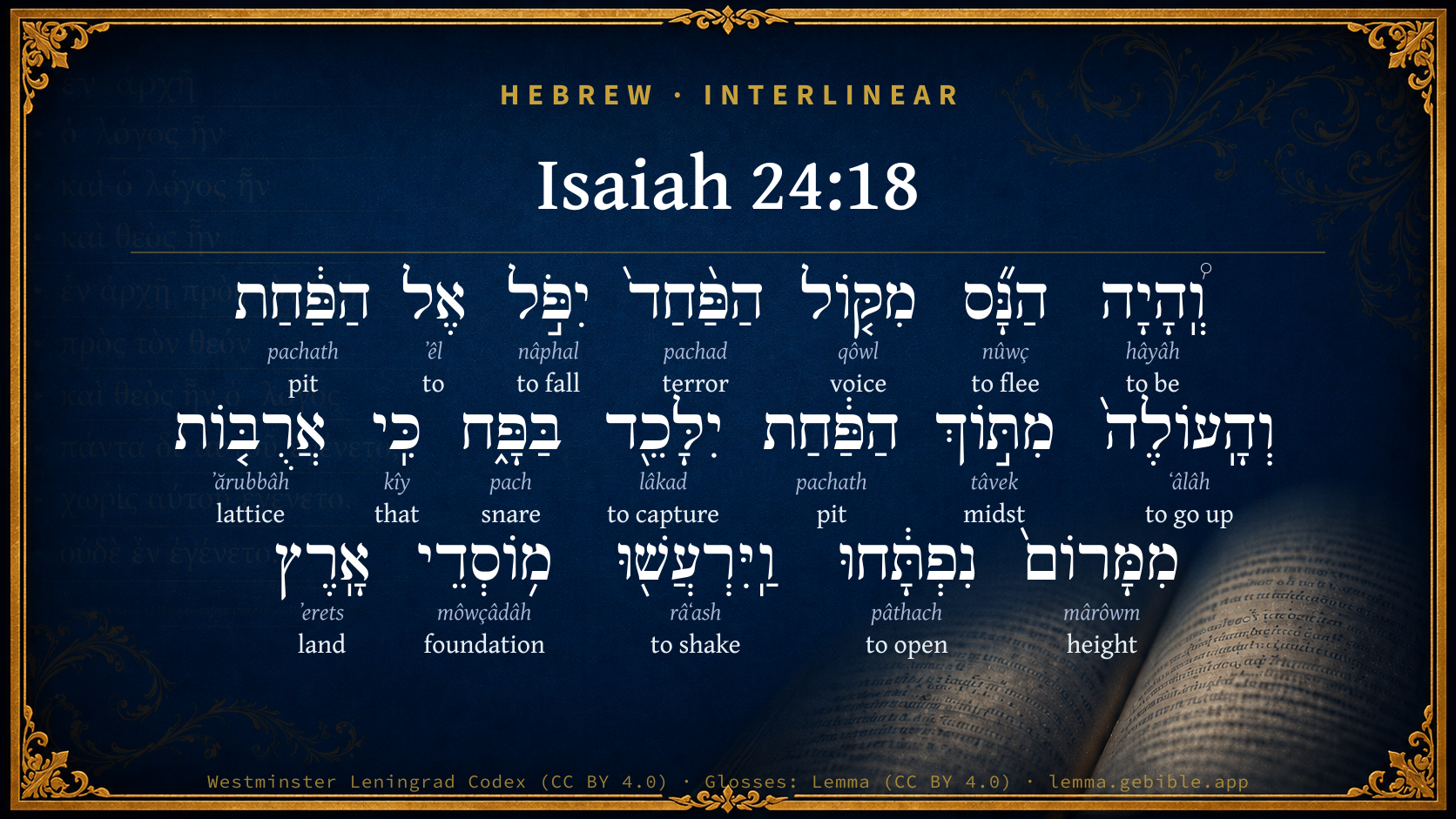
  1. וְֽ֠הָיָה hâyâh H1961 “and · to be” Conjunction + Verb, Qal, Sequential Perfect, 3rd Person, Masculine, Singular
  2. הַנָּ֞ס nûwç H5127 “the · fleeing” Particle, Definite Article + Verb, Qal, Participle Active, Masculine, Singular, Absolute
  3. מִקּ֤וֹל qôwl H6963 “from · voice of” Preposition + Noun, Common, Masculine, Singular, Construct
  4. הַפַּ֨חַד֙ pachad H6343 “the · terror” Particle, Definite Article + Noun, Common, Masculine, Singular, Absolute
  5. יִפֹּ֣ל nâphal H5307 “to fall” Verb, Qal, Imperfect, 3rd Person, Masculine, Singular
  6. אֶל ʼêl H413 “to” Preposition
  7. הַפַּ֔חַת pachath H6354 “the · pit” Particle, Definite Article + Noun, Common, Masculine, Singular, Absolute
  8. וְהָֽעוֹלֶה֙ ʻâlâh H5927 “and · the · going up” Conjunction + Particle, Definite Article + Verb, Qal, Participle Active, Masculine, Singular, Absolute
  9. מִתּ֣וֹךְ tâvek H8432 “from · midst of” Preposition + Noun, Common, Masculine, Singular, Construct
  10. הַפַּ֔חַת pachath H6354 “the · pit” Particle, Definite Article + Noun, Common, Masculine, Singular, Absolute
  11. יִלָּכֵ֖ד lâkad H3920 “to capture” Verb, Niphal, Imperfect, 3rd Person, Masculine, Singular
  12. בַּפָּ֑ח pach H6341 “in/at the · snare” Preposition, Determined + Noun, Common, Masculine, Singular, Absolute
  13. כִּֽי kîy H3588 “that” Conjunction
  14. מִמָּרוֹם֙ mârôwm H4791 “from · height” Preposition + Noun, Common, Masculine, Singular, Absolute
  15. נִפְתָּ֔חוּ pâthach H6605 “to open” Verb, Niphal, Perfect, 3rd Person, Common, Plural
  16. וַֽיִּרְעֲשׁ֖וּ râʻash H7493 “and · to shake” Conjunction + Verb, Qal, Sequential Imperfect, 3rd Person, Masculine, Plural
  17. מ֥וֹסְדֵי môwçâdâh H4146 “foundations of” Noun, Common, Both, Plural, Construct
  18. אָֽרֶץ ʼerets H776 “land” Noun, Common, Both, Singular, Absolute

About this verse

These counts appear in no published source. They are computed here, from the morphology-tagged text and Lemma’s own curated glosses. What Lemma adds →

19
words
18
distinct lemmas
Prophets
section

Notable vocabulary

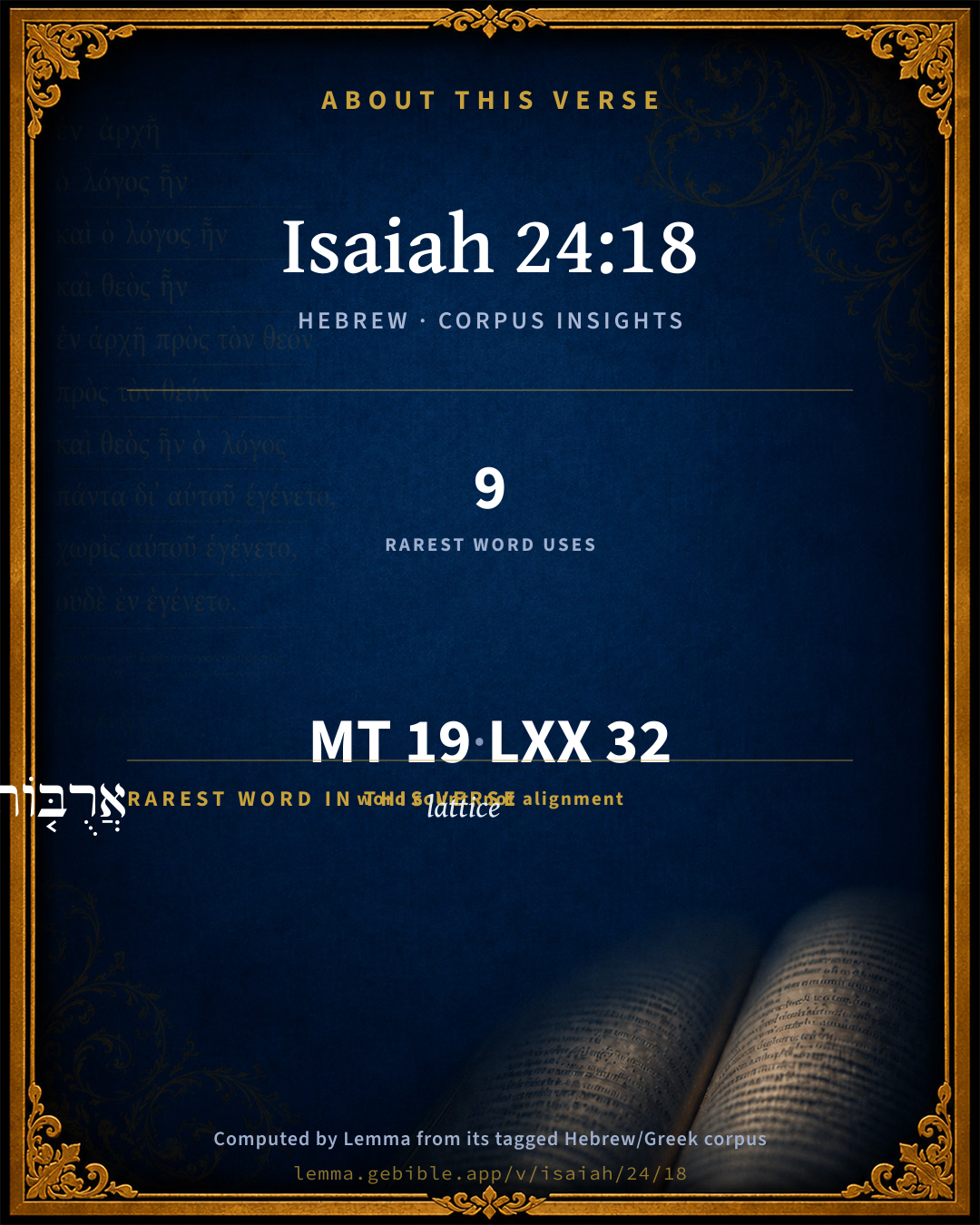
The rarest word here is אֲרֻבּ֤וֹת lattice H699 — appearing just 9 times in the whole Hebrew Bible.

Shared distinctive vocabulary

אֲרֻבּ֤וֹת lattice H699 occurs in 9 verses of the Hebrew Bible. Also found in:

Grammatical profile

  • 7 verbs
  • 10 nouns
  • 1 preposition
  • 1 conjunction

Verb forms

  • וְֽ֠הָיָה Qal · Sequential Perfect
  • הַנָּ֞ס Qal · Participle Active
  • יִפֹּ֣ל Qal · Imperfect
  • וְהָֽעוֹלֶה֙ Qal · Participle Active
  • יִלָּכֵ֖ד Niphal · Imperfect
  • נִפְתָּ֔חוּ Niphal · Perfect
  • וַֽיִּרְעֲשׁ֖וּ Qal · Sequential Imperfect

Repetition

A word recurs within this verse — often emphatic in Hebrew:

  • הַפַּ֔חַת pit H6354 ×2

Hebrew & Septuagint length

In English translation the verse runs 50 words from the Hebrew and 49 from the Septuagint (LXX English) — closely comparable.

A rough comparison of the two English renderings, which tokenize alike — not a word-level alignment.

Word counts can differ between the Hebrew and the Greek without any difference in meaning — e.g. the Hebrew direct-object marker אֵת has no separate Greek word, and Greek often adds the article ὁ.

In the original languages it is 19 Hebrew tokens and 32 Greek tokens — but the two are counted differently (Hebrew bundles its prefixes and suffixes into one token; the Greek is in lemma form), so that isn’t a like-for-like length.

Cross-references

12

Topical passages linked to Isaiah 24:18 in the Treasury of Scripture Knowledge — connected by theme and wording, ordered by reader-vote popularity; previews shown in the World English Bible.

  • Genesis 7:11 In the six hundredth year of Noah's life, in the second month, on the seventeenth day of the month, on the same day all the fountains of the great deep were burst open, and the sky's windows were opened.
  • Psalms 18:7 Then the earth shook and trembled. The foundations also of the mountains quaked and were shaken, Because he was angry.
  • Joshua 10:10–11 Yahweh confused them before Israel, and he killed them with a great slaughter at Gibeon, and chased them by the way of the ascent of Beth Horon, and struck them to Azekah, and to Makkedah.
  • Job 20:24 He shall flee from the iron weapon. The bronze arrow shall strike him through.
  • Psalms 18:15 Then the channels of waters appeared, The foundations of the world were laid bare at your rebuke, Yahweh, At the blast of the breath of your nostrils.
  • Psalms 46:2–3 Therefore we won't be afraid, though the earth changes, Though the mountains are shaken into the heart of the seas;
  • Amos 5:19 As if a man fled from a lion, And a bear met him; Or he went into the house and leaned his hand on the wall, And a snake bit him.
  • Genesis 19:24 Then Yahweh rained on Sodom and on Gomorrah sulfur and fire from Yahweh out of the sky.
  • Deuteronomy 32:22–26 For a fire is kindled in my anger, Burns to the lowest Sheol, Devours the earth with its increase, Sets on fire the foundations of the mountains.
  • 1 Kings 20:29–30 They encamped one over against the other seven days. So it was, that in the seventh day the battle was joined; and the children of Israel killed of the Syrians one hundred thousand footmen in one day.
  • 2 Kings 7:2 Then the captain on whose hand the king leaned answered the man of God, and said, Behold, if Yahweh should make windows in heaven, might this thing be? He said, Behold, you shall see it with your eyes, but shall not eat of it.
  • Job 18:8–16 For he is cast into a net by his own feet, And he wanders into its mesh.

Cross-references courtesy of OpenBible.info (CC BY 4.0).

Hebrew and Greek witnesses Masoretic Hebrew ↔ Greek Septuagint

The same verse in the two great witnesses to the Old Testament, shown verse-for-verse.

These are two independent witnesses, not word-aligned to each other, and the Septuagint is shown in lemma (dictionary) form.

Hebrew Isaiah 24:18 Masoretic · Westminster Leningrad Codex

וְֽ֠הָיָה הַנָּ֞ס מִקּ֤וֹל הַפַּ֨חַד֙ יִפֹּ֣ל אֶל הַפַּ֔חַת וְהָֽעוֹלֶה֙ מִתּ֣וֹךְ הַפַּ֔חַת יִלָּכֵ֖ד בַּפָּ֑ח כִּֽי אֲרֻבּ֤וֹת מִמָּרוֹם֙ נִפְתָּ֔חוּ וַֽיִּרְעֲשׁ֖וּ מ֥וֹסְדֵי אָֽרֶץ

It shall happen, that he who flees from the noise of the fear shall fall into the pit; and he who comes up out of the midst of the pit shall be taken in the snare: for the windows on high are opened, and the foundations of the earth tremble.

World English Bible · Public Domain

Greek LXX Isaiah 24:18 Septuagint · lemma form

καί εἰμί ὁ φεύγω ὁ φόβος ἐνπίπτω εἰς ὁ βόθυνος ὁ δέ ἐκβαίνω ἐκ ὁ βόθυνος ἁλίσκω ὑπό ὁ παγίς ὅτι θυρίς ἐκ ὁ οὐρανός ἀναοἴγω καί σείω ὁ θεμέλιον ὁ γῆ

And it shall come to pass, that he that flees from the fear shall fall into the pit; and he that comes up out of the pit shall be caught by the snare: for windows have been opened in heaven, and the foundations of the earth shall be shaken,

LXX2012 (modern English Septuagint) · Public Domain

On this verse, Adam Clarke's Commentary discusses the Septuagint’s reading. Read the note in Commentary ↓

Hebrew: Westminster Leningrad Codex (CC BY 4.0). Greek: Septuagint (public domain); English from LXX2012 (modern English Septuagint) (Public Domain). How the Septuagint differs from the Hebrew →

Targum (Aramaic paraphrase)

1

The Targum is the ancient Jewish Aramaic paraphrase of the Hebrew Scriptures — an interpretive translation, not the Hebrew text itself. Onkelos (literal) and Pseudo-Jonathan (expansive) render the Torah, and Jonathan the Prophets. Coverage is partial: where no permissively-licensed English translation exists for a verse, only the Aramaic is shown. This is verse-level text, not a word-by-word alignment to the Hebrew.

  1. Targum Jonathan Prophets (Joshua–Malachi)
    וִיהֵי דְיֶעֱרוֹק מִן קֳדָם דַחֲלָא יִפּוֹל לְגוֹ כּוּמְצָא וְדִיַסֵק מִגוֹ כּוּמְצָא יִתְאַחַד בִּסְרִיגְתָּא אֲרֵי גְבוּרָן בִּשְׁמַיָא אִתְעֲבִידָא וְזָעוּ יְסוֹדֵי אַרְעָא:

    And it shall come to pass, that he who fleeth from before the terror, he shall fall into the midst of the pit; and he that cometh up out of the midst of the pit shall be taken in the snare: for mighty works are done in the heavens, therefore the foundations of the earth quake.

    Targum Jonathan — Aramaic: “Mikraot Gedolot” (public domain). English: “Sefaria Community Translation” (CC0 1.0 (public-domain dedication)); “London "Chaldee Paraphrase," 1871” (public domain). Text via Sefaria.

Commentary

Notes on Isaiah 24:18 from classic Christian and Jewish commentators (each source and its license shown beneath its notes). The classic Christian expositions comment on the surrounding passage and are grouped to its opening verse, so a note may address several verses; the Jewish commentaries on the Tanakh (Rashi and others) are per-verse, so they appear only where the commentator wrote on this verse.

Lemma curates 59 commentaries, every one of them public domain or Creative Commons licensed, each selected and text-cleaned for this edition rather than reprinted as found. About our sources →

Trapp's Complete Commentary

John Trapp

Isa 24:18 And it shall come to pass, [that] he who fleeth from the noise of the fear shall fall into the pit; and he that cometh up out of the midst of the pit shall be taken in the snare: for the windows from on high are open, and the foundations of the earth do shake.

Ver. 18. He who fleeth from the noise of the fear.] See Amo 5:19. {See Trapp on "Amo 5:19"} And learn to fear God, the stroke of whose arm none may think to escape.

For the windows from on high are opened.] The cataract or sluices of the clouds, as once in the general deluge.

The foundations of the earth do shake.] Heaven and earth shall fight against them, and conspire to mischieve them.

John Trapp, A Commentary or Exposition upon All the Books of the Old and New Testament (1647–1656) — public domain. Text from a community e-Sword module.

The Biblical Illustrator

Joseph S. Exell

Isa_24:18-20

The foundations of the earth do shake

The religious improvement of earthquakes

(preached in 1756):--The works of Creation and Providence were undoubtedly intended for the notice and contemplation of mankind, especially when God comes out of His place, that is, departs from the usual and stated course of His providence to punish the inhabitants of the earth for their iniquities; then it becomes us to observe the operation of His hands with fear and reverence.

To this the Psalmist repeatedly calls us: Come, behold the works of the Lord, what desolations He hath made in the earth. Come, and see the works of God; He is terrible in His doing toward the children of men. This world is a state of discipline for another; therefore chastisements of various kinds and degrees are to be enumerated among the ordinary works of Providence--pain, sickness, losses, bereavements, disappointments. But when these are found too weak and ineffectual for their reformation; or when, from their being so frequent and common, men begin to think them things of course, and not to acknowledge the Divine hand in them; then the universal Ruler uses such signal and extraordinary executioners of His vengeance, as cannot but rouse a slumbering world, and render it sensible of His agency. These extraordinary ministers of His vengeance are generally these four: the Famine, Sword, Pestilence, and Earthquakes.

I. Let the majestic and terrible phenomenon of earthquakes put you in mind of THE MAJESTY AND POWER OF GOD AND THE DREADFULNESS OF HIS DISPLEASURE.

II. This desolating judgment may justly lead you to reflect upon THE SINFULNESS OF OUR WORLD.

III. This melancholy event may carry your minds gratefully to reflect upon THE PECULIAR KINDNESS OF HEAVEN towards our country, in that it was not involved in the same destruction.

IV. That which I would particularly suggest to your thoughts from the devastations of the late earthquake, is THE LAST UNIVERSAL DESTRUCTION OF OUR WORLD AT THE FINAL JUDGMENT. Of this, an earthquake is both a confirmation to human reason, and a lively representation (S. Davies, M. A.)

Removed like a cottage

(Isa_24:20):--Swayeth to and fro like a hammock. Such is the more literal rendering. The hammock (the same word as in Isa_1:8) is still used throughout the East by the night-watchers of vineyards. (Sir E. Strachey, Bart.)

.

The Biblical Illustrator, edited by Joseph S. Exell (c. 1880s–1900s) — public domain. Text from a community e-Sword module.

Tyndale Open Study Notes

Tyndale Open Resources

24:18 No one can escape the day of the Lord (see study note on 2:5-22). • Destruction falls like rain from the heavens (literally the floodgates of heaven are opened): The imagery is like the flood in Noah’s time (see study note on Gen 7:11-12). • the foundations of the earth shake: An earthquake is characteristic of a theophany, a physical manifestation of God’s presence (see also Isa 6:4; 13:13; 19:1).

Tyndale Open Study Notes — © Tyndale Open Resources, licensed CC BY-SA 4.0. Text via the HelloAO Bible API.

Geneva Bible (1599)

Geneva Bible translators

Meaning, that God’s wrath and vengeance should be over and under them: so that they should not escape no more than they did at Noah’s flood.

Geneva Bible (1599) marginal notes — public domain. Text via Bolls.life.

Jamieson, Fausset & Brown

Robert Jamieson, A. R. Fausset & David Brown

noise of . . . fear--the shout designed to rouse the game and drive it into the pitfall.

windows . . . open--taken from the account of the deluge (Gen 7:11); the flood-gates. So the final judgments of fire on the apostate world are compared to the deluge (Pe2 3:5-7).

Jamieson, Fausset & Brown — Commentary Critical and Explanatory on the Whole Bible (1871) — public domain (CC PDM 1.0). Text via the HelloAO Bible API.

Adam Clarke's Commentary

Verse 18. Out of the midst of the pit - "From the pit"] For מתוך mittoch, from the midst of, a MS. reads מן min, from, as it is in Jer 48:44; and so likewise the Septuagint, Syriac, and Vulgate.

Adam Clarke's Commentary on the Bible (1810–1826) — public domain. Text from a community e-Sword/MySword module.

Ellicott's Commentary for English Readers

(18) The windows from on high are open . . .—The phrase reminds us of the narrative of the Flood in Gen_7:11; Gen_8:2. There was a second judgment on the defiled and corrupted land like that of the deluge. The next clause and the following verses were probably reminiscences of the earthquake in Uzziah’s reign, and of the panic which it caused (Isa_2:19; Amo_1:1; Zec_14:5).

A Bible Commentary for English Readers, edited by Charles John Ellicott (1878–1897) — public domain. Text from a community e-Sword module.

John Gill's Exposition

The earth is utterly broken down,.... Still alluding to the deluge, when the earth broke in upon the waters under it, if Mr. Burnet's theory of the earth can be supported:

the earth is clean dissolved; it will be an entire dissolution, nothing shall remain; all these things, as Peter says, the heavens and the earth, and all in them, shall be dissolved, Pe2 3:11,

the earth is moved exceedingly; out of its place and form, and shall fall into its original chaos and confusion. The Targum is,

"moving, the earth shall be moved; agitating, the earth shall be agitated; breaking or dissolving, the earth shall be broken or dissolved;''

which seems to express the more gradual and natural dissolution of the world. These expressions are used, and repeated, to declare the certain and complete destruction of it.

John Gill's Exposition of the Whole Bible (1746–1763) — public domain (CC PDM 1.0). Text via the HelloAO Bible API.

Albert Barnes' Notes on the Bible

From the noise of the fear - A cry or shout was made in hunting, designed to arouse the game, and drive it to the pitfall. The image means here that calamities would be multiplied in all the land, and that if the inhabitants endeavored to avoid one danger they would fall into another.

And he that cometh up out of the midst of the pit - A figure taken still from hunting. It was possible that some of the more strong and active of the wild beasts driven into the pitfall would spring out, and attempt to escape, yet they might be secured by snares or gins purposely contrived for such an occurrence. So the prophet says, that though a few might escape the calamities that would at first threaten to overthrow them, yet they would have no security. They would immediately fall into others, and be destroyed.

For the windows on high are open - This is evidently taken from the account of the deluge in Gen 7:11 : ‘In the six hundredth year of Noah’s life, in the second month, the seventeenth day of the month, the same day were all the fountains of the great deep broken up, and the windows (or flood-gates, Margin) of heaven were opened.’ The word ‘windows’ here (ארבות 'ărubôth) is the same which occurs in Genesis, and properly denotes a grate, a lattice, a window, and then any opening, as a sluice or floodgate, and is applied to a tempest or a deluge, because when the rain descends, it seems like opening sluices or floodgates in the sky. The sense here is, that calamities had come upon the nation resembling the universal deluge.

And the foundations of the earth do shake - An image derived from an earthquake - a figure also denoting far-spreading calamities.

Albert Barnes' Notes on the Bible (1834–1885) — public domain. Text from a community e-Sword/MySword module.

Haydock's Catholic Bible Commentary

CHAPTER XXIV.

George Leo Haydock (1774–1849), Haydock's Catholic Family Bible and Commentary, 1859 edition — public domain. Excludes Psalms (Douay-Rheims chapter numbering differs from Protestant) and Deuterocanonical books (Catholic canon only).

Matthew Poole's English Annotations

He who fleeth from the noise of the fear; upon the report of some terrible evil coming towards him; the act, fear, being here put for the object, or the thing feared, as it is in many places. And thus this very phrase is taken Job 15:21.

Shall fall into the pit; when he designs to avoid one danger, by so doing he shall plunge himself into another and a greater mischief.

The windows from on high are opened, and the foundations of the earth do shake; both heaven and earth conspire against him. He alludes to the deluge of waters which God poured down from heaven, and to the earthquakes which he ofttimes causeth below.

Matthew Poole's English Annotations on the Holy Bible (1683–1685) — public domain. Text from a community e-Sword/MySword module.

The Pulpit Commentary

The noise of the fear; i.e. the sound of the pursuers. Hunters pursued their game with shouts and cries. The windows from on high are open. (comp. Gen_7:11) It is not actually another flood that is threatened, but it is a judgment as sweeping and destructive as the Flood.

The Pulpit Commentary (1880–1919), ed. H.D.M. Spence-Jones & Joseph S. Exell — public domain. Text from a community e-Sword module.

John Wesley's Explanatory Notes

Fleeth - Upon the report of some terrible evil. The foundations - Both heaven and earth conspire against him. He alludes to the deluge of waters which God poured down from heaven, and to the earthquakes which he often causes below.

John Wesley, Explanatory Notes Upon the Whole Bible (1754–1765) — public domain. Text via the GEBible commentary corpus.

J. A. Alexander on Isaiah

Joseph Addison Alexander

“And it shall be (that) the (one) flying from the voice of the fear shall fall into the pit, and the (one) coming up from the midst of the pit shall be taken in the snare; for windows from on high are opened, and the foundations of the earth are shaken.” The first clause carries out the figures of the foregoing verse; the second introduces those of a deluge and an earthquake. The allusion to the flood is acknowledged by almost all writers, and is rendered certain by the resemblance of the language to that used in Gen 7:11.

Joseph Addison Alexander, The Prophecies of Isaiah (1846–1847; New York: Scribner, 1870–1878) — public domain. Text from a community e-Sword module.

Rashi

Rabbi Shlomo Yitzchaki (Rashi)

he who flees from the sound of the fright shall fall into the pit. etc. Whoever escapes the sword of the Messiah the son of Joseph shall fall into the sword of the Messiah the son of David, and whoever escapes from there shall be snared in the trap of the wars of Gog.

Rashi on the Tanakh — English translations: “The Judaica Press complete Tanach with Rashi, translated by A. J. Rosenberg” (CC BY 4.0); “Pentateuch with Rashi's commentary by M. Rosenbaum and A.M. Silbermann, 1929-1934” (public domain); “The Metsudah Tanach series, Lakewood, N.J” (CC BY 4.0); and “The Book of Joshua, Metsudah Publications, 1997” (CC BY 4.0). Text via Sefaria.

Ibn Ezra

Rabbi Abraham ibn Ezra

Windows from on high, etc. A figure for decrees of the Lord.

Ibn Ezra on the Tanakh — English translations: “Sefaria Community Translation” (CC0 1.0 (public-domain dedication)); “Yalkut, Sifsei Chachomim Chumash, Metsudah Publications, 2009” (CC BY 4.0); and “Commentary of Ibn Ezra on Isaiah - trans. by M. Friedlander, 1873” (public domain). Text via Sefaria.

Lesson kit

Teaching starters — assembled from the data on this page, not authored interpretation. Every prompt links to the verse data it draws on. Edit before teaching.

Isaiah, in the Prophets, opens this verse with 19 words (18 distinct Hebrew lemmas). Its most distinctive word is ʼărubbâh (“lattice”). A historical commentator’s framing appears above. Read the whole chapter for the surrounding context.

Discussion questions

  1. The word ʼărubbâh carries the sense “lattice.” How does it shape the verse?
  2. Genesis 7:11 shares the word «lattice» with this verse. How do the two illuminate each other?
  3. “pit” occurs 2× in this one verse. What is the effect of the repetition?
  4. These translations render this verse differently; the difference is in the English rendering, not the original. What questions does that raise?
  5. The verb «וְֽ֠הָיָה» is Qal Sequential Perfect. How does its form color the action?
  6. Reading how Trapp's Complete Commentary and The Biblical Illustrator read this verse, where do the two commentators agree and where do they part?

Things to notice

Reading settings

Reading text

Shown beneath each verse's original-language words.

Old Testament
Old Testament edition

Read the OT as the Masoretic Hebrew (MT) or the Greek Septuagint (LXX).

English shown for the Greek Septuagint (in the Hebrew ↔ Greek comparison).

Comparing translations? Open the Compare panel on any verse page to stack up to four side by side.