Judges 5:27

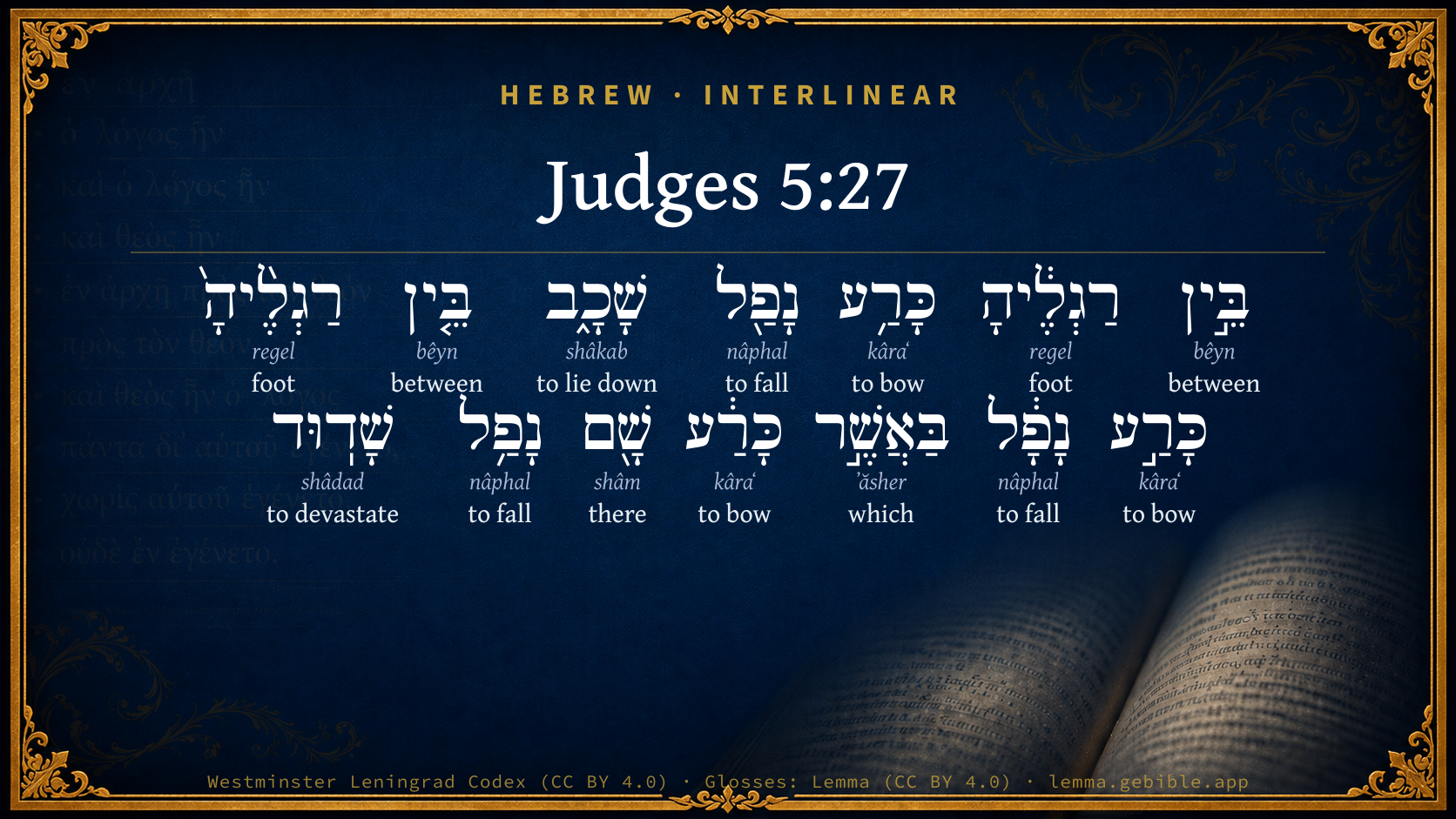
Hebrew (Westminster Leningrad Codex) Judges 5:27 appears in the Hebrew Old Testament. The text above is from the Westminster Leningrad Codex. Each word links to its Strong’s number, a concise gloss, and parsing drawn from the Open Scriptures Hebrew Bible morphology. Click any word for its full Brown-Driver-Briggs (BDB) entry.
Download image
Cite this verse

Judges 5:27 (World English Bible). Public Domain. Lemma interlinear Bible study tool, https://lemma.gebible.app/v/judges/5/27.

Show BibTeX & RIS
BibTeX
RIS
English Translation
At her feet he bowed, he fell, he lay; At her feet he bowed, he fell; Where he bowed, there he fell down dead.
World English Bible · Public Domain
Highlights
  • 1 first appearance in the Hebrew Bible
Full analysis ↓
Download a study sheet

One document with this verse’s original text, its word-by-word gloss line, the meaning frame, cross-references with their text, attributed commentary, and full source and license credits — printable, and it pastes into notes with its structure intact.

This verse Autodidact and up

Study sheet (.html) Plain text (.txt)

A passage Seminary Student

Up to 50 verses in one chapter. A passage sheet keeps up to 6 commentary sources and 12 cross-references per verse, in the order this page ranks them, and says so on the sheet whenever that leaves anything out. Ask for a single verse and you get the Autodidact verse sheet above.

Everything on this page stays free to read, with no account — the sheet is a download of what is already on screen, not access to it.

Want to remove ads? Support Godless Engineer
Compare translations 3

The same verse in 3 English versions, stacked beneath the original-language interlinear above. Click any original word for its lexicon entry.

Each is an independent rendering of the whole verse — the interlinear is not word-aligned to these translations.

Highlighted words mark where these versions differ — a whole-verse word diff, not a word-by-word alignment.

  • World English Bible Public Domain
    At her feet he bowed, he fell, he lay; At her feet he bowed, he fell; Where he bowed, there he fell down dead.
  • King James Version Public Domain
    At her feet he bowed, he fell, he lay down: at her feet he bowed, he fell: where he bowed, there he fell down dead.
  • unfoldingWord Literal Text CC BY-SA 4.0
    Between her feet, he bowed, he fell, he lay down. Between her feet he bowed, he fell. At where he bowed, there he fell, destroyed.

unfoldingWord Literal Text — © unfoldingWord, licensed CC BY-SA 4.0. Word-aligned USFM3 via Door43 (git.door43.org/unfoldingWord/en_ult).

Versions to compare (up to 4)

3 of 4 selected

Show all 18 translations

Every available English version of this verse, each an independent rendering of the whole verse.

  • World English Bible Public Domain
    At her feet he bowed, he fell, he lay; At her feet he bowed, he fell; Where he bowed, there he fell down dead.
  • Berean Standard Bible Public Domain
    At her feet he collapsed, he fell, there he lay still; at her feet he collapsed, he fell; where he collapsed, there he fell dead.
  • Majority Standard Bible Public Domain
    At her feet he collapsed, he fell, there he lay still; at her feet he collapsed, he fell; where he collapsed, there he fell dead.
  • King James Version Public Domain
    At her feet he bowed, he fell, he lay down: at her feet he bowed, he fell: where he bowed, there he fell down dead.
  • American Standard Version (1901) Public Domain
    At her feet he bowed, he fell, he lay; At her feet he bowed, he fell; Where he bowed, there he fell down dead.
  • Revised Version (1885) Public Domain
    At her feet he bowed, he fell, he lay: at her feet he bowed, he fell: where he bowed, there he fell down dead.
  • Geneva Bible (1599) Public Domain
    He bowed him downe at her feete, he fell downe, and lay still: at her feete hee bowed him downe, and fell: and when he had sunke downe, he lay there dead.
  • Douay-Rheims (1899) Public Domain
    At her feet he fell: he fainted, and he died: he rolled before her feet, and he lay lifeless and wretched.
  • Young's Literal Translation Public Domain
    Between her feet he bowed -- He fell, he lay down; Between her feet he bowed, he fell; Where he bowed, there he fell -- destroyed.
  • Literal Standard Version CC BY-SA 4.0
    He bowed between her feet—He fell, he lay down; He bowed between her feet, he fell; Where he bowed, there he fell—destroyed.
  • Unlocked Literal Bible CC BY-SA 4.0
    He collapsed between her feet, he fell and he lay there. Between her feet he fell limp. The place he collapsed is where he was violently killed.
  • unfoldingWord Literal Text CC BY-SA 4.0
    Between her feet, he bowed, he fell, he lay down. Between her feet he bowed, he fell. At where he bowed, there he fell, destroyed.
  • Darby Bible Public Domain
    He sank, he fell, he lay still at her feet; at her feet he sank, he fell; where he sank, there he fell dead.
  • World Messianic Bible Public Domain
    At her feet he bowed, he fell, he lay. At her feet he bowed, he fell. Where he bowed, there he fell down dead.
  • Webster's Bible Public Domain
    At her feet he bowed, he fell, he lay down: at her feet he bowed, he fell: where he bowed, there he fell down dead.
  • Free Bible Version CC BY-SA 4.0
    At her feet he collapsed, he fell, he lay motionless. At her feet he collapsed, he fell; where he collapsed, there he fell, his life plundered from him.
  • Bible in Basic English Public Domain
    Bent at her feet he went down, he was stretched out; bent at her feet he went down; where he was bent down, there he went down in death.
  • JPS Tanakh (1917) Public Domain
    At her feet he sunk, he fell, he lay; at her feet he sunk, he fell; where he sunk, there he fell down dead.

Literal Standard Version (2020), Covenant Press — licensed CC BY-SA 4.0. Text via the HelloAO Bible API (eBible.org). Unlocked Literal Bible (unfoldingWord) — licensed CC BY-SA 4.0. Text via the HelloAO Bible API (eBible.org). unfoldingWord Literal Text — © unfoldingWord, licensed CC BY-SA 4.0. Word-aligned USFM3 via Door43 (git.door43.org/unfoldingWord/en_ult). Free Bible Version, Dr. Jonathan Gallagher — licensed CC BY-SA 4.0. Text via the HelloAO Bible API (eBible.org).

Word by word

More ways to search: Search by grammar → Find every occurrence → Compare this word →

Practice this passage: Drill this verse → Learn its vocabulary →

כָּרַ֥ע
kâraʻ
H3766
“to bow”
Verb, Qal, Perfect, 3rd Person, Masculine, Singular
Part of Speech
Verb
Stem
Qal
Form
Perfect
Person
3rd Person
Gender
Masculine
Number
Singular
Full BDB Definition

Origin: a primitive root

TWOT: 1044

to bend, kneel, bow, bow down, sink down to one's knees, kneel down to rest (of animals), kneel in reverence - (Qal) - to bow - to bow down, crouch - to bow down over - to tilt, lean - (Hiphil) to cause to bow
  1. בֵּ֣ין bêyn H996 “between” Preposition
  2. רַגְלֶ֔יהָ regel H7272 “feet · her” Noun, Common, Feminine, Dual, Construct + Suffix, Personal, 3rd Person, Feminine, Singular
  3. נָפַ֖ל nâphal H5307 “to fall” Verb, Qal, Perfect, 3rd Person, Masculine, Singular
  4. שָׁכָ֑ב shâkab H7901 “to lie down” Verb, Qal, Perfect, 3rd Person, Masculine, Singular
  5. בֵּ֤ין bêyn H996 “between” Preposition
  6. רַגְלֶ֨יהָ֙ regel H7272 “feet · her” Noun, Common, Feminine, Dual, Construct + Suffix, Personal, 3rd Person, Feminine, Singular
  7. כָּרַ֣ע kâraʻ H3766 “to bow” Verb, Qal, Perfect, 3rd Person, Masculine, Singular
  8. נָפָ֔ל nâphal H5307 “to fall” Verb, Qal, Perfect, 3rd Person, Masculine, Singular
  9. בַּאֲשֶׁ֣ר ʼăsher H834 “in/at · which” Preposition + Particle, Relative
  10. כָּרַ֔ע kâraʻ H3766 “to bow” Verb, Qal, Perfect, 3rd Person, Masculine, Singular
  11. שָׁ֖ם shâm H8033 “there” Adverb
  12. נָפַ֥ל nâphal H5307 “to fall” Verb, Qal, Perfect, 3rd Person, Masculine, Singular
  13. שָׁדֽוּד shâdad H7703 “devastated” Verb, Qal, Participle Passive, Masculine, Singular, Absolute

About this verse

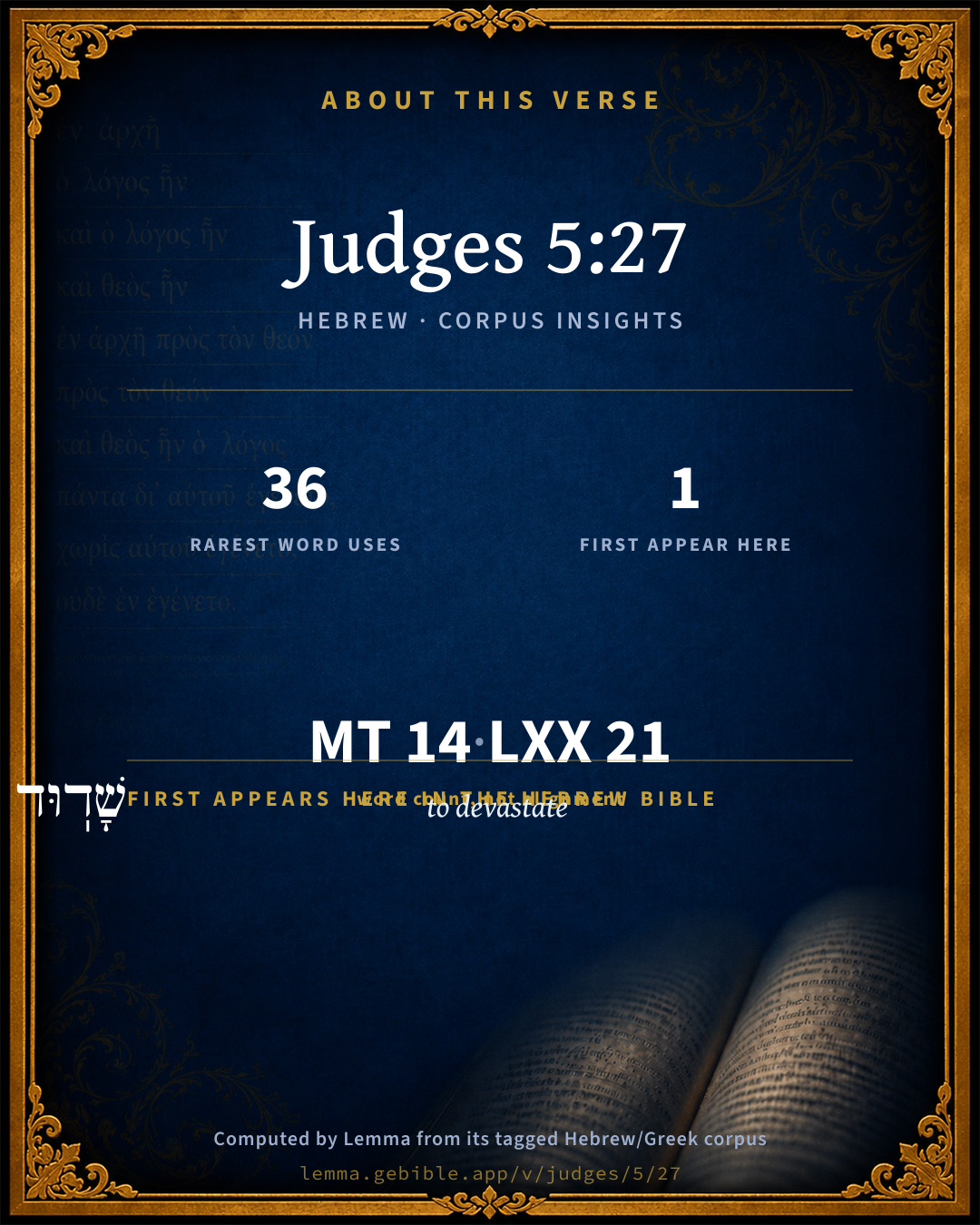
These counts appear in no published source. They are computed here, from the morphology-tagged text and Lemma’s own curated glosses. What Lemma adds →

14
words
8
distinct lemmas
Historical
section

First appearance in Scripture

This word makes its first canonical appearance in the Hebrew Bible here:

  • שָׁדֽוּד to devastate H7703

Shared distinctive vocabulary

כָּרַ֥ע to bow H3766 occurs in 32 verses of the Hebrew Bible. Also found in:

Grammatical profile

  • 8 verbs
  • 2 nouns
  • 2 prepositions
  • 1 adverb
  • 1 particle

Verb forms

  • כָּרַ֥ע Qal · Perfect
  • נָפַ֖ל Qal · Perfect
  • שָׁכָ֑ב Qal · Perfect
  • כָּרַ֣ע Qal · Perfect
  • נָפָ֔ל Qal · Perfect
  • כָּרַ֔ע Qal · Perfect
  • נָפַ֥ל Qal · Perfect
  • שָׁדֽוּד Qal · Participle Passive

Repetition

Words recur within this verse — often emphatic in Hebrew:

  • כָּרַ֥ע to bow H3766 ×3
  • נָפַ֖ל to fall H5307 ×3
  • בֵּ֣ין between H996 ×2
  • רַגְלֶ֔יהָ foot H7272 ×2

Hebrew & Septuagint length

In English translation the verse runs 24 words from the Hebrew and 24 from the Septuagint (LXX English) — the same length.

A rough comparison of the two English renderings, which tokenize alike — not a word-level alignment.

Word counts can differ between the Hebrew and the Greek without any difference in meaning — e.g. the Hebrew direct-object marker אֵת has no separate Greek word, and Greek often adds the article ὁ.

In the original languages it is 14 Hebrew tokens and 21 Greek tokens — but the two are counted differently (Hebrew bundles its prefixes and suffixes into one token; the Greek is in lemma form), so that isn’t a like-for-like length.

Cross-references

3

Topical passages linked to Judges 5:27 in the Treasury of Scripture Knowledge — connected by theme and wording, ordered by reader-vote popularity; previews shown in the World English Bible.

  • Psalms 52:7 "Behold, this is the man who didn't make God his strength, But trusted in the abundance of his riches, And strengthened himself in his wickedness."
  • James 2:13 For judgment is without mercy to him who has shown no mercy. Mercy triumphs over judgment.
  • Matthew 7:2 For with whatever judgment you judge, you will be judged; and with whatever measure you measure, it will be measured to you.

Cross-references courtesy of OpenBible.info (CC BY 4.0).

Hebrew and Greek witnesses Masoretic Hebrew ↔ Greek Septuagint

The same verse in the two great witnesses to the Old Testament, shown verse-for-verse.

These are two independent witnesses, not word-aligned to each other, and the Septuagint is shown in lemma (dictionary) form.

Hebrew Judges 5:27 Masoretic · Westminster Leningrad Codex

בֵּ֣ין רַגְלֶ֔יהָ כָּרַ֥ע נָפַ֖ל שָׁכָ֑ב בֵּ֤ין רַגְלֶ֨יהָ֙ כָּרַ֣ע נָפָ֔ל בַּאֲשֶׁ֣ר כָּרַ֔ע שָׁ֖ם נָפַ֥ל שָׁדֽוּד

At her feet he bowed, he fell, he lay; At her feet he bowed, he fell; Where he bowed, there he fell down dead.

World English Bible · Public Domain

Greek LXX Judges 5:27 Septuagint · lemma form

ἀνά μέσος ὁ πούς αὐτός κατακυλίω πίπτω καί κοιμάω ἀνά μέσος ὁ πούς αὐτός κατακλίνω πίπτω καθώς κατακλίνω ἐκεῖ πίπτω ἐκὁδεύω

He rolled down between her feet; he fell and lay between her feet; he bowed and fell: where he bowed, there he fell dead.

LXX2012 (modern English Septuagint) · Public Domain

On this verse, Trapp's Complete Commentary discusses the Septuagint’s reading. Read the note in Commentary ↓

Hebrew: Westminster Leningrad Codex (CC BY 4.0). Greek: Septuagint (public domain); English from LXX2012 (modern English Septuagint) (Public Domain). How the Septuagint differs from the Hebrew →

Targum (Aramaic paraphrase)

1

The Targum is the ancient Jewish Aramaic paraphrase of the Hebrew Scriptures — an interpretive translation, not the Hebrew text itself. Onkelos (literal) and Pseudo-Jonathan (expansive) render the Torah, and Jonathan the Prophets. Coverage is partial: where no permissively-licensed English translation exists for a verse, only the Aramaic is shown. This is verse-level text, not a word-by-word alignment to the Hebrew.

  1. Targum Jonathan Prophets (Joshua–Malachi)
    בֵּין רִגְלָהָא כְּרַע נְפַל שְׁכִיב בֵּין רִגְלָהָא כְּרַע נְפַל בַּאֲתַר דִכְרַע תַּמָן נְפַל בְּזִיזָא סִיסְרָא:

    (no public-domain English translation for this verse)

    Targum Jonathan — Aramaic: “Mikraot Gedolot” (public domain). English: “Sefaria Community Translation” (CC0 1.0 (public-domain dedication)); “London "Chaldee Paraphrase," 1871” (public domain). Text via Sefaria.

Commentary

Notes on Judges 5:27 from classic Christian and Jewish commentators (each source and its license shown beneath its notes). The classic Christian expositions comment on the surrounding passage and are grouped to its opening verse, so a note may address several verses; the Jewish commentaries on the Tanakh (Rashi and others) are per-verse, so they appear only where the commentator wrote on this verse.

Lemma curates 59 commentaries, every one of them public domain or Creative Commons licensed, each selected and text-cleaned for this edition rather than reprinted as found. About our sources →

Trapp's Complete Commentary

John Trapp

Jdg 5:27 At her feet he bowed, he fell, he lay down: at her feet he bowed, he fell: where he bowed, there he fell down dead.

Ver. 27. At her feet he bowed, he fell.] He was soon despatched, and could never tell who hurt him. There now lies the greatness of Sisera: he that had vaunted of his iron chariots, is slain by a woman with one nail of iron.

There he fell down dead.] Heb., Destroyed; dead as a door nail, as we say, ταλαιπωρος, miserable, as the Septuagint renders it. Thrice he essayed to rise, but bowed down thrice, and fell again. So did a better man than he, Huldericus Zuinglius, when slain in battle; but he could say what Sisera could not, Age, corpus quidem occidere possunt, animum non possunt. Well, the enemies may kill my body, but cannot come at my soul. {a}

{a} Scultet, Annal., p. 348.

John Trapp, A Commentary or Exposition upon All the Books of the Old and New Testament (1647–1656) — public domain. Text from a community e-Sword module.

Joseph Benson's Commentary

Jdg 5:27. At her feet he bowed, &c. — This verse is considered by many as a description of the struggles of Sisera after he was wounded; but perhaps it may only be a relation of his lying down to sleep quite spent with fatigue, from which he never rose again. For it is expressly said, (Jdg 4:21,) that Jael smote the nail quite through his temples, so as to fasten him to the ground; from whence there is great reason to conclude that the blow was instantaneously fatal, and that he never struggled nor stirred. This verse is thus translated by Dr. Kennicott:

At her feet he bowed, he fell! At her feet he bowed, he fell!

Where he bowed, there he fell dead.

And he supposes, naturally enough, the first line to be sung by Deborah, the second by Barak, and that they both joined in singing the third. The whole verse is greatly expressive of the joy of Deborah on this occasion, and shows, in a strong light, her love for her country and people. She dwells on every circumstance with seeming pleasure; she repeats them, as it were, to enjoy the idea and contemplation of them the longer. And one would think all the enemies of Israel had perished in this one man.

Joseph Benson's Commentary on the Old and New Testaments (1811–1818) — public domain. Text from a community e-Sword module.

Geneva Bible (1599)

Geneva Bible translators

Hebrew, destroyed.

Geneva Bible (1599) marginal notes — public domain. Text via Bolls.life.

Adam Clarke's Commentary

Verse 27. At her feet he bowed] בין רגליה bein ragleyha, "between her feet." After having stunned him she probably sat down, for the greater convenience of driving the nail through his temples.

He bowed - he fell] He probably made some struggles after he received the blow on the head, but could not recover his feet.

AEschylus represents Agamemnon rising, staggering, and finally falling, under the blows of Clytemnestra. - Agam. v. 1384.

Adam Clarke's Commentary on the Bible (1810–1826) — public domain. Text from a community e-Sword/MySword module.

Ellicott's Commentary for English Readers

(27) At her feet.—Literally, between her feet, as though the dauntless woman had stridden over him as he lay in the dead sleep of weariness.

He bowed.—The word means that he suddenly curled up his knees in one contortion of agony.

He fell.—Rolling, perhaps, off the divan on which he was resting.

He lay down.—Motionless in death, after that one convulsive movement.

Dead.—Rather, slaughtered, or murdered. With this one terrific word the scene ends, as with a blow.

A Bible Commentary for English Readers, edited by Charles John Ellicott (1878–1897) — public domain. Text from a community e-Sword module.

The Cambridge Bible for Schools and Colleges

gen. ed. J. J. S. Perowne

27. The effect of the blow, vividly depicted in short, abrupt words; from a standing position his body collapsed; lit. ‘he dropped on his knees, fell headlong, and lay a broken wreck upon the ground.’ For he bowed cf. Jdg_7:5-6, Isa_46:1; he fell cf. 1Sa_28:20; he lay cf. Lam_2:21; dead lit. ‘destroyed,’ ‘spoiled,’ cf. Jer_4:30, Isa_33:1.

The second line, at her feet he bowed, he fell is probably an erroneous repetition from the first.

The Cambridge Bible for Schools and Colleges (gen. ed. J. J. S. Perowne; Cambridge University Press, 1878–1918) — public domain. Text from a community e-Sword module.

John Gill's Exposition

Perhaps at her first approach to him, and attempt to drive the nail, or at the blow she gave, he rose up, but she had done the business so effectually at the first stroke, that he dropped at once, and laid down his head again:

at her feet he bowed, he fell; when she redoubled her blow:

where he bowed, there he fell down dead; and struggled and stirred no more; thus ingloriously did this general of a vast army die. This action is not otherwise to be justified, but by its being done through an impulse of the Spirit of God upon her, to take away the life of an implacable enemy of God's people; otherwise it might seem to be a breach of hospitality towards her guest she had invited in, and of the peace which subsisted between this general's prince and her husband; and therefore is not to be drawn into an example where there is no appearance of a divine warrant.

John Gill's Exposition of the Whole Bible (1746–1763) — public domain (CC PDM 1.0). Text via the HelloAO Bible API.

Haydock's Catholic Bible Commentary

Wretched. Hebrew, "he expired where he fell down." (Haydock) --- Debbora represents Jahel as ready to tread the unhappy Sisara under her feet, if he should offer to stir. She thrice repeats his death.

George Leo Haydock (1774–1849), Haydock's Catholic Family Bible and Commentary, 1859 edition — public domain. Excludes Psalms (Douay-Rheims chapter numbering differs from Protestant) and Deuterocanonical books (Catholic canon only).

Matthew Poole's English Annotations

Here is a lively representation of the thing done. At the first blow or wound he was awakened, and made some attempt to rise; but being astonished and very weak, she also following her first blow with others, he found himself impotent, and fell down dead; and then she struck the nail quite through his head into the ground, as is said, Jdg 4:21.

Matthew Poole's English Annotations on the Holy Bible (1683–1685) — public domain. Text from a community e-Sword/MySword module.

Whedon's Commentary on the Bible

Daniel D. Whedon

27. He sunk down, he fell — The reference is doubtless to the supposed convulsion in which he rolled off from the low divan and fell to the floor. See note on Jdg_4:21.

Daniel D. Whedon (gen. ed.), Commentary on the Old and New Testaments (1874–1909) — public domain. Text from a community e-Sword module.

Radak

Rabbi David Kimhi (Radak)

Between her feet he sank, he lay: Such is the custom of the language to repeat the words in order to strengthen them. And the content is that he sank a sinking, from which there would be no getting up. And that is what is stated, "where he sank, there he lay - destroyed." And there is a homiletical teaching about it - though it is distant - that between [all the mentions of] sank, lay and fell, there are seven. So they said that that wicked man had sexual intercourse with Yael seven times on that day. But what they wrote above (Judges 4:18) about the word, "semikhah (blanket)," contradicts this teaching.

Radak on the Tanakh — English translations: “Sefaria Community Translation” (CC0 1.0 (public-domain dedication)); “Eliyahu Munk, HaChut Hameshulash” (CC BY 4.0); “Rabbi Mike Feuer, Jerusalem Anthology” (CC BY 4.0); and “R. David Kimhi on the first book of Psalms, Translated by R.G. Finch, London, 1919” (public domain). Text via Sefaria.

Lesson kit

Teaching starters — assembled from the data on this page, not authored interpretation. Every prompt links to the verse data it draws on. Edit before teaching.

Judges, in the Historical, opens this verse with 14 words (8 distinct Hebrew lemmas). Its most distinctive word is kâraʻ (“to bow”). A historical commentator’s framing appears above. Read the whole chapter for the surrounding context.

Discussion questions

  1. What does “to bow” (kâraʻ) contribute to the verse as a whole?
  2. The word “to devastate” first appears here in Scripture. What is being introduced at this debut?
  3. Genesis 49:9 shares the word «to bow» with this verse. How do the two illuminate each other?
  4. “to bow” occurs 3× in this one verse. What is the effect of the repetition?
  5. These translations render this verse differently; the difference is in the English rendering, not the original. What questions does that raise?
  6. The verb «כָּרַ֥ע» is Qal Perfect. How does its form color the action?
  7. Reading how Trapp's Complete Commentary and Joseph Benson's Commentary read this verse, where do the two commentators agree and where do they part?

Things to notice

Reading settings

Reading text

Shown beneath each verse's original-language words.

Old Testament
Old Testament edition

Read the OT as the Masoretic Hebrew (MT) or the Greek Septuagint (LXX).

English shown for the Greek Septuagint (in the Hebrew ↔ Greek comparison).

Comparing translations? Open the Compare panel on any verse page to stack up to four side by side.