
Deuteronomy 9:18

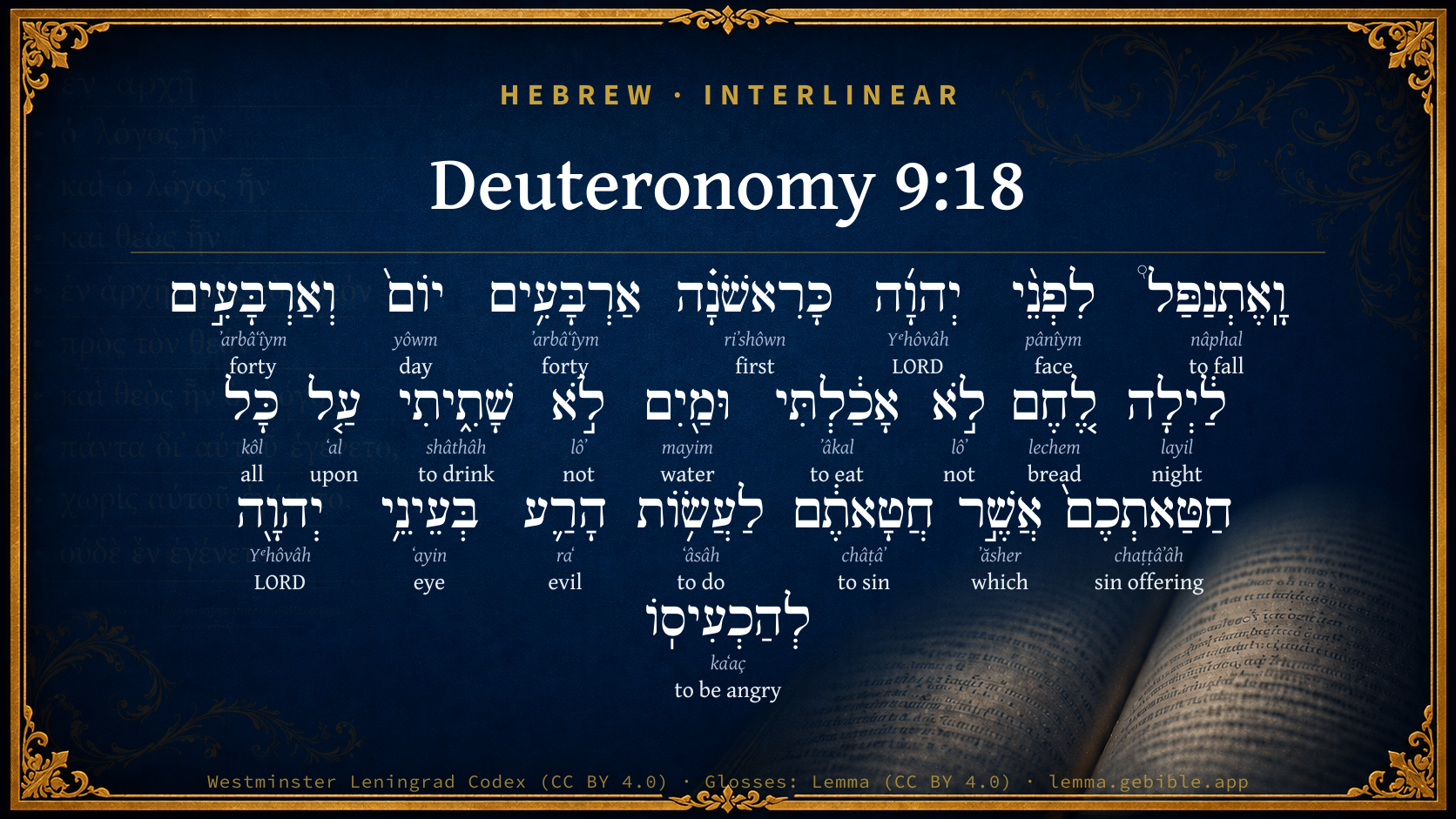
Hebrew (Westminster Leningrad Codex) Deuteronomy 9:18 appears in the Hebrew Old Testament. The text above is from the Westminster Leningrad Codex. Each word links to its Strong’s number, a concise gloss, and parsing drawn from the Open Scriptures Hebrew Bible morphology. Click any word for its full Brown-Driver-Briggs (BDB) entry.
Download image
Cite this verse

Deuteronomy 9:18 (World English Bible). Public Domain. Lemma interlinear Bible study tool, https://lemma.gebible.app/v/deuteronomy/9/18.

Show BibTeX & RIS
BibTeX
RIS
English Translation
I fell down before Yahweh, as at the first, forty days and forty nights; I did neither eat bread nor drink water; because of all your sin which you sinned, in doing that which was evil in the sight of Yahweh, to provoke him to anger.
World English Bible · Public Domain
Download a study sheet

One document with this verse’s original text, its word-by-word gloss line, the meaning frame, cross-references with their text, attributed commentary, and full source and license credits — printable, and it pastes into notes with its structure intact.

This verse Autodidact and up

Study sheet (.html) Plain text (.txt)

A passage Seminary Student

Up to 50 verses in one chapter. A passage sheet keeps up to 6 commentary sources and 12 cross-references per verse, in the order this page ranks them, and says so on the sheet whenever that leaves anything out. Ask for a single verse and you get the Autodidact verse sheet above.

Everything on this page stays free to read, with no account — the sheet is a download of what is already on screen, not access to it.

Want to remove ads? Support Godless Engineer
Compare translations 3

The same verse in 3 English versions, stacked beneath the original-language interlinear above. Click any original word for its lexicon entry.

Each is an independent rendering of the whole verse — the interlinear is not word-aligned to these translations.

Highlighted words mark where these versions differ — a whole-verse word diff, not a word-by-word alignment.

  • World English Bible Public Domain
    I fell down before Yahweh, as at the first, forty days and forty nights; I did neither eat bread nor drink water; because of all your sin which you sinned, in doing that which was evil in the sight of Yahweh, to provoke him to anger.
  • King James Version Public Domain
    And I fell down before the LORD, as at the first, forty days and forty nights: I did neither eat bread, nor drink water, because of all your sins which ye sinned, in doing wickedly in the sight of the LORD, to provoke him to anger.
  • unfoldingWord Literal Text CC BY-SA 4.0
    And I prostrated myself to the face of Yahweh as before, 40 days and 40 nights. Bread I did not eat and water I did not drink, because of all your sin that you had committed, in doing evil in the eyes of Yahweh, to provoke him to anger.

unfoldingWord Literal Text — © unfoldingWord, licensed CC BY-SA 4.0. Word-aligned USFM3 via Door43 (git.door43.org/unfoldingWord/en_ult).

Versions to compare (up to 4)

3 of 4 selected

Show all 18 translations

Every available English version of this verse, each an independent rendering of the whole verse.

  • World English Bible Public Domain
    I fell down before Yahweh, as at the first, forty days and forty nights; I did neither eat bread nor drink water; because of all your sin which you sinned, in doing that which was evil in the sight of Yahweh, to provoke him to anger.
  • Berean Standard Bible Public Domain
    Then I fell down before the LORD for forty days and forty nights, as I had done the first time. I did not eat bread or drink water because of all the sin you had committed in doing what was evil in the sight of the LORD and provoking Him to anger.
  • Majority Standard Bible Public Domain
    Then I fell down before the LORD for forty days and forty nights, as I had done the first time. I did not eat bread or drink water because of all the sin you had committed in doing what was evil in the sight of the LORD and provoking Him to anger.
  • King James Version Public Domain
    And I fell down before the LORD, as at the first, forty days and forty nights: I did neither eat bread, nor drink water, because of all your sins which ye sinned, in doing wickedly in the sight of the LORD, to provoke him to anger.
  • American Standard Version (1901) Public Domain
    And I fell down before Jehovah, as at the first, forty days and forty nights; I did neither eat bread nor drink water; because of all your sin which ye sinned, in doing that which was evil in the sight of Jehovah, to provoke him to anger.
  • Revised Version (1885) Public Domain
    And I fell down before the LORD, as at the first, forty days and forty nights; I did neither eat bread nor drink water; because of all your sin which ye sinned, in doing that which was evil in the sight of the LORD, to provoke him to anger.
  • Geneva Bible (1599) Public Domain
    And I fell downe before the Lord, fourtie dayes, and fourtie nightes, as before: I neither ate bread nor dranke water, because of al your sinnes, which ye had committed, in doing wickedly in the sight of the Lord, in that ye prouoked him vnto wrath.
  • Douay-Rheims (1899) Public Domain
    And I fell down before the Lord se before, forty days and nights neither eating bread, nor drinking water, for all your sins, which you had committed against the Lord, and had provoked him to wrath:
  • Young's Literal Translation Public Domain
    and I throw myself before Jehovah, as at first, forty days and forty nights; bread I have not eaten, and water I have not drunk, because of all your sins which ye have sinned, by doing the evil thing in the eyes of Jehovah, to make Him angry.
  • Literal Standard Version CC BY-SA 4.0
    and I throw myself before YHWH, as at first, [for] forty days and forty nights; I have not eaten bread and I have not drunk water, because of all your sins which you have sinned by doing evil in the eyes of YHWH, to make Him angry.
  • Unlocked Literal Bible CC BY-SA 4.0
    Again I lay facedown before Yahweh for forty days and forty nights; I neither ate bread nor drank water, because of all your sin that you had committed, in doing that which was evil in the sight of Yahweh, so as to provoke him to anger.
  • unfoldingWord Literal Text CC BY-SA 4.0
    And I prostrated myself to the face of Yahweh as before, 40 days and 40 nights. Bread I did not eat and water I did not drink, because of all your sin that you had committed, in doing evil in the eyes of Yahweh, to provoke him to anger.
  • Darby Bible Public Domain
    And I fell down before Jehovah, as at the first, forty days and forty nights, -- I ate no bread and drank no water, -- because of all your sin which ye had sinned, in doing what is evil in the eyes of Jehovah, to provoke him to anger.
  • World Messianic Bible Public Domain
    I fell down before the LORD, as at the first, forty days and forty nights. I neither ate bread nor drank water, because of all your sin which you sinned, in doing that which was evil in the LORD’s sight, to provoke him to anger.
  • Webster's Bible Public Domain
    And I fell down before the LORD, as at the first, forty days and forty nights: I neither ate bread, nor drank water, because of all your sins which ye sinned, in doing wickedly in the sight of the LORD, to provoke him to anger.
  • Free Bible Version CC BY-SA 4.0
    Then I lay down on the ground before the Lord for forty days and forty nights, just as I had before. I didn't eat or drink anything because of all the sins you had committed by doing what was evil in the Lord's sight, making him angry.
  • Bible in Basic English Public Domain
    And I went down on my face before the Lord, as at the first, for forty days and forty nights, without taking food or drinking water, because of all your sin, in doing evil in the eyes of the Lord and moving him to wrath.
  • JPS Tanakh (1917) Public Domain
    And I fell down before the LORD, as at the first, forty days and forty nights; I did neither eat bread nor drink water; because of all your sin which ye sinned, in doing that which was evil in the sight of the LORD, to provoke Him.

Literal Standard Version (2020), Covenant Press — licensed CC BY-SA 4.0. Text via the HelloAO Bible API (eBible.org). Unlocked Literal Bible (unfoldingWord) — licensed CC BY-SA 4.0. Text via the HelloAO Bible API (eBible.org). unfoldingWord Literal Text — © unfoldingWord, licensed CC BY-SA 4.0. Word-aligned USFM3 via Door43 (git.door43.org/unfoldingWord/en_ult). Free Bible Version, Dr. Jonathan Gallagher — licensed CC BY-SA 4.0. Text via the HelloAO Bible API (eBible.org).

Word by word

More ways to search: Search by grammar → Find every occurrence → Compare this word →

Practice this passage: Drill this verse → Learn its vocabulary →

לְהַכְעִיסֽוֹ
kaʻaç
H3707
“to be angry · him”
Preposition + Verb, Hiphil, Infinitive Construct + Suffix, Personal, 3rd Person, Masculine, Singular
Part of Speech
Preposition + Verb
Stem
Hiphil
Form
Infinitive Construct
Full BDB Definition

Origin: a primitive root

TWOT: 1016

to be angry, be vexed, be indignant, be wroth, be grieved, provoke to anger and wrath - (Qal) - to be vexed, be indignant - to be angry - (Piel) to provoke to anger - (Hiphil) - to vex - to vex, provoke to anger
  1. וָֽאֶתְנַפַּל֩ nâphal H5307 “and · to fall” Conjunction + Verb, Hithpael, Sequential Imperfect, 1st Person, Common, Singular
  2. לִפְנֵ֨י pânîym H6440 “to/for · face(s) of” Preposition + Noun, Common, Both, Plural, Construct
  3. יְהוָ֜ה Yᵉhôvâh H3068 “LORD” Noun, Proper
  4. כָּרִאשֹׁנָ֗ה riʼshôwn H7223 “like/as the · first” Preposition, Determined + Adjective, Adjective, Feminine, Singular, Absolute
  5. אַרְבָּעִ֥ים ʼarbâʻîym H705 “forty” Adjective, Cardinal number, Both, Plural, Absolute
  6. יוֹם֙ yôwm H3117 “day” Noun, Common, Masculine, Singular, Absolute
  7. וְאַרְבָּעִ֣ים ʼarbâʻîym H705 “and · forty” Conjunction + Adjective, Cardinal number, Both, Plural, Absolute
  8. לַ֔יְלָה layil H3915 “night” Noun, Common, Masculine, Singular, Absolute
  9. לֶ֚חֶם lechem H3899 “bread” Noun, Common, Both, Singular, Absolute
  10. לֹ֣א lôʼ H3808 “not” Particle, Negative
  11. אָכַ֔לְתִּי ʼâkal H398 “to eat” Verb, Qal, Perfect, 1st Person, Common, Singular
  12. וּמַ֖יִם mayim H4325 “and · water(s)” Conjunction + Noun, Common, Masculine, Plural, Absolute
  13. לֹ֣א lôʼ H3808 “not” Particle, Negative
  14. שָׁתִ֑יתִי shâthâh H8354 “to drink” Verb, Qal, Perfect, 1st Person, Common, Singular
  15. עַ֤ל ʻal H5921 “upon” Preposition
  16. כָּל kôl H3605 “all of” Noun, Common, Masculine, Singular, Construct
  17. חַטַּאתְכֶם֙ chaṭṭâʼâh H2403 “sin offering · your” Noun, Common, Feminine, Singular, Construct + Suffix, Personal, 2nd Person, Masculine, Plural
  18. אֲשֶׁ֣ר ʼăsher H834 “which” Particle, Relative
  19. חֲטָאתֶ֔ם châṭâʼ H2398 “to sin” Verb, Qal, Perfect, 2nd Person, Masculine, Plural
  20. לַעֲשׂ֥וֹת ʻâsâh H6213 “to do” Preposition + Verb, Qal, Infinitive Construct
  21. הָרַ֛ע raʻ H7451 “the · evil” Particle, Definite Article + Adjective, Adjective, Masculine, Singular, Absolute
  22. בְּעֵינֵ֥י ʻayin H5869 “in/at · eyes of” Preposition + Noun, Common, Both, Dual, Construct
  23. יְהוָ֖ה Yᵉhôvâh H3068 “LORD” Noun, Proper

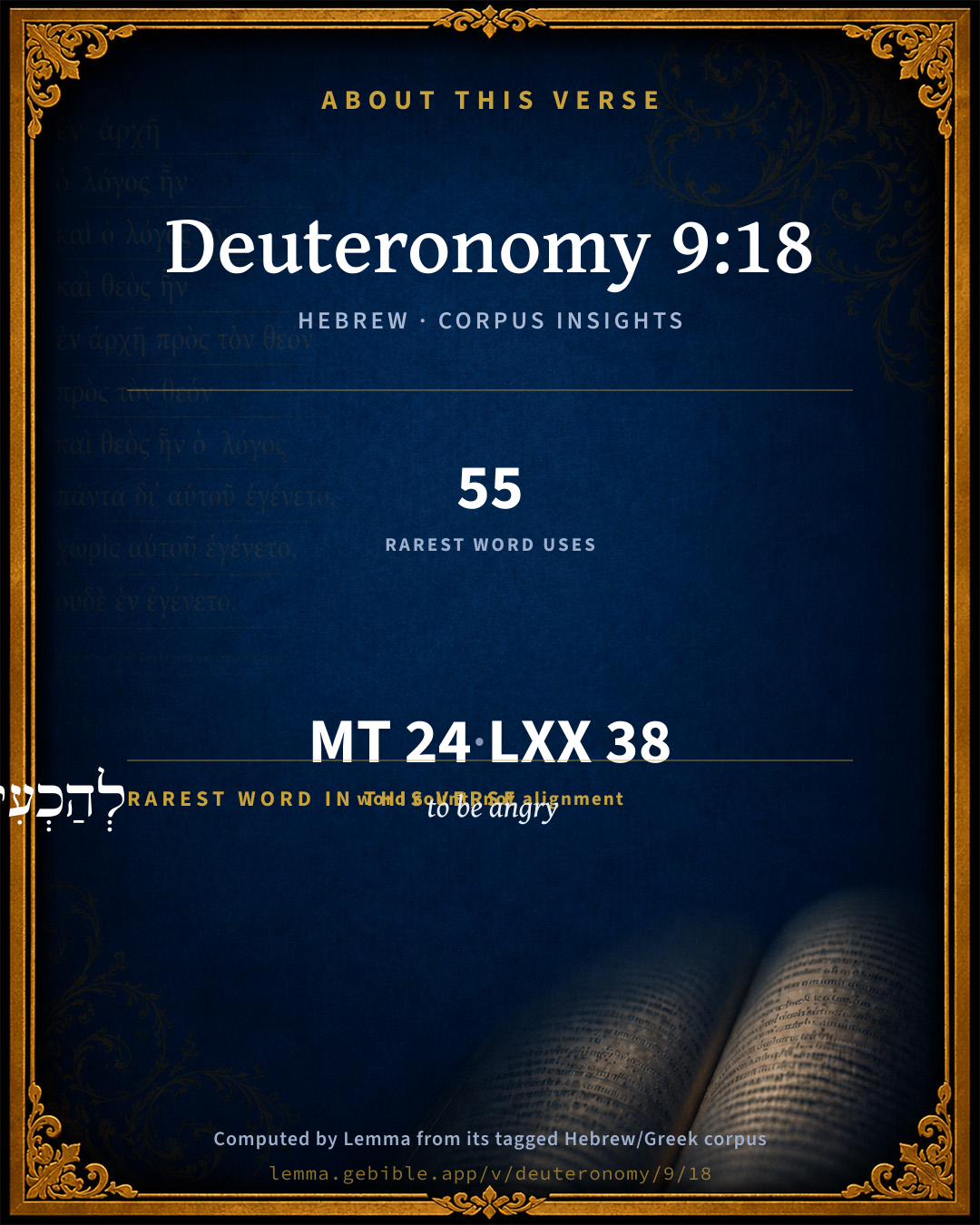
About this verse

These counts appear in no published source. They are computed here, from the morphology-tagged text and Lemma’s own curated glosses. What Lemma adds →

24
words
21
distinct lemmas
Pentateuch
section

Shared distinctive vocabulary

לְהַכְעִיסֽוֹ to be angry H3707 occurs in 53 verses of the Hebrew Bible. Also found in:

Grammatical profile

  • 6 verbs
  • 10 nouns
  • 4 adjectives
  • 1 preposition
  • 3 particles

Verb forms

  • וָֽאֶתְנַפַּל֩ Hithpael · Sequential Imperfect
  • אָכַ֔לְתִּי Qal · Perfect
  • שָׁתִ֑יתִי Qal · Perfect
  • חֲטָאתֶ֔ם Qal · Perfect
  • לַעֲשׂ֥וֹת Qal · Infinitive Construct
  • לְהַכְעִיסֽוֹ Hiphil · Infinitive Construct

Repetition

Words recur within this verse — often emphatic in Hebrew:

  • יְהוָ֜ה LORD H3068 ×2
  • אַרְבָּעִ֥ים forty H705 ×2
  • לֹ֣א not H3808 ×2

Hebrew & Septuagint length

In English translation the verse runs 46 words from the Hebrew and 45 from the Septuagint (LXX English) — closely comparable.

A rough comparison of the two English renderings, which tokenize alike — not a word-level alignment.

Word counts can differ between the Hebrew and the Greek without any difference in meaning — e.g. the Hebrew direct-object marker אֵת has no separate Greek word, and Greek often adds the article ὁ.

In the original languages it is 24 Hebrew tokens and 38 Greek tokens — but the two are counted differently (Hebrew bundles its prefixes and suffixes into one token; the Greek is in lemma form), so that isn’t a like-for-like length.

Cross-references

6

Topical passages linked to Deuteronomy 9:18 in the Treasury of Scripture Knowledge — connected by theme and wording, ordered by reader-vote popularity; previews shown in the World English Bible.

  • Exodus 34:28 He was there with Yahweh forty days and forty nights; he neither ate bread, nor drank water. He wrote on the tablets the words of the covenant, the ten commandments.
  • Deuteronomy 9:9 When I was gone up onto the mountain to receive the tables of stone, even the tables of the covenant which Yahweh made with you, then I stayed on the mountain forty days and forty nights; I did neither eat bread nor drink water.
  • Psalms 106:23 Therefore he said that he would destroy them, Had Moses, his chosen, not stood before him in the breach, To turn away his wrath, so that he wouldn't destroy them.
  • Exodus 32:10–14 Now therefore leave me alone, that my wrath may burn hot against them, and that I may consume them; and I will make of you a great nation."
  • Deuteronomy 10:10 I stayed on the mountain, as at the first time, forty days and forty nights: and Yahweh listened to me that time also; Yahweh would not destroy you.
  • 2 Samuel 12:16 David therefore begged God for the child; and David fasted, and went in, and lay all night on the earth.

Cross-references courtesy of OpenBible.info (CC BY 4.0).

Hebrew and Greek witnesses Masoretic Hebrew ↔ Greek Septuagint

The same verse in the two great witnesses to the Old Testament, shown verse-for-verse.

These are two independent witnesses, not word-aligned to each other, and the Septuagint is shown in lemma (dictionary) form.

Hebrew Deuteronomy 9:18 Masoretic · Westminster Leningrad Codex

וָֽאֶתְנַפַּל֩ לִפְנֵ֨י יְהוָ֜ה כָּרִאשֹׁנָ֗ה אַרְבָּעִ֥ים יוֹם֙ וְאַרְבָּעִ֣ים לַ֔יְלָה לֶ֚חֶם לֹ֣א אָכַ֔לְתִּי וּמַ֖יִם לֹ֣א שָׁתִ֑יתִי עַ֤ל כָּל חַטַּאתְכֶם֙ אֲשֶׁ֣ר חֲטָאתֶ֔ם לַעֲשׂ֥וֹת הָרַ֛ע בְּעֵינֵ֥י יְהוָ֖ה לְהַכְעִיסֽוֹ

I fell down before Yahweh, as at the first, forty days and forty nights; I did neither eat bread nor drink water; because of all your sin which you sinned, in doing that which was evil in the sight of Yahweh, to provoke him to anger.

World English Bible · Public Domain

Greek LXX Deuteronomy 9:18 Septuagint · lemma form

καί δέομαι ἐναντίον κύριος δεύτερος καθάπερ καί ὁ πρότερος τεσσαράκοντα ἡμέρα καί τεσσαράκοντα νύξ ἄρτος οὐ ἐσθίω καί ὕδωρ οὐ πίνω περί πᾶς ὁ ἁμαρτία σύ ὅς ἁμαρτάνω ποιέω ὁ πονηρός ἐναντίον κύριος ὁ θεός σύ παραὀξύνω αὐτός

And I made my petition before the Lord as also at the first forty days and forty nights: I ate no bread and drank no water, on account of all your sins which you⌃ sinned in doing evil before the Lord God to provoke him.

LXX2012 (modern English Septuagint) · Public Domain

On this verse, The Cambridge Bible for Schools and Colleges discusses the Septuagint’s reading. Read the note in Commentary ↓

Hebrew: Westminster Leningrad Codex (CC BY 4.0). Greek: Septuagint (public domain); English from LXX2012 (modern English Septuagint) (Public Domain). How the Septuagint differs from the Hebrew →

Targum (Aramaic paraphrase)

2

The Targum is the ancient Jewish Aramaic paraphrase of the Hebrew Scriptures — an interpretive translation, not the Hebrew text itself. Onkelos (literal) and Pseudo-Jonathan (expansive) render the Torah, and Jonathan the Prophets. Coverage is partial: where no permissively-licensed English translation exists for a verse, only the Aramaic is shown. This is verse-level text, not a word-by-word alignment to the Hebrew.

  1. Targum Onkelos Torah (Genesis–Deuteronomy)
    וְאִשְׁתַּטָחִית קֳדָם יְיָ כְּקַדְמֵיתָא אַרְבְּעִין יְמָמִין וְאַרְבְּעִין לֵילָוָן לַחְמָא לָא אֲכָלִית וּמַיָא לָא אִשְׁתֵּיתִי עַל כָּל חוֹבֵיכוֹן דִי חַבְתּוּן לְמֶעְבַּד דְבִישׁ קֳדָם יְיָ לְאַרְגָזָא קֳדָמוֹהִי

    (no public-domain English translation for this verse)

    Targum Onkelos — Aramaic: “Onkelos Genesis” (public domain); “Onkelos Exodus” (public domain); “Onkelos Leviticus” (public domain); “Onkelos Numbers” (public domain); “Onkelos Deuteronomy” (public domain). English: “Sefaria Community Translation” (CC0 1.0 (public-domain dedication)); “J.W. Etheridge. The Targums of Onkelos and Jonathan Ben Uzziel on the Pentateuch. London: Longmans, Green, 1862” (public domain). Text via Sefaria.

  2. Targum Pseudo-Jonathan Torah (Genesis–Deuteronomy)
    וּבָעִית רַחֲמִין מִן קֳדָם יְיָ כַּד בְּקַדְמֵיתָא אַרְבְּעִין יְמָמִין וְאַרְבְּעִין לֵילַוָן לַחֲמָא לָא אָכְלִית וּמוֹי לָא אִשְׁתְּיַית מְטוּל כָּל חוֹבֵיכוֹן דְּחַבְתּוּן לְמֶעֱבַד דְּבִישׁ קֳדָם יְיָ לְאַרְגְּזָא קֳדָמוֹי

    But I prayed for mercy as at the first before the Lord; forty days and forty nights I ate no bread, nor drank water, for all your sin whereby you had sinned in doing what was evil before the Lord to provoke Him to anger.

    Targum Pseudo-Jonathan — Aramaic: “Targum Jonathan on Genesis” (public domain); “Targum Jonathan on Exodus” (public domain); “Targum Jonathan on Leviticus” (public domain); “Targum Jonathan on Numbers” (public domain); “Targum Jonathan on Deuteronomy” (public domain). English: “The Targum of Jonathan ben Uzziel, trans. J. W. Etheridge, London, 1862” (public domain). Text via Sefaria.

Commentary

Notes on Deuteronomy 9:18 from classic Christian and Jewish commentators (each source and its license shown beneath its notes). The classic Christian expositions comment on the surrounding passage and are grouped to its opening verse, so a note may address several verses; the Jewish commentaries on the Tanakh (Rashi and others) are per-verse, so they appear only where the commentator wrote on this verse.

Lemma curates 59 commentaries, every one of them public domain or Creative Commons licensed, each selected and text-cleaned for this edition rather than reprinted as found. About our sources →

Trapp's Complete Commentary

John Trapp

Deu 9:18 And I fell down before the LORD, as at the first, forty days and forty nights: I did neither eat bread, nor drink water, because of all your sins which ye sinned, in doing wickedly in the sight of the LORD, to provoke him to anger.

Ver. 18. Forty days and forty nights.] This some understand of a second fasting so long together, after the people had set up the golden calf. See Deu 9:25.

John Trapp, A Commentary or Exposition upon All the Books of the Old and New Testament (1647–1656) — public domain. Text from a community e-Sword module.

Jamieson, Fausset & Brown

Robert Jamieson, A. R. Fausset & David Brown

I fell down before the Lord--The sudden and painful reaction which this scene of pagan revelry produced on the mind of the pious and patriotic leader can be more easily imagined than described. Great and public sins call for seasons of extraordinary humiliation, and in his deep affliction for the awful apostasy, he seems to have held a miraculous fast as long as before.

Jamieson, Fausset & Brown — Commentary Critical and Explanatory on the Whole Bible (1871) — public domain (CC PDM 1.0). Text via the HelloAO Bible API.

Ellicott's Commentary for English Readers

(18) And I fell down before the Lord, as at the first, forty days and forty nights.—Moses had already interceded for them in Sinai before he came down on the fortieth day (Exo_32:11-14). He now spent forty days and nights in the work of intercession. We are not to understand that the first forty were so spent. At that time he received the pattern of the tabernacle and the directions for the priesthood, which he did not deliver to Israel until after he descended from Sinai the second time. (See Exo_24:18-18, and Exo_35:1. &c.) During the first forty days, Joshua was with Moses in the mount (probably to help in taking the pattern for the tabernacle); during the second forty Moses was alone.

A Bible Commentary for English Readers, edited by Charles John Ellicott (1878–1897) — public domain. Text from a community e-Sword module.

The Cambridge Bible for Schools and Colleges

gen. ed. J. J. S. Perowne

18. as at the first] Refers to what follows it—the length of time and the fasting—not to what precedes—the falling down before God. This intercession seems to be the same as that described in Deu_10:10 and ‘anticipated here on account of its importance in the argument’ (Driver). Cp. Exo_32:30 which says that on the morrow of his meeting with the people Moses returned to the Mount to intercede for them with God; and Exo_34:9 which says that he again interceded in the second forty days which he spent on the Mount. Which of these is intended here?

all your sin] Sam., LXX: sins.

in doing that which was evil, etc.] Deu_4:25.

to provoke him] A different verb from that in Deu_9:7-8, and the same as in Deu_4:25 (q.v.), Deu_31:29; and not so characteristic of D as the other.

The Cambridge Bible for Schools and Colleges (gen. ed. J. J. S. Perowne; Cambridge University Press, 1878–1918) — public domain. Text from a community e-Sword module.

John Gill's Exposition

And I fell down before the Lord,.... In prayer for Israel who had sinned; but this he did not immediately after he had broken the tables, but when he had first ground the calf to powder, strewed it on the water, and made the children of Israel drink it; and when he had chided Aaron, and ordered the sons of Levi to slay every man his brother:

as at the first forty days and forty mights; which is to be connected, I think, not with what goes before; for we read not that he fell down before the Lord, at the first time he was with him so long in the mount; but with what follows: "I did neither eat bread nor drink water"; as he neither ate nor drank the first forty days, so neither did he these second forty; see Deu 9:9.

because of all your sins which ye sinned, in doing wickedly in the sight of the Lord, to provoke him to anger; for they were guilty of more sins than one; besides idolatry, they were guilty of unbelief, ingratitude, &c. which were notorious and flagrant, were done openly and publicly, in sight of his glory and majesty on the mount; all which must be very provoking to him, and on account of these Moses prayed and fasted.

John Gill's Exposition of the Whole Bible (1746–1763) — public domain (CC PDM 1.0). Text via the HelloAO Bible API.

Albert Barnes' Notes on the Bible

I fell down before the Lord, as at the first - Moses interceded for the people before he came down from the mountain the first time Exo 32:11-13. This intercession is only briefly alluded to in this verse. Afterward he spent another 40 days on the mountain in fasting and prayer to obtain a complete restitution of the covenant Exo 34:28. It is this second forty days, and the intercession of Moses made therein (compare Exo 34:9), that is more particularly brought forward here and in Deu 9:25-29.

Albert Barnes' Notes on the Bible (1834–1885) — public domain. Text from a community e-Sword/MySword module.

Haydock's Catholic Bible Commentary

Sins. Many believe that Moses spent the whole time in obtaining pardon. Hiscuni agrees herein with the other Rabbins, only he thinks Moses was all the time in the tabernacle. Other 40 days, or a third rigid fast, were requisite to obtain the second tables of the law, as the text seems to insinuate, (ver. 25., and chap. x. 10,) unless Moses repeat what he has here asserted, as many able chronologers suppose. (Torneil; Usher; &c.) (Calmet) (Tirinus) --- The former opinion is maintained, however, by Salien, &c., Exodus xxxiv. (Haydock)

George Leo Haydock (1774–1849), Haydock's Catholic Family Bible and Commentary, 1859 edition — public domain. Excludes Psalms (Douay-Rheims chapter numbering differs from Protestant) and Deuterocanonical books (Catholic canon only).

Matthew Poole's English Annotations

I fell down, in way of humiliation and supplication, on your behalf.

Matthew Poole's English Annotations on the Holy Bible (1683–1685) — public domain. Text from a community e-Sword/MySword module.

Whedon's Commentary on the Bible

Daniel D. Whedon

18. As at the first, forty days — Moses spends a second period in fasting. Comp. Exo_34:28.

Daniel D. Whedon (gen. ed.), Commentary on the Old and New Testaments (1874–1909) — public domain. Text from a community e-Sword module.

The Pulpit Commentary

Vers. 18-20. Moses interceded with God for the people before he came down from the mount; (Exo_22:11, etc.) but this he passes over here, merely referring to it in the words, "as at the first," and makes special mention only of a subsequent intercession, that mentioned in Exo_34:28. In the account in Exodus nothing is said of Moses interceding forAaron specially, as well as for the people generally; but prominence is given to this here, "not only that he might make the people thoroughly aware that at that time Israel could not boast even of the righteousness of its eminent men, (cf. Isa_43:27) but also to bring out the fact, whichis described still more fully in Deu_10:6, sqq., that Aaron"s investiture with the priesthood and the maintenance of this institution was purely a work of Divine grace" (Keil) That Aaron, however, was regarded as especially to be blamed in this matter is clearly intimated in Exo_32:21, Exo_32:22.

Vers. 18-29. The place of human mediation.

The best men have always desired to intercede for the bad. True holiness is benevolent.

I MEDIATION CONCERNS ITSELF WITH THE INTERESTS OF BOTH PARTIES. Moses had at heart the honor of God the maintenance of his just rule, while he also identified himself with the wellbeing of the Hebrews. If there be, on the part of the mediator, a leaning to the interests of the one party rather than the other, his office will fail. One party or both will reject him. His mission proceeds on the ground that there is an advantage common to both to be obtained by reconciliation. There is a point where God"s interests and man"s touch and blend. The business is to find that point, and to persuade both parties there to meet.

II MEDIATION IS ITSELF A FRUIT OF DIVINE MERCY. The disposition in the heart of Moses to intercede was a disposition implanted by God, and all the energy with which he pursued this mission was energy sustained from heaven. Further, the willingness, on the part of God, to allow any suit on behalf of rebels, was an act of pure mercy. It is no less absurd than profane to speak of man, the mediator, as showing more benevolence than God. The whole arrangement is one of purest kindness, and Moses was richly blest in his generous undertaking.

III MEDIATION REQUIRES THE MOST COMPLETE SELFSACRIFICE. For forty days and forty nights Moses was prostrate before the Lord. Personal needs, personal interests, personal honor, were all forgotten. Here was the completest devotion of himself to this cause. There is a profound mystery in this number of forty. It is not a natural cycle. Like the number seven, it is sacred to religion. For forty days and nights Moses waited before God, undergoing spiritual receptiveness for the revelation of his will. For forty years the Hebrews dwelt in the wilderness. For forty days Elijah tarried in Horeb. For forty days Jesus endured the temptations of the desert. For forty days he abode with men subsequent to his resurrection. All that human nature could endure, Moses endured to obtain pardon for Israel. For if pardon be too cheaply bought, it is not valued. Only in the lurid light of sin"s curse do we see the glory of forgiveness.

IV MEDIATION ACKNOWLEDGES SIN TO THE FULL. There is no extenuation of the deed, no paring down its dimensions, no cloaking any part of its baseness, no endeavors to put other colors on it than its own. It is because sin is so malignant and so ruinous that it is so desirable to rescue the sinner from its awful spell. It is because it is so dishonoring to God that it is worth while, at any price, to remove it from his universe. The anger of Jehovah is no mere passing or capricious feeling. It is sentiment arising out of the most righteous principle. Such anger against sin is essential to the Godhead. We need not be afraid of the introduction of anthropomorphic conceptions. The longer Moses remained prostrate before God, the clearer came into view Israel"s sin in the light of the Divine purity.

V MEDIATION INCLUDES THE LARGEST REPARATION. The mission of Moses as mediator had a part manward as well as Godward. The whole work was not done upon his knees. With both his hands he brake and burnt the graven image, dishonored the deity they had fashioned, reduced it to powdered dust. This would expose the impotence of the idol, the vanity of the idol system, and the insane folly of presenting to such a molten image Divine honors. Nor was this all. The fine dust that remained after the burning was cast into the brook, so that they were compelled to drink it in the exigency of their thirst. St. Paul tells us that the rock from which this stream flowed symbolized Christ; hence we see, in a figure, how the living stream from him, the Fount, bears away our sin into oblivion. Repentance upon our part is not thorough, nor sincere, unless we make whatever reparation is within our reach,

VI MEDIATION EMBRACES VERBAL INTERCESSION. The final outcome of mediation is prayer. Father, forgive them!" said the dying Savior. "He ever liveth to intercede.

1. Moses pleads God"s proprietorship in this recreant people. "They are thine inheritance." "The Lord"s portion is his people." From them he shall obtain more satisfaction than from planets and stars and suns.

2. God"s self-consistency is an argument in prayer, he had already redeemed them from Egyptian bondage. He had taken great pains with them hitherto, and had expended great power on their behalf. And he had not done this in ignorance. The latent evil in their hearts he had perceived. The future of their lives he had foreseen. Hence it would be consistent with his past favors to dispense fresh mercy.

3. God"s covenant and promises are proper arguments in prayer. He loves to be reminded of his engagements, because this remembrance deepens our sense of his faithfulness. He had engaged to bring this people to the land of promise, not for their sakes, however obedient they might be, but for their fathers" sakes. Hence their rebelliousness did not vitiate the original engagement; and although individuals might justly be destroyed yea, that whole generation still the posterity of Abraham must eventually enter the land.

4. The reputation and credit of God form also staple arguments in prayer for others. The natural effect produced on men"s minds by God"s dealings must be taken into account. Our God is not indifferent to the homage and praise of men. It is to him a great delight to receive the incense of heartfelt love. His reputation in his universe is a very precious thing, and it becomes us on all occasions to guard it well. He has formed us into a people for this very purpose, "that we should show forth his praise.

VII HUMAN MEDIATION, IF EARNEST AND PERSEVERING, SUCCEEDS. "The Lord hearkened unto me at that time also." Here is great encouragement for our intercession now! Abraham did not cease to gain successes for Sodom until he ceased to pray; and had he continued, possibly the city might have been spared. What genuine and honest intercession has ever failed? "The fervent prayer of a righteous man availeth much." Every instance of successful intercession recorded in history is a cordial to revive our drooping faith. Is not God even now waiting to hear human intercession, that he may do great things for his Church? "Give him no rest, till he make Jerusalem a praise in the earth. D.

The Pulpit Commentary (1880–1919), ed. H.D.M. Spence-Jones & Joseph S. Exell — public domain. Text from a community e-Sword module.

John Wesley's Explanatory Notes

I fell down - In a way of humiliation and supplication, on your behalf.

John Wesley, Explanatory Notes Upon the Whole Bible (1754–1765) — public domain. Text via the GEBible commentary corpus.

Rashi

Rabbi Shlomo Yitzchaki (Rashi)

ואתנפל לפני ה׳ כראשנה ארבעים יום AND I FELL DOWN BEFORE THE LORD, AS AT THE FIRST, FORTY DAYS, as it is said (Exodus 32:30) “And now I will go up to the Lord, perhaps I may atone [for your sin]”. At that ascent, which was the second I made, I tarried there forty days — consequently these terminated on the twenty-ninth of Ab, since he had ascended on the eighteenth of Tammuz. On that same day in Ab He became reconciled with Israel and said to Moses (Exodus 34:1) “Hew thee out two tablets”. He stayed there another forty days; consequently these terminated on the Day of Atonement (the tenth of Tishri). On that same day, the Holy One, blessed be He, was gladly reconciled (i.e. completely reconciled) with Israel and said to Moses, I have forgiven according to thy word. On this account it was appointed for pardon and forgiveness. And whence do we know that He was reconciled with them with complete goodwill? Because it is stated in respect to the forty days of the last tablets (in respect to third period of forty days) (Deuteronomy 10:10), “And I stayed in the mountain according to the first days”! What was the case with the first days? They were passed in God’s goodwill! (for they had not yet committed the sin of worshipping the golden calf). So, too, the last forty days were in God’s goodwill! You must now say (admit) that the intervening forty days were passed in God’s anger (Midrash Tanchuma, Ki Tisa 31; cf. Rashi on Exodus 18:13).

Rashi on the Tanakh — English translations: “The Judaica Press complete Tanach with Rashi, translated by A. J. Rosenberg” (CC BY 4.0); “Pentateuch with Rashi's commentary by M. Rosenbaum and A.M. Silbermann, 1929-1934” (public domain); “The Metsudah Tanach series, Lakewood, N.J” (CC BY 4.0); and “The Book of Joshua, Metsudah Publications, 1997” (CC BY 4.0). Text via Sefaria.

Lesson kit

Teaching starters — assembled from the data on this page, not authored interpretation. Every prompt links to the verse data it draws on. Edit before teaching.

Deuteronomy, in the Pentateuch, opens this verse with 24 words (21 distinct Hebrew lemmas). Its most distinctive word is kaʻaç (“to be angry”). A historical commentator’s framing appears above. Read the whole chapter for the surrounding context.

Discussion questions

  1. What does “to be angry” (kaʻaç) contribute to the verse as a whole?
  2. How does Deuteronomy 4:25, which shares the word «to be angry», read alongside this verse?
  3. What does the repetition of “LORD” (2× in this one verse) do in this verse?
  4. These translations render this verse differently. What is at stake in choosing one wording over another?
  5. «וָֽאֶתְנַפַּל֩» is a Hithpael Sequential Imperfect verb. How does that grammatical form shape the action described?
  6. Compare how Trapp's Complete Commentary and Jamieson, Fausset & Brown read this verse. Where do they agree or differ?

Things to notice

Reading settings

Reading text

Shown beneath each verse's original-language words.

Old Testament
Old Testament edition

Read the OT as the Masoretic Hebrew (MT) or the Greek Septuagint (LXX).

English shown for the Greek Septuagint (in the Hebrew ↔ Greek comparison).

Comparing translations? Open the Compare panel on any verse page to stack up to four side by side.