
1 Samuel 25:24

Hebrew (Westminster Leningrad Codex) 1 Samuel 25:24 appears in the Hebrew Old Testament. The text above is from the Westminster Leningrad Codex. Each word links to its Strong’s number, a concise gloss, and parsing drawn from the Open Scriptures Hebrew Bible morphology. Click any word for its full Brown-Driver-Briggs (BDB) entry.
Download image
Cite this verse

1 Samuel 25:24 (World English Bible). Public Domain. Lemma interlinear Bible study tool, https://lemma.gebible.app/v/1-samuel/25/24.

Show BibTeX & RIS
BibTeX
RIS
English Translation
She fell at his feet, and said, On me, my lord, on me be the iniquity; and please let your handmaid speak in your ears. Hear the words of your handmaid.
World English Bible · Public Domain
Download a study sheet

One document with this verse’s original text, its word-by-word gloss line, the meaning frame, cross-references with their text, attributed commentary, and full source and license credits — printable, and it pastes into notes with its structure intact.

This verse Autodidact and up

Study sheet (.html) Plain text (.txt)

A passage Seminary Student

Up to 50 verses in one chapter. A passage sheet keeps up to 6 commentary sources and 12 cross-references per verse, in the order this page ranks them, and says so on the sheet whenever that leaves anything out. Ask for a single verse and you get the Autodidact verse sheet above.

Everything on this page stays free to read, with no account — the sheet is a download of what is already on screen, not access to it.

Want to remove ads? Support Godless Engineer
Compare translations 3

The same verse in 3 English versions, stacked beneath the original-language interlinear above. Click any original word for its lexicon entry.

Each is an independent rendering of the whole verse — the interlinear is not word-aligned to these translations.

Highlighted words mark where these versions differ — a whole-verse word diff, not a word-by-word alignment.

  • World English Bible Public Domain
    She fell at his feet, and said, On me, my lord, on me be the iniquity; and please let your handmaid speak in your ears. Hear the words of your handmaid.
  • King James Version Public Domain
    And fell at his feet, and said, Upon me, my lord, upon me let this iniquity be: and let thine handmaid, I pray thee, speak in thine audience, and hear the words of thine handmaid.
  • unfoldingWord Literal Text CC BY-SA 4.0
    And she fell at his feet and said, “On me myself, my master, the iniquity. Now please let your maidservant speak in your ears, and hear the words of your maidservant.

unfoldingWord Literal Text — © unfoldingWord, licensed CC BY-SA 4.0. Word-aligned USFM3 via Door43 (git.door43.org/unfoldingWord/en_ult).

Versions to compare (up to 4)

3 of 4 selected

Show all 18 translations

Every available English version of this verse, each an independent rendering of the whole verse.

  • World English Bible Public Domain
    She fell at his feet, and said, On me, my lord, on me be the iniquity; and please let your handmaid speak in your ears. Hear the words of your handmaid.
  • Berean Standard Bible Public Domain
    She fell at his feet and said, “My lord, may the blame be on me alone, but please let your servant speak to you; hear the words of your servant.
  • Majority Standard Bible Public Domain
    She fell at his feet and said, “My lord, may the blame be on me alone, but please let your servant speak to you; hear the words of your servant.
  • King James Version Public Domain
    And fell at his feet, and said, Upon me, my lord, upon me let this iniquity be: and let thine handmaid, I pray thee, speak in thine audience, and hear the words of thine handmaid.
  • American Standard Version (1901) Public Domain
    And she fell at his feet, and said, Upon me, my lord, upon me be the iniquity; and let thy handmaid, I pray thee, speak in thine ears, and hear thou the words of thy handmaid.
  • Revised Version (1885) Public Domain
    And she fell at his feet, and said, Upon me, my lord, upon me be the iniquity: and let thine handmaid, I pray thee, speak in thine ears, and hear thou the words of thine handmaid.
  • Geneva Bible (1599) Public Domain
    And fel at his feete, and sayd, Oh, my lord, I haue committed the iniquitie, and I pray thee, let thine handmayde speake to thee, and heare thou the wordes of thine handmayde.
  • Douay-Rheims (1899) Public Domain
    And she fell at his feet, and said: Upon me let this iniquity be, my lord: let thy handmaid speak, I beseech thee, in thy ears: and hear the words of thy servant.
  • Young's Literal Translation Public Domain
    and falleth at his feet and saith, `On me, my lord, the iniquity; and let, I pray thee, thy handmaid speak in thine ear, and hear the words of thy handmaid.
  • Literal Standard Version CC BY-SA 4.0
    and falls at his feet and says, “On me, my lord, the iniquity; and please let your handmaid speak in your ear, and hear the words of your handmaid.
  • Unlocked Literal Bible CC BY-SA 4.0
    She lay at his feet and said, “On me alone, my master, be the guilt. Please let your servant speak to you, and listen to the words of your servant.
  • unfoldingWord Literal Text CC BY-SA 4.0
    And she fell at his feet and said, “On me myself, my master, the iniquity. Now please let your maidservant speak in your ears, and hear the words of your maidservant.
  • Darby Bible Public Domain
    and fell at his feet, and said, Upon me, my lord, [upon] me let the iniquity be; but let thy handmaid, I pray thee, speak in thine ears, and hear the words of thy handmaid.
  • World Messianic Bible Public Domain
    She fell at his feet and said, “On me, my lord, on me be the blame! Please let your servant speak in your ears. Hear the words of your servant.
  • Webster's Bible Public Domain
    And fell at his feet, and said, Upon me, my lord, upon me let this iniquity be: and let thy handmaid, I pray thee, speak in thy audience, and hear the words of thy handmaid.
  • Free Bible Version CC BY-SA 4.0
    Falling at his feet in respect, she said, “Sir, I accept full responsibility for what's happened. Please listen to what I, your servant, have to say.
  • Bible in Basic English Public Domain
    And falling at his feet she said, May the wrong be on me, my lord, on me: let your servant say a word to you, and give ear to the words of your servant.
  • JPS Tanakh (1917) Public Domain
    And she fell at his feet, and said: 'Upon me, my lord, upon me be the iniquity; and let thy handmaid, I pray thee, speak in thine ears, and hear thou the words of thy handmaid.

Literal Standard Version (2020), Covenant Press — licensed CC BY-SA 4.0. Text via the HelloAO Bible API (eBible.org). Unlocked Literal Bible (unfoldingWord) — licensed CC BY-SA 4.0. Text via the HelloAO Bible API (eBible.org). unfoldingWord Literal Text — © unfoldingWord, licensed CC BY-SA 4.0. Word-aligned USFM3 via Door43 (git.door43.org/unfoldingWord/en_ult). Free Bible Version, Dr. Jonathan Gallagher — licensed CC BY-SA 4.0. Text via the HelloAO Bible API (eBible.org).

Word by word

More ways to search: Search by grammar → Find every occurrence → Compare this word →

Practice this passage: Drill this verse → Learn its vocabulary →

אֲמָֽתְךָ֙
ʼâmâh
H519
“maid · your”
Noun, Common, Feminine, Singular, Construct + Suffix, Personal, 2nd Person, Masculine, Singular
Part of Speech
Noun
Type
Common
Gender
Feminine
Number
Singular
State
Construct
Full BDB Definition

Origin: apparently a primitive word

TWOT: 112

maid-servant, female slave, maid, handmaid, concubine - of humility (figuratively)
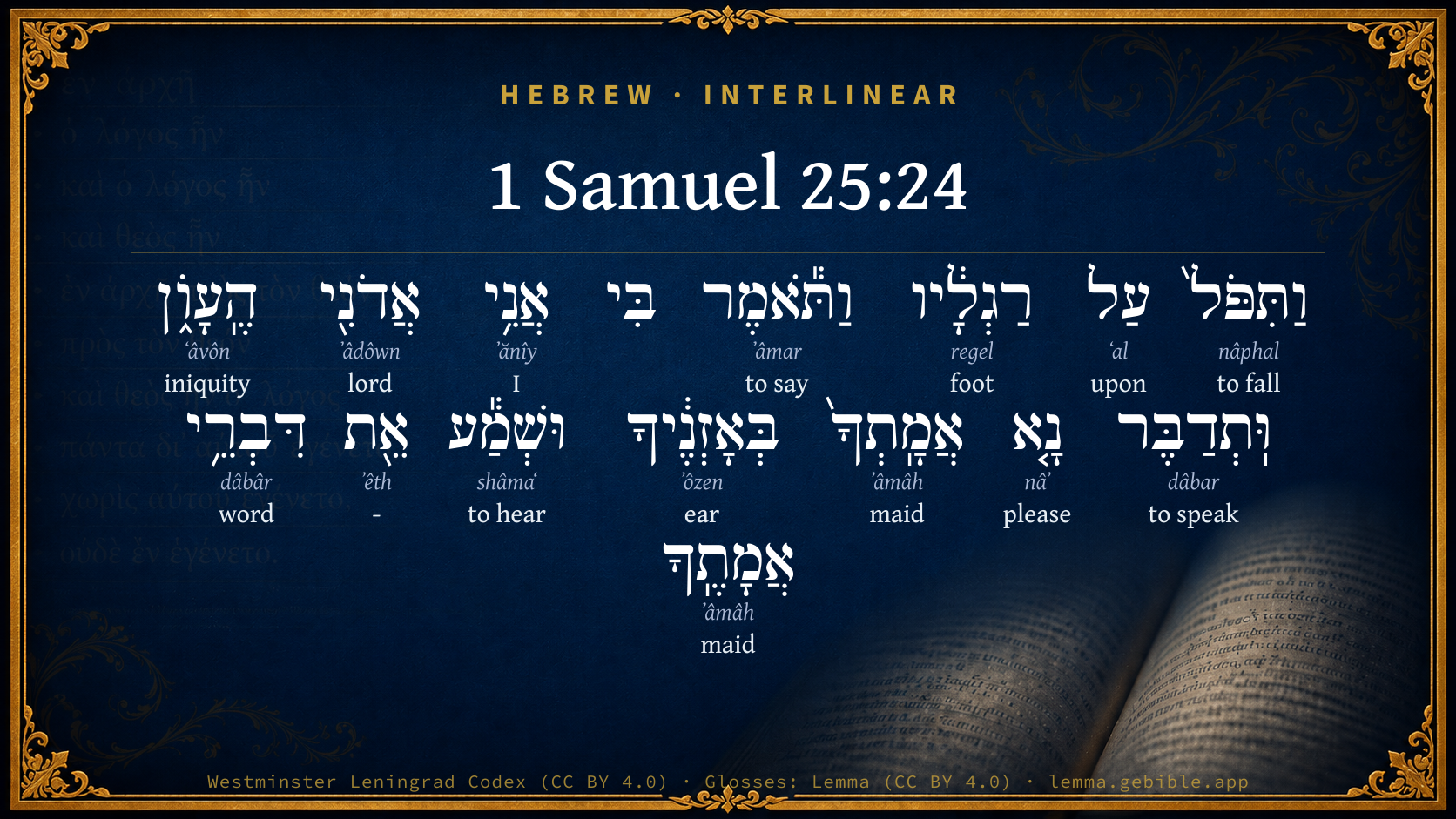
  1. וַתִּפֹּל֙ nâphal H5307 “and · to fall” Conjunction + Verb, Qal, Sequential Imperfect, 3rd Person, Feminine, Singular
  2. עַל ʻal H5921 “upon” Preposition
  3. רַגְלָ֔יו regel H7272 “feet · his” Noun, Common, Feminine, Dual, Construct + Suffix, Personal, 3rd Person, Masculine, Singular
  4. וַתֹּ֕אמֶר ʼâmar H559 “and · to say” Conjunction + Verb, Qal, Sequential Imperfect, 3rd Person, Feminine, Singular
  5. אֲנִ֥י ʼănîy H589 “I” Pronoun, Personal, 1st Person, Common, Singular
  6. אֲדֹנִ֖י ʼâdôwn H113 “lord · my” Noun, Common, Masculine, Singular, Construct + Suffix, Personal, 1st Person, Common, Singular
  7. הֶֽעָוֺ֑ן ʻâvôn H5771 “the · iniquity” Particle, Definite Article + Noun, Common, Both, Singular, Absolute
  8. וּֽתְדַבֶּר dâbar H1696 “and · to speak” Conjunction + Verb, Piel, Jussive, 3rd Person, Feminine, Singular
  9. נָ֤א nâʼ H4994 “please” Particle, Exhortation
  10. בְּאָזְנֶ֔יךָ ʼôzen H241 “in/at · ears · your” Preposition + Noun, Common, Feminine, Dual, Construct + Suffix, Personal, 2nd Person, Masculine, Singular
  11. וּשְׁמַ֕ע shâmaʻ H8085 “and · hear” Conjunction + Verb, Qal, Imperative, 2nd Person, Masculine, Singular
  12. אֵ֖ת ʼêth H853 “-” Particle, Direct Object
  13. דִּבְרֵ֥י dâbâr H1697 “words of” Noun, Common, Masculine, Plural, Construct
  14. אֲמָתֶֽךָ ʼâmâh H519 “maid · your” Noun, Common, Feminine, Singular, Construct + Suffix, Personal, 2nd Person, Masculine, Singular

About this verse

These counts appear in no published source. They are computed here, from the morphology-tagged text and Lemma’s own curated glosses. What Lemma adds →

16
words
14
distinct lemmas
Historical
section

Shared distinctive vocabulary

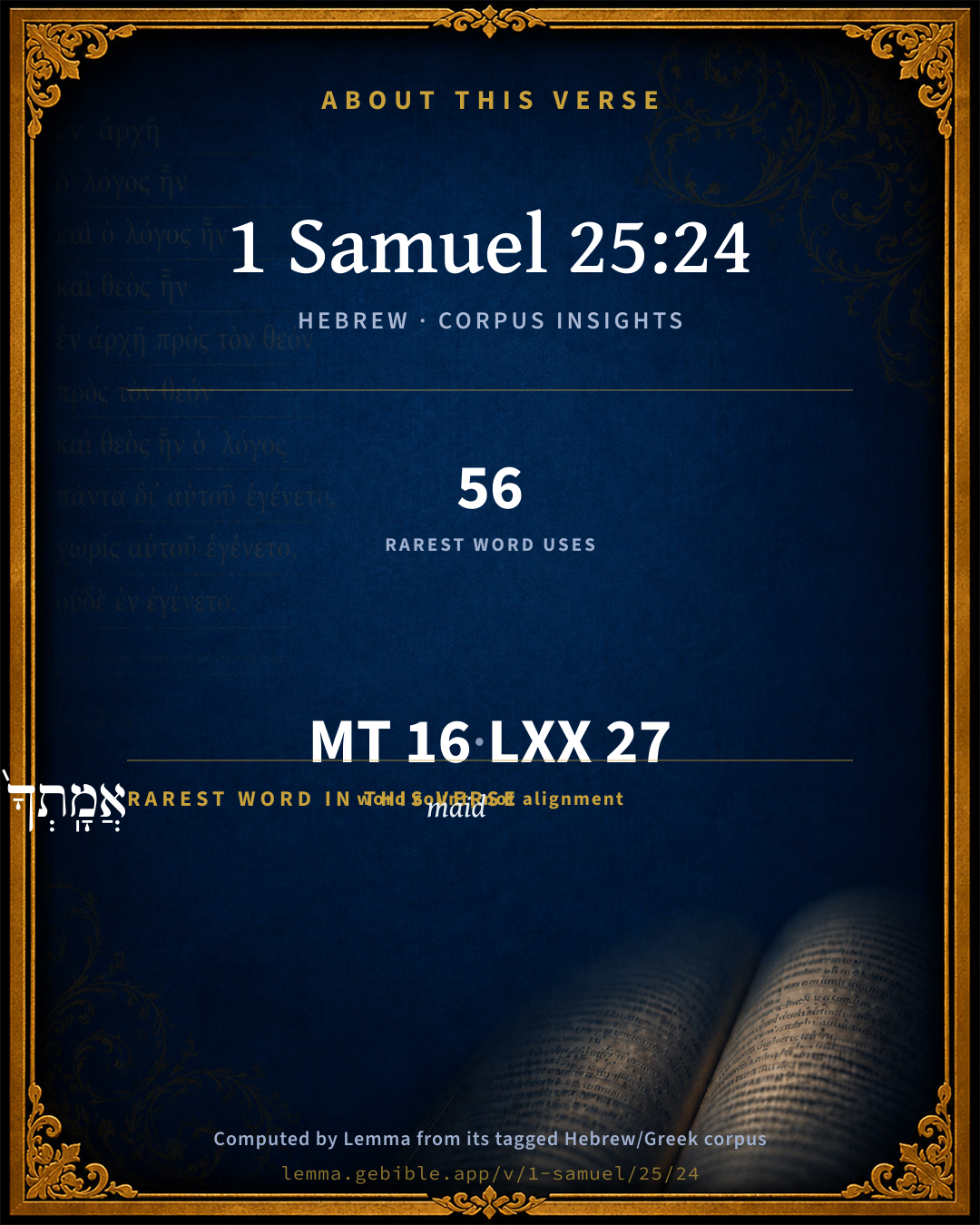
אֲמָֽתְךָ֙ maid H519 occurs in 49 verses of the Hebrew Bible. Also found in:

Grammatical profile

  • 4 verbs
  • 7 nouns
  • 1 pronoun
  • 2 prepositions
  • 2 particles

Verb forms

  • וַתִּפֹּל֙ Qal · Sequential Imperfect
  • וַתֹּ֕אמֶר Qal · Sequential Imperfect
  • וּֽתְדַבֶּר Piel · Jussive
  • וּשְׁמַ֕ע Qal · Imperative

Repetition

A word recurs within this verse — often emphatic in Hebrew:

  • אֲמָֽתְךָ֙ maid H519 ×2

Hebrew & Septuagint length

In English translation the verse runs 31 words from the Hebrew and 31 from the Septuagint (LXX English) — the same length.

A rough comparison of the two English renderings, which tokenize alike — not a word-level alignment.

Word counts can differ between the Hebrew and the Greek without any difference in meaning — e.g. the Hebrew direct-object marker אֵת has no separate Greek word, and Greek often adds the article ὁ.

In the original languages it is 16 Hebrew tokens and 27 Greek tokens — but the two are counted differently (Hebrew bundles its prefixes and suffixes into one token; the Greek is in lemma form), so that isn’t a like-for-like length.

Cross-references

9

Topical passages linked to 1 Samuel 25:24 in the Treasury of Scripture Knowledge — connected by theme and wording, ordered by reader-vote popularity; previews shown in the World English Bible.

  • 1 Samuel 25:28 Please forgive the trespass of your handmaid: for Yahweh will certainly make my lord a sure house, because my lord fights the battles of Yahweh; and evil shall not be found in you all your days.
  • 2 Samuel 14:9 The woman of Tekoa said to the king, My lord, O king, the iniquity be on me, and on my father's house; and the king and his throne be guiltless.
  • Esther 8:3 Esther spoke yet again before the king, and fell down at his feet, and begged him with tears to put away the mischief of Haman the Agagite, and his device that he had devised against the Jews.
  • 2 Kings 4:37 Then she went in, and fell at his feet, and bowed herself to the ground; and she took up her son, and went out.
  • Philemon 1:18–19 But if he has wronged you at all, or owes you anything, put that to my account.
  • Genesis 44:18 Then Judah came near to him, and said, "Oh, my lord, please let your servant speak a word in my lord's ears, and don't let your anger burn against your servant; for you are even as Pharaoh.
  • Genesis 44:33–34 Now therefore, please let your servant stay instead of the boy, a bondservant to my lord; and let the boy go up with his brothers.
  • 2 Samuel 14:12 Then the woman said, Please let your handmaid speak a word to my lord the king. He said, Say on.
  • Matthew 18:29 "So his fellow servant fell down at his feet and begged him, saying, 'Have patience with me, and I will repay you!'

Cross-references courtesy of OpenBible.info (CC BY 4.0).

Hebrew and Greek witnesses Masoretic Hebrew ↔ Greek Septuagint

The same verse in the two great witnesses to the Old Testament, shown verse-for-verse.

These are two independent witnesses, not word-aligned to each other, and the Septuagint is shown in lemma (dictionary) form.

Hebrew 1 Samuel 25:24 Masoretic · Westminster Leningrad Codex

וַתִּפֹּל֙ עַל רַגְלָ֔יו וַתֹּ֕אמֶר בִּי אֲנִ֥י אֲדֹנִ֖י הֶֽעָוֺ֑ן וּֽתְדַבֶּר נָ֤א אֲמָֽתְךָ֙ בְּאָזְנֶ֔יךָ וּשְׁמַ֕ע אֵ֖ת דִּבְרֵ֥י אֲמָתֶֽךָ

She fell at his feet, and said, On me, my lord, on me be the iniquity; and please let your handmaid speak in your ears. Hear the words of your handmaid.

World English Bible · Public Domain

Greek LXX 1 Samuel 25:24 Septuagint · lemma form

ἐπί ὁ πούς αὐτός καί εἶπον ἐν ἐγώ κύριος ἐγώ ὁ ἀδικία λαλέω δή ὁ δούλη σύ εἰς ὁ οὖς σύ καί ἀκούω ὁ δούλη σύ λόγος

even to his feet, and said, On me, my lord, be my wrong: let, I pray you, your servant speak in your ears, and hear you the words of your servant.

LXX2012 (modern English Septuagint) · Public Domain

Hebrew: Westminster Leningrad Codex (CC BY 4.0). Greek: Septuagint (public domain); English from LXX2012 (modern English Septuagint) (Public Domain). How the Septuagint differs from the Hebrew →

Targum (Aramaic paraphrase)

1

The Targum is the ancient Jewish Aramaic paraphrase of the Hebrew Scriptures — an interpretive translation, not the Hebrew text itself. Onkelos (literal) and Pseudo-Jonathan (expansive) render the Torah, and Jonathan the Prophets. Coverage is partial: where no permissively-licensed English translation exists for a verse, only the Aramaic is shown. This is verse-level text, not a word-by-word alignment to the Hebrew.

  1. Targum Jonathan Prophets (Joshua–Malachi)
    וּנְפָלַת עַל רִגְלוֹהִי וַאֲמַרַת בְּבָעוּ עֲלַי דִילִי רִבּוֹנִי חוֹבָא וּתְמַלֵל כְּעַן אַמְתָךְ קֳדָמָךְ וְתִשְׁמַע יַת פִּתְגָמֵי אַמְתָךְ:

    (no public-domain English translation for this verse)

    Targum Jonathan — Aramaic: “Mikraot Gedolot” (public domain). English: “Sefaria Community Translation” (CC0 1.0 (public-domain dedication)); “London "Chaldee Paraphrase," 1871” (public domain). Text via Sefaria.

Commentary

Notes on 1 Samuel 25:24 from classic Christian and Jewish commentators (each source and its license shown beneath its notes). The classic Christian expositions comment on the surrounding passage and are grouped to its opening verse, so a note may address several verses; the Jewish commentaries on the Tanakh (Rashi and others) are per-verse, so they appear only where the commentator wrote on this verse.

Lemma curates 59 commentaries, every one of them public domain or Creative Commons licensed, each selected and text-cleaned for this edition rather than reprinted as found. About our sources →

Trapp's Complete Commentary

John Trapp

1Sa 25:24 And fell at his feet, and said, Upon me, my lord, [upon] me [let this] iniquity [be]: and let thine handmaid, I pray thee, speak in thine audience, and hear the words of thine handmaid.

Ver. 24. Upon me, my lord, upon me let this iniquity be,] i.e., Wreak thy wrath on me, if thou canst find in thine heart; but first hear my defence, and then do thy pleasure.

John Trapp, A Commentary or Exposition upon All the Books of the Old and New Testament (1647–1656) — public domain. Text from a community e-Sword module.

Joseph Benson's Commentary

1Sa 25:24. Upon me, my lord, let this iniquity be, &c. — Impute Nabal’s sin to me; and, if thou pleasest, punish it in me, who here offer myself as a sacrifice to thy just indignation. This whole speech of Abigail shows great wisdom. By an absolute submitting to mercy, without any pretence of justification of what was done, (but rather with aggravation of it,) she endeavours to work upon David’s generosity, to pardon it. And there is hardly any head of argument, whence the greatest orator might argue in this case, which she doth not manage to the best advantage.

Joseph Benson's Commentary on the Old and New Testaments (1811–1818) — public domain. Text from a community e-Sword module.

Geneva Bible (1599)

Geneva Bible translators

Hebrew, in thine ears.

Geneva Bible (1599) marginal notes — public domain. Text via Bolls.life.

The Cambridge Bible for Schools and Colleges

gen. ed. J. J. S. Perowne

24. and fell at his feet] Apparently she first prostrated herself and did the usual obeisance as soon as she saw David, while he was still some distance off, and then afterwards approached and knelt down at his feet in the posture of a suppliant to make her petition.

The Cambridge Bible for Schools and Colleges (gen. ed. J. J. S. Perowne; Cambridge University Press, 1878–1918) — public domain. Text from a community e-Sword module.

John Gill's Exposition

And fell at his feet,.... As an humble supplicant, having a favour to ask of him; it is very probable David was on foot:

and said, upon me, my lord, upon me let this iniquity be; which her husband had been guilty of; she desires it might be transferred from him to her, and be reckoned as if done by her; she would have it imputed to herself, and all the blame lie upon her, and the punishment for it be inflicted on her; for iniquity may be put for the punishment of iniquity: this was very artfully said, as well as expressed great affection for her husband, and care of his life; for she knew, if she could get the fault removed from him to her, she would be able to vindicate herself, and her innocence would soon appear; nor would this strong affection for her husband fail of answering some good purpose, as she full well knew:

and let thine handmaid, I pray thee, speak in thine audience and hear the words of thine handmaid: as it was but reasonable she should be heard, since she stood now as the criminal, taking all the blame of her husband's conduct on herself.

John Gill's Exposition of the Whole Bible (1746–1763) — public domain (CC PDM 1.0). Text via the HelloAO Bible API.

Haydock's Catholic Bible Commentary

Iniquity, or the punishment of this fault, ver. 28. (Calmet) --- She wishes to divest the mind of David from the consideration of her husband’s incivility; and, after condemning it herself, insinuates that it would be unbecoming for a great king to mind so insignificant an enemy, ver. 28. (Haydock) --- Thus the emperor Adrian, and Louis XII, would not resent the affronts which they had received before they were raised to that high dignity. (Tirinus)

George Leo Haydock (1774–1849), Haydock's Catholic Family Bible and Commentary, 1859 edition — public domain. Excludes Psalms (Douay-Rheims chapter numbering differs from Protestant) and Deuterocanonical books (Catholic canon only).

Matthew Poole's English Annotations

Upon me let this iniquity be; impute Nabal’s sin to me, and, if thou pleasest, punish it in me, who here offer myself as a sacrifice to thy just indignation. This whole speech of Abigail is done with great artifice; and she doth here, by an absolute submitting to mercy, without any pretence of justification of what was done, (but rather with aggravation of it,) endeavour to work upon David’s generosity and good nature to pardon it; and, with great art, first would divert the punishment from her husband to herself, because she had then much more to say why David should spare her than why he should spare Nabal. And there was hardly any head of argument, whence the greatest orator might argue in this case, which she doth not manage to the best advantage, and most plausible insinuations for such an exigent.

Matthew Poole's English Annotations on the Holy Bible (1683–1685) — public domain. Text from a community e-Sword/MySword module.

John Wesley's Explanatory Notes

And said, &c. - Impute Nabal's sin to me, and if thou pleasest, punish it in me, who here offer myself as a sacrifice to thy just indignation. This whole speech of Abigail shews great wisdom, by an absolute submitting to mercy, without any pretense of justification, of what was done, (but rather with aggravation of it) she endeavours to work upon David's generosity, to pardon it. And there is hardly any head of argument, whence the greatest orator might argue in this case, which she doth not manage to the best advantage.

John Wesley, Explanatory Notes Upon the Whole Bible (1754–1765) — public domain. Text via the GEBible commentary corpus.

Rashi

Rabbi Shlomo Yitzchaki (Rashi)

My master, with me lies the sin. First she said this so that he would pay attention to her words. At the end, however, she told him the truth, that "I, your handmaid, did not see my master's youths."

Rashi on the Tanakh — English translations: “The Judaica Press complete Tanach with Rashi, translated by A. J. Rosenberg” (CC BY 4.0); “Pentateuch with Rashi's commentary by M. Rosenbaum and A.M. Silbermann, 1929-1934” (public domain); “The Metsudah Tanach series, Lakewood, N.J” (CC BY 4.0); and “The Book of Joshua, Metsudah Publications, 1997” (CC BY 4.0). Text via Sefaria.

Lesson kit

Teaching starters — assembled from the data on this page, not authored interpretation. Every prompt links to the verse data it draws on. Edit before teaching.

1 Samuel, in the Historical, opens this verse with 16 words (14 distinct Hebrew lemmas). Its most distinctive word is ʼâmâh (“maid”). A historical commentator’s framing appears above. Read the whole chapter for the surrounding context.

Discussion questions

  1. What does “maid” (ʼâmâh) contribute to the verse as a whole?
  2. How does Genesis 20:17, which shares the word «maid», read alongside this verse?
  3. What does the repetition of “maid” (2× in this one verse) do in this verse?
  4. These translations render this verse differently. What is at stake in choosing one wording over another?
  5. «וַתִּפֹּל֙» is a Qal Sequential Imperfect verb. How does that grammatical form shape the action described?
  6. Compare how Trapp's Complete Commentary and Joseph Benson's Commentary read this verse. Where do they agree or differ?

Things to notice

Reading settings

Reading text

Shown beneath each verse's original-language words.

Old Testament
Old Testament edition

Read the OT as the Masoretic Hebrew (MT) or the Greek Septuagint (LXX).

English shown for the Greek Septuagint (in the Hebrew ↔ Greek comparison).

Comparing translations? Open the Compare panel on any verse page to stack up to four side by side.