
Deuteronomy 25:2

Hebrew (Westminster Leningrad Codex) Deuteronomy 25:2 appears in the Hebrew Old Testament. The text above is from the Westminster Leningrad Codex. Each word links to its Strong’s number, a concise gloss, and parsing drawn from the Open Scriptures Hebrew Bible morphology. Click any word for its full Brown-Driver-Briggs (BDB) entry.
Download image
Cite this verse

Deuteronomy 25:2 (World English Bible). Public Domain. Lemma interlinear Bible study tool, https://lemma.gebible.app/v/deuteronomy/25/2.

Show BibTeX & RIS
BibTeX
RIS
English Translation
and it shall be, if the wicked man be worthy to be beaten, that the judge shall cause him to lie down, and to be beaten before his face, according to his wickedness, by number.
World English Bible · Public Domain
Download a study sheet

One document with this verse’s original text, its word-by-word gloss line, the meaning frame, cross-references with their text, attributed commentary, and full source and license credits — printable, and it pastes into notes with its structure intact.

This verse Autodidact and up

Study sheet (.html) Plain text (.txt)

A passage Seminary Student

Up to 50 verses in one chapter. A passage sheet keeps up to 6 commentary sources and 12 cross-references per verse, in the order this page ranks them, and says so on the sheet whenever that leaves anything out. Ask for a single verse and you get the Autodidact verse sheet above.

Everything on this page stays free to read, with no account — the sheet is a download of what is already on screen, not access to it.

Want to remove ads? Support Godless Engineer
Compare translations 3

The same verse in 3 English versions, stacked beneath the original-language interlinear above. Click any original word for its lexicon entry.

Each is an independent rendering of the whole verse — the interlinear is not word-aligned to these translations.

Highlighted words mark where these versions differ — a whole-verse word diff, not a word-by-word alignment.

  • World English Bible Public Domain
    and it shall be, if the wicked man be worthy to be beaten, that the judge shall cause him to lie down, and to be beaten before his face, according to his wickedness, by number.
  • King James Version Public Domain
    And it shall be, if the wicked man be worthy to be beaten, that the judge shall cause him to lie down, and to be beaten before his face, according to his fault, by a certain number.
  • unfoldingWord Literal Text CC BY-SA 4.0
    And if the wicked is a son of striking, then the judge shall cause him to lie down and be beaten to his face as enough in number his wickedness.

unfoldingWord Literal Text — © unfoldingWord, licensed CC BY-SA 4.0. Word-aligned USFM3 via Door43 (git.door43.org/unfoldingWord/en_ult).

Versions to compare (up to 4)

3 of 4 selected

Show all 18 translations

Every available English version of this verse, each an independent rendering of the whole verse.

  • World English Bible Public Domain
    and it shall be, if the wicked man be worthy to be beaten, that the judge shall cause him to lie down, and to be beaten before his face, according to his wickedness, by number.
  • Berean Standard Bible Public Domain
    If the guilty man deserves to be beaten, the judge shall have him lie down and be flogged in his presence with the number of lashes his crime warrants.
  • Majority Standard Bible Public Domain
    If the guilty man deserves to be beaten, the judge shall have him lie down and be flogged in his presence with the number of lashes his crime warrants.
  • King James Version Public Domain
    And it shall be, if the wicked man be worthy to be beaten, that the judge shall cause him to lie down, and to be beaten before his face, according to his fault, by a certain number.
  • American Standard Version (1901) Public Domain
    and it shall be, if the wicked man be worthy to be beaten, that the judge shall cause him to lie down, and to be beaten before his face, according to his wickedness, by number.
  • Revised Version (1885) Public Domain
    and it shall be, if the wicked man be worthy to be beaten, that the judge shall cause him to lie down, and to be beaten before his face, according to his wickedness, by number.
  • Geneva Bible (1599) Public Domain
    Then if so be the wicked be worthy to bee beaten, the iudge shall cause him to lie downe, and to be beaten before his face, according to his trespasse, vnto a certaine nomber.
  • Douay-Rheims (1899) Public Domain
    And if they see that the offender be worthy of stripes: they shall lay him down, and shall cause him to be beaten before them. According to the measure of the sin shall the measure also of the stripes be:
  • Young's Literal Translation Public Domain
    then it hath come to pass, if the wrong-doer is to be smitten, that the judge hath caused him to fall down, and `one' hath smitten him in his presence, according to the sufficiency of his wrong-doing, by number;
  • Literal Standard Version CC BY-SA 4.0
    then it has come to pass, if the wrongdoer is to be struck, that the judge has caused him to fall down, and [one] has struck him in his presence, according to the sufficiency of his wrongdoing, by number;
  • Unlocked Literal Bible CC BY-SA 4.0
    If the guilty man deserves to be beaten, then the judge will make him lie down and be beaten in his presence with the ordered number of blows, as was his crime.
  • unfoldingWord Literal Text CC BY-SA 4.0
    And if the wicked is a son of striking, then the judge shall cause him to lie down and be beaten to his face as enough in number his wickedness.
  • Darby Bible Public Domain
    And it shall be if the wicked man have deserved to be beaten, that the judge shall cause him to lie down, and be beaten before his face, according to the measure of his wickedness with a certain number [of stripes].
  • World Messianic Bible Public Domain
    It shall be, if the wicked man is worthy to be beaten, that the judge shall cause him to lie down and to be beaten before his face, according to his wickedness, by number.
  • Webster's Bible Public Domain
    And it shall be, if the wicked man be worthy to be beaten, that the judge shall cause him to lie down, and to be beaten before his face, according to his fault, by a certain number.
  • Free Bible Version CC BY-SA 4.0
    If the person who is guilty is sentenced to be flogged, the judge shall order them to lie down and be flogged before him with the number of lashes the crime deserves.
  • Bible in Basic English Public Domain
    And if the wrongdoer is to undergo punishment by whipping, the judge will give orders for him to go down on his face and be whipped before him, the number of the blows being in relation to his crime.
  • JPS Tanakh (1917) Public Domain
    then it shall be, if the wicked man deserve to be beaten, that the judge shall cause him to lie down, and to be beaten before his face, according to the measure of his wickedness, by number.

Literal Standard Version (2020), Covenant Press — licensed CC BY-SA 4.0. Text via the HelloAO Bible API (eBible.org). Unlocked Literal Bible (unfoldingWord) — licensed CC BY-SA 4.0. Text via the HelloAO Bible API (eBible.org). unfoldingWord Literal Text — © unfoldingWord, licensed CC BY-SA 4.0. Word-aligned USFM3 via Door43 (git.door43.org/unfoldingWord/en_ult). Free Bible Version, Dr. Jonathan Gallagher — licensed CC BY-SA 4.0. Text via the HelloAO Bible API (eBible.org).

Word by word

More ways to search: Search by grammar → Find every occurrence → Compare this word →

Practice this passage: Drill this verse → Learn its vocabulary →

רִשְׁעָת֖וֹ
rishʻâh
H7564
“wickedness · his”
Noun, Common, Feminine, Singular, Construct + Suffix, Personal, 3rd Person, Masculine, Singular
Part of Speech
Noun
Type
Common
Gender
Feminine
Number
Singular
State
Construct
Full BDB Definition

Origin: from H7562

TWOT: 2222c

wickedness, guilt - wickedness (in civil relations) - wickedness (of enemies) - wickedness (ethical and religious)
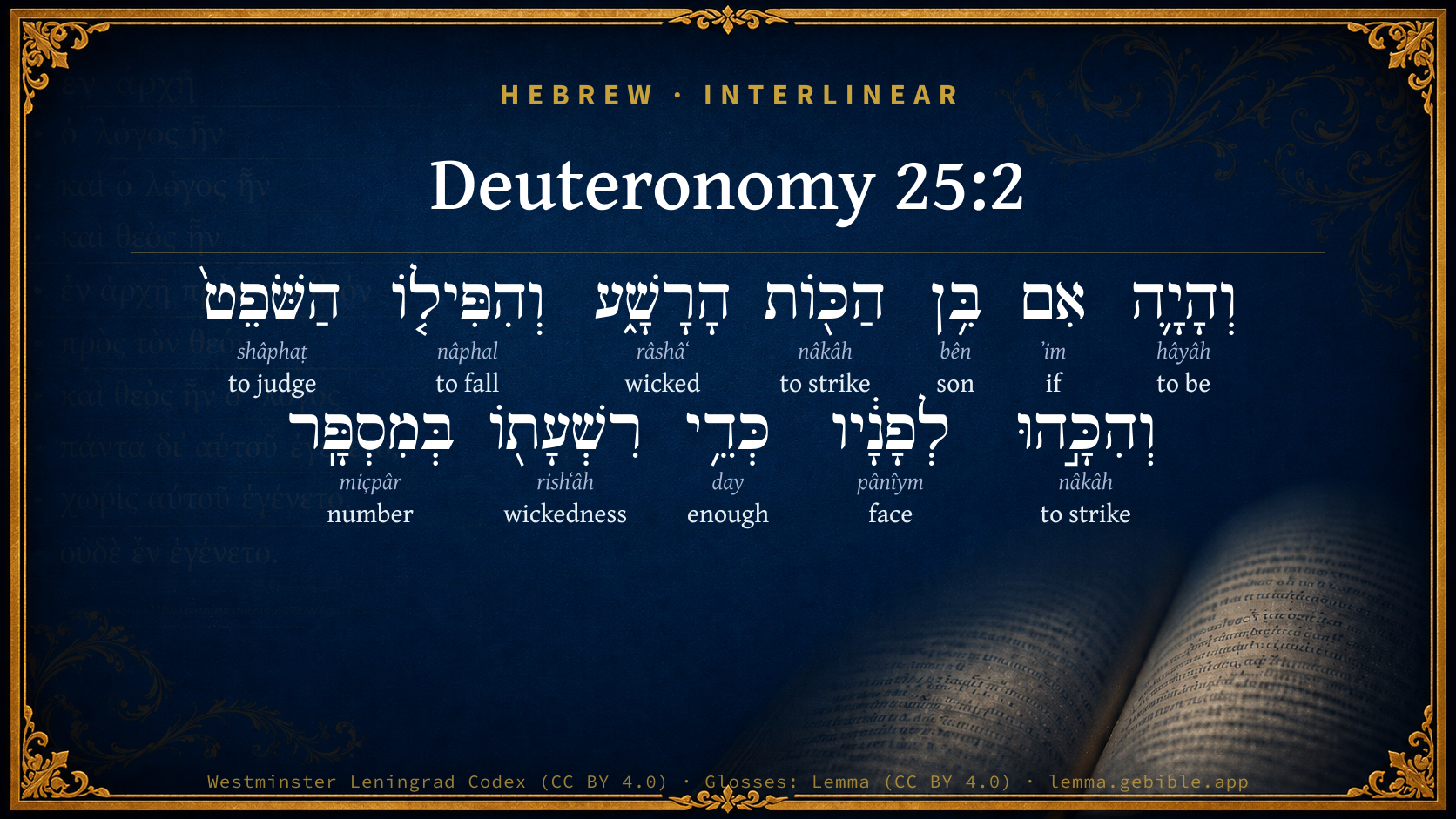
  1. וְהָיָ֛ה hâyâh H1961 “and · to be” Conjunction + Verb, Qal, Sequential Perfect, 3rd Person, Masculine, Singular
  2. אִם ʼim H518 “if” Conjunction
  3. בִּ֥ן bên H1121 “son of” Noun, Common, Masculine, Singular, Construct
  4. הַכּ֖וֹת nâkâh H5221 “to strike” Verb, Hiphil, Infinitive Construct
  5. הָרָשָׁ֑ע râshâʻ H7563 “the · wicked” Particle, Definite Article + Adjective, Adjective, Masculine, Singular, Absolute
  6. וְהִפִּיל֤וֹ nâphal H5307 “and · to fall · him” Conjunction + Verb, Hiphil, Sequential Perfect, 3rd Person, Masculine, Singular + Suffix, Personal, 3rd Person, Masculine, Singular
  7. הַשֹּׁפֵט֙ shâphaṭ H8199 “the · judging” Particle, Definite Article + Verb, Qal, Participle Active, Masculine, Singular, Absolute
  8. וְהִכָּ֣הוּ nâkâh H5221 “and · to strike · him” Conjunction + Verb, Hiphil, Sequential Perfect, 3rd Person, Masculine, Singular + Suffix, Personal, 3rd Person, Masculine, Singular
  9. לְפָנָ֔יו pânîym H6440 “to/for · face(s) · his” Preposition + Noun, Common, Both, Plural, Construct + Suffix, Personal, 3rd Person, Masculine, Singular
  10. כְּדֵ֥י day H1767 “like/as · enough of” Preposition + Noun, Common, Masculine, Singular, Construct
  11. בְּמִסְפָּֽר miçpâr H4557 “in/at · number” Preposition + Noun, Common, Masculine, Singular, Absolute

About this verse

These counts appear in no published source. They are computed here, from the morphology-tagged text and Lemma’s own curated glosses. What Lemma adds →

12
words
11
distinct lemmas
Pentateuch
section

Notable vocabulary

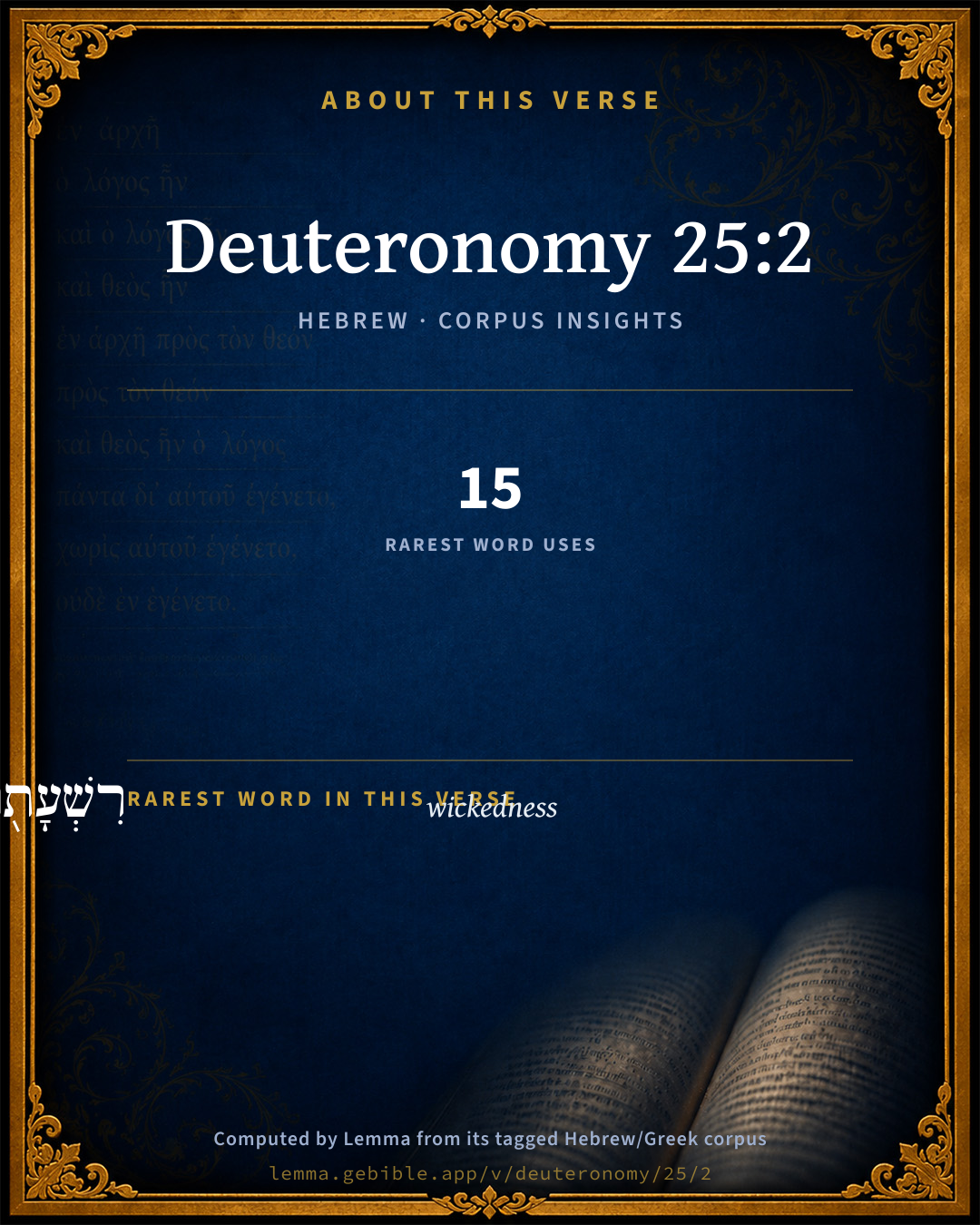
The rarest word here is רִשְׁעָת֖וֹ wickedness H7564 — appearing just 15 times in the whole Hebrew Bible.

Shared distinctive vocabulary

רִשְׁעָת֖וֹ wickedness H7564 occurs in 15 verses of the Hebrew Bible. Also found in:

Grammatical profile

  • 5 verbs
  • 5 nouns
  • 1 adjective
  • 1 conjunction

Verb forms

  • וְהָיָ֛ה Qal · Sequential Perfect
  • הַכּ֖וֹת Hiphil · Infinitive Construct
  • וְהִפִּיל֤וֹ Hiphil · Sequential Perfect
  • הַשֹּׁפֵט֙ Qal · Participle Active
  • וְהִכָּ֣הוּ Hiphil · Sequential Perfect

Repetition

A word recurs within this verse — often emphatic in Hebrew:

  • הַכּ֖וֹת to strike H5221 ×2

Hebrew & Septuagint length

In English translation the verse runs 35 words from the Hebrew and 33 from the Septuagint (LXX English) — closely comparable.

A rough comparison of the two English renderings, which tokenize alike — not a word-level alignment.

Word counts can differ between the Hebrew and the Greek without any difference in meaning — e.g. the Hebrew direct-object marker אֵת has no separate Greek word, and Greek often adds the article ὁ.

Cross-references

7

Topical passages linked to Deuteronomy 25:2 in the Treasury of Scripture Knowledge — connected by theme and wording, ordered by reader-vote popularity; previews shown in the World English Bible.

  • Luke 12:47–48 That servant, who knew his lord's will, and didn't prepare, nor do what he wanted, will be beaten with many stripes,
  • Matthew 10:17 But beware of men: for they will deliver you up to councils, and in their synagogues they will scourge you.
  • Matthew 27:26 Then he released to them Barabbas, but Jesus he flogged and delivered to be crucified.
  • Acts 5:40 They agreed with him. Summoning the apostles, they beat them and charged them not to speak in the name of Jesus, and let them go.
  • Acts 16:22–24 The multitude rose up together against them, and the magistrates tore their clothes off of them, and commanded them to be beaten with rods.
  • 1 Peter 2:20 For what glory is it if, when you sin, you patiently endure beating? But if, when you do well, you patiently endure suffering, this is commendable with God.
  • 1 Peter 2:24 who his own self bore our sins in his body on the tree, that we, having died to sins, might live to righteousness; by whose stripes you were healed.

Cross-references courtesy of OpenBible.info (CC BY 4.0).

Hebrew and Greek witnesses Masoretic Hebrew ↔ Greek Septuagint

The same verse in the two great witnesses to the Old Testament, shown verse-for-verse.

These are two independent witnesses, not word-aligned to each other, and the Septuagint is shown in lemma (dictionary) form.

Hebrew Deuteronomy 25:2 Masoretic · Westminster Leningrad Codex

וְהָיָ֛ה אִם בִּ֥ן הַכּ֖וֹת הָרָשָׁ֑ע וְהִפִּיל֤וֹ הַשֹּׁפֵט֙ וְהִכָּ֣הוּ לְפָנָ֔יו כְּדֵ֥י רִשְׁעָת֖וֹ בְּמִסְפָּֽר

and it shall be, if the wicked man be worthy to be beaten, that the judge shall cause him to lie down, and to be beaten before his face, according to his wickedness, by number.

World English Bible · Public Domain

Greek LXX Deuteronomy 25:2 Septuagint · lemma form

καί εἰμί ἐάν ἄξιος εἰμί πληγή ὁ ἀσεβέω καί καταἵζω αὐτός ἔναντι ὁ κριτής καί μαστιγόω αὐτός ἐναντίον αὐτός κατά ὁ ἀσέβεια αὐτός ἀριθμός

then it shall come to pass, if the unrighteous should be worthy of stripes, you shall lay him down before the judges, and they shall scourge him before them according to his iniquity.

LXX2012 (modern English Septuagint) · Public Domain

Hebrew: Westminster Leningrad Codex (CC BY 4.0). Greek: Septuagint (public domain); English from LXX2012 (modern English Septuagint) (Public Domain). How the Septuagint differs from the Hebrew →

Targum (Aramaic paraphrase)

2

The Targum is the ancient Jewish Aramaic paraphrase of the Hebrew Scriptures — an interpretive translation, not the Hebrew text itself. Onkelos (literal) and Pseudo-Jonathan (expansive) render the Torah, and Jonathan the Prophets. Coverage is partial: where no permissively-licensed English translation exists for a verse, only the Aramaic is shown. This is verse-level text, not a word-by-word alignment to the Hebrew.

  1. Targum Onkelos Torah (Genesis–Deuteronomy)
    וִיהֵי אִם בַּר חַיָבָא לְאַלְקָאָה חַיָבָא וְיִרְמִנֵהּ דַיָנָא וְיַלְקִנֵהּ קֳדָמוֹהִי כְּמִסַת חוֹבְתֵהּ בְּמִנְיָן

    (no public-domain English translation for this verse)

    Targum Onkelos — Aramaic: “Onkelos Genesis” (public domain); “Onkelos Exodus” (public domain); “Onkelos Leviticus” (public domain); “Onkelos Numbers” (public domain); “Onkelos Deuteronomy” (public domain). English: “Sefaria Community Translation” (CC0 1.0 (public-domain dedication)); “J.W. Etheridge. The Targums of Onkelos and Jonathan Ben Uzziel on the Pentateuch. London: Longmans, Green, 1862” (public domain). Text via Sefaria.

  2. Targum Pseudo-Jonathan Torah (Genesis–Deuteronomy)
    וִיהֵי אִין מִתְחַיֵּיב לְמִלְקֵי חַיָּיבָא וְיִרְבְּעִינֵיהּ דַּיָינָא וְיַלְקִינֵיהּ קֳדָמוֹי כְּמֵיסַת חִיּוּבֵיהּ בְּדִינֵיהּ

    And if the wicked deserve stripes, the judge shall make him lie down, and they shall scourge him in his presence by his judgment, according to the measure of his guilt.

    Targum Pseudo-Jonathan — Aramaic: “Targum Jonathan on Genesis” (public domain); “Targum Jonathan on Exodus” (public domain); “Targum Jonathan on Leviticus” (public domain); “Targum Jonathan on Numbers” (public domain); “Targum Jonathan on Deuteronomy” (public domain). English: “The Targum of Jonathan ben Uzziel, trans. J. W. Etheridge, London, 1862” (public domain). Text via Sefaria.

Commentary

Notes on Deuteronomy 25:2 from classic Christian and Jewish commentators (each source and its license shown beneath its notes). The classic Christian expositions comment on the surrounding passage and are grouped to its opening verse, so a note may address several verses; the Jewish commentaries on the Tanakh (Rashi and others) are per-verse, so they appear only where the commentator wrote on this verse.

Lemma curates 59 commentaries, every one of them public domain or Creative Commons licensed, each selected and text-cleaned for this edition rather than reprinted as found. About our sources →

Trapp's Complete Commentary

John Trapp

Deu 25:2 And it shall be, if the wicked man [be] worthy to be beaten, that the judge shall cause him to lie down, and to be beaten before his face, according to his fault, by a certain number.

Ver. 2. To be beaten before his face.] The Turks, when cruelly lashed, are compelled to return to the judge that commanded it, to kiss his hand, to give him thanks, and to pay the officer that whipped them.

John Trapp, A Commentary or Exposition upon All the Books of the Old and New Testament (1647–1656) — public domain. Text from a community e-Sword module.

Joseph Benson's Commentary

Deu 25:2. Worthy to be beaten — Which the Jews say was the case of all those who had committed crimes which the law commands to be punished, without expressing the kind or degree of punishment. Before his face — That the punishment might be duly inflicted, without excess or defect. And from this no person’s rank or quality exempted him, if he were a delinquent.

Joseph Benson's Commentary on the Old and New Testaments (1811–1818) — public domain. Text from a community e-Sword module.

Geneva Bible (1599)

Geneva Bible translators

When the crime deserveth not death.

Geneva Bible (1599) marginal notes — public domain. Text via Bolls.life.

Adam Clarke's Commentary

Verse 2. The judge shall cause him to lie down, and to be beaten before his face] This precept is literally followed in China; the culprit receives in the presence of the magistrate the punishment which the law directs to be inflicted. Thus then justice is done, for the magistrate sees that the letter of the law is duly fulfilled, and that the officers do not transgress it, either by indulgence on the one hand, or severity on the other. The culprit receives nothing more nor less than what justice requires.

Adam Clarke's Commentary on the Bible (1810–1826) — public domain. Text from a community e-Sword/MySword module.

The Cambridge Bible for Schools and Colleges

gen. ed. J. J. S. Perowne

2. then it shall be, if the guilty man be worthy to be beaten] Lit. a son of strokes.

The Cambridge Bible for Schools and Colleges (gen. ed. J. J. S. Perowne; Cambridge University Press, 1878–1918) — public domain. Text from a community e-Sword module.

John Gill's Exposition

And it shall be, if the wicked man be worthy to be beaten,.... There were four kinds of death criminals were put to by the Jews, stoning, strangling, burning, and slaying with the sword; and such crimes not as severe as these were punished with beating or scourging; and who they were that were worthy to be beaten is at large set forth in the Misnic treatise called Maccoth (x), or "stripes", which are too many to be transcribed. Maimonides says (y), that all negative precepts in the law, for the breach of which men are guilty of cutting off, but not of death by the sanhedrim, are to be beaten. They are in all twenty one, and so all deserving of death by the hand of heaven; and they are eighteen, and all negative precepts of the law broken, for which there is neither cutting off nor death by a court of judicature, for these men are to be beaten, and they are one hundred and sixty eight; and all that are to be beaten are found to be two hundred and seven:

that the judge shall cause him to lie down; which seems to be on the floor of the court, since it was to be done immediately, and in the presence of the judge; and the Jews gather (z) from hence, that he was to be beaten neither standing, nor sitting, but bowed; that is, ye shall command or order him to lie down, or to fall upon the ground with his face towards it:

and to be beaten before his face; in the presence of the judge, that the sentence might be properly executed, neither exceeded not diminished; and indeed all the judges were to be present, especially the bench of three; while he was beating, the chief of the judges read the passage in Deu 28:58; and he that was next to him counted the strokes, and the third at every blow said Smite (a): of the manner of beating or scourging; see Gill on Mat 10:17,

according to his fault, by a certain number; as his crime and wickedness was more or less heinous, more or fewer stripes were to be laid on him; as ten or twenty, fewer or more, according to the nature of his offence, as Aben Ezra observes, only he might not add above forty; though he says there are some who say that according to his fault the stripes are larger or lesser, but all of them in number forty.

(x) Ib. c. 3. sect. 1. 2, 3, &c. (y) Hilchot Sanhedrin, c. 19. sect. 1. (z) Misn. Maccot, c. 3. sect. 13. (a) Maimon & Bartenora in ib. sect. 14.

John Gill's Exposition of the Whole Bible (1746–1763) — public domain (CC PDM 1.0). Text via the HelloAO Bible API.

Haydock's Catholic Bible Commentary

Down, tying him to a low pillar; (Menochius) (Grotius) though many assert, that the criminal was forced to lie prostrate on the ground, as the Jews still do, in Germany, when they undergo this punishment. (Buxtorf, Syn. 20.) The Jews do not commonly give above 39 strokes, and double the number is inflicted on the back, from what fall upon the breast.

George Leo Haydock (1774–1849), Haydock's Catholic Family Bible and Commentary, 1859 edition — public domain. Excludes Psalms (Douay-Rheims chapter numbering differs from Protestant) and Deuterocanonical books (Catholic canon only).

Matthew Poole's English Annotations

Worthy to be beaten; which the Jews say was the case of all those crimes which the law commands to be punished, without expressing the kind or degree of the punishment.

Before his face; that the punishment may be duly inflicted, without excess or defect, which otherwise might easily happen through the executioner’s passion or partiality.

Matthew Poole's English Annotations on the Holy Bible (1683–1685) — public domain. Text from a community e-Sword/MySword module.

Whedon's Commentary on the Bible

Daniel D. Whedon

2. The judge shall cause him to lie down — The punishment was inflicted on the back. This was the Egyptian method also, as can be seen from representations on the monuments. The culprit lies flat on the ground, being held fast by his hands and feet, and receiving his punishment in the presence of the judge.

Daniel D. Whedon (gen. ed.), Commentary on the Old and New Testaments (1874–1909) — public domain. Text from a community e-Sword module.

John Wesley's Explanatory Notes

Beaten - Which the Jews say was the case of all those crimes which the law commands to be punished, without expressing the kind or degree of punishment. Before his face - That the punishment may be duly inflicted, without excess or defect. And from this no person's rank or quality exempted him, if he was a delinquent.

John Wesley, Explanatory Notes Upon the Whole Bible (1754–1765) — public domain. Text via the GEBible commentary corpus.

Rashi

Rabbi Shlomo Yitzchaki (Rashi)

והפילו השפט AND THE JUDGE SHALL CAUSE HIM TO FALL DOWN — This teaches that one is not lashed whilst standing or sitting but only when bending (Makkot 22b).

לפניו כדי רשעתו [AND THE JUDGE SHALL … SMITE HIM] IN FRONT ACCORDING TO HIS WICKEDNESS (כדי רשעתו may mean “as much as is sufficient for his wickedness”, i.e., for one part of his wickedness, רשעתו being singular) — in front (on his chest) corresponding to one part of his wickedness, and on his back corresponding to two parts: hence they (the Rabbis) derived that one must give him (anyone sentenced to lashes) two-thirds on his back and one third on his chest (Sifrei Devarim 286:6; Makkot 22b, 23a).

בְּמספר BY A NUMBER — but it (the word) is not punctuated בַּמספר by the number; this shows that it is connected with the following word, to read בְּמִסְפַּר ארבעים [“he shall smite him”] … by the number of forty, (i.e. by the number leading to forty), not, however, a full forty, but a number that leads up to the full total of forty, i.e., forty less one (Makkot 22a).

Rashi on the Tanakh — English translations: “The Judaica Press complete Tanach with Rashi, translated by A. J. Rosenberg” (CC BY 4.0); “Pentateuch with Rashi's commentary by M. Rosenbaum and A.M. Silbermann, 1929-1934” (public domain); “The Metsudah Tanach series, Lakewood, N.J” (CC BY 4.0); and “The Book of Joshua, Metsudah Publications, 1997” (CC BY 4.0). Text via Sefaria.

Lesson kit

Teaching starters — assembled from the data on this page, not authored interpretation. Every prompt links to the verse data it draws on. Edit before teaching.

Deuteronomy, in the Pentateuch, opens this verse with 12 words (11 distinct Hebrew lemmas). Its most distinctive word is rishʻâh (“wickedness”). A historical commentator’s framing appears above. Read the whole chapter for the surrounding context.

Discussion questions

  1. What does “wickedness” (rishʻâh) contribute to the verse as a whole?
  2. Deuteronomy 9:4 shares the word «wickedness» with this verse. How do the two illuminate each other?
  3. “to strike” occurs 2× in this one verse. What is the effect of the repetition?
  4. The translations on this page render this verse differently — a whole-verse word diff, not a word-by-word alignment. What might account for the different wordings?
  5. The verb «וְהָיָ֛ה» is Qal Sequential Perfect. How does its form color the action?
  6. Reading how Trapp's Complete Commentary and Joseph Benson's Commentary read this verse, where do the two commentators agree and where do they part?

Things to notice

Reading settings

Reading text

Shown beneath each verse's original-language words.

Old Testament
Old Testament edition

Read the OT as the Masoretic Hebrew (MT) or the Greek Septuagint (LXX).

English shown for the Greek Septuagint (in the Hebrew ↔ Greek comparison).

Comparing translations? Open the Compare panel on any verse page to stack up to four side by side.