
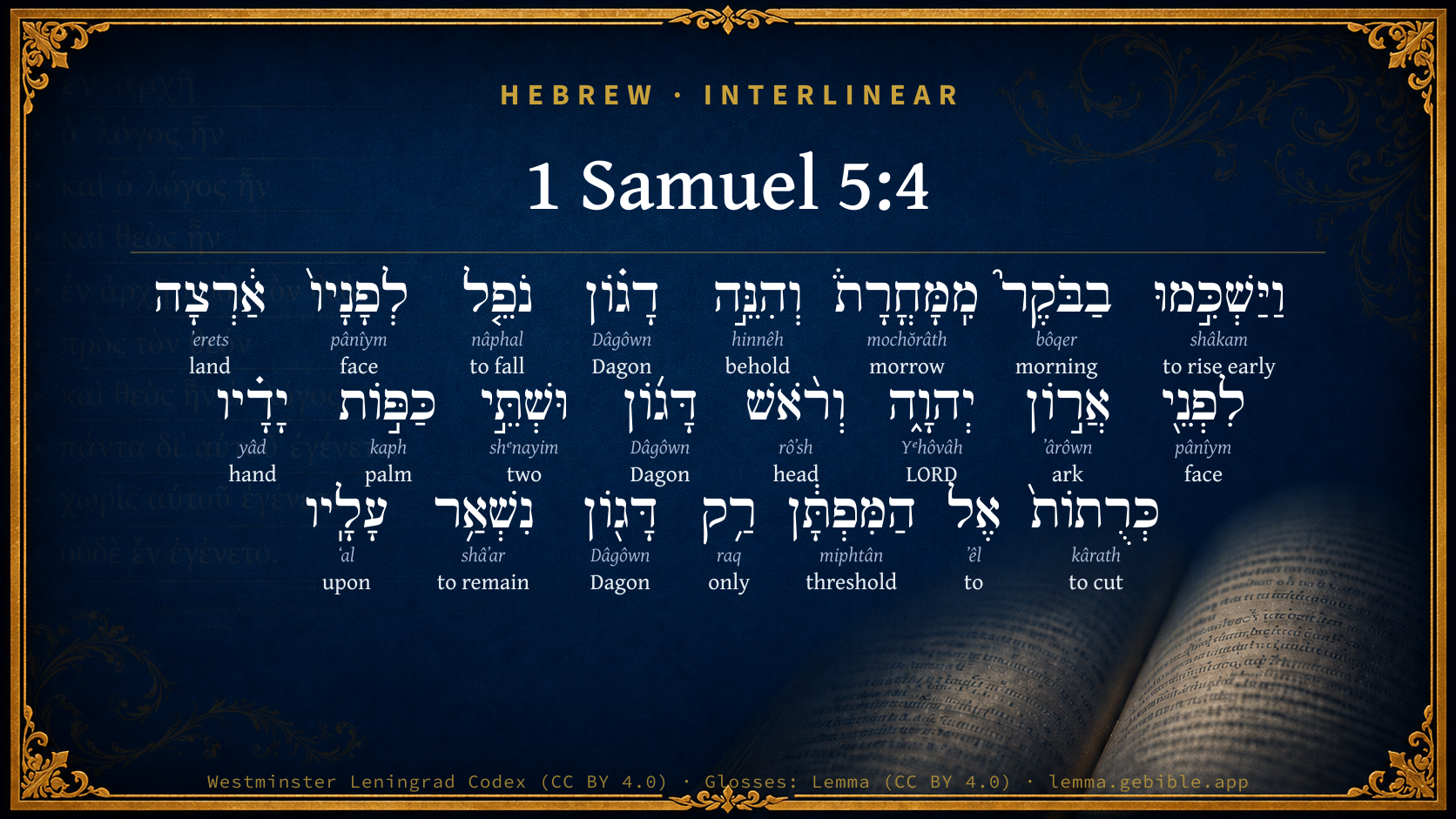
1 Samuel 5:4

Hebrew (Westminster Leningrad Codex) 1 Samuel 5:4 appears in the Hebrew Old Testament. The text above is from the Westminster Leningrad Codex. Each word links to its Strong’s number, a concise gloss, and parsing drawn from the Open Scriptures Hebrew Bible morphology. Click any word for its full Brown-Driver-Briggs (BDB) entry.
Download image
Cite this verse

1 Samuel 5:4 (World English Bible). Public Domain. Lemma interlinear Bible study tool, https://lemma.gebible.app/v/1-samuel/5/4.

Show BibTeX & RIS
BibTeX
RIS
English Translation
When they arose early on the next day morning, behold, Dagon was fallen on his face to the ground before the ark of Yahweh; and the head of Dagon and both the palms of his hands [lay] cut off on the threshold; only [the stump of] Dagon was left to him.
World English Bible · Public Domain
Highlights
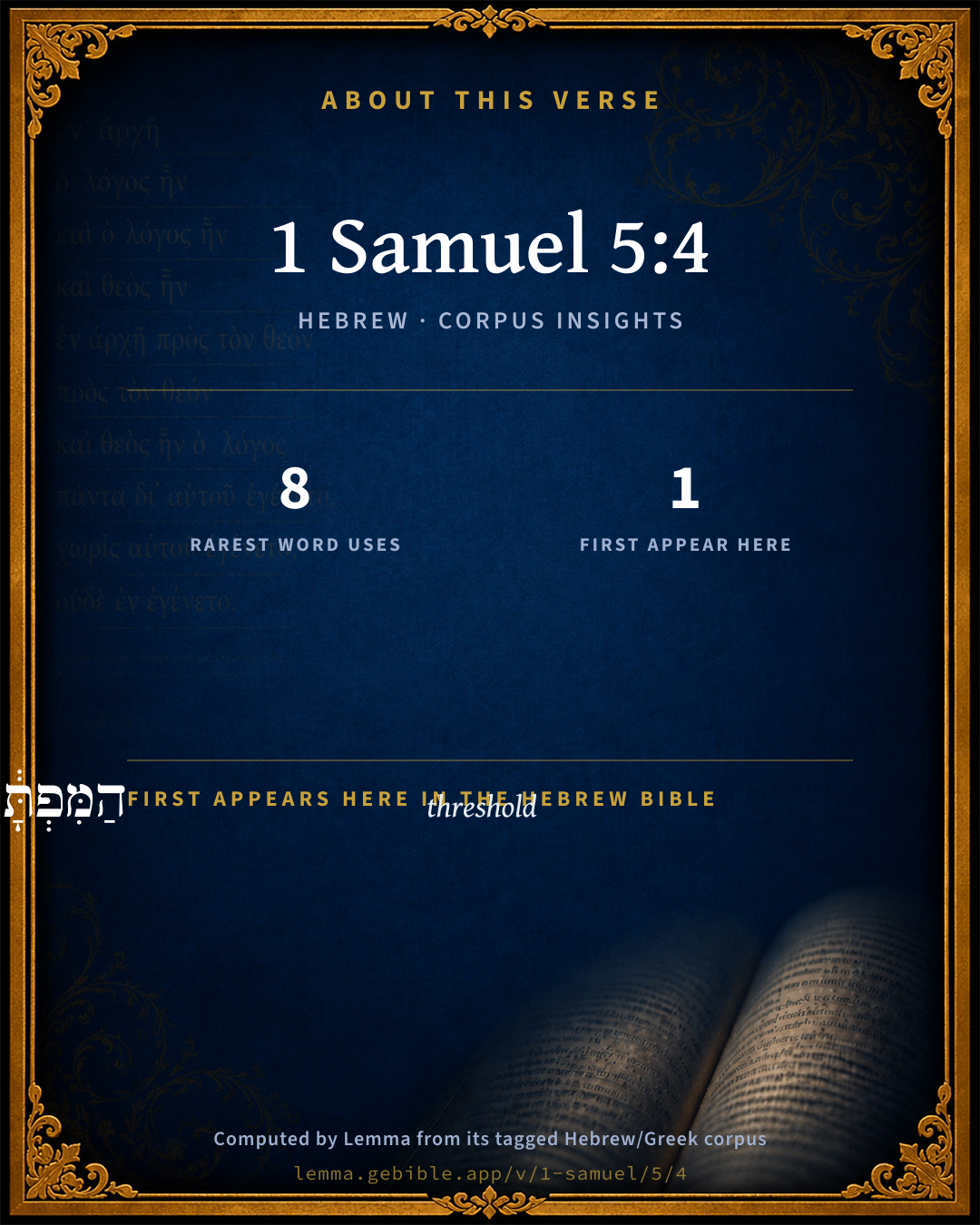
  • 1 first appearance in the Hebrew Bible
Full analysis ↓
Download a study sheet

One document with this verse’s original text, its word-by-word gloss line, the meaning frame, cross-references with their text, attributed commentary, and full source and license credits — printable, and it pastes into notes with its structure intact.

This verse Autodidact and up

Study sheet (.html) Plain text (.txt)

A passage Seminary Student

Up to 50 verses in one chapter. A passage sheet keeps up to 6 commentary sources and 12 cross-references per verse, in the order this page ranks them, and says so on the sheet whenever that leaves anything out. Ask for a single verse and you get the Autodidact verse sheet above.

Everything on this page stays free to read, with no account — the sheet is a download of what is already on screen, not access to it.

Want to remove ads? Support Godless Engineer
Compare translations 3

The same verse in 3 English versions, stacked beneath the original-language interlinear above. Click any original word for its lexicon entry.

Each is an independent rendering of the whole verse — the interlinear is not word-aligned to these translations.

Highlighted words mark where these versions differ — a whole-verse word diff, not a word-by-word alignment.

  • World English Bible Public Domain
    When they arose early on the next day morning, behold, Dagon was fallen on his face to the ground before the ark of Yahweh; and the head of Dagon and both the palms of his hands [lay] cut off on the threshold; only [the stump of] Dagon was left to him.
  • King James Version Public Domain
    And when they arose early on the morrow morning, behold, Dagon was fallen upon his face to the ground before the ark of the LORD; and the head of Dagon and both the palms of his hands were cut off upon the threshold; only the stump of Dagon was left to him.
  • unfoldingWord Literal Text CC BY-SA 4.0
    And they arose early in the morning on the next day, and behold, Dagon had fallen on his face to the ground to the face of the Box of Yahweh. And the head of Dagon and the two of the palms of his hands were cut off, on the threshold. Only Dagon was left on him.

unfoldingWord Literal Text — © unfoldingWord, licensed CC BY-SA 4.0. Word-aligned USFM3 via Door43 (git.door43.org/unfoldingWord/en_ult).

Versions to compare (up to 4)

3 of 4 selected

Show all 18 translations

Every available English version of this verse, each an independent rendering of the whole verse.

  • World English Bible Public Domain
    When they arose early on the next day morning, behold, Dagon was fallen on his face to the ground before the ark of Yahweh; and the head of Dagon and both the palms of his hands [lay] cut off on the threshold; only [the stump of] Dagon was left to him.
  • Berean Standard Bible Public Domain
    But when they got up early the next morning, there was Dagon, fallen on his face before the ark of the LORD, with his head and his hands broken off and lying on the threshold. Only the torso remained.
  • Majority Standard Bible Public Domain
    But when they got up early the next morning, there was Dagon, fallen on his face before the ark of the LORD, with his head and his hands broken off and lying on the threshold. Only the torso remained.
  • King James Version Public Domain
    And when they arose early on the morrow morning, behold, Dagon was fallen upon his face to the ground before the ark of the LORD; and the head of Dagon and both the palms of his hands were cut off upon the threshold; only the stump of Dagon was left to him.
  • American Standard Version (1901) Public Domain
    And when they arose early on the morrow morning, behold, Dagon was fallen upon his face to the ground before the ark of Jehovah; and the head of Dagon and both the palms of his hands `lay' cut off upon the threshold; only `the stump of' Dagon was left to him.
  • Revised Version (1885) Public Domain
    And when they arose early on the morrow morning, behold, Dagon was fallen upon his face to the ground before the ark of the LORD; and the head of Dagon and both the palms of his hands lay cut off upon the threshold; only the stump of Dagon was left to him.
  • Geneva Bible (1599) Public Domain
    Also they rose vp earely in the morning the next day, and beholde, Dagon was fallen vpon his face on the ground before the Arke of the Lord, and the head of Dagon and the two palmes of his hands were cut off vpon the thresholde: onely the stumpe of Dagon was left to him.
  • Douay-Rheims (1899) Public Domain
    And the next day again, when they rose in the morning, they found Dagon lying upon his face on the earth before the ark of the Lord: and the head of Dagon, and both the palms of his hands were cut off upon the threshold:
  • Young's Literal Translation Public Domain
    And they rise early in the morning on the morrow, and lo, Dagon is fallen on its face to the earth, before the ark of Jehovah, and the head of Dagon, and the two palms of its hands are cut off at the threshold, only the fishy part hath been left to him;
  • Literal Standard Version CC BY-SA 4.0
    And they rise early in the morning on the next day, and behold, Dagon is fallen on its face to the earth, before the Ark of YHWH, and the head of Dagon, and the two palms of its hands are cut off at the threshold, only Dagon’s [body] has been left of him;
  • Unlocked Literal Bible CC BY-SA 4.0
    But when they got up early the next morning, behold, Dagon had fallen facedown on the ground before the ark of Yahweh. The head of Dagon and both of his hands were lying cut off in the doorway. Only the trunk of Dagon remained.
  • unfoldingWord Literal Text CC BY-SA 4.0
    And they arose early in the morning on the next day, and behold, Dagon had fallen on his face to the ground to the face of the Box of Yahweh. And the head of Dagon and the two of the palms of his hands were cut off, on the threshold. Only Dagon was left on him.
  • Darby Bible Public Domain
    And when they arose early the next morning, behold, Dagon had fallen on his face to the ground before the ark of Jehovah; and the head of Dagon and both the palms of his hands were cut off upon the threshold; only the fish-stump was left to him.
  • World Messianic Bible Public Domain
    When they arose early on the following morning, behold, Dagon had fallen on his face to the ground before the LORD’s ark; and the head of Dagon and both the palms of his hands were cut off on the threshold. Only Dagon’s torso was intact.
  • Webster's Bible Public Domain
    And when they arose early on the morrow morning, behold, Dagon had fallen upon his face to the ground before the ark of the LORD: and the head of Dagon and both the palms of his hands were cut off upon the threshhold; only the stump of Dagon was left to him.
  • Free Bible Version CC BY-SA 4.0
    When they got up early the next morning, they saw Dagon had fallen on his face in front of the Ark of the Lord, with his head and hands broken off lying on the doorstep. Only his body remained intact.
  • Bible in Basic English Public Domain
    And when they got up early on the morning after, Dagon had come down to the earth on his face before the ark of the Lord; and his head and his hands were broken off on the doorstep; only the base was in its place.
  • JPS Tanakh (1917) Public Domain
    And when they arose early on the morrow morning, behold, Dagon was fallen upon his face to the ground before the ark of the LORD; and the head of Dagon and both the palms of his hands lay cut off upon the threshold; only the trunk of Dagon was left to him.

Literal Standard Version (2020), Covenant Press — licensed CC BY-SA 4.0. Text via the HelloAO Bible API (eBible.org). Unlocked Literal Bible (unfoldingWord) — licensed CC BY-SA 4.0. Text via the HelloAO Bible API (eBible.org). unfoldingWord Literal Text — © unfoldingWord, licensed CC BY-SA 4.0. Word-aligned USFM3 via Door43 (git.door43.org/unfoldingWord/en_ult). Free Bible Version, Dr. Jonathan Gallagher — licensed CC BY-SA 4.0. Text via the HelloAO Bible API (eBible.org).

Word by word

More ways to search: Search by grammar → Find every occurrence → Compare this word →

Practice this passage: Drill this verse → Learn its vocabulary →

הַמִּפְתָּ֔ן
miphtân
H4670
“the · threshold”
Particle, Definite Article + Noun, Common, Masculine, Singular, Absolute
Part of Speech
Particle + Noun
Type
Common
Gender
Masculine
Number
Singular
State
Absolute
Full BDB Definition

Origin: from the same as H6620

TWOT: 1858b

threshold
  1. וַיַּשְׁכִּ֣מוּ shâkam H7925 “and · to rise early” Conjunction + Verb, Hiphil, Sequential Imperfect, 3rd Person, Masculine, Plural
  2. בַבֹּקֶר֮ bôqer H1242 “in/at the · morning” Preposition, Determined + Noun, Common, Masculine, Singular, Absolute
  3. מִֽמָּחֳרָת֒ mochŏrâth H4283 “from · morrow” Preposition + Noun, Common, Feminine, Singular, Absolute
  4. וְהִנֵּ֣ה hinnêh H2009 “and · behold” Conjunction + Particle, Demonstrative
  5. דָג֗וֹן Dâgôwn H1712 “Dagon” Noun, Proper
  6. נֹפֵ֤ל nâphal H5307 “falling” Verb, Qal, Participle Active, Masculine, Singular, Absolute
  7. לְפָנָיו֙ pânîym H6440 “to/for · face(s) · his” Preposition + Noun, Common, Both, Plural, Construct + Suffix, Personal, 3rd Person, Masculine, Singular
  8. אַ֔רְצָה ʼerets H776 “land · toward” Noun, Common, Both, Singular, Absolute + Suffix, Demonstrative
  9. לִפְנֵ֖י pânîym H6440 “to/for · face(s) of” Preposition + Noun, Common, Both, Plural, Construct
  10. אֲר֣וֹן ʼârôwn H727 “ark of” Noun, Common, Both, Singular, Construct
  11. יְהוָ֑ה Yᵉhôvâh H3068 “LORD” Noun, Proper
  12. וְרֹ֨אשׁ rôʼsh H7218 “and · head of” Conjunction + Noun, Common, Masculine, Singular, Construct
  13. דָּג֜וֹן Dâgôwn H1712 “Dagon” Noun, Proper
  14. וּשְׁתֵּ֣י shᵉnayim H8147 “and · two” Conjunction + Adjective, Cardinal number, Feminine, Dual, Construct
  15. כַּפּ֣וֹת kaph H3709 “palms of” Noun, Common, Feminine, Plural, Construct
  16. יָדָ֗יו yâd H3027 “hands · his” Noun, Common, Both, Dual, Construct + Suffix, Personal, 3rd Person, Masculine, Singular
  17. כְּרֻתוֹת֙ kârath H3772 “cut” Verb, Qal, Participle Passive, Feminine, Plural, Absolute
  18. אֶל ʼêl H413 “to” Preposition
  19. רַ֥ק raq H7535 “only” Particle, Accusative
  20. דָּג֖וֹן Dâgôwn H1712 “Dagon” Noun, Proper
  21. נִשְׁאַ֥ר shâʼar H7604 “to remain” Verb, Niphal, Perfect, 3rd Person, Masculine, Singular
  22. עָלָֽיו ʻal H5921 “upon · him” Preposition + Suffix, Personal, 3rd Person, Masculine, Singular

About this verse

These counts appear in no published source. They are computed here, from the morphology-tagged text and Lemma’s own curated glosses. What Lemma adds →

23
words
20
distinct lemmas
Historical
section

Notable vocabulary

The rarest word here is הַמִּפְתָּ֔ן threshold H4670 — appearing just 8 times in the whole Hebrew Bible.

First appearance in Scripture

This word makes its first canonical appearance in the Hebrew Bible here:

  • הַמִּפְתָּ֔ן threshold H4670

Shared distinctive vocabulary

הַמִּפְתָּ֔ן threshold H4670 occurs in 8 verses of the Hebrew Bible. Also found in:

Grammatical profile

  • 4 verbs
  • 14 nouns
  • 1 adjective
  • 2 prepositions
  • 2 particles

Verb forms

  • וַיַּשְׁכִּ֣מוּ Hiphil · Sequential Imperfect
  • נֹפֵ֤ל Qal · Participle Active
  • כְּרֻתוֹת֙ Qal · Participle Passive
  • נִשְׁאַ֥ר Niphal · Perfect

Repetition

Words recur within this verse — often emphatic in Hebrew:

  • דָג֗וֹן Dagon H1712 ×3
  • לְפָנָיו֙ face H6440 ×2

Hebrew & Septuagint length

In English translation the verse runs 51 words from the Hebrew and 69 from the Septuagint (LXX English) — closely comparable.

A rough comparison of the two English renderings, which tokenize alike — not a word-level alignment.

Word counts can differ between the Hebrew and the Greek without any difference in meaning — e.g. the Hebrew direct-object marker אֵת has no separate Greek word, and Greek often adds the article ὁ.

Cross-references

7

Topical passages linked to 1 Samuel 5:4 in the Treasury of Scripture Knowledge — connected by theme and wording, ordered by reader-vote popularity; previews shown in the World English Bible.

  • Micah 1:7 All her idols will be beaten to pieces, And all her temple gifts will be burned with fire, And all her images I will destroy; For of the hire of a prostitute has she gathered them, And to the hire of a prostitute shall they return."
  • Isaiah 2:18–19 The idols shall utterly pass away.
  • Jeremiah 10:11 Thus shall you say to them, The gods that have not made the heavens and the earth, these shall perish from the earth, and from under the heavens.
  • Jeremiah 50:2 Declare you among the nations and publish, and set up a standard; publish, and don't conceal: say, Babylon is taken, Bel is disappointed, Merodach is dismayed; her images are disappointed, her idols are dismayed.
  • Isaiah 27:9 Therefore by this shall the iniquity of Jacob be forgiven, and this is all the fruit of taking away his sin: that he makes all the stones of the altar as chalk stones that are beaten in sunder, [so that] the Asherim and the sun-images shall rise no more.
  • Ezekiel 6:4–6 Your altars shall become desolate, and your sun-images shall be broken; and I will cast down your slain men before your idols.
  • Daniel 11:8 Also their gods, with their molten images, [and] with their goodly vessels of silver and of gold, shall he carry captive into Egypt; and he shall refrain some years from the king of the north.

Cross-references courtesy of OpenBible.info (CC BY 4.0).

Hebrew and Greek witnesses Masoretic Hebrew ↔ Greek Septuagint

The same verse in the two great witnesses to the Old Testament, shown verse-for-verse.

These are two independent witnesses, not word-aligned to each other, and the Septuagint is shown in lemma (dictionary) form.

Hebrew 1 Samuel 5:4 Masoretic · Westminster Leningrad Codex

וַיַּשְׁכִּ֣מוּ בַבֹּקֶר֮ מִֽמָּחֳרָת֒ וְהִנֵּ֣ה דָג֗וֹן נֹפֵ֤ל לְפָנָיו֙ אַ֔רְצָה לִפְנֵ֖י אֲר֣וֹן יְהוָ֑ה וְרֹ֨אשׁ דָּג֜וֹן וּשְׁתֵּ֣י כַּפּ֣וֹת יָדָ֗יו כְּרֻתוֹת֙ אֶל הַמִּפְתָּ֔ן רַ֥ק דָּג֖וֹן נִשְׁאַ֥ר עָלָֽיו

When they arose early on the next day morning, behold, Dagon was fallen on his face to the ground before the ark of Yahweh; and the head of Dagon and both the palms of his hands [lay] cut off on the threshold; only [the stump of] Dagon was left to him.

World English Bible · Public Domain

Greek LXX 1 Samuel 5:4 Septuagint · lemma form

καί γίγνομαι ὅτε ὀρθρίζω ὁ πρωΐ καί ἰδού δαγων πίπτω ἐπί πρόσωπον αὐτός ἐνώπιον κιβωτός διαθήκη κύριος καί ὁ κεφαλή δαγων καί ἀμφότεροι ὁ ἴχνος χείρ αὐτός ἀποαἱρέω ἐπί ὁ ἐμπρόσθιον αμαφεθ ἕκαστος καί ἀμφότεροι ὁ καρπός ὁ χείρ αὐτός πίπτω ἐπί ὁ πρόθυρον πλήν ὁ ῥάχις δαγων ὑπολείπω

And it came to pass when they rose early in the morning, behold, Dagon had fallen on his face before the ark of the covenant of the Lord; and the head of Dagon and both the palms of his hands were cut off each before the threshold, and both the wrists of his hands had fallen on the floor of the porch; only the stump of Dagon was left.

LXX2012 (modern English Septuagint) · Public Domain

On this verse, Whedon's Commentary on the Bible discusses the Septuagint’s reading. Read the note in Commentary ↓

Hebrew: Westminster Leningrad Codex (CC BY 4.0). Greek: Septuagint (public domain); English from LXX2012 (modern English Septuagint) (Public Domain). How the Septuagint differs from the Hebrew →

Targum (Aramaic paraphrase)

1

The Targum is the ancient Jewish Aramaic paraphrase of the Hebrew Scriptures — an interpretive translation, not the Hebrew text itself. Onkelos (literal) and Pseudo-Jonathan (expansive) render the Torah, and Jonathan the Prophets. Coverage is partial: where no permissively-licensed English translation exists for a verse, only the Aramaic is shown. This is verse-level text, not a word-by-word alignment to the Hebrew.

  1. Targum Jonathan Prophets (Joshua–Malachi)
    וְאַקְדִימוּ בְצַפְרָא בְּיוֹמָא דְבַתְרוֹהִי וְהָא דָגוֹן רָמֵי עַל אַפּוֹהִי עַל אַרְעָא קֳדָם אֲרוֹנָא דַייָ וְרֵישׁ דָגוֹן וְתַרְתֵּין פִּיסַת יְדוֹהִי קְצִיצָן מַחְתָא עַל סְקוּפְתָּא לְחוֹד גוּפֵיהּ אִשְׁתָּאַר עֲלוֹהִי:

    (no public-domain English translation for this verse)

    Targum Jonathan — Aramaic: “Mikraot Gedolot” (public domain). English: “Sefaria Community Translation” (CC0 1.0 (public-domain dedication)); “London "Chaldee Paraphrase," 1871” (public domain). Text via Sefaria.

Commentary

Notes on 1 Samuel 5:4 from classic Christian and Jewish commentators (each source and its license shown beneath its notes). The classic Christian expositions comment on the surrounding passage and are grouped to its opening verse, so a note may address several verses; the Jewish commentaries on the Tanakh (Rashi and others) are per-verse, so they appear only where the commentator wrote on this verse.

Lemma curates 59 commentaries, every one of them public domain or Creative Commons licensed, each selected and text-cleaned for this edition rather than reprinted as found. About our sources →

Trapp's Complete Commentary

John Trapp

1Sa 5:4 And when they arose early on the morrow morning, behold, Dagon [was] fallen upon his face to the ground before the ark of the LORD; and the head of Dagon and both the palms of his hands [were] cut off upon the threshold; only [the stump of] Dagon was left to him.

Ver. 4. Behold, Dagon was fallen, &c.] This second fall convinced them that it was no chance, but the very finger of God. {1Sa 5:7} Woe, woe to our stupidity. Vae, vae stupori nostro.

And the head of Dagon and both the palms of his hands.] The head, saith Peter Martyr, signifieth wisdom, and the hands power. To show them that he had neither wisdom nor power to help them, was this done.

Upon the threshold.] That those that came to his temple to worship him might now tread upon him, as unsavoury salt, as a dunghill deity. But they made no such good use of it, as appeareth by the sequel.

Only the stump of Dagon was left to him,] i.e., The fishy part, whence he had his name; for of his feet there is no mention made, and his shoulders, breast, and belly were battered and mutilated.

John Trapp, A Commentary or Exposition upon All the Books of the Old and New Testament (1647–1656) — public domain. Text from a community e-Sword module.

Joseph Benson's Commentary

1Sa 5:4-5. Behold Dagon was fallen &c. — Which showed that his former fall was not by chance, but by the power of God, before whom he could not stand. The head of Dagon, and both his hands, were cut off — The head is the seat of wisdom; the hands the instruments of action; both are cut off, to show that he had neither wisdom nor strength to defend himself or his worshippers. Thus the priests, by concealing Dagon’s shame before, make it more evident and infamous. The stump — Hebrew, only Dagon; that is, saith Rabbi Kimchi, that part of it from which it was called Dagon, namely, the fishy part; for dag, in Hebrew, signifies a fish. Upon it — Upon the threshold; there the trunk abode in the place where it fell, but the head and hands were flung to distant places. Neither the priests tread on the threshold of Dagon — Out of reverence to it, looking upon it as a holy thing, by the touch of Dagon’s head and hands. So foolishly did they pervert the meaning of God, that instead of being convinced that Dagon was no god, they even honoured the threshold which his broken limbs had fallen upon! Unto this day — When this history was written, which, if written by Samuel toward the end of his life, was a sufficient ground for this expression.

Joseph Benson's Commentary on the Old and New Testaments (1811–1818) — public domain. Text from a community e-Sword module.

Tyndale Open Study Notes

Tyndale Open Resources

5:4 his head and hands had broken off: A symbol of God’s supremacy over the idol (5:7; see also 17:51).

Tyndale Open Study Notes — © Tyndale Open Resources, licensed CC BY-SA 4.0. Text via the HelloAO Bible API.

Adam Clarke's Commentary

Verse 4. Only the stump of Dagon was left] Literally, Only דגן dagon (i.e., the little fish) was left. It has already been remarked that Dagon had the head, arms and hands of a man or woman, and that the rest of the idol was in the form of a fish, to which Horace is supposed to make allusion in the following words: -

Desinat in piscem mulisr formosa superne

"The upper part resembling a beautiful woman; the lower, a fish."

All that was human in his form was broken off from what resembled a fish. Here was a proof that the affair was not accidental; and these proofs of God's power and authority prepared the way for his judgments.

Adam Clarke's Commentary on the Bible (1810–1826) — public domain. Text from a community e-Sword/MySword module.

Ellicott's Commentary for English Readers

(4) When they arose early on the morrow.—Strange to say, on the next day a new and startling circumstance aroused and disturbed the exultant Philistines. The idol was again fallen, but this time broken. No mere accident could account for what had happened. The head and hands were severed from the image, and thrown contemptuously on the threshold of the temple, upon which the foot of every priest or worshipper as he passed into the sacred house must tread.

Only the stump of Dagon.—The Hebrew, rendered literally, would run, only Dagon was left to him: that is to say, only “the fish,” the least noble part of the idol image, was left standing; the human head and hands were tossed down for men as they passed in to trample on; “only the form of a fish was left in him.”—R. D. Kimchi.

A Bible Commentary for English Readers, edited by Charles John Ellicott (1878–1897) — public domain. Text from a community e-Sword module.

The Cambridge Bible for Schools and Colleges

gen. ed. J. J. S. Perowne

4. cut off upon the threshold] i.e. cut off and lying upon the doorsill, probably not of the main entrance to the temple, but of the chapel or recess in which the statue stood. In this position they would be liable to the indignity of being trampled upon by the priests and worshippers who entered the shrine.

only the stump of Dagon was left to him] Lit., only Dagon was left upon him. Either some word for ‘trunk’ or ‘body’ has been lost in the original, or ‘Dagon’ is used to denote the fish-shaped body of the idol, from which the god derived his name.

“Next came one

Who mourned in earnest, when the captive ark

Maimed his brute image, head and hands lopped off

In his own temple, on the grunsel edge,

Where he fell flat, and shamed his worshippers.”

Paradise Lost, I. 457.

The Cambridge Bible for Schools and Colleges (gen. ed. J. J. S. Perowne; Cambridge University Press, 1878–1918) — public domain. Text from a community e-Sword module.

John Gill's Exposition

And when they arose early on the morrow morning,.... For the same purpose as before; unless they had any curiosity to indulge, to see whether the ark and Dagon agreed better together, if they had any suspicion that the former mischance was to be attributed to some variance and disagreement between them:

behold, Dagon was fallen upon his face to the ground before the ark of the Lord: again, and in a worse condition than before:

and the head of Dagon, and both the palms of his hands, were cut off upon the threshold; of the temple, upon which he fell with such force, that the threshold cut off his head, and both his hands; which signified he had neither wisdom to contrive for his own safety, nor strength and power to defend himself; and therefore of what advantage could he be to his votaries? This may be an emblem of the fall of idolatry in the Gentile world, before the preaching of Christ and his Gospel in it; or of the idol of man's righteousness, which is set up, though it cannot stand, against the righteousness of Christ, and of man's renouncing that, when convinced of the weakness and insufficiency of it, and submitting to the righteousness of Christ:

only the stump of Dagon was left to him: his body, as the Targum, his head and hands being cut off; or, as it is in the Hebrew text, only Dagon was left; that is, the fishy part of this idol; for "Dag" signifies a fish; and, as Kimchi relates, this idol, from the navel upwards, had the form of a man, and from thence downwards the form of a fish; and it was the lower part that was left; See Gill on Jdg 16:23.

John Gill's Exposition of the Whole Bible (1746–1763) — public domain (CC PDM 1.0). Text via the HelloAO Bible API.

Haydock's Catholic Bible Commentary

Threshold. The idol is treated worse the second time. (Menochius)

George Leo Haydock (1774–1849), Haydock's Catholic Family Bible and Commentary, 1859 edition — public domain. Excludes Psalms (Douay-Rheims chapter numbering differs from Protestant) and Deuterocanonical books (Catholic canon only).

Matthew Poole's English Annotations

The

head is the seat of wisdom; the hands, the instruments of action: both are cut off, to show that he had neither wisdom nor strength to defend himself nor his worshippers. This the priests, by concealing Dagon’s shame before, make it more evident and infamous.

Only the stump of Dagon, Heb. only Dagon, i.e. that part of it from which it was called Dagon, to wit, the fishy part, for dag in Hebrew signifies a fish. And hence their opinion seems most probable, that this idol of Dagon had in its upper parts a human shape, and in its lower parts the form of a fish; for such was the form of divers of the heathen gods, and particularly of a god of the Phoenicians, (under which name the Philistines are comprehended,) as Diodorus Siculus and Lucian both witness, though they call it by another name.

Was left to him, or, upon it, i.e. upon the threshold; there the trunk abode in the place where it fell, but the head and hands being violently cut off, were flung to distant and several places.

Matthew Poole's English Annotations on the Holy Bible (1683–1685) — public domain. Text from a community e-Sword/MySword module.

Whedon's Commentary on the Bible

Daniel D. Whedon

4. Only the stump of Dagon was left to him — רק דגון נשׁאר עליו, only Dagon was left upon him; Septuagint, only the spine (ραχις) of Dagon was left; marginal reading, only the fishy part was left. Those parts of the idol which resembled man, namely, the head and hands, were smitten off by Jehovah’s power, and thrown upon the sill of the door which led into the apartment of the temple where the idol stood; so there was left upon the pedestal only that part of the image which resembled a fish, and from which the idol received its characteristic name, Dagon.

Daniel D. Whedon (gen. ed.), Commentary on the Old and New Testaments (1874–1909) — public domain. Text from a community e-Sword module.

John Wesley's Explanatory Notes

Cut off - The head is the seat of wisdom; the hands the instruments of action: both are cut off to shew that he had neither wisdom nor strength to defend himself or his worshippers. Thus the priests by concealing Dagon's shame before, make it more evident and infamous. The stump - Hebrew. only dagon, that is, that part of it from which it was called Dagon, namely the fishy part, for Dag in Hebrew signifies a fish. It - Upon the threshold; there the trunk abode in the place where it fell, but the head and hands were slung to distant places.

John Wesley, Explanatory Notes Upon the Whole Bible (1754–1765) — public domain. Text via the GEBible commentary corpus.

Keil & Delitzsch

C. F. Keil & F. Delitzsch

But they were obliged to give up this notion when they found the god lying on his face upon the ground again the next morning in front of the ark of Jehovah, and in fact broken to pieces, so that Dagon's head and the two hollow hands of his arms lay severed upon the threshold, and nothing was left but the trunk of the fish (דּגון). The word Dagon, in this last clause, is used in an appellative sense, viz., the fishy part, or fish's shape, from דּג, a fish. המּפתּן is no doubt the threshold of the door of the recess in which the image was set up. We cannot infer from this, however, as Thenius has done, that with the small dimensions of the recesses in the ancient temples, if the image fell forward, the pieces named might easily fall upon the threshold. This naturalistic interpretation of the miracle is not only proved to be untenable by the word כּרתות, since כּרוּת means cut off, and not broken off, but is also precluded by the improbability, not to say impossibility, of the thing itself. For if the image of Dagon, which was standing by the side of the ark, was thrown down towards the ark, so as to lie upon its face in front of it, the pieces that were broken off, viz., the head and hands, could not have fallen sideways, so as to lie upon the threshold. Even the first fall of the image of Dagon was a miracle. From the fact that their god Dagon lay upon its face before the ark of Jehovah, i.e., lay prostrate upon the earth, as though worshipping before the God of Israel, the Philistines were to learn, that even their supreme deity had been obliged to fall down before the majesty of Jehovah, the God of the Israelites. But as they did not discern the meaning of this miraculous sign, the second miracle was to show them the annihilation of their idol through the God of Israel, in such a way as to preclude every thought of accident. The disgrace attending the annihilation of their idol was probably to be heightened by the fact, that the pieces of Dagon that were smitten off were lying upon the threshold, inasmuch as what lay upon the threshold was easily trodden upon by any one who entered the house. This is intimated in the custom referred to in Sa1 5:5, that in consequence of this occurrence, the priests of Dagon, and all who entered the temple of Dagon at Ashdod, down to the time of the historian himself, would not step upon the threshold of Dagon, i.e., the threshold where Dagon's head and hands had lain, but stepped over the threshold (not "leaped over," as many commentators assume on the ground of Zep 1:5, which has nothing to do with the matter), that they might not touch with their feet, and so defile, the place where the pieces of their god had lain.

Keil & Delitzsch — Biblical Commentary on the Old Testament (1861–1891) — public domain (CC PDM 1.0). Text via the HelloAO Bible API. (Old Testament only.)

unfoldingWord translationNotes

Door43 World Missions Community

Dagon had fallen

The reader should understand that Yahweh had caused Dagon to fall.

The head of Dagon and both of his hands were lying cut off

It was as if Yahweh were a soldier who had defeated his enemy and cut off the enemy's head and hands.

This is why, even today

The writer is about to give some background information separate from the main story. (See: Background Information)

even today

Here "today" means up to the day when the author was writing this book.

translationWords

priest

unfoldingWord translationNotes — © Distant Shores Media and the Door43 World Missions Community, licensed CC BY-SA 4.0. Source: git.door43.org/Door43/en_tn.

Rashi

Rabbi Shlomo Yitzchaki (Rashi)

The threshold. The equivalent of אַסְקוּפָה [=threshold].

Rashi on the Tanakh — English translations: “The Judaica Press complete Tanach with Rashi, translated by A. J. Rosenberg” (CC BY 4.0); “Pentateuch with Rashi's commentary by M. Rosenbaum and A.M. Silbermann, 1929-1934” (public domain); “The Metsudah Tanach series, Lakewood, N.J” (CC BY 4.0); and “The Book of Joshua, Metsudah Publications, 1997” (CC BY 4.0). Text via Sefaria.

Lesson kit

Teaching starters — assembled from the data on this page, not authored interpretation. Every prompt links to the verse data it draws on. Edit before teaching.

1 Samuel, in the Historical, opens this verse with 23 words (20 distinct Hebrew lemmas). Its most distinctive word is miphtân (“threshold”). A historical commentator’s framing appears above. Read the whole chapter for the surrounding context.

Discussion questions

  1. How does “threshold” (miphtân) shape what this verse is saying?
  2. This is the first place “threshold” appears in Scripture (first appears here). What does its debut here establish?
  3. How does 1 Samuel 5:5, which shares the word «threshold», read alongside this verse?
  4. What does the repetition of “Dagon” (3× in this one verse) do in this verse?
  5. The translations on this page render this verse differently — a whole-verse word diff, not a word-by-word alignment. What might account for the different wordings?
  6. «וַיַּשְׁכִּ֣מוּ» is a Hiphil Sequential Imperfect verb. How does that grammatical form shape the action described?
  7. Compare how Trapp's Complete Commentary and Joseph Benson's Commentary read this verse. Where do they agree or differ?

Things to notice

  • 1 word makes its first canonical appearance in Scripture here.
  • These translations choose different wording for 15 words in this verse.
  • “Dagon” occurs 3× in this single verse.
  • 20 distinct Hebrew lemmas span 23 words in this verse.

Reading settings

Reading text

Shown beneath each verse's original-language words.

Old Testament
Old Testament edition

Read the OT as the Masoretic Hebrew (MT) or the Greek Septuagint (LXX).

English shown for the Greek Septuagint (in the Hebrew ↔ Greek comparison).

Comparing translations? Open the Compare panel on any verse page to stack up to four side by side.