1 Samuel 25:23

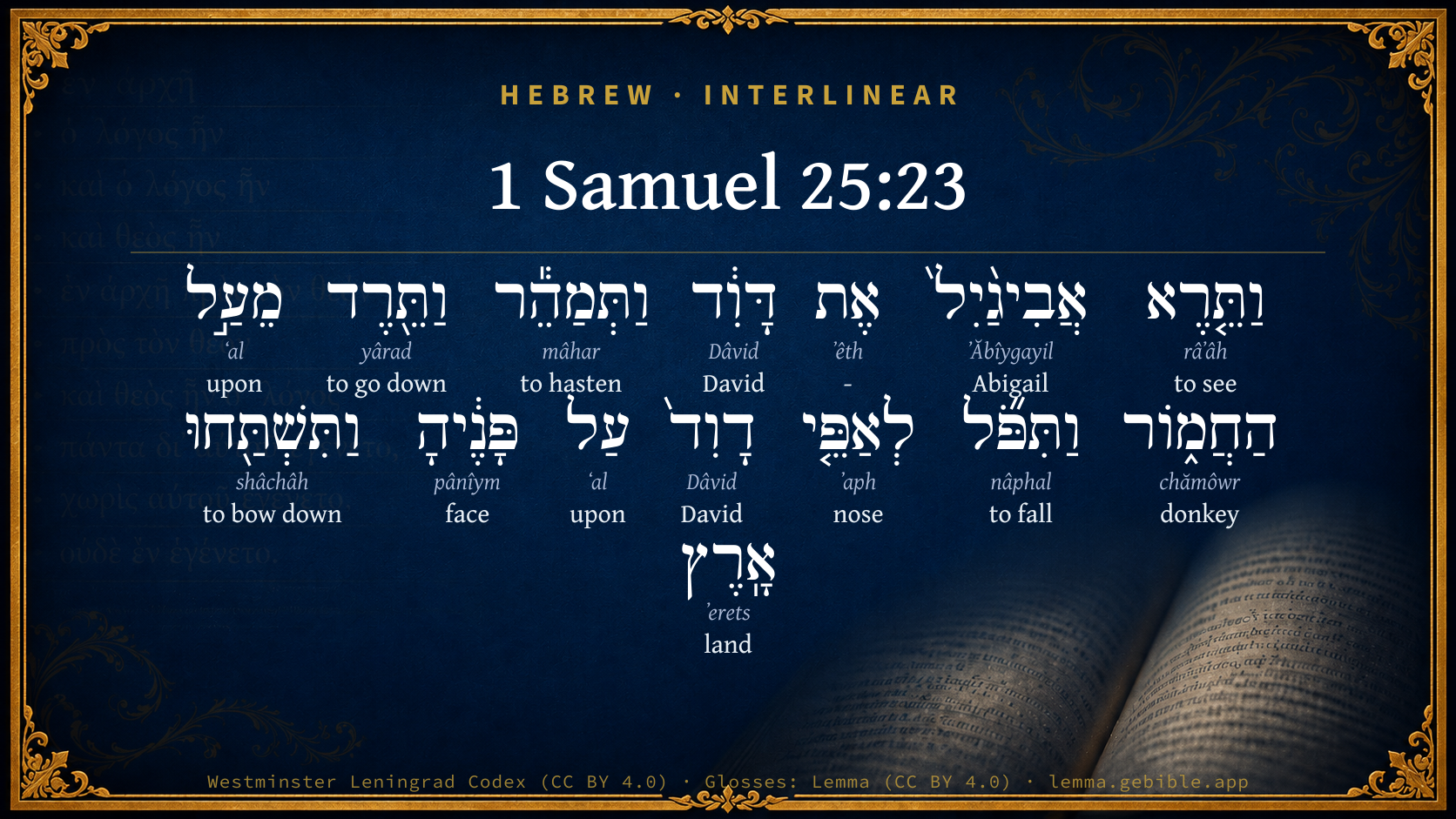
Hebrew (Westminster Leningrad Codex) 1 Samuel 25:23 appears in the Hebrew Old Testament. The text above is from the Westminster Leningrad Codex. Each word links to its Strong’s number, a concise gloss, and parsing drawn from the Open Scriptures Hebrew Bible morphology. Click any word for its full Brown-Driver-Briggs (BDB) entry.
Download image
Cite this verse

1 Samuel 25:23 (World English Bible). Public Domain. Lemma interlinear Bible study tool, https://lemma.gebible.app/v/1-samuel/25/23.

Show BibTeX & RIS
BibTeX
RIS
English Translation
When Abigail saw David, she hurried, and alighted from her donkey, and fell before David on her face, and bowed herself to the ground.
World English Bible · Public Domain
Download a study sheet

One document with this verse’s original text, its word-by-word gloss line, the meaning frame, cross-references with their text, attributed commentary, and full source and license credits — printable, and it pastes into notes with its structure intact.

This verse Autodidact and up

Study sheet (.html) Plain text (.txt)

A passage Seminary Student

Up to 50 verses in one chapter. A passage sheet keeps up to 6 commentary sources and 12 cross-references per verse, in the order this page ranks them, and says so on the sheet whenever that leaves anything out. Ask for a single verse and you get the Autodidact verse sheet above.

Everything on this page stays free to read, with no account — the sheet is a download of what is already on screen, not access to it.

Want to remove ads? Support Godless Engineer
Compare translations 3

The same verse in 3 English versions, stacked beneath the original-language interlinear above. Click any original word for its lexicon entry.

Each is an independent rendering of the whole verse — the interlinear is not word-aligned to these translations.

Highlighted words mark where these versions differ — a whole-verse word diff, not a word-by-word alignment.

  • World English Bible Public Domain
    When Abigail saw David, she hurried, and alighted from her donkey, and fell before David on her face, and bowed herself to the ground.
  • King James Version Public Domain
    And when Abigail saw David, she hasted, and lighted off the ass, and fell before David on her face, and bowed herself to the ground,
  • unfoldingWord Literal Text CC BY-SA 4.0
    And Abigail saw David, and she hurried and got down from upon the donkey. And she fell to the face of David on her face and prostrated herself the ground.

unfoldingWord Literal Text — © unfoldingWord, licensed CC BY-SA 4.0. Word-aligned USFM3 via Door43 (git.door43.org/unfoldingWord/en_ult).

Versions to compare (up to 4)

3 of 4 selected

Show all 18 translations

Every available English version of this verse, each an independent rendering of the whole verse.

  • World English Bible Public Domain
    When Abigail saw David, she hurried, and alighted from her donkey, and fell before David on her face, and bowed herself to the ground.
  • Berean Standard Bible Public Domain
    When Abigail saw David, she quickly got off the donkey, fell facedown, and bowed before him.
  • Majority Standard Bible Public Domain
    When Abigail saw David, she quickly got off the donkey, fell facedown, and bowed before him.
  • King James Version Public Domain
    And when Abigail saw David, she hasted, and lighted off the ass, and fell before David on her face, and bowed herself to the ground,
  • American Standard Version (1901) Public Domain
    And when Abigail saw David, she hasted, and alighted from her ass, and fell before David on her face, and bowed herself to the ground.
  • Revised Version (1885) Public Domain
    And when Abigail saw David, she hasted, and lighted off her ass, and fell before David on her face, and bowed herself to the ground.
  • Geneva Bible (1599) Public Domain
    And when Abigail sawe Dauid, she hasted and lighted off her asse, and fell before Dauid on her face, and bowed her selfe to the ground,
  • Douay-Rheims (1899) Public Domain
    And when Abigail saw David she made haste and lighted off the ass, and fell before David, on her face, and adored upon the ground.
  • Young's Literal Translation Public Domain
    And Abigail seeth David, and hasteth and cometh down from off the ass, and falleth before David on her face, and boweth herself to the earth,
  • Literal Standard Version CC BY-SA 4.0
    And Abigail sees David, and hurries and comes down from off the donkey, and falls on her face before David, and bows herself to the earth,
  • Unlocked Literal Bible CC BY-SA 4.0
    When Abigail saw David, she hurried and got down from her donkey and lay before David facedown and bowed herself to the ground.
  • unfoldingWord Literal Text CC BY-SA 4.0
    And Abigail saw David, and she hurried and got down from upon the donkey. And she fell to the face of David on her face and prostrated herself the ground.
  • Darby Bible Public Domain
    And when Abigail saw David, she hasted and lighted off the ass, and fell before David on her face, and bowed herself to the ground,
  • World Messianic Bible Public Domain
    When Abigail saw David, she hurried and got off her donkey, and fell before David on her face and bowed herself to the ground.
  • Webster's Bible Public Domain
    And when Abigail saw David, she hasted, and lighted off the ass, and fell before David on her face, and bowed herself to the ground.
  • Free Bible Version CC BY-SA 4.0
    When Abigail saw David, she quickly got off the donkey, and bowed before him, her face to the ground.
  • Bible in Basic English Public Domain
    And when Abigail saw David, she quickly got off her ass, falling down on her face before him.
  • JPS Tanakh (1917) Public Domain
    And when Abigail saw David, she made haste, and alighted from her ass, and fell before David on her face, and bowed down to the ground.

Literal Standard Version (2020), Covenant Press — licensed CC BY-SA 4.0. Text via the HelloAO Bible API (eBible.org). Unlocked Literal Bible (unfoldingWord) — licensed CC BY-SA 4.0. Text via the HelloAO Bible API (eBible.org). unfoldingWord Literal Text — © unfoldingWord, licensed CC BY-SA 4.0. Word-aligned USFM3 via Door43 (git.door43.org/unfoldingWord/en_ult). Free Bible Version, Dr. Jonathan Gallagher — licensed CC BY-SA 4.0. Text via the HelloAO Bible API (eBible.org).

Word by word

More ways to search: Search by grammar → Find every occurrence → Compare this word →

Practice this passage: Drill this verse → Learn its vocabulary →

אֲבִיגַ֨יִל֙
ʼĂbîygayil
H26
“Abigail”
Noun, Proper
Part of Speech
Noun
Type
Proper
Full BDB Definition

Origin: from H1 and H1524

TWOT: None

Abigail = "my father is joy" - wife of Nabal, then of David - sister of David
  1. וַתֵּ֤רֶא râʼâh H7200 “and · to see” Conjunction + Verb, Qal, Sequential Imperfect, 3rd Person, Feminine, Singular
  2. אֶת ʼêth H853 “-” Particle, Direct Object
  3. דָּוִ֔ד Dâvid H1732 “David” Noun, Proper
  4. וַתְּמַהֵ֕ר mâhar H4116 “and · to hasten” Conjunction + Verb, Piel, Sequential Imperfect, 3rd Person, Feminine, Singular
  5. וַתֵּ֖רֶד yârad H3381 “and · to go down” Conjunction + Verb, Qal, Sequential Imperfect, 3rd Person, Feminine, Singular
  6. מֵעַ֣ל ʻal H5921 “from · upon” Preposition + Preposition
  7. הַחֲמ֑וֹר chămôwr H2543 “the · donkey” Particle, Definite Article + Noun, Common, Both, Singular, Absolute
  8. וַתִּפֹּ֞ל nâphal H5307 “and · to fall” Conjunction + Verb, Qal, Sequential Imperfect, 3rd Person, Feminine, Singular
  9. לְאַפֵּ֤י ʼaph H639 “to/for · nostrils of” Preposition + Noun, Common, Masculine, Dual, Construct
  10. דָוִד֙ Dâvid H1732 “David” Noun, Proper
  11. עַל ʻal H5921 “upon” Preposition
  12. פָּנֶ֔יהָ pânîym H6440 “face(s) · her” Noun, Common, Both, Plural, Construct + Suffix, Personal, 3rd Person, Feminine, Singular
  13. וַתִּשְׁתַּ֖חוּ shâchâh H7812 “and · to bow down” Conjunction + Verb, Hishtaphel, Sequential Imperfect, 3rd Person, Feminine, Singular
  14. אָֽרֶץ ʼerets H776 “land” Noun, Common, Both, Singular, Absolute

About this verse

These counts appear in no published source. They are computed here, from the morphology-tagged text and Lemma’s own curated glosses. What Lemma adds →

15
words
13
distinct lemmas
Historical
section

Notable vocabulary

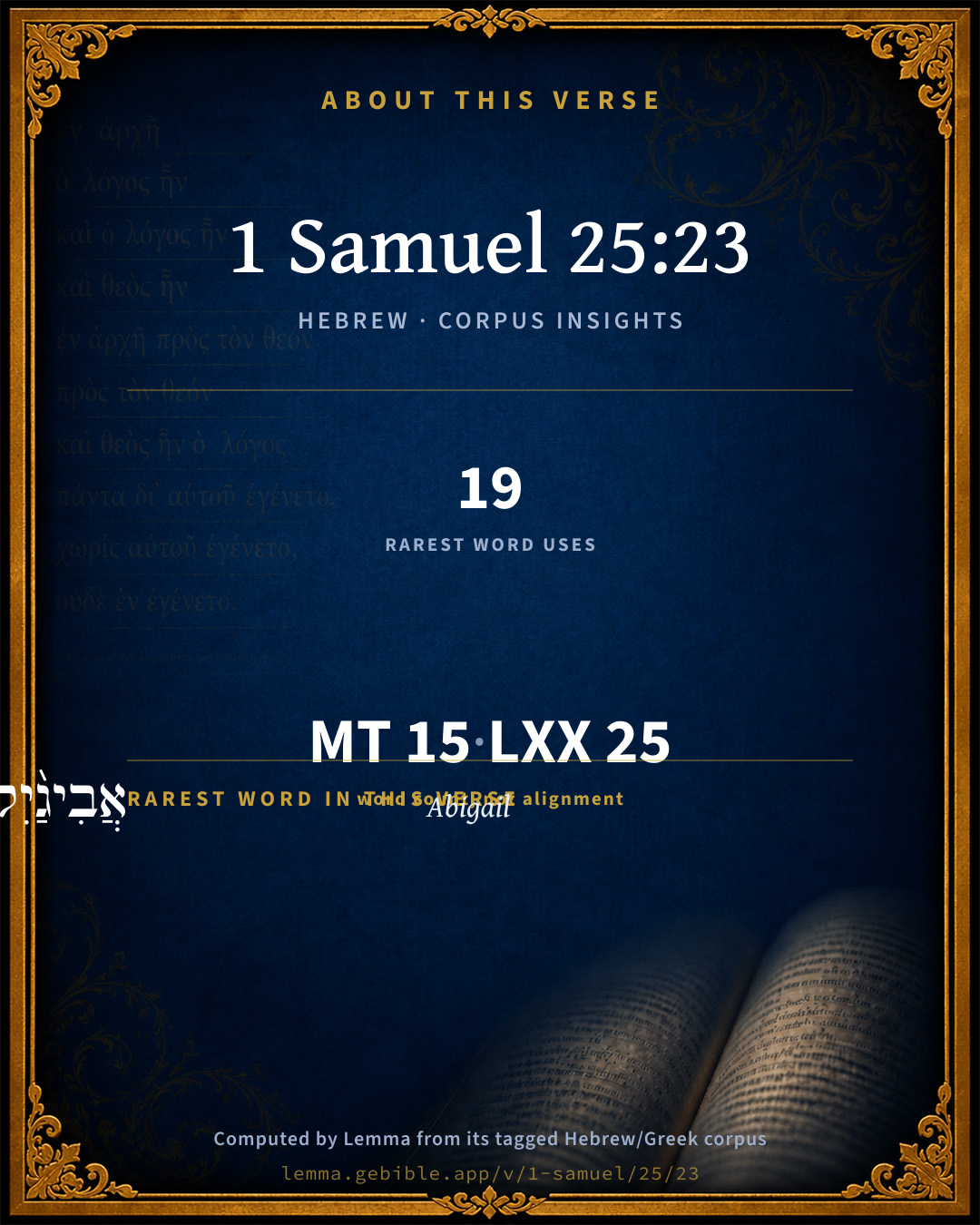
The rarest word here is אֲבִיגַ֨יִל֙ Abigail H26 — appearing just 19 times in the whole Hebrew Bible.

Shared distinctive vocabulary

אֲבִיגַ֨יִל֙ Abigail H26 occurs in 17 verses of the Hebrew Bible. Also found in:

Grammatical profile

  • 5 verbs
  • 7 nouns
  • 2 prepositions
  • 1 particle

Verb forms

  • וַתֵּ֤רֶא Qal · Sequential Imperfect
  • וַתְּמַהֵ֕ר Piel · Sequential Imperfect
  • וַתֵּ֖רֶד Qal · Sequential Imperfect
  • וַתִּפֹּ֞ל Qal · Sequential Imperfect
  • וַתִּשְׁתַּ֖חוּ Hishtaphel · Sequential Imperfect

Repetition

Words recur within this verse — often emphatic in Hebrew:

  • דָּוִ֔ד David H1732 ×2
  • מֵעַ֣ל upon H5921 ×2

Hebrew & Septuagint length

In English translation the verse runs 24 words from the Hebrew and 29 from the Septuagint (LXX English) — closely comparable.

A rough comparison of the two English renderings, which tokenize alike — not a word-level alignment.

Word counts can differ between the Hebrew and the Greek without any difference in meaning — e.g. the Hebrew direct-object marker אֵת has no separate Greek word, and Greek often adds the article ὁ.

In the original languages it is 15 Hebrew tokens and 25 Greek tokens — but the two are counted differently (Hebrew bundles its prefixes and suffixes into one token; the Greek is in lemma form), so that isn’t a like-for-like length.

Cross-references

4

Topical passages linked to 1 Samuel 25:23 in the Treasury of Scripture Knowledge — connected by theme and wording, ordered by reader-vote popularity; previews shown in the World English Bible.

  • 1 Samuel 20:41 As soon as the boy was gone, David arose out of [a place] toward the South, and fell on his face to the ground, and bowed himself three times: and they kissed one another, and wept one with another, until David exceeded.
  • Joshua 15:18 It happened, when she came [to him], that she moved him to ask of her father a field: and she alighted from off her donkey; and Caleb said, What would you?
  • Judges 1:14 It happened, when she came [to him], that she moved him to ask of her father a field: and she alighted from off her donkey; and Caleb said to her, What would you?
  • 1 Samuel 24:8 David also arose afterward, and went out of the cave, and cried after Saul, saying, My lord the king. When Saul looked behind him, David bowed with his face to the earth, and did obeisance.

Cross-references courtesy of OpenBible.info (CC BY 4.0).

Hebrew and Greek witnesses Masoretic Hebrew ↔ Greek Septuagint

The same verse in the two great witnesses to the Old Testament, shown verse-for-verse.

These are two independent witnesses, not word-aligned to each other, and the Septuagint is shown in lemma (dictionary) form.

Hebrew 1 Samuel 25:23 Masoretic · Westminster Leningrad Codex

וַתֵּ֤רֶא אֲבִיגַ֨יִל֙ אֶת דָּוִ֔ד וַתְּמַהֵ֕ר וַתֵּ֖רֶד מֵעַ֣ל הַחֲמ֑וֹר וַתִּפֹּ֞ל לְאַפֵּ֤י דָוִד֙ עַל פָּנֶ֔יהָ וַתִּשְׁתַּ֖חוּ אָֽרֶץ

When Abigail saw David, she hurried, and alighted from her donkey, and fell before David on her face, and bowed herself to the ground.

World English Bible · Public Domain

Greek LXX 1 Samuel 25:23 Septuagint · lemma form

καί ὁράω αβιγαια ὁ δαυίδ καί σπεύδω καί καταπηδάω ἀπό ὁ ὄνος καί πίπτω ἐνώπιον δαυίδ ἐπί πρόσωπον αὐτός καί προςκυνέω αὐτός ἐπί ὁ γῆ

And Abigaia saw David, and she hasted and alighted from her ass; and she fell before David on her face, and did obeisance to him, bowing to the ground

LXX2012 (modern English Septuagint) · Public Domain

Hebrew: Westminster Leningrad Codex (CC BY 4.0). Greek: Septuagint (public domain); English from LXX2012 (modern English Septuagint) (Public Domain). How the Septuagint differs from the Hebrew →

Targum (Aramaic paraphrase)

1

The Targum is the ancient Jewish Aramaic paraphrase of the Hebrew Scriptures — an interpretive translation, not the Hebrew text itself. Onkelos (literal) and Pseudo-Jonathan (expansive) render the Torah, and Jonathan the Prophets. Coverage is partial: where no permissively-licensed English translation exists for a verse, only the Aramaic is shown. This is verse-level text, not a word-by-word alignment to the Hebrew.

  1. Targum Jonathan Prophets (Joshua–Malachi)
    וַחֲזַת אֲבִיגַיל יַת דָוִד וְאוֹחִיאַת וְאִתְרְכִינַת מֵעַל חַמָרָא וּנְפַלַת לְאַפֵּי דָוִד עַל אַפָּהָא וּסְגִידַת עַל אַרְעָא:

    (no public-domain English translation for this verse)

    Targum Jonathan — Aramaic: “Mikraot Gedolot” (public domain). English: “Sefaria Community Translation” (CC0 1.0 (public-domain dedication)); “London "Chaldee Paraphrase," 1871” (public domain). Text via Sefaria.

Commentary

Notes on 1 Samuel 25:23 from classic Christian and Jewish commentators (each source and its license shown beneath its notes). The classic Christian expositions comment on the surrounding passage and are grouped to its opening verse, so a note may address several verses; the Jewish commentaries on the Tanakh (Rashi and others) are per-verse, so they appear only where the commentator wrote on this verse.

Lemma curates 59 commentaries, every one of them public domain or Creative Commons licensed, each selected and text-cleaned for this edition rather than reprinted as found. About our sources →

Trapp's Complete Commentary

John Trapp

1Sa 25:23 And when Abigail saw David, she hasted, and lighted off the ass, and fell before David on her face, and bowed herself to the ground,

Ver. 23. And fell before David on her face.] By which most humble posture she disarmed David’s indignation, and redeemed her own sorrows. Caesar said that he did nothing more glady than pardon humble suppliants. {a} The very Turks, though remorseless to those that bear up, yet receive they humiliation with much sweetness. {b} "Humble yourselves under the mighty hand of God," &c. {Jas 4:10}

{a} Caes., Comment. de Bell. Alexan.

{b} Sir H. Blunt’s Voyage in the Levant.

John Trapp, A Commentary or Exposition upon All the Books of the Old and New Testament (1647–1656) — public domain. Text from a community e-Sword module.

Jamieson, Fausset & Brown

Robert Jamieson, A. R. Fausset & David Brown

she hasted, and lighted off the ass, and fell before David on her face--Dismounting in presence of a superior is the highest token of respect that can be given; and it is still an essential act of homage to the great. Accompanying this act of courtesy with the lowest form of prostration, she not only by her attitude, but her language, made the fullest amends for the disrespect shown by her husband, as well as paid the fullest tribute of respect to the character and claims of David.

Jamieson, Fausset & Brown — Commentary Critical and Explanatory on the Whole Bible (1871) — public domain (CC PDM 1.0). Text via the HelloAO Bible API.

Ellicott's Commentary for English Readers

(23) Fell before David.—This act of obeisance, and, in fact, the whole tone of the wise wife of Nabal in her address to David, seems to betoken her consciousness that she was addressing the anointed of Jehovah, the future king—at no distant date—of Israel. Her worst fears she found realised when she met David, probably at no great distance from the principal residence of Nabal, accompanied by so large an armed force, evidently bent on some deed of violence. She deprecated his wrath by representing her husband not merely as a bad man, but as one scarcely responsible for his actions. Had she only known of the mission of David’s followers to Nabal, she implies, very different indeed had been their reception; they would not, at least, have returned to David empty-handed.

A Bible Commentary for English Readers, edited by Charles John Ellicott (1878–1897) — public domain. Text from a community e-Sword module.

The Cambridge Bible for Schools and Colleges

gen. ed. J. J. S. Perowne

23–31. Abigail’s meeting with David

23. lighted off the ass] i.e. got down from, an old form of alighted. The Heb. word is different from that similarly translated in Jos_15:18, and simply means “to descend.”

The Cambridge Bible for Schools and Colleges (gen. ed. J. J. S. Perowne; Cambridge University Press, 1878–1918) — public domain. Text from a community e-Sword module.

John Gill's Exposition

And when Abigail saw David,.... Whom she either knew personally, or rather supposed who he was by the number of men that followed him:

she hasted, and alighted off the ass; on which she rode:

and fell before David on her face, and bowed herself to the ground; in respect to, and reverence of, so great a person as David was.

John Gill's Exposition of the Whole Bible (1746–1763) — public domain (CC PDM 1.0). Text via the HelloAO Bible API.

Haydock's Catholic Bible Commentary

CHAPTER XXV.

George Leo Haydock (1774–1849), Haydock's Catholic Family Bible and Commentary, 1859 edition — public domain. Excludes Psalms (Douay-Rheims chapter numbering differs from Protestant) and Deuterocanonical books (Catholic canon only).

Matthew Poole's English Annotations

Not only in token of deep reverence, but as a most humble supplicant, as 2Ki 4:27.

Matthew Poole's English Annotations on the Holy Bible (1683–1685) — public domain. Text from a community e-Sword/MySword module.

The Pulpit Commentary

Vers. 23-25. Abigail fell before David on her face. This very abject obeisance may have been grounded on her belief in David"s future kingship, or it may simply mark the inferior position held by women in those days (see ver. 41). Her whole address is couched in very humble terms. David (1Sa_24:8) only stooped with his face to the ground before Saul. Upon me. Abigail represents herself as the person really guilty, on whom the iniquity, i.e. the punishment of the offence, must fall. Nabal is a mere son of Belial, a worthless, bad man, whose name Nabal, i.e. fool, is a sign that folly is with him, and accompanies all his acts. As a fool he is scarcely accountable for his doings, and Abigail, whose wont and business it was to set things to rights, saw not the young men, and so was unable to save them from her husband"s rudeness.

The Pulpit Commentary (1880–1919), ed. H.D.M. Spence-Jones & Joseph S. Exell — public domain. Text from a community e-Sword module.

unfoldingWord translationNotes

Door43 World Missions Community

Connecting Statement:

The writer has finished giving background information, so he continues the story. (See: Background Information)

lay before David facedown and bowed herself to the ground

Abigail was being humble and showing that she would obey David because he was a powerful leader.

listen to

"hear"

my master ... your servant ... words of your servant

"you ... my words." Abigail speaks of herself and David as if they are two different people to show that she respects David. (See: Pronouns)

translationWords

David

donkey

bow

lord

guilt

servant

word

unfoldingWord translationNotes — © Distant Shores Media and the Door43 World Missions Community, licensed CC BY-SA 4.0. Source: git.door43.org/Door43/en_tn.

Lesson kit

Teaching starters — assembled from the data on this page, not authored interpretation. Every prompt links to the verse data it draws on. Edit before teaching.

1 Samuel, in the Historical, opens this verse with 15 words (13 distinct Hebrew lemmas). Its most distinctive word is ʼĂbîygayil (“Abigail”). A historical commentator’s framing appears above. Read the whole chapter for the surrounding context.

Discussion questions

  1. What does “Abigail” (ʼĂbîygayil) contribute to the verse as a whole?
  2. 1 Samuel 25:3 shares the word «Abigail» with this verse. How do the two illuminate each other?
  3. “David” occurs 2× in this one verse. What is the effect of the repetition?
  4. The translations on this page render this verse differently — a whole-verse word diff, not a word-by-word alignment. What might account for the different wordings?
  5. The verb «וַתֵּ֤רֶא» is Qal Sequential Imperfect. How does its form color the action?
  6. Reading how Trapp's Complete Commentary and Jamieson, Fausset & Brown read this verse, where do the two commentators agree and where do they part?

Things to notice

Reading settings

Reading text

Shown beneath each verse's original-language words.

Old Testament
Old Testament edition

Read the OT as the Masoretic Hebrew (MT) or the Greek Septuagint (LXX).

English shown for the Greek Septuagint (in the Hebrew ↔ Greek comparison).

Comparing translations? Open the Compare panel on any verse page to stack up to four side by side.