
Judges 19:27

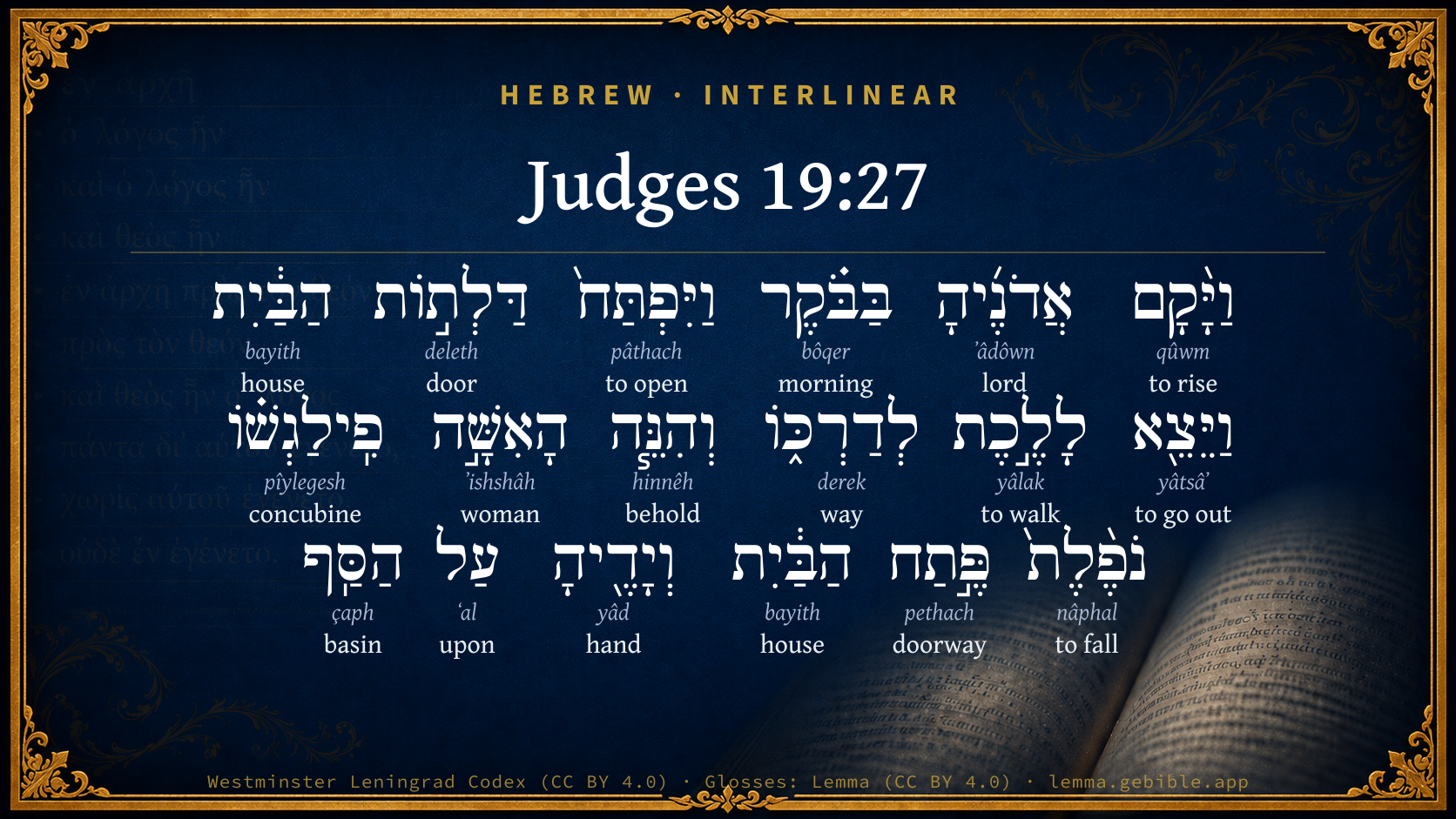
Hebrew (Westminster Leningrad Codex) Judges 19:27 appears in the Hebrew Old Testament. The text above is from the Westminster Leningrad Codex. Each word links to its Strong’s number, a concise gloss, and parsing drawn from the Open Scriptures Hebrew Bible morphology. Click any word for its full Brown-Driver-Briggs (BDB) entry.
Download image
Cite this verse

Judges 19:27 (World English Bible). Public Domain. Lemma interlinear Bible study tool, https://lemma.gebible.app/v/judges/19/27.

Show BibTeX & RIS
BibTeX
RIS
English Translation
Her lord rose up in the morning, and opened the doors of the house, and went out to go his way; and, behold, the woman his concubine was fallen down at the door of the house, with her hands on the threshold.
World English Bible · Public Domain
Download a study sheet

One document with this verse’s original text, its word-by-word gloss line, the meaning frame, cross-references with their text, attributed commentary, and full source and license credits — printable, and it pastes into notes with its structure intact.

This verse Autodidact and up

Study sheet (.html) Plain text (.txt)

A passage Seminary Student

Up to 50 verses in one chapter. A passage sheet keeps up to 6 commentary sources and 12 cross-references per verse, in the order this page ranks them, and says so on the sheet whenever that leaves anything out. Ask for a single verse and you get the Autodidact verse sheet above.

Everything on this page stays free to read, with no account — the sheet is a download of what is already on screen, not access to it.

Want to remove ads? Support Godless Engineer
Compare translations 3

The same verse in 3 English versions, stacked beneath the original-language interlinear above. Click any original word for its lexicon entry.

Each is an independent rendering of the whole verse — the interlinear is not word-aligned to these translations.

Highlighted words mark where these versions differ — a whole-verse word diff, not a word-by-word alignment.

  • World English Bible Public Domain
    Her lord rose up in the morning, and opened the doors of the house, and went out to go his way; and, behold, the woman his concubine was fallen down at the door of the house, with her hands on the threshold.
  • King James Version Public Domain
    And her lord rose up in the morning, and opened the doors of the house, and went out to go his way: and, behold, the woman his concubine was fallen down at the door of the house, and her hands were upon the threshold.
  • unfoldingWord Literal Text CC BY-SA 4.0
    And her master arose in the morning, and he opened the doors of the house and went out to go on his way. And behold, the woman, his concubine, fallen the entrance of the house, and her hands on the threshold.

unfoldingWord Literal Text — © unfoldingWord, licensed CC BY-SA 4.0. Word-aligned USFM3 via Door43 (git.door43.org/unfoldingWord/en_ult).

Versions to compare (up to 4)

3 of 4 selected

Show all 18 translations

Every available English version of this verse, each an independent rendering of the whole verse.

  • World English Bible Public Domain
    Her lord rose up in the morning, and opened the doors of the house, and went out to go his way; and, behold, the woman his concubine was fallen down at the door of the house, with her hands on the threshold.
  • Berean Standard Bible Public Domain
    In the morning, when her master got up and opened the doors of the house to go out on his journey, there was his concubine, collapsed in the doorway of the house, with her hands on the threshold.
  • Majority Standard Bible Public Domain
    In the morning, when her master got up and opened the doors of the house to go out on his journey, there was his concubine, collapsed in the doorway of the house, with her hands on the threshold.
  • King James Version Public Domain
    And her lord rose up in the morning, and opened the doors of the house, and went out to go his way: and, behold, the woman his concubine was fallen down at the door of the house, and her hands were upon the threshold.
  • American Standard Version (1901) Public Domain
    And her lord rose up in the morning, and opened the doors of the house, and went out to go his way; and, behold, the woman his concubine was fallen down at the door of the house, with her hands upon the threshold.
  • Revised Version (1885) Public Domain
    And her lord rose up in the morning, and opened the doors of the house, and went out to go his way: and, behold, the woman his concubine was fallen down at the door of the house, with her hands upon the threshold.
  • Geneva Bible (1599) Public Domain
    And her lorde arose in the morning, and opened the doores of the house, and went out to goe his way, and beholde, the woman his concubine was dead at the doore of the house and her handes lay vpon the thresholde.
  • Douay-Rheims (1899) Public Domain
    And in the morning the man arose, and opened the door that he might end the journey he had begun: and behold his concubine lay before the door with her hands spread on the threshold.
  • Young's Literal Translation Public Domain
    And her lord riseth in the morning, and openeth the doors of the house, and goeth out to go on his way, and lo, the woman, his concubine, is fallen at the opening of the house, and her hands `are' on the threshold,
  • Literal Standard Version CC BY-SA 4.0
    And her lord rises in the morning, and opens the doors of the house, and goes out to go on his way, and behold, the woman, his concubine, is fallen at the opening of the house, and her hands [are] on the threshold,
  • Unlocked Literal Bible CC BY-SA 4.0
    Her master rose up in the morning and opened the doors of the house and went out to go on his way. He could see his concubine lying there at the door, with her hands on the threshold.
  • unfoldingWord Literal Text CC BY-SA 4.0
    And her master arose in the morning, and he opened the doors of the house and went out to go on his way. And behold, the woman, his concubine, fallen the entrance of the house, and her hands on the threshold.
  • Darby Bible Public Domain
    And her master rose up in the morning, and when he opened the doors of the house and went out to go on his way, behold, there was his concubine lying at the door of the house, with her hands on the threshold.
  • World Messianic Bible Public Domain
    Her lord rose up in the morning and opened the doors of the house, and went out to go his way; and behold, the woman his concubine had fallen down at the door of the house, with her hands on the threshold.
  • Webster's Bible Public Domain
    And her lord rose in the morning, and opened the doors of the house, and went out to go his way: and behold, the woman his concubine had fallen down at the door of the house, and her hands were upon the threshhold.
  • Free Bible Version CC BY-SA 4.0
    Her master got up in the morning and opened the door of the house. He went out to continue his journey and there was his concubine, stretched out in the doorway of the house, with her hands holding onto the doorstep.
  • Bible in Basic English Public Domain
    In the morning her master got up, and opening the door of the house went out to go on his way; and he saw his servant-wife stretched on the earth at the door of the house with her hands on the step.
  • JPS Tanakh (1917) Public Domain
    And her lord rose up in the morning, and opened the doors of the house, and went out to go his way; and, behold, the woman his concubine was fallen down at the door of the house, with her hands upon the threshold.

Literal Standard Version (2020), Covenant Press — licensed CC BY-SA 4.0. Text via the HelloAO Bible API (eBible.org). Unlocked Literal Bible (unfoldingWord) — licensed CC BY-SA 4.0. Text via the HelloAO Bible API (eBible.org). unfoldingWord Literal Text — © unfoldingWord, licensed CC BY-SA 4.0. Word-aligned USFM3 via Door43 (git.door43.org/unfoldingWord/en_ult). Free Bible Version, Dr. Jonathan Gallagher — licensed CC BY-SA 4.0. Text via the HelloAO Bible API (eBible.org).

Word by word

More ways to search: Search by grammar → Find every occurrence → Compare this word →

Practice this passage: Drill this verse → Learn its vocabulary →

הַסַּֽף
çaph
H5592
“the · basin”
Particle, Definite Article + Noun, Common, Masculine, Singular, Absolute
Part of Speech
Particle + Noun
Type
Common
Gender
Masculine
Number
Singular
State
Absolute
Full BDB Definition

Origin: from H5605 , in its original sense of containing

TWOT: 1538a , 1538b

a spreading out, basin, goblet, bowl - basin, goblet - threshold, sill - threshold, sill, door-keeper
  1. וַיָּ֨קָם qûwm H6965 “and · to rise” Conjunction + Verb, Qal, Sequential Imperfect, 3rd Person, Masculine, Singular
  2. אֲדֹנֶ֜יהָ ʼâdôwn H113 “lords · her” Noun, Common, Masculine, Plural, Construct + Suffix, Personal, 3rd Person, Feminine, Singular
  3. בַּבֹּ֗קֶר bôqer H1242 “in/at the · morning” Preposition, Determined + Noun, Common, Masculine, Singular, Absolute
  4. וַיִּפְתַּח֙ pâthach H6605 “and · to open” Conjunction + Verb, Qal, Sequential Imperfect, 3rd Person, Masculine, Singular
  5. דַּלְת֣וֹת deleth H1817 “doors of” Noun, Common, Feminine, Plural, Construct
  6. הַבַּ֔יִת bayith H1004 “the · house” Particle, Definite Article + Noun, Common, Masculine, Singular, Absolute
  7. וַיֵּצֵ֖א yâtsâʼ H3318 “and · to go out” Conjunction + Verb, Qal, Sequential Imperfect, 3rd Person, Masculine, Singular
  8. לָלֶ֣כֶת yâlak H3212 “to walk” Preposition + Verb, Qal, Infinitive Construct
  9. לְדַרְכּ֑וֹ derek H1870 “to/for · way · his” Preposition + Noun, Common, Both, Singular, Construct + Suffix, Personal, 3rd Person, Masculine, Singular
  10. וְהִנֵּ֧ה hinnêh H2009 “and · behold” Conjunction + Particle, Demonstrative
  11. הָאִשָּׁ֣ה ʼishshâh H802 “the · woman” Particle, Definite Article + Noun, Common, Feminine, Singular, Absolute
  12. פִֽילַגְשׁ֗וֹ pîylegesh H6370 “concubine · his” Noun, Common, Feminine, Singular, Construct + Suffix, Personal, 3rd Person, Masculine, Singular
  13. נֹפֶ֨לֶת֙ nâphal H5307 “falling” Verb, Qal, Participle Active, Feminine, Singular, Absolute
  14. פֶּ֣תַח pethach H6607 “doorway of” Noun, Common, Masculine, Singular, Construct
  15. הַבַּ֔יִת bayith H1004 “the · house” Particle, Definite Article + Noun, Common, Masculine, Singular, Absolute
  16. וְיָדֶ֖יהָ yâd H3027 “and · hands · her” Conjunction + Noun, Common, Both, Dual, Construct + Suffix, Personal, 3rd Person, Feminine, Singular
  17. עַל ʻal H5921 “upon” Preposition

About this verse

These counts appear in no published source. They are computed here, from the morphology-tagged text and Lemma’s own curated glosses. What Lemma adds →

18
words
17
distinct lemmas
Historical
section

Shared distinctive vocabulary

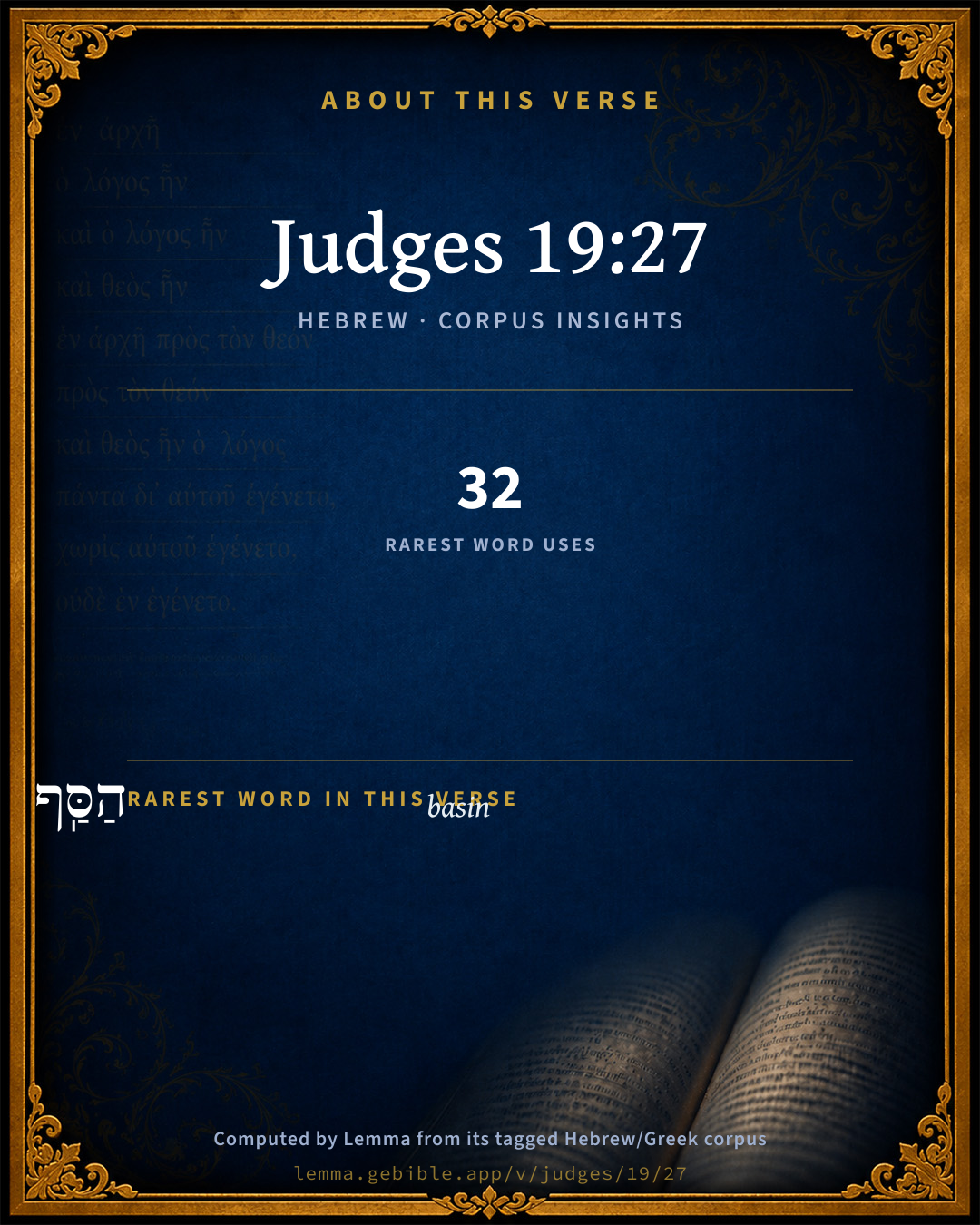
הַסַּֽף basin H5592 occurs in 28 verses of the Hebrew Bible. Also found in:

Grammatical profile

  • 5 verbs
  • 11 nouns
  • 1 preposition
  • 1 particle

Verb forms

  • וַיָּ֨קָם Qal · Sequential Imperfect
  • וַיִּפְתַּח֙ Qal · Sequential Imperfect
  • וַיֵּצֵ֖א Qal · Sequential Imperfect
  • לָלֶ֣כֶת Qal · Infinitive Construct
  • נֹפֶ֨לֶת֙ Qal · Participle Active

Repetition

A word recurs within this verse — often emphatic in Hebrew:

  • הַבַּ֔יִת house H1004 ×2

Hebrew & Septuagint length

In English translation the verse runs 42 words from the Hebrew and 45 from the Septuagint (LXX English) — closely comparable.

A rough comparison of the two English renderings, which tokenize alike — not a word-level alignment.

Word counts can differ between the Hebrew and the Greek without any difference in meaning — e.g. the Hebrew direct-object marker אֵת has no separate Greek word, and Greek often adds the article ὁ.

Hebrew and Greek witnesses Masoretic Hebrew ↔ Greek Septuagint

The same verse in the two great witnesses to the Old Testament, shown verse-for-verse.

These are two independent witnesses, not word-aligned to each other, and the Septuagint is shown in lemma (dictionary) form.

Hebrew Judges 19:27 Masoretic · Westminster Leningrad Codex

וַיָּ֨קָם אֲדֹנֶ֜יהָ בַּבֹּ֗קֶר וַיִּפְתַּח֙ דַּלְת֣וֹת הַבַּ֔יִת וַיֵּצֵ֖א לָלֶ֣כֶת לְדַרְכּ֑וֹ וְהִנֵּ֧ה הָאִשָּׁ֣ה פִֽילַגְשׁ֗וֹ נֹפֶ֨לֶת֙ פֶּ֣תַח הַבַּ֔יִת וְיָדֶ֖יהָ עַל הַסַּֽף

Her lord rose up in the morning, and opened the doors of the house, and went out to go his way; and, behold, the woman his concubine was fallen down at the door of the house, with her hands on the threshold.

World English Bible · Public Domain

Greek LXX Judges 19:27 Septuagint · lemma form

καί ἀναἵστημι ὁ ἀνήρ αὐτός ὁ πρωΐ καί ἀναοἴγω ὁ θύρα ὁ οἶκος καί ἐκἔρχομαι ὁ πορεύομαι ὁ ὁδός αὐτός καί ἰδού ὁ γυνή ὁ παλλακή αὐτός πίπτω παρά ὁ θύρα ὁ οἶκος καί ὁ χείρ αὐτός ἐπί ὁ πρόθυρον

And her husband rose up in the morning, and opened the doors of the house, and went forth to go on his journey; and, behold, the woman his concubine had fallen down by the doors of the house, and her hands were on the threshold.

LXX2012 (modern English Septuagint) · Public Domain

Hebrew: Westminster Leningrad Codex (CC BY 4.0). Greek: Septuagint (public domain); English from LXX2012 (modern English Septuagint) (Public Domain). How the Septuagint differs from the Hebrew →

Targum (Aramaic paraphrase)

1

The Targum is the ancient Jewish Aramaic paraphrase of the Hebrew Scriptures — an interpretive translation, not the Hebrew text itself. Onkelos (literal) and Pseudo-Jonathan (expansive) render the Torah, and Jonathan the Prophets. Coverage is partial: where no permissively-licensed English translation exists for a verse, only the Aramaic is shown. This is verse-level text, not a word-by-word alignment to the Hebrew.

  1. Targum Jonathan Prophets (Joshua–Malachi)
    וְקָם רִבּוֹנָהָא בְּצַפְרָא וּפְתַח דָשֵׁי בֵיתָא וּנְפַק לְמֵיזַל לְאָרְחֵיהּ וְהָא אִתְּתָא לְחֵינָתֵיהּ רַמְיָא בִּתְרַע בֵיתָא וִידָהָא מַחֲתִין עַל סִיפָא:

    (no public-domain English translation for this verse)

    Targum Jonathan — Aramaic: “Mikraot Gedolot” (public domain). English: “Sefaria Community Translation” (CC0 1.0 (public-domain dedication)); “London "Chaldee Paraphrase," 1871” (public domain). Text via Sefaria.

Commentary

Notes on Judges 19:27 from classic Christian and Jewish commentators (each source and its license shown beneath its notes). The classic Christian expositions comment on the surrounding passage and are grouped to its opening verse, so a note may address several verses; the Jewish commentaries on the Tanakh (Rashi and others) are per-verse, so they appear only where the commentator wrote on this verse.

Lemma curates 59 commentaries, every one of them public domain or Creative Commons licensed, each selected and text-cleaned for this edition rather than reprinted as found. About our sources →

Trapp's Complete Commentary

John Trapp

Jdg 19:27 And her lord rose up in the morning, and opened the doors of the house, and went out to go his way: and, behold, the woman his concubine was fallen down [at] the door of the house, and her hands [were] upon the threshold.

Ver. 27. The woman his concubine was fallen down.] As Jdg 19:26. Like as she sinned, so she suffered: Per quod quis peccat, &c. See Heb 13:4. And let the guilty that go yet unpunished make an end of all in God’s privy chamber of mercy by repentance, that so his open judicial proceeding in court may be stopped.

John Trapp, A Commentary or Exposition upon All the Books of the Old and New Testament (1647–1656) — public domain. Text from a community e-Sword module.

Joseph Benson's Commentary

Jdg 19:27-28. Went out to go his way — Concluding, without doubt, that the Gibeathites had conveyed away his concubine, and would keep her, and therefore he hasted home to take proper measures for the recovery of her; as we find he did afterward to revenge her death. He said unto her, Up, and let us be going — He thought she was only asleep, and the unexpected surprise of seeing her, and his haste to get out of this inhospitable place, might make him express himself in this manner.

Joseph Benson's Commentary on the Old and New Testaments (1811–1818) — public domain. Text from a community e-Sword module.

Geneva Bible (1599)

Geneva Bible translators

Or, husband.

Or, fallen.

Geneva Bible (1599) marginal notes — public domain. Text via Bolls.life.

Ellicott's Commentary for English Readers

(27) Her hands were upon the threshold.—As though they had been stretched out towards her husband in one last agony of appeal (Vulg., sparsis in limine cnanibus).

A Bible Commentary for English Readers, edited by Charles John Ellicott (1878–1897) — public domain. Text from a community e-Sword module.

The Cambridge Bible for Schools and Colleges

gen. ed. J. J. S. Perowne

27. With instinctive art the Hebrew story-teller leaves much to the imagination (cf. Jdg_11:39); but at the end of the verse he adds a detail which betrays the pathos of the tragedy.

The Cambridge Bible for Schools and Colleges (gen. ed. J. J. S. Perowne; Cambridge University Press, 1878–1918) — public domain. Text from a community e-Sword module.

John Gill's Exposition

And her lord rose up in the morning,.... Very early no doubt, and it is scarcely reasonable to think he should sleep quietly after such a riot, and his concubine or wife delivered up to the lust of such brutish creatures:

and opened the doors of the house, and went out to go his way; either in search of her, or rather to make the best of his way on his journey, to preserve his own life, having given her up for lost:

and, behold the woman his concubine was fallen down at the door of the house, and her hands were upon the threshold; in a posture that persons are when they fall, stretching out their hands to save themselves what they can; or of such who lay themselves down to sleep with their hands under their heads, and which her husband thought was her case, by what follows.

John Gill's Exposition of the Whole Bible (1746–1763) — public domain (CC PDM 1.0). Text via the HelloAO Bible API.

Matthew Poole's English Annotations

The posture either of one that had fallen down, or of one that was laid down to sleep, her hands or arms (for the Hebrew word signifies both) leaning upon the threshold and being put under her head; and therefore he thought to awake her, and raise her up.

Matthew Poole's English Annotations on the Holy Bible (1683–1685) — public domain. Text from a community e-Sword/MySword module.

The Pulpit Commentary

The woman was fallen down at the door, etc. Poor thing! with her last breath she turned to the house where he was who should have been her protector, but who had deserted her in her hour of need.

The Pulpit Commentary (1880–1919), ed. H.D.M. Spence-Jones & Joseph S. Exell — public domain. Text from a community e-Sword module.

unfoldingWord translationNotes

Door43 World Missions Community

But there was no answer

The woman did not answer because she was dead. This can be stated clearly. AT: "But she did not answer because she was dead" (See: Assumed Knowledge and Implicit Information)

translationWords

lord

concubine

threshold

Levi

donkey

unfoldingWord translationNotes — © Distant Shores Media and the Door43 World Missions Community, licensed CC BY-SA 4.0. Source: git.door43.org/Door43/en_tn.

Lesson kit

Teaching starters — assembled from the data on this page, not authored interpretation. Every prompt links to the verse data it draws on. Edit before teaching.

Judges, in the Historical, opens this verse with 18 words (17 distinct Hebrew lemmas). Its most distinctive word is çaph (“basin”). A historical commentator’s framing appears above. Read the whole chapter for the surrounding context.

Discussion questions

  1. How does “basin” (çaph) shape what this verse is saying?
  2. How does Exodus 12:22, which shares the word «basin», read alongside this verse?
  3. What does the repetition of “house” (2× in this one verse) do in this verse?
  4. These translations render this verse differently. What is at stake in choosing one wording over another?
  5. «וַיָּ֨קָם» is a Qal Sequential Imperfect verb. How does that grammatical form shape the action described?
  6. Compare how Trapp's Complete Commentary and Joseph Benson's Commentary read this verse. Where do they agree or differ?

Things to notice

Reading settings

Reading text

Shown beneath each verse's original-language words.

Old Testament
Old Testament edition

Read the OT as the Masoretic Hebrew (MT) or the Greek Septuagint (LXX).

English shown for the Greek Septuagint (in the Hebrew ↔ Greek comparison).

Comparing translations? Open the Compare panel on any verse page to stack up to four side by side.