2 Samuel 21:22

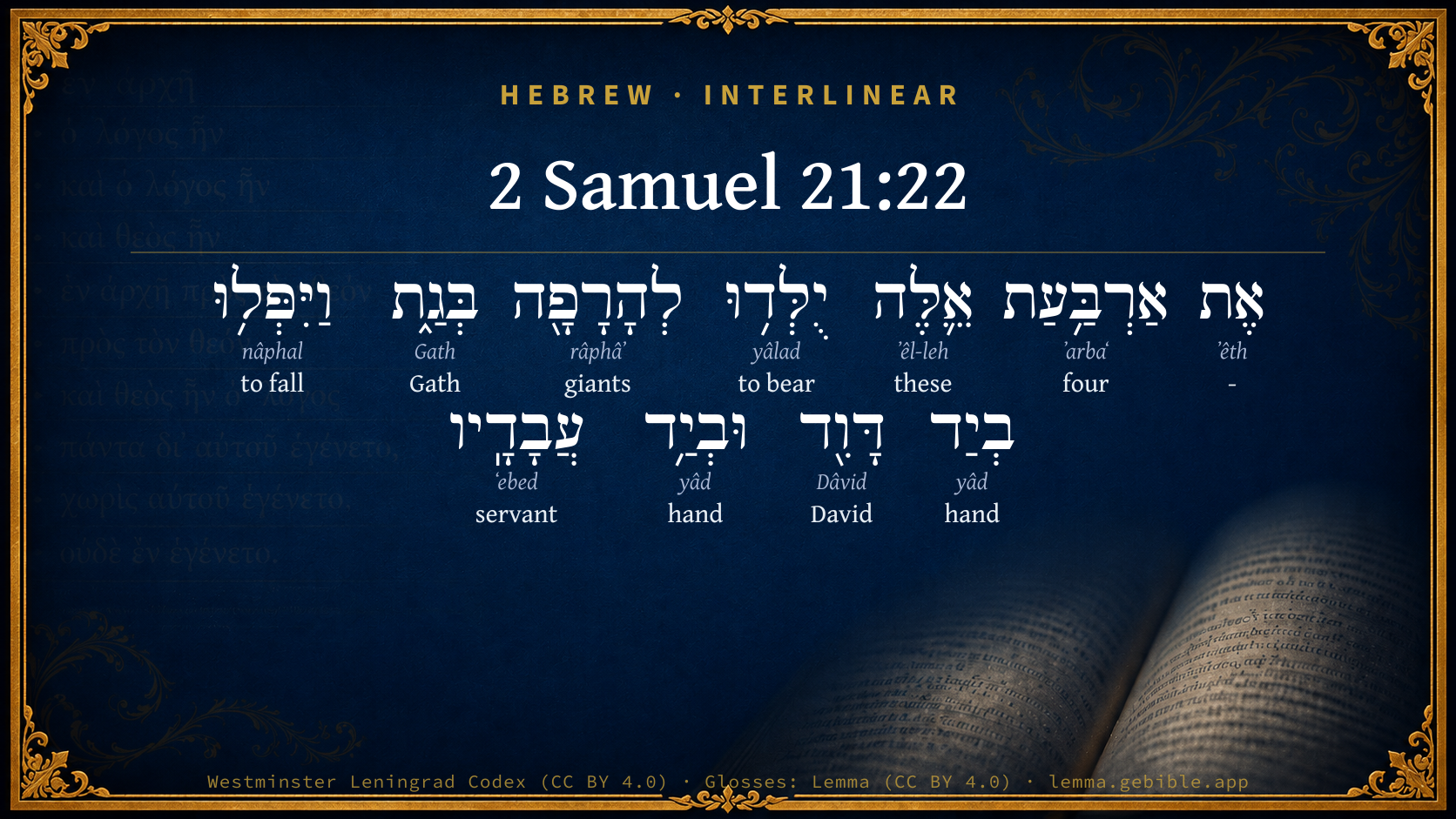
Hebrew (Westminster Leningrad Codex) 2 Samuel 21:22 appears in the Hebrew Old Testament. The text above is from the Westminster Leningrad Codex. Each word links to its Strong’s number, a concise gloss, and parsing drawn from the Open Scriptures Hebrew Bible morphology. Click any word for its full Brown-Driver-Briggs (BDB) entry.
Download image
Cite this verse

2 Samuel 21:22 (World English Bible). Public Domain. Lemma interlinear Bible study tool, https://lemma.gebible.app/v/2-samuel/21/22.

Show BibTeX & RIS
BibTeX
RIS
English Translation
These four were born to the giant in Gath; and they fell by the hand of David, and by the hand of his servants.
World English Bible · Public Domain
Download a study sheet

One document with this verse’s original text, its word-by-word gloss line, the meaning frame, cross-references with their text, attributed commentary, and full source and license credits — printable, and it pastes into notes with its structure intact.

This verse Autodidact and up

Study sheet (.html) Plain text (.txt)

A passage Seminary Student

Up to 50 verses in one chapter. A passage sheet keeps up to 6 commentary sources and 12 cross-references per verse, in the order this page ranks them, and says so on the sheet whenever that leaves anything out. Ask for a single verse and you get the Autodidact verse sheet above.

Everything on this page stays free to read, with no account — the sheet is a download of what is already on screen, not access to it.

Want to remove ads? Support Godless Engineer
Compare translations 3

The same verse in 3 English versions, stacked beneath the original-language interlinear above. Click any original word for its lexicon entry.

Each is an independent rendering of the whole verse — the interlinear is not word-aligned to these translations.

Highlighted words mark where these versions differ — a whole-verse word diff, not a word-by-word alignment.

  • World English Bible Public Domain
    These four were born to the giant in Gath; and they fell by the hand of David, and by the hand of his servants.
  • King James Version Public Domain
    These four were born to the giant in Gath, and fell by the hand of David, and by the hand of his servants.
  • unfoldingWord Literal Text CC BY-SA 4.0
    These four were born to Rapha in Gath. And they fell by the hand of David and by the hand of his servants.

unfoldingWord Literal Text — © unfoldingWord, licensed CC BY-SA 4.0. Word-aligned USFM3 via Door43 (git.door43.org/unfoldingWord/en_ult).

Versions to compare (up to 4)

3 of 4 selected

Show all 18 translations

Every available English version of this verse, each an independent rendering of the whole verse.

  • World English Bible Public Domain
    These four were born to the giant in Gath; and they fell by the hand of David, and by the hand of his servants.
  • Berean Standard Bible Public Domain
    So these four descendants of Rapha in Gath fell at the hands of David and his servants.
  • Majority Standard Bible Public Domain
    So these four descendants of Rapha in Gath fell at the hands of David and his servants.
  • King James Version Public Domain
    These four were born to the giant in Gath, and fell by the hand of David, and by the hand of his servants.
  • American Standard Version (1901) Public Domain
    These four were born to the giant in Gath; and they fell by the hand of David, and by the hand of his servants.
  • Revised Version (1885) Public Domain
    These four were born to the giant in Gath; and they fell by the hand of David, and by the hand of his servants.
  • Geneva Bible (1599) Public Domain
    These foure were borne to Haraphah in Gath, and died by the hande of Dauid and by the hands of his seruants.
  • Douay-Rheims (1899) Public Domain
    These four were born of Arapha in Geth, and they fell by the hand of David, and of his servants.
  • Young's Literal Translation Public Domain
    these four have been born to the giant in Gath, and they fall by the hand of David, and by the hand of his servants.
  • Literal Standard Version CC BY-SA 4.0
    these four have been born to the giant in Gath, and they fall by the hand of David, and by the hand of his servants.
  • Unlocked Literal Bible CC BY-SA 4.0
    These were descendants of the Rephaim of Gath, and they were killed by the hand of David and by the hand of his soldiers.
  • unfoldingWord Literal Text CC BY-SA 4.0
    These four were born to Rapha in Gath. And they fell by the hand of David and by the hand of his servants.
  • Darby Bible Public Domain
    These four were born to Raphah, in Gath; and they fell by the hand of David, and by the hand of his servants.
  • World Messianic Bible Public Domain
    These four were born to the giant in Gath; and they fell by the hand of David and by the hand of his servants.
  • Webster's Bible Public Domain
    These four were born to the giant in Gath, and fell by the hand of David, and by the hand of his servants.
  • Free Bible Version CC BY-SA 4.0
    These four were the descendants of the giants in Gath, but they were all killed by David and his men.
  • Bible in Basic English Public Domain
    These four were of the offspring of the Rephaim in Gath; and they came to their end by the hands of David and his servants.
  • JPS Tanakh (1917) Public Domain
    These four were born to the giant in Gath; and they fell by the hand of David, and by the hand of his servants.

Literal Standard Version (2020), Covenant Press — licensed CC BY-SA 4.0. Text via the HelloAO Bible API (eBible.org). Unlocked Literal Bible (unfoldingWord) — licensed CC BY-SA 4.0. Text via the HelloAO Bible API (eBible.org). unfoldingWord Literal Text — © unfoldingWord, licensed CC BY-SA 4.0. Word-aligned USFM3 via Door43 (git.door43.org/unfoldingWord/en_ult). Free Bible Version, Dr. Jonathan Gallagher — licensed CC BY-SA 4.0. Text via the HelloAO Bible API (eBible.org).

Word by word

More ways to search: Search by grammar → Find every occurrence → Compare this word →

Practice this passage: Drill this verse → Learn its vocabulary →

לְהָרָפָ֖ה
râphâʼ
H7497
“to/for · the · giants”
Preposition + Particle, Definite Article + Noun, Gentilic, Masculine, Singular, Absolute
Part of Speech
Preposition + Particle + Noun
Type
Gentilic
Gender
Masculine
Number
Singular
State
Absolute
Full BDB Definition

Origin: from H7495 in the sense of invigorating

TWOT: 2198d

giants, Rephaim - old tribe of giants
  1. אֶת ʼêth H853 “-” Particle, Direct Object
  2. אַרְבַּ֥עַת ʼarbaʻ H702 “four” Adjective, Cardinal number, Masculine, Singular, Construct
  3. אֵ֛לֶּה ʼêl-leh H428 “these” Pronoun, Demonstrative, Common, Plural
  4. יֻלְּד֥וּ yâlad H3205 “to bear” Verb, Pual, Perfect, 3rd Person, Common, Plural
  5. בְּגַ֑ת Gath H1661 “in/at · Gath” Preposition + Noun, Proper
  6. וַיִּפְּל֥וּ nâphal H5307 “and · to fall” Conjunction + Verb, Qal, Sequential Imperfect, 3rd Person, Masculine, Plural
  7. בְיַד yâd H3027 “in/at · hand of” Preposition + Noun, Common, Both, Singular, Construct
  8. דָּוִ֖ד Dâvid H1732 “David” Noun, Proper
  9. וּבְיַ֥ד yâd H3027 “and · in/at · hand of” Conjunction + Preposition + Noun, Common, Both, Singular, Construct
  10. עֲבָדָֽיו ʻebed H5650 “servants · his” Noun, Common, Masculine, Plural, Construct + Suffix, Personal, 3rd Person, Masculine, Singular

About this verse

These counts appear in no published source. They are computed here, from the morphology-tagged text and Lemma’s own curated glosses. What Lemma adds →

11
words
10
distinct lemmas
Historical
section

Notable vocabulary

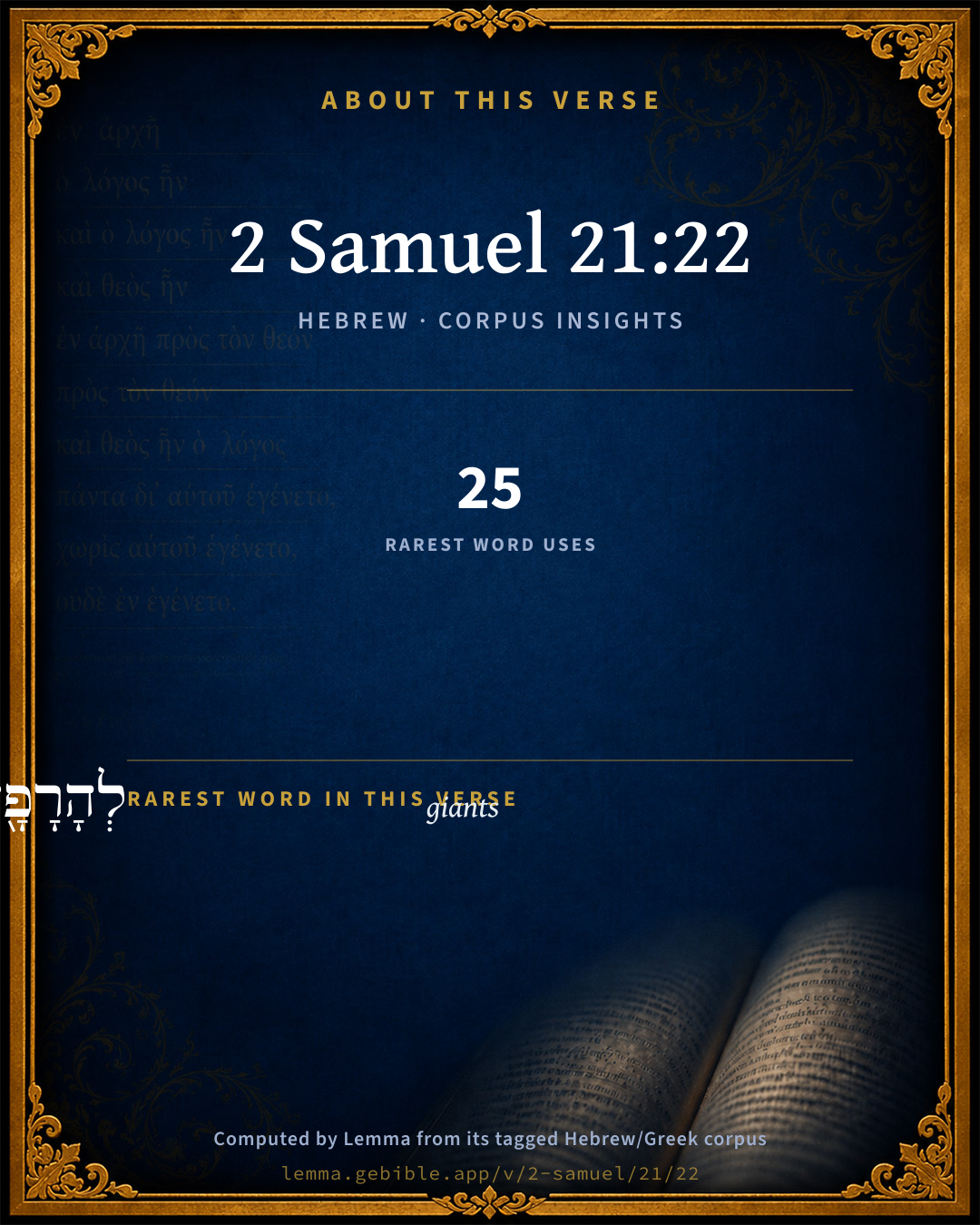
The rarest word here is לְהָרָפָ֖ה giants H7497 — appearing just 25 times in the whole Hebrew Bible.

Shared distinctive vocabulary

לְהָרָפָ֖ה giants H7497 occurs in 24 verses of the Hebrew Bible. Also found in:

Grammatical profile

  • 2 verbs
  • 6 nouns
  • 1 adjective
  • 1 pronoun
  • 1 particle

Verb forms

  • יֻלְּד֥וּ Pual · Perfect
  • וַיִּפְּל֥וּ Qal · Sequential Imperfect

Repetition

A word recurs within this verse — often emphatic in Hebrew:

  • בְיַד hand H3027 ×2

Hebrew & Septuagint length

In English translation the verse runs 24 words from the Hebrew and 29 from the Septuagint (LXX English) — closely comparable.

A rough comparison of the two English renderings, which tokenize alike — not a word-level alignment.

Word counts can differ between the Hebrew and the Greek without any difference in meaning — e.g. the Hebrew direct-object marker אֵת has no separate Greek word, and Greek often adds the article ὁ.

Cross-references

9

Topical passages linked to 2 Samuel 21:22 in the Treasury of Scripture Knowledge — connected by theme and wording, ordered by reader-vote popularity; previews shown in the World English Bible.

  • 1 Chronicles 20:8 These were born to the giant in Gath; and they fell by the hand of David, and by the hand of his servants.
  • Romans 8:31 What then shall we say about these things? If God is for us, who can be against us?
  • Jeremiah 9:23 Thus says Yahweh, Don't let the wise man glory in his wisdom, neither let the mighty man glory in his might, don't let the rich man glory in his riches;
  • Joshua 14:12 Now therefore give me this hill-country, of which Yahweh spoke in that day; for you heard in that day how the Anakim were there, and cities great and fortified: it may be that Yahweh will be with me, and I shall drive them out, as Yahweh spoke.
  • Psalms 60:12 Through God we shall do valiantly, For it is he who will tread down our adversaries.
  • Psalms 108:13 Through God, we will do valiantly. For it is he who will tread down our enemies.
  • Psalms 118:15 The voice of rejoicing and salvation is in the tents of the righteous. "The right hand of Yahweh does valiantly.
  • Ecclesiastes 9:11 I returned, and saw under the sun, that the race is not to the swift, nor the battle to the strong, neither yet bread to the wise, nor yet riches to men of understanding, nor yet favor to men of skill; but time and chance happen to them all.
  • Romans 8:37 No, in all these things, we are more than conquerors through him who loved us.

Cross-references courtesy of OpenBible.info (CC BY 4.0).

Hebrew and Greek witnesses Masoretic Hebrew ↔ Greek Septuagint

The same verse in the two great witnesses to the Old Testament, shown verse-for-verse.

These are two independent witnesses, not word-aligned to each other, and the Septuagint is shown in lemma (dictionary) form.

Hebrew 2 Samuel 21:22 Masoretic · Westminster Leningrad Codex

אֶת אַרְבַּ֥עַת אֵ֛לֶּה יֻלְּד֥וּ לְהָרָפָ֖ה בְּגַ֑ת וַיִּפְּל֥וּ בְיַד דָּוִ֖ד וּבְיַ֥ד עֲבָדָֽיו

These four were born to the giant in Gath; and they fell by the hand of David, and by the hand of his servants.

World English Bible · Public Domain

Greek LXX 2 Samuel 21:22 Septuagint · lemma form

ὁ τέσσαρες οὗτος τίκτω ἀπόγονος ὁ γίγας ἐν γεθ ὁ ραφα οἶκος καί πίπτω ἐν χείρ δαυίδ καί ἐν χείρ ὁ δοῦλος αὐτός

These four were born descendants of the giants in Geth, the family of Rapha; and they fell by the hand of David, and by the hand of his servants.

LXX2012 (modern English Septuagint) · Public Domain

Hebrew: Westminster Leningrad Codex (CC BY 4.0). Greek: Septuagint (public domain); English from LXX2012 (modern English Septuagint) (Public Domain). How the Septuagint differs from the Hebrew →

Targum (Aramaic paraphrase)

1

The Targum is the ancient Jewish Aramaic paraphrase of the Hebrew Scriptures — an interpretive translation, not the Hebrew text itself. Onkelos (literal) and Pseudo-Jonathan (expansive) render the Torah, and Jonathan the Prophets. Coverage is partial: where no permissively-licensed English translation exists for a verse, only the Aramaic is shown. This is verse-level text, not a word-by-word alignment to the Hebrew.

  1. Targum Jonathan Prophets (Joshua–Malachi)
    יַת אַרְבַּעַת אִילֵין אִתְיְלִידוּ לְגִבָּרָא בְּגַת וְאִתְמַסְרוּ בִידָא דְדָוִד וּבִידָא דְעַבְדוֹהִי:

    (no public-domain English translation for this verse)

    Targum Jonathan — Aramaic: “Mikraot Gedolot” (public domain). English: “Sefaria Community Translation” (CC0 1.0 (public-domain dedication)); “London "Chaldee Paraphrase," 1871” (public domain). Text via Sefaria.

Commentary

Notes on 2 Samuel 21:22 from classic Christian and Jewish commentators (each source and its license shown beneath its notes). The classic Christian expositions comment on the surrounding passage and are grouped to its opening verse, so a note may address several verses; the Jewish commentaries on the Tanakh (Rashi and others) are per-verse, so they appear only where the commentator wrote on this verse.

Lemma curates 59 commentaries, every one of them public domain or Creative Commons licensed, each selected and text-cleaned for this edition rather than reprinted as found. About our sources →

Trapp's Complete Commentary

John Trapp

2Sa 21:22 These four were born to the giant in Gath, and fell by the hand of David, and by the hand of his servants.

Ver. 22. And fell by the hand of David.] Because by the hand of his servants and soldiers. Let us ascribe the honour of all our victories over enemies, corporal or spiritual, to Christ alone.

John Trapp, A Commentary or Exposition upon All the Books of the Old and New Testament (1647–1656) — public domain. Text from a community e-Sword module.

Ellicott's Commentary for English Readers

(22) Born to the giant.—They were all descendants of Rapha, but not necessarily all the sons of one man.

A Bible Commentary for English Readers, edited by Charles John Ellicott (1878–1897) — public domain. Text from a community e-Sword module.

The Cambridge Bible for Schools and Colleges

gen. ed. J. J. S. Perowne

22. were born to the giant] Were descendants of Rapha, or, the giant: not necessarily all four sons of one man. See note on 2Sa_21:16.

The Cambridge Bible for Schools and Colleges (gen. ed. J. J. S. Perowne; Cambridge University Press, 1878–1918) — public domain. Text from a community e-Sword module.

Albert Barnes' Notes on the Bible

Four - Not necessarily meaning that they were brothers, but that they were all of the race of the Giant, all Rephaim. The word “four” is omitted in the parallel passage, only the three last being mentioned in that chapter.

Albert Barnes' Notes on the Bible (1834–1885) — public domain. Text from a community e-Sword/MySword module.

Haydock's Catholic Bible Commentary

Of David, who was present, though it does not appear that he slew any of the four. (Calmet)

George Leo Haydock (1774–1849), Haydock's Catholic Family Bible and Commentary, 1859 edition — public domain. Excludes Psalms (Douay-Rheims chapter numbering differs from Protestant) and Deuterocanonical books (Catholic canon only).

Matthew Poole's English Annotations

Fell by the hand of David; either because they were slain by his conduct, and counsel, or concurrence; for he contributed by his hand to the death of one of them, whilst maintaining a fight with him, he gave Abishai the easier opportunity of killing him, 2Sa 21:16,17; or because what is done by the inferior commanders is commonly ascribed to the general, both in sacred and profane writers.

Matthew Poole's English Annotations on the Holy Bible (1683–1685) — public domain. Text from a community e-Sword/MySword module.

Whedon's Commentary on the Bible

Daniel D. Whedon

22. These four — Goliath was the fifth, and they were all sons of Raphah. See on 2Sa_21:16.

By the hand of David — He had personally assisted in the slaughter of Ishbi-benob.

Daniel D. Whedon (gen. ed.), Commentary on the Old and New Testaments (1874–1909) — public domain. Text from a community e-Sword module.

The Pulpit Commentary

These four were born to the giant; Hebrew, were born to the Raphah; that is, belonged to the race of the Rephaim, who seem to have settled in Gath in large numbers, and to have been a fine race of men. (For their antiquity, see Gen_14:5) By the hand of David. Not necessarily in personal conflict, though the Hebrew in ver. 17 would admit of the translation that, with the aid of Abishai, David himself slew Ishbibenob. But the glory of all that the Gibborim did belonged also to David their king.

The Pulpit Commentary (1880–1919), ed. H.D.M. Spence-Jones & Joseph S. Exell — public domain. Text from a community e-Sword module.

John Wesley's Explanatory Notes

Born to the giant in Gath - These giants were probably the remains of the sons of Anak, who, tho' long feared, fell at last.

John Wesley, Explanatory Notes Upon the Whole Bible (1754–1765) — public domain. Text via the GEBible commentary corpus.

Lesson kit

Teaching starters — assembled from the data on this page, not authored interpretation. Every prompt links to the verse data it draws on. Edit before teaching.

2 Samuel, in the Historical, opens this verse with 11 words (10 distinct Hebrew lemmas). Its most distinctive word is râphâʼ (“giants”). A historical commentator’s framing appears above. Read the whole chapter for the surrounding context.

Discussion questions

  1. How does “giants” (râphâʼ) shape what this verse is saying?
  2. Genesis 14:5 shares the word «giants» with this verse. How do the two illuminate each other?
  3. “hand” occurs 2× in this one verse. What is the effect of the repetition?
  4. The translations on this page render this verse differently — a whole-verse word diff, not a word-by-word alignment. What might account for the different wordings?
  5. The verb «יֻלְּד֥וּ» is Pual Perfect. How does its form color the action?
  6. Reading how Trapp's Complete Commentary and Ellicott's Commentary for English Readers read this verse, where do the two commentators agree and where do they part?

Things to notice

Reading settings

Reading text

Shown beneath each verse's original-language words.

Old Testament
Old Testament edition

Read the OT as the Masoretic Hebrew (MT) or the Greek Septuagint (LXX).

English shown for the Greek Septuagint (in the Hebrew ↔ Greek comparison).

Comparing translations? Open the Compare panel on any verse page to stack up to four side by side.