1 Chronicles 10:1

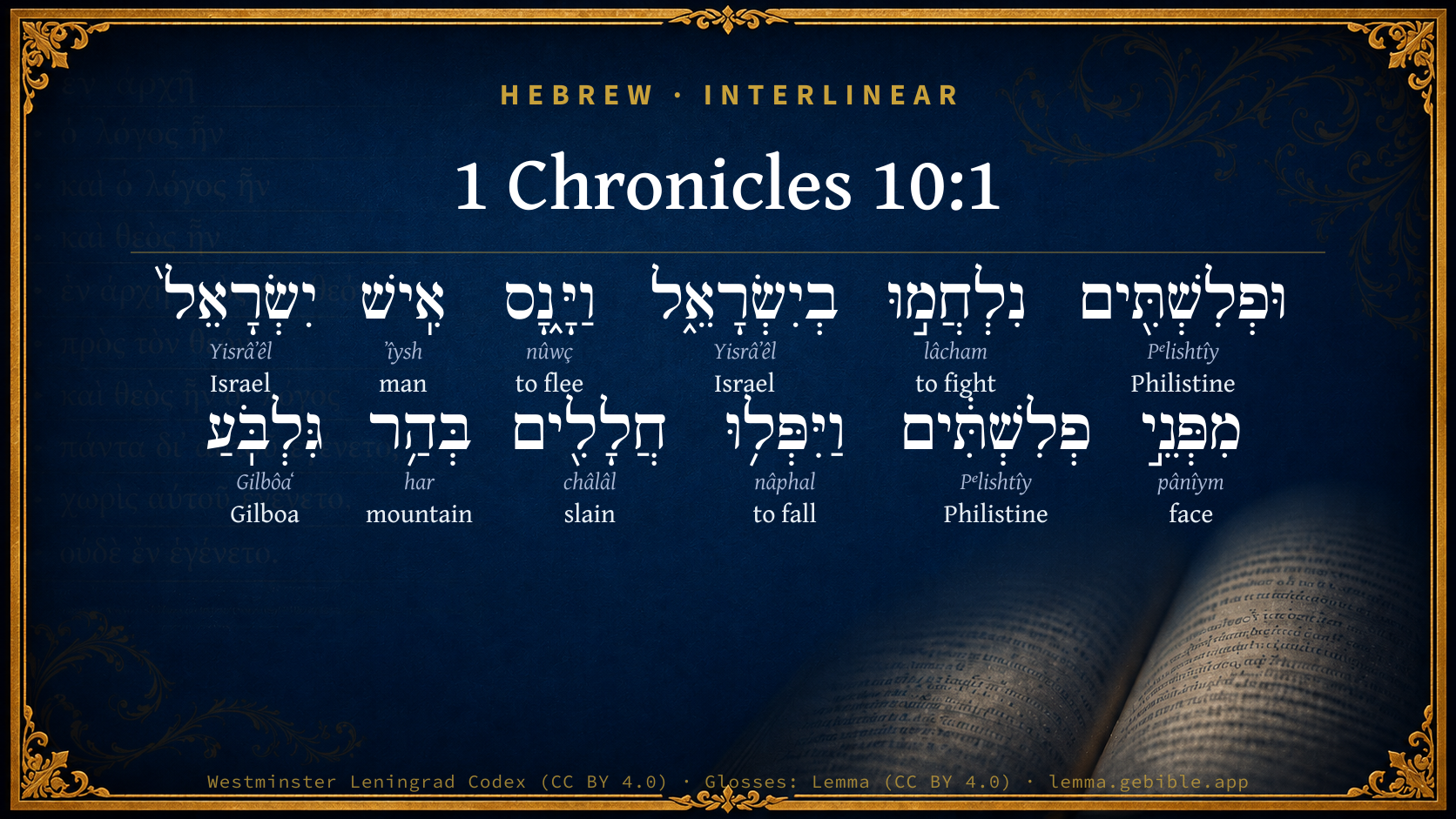
Hebrew (Westminster Leningrad Codex) 1 Chronicles 10:1 appears in the Hebrew Old Testament. The text above is from the Westminster Leningrad Codex. Each word links to its Strong’s number, a concise gloss, and parsing drawn from the Open Scriptures Hebrew Bible morphology. Click any word for its full Brown-Driver-Briggs (BDB) entry.
Download image
Cite this verse

1 Chronicles 10:1 (World English Bible). Public Domain. Lemma interlinear Bible study tool, https://lemma.gebible.app/v/1-chronicles/10/1.

Show BibTeX & RIS
BibTeX
RIS
English Translation
Now the Philistines fought against Israel: and the men of Israel fled from before the Philistines, and fell down slain on Mount Gilboa.
World English Bible · Public Domain
Download a study sheet

One document with this verse’s original text, its word-by-word gloss line, the meaning frame, cross-references with their text, attributed commentary, and full source and license credits — printable, and it pastes into notes with its structure intact.

This verse Autodidact and up

Study sheet (.html) Plain text (.txt)

A passage Seminary Student

Up to 50 verses in one chapter. A passage sheet keeps up to 6 commentary sources and 12 cross-references per verse, in the order this page ranks them, and says so on the sheet whenever that leaves anything out. Ask for a single verse and you get the Autodidact verse sheet above.

Everything on this page stays free to read, with no account — the sheet is a download of what is already on screen, not access to it.

Want to remove ads? Support Godless Engineer
Compare translations 3

The same verse in 3 English versions, stacked beneath the original-language interlinear above. Click any original word for its lexicon entry.

Each is an independent rendering of the whole verse — the interlinear is not word-aligned to these translations.

Highlighted words mark where these versions differ — a whole-verse word diff, not a word-by-word alignment.

  • World English Bible Public Domain
    Now the Philistines fought against Israel: and the men of Israel fled from before the Philistines, and fell down slain on Mount Gilboa.
  • King James Version Public Domain
    Now the Philistines fought against Israel; and the men of Israel fled from before the Philistines, and fell down slain in mount Gilboa.
  • unfoldingWord Literal Text CC BY-SA 4.0
    Now the Philistines fought with Israel, and the men of Israel fled from the face of the Philistines, and they fell slain on Mount Gilboa.

unfoldingWord Literal Text — © unfoldingWord, licensed CC BY-SA 4.0. Word-aligned USFM3 via Door43 (git.door43.org/unfoldingWord/en_ult).

Versions to compare (up to 4)

3 of 4 selected

Show all 18 translations

Every available English version of this verse, each an independent rendering of the whole verse.

  • World English Bible Public Domain
    Now the Philistines fought against Israel: and the men of Israel fled from before the Philistines, and fell down slain on Mount Gilboa.
  • Berean Standard Bible Public Domain
    Now the Philistines fought against Israel, and the men of Israel fled before them, and many fell slain on Mount Gilboa.
  • Majority Standard Bible Public Domain
    Now the Philistines fought against Israel, and the men of Israel fled before them, and many fell slain on Mount Gilboa.
  • King James Version Public Domain
    Now the Philistines fought against Israel; and the men of Israel fled from before the Philistines, and fell down slain in mount Gilboa.
  • American Standard Version (1901) Public Domain
    Now the Philistines fought against Israel: and the men of Israel fled from before the Philistines, and fell down slain in mount Gilboa.
  • Revised Version (1885) Public Domain
    Now the Philistines fought against Israel: and the men of Israel fled from before the Philistines, and fell down slain in mount Gilboa.
  • Geneva Bible (1599) Public Domain
    Then the Philistims fought against Israel: and the men of Israel fled before the Philistims, and fell downe slaine in mount Gilboa.
  • Douay-Rheims (1899) Public Domain
    Now the Philistines fought against Israel, and the men of Israel fled from before the Philistines, and fell down wounded in mount Gelboe.
  • Young's Literal Translation Public Domain
    And the Philistines have fought with Israel, and the men of Israel flee from the face of the Philistines, and fall wounded in mount Gilboa,
  • Literal Standard Version CC BY-SA 4.0
    And the Philistines have fought with Israel, and the men of Israel flee from the face of the Philistines, and fall wounded in Mount Gilboa,
  • Unlocked Literal Bible CC BY-SA 4.0
    Now the Philistines fought against Israel. Every man of Israel fled from before the Philistines and fell down dead on Mount Gilboa.
  • unfoldingWord Literal Text CC BY-SA 4.0
    Now the Philistines fought with Israel, and the men of Israel fled from the face of the Philistines, and they fell slain on Mount Gilboa.
  • Darby Bible Public Domain
    And the Philistines fought against Israel; and the men of Israel fled from before the Philistines, and fell down slain on mount Gilboa.
  • World Messianic Bible Public Domain
    Now the Philistines fought against Israel; and the men of Israel fled from before the Philistines, and fell down slain on Mount Gilboa.
  • Webster's Bible Public Domain
    Now the Philistines fought against Israel; and the men of Israel fled from before the Philistines, and fell down slain in mount Gilboa.
  • Free Bible Version CC BY-SA 4.0
    The Philistines attacked Israel and all the Israelites soldiers ran away from them. Many Israelites were cut down on Mount Gilboa.
  • Bible in Basic English Public Domain
    Now the Philistines were fighting against Israel; and the men of Israel went in flight before the Philistines, falling down wounded in Mount Gilboa.
  • JPS Tanakh (1917) Public Domain
    Now the Philistines fought against Israel; and the men of Israel fled from before the Philistines, and fell down slain in mount Gilboa.

Literal Standard Version (2020), Covenant Press — licensed CC BY-SA 4.0. Text via the HelloAO Bible API (eBible.org). Unlocked Literal Bible (unfoldingWord) — licensed CC BY-SA 4.0. Text via the HelloAO Bible API (eBible.org). unfoldingWord Literal Text — © unfoldingWord, licensed CC BY-SA 4.0. Word-aligned USFM3 via Door43 (git.door43.org/unfoldingWord/en_ult). Free Bible Version, Dr. Jonathan Gallagher — licensed CC BY-SA 4.0. Text via the HelloAO Bible API (eBible.org).

Word by word

More ways to search: Search by grammar → Find every occurrence → Compare this word →

Practice this passage: Drill this verse → Learn its vocabulary →

גִּלְבֹּֽעַ
Gilbôaʻ
H1533
“Gilboa”
Noun, Proper
Part of Speech
Noun
Type
Proper
Full BDB Definition

Origin: from H1530 and H1158

TWOT: None

Gilboa = "swollen heap" - a mountain-ridge at the southeastern end of the plain of Jezreel, site of the death of Saul and Jonathan
  1. וּפְלִשְׁתִּ֖ים Pᵉlishtîy H6430 “and · Philistines” Conjunction + Noun, Gentilic, Masculine, Plural, Absolute
  2. נִלְחֲמ֣וּ lâcham H3898 “to fight” Verb, Niphal, Perfect, 3rd Person, Common, Plural
  3. בְיִשְׂרָאֵ֑ל Yisrâʼêl H3478 “in/at · Israel” Preposition + Noun, Proper
  4. וַיָּ֑נָס nûwç H5127 “and · to flee” Conjunction + Verb, Qal, Sequential Imperfect, 3rd Person, Masculine, Singular
  5. אִֽישׁ ʼîysh H376 “man of” Noun, Common, Masculine, Singular, Construct
  6. יִשְׂרָאֵל֙ Yisrâʼêl H3478 “Israel” Noun, Proper
  7. מִפְּנֵ֣י pânîym H6440 “from · face(s) of” Preposition + Noun, Common, Both, Plural, Construct
  8. פְלִשְׁתִּ֔ים Pᵉlishtîy H6430 “Philistines” Noun, Gentilic, Masculine, Plural, Absolute
  9. וַיִּפְּל֥וּ nâphal H5307 “and · to fall” Conjunction + Verb, Qal, Sequential Imperfect, 3rd Person, Masculine, Plural
  10. חֲלָלִ֖ים châlâl H2491 “slain” Adjective, Adjective, Masculine, Plural, Absolute
  11. בְּהַ֥ר har H2022 “in/at · mountain of” Preposition + Noun, Common, Masculine, Singular, Construct

About this verse

These counts appear in no published source. They are computed here, from the morphology-tagged text and Lemma’s own curated glosses. What Lemma adds →

12
words
10
distinct lemmas
Historical
section

Notable vocabulary

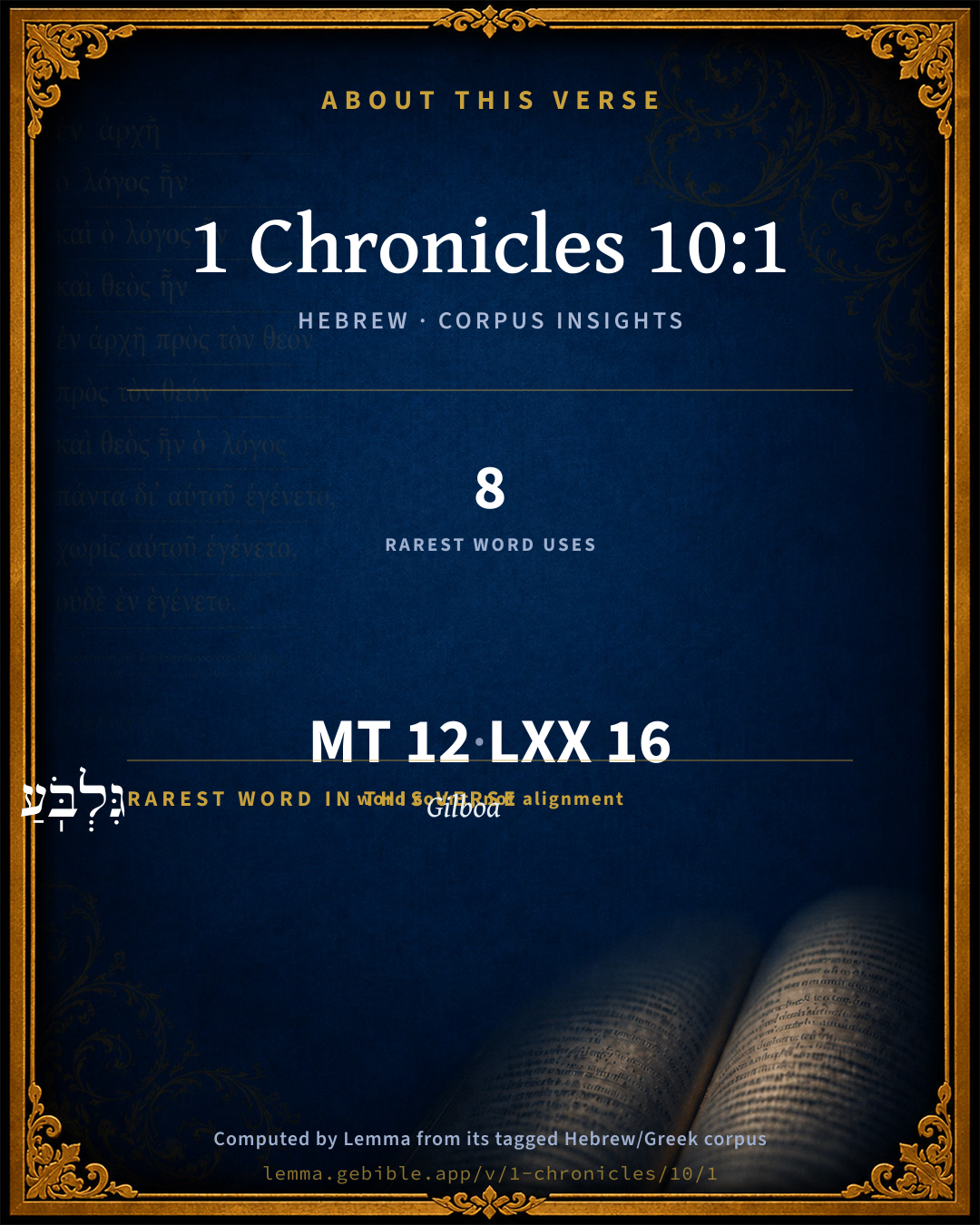
The rarest word here is גִּלְבֹּֽעַ Gilboa H1533 — appearing just 8 times in the whole Hebrew Bible.

Shared distinctive vocabulary

גִּלְבֹּֽעַ Gilboa H1533 occurs in 8 verses of the Hebrew Bible. Also found in:

Grammatical profile

  • 3 verbs
  • 8 nouns
  • 1 adjective

Verb forms

  • נִלְחֲמ֣וּ Niphal · Perfect
  • וַיָּ֑נָס Qal · Sequential Imperfect
  • וַיִּפְּל֥וּ Qal · Sequential Imperfect

Repetition

Words recur within this verse — often emphatic in Hebrew:

  • וּפְלִשְׁתִּ֖ים Philistine H6430 ×2
  • בְיִשְׂרָאֵ֑ל Israel H3478 ×2

Hebrew & Septuagint length

In English translation the verse runs 23 words from the Hebrew and 20 from the Septuagint (LXX English) — closely comparable.

A rough comparison of the two English renderings, which tokenize alike — not a word-level alignment.

Word counts can differ between the Hebrew and the Greek without any difference in meaning — e.g. the Hebrew direct-object marker אֵת has no separate Greek word, and Greek often adds the article ὁ.

In the original languages it is 12 Hebrew tokens and 16 Greek tokens — but the two are counted differently (Hebrew bundles its prefixes and suffixes into one token; the Greek is in lemma form), so that isn’t a like-for-like length.

Cross-references

8

Topical passages linked to 1 Chronicles 10:1 in the Treasury of Scripture Knowledge — connected by theme and wording, ordered by reader-vote popularity; previews shown in the World English Bible.

  • 1 Samuel 31:1–13 Now the Philistines fought against Israel: and the men of Israel fled from before the Philistines, and fell down slain on Mount Gilboa.
  • 1 Chronicles 10:8 It happened on the next day, when the Philistines came to strip the slain, that they found Saul and his sons fallen on Mount Gilboa.
  • 1 Samuel 28:4 The Philistines gathered themselves together, and came and encamped in Shunem: and Saul gathered all Israel together, and they encamped in Gilboa.
  • 2 Samuel 1:6 The young man who told him said, As I happened by chance on Mount Gilboa, behold, Saul was leaning on his spear; and, behold, the chariots and the horsemen followed hard after him.
  • 2 Samuel 1:21 You mountains of Gilboa, Let there be no dew nor rain on you, neither fields of offerings: For there the shield of the mighty was vilely cast away, The shield of Saul, not anointed with oil.
  • 2 Samuel 21:12 David went and took the bones of Saul and the bones of Jonathan his son from the men of Jabesh Gilead, who had stolen them from the street of Beth-shan, where the Philistines had hanged them, in the day that the Philistines killed Saul in Gilboa;
  • 1 Samuel 28:1 It happened in those days, that the Philistines gathered their hosts together for warfare, to fight with Israel. Achish said to David, Know you assuredly, that you shall go out with me in the host, you and your men.
  • 1 Samuel 29:1–2 Now the Philistines gathered together all their hosts to Aphek: and the Israelites encamped by the spring which is in Jezreel.

Cross-references courtesy of OpenBible.info (CC BY 4.0).

Hebrew and Greek witnesses Masoretic Hebrew ↔ Greek Septuagint

The same verse in the two great witnesses to the Old Testament, shown verse-for-verse.

These are two independent witnesses, not word-aligned to each other, and the Septuagint is shown in lemma (dictionary) form.

Hebrew 1 Chronicles 10:1 Masoretic · Westminster Leningrad Codex

וּפְלִשְׁתִּ֖ים נִלְחֲמ֣וּ בְיִשְׂרָאֵ֑ל וַיָּ֑נָס אִֽישׁ יִשְׂרָאֵל֙ מִפְּנֵ֣י פְלִשְׁתִּ֔ים וַיִּפְּל֥וּ חֲלָלִ֖ים בְּהַ֥ר גִּלְבֹּֽעַ

Now the Philistines fought against Israel: and the men of Israel fled from before the Philistines, and fell down slain on Mount Gilboa.

World English Bible · Public Domain

Greek LXX 1 Chronicles 10:1 Septuagint · lemma form

καί ἀλλόφυλος πολεμέω πρός ἰσραήλ καί φεύγω ἀπό πρόσωπον ἀλλόφυλος καί πίπτω τραυματίας ἐν ὄρος γελβουε

Now the Philistines warred against Israel; and they fled from before the Philistines, and fell down slain in mount Gelbue.

LXX2012 (modern English Septuagint) · Public Domain

On this verse, Haydock's Catholic Bible Commentary discusses the Septuagint’s reading. Read the note in Commentary ↓

Hebrew: Westminster Leningrad Codex (CC BY 4.0). Greek: Septuagint (public domain); English from LXX2012 (modern English Septuagint) (Public Domain). How the Septuagint differs from the Hebrew →

Commentary

Notes on 1 Chronicles 10:1 from classic Christian and Jewish commentators (each source and its license shown beneath its notes). The classic Christian expositions comment on the surrounding passage and are grouped to its opening verse, so a note may address several verses; the Jewish commentaries on the Tanakh (Rashi and others) are per-verse, so they appear only where the commentator wrote on this verse.

Lemma curates 59 commentaries, every one of them public domain or Creative Commons licensed, each selected and text-cleaned for this edition rather than reprinted as found. About our sources →

Matthew Henry's Commentary

This account of Saul's death is the same with that which we had, Sa1 31:1, etc. We need not repeat the exposition of it. Only let us observe, 1. Princes sin and the people suffer for it. It was a bad time with Israel when they fled before the Philistines and fell down slain (Ch1 10:1), when they quitted their cities, and the Philistines came and dwelt in them, Ch1 10:7. We do not find that they were at this time guilty of idolatry, as they had been before, in the days of the judges, and were afterwards, in the days of the kings. Samuel had reformed them, and they were reformed: and yet they are thus given to the spoil and to the robbers. No doubt there was enough in them to deserve this judgment; but that which divine Justice had chiefly an eye to was the sin of Saul. Note, Princes and great men should in a special manner take heed of provoking God's wrath; for, if they kindle that fire, they know not how many may be consumed by it for their sakes. 2. Parents sin and the children suffer for it. When the measure of Saul's iniquity was full, and his day came to fall (which David foresaw, Sa1 26:10), he not only descended into battle and perished himself, but his sons (all but Ishbosheth) perished with him, and Jonathan among the rest, that gracious, generous man; for all things come alike to all. Thus was the iniquity of the fathers visited upon the children, and they fell as parts of the condemned father. Note, Those that love their seed must leave their sins, lest they perish not alone in their iniquity, but bring ruin on their families with themselves, or entail a curse upon them when they are gone. 3. Sinners sin and at length suffer for it themselves, though they be long reprieved; for, although sentence be not executed speedily, it will be executed. It was so upon Saul; and the manner of his fall was such as, in various particulars, answered to his sin. (1.) He had thrown a javelin more than once at David, and missed him; but the archers hit him, and he was wounded of the archers. (2.) He had commanded Doeg to slay the priests of the Lord; and now, in despair, he commands his armour-bearer to draw his sword and thrust him through. (3.) He had disobeyed the command of God in not destroying the Amalekites, and his armour-bearer disobeys him in not destroying him. (4.) He that was the murderer of the priests is justly left to himself to be his own murderer; and his family is cut off who cut off the city of the priests. See, and say, The Lord is righteous.

Matthew Henry's Commentary on the Whole Bible (1708–1710) — public domain (CC PDM 1.0). Text via the HelloAO Bible API.

Ellicott's Commentary for English Readers

1 Chronicles 10-29—The history of King David, who made Jerusalem the political and religious centre of Israel, organised the Levitical ministry in its permanent shape, and amassed great stores of wealth and material for the Temple, which his son and successor was to build.

X.

A BRIEF NARRATIVE OF THE OVERTHROW AND DEATH OF SAUL, BY WAY OF PRELUDE TO THE REIGN OF DAVID.

1Ch_10:1-12 are parallel to 1Sa_31:1-13. The general coincidence of the two texts is so exact as to preclude the supposition of independence. We know that the chronicler has drawn much in his earlier chapters from the Pentateuch; and as he must have been acquainted with the Books of Samuel, it is à priori likely that he made a similar use of them. At the same time, a number of small variations—on an average, three at least in each verse—some of which can neither be referred to the freaks or mistakes of copyists nor to the supposed caprice of the compiler, may be taken to indicate the use of an additional source, or perhaps of a text of Samuel differing in some respects from that which we possess. (See Introduction.)

(1) Now the Philistines fought against Israel.—For a similarly abrupt beginning, comp. Isa_2:1. The battle was fought in the plain of Jezreel, or Esdraelon, the scene of so many of the struggles of ancient history. (Comp. Hos_2:10 : “I will break the bow of Israel in the valley of Jezreel.”)

The men of Israel.—Heb., man—a collective expression, which gives a more vivid image of the rout. They fled as one man, or in a body. Samuel has the plural.

Fell down slain in mount Gilboa.—The Jebel Faku’a rises out of the plain of Jezreel to a height of one thousand seven hundred feet. The defeated army of Saul fell back upon this mountain, which had been their first position (1Sa_28:4), but were pursued thither. “Slain” is right, as in 1Ch_10:8.

A Bible Commentary for English Readers, edited by Charles John Ellicott (1878–1897) — public domain. Text from a community e-Sword module.

Trapp's Complete Commentary

John Trapp

1Ch 10:1 Now the Philistines fought against Israel; and the men of Israel fled from before the Philistines, and fell down slain in mount Gilboa.

Ver. 1. Now the Philistines.] See on 1Sa 31:1-2, &c.

John Trapp, A Commentary or Exposition upon All the Books of the Old and New Testament (1647–1656) — public domain. Text from a community e-Sword module.

Joseph Benson's Commentary

1Ch 10:1. The men of Israel fled — Thus princes sin, and the people suffer for it. No doubt there was enough in them to deserve it. But that which divine justice had chiefly an eye to, was the sin of Saul. Great men should, in an especial manner, take heed of provoking God’s wrath. For if they kindle that fire, they know not how many may be consumed by it for their sakes. See notes on 1 Samuel 31.

Joseph Benson's Commentary on the Old and New Testaments (1811–1818) — public domain. Text from a community e-Sword module.

The Preacher's Complete Homiletical Commentary

Joseph S. Exell (gen. ed.)

CRITICAL NOTES.] The genealogical introduction now closed. Narrative in twenty chapters describes the reign of David. The first 12 verses in this chapter a second edition of 1 Samuel 31, with variations in diction and in facts, partly from brevity and an interval of five or six centuries.

1Ch_10:1-7.—The death of Saul. Gilboa on which Gideon triumphed (Jdg_7:1-8). Followed. Hebrew implies that Saul was special object of pursuit. 1Ch_10:2. “Sons of S.,” without article: four altogether (cf. 1Ch_9:39). 1Ch_10:3. Wounded, not dangerously, perhaps. “Some read he trembled before the archers,” who hit, literally found, reached him in pursuing. 1Ch_10:4. Abuse me, mock me. Afraid out of respect for loyalty and in the same peril. 1Ch_10:6. House, not whole family or all his sons, for Ishbosheth survived and succeeded him in portion of kingdom (2Sa_2:8-16; 2Sa_3:6-15); but “all his household,” or body of attendants in war.

1Ch_10:8-12.—Treatment of remains. House of Ashtaroth (1Sa_31:10). Customary to deposit spoils of war in heathen temples. 1Ch_10:10. Head, skull. Dagon (1Sa_5:2). This temple destroyed in time of Maccabees (1Ma_10:82-85). The headless corpse fixed to the wall of Beth-shan (1Sa_31:10). 1Ch_10:11. Jab-gil. moved by gratitude for former help (1Sa_11:1-3). Buried the bones (after burning of the bodies, 1Sa_31:12) under oak or terebinth, “the tree” or tamarisk in Samuel. The word in both places generic, different names from one root, refer to large variety of oaks [cf. Dr. Thom., The Ld. and Bk., pp. 243, 244].

1Ch_10:13-14.—Moral of Saul’s death. Transgression in sparing king of Amalckites (1Sa_10:8; 1Sa_13:15); and in consulting a familiar spirit (1 Samuel 28). 1Ch_10:14. Inquired in form, not in right spirit. Impatient consultation considered by the writer as so inquiry at all.

HOMILETICS

THE HEIGHTS OF GILBOA.—1Ch_10:1-6

Mount Gilboa a noted place in the lot of Issachar, “flanked by the Little Hermon ridge on north-east, and by Gilboa on south-east; a mountain range of ten miles long, about 600 feet high, and mentioned only in the melancholy connection of this history.”

I. The important battle. Philistines an old and inveterate enemy, more numerous, perhaps better led and better posted, began attack. Some think Saul had gone to consult the witch and left the camp. Israel ever exposed to a watchful foe. Christian life a conflict. When thrown off our guard and God forgotten, we are easily surrounded and overcome.

II. The disgraceful flight. Best of troops put into disorder. The people of God chased by the enemy, and multitudes slain! How different from yore, when one put a thousand to flight! But when a people walk contrary to God, He will send a faintness into their hearts, and the sound of a shaken leaf shall chase them; and they shall flee as fleeing from a sword; and they shall fall when none pursueth (Lev_26:23-36).

III. The pride of Israel slain. Sad scenes on Gilboa’s top! The chosen of God and the hero of Israel wounded by archers and falling upon his own sword! The king’s sons, the bodyguard and the pride of his army, perish with him. “How are the mighty fallen!” Learn that one sinner not only destroyeth much good, but entails much suffering.

1. Upon his own kindred. Parents sin, and children suffer. Princes disobey, and their heirs are cut off.

2. In society at large. Not only the family, but the subjects of Saul suffered. How many homes, how many nations have been thrown into sorrow and deprived of their glory through sinful leaders! Achan perished not alone in his iniquity. “If ye shall still do wickedly, ye shall be consumed, both ye and your king.”

THE DEATH OF SAUL.—1Ch_10:3-7; 1Ch_10:13-14

The life and conduct of Saul full of incident, dramatic effect, and solemn warning. Learn—

I. That a splendid beginning may have an awful ending. Saul loved and elevated, called from obscurity to the service of his country; had gifts of body and mind; but opportunities lost, calling unfulfilled, and life a failure! “The chosen of the Lord” died a self-murderer! “All is well that ends well.”

II. That divine judgments overtake men’s sins. “The Lord slew him.” He had disobeyed law, defied the authority of Samuel; persisted in his self-will, and became the proud controller of his own life. Frightful to die in rebellion, to rush unbidden into God’s presence, and become a monument of judgment! From Scripture, history, and moral law we learn that “God overthroweth the wicked for their wickedness.”

III. That in national calamities the godly suffer with the ungodly. The sons, the family, and the dynasty of Saul suffered through his guilt. Sin is personal, but its consequences extensive and self-propagating. The innocent involved by the guilty. A father’s conduct ruins the children; a monarch’s government destroys the nation. If by the arrangements of society and by the law of influence we entail good or evil, let the ungodly beware and the righteous be faithful, “for none of us liveth to himself.”

SCENES IN THE CAPITAL OF GATH.—1Ch_10:7-10

I. Tidings of the deaths of the royal family. When day after battle dawned, the Philistines found dead bodies of father and three sons. Tidings told in capital of Gath and published in the streets of Ashkelon.

II. Welcome to the victorious army. Daughters of accursed race rejoiced and welcomed back their victorious army. Retribution had come for the fall of their champion leader.

III. Trophies suspended in the temple of the gods. This customary. “As head and sword of Goliath were carried off to the sanctuary, so head of Saul cut off and fastened to the temple of Dagon at Ashdod, and his arms—the spear on which he had so often rested, the sword and the famous bow of Jonathan—were sent round in festive processions to the Philistine cities, and finally deposited in the temple of Ashtaroth, in the Canaanitish city of Bethshan, hard by the fatal field. On the walls of the same city, overhanging the public place in front of the gates, were hung the stripped and dismembered corpses.” A lasting memorial of Israel’s ignominious defeat and subjugation.

THE DEVOTED CITY.—1Ch_10:11-12

I. The patriotism of the city. In general defection trans-Jordanic towns loyal to the fallen house. Jabesh-gilead specially devoted. Concerned for the land defiled by exposure of dead bodies, and for the crown of Israel profaned by uncircumcised.

II. The zeal of the city. Enthusiasm contagious. Seen—

1. In arming the people. “All the valiant men arose.”

2. In a successful raid. A long journey, a distance of about twelve miles; dangerous in the night, and by a narrow upland passage; guard surprised and bodies rescued.

III. The gratitude of the city. All this in remembrance of services rendered by Saul against their enemies (1Sa_11:1-13). Gratitude expressed—

1. In solemn funeral rites; and

2. In fasting and sorrow. Rare to show gratitude to a fallen foe. This act commended by David (2Sa_2:5), and mentioned by Josephus (Antiq. vi. 6, ch. xiv., sect 8). Cherish the memory of past help; repay when opportunity comes, for come it will. You shall reap what you sow, a reward from God and man. “The Lord show kindness and truth unto you; and I also will requite you this kindness, because ye have done this thing” (2Sa_2:6).

SAUL’S TRANSGRESSION.—1Ch_10:14

I. He was a disobedient king. God’s command definite: “Slay man and woman.” Saul’s conduct was partial, he spared Agag the king, and kept best of cattle (1Sa_16:1). Men never prosper who violate God’s commands. Sooner or later punishment overtakes them. Adam, Balaam, Jonah.

II. He was an untruthful king. “I have performed the commandment of the Lord.” Saul had a bad heart and a false tongue. He coveted Agar’s wealth and Samuel’s blessing. The bleeting of sheep convicted the lying king. God will expose the untruthful. Abraham, Ananias, &c.

III. He was a hypocritical king. “The people spared the fattest of the sheep and the oxen to sacrifice to the Lord.” When convicted of sin he blamed the people, but attributes their sin to a sacred motive. Hypocrisy adorns herself in the most attractive attire. One sin opens the gates for another. Disobedience leads to falsehood; falsehood to hypocrisy; hypocrisy to ruin. Bad men disqualify themselves for exalted positions. When kings refuse to obey God, he will cut them off. When great men fail, God appoints their successors. God can raise up men for the most arduous duties [J. T. Woodhouse].

THE LOST KINGDOM.—1Ch_10:14

I. Lost through sin. Disobedience, obstinate pride, and self-will.

II. Transferred by divine appointment. “He turned the kingdom unto David, the son of Jesse.” God overturns one and raises up another. Royalty no shelter against judgments, power no defence against heaven. “Thy kingdom shall not continue.” A proud man, elated by talent and success; a boasting church, a people glorying in wealth or wisdom, in anything but Christ, may soon be abased. God brings down the mighty from their seats and exalts the humble, “to the intent that the living may know that the Most High ruleth in the kingdom of men, and giveth it to whomsoever he will.”

HOMILETIC HINTS AND SUGGESTIONS

1Ch_10:1-7. Battle against Saul, who was—

1. Abandoned to despair. “Sore afraid,” 1Ch_10:4, i.e., he trembled, was frightened at archers. After scene of Endor might well fear.

2. Failed in resources. No prophet, no divine guidance, sorely wounded and unable to defend himself. A fearful thing to fall into the hands of the living God.

1Ch_10:2. Jonathan. That peerless prince, the glory of chivalry, that lumen et columen of his country. He dieth among the rest, and hath his share as deep as any other in that common calamity; so true is that of Solomon, “There is one event to the righteous and to the wicked” (Ecc_9:1-2); but God maketh them to differ (Mal_3:18), as the harvest-man cutteth down the good corn and the weeds together, but for a different purpose [Trapp].

1Ch_10:4. Abuse me, i.e., my body, whereof he took more care than for his precious soul. A common fault. His body was abused nevertheless [Trapp].

1Ch_10:5. Fell likewise. Evil examples, especially of the great, never escaped imitation: the armour-bearer of Saul follows his master, and dares do that to himself which to his king he durst not [Bp. Hall]. Fell by Saul’s evil example, and perhaps in love to him, as loth to outlive him whom he had held the joy of his heart, the breath of his nostrils. He had done better if he had died by the hand of the enemy, in his master’s defence [Trapp].

1Ch_10:4. Suicide as illustrated by the case of Saul. I. Causes;

1. Not merely accumulated misfortunes, but long-continued wrongdoing;

2. Cowardly fear of suffering (1Ch_10:3), even in a man formerly brave;

3. Caring more for disgrace than for sin;

4. Abandonment of trust in God as to this life and the future life. II. Effects:

1. Others led by the example into the same folly and sin (1Ch_10:5);

2. Personal dishonour not really prevented (1Ch_10:4; 1Ch_10:9-10);

3. A crowning and lasting reproach to the man’s memory [Lange].

1Ch_10:11-12. Exploit of men of Jabesh-gilead.

1. It was a brave deed;

2. A patriotic deed;

3. A grateful deed (ch. 11);

4. But the bravery, patriotism, and gratitude had been better shown before Saul’s death by helping him (which they do not appear to have done). Honours after death make poor amends for neglect and unfaithfulness during life;

5. And care of the poor remains could avail little for the man’s reputation in this world, and nothing for his repose in eternity [Lange].

1Ch_10:13. A familiar spirit. He turned aside (1Sa_12:20), indicating not only external defection in non-fulfilment of the word, but internal, a falling away in fellowship and walk with God, was not subject to God’s will and word. Learn—

1. The possibility that a man may fall from spiritual communion with the divine and invisible. “God is departed from me and answereth me no more, neither by prophets nor by dreams.”

2. The rapidity with which a man may fall from the highest eminence. “Because thou obeyedst not, therefore hath the Lord done this thing.”

3. The certainty that one day the impenitent will want their old teachers. “Bring me up Samuel” [City Temple, vol. i.].

ILLUSTRATIONS TO CHAPTER 10

1Ch_10:6. Saul died. There is not in sacred history, or in any other, a character more melancholy to contemplate than that of Saul. Naturally humble and modest, though of strong passions, he might have adorned a private station. In circumstances which did not expose him to temptation, he would probably have acted virtuously. But his natural rashness was controlled neither by a powerful understanding nor a scrupulous conscience, and the obligations of duty and the ties of gratitude, always felt by him too slightly, were totally disregarded when ambition, envy, and jealousy had taken possession of his mind. The diabolical nature of these passions is seen, with frightful distinctness, in Saul, whom their indulgence transformed into an unnatural monster, who constantly exhibited the moral infatuation so common among those who have abandoned themselves to sin, of thinking that the punishment of one crime may be escaped by the perpetration of another. In him also is seen the moral anomaly or contradiction which would be incredible did we not often witness it, of an individual pursuing habitually a course which his better nature pronounces not only flagitious, but insane (1Sa_24:16-22). Saul knew that the person should be king whom he persisted in seeking to destroy, and so accelerated his own ruin [Kitto].

1Ch_10:14. Turned. Because of unrighteous dealings, the kingdom is turned from one people to another (Sir_10:8).

“Kings then at last have but the lot of all,

By their own conduct they must stand or fall” [Cowper].

The Preacher's Complete Homiletical Commentary (gen. ed. Joseph S. Exell; Funk & Wagnalls, c. 1892) — public domain (pre-1929). A full-Bible homiletical/sermon-outline anthology covering 65 of 66 books (2 John is absent from the source module). Text from a community e-Sword module.

Lange's Commentary on the Holy Scriptures

§ 2. HISTORY OF THE KINGS IN JERUSALEM FROM DAVID TO THE EXILE.—

1 Chronicles 10-36

1. DAVID.—1 Chronicles 10-29

a. Introduction: Fall of the House of Saul.—Ch. 10

1Ch_10:1.And the Philistines fought against Israel; and the men of Israel fled before the Philistines, and fell down slain in Mount Gilboa. 2And the Philistines pursued Saul and his sons; and the Philistines smote Jonathan and Abinadab and Malchi-shua, sons of Saul. 3And the battle went sore against 4Saul, and the archers found him, and he trembled for the archers. And Saul said to his armour-bearer, Draw thy sword and thrust me through therewith, lest these uncircumcised come1 and insult me; but his armour-bearer would 5not; for he was sore afraid; and Saul took the sword and fell upon it. And his armour-bearer saw that Saul was dead, and he also fell on the sword and 6died. And Saul died, and his three sons, and all his house died together. 7And all the men of Israel that were in the valley saw that they fled, and that Saul and his sons were dead; and they forsook their cities and fled, and the Philistines came and dwelt in them.

8And it came to pass on the morrow that the Philistines came to strip the slain, 9and they found Saul and his sons fallen in Mount Gilboa. And they stripped him, and took his head and his armour, and sent into the land of the Philistines around, to bear tidings to their idols and to the people. 10And they put his armour in the house of their god, and fastened his skull in the house of Dagon. 11, 12And all Jabesh-gilead heard all that the Philistines had done to Saul. And all the valiant men arose, and took the body of Saul and the bodies of his sons, and brought them to Jabesh, and buried their bones under the oak in Jabesh, and fasted seven days.

13And Saul died for his transgression which he committed against the Lord, for the word of the Lord which he kept not, and also for asking a necromancer 14to inquire.2 And inquired not of the Lord; and He slew him, and turned the kingdom to David the son of Jesse.

EXEGETICAL

Preliminary Remark.—This account of the downfall of Saul and his house agrees, except in coordinate details, literally with 1Sa_31:13 ; only the 1Ch_10:13-14 are an addition of the Chronist, designed to mark the history of the fall of Saul’s family as the transition to the following history of David, that forms the proper centre of the whole work of our historian. For this history of David points all that precedes, the whole of the genealogies in the first nine chapters, with their emphatic elevation of the tribe of Judah. And if these genealogies are so disposed that they close with the register of the Benjamite house of Saul, this serves to prepare for the contents of our chapter, which on its part is preparatory to the following special history of the reign of David, the ancestor aud founder of the legitimate line of kings.

1. Saul’s Defeat and Death in the Battle with the Philistines on Mount Gilboa: 1Ch_10:1-12 comp. 1Sa_31:1-12).—And the men of Israel fled before the Philistines. The fuller statement of the books of Samuel (1 Samuel 29 comp. 1Ch_28:4) shows that this flight of the defeated Israelites was directed from the plain of Jezreel, as the proper field of battle, to Mount Gilboa, their former post.

1Ch_10:2. And the Philistines pursued Saul and his sons; properly, clung to Saul,” a fit expression for the incessant and vehement pursuit (Sept.: συνάπτουσι τῷ Σαούλ; Luth.: “hingen sich an Saul”). The abridged form וַיַּדְבְּקוּ, for וַיַּדְבִּיקוּ, as in 1Sa_14:22; 1Sa_21:2. On Jonathan, Abinadab, and Malchishua see 1Ch_8:33.

1Ch_10:3. And the archers found him, overtook him (as 1Ch_10:8; comp. 1Sa_20:11).—And he trembled for the archers. וַיָּחֶל lit. apoc. Kal of חוּל, torqueri, tremerc; so 1Sa_31:3; comp. וַתָּחֶל, Ps. 197. 4. The resent terror of Saul corresponds with that in 1Sa_28:5. It is unnecessary here to prefer the reading of the Sept.: καὶ ἐπόνεσεν ἀπὸ τῶντόξων (ἐπόνεσεν, perhaps resting on a וַיַּחַל, from חָלָןא, πονεῖν), and so render (with Kamph.), “and he was pressed by the archers.” For the ἐτραυατίσθη “he was wounded,” of the Sept. in the parallel 1Sa_31:3, comp. Berth, and Wellh., Text der der BiicherSam. p. 147, who perhaps unnecessarily assumes that the Chronist may have read וַיֵחַל “and he was wounded” Niph. of חלל), and therefore omitted מְאֹד, which did not suit this verb. The omission of this adverb is sufficiently accounted for by the abbreviating habit of the author, on which also the omission of the pleonastic אֲנָשִׁים after הַמּוֹרִים (1Sa_31:3) rests, as also that of עִמּוֹ at the close of 1Ch_10:5, etc.

1Ch_10:4. Lest these uncircumcised come and insult me. Before וְהִתְעַלְּלוּ־בִי (comp. Jer_38:19; 1Sa_6:6) the parallel text in Samuel exhibits a וּדְקָרֻנִי, which perhaps did not originally stand in the text, but seems to be repeated by mistake from the foregoing imper. וְדָקְרֵנִי, so that the word is rightly omitted by the Chronist; comp. Berth, and Wellh.

1Ch_10:6. And all his house died together. Again an abbreviation for, “and his armour-bearer, and all his men on that day together, “in Sam. 31. The design of this abbreviation was scarcely to remove the strong” exaggeration” (Wellh.) contained in גַּם כָּל־נָשָׁיו on account of which the Sept. perhaps left these words untranslated; for the וְכָל־בֵּיתוֹ of our author contains a like exaggeration, as Saul’s whole house did not fall in this battle, as the author (1Ch_9:35 ff.) knew very well. The expression is general and excessive, as the longer one in 1 Samuel 31. also.

1Ch_10:7. And all the men of Israel that were in the valley, or on the plain. More exactly, 1 Samuel 31, “the men of Israel that were beyond the valley and beyond the Jordan,” that is, that dwelt west and east of Mount Gilboa. That our writer had a defective text (Thenius) is not to be assumed ; rather the same process of abbreviation is found here, as immediately after, where the required subject אַנְשֵׁי יִשְׂרָאֵל is omitted after כִּי נָסוּ.

1Ch_10:9. And they stripped him, and took his head and his armour. Instead of this, 1Sa_31:9 has, “and they cut off his head and stripped off his armour.” The beheading, understood of itself (comp. Goliath, 1Sa_17:54), our author leaves unmentioned.—And sent into the land of the Philistines around, namely, these trophies, Saul’s head and armour (comp. Jdg_19:29 f.). Accordingly, the Sept. in 1 Samuel has translated καὶ ἀποστέλλουσιν αὐτά, where perhaps “messengers” (מְבַשְּׂרִים ,צִירִים) is to be supplied; see Then. and Wellh.—To their idols and to the people. For אֶת־עֲצַבֵּיהֶם (where אֶת=with, before), the text in Samuel has בֵּית עֲצַ׳, “in the house of their idols,” a reading not confirmed by the Sept., which seems to owe its origin to the following verse (בית־אלהיהם).

1Ch_10:10. And they put his armour in the house of their god; according to 1Sa_31:10, in the temple of Astarte. for the Ashtaroth, the same deity as the “queen of heaven” of the Canaanites, Jer_7:18 ff., or the Alilat of the Arabs, Herod, iii. 8 (perhaps also = the Phenician mother of gods, Astronoe of Damascius [vit. lsid. 302; comp. Döllinger, Judenth. p. 143], and the Spartan Venus hastata victrix of Cythera), was the chief deity of the Philistines, that ’Aφροδίτη Οὐρανία whose ancient and wealthy sanctuary at Askelon is mentioned by Herodotus i. 108. We are perhaps, therefore, to understand this Astarte temple at Askelon, as the text named temple of Dagon, the second chief divinity of the Philistines, will be that mentioned, 1Sa_5:3 ff., at Ashdod, which was especially frequented in the times of Saul (comp. Vaihinger, Art. “Philister” in Herzog’s Encycl. xi. 576 f.). That “their god” and “Dagon” could not be opposed, as Wellh. thinks, is too much to assert. Rather was the Astarte of the Philistines a kind of androgynous being, that formed with Baal a syzygy or a supreme divine principle, and certainly one fundamentally different from the fish god Dagon (because the latter was both younger and less esteemed). Comp. Döllinger, p. 397 ff.; Müller, Astarte, a contribution to the mythology of oriental antiquity, Wien 1861 (in which also the Cretan Europa [ = רַבָּה the strong] is identified with Astarte), Vaihinger, as above.—And fastened his skull in the house of Dagon. These words are wanting in 1 Samuel 31, where, on the contrary (1Ch_10:10), is found the following notice: “and they fastened his body to the wall of Beth-shean.” Here we must choose between the assumption, that our text arose from a corruption of this reading of Samuel (Wellh.), and such harmonizing attempts as that of Ewald and Thenius, who assume that originally after the words, “his skull in the house of Dagon,” stood the following, “and they fastened his body to the wall of Bethshean,” but they fell out on account of the similarity of ואת גלגלתו and ואת גויתו; or that of Bertheau, who explains the omission of the notice of the fastening of the body to the wall of Bethshean as an intentional one, that is to be judged in the same way as the other abbreviations of our writer. The latter assumption is the most probable, because in 1Ch_10:12 there is no mention of fetching the body from Bethshean.

1Ch_10:11. And all Jabesh-gilead:1 Samuel 31 : “and the inhabitants of Jabesh-gilead.” According to Berth., the ישְׁבֵי before יָבֵשׁ; came into the text on account of the plur. וישׁמעוּ but here again the easier supposition is that the Chronist has abbreviated the text of Samuel. Besides, it was gratitude for the deliverance wrought for them by Saul (1 Samuel 11) that moved the oitizens of Jabesh to this pious care for his burial.

1Ch_10:12. And took the body of Saul.גּוּפַת is a later phrase, usual in Aramaic, occurring only here in the O. T. for the גְּוִיַּת of Samuel, Whence the body was fetched, and what was done with it (for example, its incremation, 1Sa_31:12), our author, true to his abbreviating habit, omits.

2. Closing Reflection on the Fall of the Kingdom of Saul: 1Ch_10:13-14.—And Saul died for his transgression. Wherein this transgression מעל: unfaithfulness, apostasy; comp. 1Ch_5:25, 1Ch_9:1; Lev_5:5) consisted, is added—1. In not following the word of the Lord, that is, His command to destroy Amalek (1Sa_15:11; comp. 1Ch_28:18);–2. In inquiring of the necromancer.—For the word of the Lord which he kept not. Besides 1 Samuel 15, we are to understand here, also, that earlier case of disobedience in 1Sa_10:8; 1Sa_13:13, and also 1Sa_22:18 f.—And also for asking the necromancer to inquire, to seek an oracle, a revelation; comp. 1Sa_28:7, where דרשׁ is used in the same pregnant sense. On the quite superfluous gloss of the Sept., comp. Crit. Note.

1Ch_10:14. And inquired not of the Lord, sought not information. This is not inconsistent with the fact that, 1Sa_14:37; 1Sa_26:6, Saul had inquired of the Lord, but without effect (because the Lord had departed from him, 1Ch_28:15). It rests rather on the certainly correct and historical presupposition, that Saul had neglected to seek the favour of Jehovah with the proper zeal, and then inquire of Him. Comp. Starke: “he sought Jehovah not uprightly and in due order, and put not his trust in the Lord, in the order of true repentance;—he did not continue his inquiry of the Lord, when God refused him an answer on account of his sins, to the confession and entreaty for pardon of which he had not brought himself, but betook himself forthwith to the soothsayer.”—And He slew him (in the battle, after Samuel’s spirit had announced to him his doom, 1Sa_28:19), and turned the kingdom to David. On ויסב, comp. 1Ch_12:23; 2Sa_13:12. On the significance of the present small section for the history of salvation, comp. the evangelical and ethical reflections on 1 Chronicles 10-29, No. 1.

Footnotes:

[1] Kethib: יָבאֹוּ. Keri: יָבוֹאוּ.

[2]After לִדְרוֹשׁ the Sept. gives the superfiuous addition: καὶ ἀπεκρίνατο αὐτῷ Σαμουῆλ ὁ προφήτης. Comp. Sir_46:20.

Lange's Commentary on the Holy Scriptures (Critical, Doctrinal, and Homiletical), ed. John Peter Lange, English translation edited by Philip Schaff (1864–1880) — public domain. Text from a community e-Sword module.

The Annotated Bible

Arno C. Gaebelein

II. THE OVERTHROW AND END OF SAUL

CHAPTER 10

1. The overthrow and death of Saul (1Ch 10:1-7)

2. The burial of Saul and his sons (1Ch 10:8-12)

3. The cause of Saul’s failure (1Ch 10:13-14)

1 Samuel 31 contains the same record of Saul’s miserable end and trial. The writer of Chronicles uses the departure of Saul to introduce the history of the king after God’s own heart, why God had dealt with Saul in judgment, and that the kingdom was turned unto David, the son of Jesse. The fatal battle between the Philistines and Israel took place in Mount Gilboa. Gilboa is south-east of the plain of Esdraelon which runs from Carmel to the Jordan valley. The cause of this war is unknown. Saul suffered a great defeat and many were the slain of Israel which fell in Gilboa. Among them were Saul’s three sons, Jonathan, Abinadab, also called Ishui (1Sa 14:49), and Melchi-shua. Then Saul himself was hit by an archer and wounded. Fearing abuse and insults from the Philistines, he requested his armor bearer to draw his sword and to kill him, but he was afraid, because Saul was the Lord’s anointed. Then the unhappy king took his own sword and fell upon it. The armor bearer also committed suicide. The reader will find in annotations on 2 Samuel 1 the story of the Amalekite explained.

The victory of the Philistines was complete. The people forsook their cities and these were occupied by the Philistines. When the plunderers came searching for the slain, in order to strip them of their belongings, the bodies of Saul and his sons were found. Then the body of Saul was stripped and beheaded and the armor was brought into the house of their gods, (Ashtaroth, the Phoenician Venus) and the gory head fastened as a trophy in the house of Dagon. 1Sa 31:10 tells us that the body was fastened to the wall of Beth-shan, but here we read that only the head was fastened in the house of Dagon. Beth-shan was a mountain fortress, and here the bodies of Saul and his unfortunate sons were fastened.

“And now night with her dark mantle once more covered these horrible trophies. Shall the eagles and vultures complete the work which, no doubt, they had already begun? The tidings had been carried across the Jordan, and wakened echoes in one of Israel’s cities. It was to Jabesh-gilead that Saul, when only named but not yet acknowledged king, had by a forced night-march brought help, delivering it from utter destruction (1 Sam. 11). That had been the morning of Saul’s life, bright, and promising as none other; his first glorious victory, which had made him king by acclamation, and drawn Israel’s thousands to that gathering in Gilgal, when, amidst the jubilee of an exultant people, the new kingdom was inaugurated. And now it was night; and the headless bodies of Saul and his sons, deserted by all, swung in the wind on the walls of Beth-shan, amid the hoarse music of vultures and jackals.

“But it must not be so; it cannot be so. There was still truth, gratitude, and courage in Israel. And the brave men of Jabesh-gilead marched all the weary night; they crossed Jordan; they climbed that steep brow, and silently detached the dead bodies from the walls. Reverently they bore them across the river, and ere the morning light were far out of reach of the Philistines. Though it had always been the custom in Israel to bury the dead, they would not do so to these mangled remains, that they might not, as it were, perpetuate their disgrace. They burned them just sufficiently to destroy all traces of insult, and the bones they reverently laid under their great tamarisk tree, themselves fasting for seven days in token of public mourning. All honor to the brave men of Jabesh-gilead, whose deed Holy Scripture has preserved to all generations!” (Bible History).

Sad and solemn is the final record of King Saul in these historical books. “So Saul died for his transgression which he committed against the LORD, even against the Word of the LORD, which he kept not, and also for asking counsel of one that had a familiar spirit, to inquire of it” (1Sa 28:6-7). He had disobeyed God, rejected His Word and then turned to the agency of Satan, to a demon instrument for help and advice. This is the road of apostasy. The road of the apostasy in Christendom so prominent in the closing days of our age is the same. It is departure from the faith and giving heed to seducing spirits and doctrines of demons (1Ti 4:1). It is a turning away from the truth, the Word of God, and turning to fables (2Ti 4:4).

Arno C. Gaebelein, The Annotated Bible (1913–1922) — public domain. Text from a community e-Sword module.

Tyndale Open Study Notes

Tyndale Open Resources

10:1-14 The narrative of Israel as a kingdom begins with the death of Saul, who failed to fulfill God’s purposes for him as king and for Israel as a nation. Saul’s death prepares the way for David, whom the Chronicler regarded as the first true king of Israel.

Tyndale Open Study Notes — © Tyndale Open Resources, licensed CC BY-SA 4.0. Text via the HelloAO Bible API.

Adam Clarke's Commentary

CHAPTER X

A fatal battle between the Israelites and Philistines in

Gilboa, in which Saul is mortally wounded, and has three sons

slain, 1-6.

The Israelites being totally routed, the Philistines, coming to

strip the dead, find Saul and has three sons among the slain;

they cut off Saul's head, and send it and his armour about the

country to the idol temples; and then fix them up in the house

of Dagon, 7-10.

The men of Jabesh-gilead come by night, and take away the

bodies of Saul and has three sons, and bury them in Jabesh,

11, 12.

The reason of Saul's tragical death; the kingdom is transferred

to David, 13, 14.

NOTES ON CHAP. X

Verse 1. Now the Philistines fought against Israel] The reader will find the same history in almost the same words, in 1Sa 31:1-13, to the notes on which he is referred for every thing important in this.

Adam Clarke's Commentary on the Bible (1810–1826) — public domain. Text from a community e-Sword/MySword module.

The Cambridge Bible for Schools and Colleges

gen. ed. J. J. S. Perowne

There are several variations between the text given here and the text of 1 Sam., which are noticed as they occur in the following notes.

1. in mount Gilboa] In the campaign of Gilboa the Philistines shewed new and skilful strategy. Instead of at once marching eastward up the ravines which lead into Judah and Benjamin—in which there was no room for their chariots (2Sa_1:6) to manœuvre—they first marched northward along the sea-coast and then turned eastward just before reaching Mount Carmel. This movement brought them into the great fertile plain watered by the Kishon, ground over which chariots could act with decisive effect. At the N.E. end of the plain rose the heights of Gilboa. When Saul and his Benjamites advanced to meet the Philistines, the latter succeeded in interposing themselves between the Israelite army and its base in Benjamin—an easy achievement for an enemy who by his chariots possessed a high degree of mobility. Saul was therefore driven to take up his position on the north side of the plain on Mount Gilboa, where he was attacked by the Philistines, probably from the S.W., on which side the slopes of the mountain are comparatively gentle. The Israelites cut off from their homes, outmarched, outgeneralled, and probably outnumbered, were speedily routed. The battle of Gilboa was won like Hastings by cavalry (chariots) and archers (1Ch_10:3) against infantry, which was obliged to stand on the defensive, under pain of being cut to pieces if it ventured to attack.

The Cambridge Bible for Schools and Colleges (gen. ed. J. J. S. Perowne; Cambridge University Press, 1878–1918) — public domain. Text from a community e-Sword module.

John Gill's Exposition

See Gill on Sa1 31:1.

.

1 Chronicles 10:13

ch1 10:13

ch1 10:13

ch1 10:13So Saul died for his transgression,.... See Gill on Sa1 31:13 A violent and dishonourable death, which was suffered on account of the sins he was guilty of:

one was, which he committed against the Lord, even against the word of the Lord, which he kept not; both in not staying for Samuel the time appointed, and by sparing the Amalekites whom he was bid to destroy, Sa1 13:13.

and also for asking counsel of one that had a familiar spirit, to inquire of it; what he should do with respect to engaging in battle with the Philistines, Sa1 28:8 which to do was contrary to an express command of God, Lev 19:31.

John Gill's Exposition of the Whole Bible (1746–1763) — public domain (CC PDM 1.0). Text via the HelloAO Bible API.

Albert Barnes' Notes on the Bible

The present chapter contains two facts not found in 1Sa 31:1-13 - the fastening of Saul’s head in the temple of Dagon 1Ch 10:10, and the burial of his bones, and those of his sons, under an oak 1Ch 10:12. Otherwise the narrative differs from 1Sa 31:1-13 only by being abbreviated (see especially 1Ch 10:6-7, 1Ch 10:11-12), and by having some moral reflections attached to it 1Ch 10:13-14.

Albert Barnes' Notes on the Bible (1834–1885) — public domain. Text from a community e-Sword/MySword module.

Haydock's Catholic Bible Commentary

Now. Septuagint, "and." (Haydock) --- This has no connexion with what goes before. (Calmet) --- This history is given more at large, 1 Kings xxxi., and 2 Kings i. (Menochius)

George Leo Haydock (1774–1849), Haydock's Catholic Family Bible and Commentary, 1859 edition — public domain. Excludes Psalms (Douay-Rheims chapter numbering differs from Protestant) and Deuterocanonical books (Catholic canon only).

Matthew Poole's English Annotations

Of this and the following verses till 1Ch 10:13, see my notes on 1Sa 31, where we have the same thing expressed almost in thee same words.

Matthew Poole's English Annotations on the Holy Bible (1683–1685) — public domain. Text from a community e-Sword/MySword module.

Dummelow's Commentary on the Holy Bible

J. R. Dummelow

Saul's Overthrow and Death

This chapter is abbreviated from 1Sa_31:1-13, but supplements it by statements that Saul's head was fastened in the temple of Dagon, and by a brief explanation of the causes of his overthrow.

6. All his house] This cannot mean 'all his family,' since Ish-bosheth and others of his children survived him (2Sa_2:8; 2Sa_21:8), but must refer to those of his household who attended him at Gilboa.

13. His transgression] The writer refers to what is related in 1Sa_13:13-14; 1Sa_15:1-9; 1Sa_28:7.

14. Enquired not of the Lord] Saul at first enquired of the Lord (1Sa_28:6), but on receiving no answer had recourse to the witch of Endor instead of being importunate in his supplications.

J. R. Dummelow, A Commentary on the Holy Bible (Macmillan, 1909) — public domain. Text from a community e-Sword module.

The Pulpit Commentary

It is evident that the compiler of the Chronicles intended its history proper to begin substantially with the reign of David. Strictly, however, it opens with the last mournful chapter of the career of Saul and his sons, or of three out of the four (1Ch_9:39) of them. The mention of Saul had been prepared for by the short preamble of his pedigree and family; and, in like manner, the way is paved for the introduction of the reign add deeds of David by the brief and affecting narration of the end of his predecessor on the throne. The last chapter of the First Book of Samuel occupies itself with the same subject and covers the same ground. Our present chapter compared with that is sufficient to convince us that both were drawn from some common source or sources. It is not possible to suppose that the writer of Chronicles merely copied from the Book of Samuel. The differences are very slight, but they are such as produce a different conviction, and are not consistent with the assumption of being mere alterations and additions upon what is read in the other work. The last two verses of this chapter form the distinctive feature of it, compared with the parallel of 1Sa 31. The appropriateness of these two verses, as bridging over the history from Saul to David, is evident, and is but another incidental indication of the thorough unity of purpose of the compiler. They may even be viewed as tacitly compensating for the abrupt introduction, at the commencement of the chapter, of the battle with the Philistines, and the slaughter on Mount Gilboa.

No abruptness marks this narration in 1Sa 31. On the contrary, it is there the natural conclusion of the wars between the Philistines and Saul. This engagement took place (1Sa_28:4 1Sa_29:1, 1Sa_29:11) on the plains of Jezreel. The name Jezreel marks either the city (Jos_19:18; 1Ki_21:1, 1Ki_21:11) or the cele brated valley or plain called in later times Esdraelon, the Greek form of the word. The plain in its largest proportions may be said to have been bounded by the Mediterranean (although it is called the plain of Accho, where it abuts on that sea) and the Jordan, and by the Samaria and Carmel ranges on the south and south-west, and those of Galilee on the north and northeast. While called a "plain" and "the great plain" in Jud_1:8, its name in the Old Testament is "valley." It lay like a scalene triangle, with its apex in the direction of the Mediterranean, opening into the above-mentioned plain of Accho, and its sides going from right to left, about fifteen, twelve, and eighteen miles long respectively. The allusions to it in Old Testament history are frequent. Its exceeding richness is now turned into desolation unexceeded. Megiddo (Jos_12:21; Jud 1:27) the city, centre of a smaller valley called by the same name (1Ch_7:29; Jud_1:5:19) was situated within it, in the direction of Carmel. (For very full and interesting account of the Jezreel with which we have here to do, and of Esdraelon, see Stanley"s "Sinai and Palestine," pp. 336-356, edit. 1866.) Mount Gilboa identifies for us the exact battle-field of the text. It is the same with that on which Gideon triumphed. (Jud_1:7:1, 8) It is in the lot of Issachar, flanked by the Little Hermon ridge on the north-east, and by Gilboa on the south-east, a mountain range of ten miles long, about six hundred feet high, and mentioned only in the melancholy connection of this history. The flight of the men of Israel and of Saul was from the plain back to their position on Mount Gilboa, where they were pursued, overtaken, and slain. The modern name of the town Jezreel is Zerin, the depraved aliases of which appear as Gerin and Zazzin (Robinson"s "Bibl. Res.," 3:162-165, 3rd edit.), and Jezreel, Shunem, and Beth-shean are the three most conspicuous places in this part of the whole plain of Esdraelon.

HOMILIES BY W. CLARKSON Vers. 1-10.

Understanding the end.

The psalmistwas (Ps 73) much perplexed and perturbed in spirit "when he saw the prosperity of the wicked." He was disposed to think that he had "cleansed his heart in vain," and in vain "washed his hands in innocency". (Psa_73:13) But on further and deeper thought, he arrived at a sound conclusion. When he" went into the sanctuary of God," i.e. when he looked at the matter in the light of Divine truth, then he "understood their end." If any one should wonder at Saul"s continued prosperity, should wonder where God was that a man whose hands were so stained with blood should so long be seated on a throne, he would only have to wait and see the end to know that "verily there is a God that judgeth in the earth." We learn from these verses

I THAT WE CANNOT TELL WHETHER HUMAN LIFE WILL PROVE TO BE ENVIABLE TILL IT IS CONCLUDED. The ancients said, "Call no man happy till he is dead." The epigram was the outcome of the fact, finding frequent illustration, that men who were supposed to be most enviable proved, after all, to be those with whom few would willingly exchange conditions. In the heyday of Saul"s power and prominence there must have been many Israelites who wished that such happy fortune had been theirs; that the kingly lot had fallen on their tribe, on their family, on themselves. (1Sa_10:20, 1Sa_10:21) But who, now, would wish to have been the first King of Israel, to have run his checkered course, to have been driven to such sad and guilty shifts, and to have terminated a career in such ruinous dishonour as that which closed his clouded life? To be miserably beaten, to be utterly routed in battle (ver. 3), to be driven to suicide in order to avoid the worst abuses (ver. 4), to know, before he died, that his house was perishing with him (ver. 5), to be dishonoured by the enemy after death (ver. 9), to have his body taken and exposed in the temple of an idol (ver. 10), all this was the last extreme of humiliation and disaster. Envy not those whose outward career seems enviable. Who knows what miseries are within; what madness reclines at the royal hearth; what wretchedness reposes under the princely roof; what jealousy drives in the gilded chariot; what insatiable hatred or inappeasable remorse sits down to the sumptuous meal? Who knows in what black clouds of calamity the sun of human greatness will set? Who can tell whether the end will not, like Saul"s, be such an end that all the brightness and the excellency that went before will be utterly eclipsed, and that all men will join to say, "What a miserable man was he!

II THAT ONE MAN"S SIN INVOLVES MANY MEN"S SUFFERING. Because Saul had sinned, "the men of Israel fled.... and fell down slain" (ver. 1). Because their faulty king had fallen, "the men of Israel forsook their cities and the Philistines came and dwelt in them" (ver. 7). Sinful sovereigns have entailed heavy penalties on suffering nations. But it is not kings only that cause human hearts to bleed, and that fill human lives with trouble and distress. How many thousands of homes are the abodes of sorrow, of keen disappointment, of cruel suffering, of dark foreboding, because one soul has forsaken God and made shipwreck of a good conscience!

III THAT OUTWARD FORTUNE IS NO SAFE CRITERION OF HUMAN CHARACTER. Jonathan perished on the same field with Saul; the brave and generous son with his jealous and murderous father! "Judge not according to the appearance, but judge righteous judgment". (Joh_7:24)

IV THAT MEN SOMETIMES TACITLY CONFESS THEIR OWN FOLLY, "They sent to carry tidings unto their idols" (ver. 9) to inform their gods! Surely they were thus condemning their own idolatry. How often do we condemn ourselves! C.

The Pulpit Commentary (1880–1919), ed. H.D.M. Spence-Jones & Joseph S. Exell — public domain. Text from a community e-Sword module.

John Wesley's Explanatory Notes

The overthrow and death of Saul, ver. 1-7. The triumph of the Philistines, ver. 8-10. The men of Jabesh-gilead take down and bury the bodies of Saul and his sons, ver. 11, 12. The reason of Saul's death, ver. 13, 14.

The men of Israel fled, &c. - Thus princes sin and the people suffer for it. No doubt there was enough in them to deserve it. But that which divine justice had chiefly an eye to, was the sin of Saul. Great men should in an especial manner, take heed of provoking God's wrath. For if they kindle that fire, they know not how many may be consumed by it for their sakes.

John Wesley, Explanatory Notes Upon the Whole Bible (1754–1765) — public domain. Text via the GEBible commentary corpus.

Keil & Delitzsch

C. F. Keil & F. Delitzsch

See Gill on Sa1 31:1.

.

1 Chronicles 10:13

ch1 10:13

ch1 10:13

ch1 10:13So Saul died for his transgression,.... See Gill on Sa1 31:13 A violent and dishonourable death, which was suffered on account of the sins he was guilty of:

one was, which he committed against the Lord, even against the word of the Lord, which he kept not; both in not staying for Samuel the time appointed, and by sparing the Amalekites whom he was bid to destroy, Sa1 13:13.

and also for asking counsel of one that had a familiar spirit, to inquire of it; what he should do with respect to engaging in battle with the Philistines, Sa1 28:8 which to do was contrary to an express command of God, Lev 19:31.

Keil & Delitzsch — Biblical Commentary on the Old Testament (1861–1891) — public domain (CC PDM 1.0). Text via the HelloAO Bible API. (Old Testament only.)

Kretzmann's Popular Commentary

Paul E. Kretzmann

The Battle Near Mount Gilboa

v. 1. Now, the Philistines fought against Israel, in the Plain of Jezreel, 1 Samuel 31; and the men of Israel fled from before the Philistines, and fell down slain, wounded and killed, in Mount Gilboa, where they were trying to make their escape.

v. 2. And the Philistines followed hard after Saul and after his sons, clinging to their footsteps, intending, above all, to put them out of the way. And the Philistines slew Jonathan, and Abinadab, and Malchi-shua, the sons of Saul.

v. 3. And the battle went sore against Saul, and the archers hit him, and he was wounded of the archers, literally, "he trembled for the archers," he was seized with a sudden terror as they gradually closed in upon him.

v. 4. Then said Saul to his armor bearer, Draw thy sword and thrust me through therewith, lest these uncircumcised, a common name for the heathen, as not being partakers of the covenant of Jehovah, come and abuse me, insult him, make mockery of him as a vanquished enemy. But his armor-bearer would not, for he was sore afraid; he dreaded the vengeance of the Lord upon him in case he would lay his hand upon the anointed king of the nation. So Saul took a sword and fell upon it, committing suicide, dying the death of a coward.

v. 5. And when his armor-bearer saw that Saul was dead, he fell likewise on the sword and died, following the bad example of his sovereign.

v. 6. So Saul died, and his three sons and all his house, his near relatives and the members of his household, died together.

v. 7. And when all the men of Israel that were in the valley saw that they fled, and that Saul and his sons were dead, then they forsook their cities, out in the open country, and fled; and the Philistines came and dwelt in them, establishing their outposts in the very midst of the country of Israel. Thus the wrath of the Lord overtook Saul, because he had forsaken His precepts and insisted upon going his own way. God will not be mocked, as many a scoffer has found out to his sorrow.

Paul E. Kretzmann, Popular Commentary of the Bible (1921–1924) — public domain. Text from a community e-Sword module.

The Sermon Bible

William Robertson Nicoll (ed.)

1Ch 10:13

I. Observe, first, that Saul, who here had recourse to witchcraft, had before taken vigorous measures for exterminating witchcraft; and it was at once a proof that he was far gone in iniquity and an evidence that his ruin came on apace when he could thus become the patron of a sin of which he had once been the opponent. There is no greater moral peril than that which surrounds an individual who, after he has given up a sinful practice, again betakes himself to it.

II. Observe that it was not until Saul had consulted God, and God had refused to answer him by dreams, or by Urim, or by prophets, that he took the fatal resolve of applying to the necromancer. Men are apt to forget, when roused to anxiety as to the soul, how long they have made God wait for them and how justly therefore they might expect that the peace and happiness of the Gospel will not be imparted at the first moment they are sought; and then there is great danger of their being quickly wearied and turning to other and worthless sources of comfort.

III. There is something very touching in the fact that it was Samuel whom Saul desired the witch to call up. Samuel had boldly reproved Saul, and, as it would appear, offended him by his faithfulness. And yet Saul said, "Bring up Samuel." How many who have despised the advice of a father or a mother, and grieved their parents by opposition and disobedience, long bitterly to bring them back when they have gone down to the grave, that they may have the benefit of the counsel which they once slighted and scorned.

H. Melvill, Penny Pulpit, No. 1884.

References: 1Ch 11:7-9.—J. M. Neale, Occasional Sermons, p. 59. 1Ch 11:15, 1Ch 11:19.—D. R. Evans, Christian World Pulpit, vol. xxvi., p. 393.

The Sermon Bible, ed. William Robertson Nicoll (1888–1900) — public domain. Text from a community e-Sword module.

unfoldingWord translationNotes

Door43 World Missions Community

Every man of Israel fled from before the Philistines and fell down dead on Mount Gilboa

It is implied that these men were Israelite soldiers. AT: "The whole army of Israel ran away from the Philistines" (See: Assumed Knowledge and Implicit Information)

Every man of Israel ... fell down dead

This is probably a generalization. It seems that while all the soldiers did run away, not all of them died. AT: "Every man of Israel ... most of them died" (See: Hyperbole and Generalization)

Abinadab ... Malki-Shua

See how you translated these men's names in 1 Chronicles 8:33. (See: How to Translate Names)

translationWords

Philistines

Israel

die

Saul (OT)

Jonathan

archer

unfoldingWord translationNotes — © Distant Shores Media and the Door43 World Missions Community, licensed CC BY-SA 4.0. Source: git.door43.org/Door43/en_tn.

Rashi

Rabbi Shlomo Yitzchaki (Rashi)

And the Philistines fought with Israel He relates only Saul’s downfall; when relating the story of David, he does not tell of his disgrace, only of his heroism and greatness, because the Book pertains to him and to the kings of Judah.

Rashi on the Tanakh — English translations: “The Judaica Press complete Tanach with Rashi, translated by A. J. Rosenberg” (CC BY 4.0); “Pentateuch with Rashi's commentary by M. Rosenbaum and A.M. Silbermann, 1929-1934” (public domain); “The Metsudah Tanach series, Lakewood, N.J” (CC BY 4.0); and “The Book of Joshua, Metsudah Publications, 1997” (CC BY 4.0). Text via Sefaria.

Lesson kit

Teaching starters — assembled from the data on this page, not authored interpretation. Every prompt links to the verse data it draws on. Edit before teaching.

1 Chronicles, in the Historical, opens this verse with 12 words (10 distinct Hebrew lemmas). Its most distinctive word is Gilbôaʻ (“Gilboa”). A historical commentator’s framing appears above. Read the whole chapter for the surrounding context.

Discussion questions

  1. What does “Gilboa” (Gilbôaʻ) contribute to the verse as a whole?
  2. How does 1 Samuel 28:4, which shares the word «Gilboa», read alongside this verse?
  3. What does the repetition of “Philistine” (2× in this one verse) do in this verse?
  4. These translations render this verse differently; the difference is in the English rendering, not the original. What questions does that raise?
  5. «נִלְחֲמ֣וּ» is a Niphal Perfect verb. How does that grammatical form shape the action described?
  6. Compare how Matthew Henry's Commentary and Ellicott's Commentary for English Readers read this verse. Where do they agree or differ?

Things to notice

Reading settings

Reading text

Shown beneath each verse's original-language words.

Old Testament
Old Testament edition

Read the OT as the Masoretic Hebrew (MT) or the Greek Septuagint (LXX).

English shown for the Greek Septuagint (in the Hebrew ↔ Greek comparison).

Comparing translations? Open the Compare panel on any verse page to stack up to four side by side.