
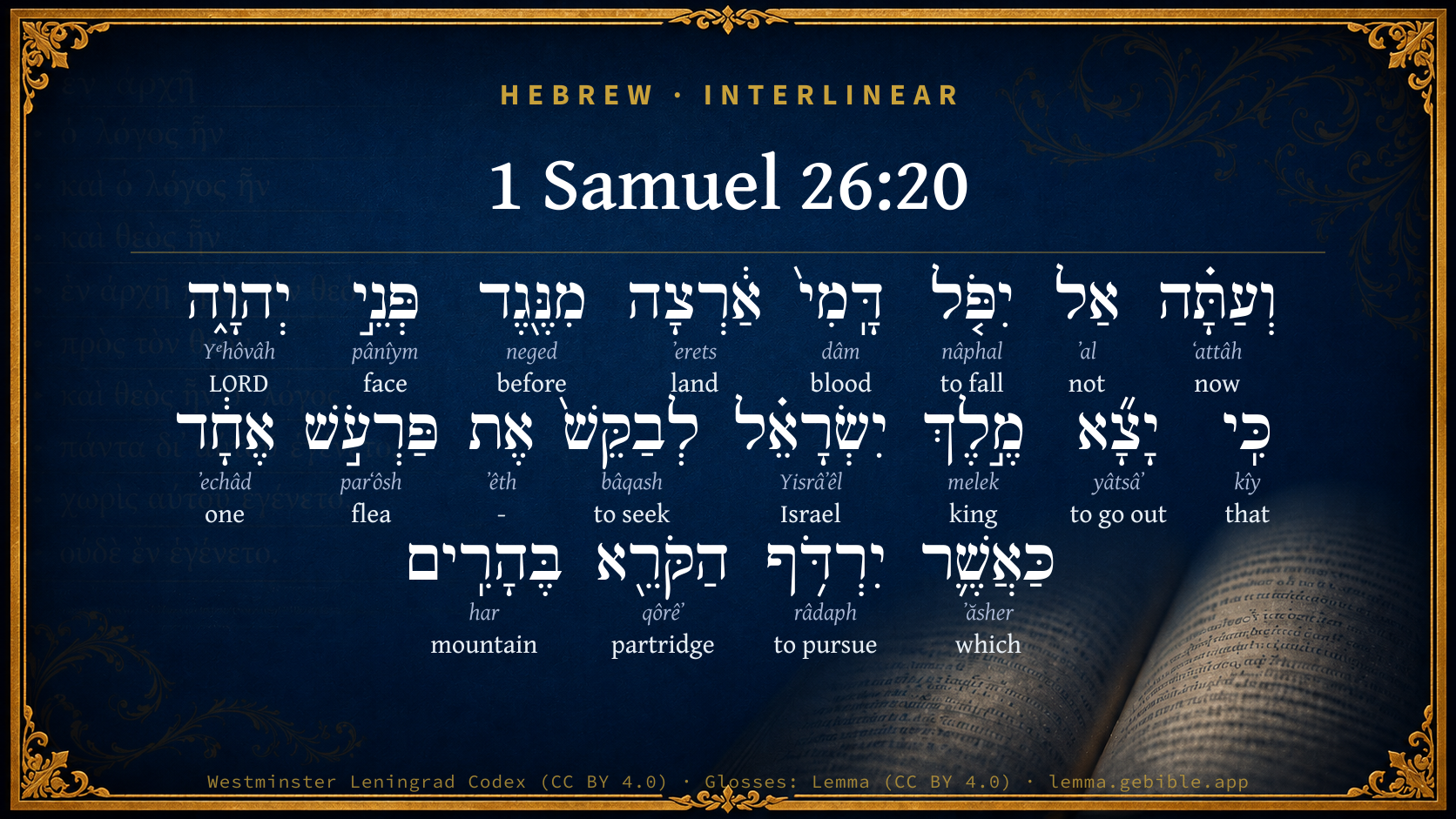
1 Samuel 26:20

Hebrew (Westminster Leningrad Codex) 1 Samuel 26:20 appears in the Hebrew Old Testament. The text above is from the Westminster Leningrad Codex. Each word links to its Strong’s number, a concise gloss, and parsing drawn from the Open Scriptures Hebrew Bible morphology. Click any word for its full Brown-Driver-Briggs (BDB) entry.
Download image
Cite this verse

1 Samuel 26:20 (World English Bible). Public Domain. Lemma interlinear Bible study tool, https://lemma.gebible.app/v/1-samuel/26/20.

Show BibTeX & RIS
BibTeX
RIS
English Translation
Now therefore, don't let my blood fall to the earth away from the presence of Yahweh: for the king of Israel is come out to seek a flea, as when one does hunt a partridge in the mountains.
World English Bible · Public Domain
Highlights
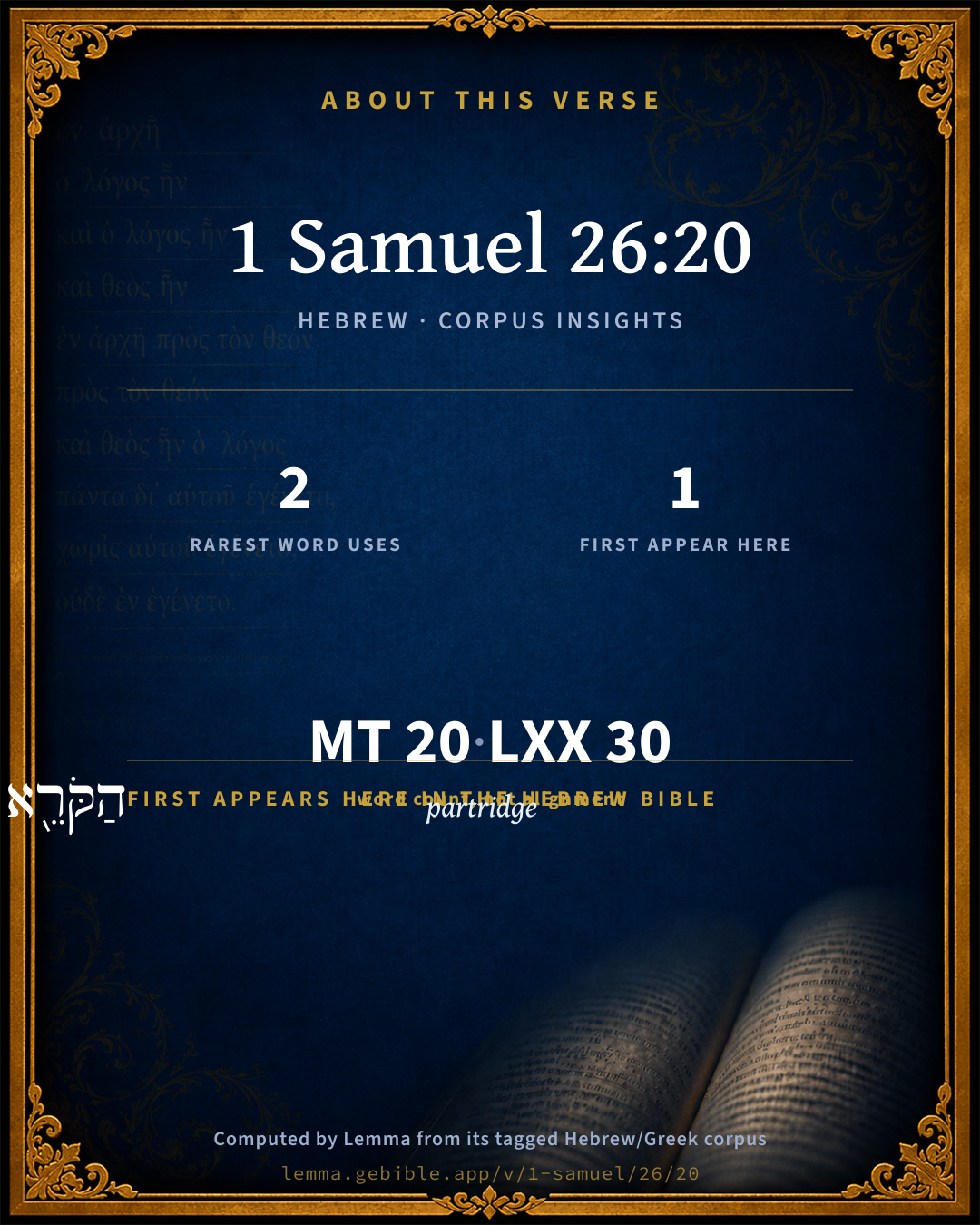
  • 1 first appearance in the Hebrew Bible
Full analysis ↓
Download a study sheet

One document with this verse’s original text, its word-by-word gloss line, the meaning frame, cross-references with their text, attributed commentary, and full source and license credits — printable, and it pastes into notes with its structure intact.

This verse Autodidact and up

Study sheet (.html) Plain text (.txt)

A passage Seminary Student

Up to 50 verses in one chapter. A passage sheet keeps up to 6 commentary sources and 12 cross-references per verse, in the order this page ranks them, and says so on the sheet whenever that leaves anything out. Ask for a single verse and you get the Autodidact verse sheet above.

Everything on this page stays free to read, with no account — the sheet is a download of what is already on screen, not access to it.

Want to remove ads? Support Godless Engineer
Compare translations 3

The same verse in 3 English versions, stacked beneath the original-language interlinear above. Click any original word for its lexicon entry.

Each is an independent rendering of the whole verse — the interlinear is not word-aligned to these translations.

Highlighted words mark where these versions differ — a whole-verse word diff, not a word-by-word alignment.

  • World English Bible Public Domain
    Now therefore, don't let my blood fall to the earth away from the presence of Yahweh: for the king of Israel is come out to seek a flea, as when one does hunt a partridge in the mountains.
  • King James Version Public Domain
    Now therefore, let not my blood fall to the earth before the face of the LORD: for the king of Israel is come out to seek a flea, as when one doth hunt a partridge in the mountains.
  • unfoldingWord Literal Text CC BY-SA 4.0
    And now, do not let my blood fall to the earth from before the face of Yahweh. For the king of Israel has come out to seek one flea, just as one pursues a partridge in the mountains.”

unfoldingWord Literal Text — © unfoldingWord, licensed CC BY-SA 4.0. Word-aligned USFM3 via Door43 (git.door43.org/unfoldingWord/en_ult).

Versions to compare (up to 4)

3 of 4 selected

Show all 18 translations

Every available English version of this verse, each an independent rendering of the whole verse.

  • World English Bible Public Domain
    Now therefore, don't let my blood fall to the earth away from the presence of Yahweh: for the king of Israel is come out to seek a flea, as when one does hunt a partridge in the mountains.
  • Berean Standard Bible Public Domain
    So do not let my blood fall to the ground far from the presence of the LORD. For the king of Israel has come out to look for a flea, like one who hunts a partridge in the mountains.”
  • Majority Standard Bible Public Domain
    So do not let my blood fall to the ground far from the presence of the LORD. For the king of Israel has come out to look for a flea, like one who hunts a partridge in the mountains.”
  • King James Version Public Domain
    Now therefore, let not my blood fall to the earth before the face of the LORD: for the king of Israel is come out to seek a flea, as when one doth hunt a partridge in the mountains.
  • American Standard Version (1901) Public Domain
    Now therefore, let not my blood fall to the earth away from the presence of Jehovah: for the king of Israel is come out to seek a flea, as when one doth hunt a partridge in the mountains.
  • Revised Version (1885) Public Domain
    Now therefore, let not my blood fall to the earth away from the presence of the LORD: for the king of Israel is come out to seek a flea, as when one doth hunt a partridge in the mountains.
  • Geneva Bible (1599) Public Domain
    Nowe therefore let not my blood fall to the earth before the face of the Lord: for the King of Israel is come out to seeke a flea, as one would hunt a partridge in the mountaines.
  • Douay-Rheims (1899) Public Domain
    And now let not my blood be shed upon the earth before the Lord: for the king of Israel is come out to seek a flea, as the partridge is hunted in the mountains.
  • Young's Literal Translation Public Domain
    `And now, let not my blood fall to the earth over-against the face of Jehovah, for the king of Israel hath come out to seek one flea, as `one' pursueth the partridge in mountains.'
  • Literal Standard Version CC BY-SA 4.0
    And now, do not let my blood fall to the earth before the face of YHWH, for the king of Israel has come out to seek one flea, as [one] pursues the partridge in mountains.”
  • Unlocked Literal Bible CC BY-SA 4.0
    Now therefore, do not let my blood fall to the earth away from Yahweh's presence; for the king of Israel has come out to look for the one flea as when one hunts a partridge in the mountains.”
  • unfoldingWord Literal Text CC BY-SA 4.0
    And now, do not let my blood fall to the earth from before the face of Yahweh. For the king of Israel has come out to seek one flea, just as one pursues a partridge in the mountains.”
  • Darby Bible Public Domain
    And now, let not my blood fall to the earth far from the face of Jehovah; for the king of Israel is come out to seek a single flea, as when they hunt a partridge on the mountains.
  • World Messianic Bible Public Domain
    Now therefore, don’t let my blood fall to the earth away from the presence of the LORD; for the king of Israel has come out to seek a flea, as when one hunts a partridge in the mountains.”
  • Webster's Bible Public Domain
    Now therefore, let not my blood fall to the earth before the face of the LORD: for the king of Israel hath come out to seek a flea, as when one doth hunt a partridge in the mountains.
  • Free Bible Version CC BY-SA 4.0
    Please don't let me die so far from the presence of the Lord. The king of Israel has come to chase down one little flea, hunting me like someone who hunts a partridge in the mountains.”
  • Bible in Basic English Public Domain
    Then do not let my blood be drained out on the earth away from the face of the Lord: for the king of Israel has come out to take my life, like one going after birds in the mountains.
  • JPS Tanakh (1917) Public Domain
    Now therefore, let not my blood fall to the earth away from the presence of the LORD; for the king of Israel is come out to seek a single flea, as when one doth hunt a partridge in the mountains.'

Literal Standard Version (2020), Covenant Press — licensed CC BY-SA 4.0. Text via the HelloAO Bible API (eBible.org). Unlocked Literal Bible (unfoldingWord) — licensed CC BY-SA 4.0. Text via the HelloAO Bible API (eBible.org). unfoldingWord Literal Text — © unfoldingWord, licensed CC BY-SA 4.0. Word-aligned USFM3 via Door43 (git.door43.org/unfoldingWord/en_ult). Free Bible Version, Dr. Jonathan Gallagher — licensed CC BY-SA 4.0. Text via the HelloAO Bible API (eBible.org).

Word by word

More ways to search: Search by grammar → Find every occurrence → Compare this word →

Practice this passage: Drill this verse → Learn its vocabulary →

פַּרְעֹ֣שׁ
parʻôsh
H6550
“flea”
Noun, Common, Masculine, Singular, Absolute
Part of Speech
Noun
Type
Common
Gender
Masculine
Number
Singular
State
Absolute
Full BDB Definition

Origin: probably from H6544 and H6211

TWOT: 1825 . 1

flea
  1. וְעַתָּ֗ה ʻattâh H6258 “and · now” Conjunction + Adverb
  2. אַל ʼal H408 “not” Particle, Negative
  3. יִפֹּ֤ל nâphal H5307 “to fall” Verb, Qal, Jussive, 3rd Person, Masculine, Singular
  4. דָּֽמִי֙ dâm H1818 “blood · my” Noun, Common, Masculine, Singular, Construct + Suffix, Personal, 1st Person, Common, Singular
  5. אַ֔רְצָה ʼerets H776 “land · toward” Noun, Common, Both, Singular, Absolute + Suffix, Demonstrative
  6. מִנֶּ֖גֶד neged H5048 “from · before” Preposition + Preposition
  7. פְּנֵ֣י pânîym H6440 “face(s) of” Noun, Common, Both, Plural, Construct
  8. יְהוָ֑ה Yᵉhôvâh H3068 “LORD” Noun, Proper
  9. כִּֽי kîy H3588 “that” Conjunction
  10. יָצָ֞א yâtsâʼ H3318 “to go out” Verb, Qal, Perfect, 3rd Person, Masculine, Singular
  11. מֶ֣לֶךְ melek H4428 “king of” Noun, Common, Masculine, Singular, Construct
  12. יִשְׂרָאֵ֗ל Yisrâʼêl H3478 “Israel” Noun, Proper
  13. לְבַקֵּשׁ֙ bâqash H1245 “to seek” Preposition + Verb, Piel, Infinitive Construct
  14. אֶת ʼêth H853 “-” Particle, Direct Object
  15. אֶחָ֔ד ʼechâd H259 “one” Adjective, Cardinal number, Masculine, Singular, Absolute
  16. כַּאֲשֶׁ֛ר ʼăsher H834 “like/as · which” Preposition + Particle, Relative
  17. יִרְדֹּ֥ף râdaph H7291 “to pursue” Verb, Qal, Imperfect, 3rd Person, Masculine, Singular
  18. הַקֹּרֵ֖א qôrêʼ H7124 “the · partridge” Particle, Definite Article + Noun, Common, Masculine, Singular, Absolute
  19. בֶּהָרִֽים har H2022 “in/at the · mountains” Preposition, Determined + Noun, Common, Masculine, Plural, Absolute

About this verse

These counts appear in no published source. They are computed here, from the morphology-tagged text and Lemma’s own curated glosses. What Lemma adds →

20
words
20
distinct lemmas
Historical
section

Notable vocabulary

The rarest word here is פַּרְעֹ֣שׁ flea H6550 — appearing just 2 times in the whole Hebrew Bible.

First appearance in Scripture

This word makes its first canonical appearance in the Hebrew Bible here:

  • הַקֹּרֵ֖א partridge H7124

Shared distinctive vocabulary

פַּרְעֹ֣שׁ flea H6550 occurs in 2 verses of the Hebrew Bible. Also found in:

Grammatical profile

  • 4 verbs
  • 9 nouns
  • 1 adjective
  • 1 preposition
  • 1 conjunction
  • 1 adverb
  • 3 particles

Verb forms

  • יִפֹּ֤ל Qal · Jussive
  • יָצָ֞א Qal · Perfect
  • לְבַקֵּשׁ֙ Piel · Infinitive Construct
  • יִרְדֹּ֥ף Qal · Imperfect

Hebrew & Septuagint length

In English translation the verse runs 38 words from the Hebrew and 35 from the Septuagint (LXX English) — closely comparable.

A rough comparison of the two English renderings, which tokenize alike — not a word-level alignment.

Word counts can differ between the Hebrew and the Greek without any difference in meaning — e.g. the Hebrew direct-object marker אֵת has no separate Greek word, and Greek often adds the article ὁ.

In the original languages it is 20 Hebrew tokens and 30 Greek tokens — but the two are counted differently (Hebrew bundles its prefixes and suffixes into one token; the Greek is in lemma form), so that isn’t a like-for-like length.

Cross-references

5

Topical passages linked to 1 Samuel 26:20 in the Treasury of Scripture Knowledge — connected by theme and wording, ordered by reader-vote popularity; previews shown in the World English Bible.

  • 1 Samuel 24:14 After whom is the king of Israel come out? after whom do you pursue? after a dead dog, after a flea.
  • 1 Samuel 2:9 He will keep the feet of his holy ones; But the wicked shall be put to silence in darkness; For by strength shall no man prevail.
  • 1 Samuel 25:29 Though men be risen up to pursue you, and to seek your soul, yet the soul of my lord shall be bound in the bundle of life with Yahweh your God; and the souls of your enemies, them shall he sling out, as from the hollow of a sling.
  • Matthew 26:47 While he was still speaking, behold, Judas, one of the twelve, came, and with him a great multitude with swords and clubs, from the chief priest and elders of the people.
  • Matthew 26:55 In that hour Jesus said to the multitudes, "Have you come out as against a robber with swords and clubs to seize me? I sat daily in the temple teaching, and you didn't arrest me.

Cross-references courtesy of OpenBible.info (CC BY 4.0).

Hebrew and Greek witnesses Masoretic Hebrew ↔ Greek Septuagint

The same verse in the two great witnesses to the Old Testament, shown verse-for-verse.

These are two independent witnesses, not word-aligned to each other, and the Septuagint is shown in lemma (dictionary) form.

Hebrew 1 Samuel 26:20 Masoretic · Westminster Leningrad Codex

וְעַתָּ֗ה אַל יִפֹּ֤ל דָּֽמִי֙ אַ֔רְצָה מִנֶּ֖גֶד פְּנֵ֣י יְהוָ֑ה כִּֽי יָצָ֞א מֶ֣לֶךְ יִשְׂרָאֵ֗ל לְבַקֵּשׁ֙ אֶת פַּרְעֹ֣שׁ אֶחָ֔ד כַּאֲשֶׁ֛ר יִרְדֹּ֥ף הַקֹּרֵ֖א בֶּהָרִֽים

Now therefore, don't let my blood fall to the earth away from the presence of Yahweh: for the king of Israel is come out to seek a flea, as when one does hunt a partridge in the mountains.

World English Bible · Public Domain

Greek LXX 1 Samuel 26:20 Septuagint · lemma form

καί νῦν μή πίπτω ὁ αἷμα ἐγώ ἐπί ὁ γῆ ἐκ ἐναντίος πρόσωπον κύριος ὅτι ἐκἔρχομαι ὁ βασιλεύς ἰσραήλ ζητέω ὁ ψυχή ἐγώ καθώς καταδιώκω ὁ νυκτικόραξ ἐν ὁ ὄρος

And now let not my blood fall to the ground before the Lord, for the king of Israel has come forth to seek your life, as the night hawk pursues its prey in the mountains.

LXX2012 (modern English Septuagint) · Public Domain

On this verse, Ellicott's Commentary for English Readers discusses the Septuagint’s reading. Read the note in Commentary ↓

Hebrew: Westminster Leningrad Codex (CC BY 4.0). Greek: Septuagint (public domain); English from LXX2012 (modern English Septuagint) (Public Domain). How the Septuagint differs from the Hebrew →

Targum (Aramaic paraphrase)

1

The Targum is the ancient Jewish Aramaic paraphrase of the Hebrew Scriptures — an interpretive translation, not the Hebrew text itself. Onkelos (literal) and Pseudo-Jonathan (expansive) render the Torah, and Jonathan the Prophets. Coverage is partial: where no permissively-licensed English translation exists for a verse, only the Aramaic is shown. This is verse-level text, not a word-by-word alignment to the Hebrew.

  1. Targum Jonathan Prophets (Joshua–Malachi)
    וּכְעַן לָא יִתְשַׁד דָמִי לְאַרְעָא מִן קֳדָם מֵימְרָא דַייָ אֲרֵי נְפַק מַלְכָּא דְיִשְׂרָאֵל לְמִיבְעֵי יַת חֲלָשׁ חַד כְּמָא דְמִתְרַדֵיף קוֹרָאָה בְּטוּרַיָא:

    (no public-domain English translation for this verse)

    Targum Jonathan — Aramaic: “Mikraot Gedolot” (public domain). English: “Sefaria Community Translation” (CC0 1.0 (public-domain dedication)); “London "Chaldee Paraphrase," 1871” (public domain). Text via Sefaria.

Commentary

Notes on 1 Samuel 26:20 from classic Christian and Jewish commentators (each source and its license shown beneath its notes). The classic Christian expositions comment on the surrounding passage and are grouped to its opening verse, so a note may address several verses; the Jewish commentaries on the Tanakh (Rashi and others) are per-verse, so they appear only where the commentator wrote on this verse.

Lemma curates 59 commentaries, every one of them public domain or Creative Commons licensed, each selected and text-cleaned for this edition rather than reprinted as found. About our sources →

Trapp's Complete Commentary

John Trapp

1Sa 26:20 Now therefore, let not my blood fall to the earth before the face of the LORD: for the king of Israel is come out to seek a flea, as when one doth hunt a partridge in the mountains.

Ver. 20. Let not my blood fall to the earth.] Slay me not, for God seeth and will require it. {2Ch 24:22}

“ Ne pecces, Deus ipse videt, bonus Angelus astat. ”

To seek a flea, as when one doth hunt a partridge.] Out of his modesty and low mindedness, comparat se pulici et perdici, he compareth himself to these contemptible creatures, see 1Sa 24:14.

John Trapp, A Commentary or Exposition upon All the Books of the Old and New Testament (1647–1656) — public domain. Text from a community e-Sword module.

Joseph Benson's Commentary

1Sa 26:20. Before the face of the Lord — The Lord seeing it, and being the avenger. Remember, if thou dost it, God, the judge of all men, observes and will call thee to account for it, though I will not avenge myself. Is come out to seek a flea — Is come out for a purpose beneath him, and not of importance enough to deserve his trouble. As when one doth hunt a partridge — The Hebrew word קרא, kore, does not seem to be rightly translated partridge here. Rabbi Salomon renders it cuculus, cuckow, so called from its crying. It certainly must be the name of a bird of no value for food, or any other use; and therefore the pursuing it on the mountains, through difficult places, was a useless and insignificant labour.

Joseph Benson's Commentary on the Old and New Testaments (1811–1818) — public domain. Text from a community e-Sword module.

Tyndale Open Study Notes

Tyndale Open Resources

26:20 a single flea: Cp. 24:14.

Tyndale Open Study Notes — © Tyndale Open Resources, licensed CC BY-SA 4.0. Text via the HelloAO Bible API.

Jamieson, Fausset & Brown

Robert Jamieson, A. R. Fausset & David Brown

as when one doth hunt a partridge--People in the East, in hunting the partridge and other game birds, pursue them, till observing them becoming languid and fatigued after they have been put up two or three times, they rush upon the birds stealthily and knock them down with bludgeons [SHAW, Travels]. It was exactly in this manner that Saul was pursuing David. He drove him from time to time from his hiding-place, hoping to render him weary of his life, or obtain an opportunity of accomplishing his destruction.

Jamieson, Fausset & Brown — Commentary Critical and Explanatory on the Whole Bible (1871) — public domain (CC PDM 1.0). Text via the HelloAO Bible API.

Adam Clarke's Commentary

Verse 20. As when one doth hunt a partridge] It is worthy of remark that the Arabs, observing that partridges, being put up several times, soon become so weary as not to be able to fly; they in this manner hunt them upon the mountains, till at last they can knock them down with their clubs.

It was in this manner that Saul hunted David, coming hastily upon him, and putting him up from time to time, in hopes that he should at length, by frequent repetitions of it, be able to destroy him. See Harmer.

Adam Clarke's Commentary on the Bible (1810–1826) — public domain. Text from a community e-Sword/MySword module.

Ellicott's Commentary for English Readers

(20) Before the face of the Lord.—Better rendered, far from the presence of the Lord. The same thought dwelt upon in the last verse is here enlarged. “If this savage persecution continues,” David goes on to say, “sooner or later I shall fall a victim to one or other of the countless perils to which one in my situation, as leader of a band of outlaws, is daily exposed. Let not such hard, cruel fate be mine—to die a violent death far away from the land which Jehovah loves.” It was the same thought which inspires so touchingly this last prayer he made to Saul which, ever present in his heart, made the bringing up of the Ark to a permanent sanctuary, where the visible symbol of the Eternal Presence should dwell for ever, the dream of David’s life. It was the same holy thought which induced him to spend so much time and to lay up such vast stores for the building of a glorious sanctuary. The passionate longing of the “man after God’s own heart” to worship his Eternal Master in a fitting house devoted to His service, and in the company of men who loved and honoured the Name of names, is to be found in some of the most soul-searching of his psalms.

To seek a flea.—The same humiliating comparison he had made once before on a similar occasion again occurs to him. Such repetition is of ordinary occurrence, as we well know, both in speeches and writings. The LXX. here substitute for “a flea” “my soul,” probably with the view of avoiding the repetition of the simile of a flea, which David had made use of on the previous occasion of his sparing the king’s life at En-gedi.

A partridge in the mountains.—The LXX. needlessly alters “partridge” into “screech-owl,” and changes the sense: “as the screech-owl hunts on the mountains.” The meaning of the simile in the Hebrew original is well given by Erdmann, in Lange: “The isolated from God’s people, far from all association, a fugitive from their plots on the mountain heights, thou seekest at all cost to destroy, as one hunts a single fugitive partridge on the mountain, only to kill it at all costs, while otherwise, from its insignificance, it would not be hunted, since partridges are to be found in the field in coveys.” Conder (Tent Life in Palestine) especially tells us that partridges still tenant these wilds; and speaking of the precipitous cliffs overhanging the Dead Sea, he says: “Among the rocks of the wild goats the bands of ibex may be seen still bounding, and the partridge is still chased on the mountains, as David was followed by the stealthy hunter Saul.”

A Bible Commentary for English Readers, edited by Charles John Ellicott (1878–1897) — public domain. Text from a community e-Sword module.

The Cambridge Bible for Schools and Colleges

gen. ed. J. J. S. Perowne

20. before the face of the Lord] Slay me not, lest Jehovah avenge my blood upon thee. But it is possible to render “far from the presence of Jehovah:” i.e. let me not die a violent death in a heathen land: and this suits the context better.

a flea] A single flea. Cp. 1Sa_24:14. The Sept. however reads instead, perhaps rightly, “my life.”

a partridge] “David alludes to the mode of chase practised now as of old, when the partridge continuously chased was at length, when fatigued, knocked down by sticks thrown along the ground. It must be remembered that both the species of partridge common in the Holy Land, unlike our bird, endeavour to save themselves by running in preference to flight, unless when suddenly started; that they are not inhabitants of plains or cornfields but of rocky hill-sides.” The Hebrew name means “caller,” from “its ringing call-note, which in early morning echoes from cliff to cliff alike amidst the barrenness of the wilderness of Judaea, and in the glens of the forest of Carmel.” Tristram, Natural History of the Bible, p. 225.

David means to say that the King of Israel’s pursuit of him is altogether unworthy of his dignity.

The Cambridge Bible for Schools and Colleges (gen. ed. J. J. S. Perowne; Cambridge University Press, 1878–1918) — public domain. Text from a community e-Sword module.

John Gill's Exposition

Now therefore let not my blood fall to the earth before the face of the Lord,.... For should it be spilled, God, who is omniscient, will see it, and take notice of it; and being righteous, and to whom vengeance belongs, he will avenge it: some render it, "my blood shall not fall to the earth before the face of the Lord" (r); I am continually under his eye and care, and he will protect and defend me; and in vain is it for thee to pursue after me; I shall never fall into thine hands, though I may be obliged to quit my country, and go into an idolatrous nation, against my will:

for the king of Israel is come out to seek a flea; which leaps from place to place and is not easily taken: or this may denote what a mean, poor, weak, insignificant person David was; and how much it was below Saul to come out with an army of chosen men in pursuit of him; so the Targum,"the king of Israel is come out to seek one that is weak or feeble:"

as when one doth hunt a partridge in the mountains; as kings for their delight used to do, as Abarbinel observes; but this being a business of pleasure, and this a bird of worth, some other is thought to be here intended. Indeed the is represented as worth no more than an "obolus", or five farthings, though fifty drachmas or drachms were ordered to be paid for one (s); the Septuagint renders the word an "owl": the word is "kore", and from the etymology of it one would think it was the raven or crow. Jarchi on Jer 17:11 takes it to be the cuckoo, though here the partridge as others; Bochart (t) will have it to be the woodcock, snipe, or snite (u). Some choose to read the words,"as the kore or partridge on the mountains hunts;''which, it is said, hunts and seeks after the nests of other birds, and sits on their eggs (v): see Jer 17:11; so Saul hunted after David, though he could not take him; several naturalists (w) observe, that the partridge is very difficult to be taken by the hunter.

(r) "non effundetur", Martyr. and to this sense are Syr. Ar. vers. (s) Laert. l. 2. in Vita Aristippi. (t) Hierozoic. par. 2. l. 1. c. 12. col. 81. (u) (A snite is like a snipe, yet a different species of lark-like bird. Oxford English Dictionary. Editor) (v) T. Bab. Cholin, fol. 140. 2. Jarchi & Abarbinel in loc. (w) Aristot. Hist. Animal. l. 9. c. 8. Plin. Nat. Hist. l. 10. c. 33. Aelian. Hist. Animal. l. 3. c. 16.

John Gill's Exposition of the Whole Bible (1746–1763) — public domain (CC PDM 1.0). Text via the HelloAO Bible API.

Haydock's Catholic Bible Commentary

Before, the contrary to the decrees of the Lord, (Haydock) who will be my avenger. --- Hunted, (persequiur) is here used in a passive sense; (Calmet) or it may be rendered, "as a partridge pursues" what it feeds upon. (Haydock)

George Leo Haydock (1774–1849), Haydock's Catholic Family Bible and Commentary, 1859 edition — public domain. Excludes Psalms (Douay-Rheims chapter numbering differs from Protestant) and Deuterocanonical books (Catholic canon only).

Matthew Poole's English Annotations

Let not my blood fall to the earth; do not attempt to spill my innocent blood like water upon the ground.

Before the face of the Lord; remember, if thou dost it, God the judge of all men seeth it, and will avenge it of thee, though I will not avenge myself.

A flea; hard to be taken, and not worth catching; a mean and contemptible person.

In the mountains, where his advantage doth no way compensate his labour.

Matthew Poole's English Annotations on the Holy Bible (1683–1685) — public domain. Text from a community e-Sword/MySword module.

Whedon's Commentary on the Bible

Daniel D. Whedon

20. Before the face of the Lord — Rather, At a distance from, or far off from, the face of the Lord. That is, in a distant land, or an enemy’s country.

A flea — An insignificant insect. Compare 1Sa_24:14.

As when one doth hunt a partridge in the mountains — Additional comparison, instead of dead dog, in 1Sa_24:14. The partridge does not so much frequent the mountains as the fields and lowlands; it would therefore be idle for one to hunt a single partridge far off on the mountains, when he could find flocks of them in the lower brushwoods and the fields.

Daniel D. Whedon (gen. ed.), Commentary on the Old and New Testaments (1874–1909) — public domain. Text from a community e-Sword module.

The Pulpit Commentary

Let not my blood fall to the earth before the face of Jehovah. Hebrew, "far from the presence of Jehovah." The point of David"s appeal is not that his life may be spared, but that he may not thus be driven far away from the land where Jehovah manifests himself; nor does he seem so much to contemplate Saul"s putting him to death as the probability that sooner or later the life of an exile will be cut short by one or other of the many dangers by which he is surrounded. A flea. Hebrew, "a single flea," as in 1Sa_24:14. A partridge. Many emendations of the text have been proposed on the supposition that partridges are only to be found in plains. But Mr. Condor tells us that partridges are among the few living creatures which still tenant these wilds; and, speaking of the precipitous cliffs which overhang the Dead Sea, he says, Here, among "the rocks of the wild goats, the herds of ibex may be seen bounding, and the partridge is still chased on the mountains, as David was followed by the stealthy hunter Saul" ("Tent Work," 2:90: see also 1Sa_23:19).

The Pulpit Commentary (1880–1919), ed. H.D.M. Spence-Jones & Joseph S. Exell — public domain. Text from a community e-Sword module.

John Wesley's Explanatory Notes

Before the Lord - Remember, if thou dost it, God the judge of all men seeth it, and will avenge it; though I will not avenge myself.

John Wesley, Explanatory Notes Upon the Whole Bible (1754–1765) — public domain. Text via the GEBible commentary corpus.

Rashi

Rabbi Shlomo Yitzchaki (Rashi)

As the partridge. A bird named קוֹרֵא, and in O.F. perdriz; and similarly, "as the partridge calls together [offspring] it did not bear" and it seeks the nests of other birds, and sits on their eggs.

Rashi on the Tanakh — English translations: “The Judaica Press complete Tanach with Rashi, translated by A. J. Rosenberg” (CC BY 4.0); “Pentateuch with Rashi's commentary by M. Rosenbaum and A.M. Silbermann, 1929-1934” (public domain); “The Metsudah Tanach series, Lakewood, N.J” (CC BY 4.0); and “The Book of Joshua, Metsudah Publications, 1997” (CC BY 4.0). Text via Sefaria.

Lesson kit

Teaching starters — assembled from the data on this page, not authored interpretation. Every prompt links to the verse data it draws on. Edit before teaching.

1 Samuel, in the Historical, opens this verse with 20 words (20 distinct Hebrew lemmas). Its most distinctive word is parʻôsh (“flea”). A historical commentator’s framing appears above. Read the whole chapter for the surrounding context.

Discussion questions

  1. What does “flea” (parʻôsh) contribute to the verse as a whole?
  2. The word “partridge” first appears here in Scripture. What is being introduced at this debut?
  3. 1 Samuel 24:14 shares the word «flea» with this verse. How do the two illuminate each other?
  4. The translations on this page render this verse differently — a whole-verse word diff, not a word-by-word alignment. What might account for the different wordings?
  5. The verb «יִפֹּ֤ל» is Qal Jussive. How does its form color the action?
  6. Reading how Trapp's Complete Commentary and Joseph Benson's Commentary read this verse, where do the two commentators agree and where do they part?

Things to notice

Reading settings

Reading text

Shown beneath each verse's original-language words.

Old Testament
Old Testament edition

Read the OT as the Masoretic Hebrew (MT) or the Greek Septuagint (LXX).

English shown for the Greek Septuagint (in the Hebrew ↔ Greek comparison).

Comparing translations? Open the Compare panel on any verse page to stack up to four side by side.