
Psalms 91:7

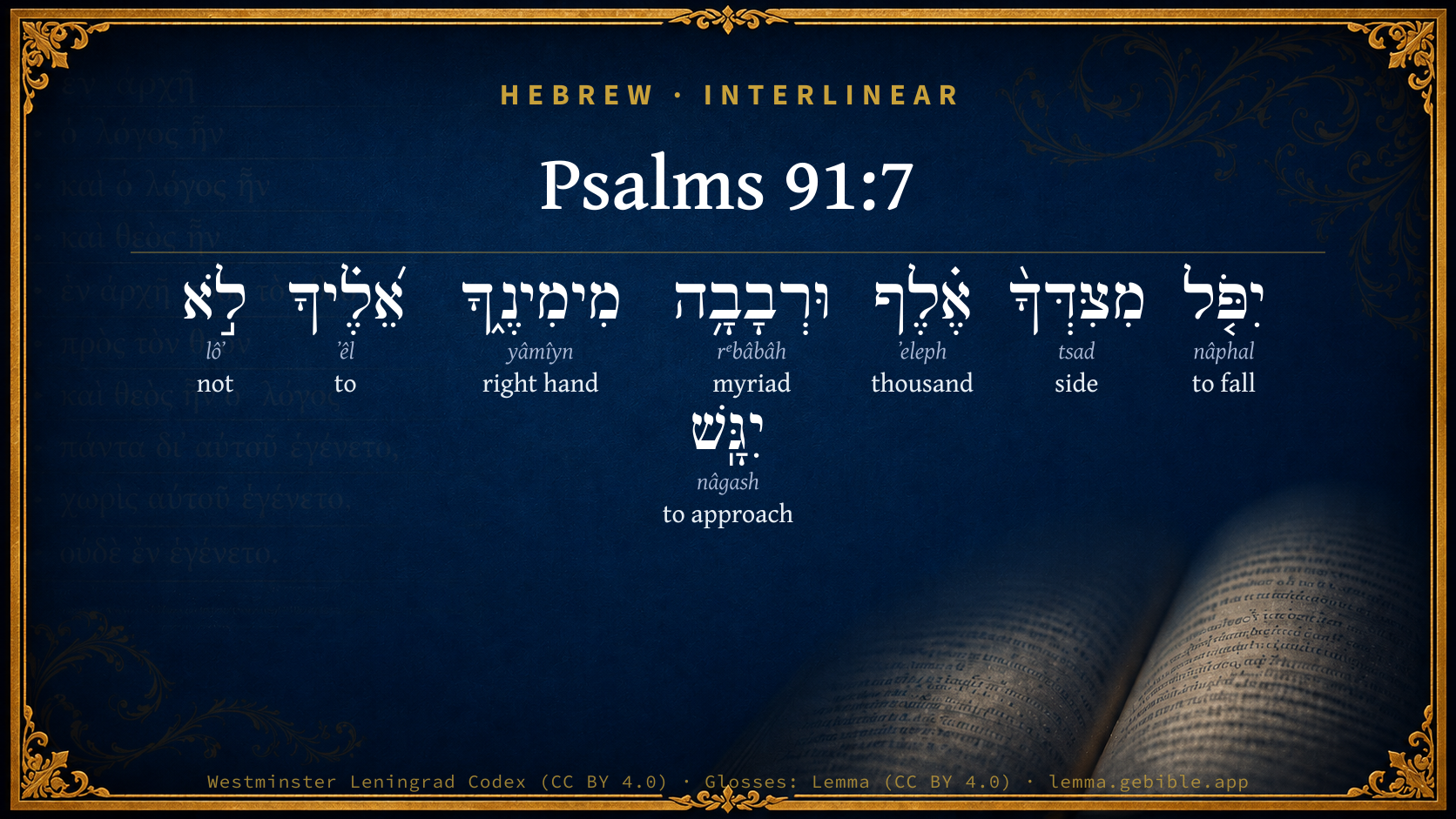
Hebrew (Westminster Leningrad Codex) Psalms 91:7 appears in the Hebrew Old Testament. The text above is from the Westminster Leningrad Codex. Each word links to its Strong’s number, a concise gloss, and parsing drawn from the Open Scriptures Hebrew Bible morphology. Click any word for its full Brown-Driver-Briggs (BDB) entry.
Download image
Cite this verse

Psalms 91:7 (World English Bible). Public Domain. Lemma interlinear Bible study tool, https://lemma.gebible.app/v/psalms/91/7.

Show BibTeX & RIS
BibTeX
RIS
English Translation
A thousand may fall at your side, And ten thousand at your right hand; But it will not come near you.
World English Bible · Public Domain
Download a study sheet

One document with this verse’s original text, its word-by-word gloss line, the meaning frame, cross-references with their text, attributed commentary, and full source and license credits — printable, and it pastes into notes with its structure intact.

This verse Autodidact and up

Study sheet (.html) Plain text (.txt)

A passage Seminary Student

Up to 50 verses in one chapter. A passage sheet keeps up to 6 commentary sources and 12 cross-references per verse, in the order this page ranks them, and says so on the sheet whenever that leaves anything out. Ask for a single verse and you get the Autodidact verse sheet above.

Everything on this page stays free to read, with no account — the sheet is a download of what is already on screen, not access to it.

Want to remove ads? Support Godless Engineer
Compare translations 3

The same verse in 3 English versions, stacked beneath the original-language interlinear above. Click any original word for its lexicon entry.

Each is an independent rendering of the whole verse — the interlinear is not word-aligned to these translations.

Highlighted words mark where these versions differ — a whole-verse word diff, not a word-by-word alignment.

  • World English Bible Public Domain
    A thousand may fall at your side, And ten thousand at your right hand; But it will not come near you.
  • King James Version Public Domain
    A thousand shall fall at thy side, and ten thousand at thy right hand; but it shall not come nigh thee.
  • unfoldingWord Literal Text CC BY-SA 4.0
    A thousand may fall at your side, and a myriad at your right hand; it will not approach toward you.

unfoldingWord Literal Text — © unfoldingWord, licensed CC BY-SA 4.0. Word-aligned USFM3 via Door43 (git.door43.org/unfoldingWord/en_ult).

Versions to compare (up to 4)

3 of 4 selected

Show all 18 translations

Every available English version of this verse, each an independent rendering of the whole verse.

  • World English Bible Public Domain
    A thousand may fall at your side, And ten thousand at your right hand; But it will not come near you.
  • Berean Standard Bible Public Domain
    Though a thousand may fall at your side, and ten thousand at your right hand, no harm will come near you.
  • Majority Standard Bible Public Domain
    Though a thousand may fall at your side, and ten thousand at your right hand, no harm will come near you.
  • King James Version Public Domain
    A thousand shall fall at thy side, and ten thousand at thy right hand; but it shall not come nigh thee.
  • American Standard Version (1901) Public Domain
    A thousand shall fall at thy side, And ten thousand at thy right hand; `But' it shall not come nigh thee.
  • Revised Version (1885) Public Domain
    A thousand shall fall at thy side, and ten thousand at thy right hand; but it shall not come nigh thee.
  • Geneva Bible (1599) Public Domain
    A thousand shall fall at thy side, and tenne thousand at thy right hand, but it shall not come neere thee.
  • Douay-Rheims (1899) Public Domain
    A thousand shall fall at thy side, and ten thousand at thy right hand: but it shall not come nigh thee.
  • Young's Literal Translation Public Domain
    There fall at thy side a thousand, And a myriad at thy right hand, Unto thee it cometh not nigh.
  • Literal Standard Version CC BY-SA 4.0
    One thousand fall at your side, || And a myriad at your right hand, || [But] it does not come near to you.
  • Unlocked Literal Bible CC BY-SA 4.0
    A thousand may fall at your side and ten thousand at your right hand, but it will not reach you.
  • unfoldingWord Literal Text CC BY-SA 4.0
    A thousand may fall at your side, and a myriad at your right hand; it will not approach toward you.
  • Darby Bible Public Domain
    A thousand shall fall at thy side, and ten thousand at thy right hand; [but] it shall not come nigh thee.
  • World Messianic Bible Public Domain
    A thousand may fall at your side, and ten thousand at your right hand; but it will not come near you.
  • Webster's Bible Public Domain
    A thousand shall fall at thy side, and ten thousand at thy right hand; but it shall not come nigh thee.
  • Free Bible Version CC BY-SA 4.0
    A thousand may fall beside you, ten thousand die at your right hand, but you won't be harmed.
  • Bible in Basic English Public Domain
    You will see a thousand falling by your side, and ten thousand at your right hand; but it will not come near you.
  • JPS Tanakh (1917) Public Domain
    A thousand may fall at Thy side, and ten thousand at Thy right hand; it shall not come nigh thee.

Literal Standard Version (2020), Covenant Press — licensed CC BY-SA 4.0. Text via the HelloAO Bible API (eBible.org). Unlocked Literal Bible (unfoldingWord) — licensed CC BY-SA 4.0. Text via the HelloAO Bible API (eBible.org). unfoldingWord Literal Text — © unfoldingWord, licensed CC BY-SA 4.0. Word-aligned USFM3 via Door43 (git.door43.org/unfoldingWord/en_ult). Free Bible Version, Dr. Jonathan Gallagher — licensed CC BY-SA 4.0. Text via the HelloAO Bible API (eBible.org).

Word by word

More ways to search: Search by grammar → Find every occurrence → Compare this word →

Practice this passage: Drill this verse → Learn its vocabulary →

About this verse

These counts appear in no published source. They are computed here, from the morphology-tagged text and Lemma’s own curated glosses. What Lemma adds →

8
words
8
distinct lemmas
Wisdom
section

Notable vocabulary

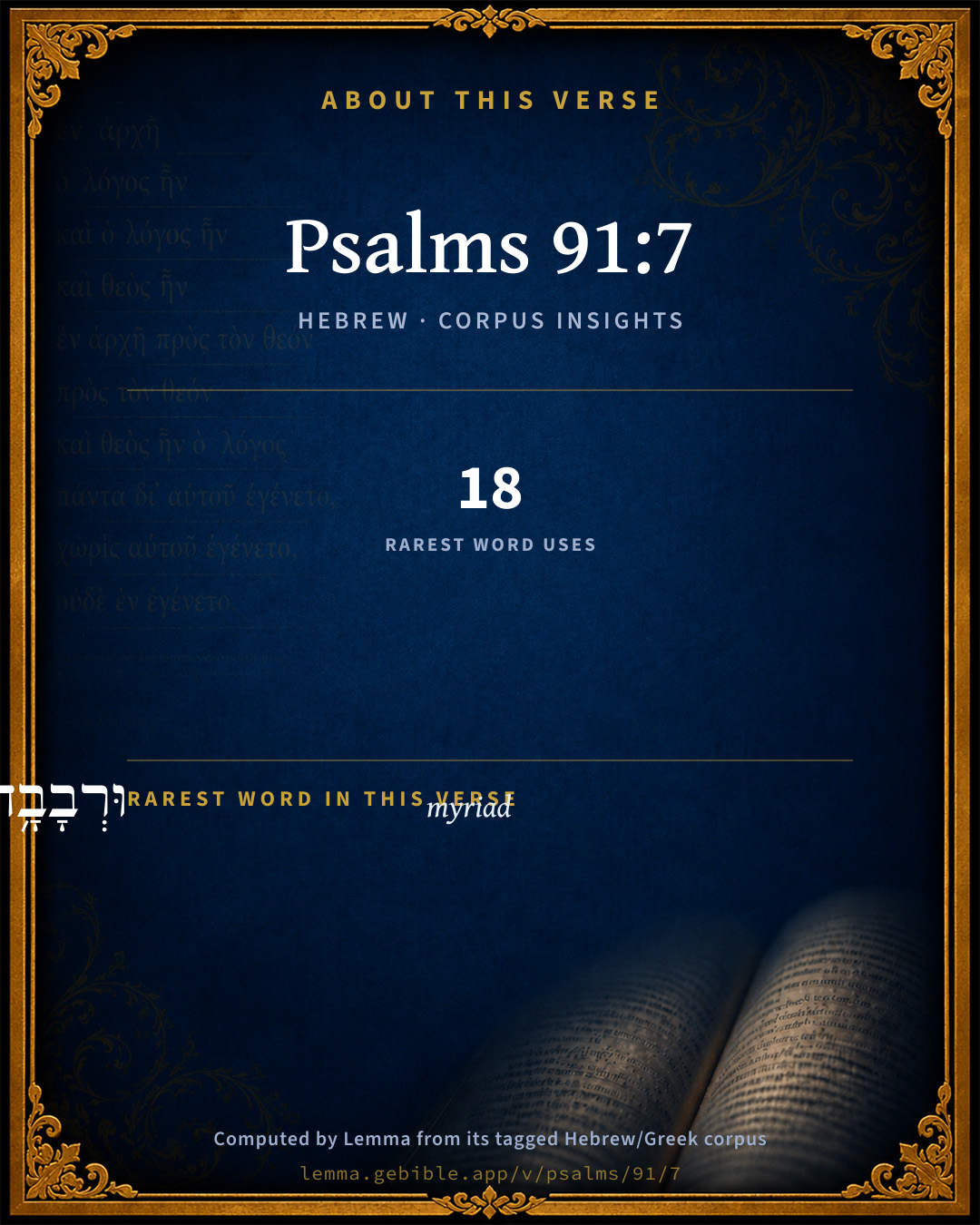
The rarest word here is וּרְבָבָ֥ה myriad H7233 — appearing just 18 times in the whole Hebrew Bible.

Shared distinctive vocabulary

וּרְבָבָ֥ה myriad H7233 occurs in 16 verses of the Hebrew Bible. Also found in:

Grammatical profile

  • 2 verbs
  • 3 nouns
  • 1 adjective
  • 1 preposition
  • 1 particle

Verb forms

  • יִפֹּ֤ל Qal · Imperfect
  • יִגָּֽשׁ Qal · Imperfect

Hebrew & Septuagint length

In English translation the verse runs 21 words from the Hebrew and 21 from the Septuagint (LXX English) — the same length.

A rough comparison of the two English renderings, which tokenize alike — not a word-level alignment.

Word counts can differ between the Hebrew and the Greek without any difference in meaning — e.g. the Hebrew direct-object marker אֵת has no separate Greek word, and Greek often adds the article ὁ.

Cross-references

5

Topical passages linked to Psalms 91:7 in the Treasury of Scripture Knowledge — connected by theme and wording, ordered by reader-vote popularity; previews shown in the World English Bible.

  • Exodus 12:12–13 For I will go through the land of Egypt in that night, and will strike all the firstborn in the land of Egypt, both man and animal. Against all the gods of Egypt I will execute judgments: I am Yahweh.
  • Genesis 7:23 Every living thing was destroyed that was on the surface of the ground, including man, cattle, creeping things, and birds of the sky. They were destroyed from the earth. Only Noah was left, and those who were with him in the ark.
  • Psalms 32:6 For this, let everyone who is godly pray to you in a time when you may be found. Surely when the great waters overflow, they shall not reach to him.
  • Numbers 14:37–38 even those men who did bring up an evil report of the land, died by the plague before Yahweh.
  • Joshua 14:10 Now, behold, Yahweh has kept me alive, as he spoke, these forty-five years, from the time that Yahweh spoke this word to Moses, while Israel walked in the wilderness: and now, behold, I am this day eighty-five years old.

Cross-references courtesy of OpenBible.info (CC BY 4.0).

Hebrew and Greek witnesses Masoretic Hebrew ↔ Greek Septuagint

The same verse in the two great witnesses to the Old Testament, shown verse-for-verse.

You’re reading Greek Psalm 90 (Hebrew Psalm 91). The Septuagint counts the superscription, so verse numbers can differ from the Hebrew — chapter-level alignment, not verse-by-verse. Numbering follows Rahlfs.

These are two independent witnesses, not word-aligned to each other, and the Septuagint is shown in lemma (dictionary) form.

Hebrew Psalms 91:7 Masoretic · Westminster Leningrad Codex

יִפֹּ֤ל מִצִּדְּךָ֨ אֶ֗לֶף וּרְבָבָ֥ה מִימִינֶ֑ךָ אֵ֝לֶ֗יךָ לֹ֣א יִגָּֽשׁ

A thousand may fall at your side, And ten thousand at your right hand; But it will not come near you.

World English Bible · Public Domain

Greek LXX Greek Psalm 90:7 Septuagint · lemma form

πίπτω ἐκ ὁ κλίτος σύ χίλιοι καί μυριάς ἐκ δεξιός σύ πρός σύ δέ οὐ ἐγγίζω

A thousand shall fall at your side, and ten thousand at your right hand; but it shall not come near you.

LXX2012 (modern English Septuagint) · Public Domain

Hebrew: Westminster Leningrad Codex (CC BY 4.0). Greek: Septuagint (public domain); English from LXX2012 (modern English Septuagint) (Public Domain). How the Septuagint differs from the Hebrew →

Commentary

Notes on Psalms 91:7 from classic Christian and Jewish commentators (each source and its license shown beneath its notes). The classic Christian expositions comment on the surrounding passage and are grouped to its opening verse, so a note may address several verses; the Jewish commentaries on the Tanakh (Rashi and others) are per-verse, so they appear only where the commentator wrote on this verse.

Lemma curates 59 commentaries, every one of them public domain or Creative Commons licensed, each selected and text-cleaned for this edition rather than reprinted as found. About our sources →

Trapp's Complete Commentary

John Trapp

Psa 91:7 A thousand shall fall at thy side, and ten thousand at thy right hand; [but] it shall not come nigh thee.

Ver. 7. A thousand shall fall, &c.] This deadly disease lays heaps upon heaps (as we have had lamentable experience), and scarce leaveth living enough to bury the dead, as in the days of Decius the emperor.

But it shall not come nigh thee] Thou shalt be antidoted and privileged; sc. if God see it good for thee, {see Psa 91:6} and thou be careful to serve his providence. The Turks shun not the company of those that have the plague; but pointing upon their foreheads, say, It was written there at their birth when they shall die. Thus to do is not to trust God, but to tempt him.

John Trapp, A Commentary or Exposition upon All the Books of the Old and New Testament (1647–1656) — public domain. Text from a community e-Sword module.

Joseph Benson's Commentary

Psa 91:7. A thousand shall fall at thy side — At thy left side, this being opposed to the right hand, immediately mentioned; but it shall not come nigh thee — This and such like promises are not to be understood absolutely and universally, as if no truly good man could be cut off by the plague, or by other common calamities, which is confuted both by other plain texts of Scripture, and by unquestionable experience; but with due limitations and conditions; either on man’s part, as, if there be a defect in his faith or obedience; or on God’s part, when God sees death is more for his good than life, as it apparently is, when righteous men are taken away from the evil to come, as is said Isa 57:1. In which case, though God doth not give the thing promised, yet he giveth a far greater mercy instead of it, and so fulfils his promise in the best sense, and with most advantage.

Joseph Benson's Commentary on the Old and New Testaments (1811–1818) — public domain. Text from a community e-Sword module.

J. A. Alexander on Psalms

Joseph Addison Alexander

7. (Psa 91:7) There shall fall at thy side a thousand, and a myriad at thy right hand; to thee it shall not come nigh. This is equivalent to saying in our idiom, though a thousand fall, etc., which, however, would not be an exact translation, as it substitutes a hypothetical for an affirmative proposition, For the double sense and usage of the word translated myriad, see above, on Psa 3:6, and compare the cognate form, Psa 68:17. Myriad represents the original term better than ten thousand, because it is wholly different, in form and etymology, from that translated thousand.

Joseph Addison Alexander, The Psalms Translated and Explained (1850) — public domain. Text from a community e-Sword module.

Adam Clarke's Commentary

Verse 7. A thousand shall fall at thy side] Calmet thinks this place should be translated thus: "A thousand enemies may fall upon thee on one side, and ten thousand may fall upon thee on thy right hand: but they shall not come nigh thee to take away thy life." It is a promise of perfect protection, and the utmost safety.

Adam Clarke's Commentary on the Bible (1810–1826) — public domain. Text from a community e-Sword/MySword module.

John Calvin's Commentaries

7 A thousand shall fall at thy side. He proceeds to show that, though the state of all men may to appearance be alike, the believer has the special privilege of being exempted from evils of an imminent and impending nature; for it might be objected that he was but man, and, as such, exposed with others to death in its thousand different forms. To correct this mistake, the Psalmist does not hesitate to assert that, when universal ruin prevails around, the Lord’s children are the objects of his distinguishing care, and are preserved amidst the general destruction. The lesson is one which is needed by us all, that, though naturally subject to the common evils which are spread around, we are privileged with a special exemption which secures our safety in the midst of dangers. In the verse succeeding more is meant than merely that the believer will have personal experience of the truth which the Psalmist had stated, actually feeling and seeing with his own eyes that God manages his defense; a new argument is brought forward in support of the truth, which is this, that God, as the righteous judge of the world, cannot but punish the wicked according to their sins, and extend protection to his own children. There is much that is dark in the aspect of things in this world, yet the Psalmist hints that, amidst all the confusion which reigns, we may collect from what we see of God’s judgments, that he does not disappoint the expectations of his believing people. He must be considered, however, as addressing those who have eyes to see, who are privileged with the true light of faith, who are fully awake to the consideration of the Divine judgments, and who wait patiently and quietly till the proper time arrive; for most men stagger and confuse their minds upon this subject, by starting to precipitate conclusions, and are prevented from discovering the providence of God by judging according to sense. It becomes us too to be satisfied with apprehending the judgments of God only in some imperfect measure while we remain upon earth, and leaving him to defer the fuller discovery of them to the day of complete revelation.

John Calvin's Commentaries (1540-1563) — public domain. Text from the Calvin Translation Society English edition (1840s-50s) via the Christian Classics Ethereal Library (ccel.org). Calvin's coverage is partial (roughly two-thirds of the Bible); uncommented books and verses are honest gaps, never fabricated. The 19th-century editor's footnotes and remarks are omitted so the notes are faithfully Calvin's own voice.

Ellicott's Commentary for English Readers

(7) It shall not come nigh thee.—It, i.e., no one of the dangers enumerated. The pious Israelite bears a charmed life. Safe under Divine protection, he only sees the effect of perils that pass by him harmless.

A Bible Commentary for English Readers, edited by Charles John Ellicott (1878–1897) — public domain. Text from a community e-Sword module.

The Cambridge Bible for Schools and Colleges

gen. ed. J. J. S. Perowne

7, 8. Though a thousand fall … it shall not come nigh thee] The emphasis is on thee. Thou shalt be as safe as Israel when the firstborn of the Egyptians were smitten (Exo_12:23): unharmed thyself thou shalt be a spectator of the punishment of the wicked, as Israel was at the Red Sea (Exo_14:30-31). That punishment is the indispensable counterpart of the deliverance of the righteous, Psa_91:14-16. Cp. Psa_92:11, and notes there.

The Cambridge Bible for Schools and Colleges (gen. ed. J. J. S. Perowne; Cambridge University Press, 1878–1918) — public domain. Text from a community e-Sword module.

John Gill's Exposition

A thousand shall fall at thy side,.... The left side, as the Targum; so the Arabic version, and Jarchi and Kimchi; which sense the opposition and distinction in the next clause direct unto: this is not to be understood of falling in battle, as some interpret it, but by the pestilence before spoken of:

and ten thousand at thy right hand; which shows both the great devastation made by the plague where it comes, and the special care and providence of God in preserving his people from it; of which David had an experience, when vast numbers of his people were destroyed by it on the right and left:

but it shall not come nigh thee; it may come near the place where good men are, or else it could not be said that a thousand should fall on their side, and ten thousand at their right hand: the plague that killed the firstborn in Egypt was near the dwellings of the Israelites, though it entered not into them; and that in David's time was near him, though he was not infected with it: but the meaning is, that it should not come so near such as to seize their bodies and they fall by the distemper; there being a particular providence oftentimes concerned for their safety, which guards them from it; see Eze 9:4, not but that good men may fall in a common calamity, and by an epidemical distemper; but then it is for their good, and not their hurt; they are taken away from the evil to come, and are delivered from a worse plague than that by which they fall, the plague of their own hearts, the evil of sin; and so the Targum adds, "shall not come near to hurt", though it understands it of devils.

John Gill's Exposition of the Whole Bible (1746–1763) — public domain (CC PDM 1.0). Text via the HelloAO Bible API.

Albert Barnes' Notes on the Bible

A thousand shall fall at thy side - Though a thousand should fall at thy side, or close to thee. This alludes to the manner in which the pestilence often moves among people.

And ten thousand at thy right hand - Compare Psa 3:6. The word “myriad” would better represent the exact idea in the original, as the Hebrew word is different from that which is translated “a thousand.” It is put here for any large number. No matter how many fall around thee, on the right hand and the left, you will have nothing to fear.

But it shall not come nigh thee - You will be safe. You may feel assured of the divine protection. Your mind may be calm through a sense of such guardianship, and your very calmness will conduce to your safety. This refers, as remarked above, to a “general” law in regard to the judgments of God. It is true that others, beside the dissipated, vicious, and debased, may be the victims; but the great law is that temperance, soberness, virtue, cleanliness, and that regard to comfort and health to which religion and virtue prompt, constitute a marked security - so marked as to illustrate the “general” law referred to in the psalm before us.

Albert Barnes' Notes on the Bible (1834–1885) — public domain. Text from a community e-Sword/MySword module.

Matthew Poole's English Annotations

At thy side; at thy left side, because this is opposed to the right side here following. See the like ellipsis Num 9:16; Psa 84:11.

It shall not come nigh thee: this and such-like promises are not to be understood absolutely and universally, as if no truly good man could be cut off by the plague or other common calamities, which is confitted both by other plain texts of Scripture, and by unquestionable experience; but with due limitations and conditions, either on man’s part, as if there be a defect in his faith or obedience; or on God’s part, when God sees that death is more for his good than life, as it apparently is when righteous men axe taken away from the evil to come, as is said, Isa 57:1; in which case, though God doth not give the thing promised, yet he giveth a far greater mercy instead of it, and so fulfils his promise in the best sense, and with most advantage. As, if one man should solemnly promise to another to give him his daily food every day, he not only might, but ought, notwithstanding this promise, to deny and withdraw this food, when his body is so distempered, that in the judgment of the wisest physicians the taking of his food would evidently endanger his life.

Matthew Poole's English Annotations on the Holy Bible (1683–1685) — public domain. Text from a community e-Sword/MySword module.

The Treasury of David

Charles H. Spurgeon

Ver. 7. A thousand shall fall at thy side and ten thousand at thy right hand. So terribly may the plague rage among men that the bills of mortality may become very heavy and continue to grow ten times heavier still, yet shall such as this Psalm speaks of survive the scythe of death.

It shall not come nigh thee. It shall be so near as to be at thy side, and yet not nigh enough to touch thee; like a fire it shall burn all around, yet shall not the smell of it pass upon thee. How true is this of the plague of moral evil, of heresy, and of backsliding. Whole nations are infected, yet the man who communes with God is not affected by the contagion; he holds the truth when falsehood is all the fashion. Professors all around him are plague smitten, the church is wasted, the very life of religion decays, but in the same place and time, in fellowship with God, the believer renews his youth, and his soul knows no sickness. In a measure this also is true of physical evil; the Lord still puts a difference between Israel and Egypt in the day of his plagues. Sennacherib's army is blasted, but Jerusalem is in health.

"Our God his chosen people saves

Amongst the dead, amidst the graves."

Ver. 7. Ten thousand. The word myriad would better represent the exact idea in the original, as the Hebrew word is different from that which is translated "a thousand." It is here put for any large number. Albert Barnes.

Ver. 7. It shall not come nigh thee. Not nigh thee? What? when they die on this side and on that, on every hand of a man, doth it not come nigh him? Yes, nigh him, but not so nigh as to hurt him: the power of God can bring us near to danger, and yet keep us far from harm. As good may be locally near us, and yet virtually far from us, so may evil. The multitude thronged Christ in the Gospel, and yet but one touched him so as to receive good; so Christ can keep us in a throng of dangers, that not one shall touch us to our hurt. Joseph Caryl.

Ver. 7. It shall not come nigh thee. Not with a view of showing that all good men may hope to escape from the pestilence, but as proofs that some who have had superior faith have done so, I have collected the following instances from various sources. C. H. S.

Before his departure from Isna (Isny), the town was greatly afflicted with the pestilence; and he, understanding that many of the wealthiest of the inhabitants intended to forsake the place, without having any respect or care of such as laboured with that disease, and that the houses of such as were infected, were commanded to be shut up by the magistrate, he openly admonished them, either to continue in the town, or liberally to bestow their alms before their departure, for the relief of such as were sick. And during the time of the visitation, he himself in person would visit those that were sick: he would administer spiritual comfort unto them, pray for them, and would be present with them day and night; and yet by the providence of God he remained untouched, and was preserved by the all powerful hand of God. From the Life of Paulus Fagius, in T. Fuller's Abel Redevivus.

In 1576, Cardinal Carlo Borromeo, Archbishop of Milan, the worthiest of all the successors of St. Ambrose, when he learnt at Lodi, that the plague had made its appearance in his city, went at once to the city. His council of clergy advised him to remain in some healthy part of his diocese till the sickness should have spent itself, but he replied that a bishop, whose duty it is to give his life for his sheep, could not rightly abandon them in time of peril. They owned that to stand by them was the higher course. "Well, "he said, "is it not a bishop's duty to choose the higher course?" So back into the town of deadly sickness he went, leading the people to repent, and watching over them in their suffering, visiting the hospitals, and, by his own example, encouraging his clergy in carrying spiritual consolation to the dying. All the time the plague lasted, which was four months, his exertions were fearless and unwearied, and what was remarkable was, that of his whole household only two died, and they were persons who had not been called to go about among the sick. From "A Book of Golden Deeds, "1864.

Although Defoe's history of the plague is a work of fiction, yet its statements are generally facts, and therefore we extract the following: "The misery of the poor I had many occasions to be an eyewitness of, and sometimes also of the charitable assistance that some pious people daily gave to such, sending them relief and supplies both of food, physic, and other help as they found they wanted... Some pious ladies were transported with zeal in so good a work, and so confident in the protection of Providence in discharge of the great duty of charity, that they went about in person distributing alms to the poor, and even visiting poor families, though sick and infected, in their very houses, appointing nurses to attend those that wanted attending, and ordering apothecaries and surgeons... giving their blessing to the poor in substantial relief to them, as well as hearty prayers for them. I will not undertake to say, as some do, that none of those charitable people were suffered to fall under the calamity itself; but this I may say, that I never knew anyone of them that came to any ill, which I mention for the encouragement of others in case of the like distress, and, doubtless, if they that give to the poor lend to the Lord, and he will repay them, those that hazard their lives to give to the poor, and to comfort and assist the poor in such misery as this, may hope to be protected in the work." Daniel Defoe's Journal of the Plague in London.

Horne, in his notes on the Psalms, refers to the plague in Marseilles and the devotion of its bishop. There is a full account of him in the Percy Anecdotes from which we cull the following: "M. de Belsunce, Bishop of Marseilles, so distinguished himself for his humanity during the plague which raged in that city in 1720, that the Regent of France offered him the richer and more honourable See of Laon, in Picardy; but he refused it, saying, he should be unwilling to leave a flock that had been endeared to him by their sufferings. His pious and intrepid labours are commemorated in a picture in the Town Hall of Marseilles, in which he is represented in his episcopal habit, attended by his almoners, giving his benediction to the dying... But perhaps the most touching picture extant of the bishop's humane labours, is to be found in a letter of his own, written to the Bishop of Soissons, Sept. 27, 1720. `Never, 'he says, `was desolation greater, nor was ever anything like this. Here have been many cruel plagues, but none was ever more cruel: to be sick and dead was almost the same thing. What a melancholy spectacle have we on all sides', we go into the streets full of dead bodies, half rotten through, which we pass to come to a dying body, to excite him to an act of contrition, and to give him absolution.'"Notwithstanding exposure to a pestilence so fatal, the devoted bishop escaped uninjured.

While France justly boasts of "Marseilles' good Bishop, "England may congratulate herself on having cherished in her bosom a clergyman who in an equally earnest manner discharged his pastoral care, and watched over the simple flock committed to his charge, at no less risk of life, and with no less fervour of piety and benevolence. The Rev. W. Mompesson was rector of Eyam in Derbyshire, in the time of the plague that nearly depopulated the town in the year 1666. During the whole time of the calamity, he performed the functions of the physician, the legislator, and the minister of his afflicted parish; assisting the sick with his medicines, his advice, and his prayers. Tradition still shows a cavern near Eyam, where this worthy pastor used to preach to such of his parishioners as had not caught the distemper, Although the village was almost depopulated, his exertions prevented the spread of the plague to other districts, and he himself survived unharmed.

Ver. 7. How an evil may be near but not nigh.

Psalms 91:8*

Charles H. Spurgeon's The Treasury of David (1869–1885) — public domain. Psalms only. Text from a community e-Sword/MySword module.

The Pulpit Commentary

A thousand shall fall at thy side, and ten thousand at thy right hand. The meaning is, "Though a thousand, or even ten thousand, should fall beside thee, in battle, or through pestilence, or sunstroke," yetIt shall not come nigh thee the danger, whatever it be, shall not touch thy person; thou shalt be protected from it.

The Pulpit Commentary (1880–1919), ed. H.D.M. Spence-Jones & Joseph S. Exell — public domain. Text from a community e-Sword module.

Rashi

Rabbi Shlomo Yitzchaki (Rashi)

A thousand will be stationed at your side Heb. יפל, an expression of encamping, as (Gen. 25: 18): “before the face of all his brothers did he settle (נפל).”

at your side At your left a thousand demons will be stationed, and they will not approach you to harm [you].

Rashi on the Tanakh — English translations: “The Judaica Press complete Tanach with Rashi, translated by A. J. Rosenberg” (CC BY 4.0); “Pentateuch with Rashi's commentary by M. Rosenbaum and A.M. Silbermann, 1929-1934” (public domain); “The Metsudah Tanach series, Lakewood, N.J” (CC BY 4.0); and “The Book of Joshua, Metsudah Publications, 1997” (CC BY 4.0). Text via Sefaria.

Lesson kit

Teaching starters — assembled from the data on this page, not authored interpretation. Every prompt links to the verse data it draws on. Edit before teaching.

Psalms, in the Wisdom, opens this verse with 8 words (8 distinct Hebrew lemmas). Its most distinctive word is rᵉbâbâh (“myriad”). A historical commentator’s framing appears above. Read the whole chapter for the surrounding context.

Discussion questions

  1. What does “myriad” (rᵉbâbâh) contribute to the verse as a whole?
  2. How does Genesis 24:60, which shares the word «myriad», read alongside this verse?
  3. These translations render this verse differently. What is at stake in choosing one wording over another?
  4. «יִפֹּ֤ל» is a Qal Imperfect verb. How does that grammatical form shape the action described?
  5. Compare how Trapp's Complete Commentary and Joseph Benson's Commentary read this verse. Where do they agree or differ?

Things to notice

Reading settings

Reading text

Shown beneath each verse's original-language words.

Old Testament
Old Testament edition

Read the OT as the Masoretic Hebrew (MT) or the Greek Septuagint (LXX).

English shown for the Greek Septuagint (in the Hebrew ↔ Greek comparison).

Comparing translations? Open the Compare panel on any verse page to stack up to four side by side.