1 Chronicles 10:8

Hebrew (Westminster Leningrad Codex) 1 Chronicles 10:8 appears in the Hebrew Old Testament. The text above is from the Westminster Leningrad Codex. Each word links to its Strong’s number, a concise gloss, and parsing drawn from the Open Scriptures Hebrew Bible morphology. Click any word for its full Brown-Driver-Briggs (BDB) entry.
Download image
Cite this verse

1 Chronicles 10:8 (World English Bible). Public Domain. Lemma interlinear Bible study tool, https://lemma.gebible.app/v/1-chronicles/10/8.

Show BibTeX & RIS
BibTeX
RIS
English Translation
It happened on the next day, when the Philistines came to strip the slain, that they found Saul and his sons fallen on Mount Gilboa.
World English Bible · Public Domain
Download a study sheet

One document with this verse’s original text, its word-by-word gloss line, the meaning frame, cross-references with their text, attributed commentary, and full source and license credits — printable, and it pastes into notes with its structure intact.

This verse Autodidact and up

Study sheet (.html) Plain text (.txt)

A passage Seminary Student

Up to 50 verses in one chapter. A passage sheet keeps up to 6 commentary sources and 12 cross-references per verse, in the order this page ranks them, and says so on the sheet whenever that leaves anything out. Ask for a single verse and you get the Autodidact verse sheet above.

Everything on this page stays free to read, with no account — the sheet is a download of what is already on screen, not access to it.

Want to remove ads? Support Godless Engineer
Compare translations 3

The same verse in 3 English versions, stacked beneath the original-language interlinear above. Click any original word for its lexicon entry.

Each is an independent rendering of the whole verse — the interlinear is not word-aligned to these translations.

Highlighted words mark where these versions differ — a whole-verse word diff, not a word-by-word alignment.

  • World English Bible Public Domain
    It happened on the next day, when the Philistines came to strip the slain, that they found Saul and his sons fallen on Mount Gilboa.
  • King James Version Public Domain
    And it came to pass on the morrow, when the Philistines came to strip the slain, that they found Saul and his sons fallen in mount Gilboa.
  • unfoldingWord Literal Text CC BY-SA 4.0
    And it happened on the next day that the Philistines came to strip the slain. And they found Saul and his sons fallen on Mount Gilboa.

unfoldingWord Literal Text — © unfoldingWord, licensed CC BY-SA 4.0. Word-aligned USFM3 via Door43 (git.door43.org/unfoldingWord/en_ult).

Versions to compare (up to 4)

3 of 4 selected

Show all 18 translations

Every available English version of this verse, each an independent rendering of the whole verse.

  • World English Bible Public Domain
    It happened on the next day, when the Philistines came to strip the slain, that they found Saul and his sons fallen on Mount Gilboa.
  • Berean Standard Bible Public Domain
    The next day, when the Philistines came to strip the dead, they found Saul and his sons fallen on Mount Gilboa.
  • Majority Standard Bible Public Domain
    The next day, when the Philistines came to strip the dead, they found Saul and his sons fallen on Mount Gilboa.
  • King James Version Public Domain
    And it came to pass on the morrow, when the Philistines came to strip the slain, that they found Saul and his sons fallen in mount Gilboa.
  • American Standard Version (1901) Public Domain
    And it came to pass on the morrow, when the Philistines came to strip the slain, that they found Saul and his sons fallen in mount Gilboa.
  • Revised Version (1885) Public Domain
    And it came to pass on the morrow, when the Philistines came to strip the slain, that they found Saul and his sons fallen in mount Gilboa.
  • Geneva Bible (1599) Public Domain
    And on the morrowe when the Philistims came to spoyle them that were slaine, they found Saul and his sonnes lying in mount Gilboa.
  • Douay-Rheims (1899) Public Domain
    And the next day the Philistines taking away the spoils of them that were slain, found Saul and his sons lying on mount Gelboe.
  • Young's Literal Translation Public Domain
    And it cometh to pass, on the morrow, that the Philistines come to strip the wounded, and find Saul and his sons fallen in mount Gilboa,
  • Literal Standard Version CC BY-SA 4.0
    And it comes to pass, on the next day, that the Philistines come to strip the wounded, and find Saul and his sons fallen in Mount Gilboa,
  • Unlocked Literal Bible CC BY-SA 4.0
    It came about on the next day, when the Philistines came to strip the dead, that they found Saul and his sons fallen on Mount Gilboa.
  • unfoldingWord Literal Text CC BY-SA 4.0
    And it happened on the next day that the Philistines came to strip the slain. And they found Saul and his sons fallen on Mount Gilboa.
  • Darby Bible Public Domain
    And it came to pass the next day, that the Philistines came to strip the slain, and they found Saul and his sons fallen on mount Gilboa.
  • World Messianic Bible Public Domain
    On the next day, when the Philistines came to strip the slain, they found Saul and his sons fallen on Mount Gilboa.
  • Webster's Bible Public Domain
    And it came to pass on the morrow, when the Philistines came to strip the slain, that they found Saul and his sons fallen in mount Gilboa.
  • Free Bible Version CC BY-SA 4.0
    The following day, when the Philistines came to strip the dead, they discovered the bodies of Saul and his sons on Mount Gilboa.
  • Bible in Basic English Public Domain
    Now the day after, when the Philistines came to take their goods from the dead, they saw Saul and his sons dead in Mount Gilboa.
  • JPS Tanakh (1917) Public Domain
    And it came to pass on the morrow, when the Philistines came to strip the slain, that they found Saul and his sons fallen in mount Gilboa.

Literal Standard Version (2020), Covenant Press — licensed CC BY-SA 4.0. Text via the HelloAO Bible API (eBible.org). Unlocked Literal Bible (unfoldingWord) — licensed CC BY-SA 4.0. Text via the HelloAO Bible API (eBible.org). unfoldingWord Literal Text — © unfoldingWord, licensed CC BY-SA 4.0. Word-aligned USFM3 via Door43 (git.door43.org/unfoldingWord/en_ult). Free Bible Version, Dr. Jonathan Gallagher — licensed CC BY-SA 4.0. Text via the HelloAO Bible API (eBible.org).

Word by word

More ways to search: Search by grammar → Find every occurrence → Compare this word →

Practice this passage: Drill this verse → Learn its vocabulary →

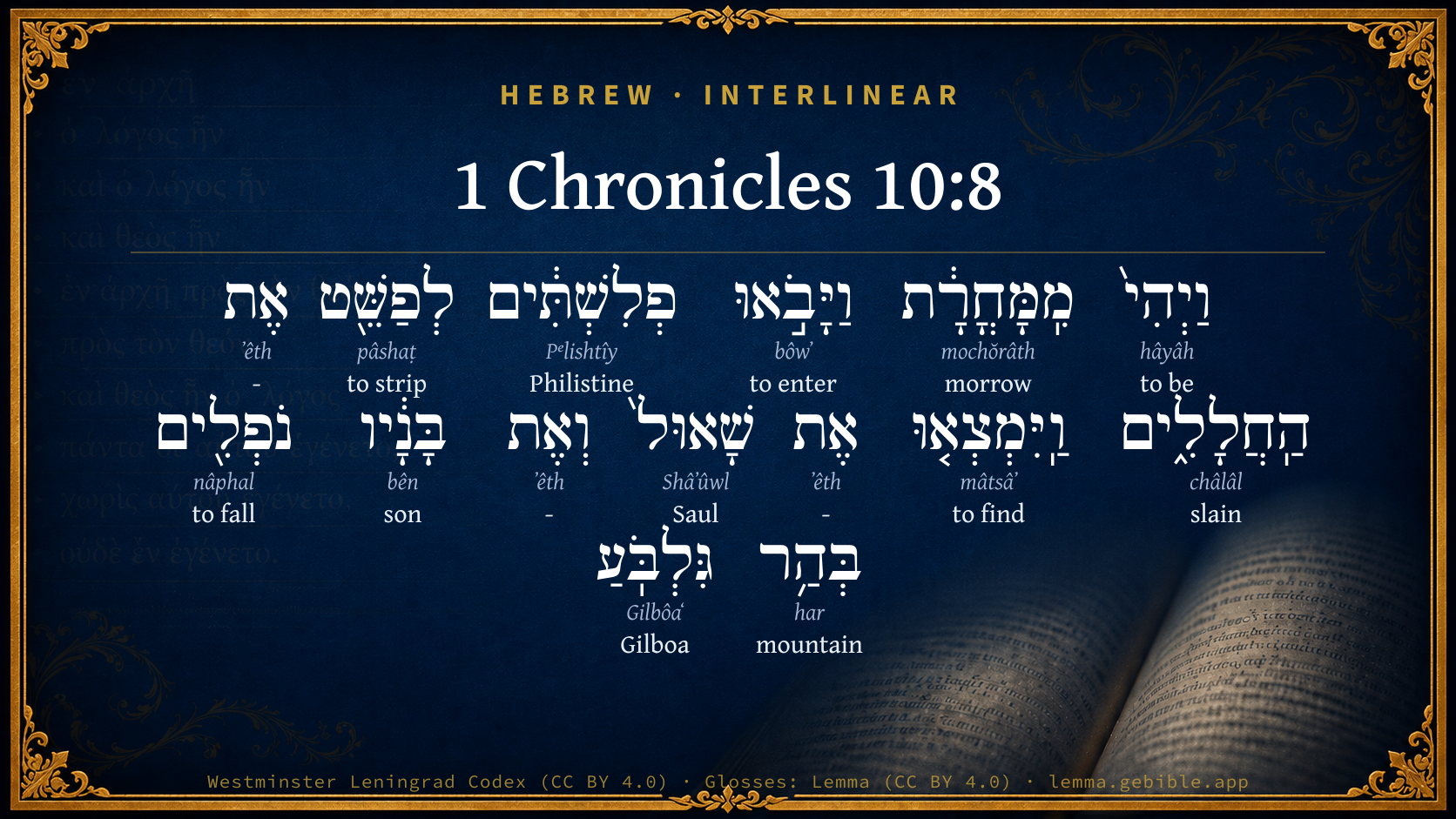
גִּלְבֹּֽעַ
Gilbôaʻ
H1533
“Gilboa”
Noun, Proper
Part of Speech
Noun
Type
Proper
Full BDB Definition

Origin: from H1530 and H1158

TWOT: None

Gilboa = "swollen heap" - a mountain-ridge at the southeastern end of the plain of Jezreel, site of the death of Saul and Jonathan
  1. וַיְהִי֙ hâyâh H1961 “and · to be” Conjunction + Verb, Qal, Sequential Imperfect, 3rd Person, Masculine, Singular
  2. מִֽמָּחֳרָ֔ת mochŏrâth H4283 “from · morrow” Preposition + Noun, Common, Feminine, Singular, Absolute
  3. וַיָּבֹ֣אוּ bôwʼ H935 “and · to enter” Conjunction + Verb, Qal, Sequential Imperfect, 3rd Person, Masculine, Plural
  4. פְלִשְׁתִּ֔ים Pᵉlishtîy H6430 “Philistines” Noun, Gentilic, Masculine, Plural, Absolute
  5. לְפַשֵּׁ֖ט pâshaṭ H6584 “to strip” Preposition + Verb, Piel, Infinitive Construct
  6. אֶת ʼêth H853 “-” Particle, Direct Object
  7. הַֽחֲלָלִ֑ים châlâl H2491 “the · slain” Particle, Definite Article + Adjective, Adjective, Masculine, Plural, Absolute
  8. וַֽיִּמְצְא֤וּ mâtsâʼ H4672 “and · to find” Conjunction + Verb, Qal, Sequential Imperfect, 3rd Person, Masculine, Plural
  9. אֶת ʼêth H853 “-” Particle, Direct Object
  10. שָׁאוּל֙ Shâʼûwl H7586 “Saul” Noun, Proper
  11. וְאֶת ʼêth H853 “and · -” Conjunction + Particle, Direct Object
  12. בָּנָ֔יו bên H1121 “sons · his” Noun, Common, Masculine, Plural, Construct + Suffix, Personal, 3rd Person, Masculine, Singular
  13. נֹפְלִ֖ים nâphal H5307 “falling” Verb, Qal, Participle Active, Masculine, Plural, Absolute
  14. בְּהַ֥ר har H2022 “in/at · mountain of” Preposition + Noun, Common, Masculine, Singular, Construct

About this verse

These counts appear in no published source. They are computed here, from the morphology-tagged text and Lemma’s own curated glosses. What Lemma adds →

15
words
13
distinct lemmas
Historical
section

Notable vocabulary

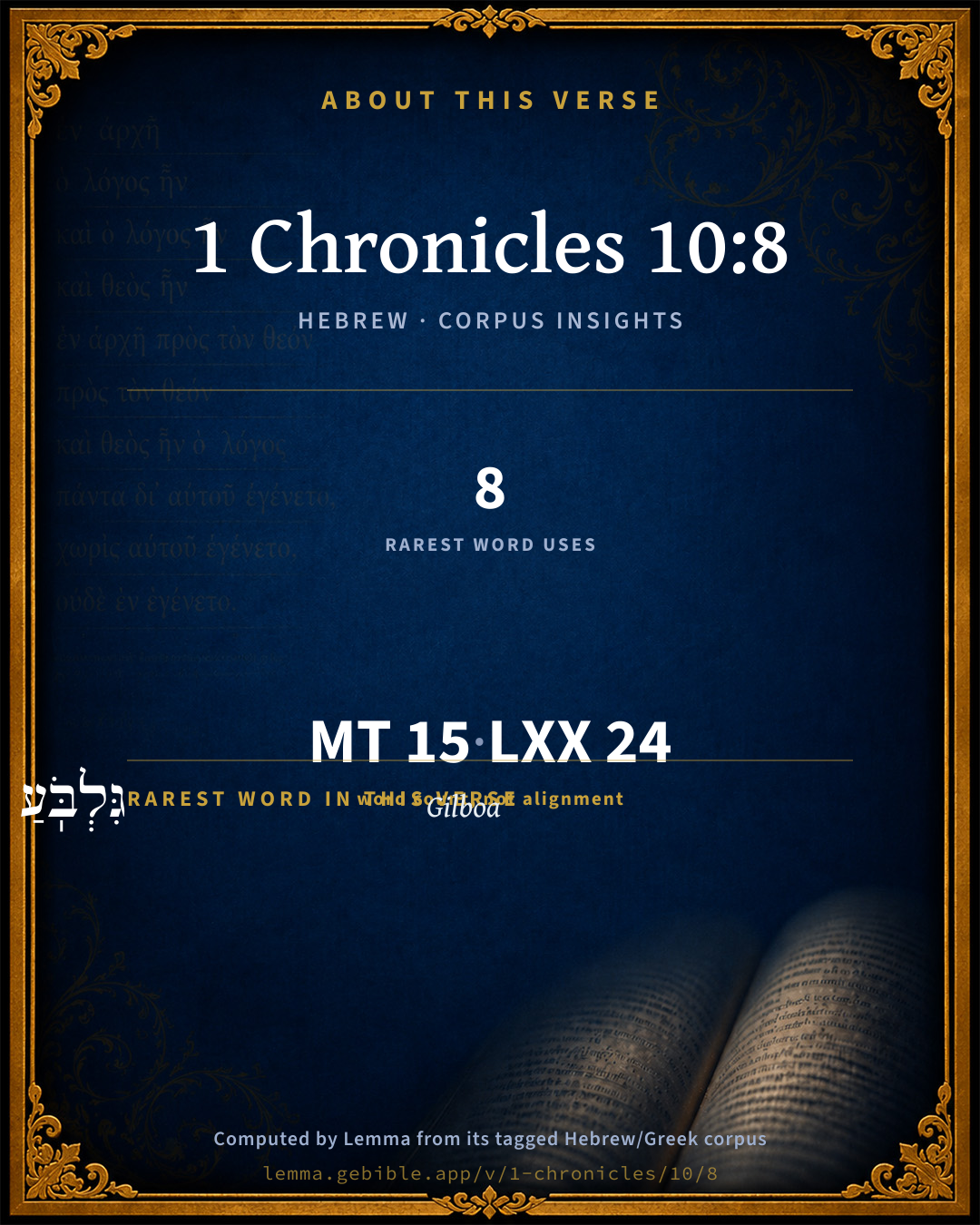
The rarest word here is גִּלְבֹּֽעַ Gilboa H1533 — appearing just 8 times in the whole Hebrew Bible.

Shared distinctive vocabulary

גִּלְבֹּֽעַ Gilboa H1533 occurs in 8 verses of the Hebrew Bible. Also found in:

Grammatical profile

  • 5 verbs
  • 6 nouns
  • 1 adjective
  • 3 particles

Verb forms

  • וַיְהִי֙ Qal · Sequential Imperfect
  • וַיָּבֹ֣אוּ Qal · Sequential Imperfect
  • לְפַשֵּׁ֖ט Piel · Infinitive Construct
  • וַֽיִּמְצְא֤וּ Qal · Sequential Imperfect
  • נֹפְלִ֖ים Qal · Participle Active

Hebrew & Septuagint length

In English translation the verse runs 25 words from the Hebrew and 28 from the Septuagint (LXX English) — closely comparable.

A rough comparison of the two English renderings, which tokenize alike — not a word-level alignment.

Word counts can differ between the Hebrew and the Greek without any difference in meaning — e.g. the Hebrew direct-object marker אֵת has no separate Greek word, and Greek often adds the article ὁ.

In the original languages it is 15 Hebrew tokens and 24 Greek tokens — but the two are counted differently (Hebrew bundles its prefixes and suffixes into one token; the Greek is in lemma form), so that isn’t a like-for-like length.

Cross-references

3

Topical passages linked to 1 Chronicles 10:8 in the Treasury of Scripture Knowledge — connected by theme and wording, ordered by reader-vote popularity; previews shown in the World English Bible.

  • 1 Samuel 31:8 It happened on the next day, when the Philistines came to strip the slain, that they found Saul and his three sons fallen on Mount Gilboa.
  • 2 Kings 3:23 and they said, This is blood; the kings are surely destroyed, and they have struck each man his fellow: now therefore, Moab, to the spoil.
  • 2 Chronicles 20:25 When Jehoshaphat and his people came to take the spoil of them, they found among them in abundance both riches and dead bodies, and precious jewels, which they stripped off for themselves, more than they could carry away: and they were three days in taking the spoil, it was so much.

Cross-references courtesy of OpenBible.info (CC BY 4.0).

Hebrew and Greek witnesses Masoretic Hebrew ↔ Greek Septuagint

The same verse in the two great witnesses to the Old Testament, shown verse-for-verse.

These are two independent witnesses, not word-aligned to each other, and the Septuagint is shown in lemma (dictionary) form.

Hebrew 1 Chronicles 10:8 Masoretic · Westminster Leningrad Codex

וַיְהִי֙ מִֽמָּחֳרָ֔ת וַיָּבֹ֣אוּ פְלִשְׁתִּ֔ים לְפַשֵּׁ֖ט אֶת הַֽחֲלָלִ֑ים וַֽיִּמְצְא֤וּ אֶת שָׁאוּל֙ וְאֶת בָּנָ֔יו נֹפְלִ֖ים בְּהַ֥ר גִּלְבֹּֽעַ

It happened on the next day, when the Philistines came to strip the slain, that they found Saul and his sons fallen on Mount Gilboa.

World English Bible · Public Domain

Greek LXX 1 Chronicles 10:8 Septuagint · lemma form

καί γίγνομαι ὁ ἔχω καί ἔρχομαι ἀλλόφυλος ὁ σκυλεύω ὁ τραυματίας καί εὑρίσκω ὁ σαούλ καί ὁ υἱός αὐτός πίπτω ἐν ὁ ὄρος γελβουε

And it came to pass on the next day that the Philistines came to strip the slain, and they found Saul and his sons fallen on mount Gelbue.

LXX2012 (modern English Septuagint) · Public Domain

Hebrew: Westminster Leningrad Codex (CC BY 4.0). Greek: Septuagint (public domain); English from LXX2012 (modern English Septuagint) (Public Domain). How the Septuagint differs from the Hebrew →

Commentary

Notes on 1 Chronicles 10:8 from classic Christian and Jewish commentators (each source and its license shown beneath its notes). The classic Christian expositions comment on the surrounding passage and are grouped to its opening verse, so a note may address several verses; the Jewish commentaries on the Tanakh (Rashi and others) are per-verse, so they appear only where the commentator wrote on this verse.

Lemma curates 59 commentaries, every one of them public domain or Creative Commons licensed, each selected and text-cleaned for this edition rather than reprinted as found. About our sources →

Trapp's Complete Commentary

John Trapp

1Ch 10:8 And it came to pass on the morrow, when the Philistines came to strip the slain, that they found Saul and his sons fallen in mount Gilboa.

Ver. 8. And it came to pass on the morrow.] They flew not on the spoil, till they had secured the victory: for

“ Victorem a victo superari saepe videmus. ”

John Trapp, A Commentary or Exposition upon All the Books of the Old and New Testament (1647–1656) — public domain. Text from a community e-Sword module.

The Biblical Illustrator

Joseph S. Exell

1Ch_10:8-10

And it came to pass on the morrow, when the Philistines came to strip the slain, that they found Saul.

A good beginning with a bad ending

Many men begin with influential parentage, social station, ample education, pecuniary competence, yet they travel a downhill road, falling first into neglect and then into oblivion. Physical greatness, social security, public applause are being continually rebuked, humiliated, and put to shame. The proverb wisely says, Call no man happy until he is dead. The meaning is that at the very best a man may make a slip which will bring his whole life into degradation in every sense of the term. There is but a step between man and death--not physical death only, but the death of character, reputation, and influence. It remains with each man to say whether a good beginning shall have a good ending. This is a question of personal discipline, holy fellowship with God, and an acceptance of all processes which have been divinely established for the training and sanctification of man. The word comes with special urgency to young persons, to men of influence, to successful men, and to all who are plied by the temptations incident to high station and wide influence. (J. Parker, D. D.)

The Biblical Illustrator, edited by Joseph S. Exell (c. 1880s–1900s) — public domain. Text from a community e-Sword module.

Geneva Bible (1599)

Geneva Bible translators

Hebrew, fallen.

Geneva Bible (1599) marginal notes — public domain. Text via Bolls.life.

Matthew Henry's Commentary

Here, I. From the triumph of the Philistines over the body of Saul we may learn, 1. That the greater dignity men are advanced to the greater disgrace they are in danger of falling into. Saul's dead body, because he was king, was abused more than any other of the slain. Advancement makes men a mark for malice. 2. That, if we give not to God the glory of our successes, even the Philistines will rise up in judgment against us and condemn us; for, when they had obtained a victory over Saul, they sent tidings to their idols - poor idols, that knew not what was done a few miles off till the tidings were brought to them, nor then either! They also put Saul's armour in the house of their gods, Ch1 10:10. Shall Dagon have so honourable a share in their triumphs and the true and living God be forgotten in ours?

II. From the triumph of the men of Jabesh-Gilead in the rescue of the bodies of Saul and his sons we learn that there is a respect due to the remains of the deceased, especially of deceased princes. We are not to enquire concerning the eternal state; that must be left to God: but we must treat the dead body as those who remember it has been united to an immortal soul and must be so again.

III. From the triumphs of divine Justice in the ruin of Saul we may learn, 1. That the sin of sinners will certainly find them out, sooner or later: Saul died for his transgression. 2. That no man's greatness can exempt him from the judgments of God. 3. Disobedience is a killing thing. Saul died for not keeping the word of the Lord, by which he was ordered to destroy the Amalekites. 4. Consulting with witches is a sin that fills the measure of iniquity as soon as any thing. Saul enquired of one that had a familiar spirit, and enquired not of the Lord, therefore he slew him, Ch1 10:13, Ch1 10:14. Saul slew himself, and yet it is said, God slew him. What is done by wicked hands is yet done by the determinate counsel and foreknowledge of God. Those that abandon themselves to the devil shall be abandoned to him; so shall their doom be. It is said (Sa1 28:6) that Saul did enquire of the Lord and he answered him not: but here it is said, Saul did not enquire of God; for he did not till he was brought to the last extremity, and then it was too late.

Matthew Henry's Commentary on the Whole Bible (1708–1710) — public domain (CC PDM 1.0). Text via the HelloAO Bible API.

Ellicott's Commentary for English Readers

(8) His sons.—Samuel, “his three sons.” Otherwise the two verses are word for word the same.

A Bible Commentary for English Readers, edited by Charles John Ellicott (1878–1897) — public domain. Text from a community e-Sword module.

The Pulpit Commentary

And his sons. The parallel (1Sa_31:8) says explicitly, "And his three sons."

The Pulpit Commentary (1880–1919), ed. H.D.M. Spence-Jones & Joseph S. Exell — public domain. Text from a community e-Sword module.

Kretzmann's Popular Commentary

Paul E. Kretzmann

The Triumph of the Philistines

v. 8. And it came to pass on the morrow, when the Philistines came to strip the slain, to make the customary plunder of personal belongings, that they found Saul and his sons fallen in Mount Gilboa.

v. 9. And when they had stripped him, they took his head, and his armor, and sent into the land of the Philistines round about, to carry tidings unto their idols, to whom they attributed this victory, and to the people.

v. 10. And they put his armor in the house of their gods, in the temple of Astarte, as trophies of the great victory, and fastened his head in the temple of Dagon, their chief god, while the trunk was affixed to the wall of Beth-shan, 1Sa 31:10.

v. 11. And when all Jabesh-gilead, the inhabitants of the city east of Jordan, which owed so much to Saul, heard all that the Philistines had done to Saul,

v. 12. they arose, all the valiant men, and took away the body of Saul, from the wall of Beth-shan, and the bodies of his sons, and brought them to Jabesh, and buried their bones under the oak in Jabesh, and fasted seven days, in token of mourning. Cf 1Sa 31:11-13.

v. 13. So Saul died for his transgression which he committed against the Lord, even against the word of the Lord, which he kept not, 1Sa 13:13, and also for asking counsel of one that had a familiar spirit, to enquire of it, 1Sa 28:1;

v. 14. and enquired not of the Lord, namely, after sound repentance; therefore he slew him, and turned the kingdom unto David, the son of Jesse. Rejecting the Word of God is equivalent to rejecting the Lord Himself and is followed by the same punishment. A professed Christian who seeks the advice of the modern necromancers and fortune-tellers by that fact sets aside his Christian faith, sinning against the Second Commandment.

Paul E. Kretzmann, Popular Commentary of the Bible (1921–1924) — public domain. Text from a community e-Sword module.

Lesson kit

Teaching starters — assembled from the data on this page, not authored interpretation. Every prompt links to the verse data it draws on. Edit before teaching.

1 Chronicles, in the Historical, opens this verse with 15 words (13 distinct Hebrew lemmas). Its most distinctive word is Gilbôaʻ (“Gilboa”). A historical commentator’s framing appears above. Read the whole chapter for the surrounding context.

Discussion questions

  1. How does “Gilboa” (Gilbôaʻ) shape what this verse is saying?
  2. 1 Samuel 28:4 shares the word «Gilboa» with this verse. How do the two illuminate each other?
  3. The translations on this page render this verse differently — a whole-verse word diff, not a word-by-word alignment. What might account for the different wordings?
  4. The verb «וַיְהִי֙» is Qal Sequential Imperfect. How does its form color the action?
  5. Reading how Trapp's Complete Commentary and The Biblical Illustrator read this verse, where do the two commentators agree and where do they part?

Things to notice

Reading settings

Reading text

Shown beneath each verse's original-language words.

Old Testament
Old Testament edition

Read the OT as the Masoretic Hebrew (MT) or the Greek Septuagint (LXX).

English shown for the Greek Septuagint (in the Hebrew ↔ Greek comparison).

Comparing translations? Open the Compare panel on any verse page to stack up to four side by side.