
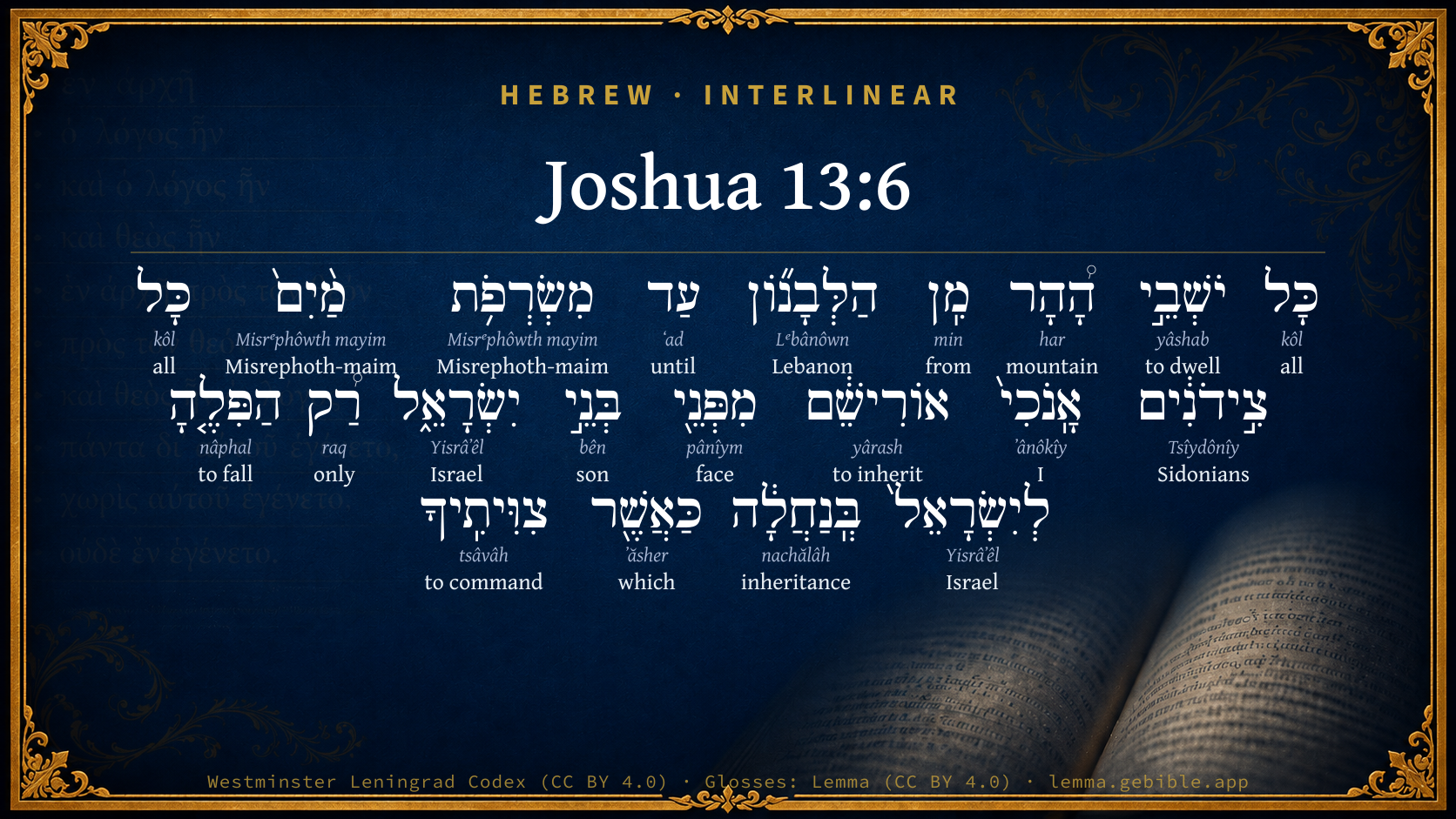
Joshua 13:6

Hebrew (Westminster Leningrad Codex) Joshua 13:6 appears in the Hebrew Old Testament. The text above is from the Westminster Leningrad Codex. Each word links to its Strong’s number, a concise gloss, and parsing drawn from the Open Scriptures Hebrew Bible morphology. Click any word for its full Brown-Driver-Briggs (BDB) entry.
Download image
Cite this verse

Joshua 13:6 (World English Bible). Public Domain. Lemma interlinear Bible study tool, https://lemma.gebible.app/v/joshua/13/6.

Show BibTeX & RIS
BibTeX
RIS
English Translation
all the inhabitants of the hill-country from Lebanon to Misrephoth Maim, even all the Sidonians; them will I drive out from before the children of Israel: only allot you it to Israel for an inheritance, as I have commanded you.
World English Bible · Public Domain
Download a study sheet

One document with this verse’s original text, its word-by-word gloss line, the meaning frame, cross-references with their text, attributed commentary, and full source and license credits — printable, and it pastes into notes with its structure intact.

This verse Autodidact and up

Study sheet (.html) Plain text (.txt)

A passage Seminary Student

Up to 50 verses in one chapter. A passage sheet keeps up to 6 commentary sources and 12 cross-references per verse, in the order this page ranks them, and says so on the sheet whenever that leaves anything out. Ask for a single verse and you get the Autodidact verse sheet above.

Everything on this page stays free to read, with no account — the sheet is a download of what is already on screen, not access to it.

Want to remove ads? Support Godless Engineer
Compare translations 3

The same verse in 3 English versions, stacked beneath the original-language interlinear above. Click any original word for its lexicon entry.

Each is an independent rendering of the whole verse — the interlinear is not word-aligned to these translations.

Highlighted words mark where these versions differ — a whole-verse word diff, not a word-by-word alignment.

  • World English Bible Public Domain
    all the inhabitants of the hill-country from Lebanon to Misrephoth Maim, even all the Sidonians; them will I drive out from before the children of Israel: only allot you it to Israel for an inheritance, as I have commanded you.
  • King James Version Public Domain
    All the inhabitants of the hill country from Lebanon unto Misrephothmaim, and all the Sidonians, them will I drive out from before the children of Israel: only divide thou it by lot unto the Israelites for an inheritance, as I have commanded thee.
  • unfoldingWord Literal Text CC BY-SA 4.0
    All of the dwellers of the hill country, from Lebanon unto Misrephoth Maim, all of the Sidonians, I myself will dispossess them from the face of the sons of Israel. You shall only cause it to fall to Israel as an inheritance, just as I have commanded you.

unfoldingWord Literal Text — © unfoldingWord, licensed CC BY-SA 4.0. Word-aligned USFM3 via Door43 (git.door43.org/unfoldingWord/en_ult).

Versions to compare (up to 4)

3 of 4 selected

Show all 18 translations

Every available English version of this verse, each an independent rendering of the whole verse.

  • World English Bible Public Domain
    all the inhabitants of the hill-country from Lebanon to Misrephoth Maim, even all the Sidonians; them will I drive out from before the children of Israel: only allot you it to Israel for an inheritance, as I have commanded you.
  • Berean Standard Bible Public Domain
    All the inhabitants of the hill country from Lebanon to Misrephoth-maim—all the Sidonians—I Myself will drive out before the Israelites. Be sure to divide it by lot as an inheritance to Israel, as I have commanded you.
  • Majority Standard Bible Public Domain
    All the inhabitants of the hill country from Lebanon to Misrephoth-maim—all the Sidonians—I Myself will drive out before the Israelites. Be sure to divide it by lot as an inheritance to Israel, as I have commanded you.
  • King James Version Public Domain
    All the inhabitants of the hill country from Lebanon unto Misrephothmaim, and all the Sidonians, them will I drive out from before the children of Israel: only divide thou it by lot unto the Israelites for an inheritance, as I have commanded thee.
  • American Standard Version (1901) Public Domain
    all the inhabitants of the hill-country from Lebanon unto Misrephoth-maim, even all the Sidonians; them will I drive out from before the children of Israel: only allot thou it unto Israel for an inheritance, as I have commanded thee.
  • Revised Version (1885) Public Domain
    all the inhabitants of the hill country from Lebanon unto Misrephoth-maim, even all the Zidonians; them will I drive out from before the children of Israel: only allot thou it unto Israel for an inheritance, as I have commanded thee.
  • Geneva Bible (1599) Public Domain
    All the inhabitants of the mountaines from Lebanon vnto Misrephothmaim, and all the Sidonians, I wil cast them out from before the children of Israel: only deuide thou it by lot vnto the Israelites, to inherite, as I haue commanded thee.
  • Douay-Rheims (1899) Public Domain
    Of all that dwell in the mountains from Libanus, to the waters of Maserephoth, and all the Sidonians. I am he that will cut them off from before the face of the children of Israel. So let their land come in as a part of the inheritance of Israel, as I have commanded thee.
  • Young's Literal Translation Public Domain
    all the inhabitants of the hill-country, from Lebanon unto Misrephoth-Maim, all the Sidonians: I -- I dispossess them before the sons of Israel; only, cause it to fall to Israel for an inheritance, as I have commanded thee.
  • Literal Standard Version CC BY-SA 4.0
    all the inhabitants of the hill-country, from Lebanon to Misrephoth-Maim, all the Sidonians: I dispossess them before the sons of Israel; only, cause it to fall to Israel for an inheritance, as I have commanded you.
  • Unlocked Literal Bible CC BY-SA 4.0
    Also, all the inhabitants of the hill country from Lebanon as far as Misrephoth Maim, including all the people of Sidon. I will drive them out before the army of Israel. Be sure to assign the land to Israel as an inheritance, as I commanded you.
  • unfoldingWord Literal Text CC BY-SA 4.0
    All of the dwellers of the hill country, from Lebanon unto Misrephoth Maim, all of the Sidonians, I myself will dispossess them from the face of the sons of Israel. You shall only cause it to fall to Israel as an inheritance, just as I have commanded you.
  • Darby Bible Public Domain
    all the inhabitants of the hill-country from Lebanon to Misrephoth-maim, all the Sidonians; I will dispossess them from before the children of Israel. Only, partition it by lot to Israel for an inheritance, as I have commanded thee.
  • World Messianic Bible Public Domain
    all the inhabitants of the hill country from Lebanon to Misrephoth Maim, even all the Sidonians. I will drive them out from before the children of Israel. Just allocate it to Israel for an inheritance, as I have commanded you.
  • Webster's Bible Public Domain
    And the inhabitants of the hill-country from Lebanon to Misrephoth-maim, and all the Sidonians, them will I drive out from before the children of Israel: only divide thou it by lot to the Israelites for an inheritance, as I have commanded thee.
  • Free Bible Version CC BY-SA 4.0
    and the those who live in the hill country from Lebanon to Misrephoth Maim, including all the land of the Sidonians. I myself will drive them out ahead of the Israelites. Just allocate the land to Israel for them to own, as I have commanded you.
  • Bible in Basic English Public Domain
    All the people of the hill-country from Lebanon to Misrephoth-maim, all the Zidonians; them will I send out from before the children of Israel: only make division of it to Israel for a heritage, as I have given you orders to do.
  • JPS Tanakh (1917) Public Domain
    all the inhabitants of the hill-country from Lebanon unto Misrephoth-maim, even all the Zidonians; them will I drive out from before the children of Israel; only allot thou it unto Israel for an inheritance, as I have commanded thee.

Literal Standard Version (2020), Covenant Press — licensed CC BY-SA 4.0. Text via the HelloAO Bible API (eBible.org). Unlocked Literal Bible (unfoldingWord) — licensed CC BY-SA 4.0. Text via the HelloAO Bible API (eBible.org). unfoldingWord Literal Text — © unfoldingWord, licensed CC BY-SA 4.0. Word-aligned USFM3 via Door43 (git.door43.org/unfoldingWord/en_ult). Free Bible Version, Dr. Jonathan Gallagher — licensed CC BY-SA 4.0. Text via the HelloAO Bible API (eBible.org).

Word by word

More ways to search: Search by grammar → Find every occurrence → Compare this word →

Practice this passage: Drill this verse → Learn its vocabulary →

מִשְׂרְפֹ֥ת
Misrᵉphôwth mayim
H4956
“Misrephoth-maim”
Noun, Proper
Part of Speech
Noun
Type
Proper
Full BDB Definition

Origin: from pl of H4955 and H4325

TWOT: None

Misrephoth-maim = "burnings of water" - a place in northern Palestine near Sidon
  1. כָּל kôl H3605 “all of” Noun, Common, Masculine, Singular, Construct
  2. יֹשְׁבֵ֣י yâshab H3427 “dwelling” Verb, Qal, Participle Active, Masculine, Plural, Construct
  3. הָ֠הָר har H2022 “the · mountain” Particle, Definite Article + Noun, Common, Masculine, Singular, Absolute
  4. מִֽן min H4480 “from” Preposition
  5. הַלְּבָנ֞וֹן Lᵉbânôwn H3844 “the · Lebanon” Particle, Definite Article + Noun, Proper
  6. עַד ʻad H5704 “until” Preposition
  7. מַ֨יִם֙ Misrᵉphôwth mayim H4956 “Misrephoth-maim” Noun, Proper
  8. כָּל kôl H3605 “all of” Noun, Common, Masculine, Singular, Construct
  9. צִ֣ידֹנִ֔ים Tsîydônîy H6722 “Sidonians” Noun, Gentilic, Masculine, Plural, Absolute
  10. אָֽנֹכִי֙ ʼânôkîy H595 “I” Pronoun, Personal, 1st Person, Common, Singular
  11. אוֹרִישֵׁ֔ם yârash H3423 “to inherit · them” Verb, Hiphil, Imperfect, 1st Person, Common, Singular + Suffix, Personal, 3rd Person, Masculine, Plural
  12. מִפְּנֵ֖י pânîym H6440 “from · face(s) of” Preposition + Noun, Common, Both, Plural, Construct
  13. בְּנֵ֣י bên H1121 “sons of” Noun, Common, Masculine, Plural, Construct
  14. יִשְׂרָאֵ֑ל Yisrâʼêl H3478 “Israel” Noun, Proper
  15. רַ֠ק raq H7535 “only” Particle, Accusative
  16. הַפִּלֶ֤הָ nâphal H5307 “fall · her” Verb, Hiphil, Imperative, 2nd Person, Masculine, Singular + Suffix, Personal, 3rd Person, Feminine, Singular
  17. לְיִשְׂרָאֵל֙ Yisrâʼêl H3478 “to/for · Israel” Preposition + Noun, Proper
  18. בְּֽנַחֲלָ֔ה nachălâh H5159 “in/at · inheritance” Preposition + Noun, Common, Feminine, Singular, Absolute
  19. כַּאֲשֶׁ֖ר ʼăsher H834 “like/as · which” Preposition + Particle, Relative
  20. צִוִּיתִֽיךָ tsâvâh H6680 “to command · you” Verb, Piel, Perfect, 1st Person, Common, Singular + Suffix, Personal, 2nd Person, Masculine, Singular

About this verse

These counts appear in no published source. They are computed here, from the morphology-tagged text and Lemma’s own curated glosses. What Lemma adds →

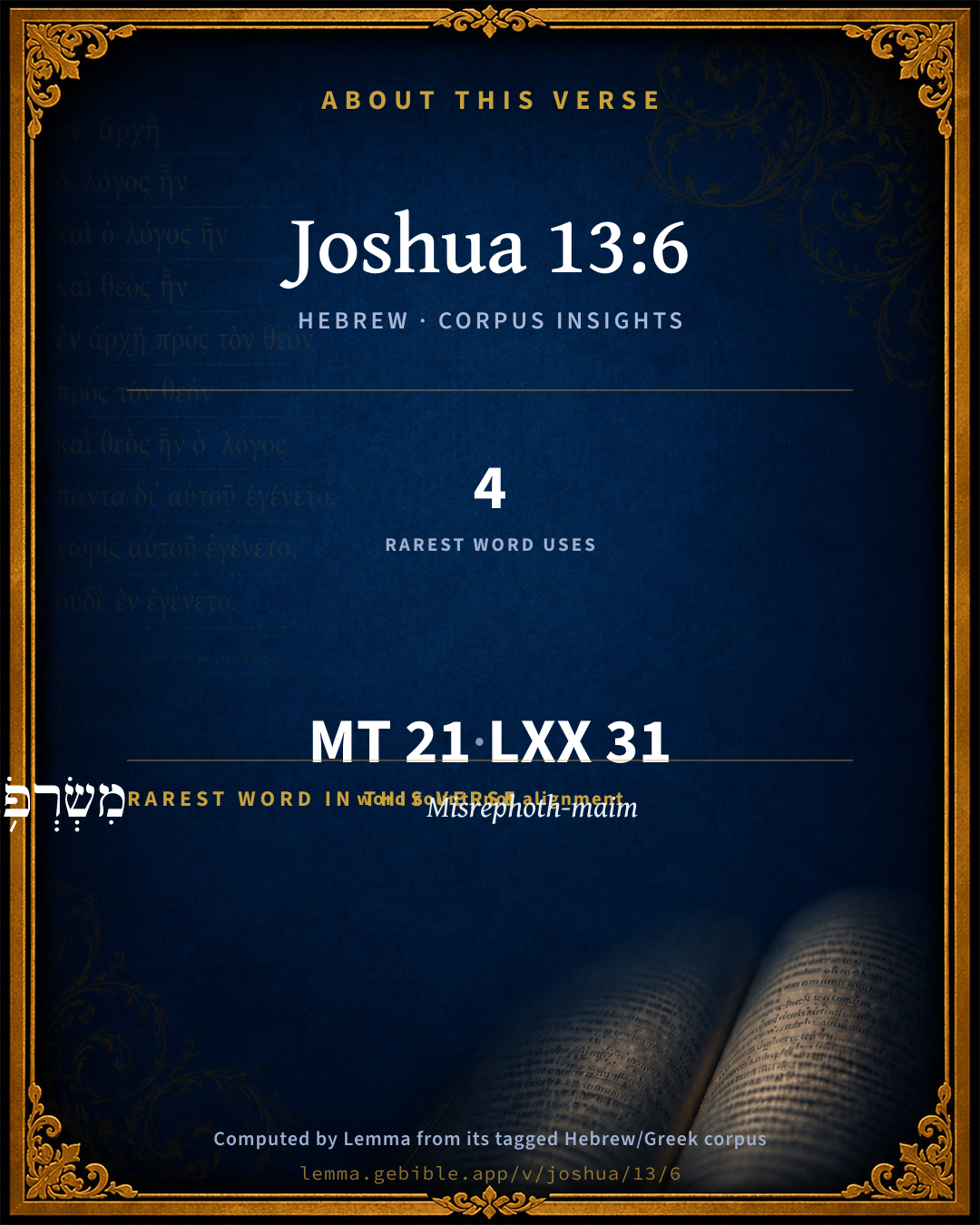
21
words
18
distinct lemmas
Historical
section

Notable vocabulary

The rarest word here is מִשְׂרְפֹ֥ת Misrephoth-maim H4956 — appearing just 4 times in the whole Hebrew Bible.

Shared distinctive vocabulary

מִשְׂרְפֹ֥ת Misrephoth-maim H4956 occurs in 2 verses of the Hebrew Bible. Also found in:

Grammatical profile

  • 4 verbs
  • 12 nouns
  • 1 pronoun
  • 2 prepositions
  • 2 particles

Verb forms

  • יֹשְׁבֵ֣י Qal · Participle Active
  • אוֹרִישֵׁ֔ם Hiphil · Imperfect
  • הַפִּלֶ֤הָ Hiphil · Imperative
  • צִוִּיתִֽיךָ Piel · Perfect

Repetition

Words recur within this verse — often emphatic in Hebrew:

  • כָּל all H3605 ×2
  • מִשְׂרְפֹ֥ת Misrephoth-maim H4956 ×2
  • יִשְׂרָאֵ֑ל Israel H3478 ×2

Hebrew & Septuagint length

In English translation the verse runs 40 words from the Hebrew and 37 from the Septuagint (LXX English) — closely comparable.

A rough comparison of the two English renderings, which tokenize alike — not a word-level alignment.

Word counts can differ between the Hebrew and the Greek without any difference in meaning — e.g. the Hebrew direct-object marker אֵת has no separate Greek word, and Greek often adds the article ὁ.

In the original languages it is 21 Hebrew tokens and 31 Greek tokens — but the two are counted differently (Hebrew bundles its prefixes and suffixes into one token; the Greek is in lemma form), so that isn’t a like-for-like length.

Cross-references

8

Topical passages linked to Joshua 13:6 in the Treasury of Scripture Knowledge — connected by theme and wording, ordered by reader-vote popularity; previews shown in the World English Bible.

  • Joshua 11:8 Yahweh delivered them into the hand of Israel, and they struck them, and chased them to great Sidon, and to Misrephoth Maim, and to the valley of Mizpeh eastward; and they struck them, until they left them none remaining.
  • Joshua 23:13 know for a certainty that Yahweh your God will no more drive these nations from out of your sight; but they shall be a snare and a trap to you, and a scourge in your sides, and thorns in your eyes, until you perish from off this good land which Yahweh your God has given you.
  • Judges 2:21–23 I also will not henceforth drive out any from before them of the nations that Joshua left when he died;
  • Genesis 15:18–21 In that day Yahweh made a covenant with Abram, saying, "To your seed have I given this land, from the river of Egypt to the great river, the river Euphrates:
  • Exodus 23:30–31 Little by little I will drive them out from before you, until you have increased and inherit the land.
  • Numbers 33:54 You shall inherit the land by lot according to your families; to the more you shall give the more inheritance, and to the fewer you shall give the less inheritance: wherever the lot falls to any man, that shall be his; according to the tribes of your fathers shall you inherit.
  • Joshua 14:1–2 These are the inheritances which the children of Israel took in the land of Canaan, which Eleazar the priest, and Joshua the son of Nun, and the heads of the fathers' [houses] of the tribes of the children of Israel, distributed to them,
  • Joshua 23:4 Behold, I have allotted to you these nations that remain, to be an inheritance for your tribes, from the Jordan, with all the nations that I have cut off, even to the great sea toward the going down of the sun.

Cross-references courtesy of OpenBible.info (CC BY 4.0).

Hebrew and Greek witnesses Masoretic Hebrew ↔ Greek Septuagint

The same verse in the two great witnesses to the Old Testament, shown verse-for-verse.

These are two independent witnesses, not word-aligned to each other, and the Septuagint is shown in lemma (dictionary) form.

Hebrew Joshua 13:6 Masoretic · Westminster Leningrad Codex

כָּל יֹשְׁבֵ֣י הָ֠הָר מִֽן הַלְּבָנ֞וֹן עַד מִשְׂרְפֹ֥ת מַ֨יִם֙ כָּל צִ֣ידֹנִ֔ים אָֽנֹכִי֙ אוֹרִישֵׁ֔ם מִפְּנֵ֖י בְּנֵ֣י יִשְׂרָאֵ֑ל רַ֠ק הַפִּלֶ֤הָ לְיִשְׂרָאֵל֙ בְּֽנַחֲלָ֔ה כַּאֲשֶׁ֖ר צִוִּיתִֽיךָ

all the inhabitants of the hill-country from Lebanon to Misrephoth Maim, even all the Sidonians; them will I drive out from before the children of Israel: only allot you it to Israel for an inheritance, as I have commanded you.

World English Bible · Public Domain

Greek LXX Joshua 13:6 Septuagint · lemma form

πᾶς ὁ καταοἰκέω ὁ ὀρεινή ἀπό ὁ λίβανος ἕως ὁ μασερεφωθμαιμ πᾶς ὁ σιδώνιος ἐγώ αὐτός ἐκὀλεθρεύω ἀπό πρόσωπον ἰσραήλ ἀλλά διαδίδωμι αὐτός ἐν κλῆρος ὁ ἰσραήλ ὅς τρόπος σύ ἐντέλλομαι

every one that inhabits the hill country from Libanus as far as Masereth Memphomaim. All the Sidonians, I will destroy them from before Israel; but do you give them by inheritance to Israel, as I charged you.

LXX2012 (modern English Septuagint) · Public Domain

Hebrew: Westminster Leningrad Codex (CC BY 4.0). Greek: Septuagint (public domain); English from LXX2012 (modern English Septuagint) (Public Domain). How the Septuagint differs from the Hebrew →

Targum (Aramaic paraphrase)

1

The Targum is the ancient Jewish Aramaic paraphrase of the Hebrew Scriptures — an interpretive translation, not the Hebrew text itself. Onkelos (literal) and Pseudo-Jonathan (expansive) render the Torah, and Jonathan the Prophets. Coverage is partial: where no permissively-licensed English translation exists for a verse, only the Aramaic is shown. This is verse-level text, not a word-by-word alignment to the Hebrew.

  1. Targum Jonathan Prophets (Joshua–Malachi)
    כָּל יַתְבֵי טוּרָא מִן לִבְנַן עַד חַרְצֵי יַמָּא כָּל צִידוֹנָאֵי בְּמֵימְרִי אֲתָרְכִינוּן מִן קֳדָם בְּנֵי יִשְׂרָאֵל לְחוֹד פְּלִיגְהָא לְיִשְׂרָאֵל בְּאַחֲסָנָא כְּמָא דְפַקִידְתָּךְ:

    (no public-domain English translation for this verse)

    Targum Jonathan — Aramaic: “Mikraot Gedolot” (public domain). English: “Sefaria Community Translation” (CC0 1.0 (public-domain dedication)); “London "Chaldee Paraphrase," 1871” (public domain). Text via Sefaria.

Commentary

Notes on Joshua 13:6 from classic Christian and Jewish commentators (each source and its license shown beneath its notes). The classic Christian expositions comment on the surrounding passage and are grouped to its opening verse, so a note may address several verses; the Jewish commentaries on the Tanakh (Rashi and others) are per-verse, so they appear only where the commentator wrote on this verse.

Lemma curates 59 commentaries, every one of them public domain or Creative Commons licensed, each selected and text-cleaned for this edition rather than reprinted as found. About our sources →

Trapp's Complete Commentary

John Trapp

Jos 13:6 All the inhabitants of the hill country from Lebanon unto Misrephothmaim, [and] all the Sidonians, them will I drive out from before the children of Israel: only divide thou it by lot unto the Israelites for an inheritance, as I have commanded thee.

Ver. 6. Them will I drive out, &c., ] viz., If the Israelites rule with me and be faithful with my saints, as Hos 11:12; else "they shall know my breach of promise," as Num 14:34.

John Trapp, A Commentary or Exposition upon All the Books of the Old and New Testament (1647–1656) — public domain. Text from a community e-Sword module.

Joseph Benson's Commentary

Jos 13:6. Them will I drive out — Whatever becomes of us, however we may be laid aside as broken vessels, God will do his work in his own time. I will do it by my word; so the Chaldee here, as in many other places: by the eternal Word, the captain of my host. But the promise of driving them out from before the children of Israel, supposes that the Israelites must use their own endeavours, must go up against them. If Israel, through sloth or cowardice, let them alone, they are not likely to be driven out. We must go forth in our Christian warfare, and then God will go before us.

Joseph Benson's Commentary on the Old and New Testaments (1811–1818) — public domain. Text from a community e-Sword module.

Tyndale Open Study Notes

Tyndale Open Resources

13:6b-7 The lands just listed had not yet been conquered, but God directed Joshua to show his faith by allotting them to the tribes against the future, when they would be taken.

Tyndale Open Study Notes — © Tyndale Open Resources, licensed CC BY-SA 4.0. Text via the HelloAO Bible API.

Geneva Bible (1599)

Geneva Bible translators

Read Josh. 11:8.

Geneva Bible (1599) marginal notes — public domain. Text via Bolls.life.

Jamieson, Fausset & Brown

Robert Jamieson, A. R. Fausset & David Brown

All the inhabitants of the hill country from Lebanon unto Misrephoth-maim--(See on Jos 11:8) --that is, "all the Sidonians and Phœnicians."

them will I drive out--The fulfilment of this promise was conditional. In the event of the Israelites proving unfaithful or disobedient, they would not subdue the districts now specified; and, in point of fact, the Israelites never possessed them though the inhabitants were subjected to the power of David and Solomon.

only divide thou it by lot unto the Israelites for an inheritance--The parenthetic section being closed, the historian here resumes the main subject of this chapter--the order of God to Joshua to make an immediate allotment of the land. The method of distribution by lot was, in all respects, the best that could have been adopted, as it prevented all ground of discontent, as well as charges of arbitrary or partial conduct on the part of the leaders; and its announcement in the life of Moses (Num 33:54), as the system according to which the allocations to each tribe should be made, was intended to lead the people to the acknowledgment of God as the proprietor of the land and as having the entire right to its disposal. Moreover, a solemn appeal to the lot showed it to be the dictate not of human, but divine, wisdom. It was used, however, only in determining the part of the country where a tribe was to be settled--the extent of the settlement was to be decided on a different principle (Num 26:54). The overruling control of God is conclusively proved because each tribe received the possession predicted by Jacob (Gen. 49:3-28) and by Moses (Deu. 33:6-25).

Jamieson, Fausset & Brown — Commentary Critical and Explanatory on the Whole Bible (1871) — public domain (CC PDM 1.0). Text via the HelloAO Bible API.

Adam Clarke's Commentary

Verse 6. Misrephoth-maim] See Clarke on Jos 11:7.

These will I drive out] That is, if the Israelites continued to be obedient; but they did not, and therefore they never fully possessed the whole of that land which, on this condition alone, God had promised them: the Sidonians were never expelled by the Israelites, and were only brought into a state of comparative subjection in the days of David and Solomon.

Some have taken upon them to deny the authenticity of Divine revelation relative to this business, "because," say they, "God is stated to have absolutely promised that Joshua should conquer the whole land, and put the Israelites in possession of it." This is a total mistake.

1. God never absolutely, i.e., unconditionally, promised to put them in possession of this land. The promise of their possessing the whole was suspended on their fidelity to God. They were not faithful, and therefore God was not bound by his promise to give them any part of the land, after their first act of national defection from his worship.

2. God never said that Joshua should conquer the whole land, and give it to them; the promise was simply this: "Thou shalt bring them into the land, and thou shalt divide it among them:" both of which he did, and procured them footing by his conquests, sufficient to have enabled them to establish themselves in it for ever.

3. It was never said, Thou shalt conquer it all, and then divide it; no. Several of the tribes, after their quota was allotted them, were obliged to drive out the ancient inhabitants. See Clarke on Jos 11:18.

Adam Clarke's Commentary on the Bible (1810–1826) — public domain. Text from a community e-Sword/MySword module.

John Calvin's Commentaries

6. All the inhabitants of the hill country, etc Joshua is again admonished, though the Israelites do not yet possess those regions, not to defer the partition, but trust to the promise of God, because it would detract injuriously from his honor if there were any doubt as to the event. It is accordingly said: Only do what is thy duty in the distribution of the land; nor let that which the enemy still hold securely be exempted from the lot; for it will be my care to fulfil what I have promised. Hence let us learn in undertaking any business, so to depend on the lips of God as that no doubt can delay us. It is not ours, indeed, to fabricate vain hopes for ourselves; but when our confidence is founded on the Lord, let us only obey his commands, and there is no reason to fear that the event will disappoint us.

He afterwards assigns the land of Canaan to nine tribes and a half tribe, because the portion of the Reubenites, Gadites, and half tribe of Manasseh had already been assigned beyond the Jordan. Though there is a seeming tautology in the words, Which Moses gave them, as Moses gave them, there is nothing superfluous, because in the second clause the donation is confirmed; as if God were ordering that which was done to be ratified, or saying, in other words, As Moses gave them that land, so let them remain tranquil in the possession of it. For this reason also he is distinguished by the title of servant of God, as if it were said, Let no one interfere with that decree which a faithful minister has pronounced on the authority of God. It was certainly necessary to provide by anticipation against the disputes which otherwise must have daily arisen.

John Calvin's Commentaries (1540-1563) — public domain. Text from the Calvin Translation Society English edition (1840s-50s) via the Christian Classics Ethereal Library (ccel.org). Calvin's coverage is partial (roughly two-thirds of the Bible); uncommented books and verses are honest gaps, never fabricated. The 19th-century editor's footnotes and remarks are omitted so the notes are faithfully Calvin's own voice.

The Cambridge Bible for Schools and Colleges

gen. ed. J. J. S. Perowne

6. All the inhabitants] In addition to those already enumerated there remained to be conquered all the inhabitants of the mountains from Lebanon unto Mizrephoth-maim, which has been already mentioned above, ch. Jos_11:8. “May it not be the place,” asks Mr Grove, “with which we are familiar in the later history as Zarephath?” Smith’s Bibl. Dict.

only divide thou it by lot] These words connect themselves with Jos_13:1.

The Cambridge Bible for Schools and Colleges (gen. ed. J. J. S. Perowne; Cambridge University Press, 1878–1918) — public domain. Text from a community e-Sword module.

John Gill's Exposition

All the inhabitants of the hill country,.... Not in Judea, but in and about Lebanon, as follows:

from Lebanon unto Misrephothmaim; of which see Jos 11:8,

and all the Sidonians; the inhabitants of the ancient city of Sidon, and the villages and lands belonging to it: these remained unconquered, and never were possessed by the Israelites:

them will I drive out from before the children of Israel: which, though it may have a special respect unto the Sidonians, with whom the clause is closely connected, yet may include all the above lands unconquered, out of which, as well as Sidon, the Lord promises to drive the inhabitants, to make way for the children of Israel; that is, on condition of their obedience, for it appears that not only the Sidonians, but many others, even the chief, and most of those mentioned, were never possessed by them:

only divide thou it by lot unto the Israelites for an inheritance; that is, the whole land, as Abarbinel rightly remarks, both what was subdued and what was not; that was the business, and all the business, Joshua had now to do; he was not to be employed in making any further conquests, but leave them to others, and apply himself to the division of the land, by lot, to the tribes that as yet had no portion assigned them:

as I have commanded thee; now, at this time.

John Gill's Exposition of the Whole Bible (1746–1763) — public domain (CC PDM 1.0). Text via the HelloAO Bible API.

Albert Barnes' Notes on the Bible

The King James Version would exhibit the sense more clearly if the words from the beginning of Jos 13:2 to the words “the Sidonians” in this verse were placed in a parenthesis, and the order of the words before us changed thus: “I will drive them out.” The “them” meaning the inhabitants of the “very much land to be possessed,” spoken of in Jos 13:1.

Albert Barnes' Notes on the Bible (1834–1885) — public domain. Text from a community e-Sword/MySword module.

Matthew Poole's English Annotations

Them will I drive out from before the children of Israel, presently after thy death, if the Israelites do not hinder it by their unbelief or wickedness.

Though they be now unconquered, yet divide them, partly, as a pledge to assure them of my help in conquering them after thy death; partly, to lay an obligation upon the Israelites to proceed in conquering work, and to bear witness against them in case they did not; and partly, as a wall of partition between them and the Canaanites, to prevent all agreements, contracts, and confederacies with them, to which God saw they began to incline.

Matthew Poole's English Annotations on the Holy Bible (1683–1685) — public domain. Text from a community e-Sword/MySword module.

Whedon's Commentary on the Bible

Daniel D. Whedon

6. Misrephoth-maim — See chap. Jos_11:8, note.

Them will I drive out — God’s promises of good to man are all grounded on the implied condition of his obedience and faithful co-operation. This promise never was fulfilled, through the failure of the Hebrew nation to maintain an all-conquering faith in their divine Ally.

Divide thou it — The pronoun it is to be referred to the land in the first verse, and the intervening verses are to be read parenthetically. Without a special command, Joshua, who supposed that all the land must be first conquered, would not have dared to allot territory still held by the enemy.

By lot — A difficulty here arises. The land was to be apportioned by lot, and yet, according to Num_26:53-56, it was also to be divided according to the size of the tribes. The best solution of this difficulty is the supposition that the lot only determined the relative location of each portion, (Num_33:54,) while the extent and bounds were to be fixed by a board of commissioners. See Jos_14:1, note. The manner of the lot is unknown, but probably there were two urns, one containing the names of the tribes, and the other the location of the portions; then by drawing one card or pebble from each urn, the question would be decided by the divine Providence, which directed the lots. The lot thus publicly drawn would allay jealousies and prevent disputes. As the result was in exact harmony with Jacob’s prophecy in his dying hour two hundred and fifty years before, and in striking fulfilment of Moses’ prediction just before his death, it would confirm the Israelites’ faith in Jehovah, who had inspired these predictions, and so guided the lots as to secure their accomplishment.

Daniel D. Whedon (gen. ed.), Commentary on the Old and New Testaments (1874–1909) — public domain. Text from a community e-Sword module.

The Pulpit Commentary

All the Sidonians. The word lko here, as elsewhere, must be taken in a restricted sense. A large portion of the Sidonian territory was taken, but Sidon retained its independence. (see Jud 1:31, 32) It is clear, too, that the promise was conditional. Had not the Asherites been willing to tolerate the existence of the Canaanites in their midst, they need not have done so. (see Jud 1:28)

The Pulpit Commentary (1880–1919), ed. H.D.M. Spence-Jones & Joseph S. Exell — public domain. Text from a community e-Sword module.

John Wesley's Explanatory Notes

Will I drive out - Whatever becomes of us, however we may be laid aside as broken vessels, God will do his work in his own time. I will do it by my word; so the Chaldee here, as in many other places: by the eternal word, the captain of my host. But the promise of driving them out from before the children of Israel, supposes that the Israelites must use their own endeavours, must go up against them. If Israel, thro' sloth or cowardice let them alone, they are not likely to be driven out. We must go forth on our Christian warfare, and then God will go before us.

John Wesley, Explanatory Notes Upon the Whole Bible (1754–1765) — public domain. Text via the GEBible commentary corpus.

unfoldingWord translationNotes

Door43 World Missions Community

Misrephoth Maim

this is the name of a place (See: How to Translate Names)

land ... as an inheritance

The land that Israel will claim is spoken of as if it were an inheritance that they will receive as a permanent possession. (See: Metaphor)

translationWords

cast out

Israel

assign

inherit

command

tribe

Manasseh

unfoldingWord translationNotes — © Distant Shores Media and the Door43 World Missions Community, licensed CC BY-SA 4.0. Source: git.door43.org/Door43/en_tn.

Rashi

Rabbi Shlomo Yitzchaki (Rashi)

I will evict them— after your death.

Cast lots to divide it as an inheritance to Bnei Yisroel— and later they will conquer, each tribe [will conquer] that area which fell in its lot.

Rashi on the Tanakh — English translations: “The Judaica Press complete Tanach with Rashi, translated by A. J. Rosenberg” (CC BY 4.0); “Pentateuch with Rashi's commentary by M. Rosenbaum and A.M. Silbermann, 1929-1934” (public domain); “The Metsudah Tanach series, Lakewood, N.J” (CC BY 4.0); and “The Book of Joshua, Metsudah Publications, 1997” (CC BY 4.0). Text via Sefaria.

Lesson kit

Teaching starters — assembled from the data on this page, not authored interpretation. Every prompt links to the verse data it draws on. Edit before teaching.

Joshua, in the Historical, opens this verse with 21 words (18 distinct Hebrew lemmas). Its most distinctive word is Misrᵉphôwth mayim (“Misrephoth-maim”). A historical commentator’s framing appears above. Read the whole chapter for the surrounding context.

Discussion questions

  1. How does “Misrephoth-maim” (Misrᵉphôwth mayim) shape what this verse is saying?
  2. Joshua 11:8 shares the word «Misrephoth-maim» with this verse. How do the two illuminate each other?
  3. “all” occurs 2× in this one verse. What is the effect of the repetition?
  4. The translations on this page render this verse differently — a whole-verse word diff, not a word-by-word alignment. What might account for the different wordings?
  5. The verb «יֹשְׁבֵ֣י» is Qal Participle Active. How does its form color the action?
  6. Reading how Trapp's Complete Commentary and Joseph Benson's Commentary read this verse, where do the two commentators agree and where do they part?

Things to notice

Reading settings

Reading text

Shown beneath each verse's original-language words.

Old Testament
Old Testament edition

Read the OT as the Masoretic Hebrew (MT) or the Greek Septuagint (LXX).

English shown for the Greek Septuagint (in the Hebrew ↔ Greek comparison).

Comparing translations? Open the Compare panel on any verse page to stack up to four side by side.