

1 Chronicles 21:14

Hebrew (Westminster Leningrad Codex) 1 Chronicles 21:14 appears in the Hebrew Old Testament. The text above is from the Westminster Leningrad Codex. Each word links to its Strong’s number, a concise gloss, and parsing drawn from the Open Scriptures Hebrew Bible morphology. Click any word for its full Brown-Driver-Briggs (BDB) entry.
Download image
Cite this verse

1 Chronicles 21:14 (World English Bible). Public Domain. Lemma interlinear Bible study tool, https://lemma.gebible.app/v/1-chronicles/21/14.

Show BibTeX & RIS
BibTeX
RIS
English Translation
So Yahweh sent a pestilence on Israel; and there fell of Israel seventy thousand men.
World English Bible · Public Domain
Download a study sheet

One document with this verse’s original text, its word-by-word gloss line, the meaning frame, cross-references with their text, attributed commentary, and full source and license credits — printable, and it pastes into notes with its structure intact.

This verse Autodidact and up

Study sheet (.html) Plain text (.txt)

A passage Seminary Student

Up to 50 verses in one chapter. A passage sheet keeps up to 6 commentary sources and 12 cross-references per verse, in the order this page ranks them, and says so on the sheet whenever that leaves anything out. Ask for a single verse and you get the Autodidact verse sheet above.

Everything on this page stays free to read, with no account — the sheet is a download of what is already on screen, not access to it.

Want to remove ads? Support Godless Engineer
Compare translations 3

The same verse in 3 English versions, stacked beneath the original-language interlinear above. Click any original word for its lexicon entry.

Each is an independent rendering of the whole verse — the interlinear is not word-aligned to these translations.

Highlighted words mark where these versions differ — a whole-verse word diff, not a word-by-word alignment.

  • World English Bible Public Domain
    So Yahweh sent a pestilence on Israel; and there fell of Israel seventy thousand men.
  • King James Version Public Domain
    So the LORD sent pestilence upon Israel: and there fell of Israel seventy thousand men.
  • unfoldingWord Literal Text CC BY-SA 4.0
    And Yahweh put a plague on Israel, and 70,000 men from Israel fell.

unfoldingWord Literal Text — © unfoldingWord, licensed CC BY-SA 4.0. Word-aligned USFM3 via Door43 (git.door43.org/unfoldingWord/en_ult).

Versions to compare (up to 4)

3 of 4 selected

Show all 18 translations

Every available English version of this verse, each an independent rendering of the whole verse.

  • World English Bible Public Domain
    So Yahweh sent a pestilence on Israel; and there fell of Israel seventy thousand men.
  • Berean Standard Bible Public Domain
    So the LORD sent a plague upon Israel, and seventy thousand men of Israel fell dead.
  • Majority Standard Bible Public Domain
    So the LORD sent a plague upon Israel, and seventy thousand men of Israel fell dead.
  • King James Version Public Domain
    So the LORD sent pestilence upon Israel: and there fell of Israel seventy thousand men.
  • American Standard Version (1901) Public Domain
    So Jehovah sent a pestilence upon Israel; and there fell of Israel seventy thousand men.
  • Revised Version (1885) Public Domain
    So the LORD sent a pestilence upon Israel: and there fell of Israel seventy thousand men.
  • Geneva Bible (1599) Public Domain
    So the Lord sent a pestilence in Israel, and there fell of Israel seuentie thousande men.
  • Douay-Rheims (1899) Public Domain
    And David said to Gad: I am on every side in a great strait: but it is better for me to fall into the hands of the Lord, for his mercies are many, than into the hands of men.
  • Young's Literal Translation Public Domain
    And Jehovah giveth a pestilence in Israel, and there fall of Israel seventy thousand men,
  • Literal Standard Version CC BY-SA 4.0
    And YHWH gives a pestilence in Israel, and there falls from Israel seventy thousand men,
  • Unlocked Literal Bible CC BY-SA 4.0
    So Yahweh sent a plague on Israel, and seventy thousand people died.
  • unfoldingWord Literal Text CC BY-SA 4.0
    And Yahweh put a plague on Israel, and 70,000 men from Israel fell.
  • Darby Bible Public Domain
    And Jehovah sent a pestilence upon Israel; and there fell of Israel seventy thousand men.
  • World Messianic Bible Public Domain
    So the LORD sent a pestilence on Israel, and seventy thousand men of Israel fell.
  • Webster's Bible Public Domain
    So the LORD sent pestilence upon Israel: and there fell of Israel seventy thousand men.
  • Free Bible Version CC BY-SA 4.0
    So the Lord a plague on Israel, and 70,000 Israelites died.
  • Bible in Basic English Public Domain
    So the Lord sent disease on Israel, causing the death of seventy thousand men.
  • JPS Tanakh (1917) Public Domain
    So the LORD sent a pestilence upon Israel; and there fell of Israel seventy thousand men.

Literal Standard Version (2020), Covenant Press — licensed CC BY-SA 4.0. Text via the HelloAO Bible API (eBible.org). Unlocked Literal Bible (unfoldingWord) — licensed CC BY-SA 4.0. Text via the HelloAO Bible API (eBible.org). unfoldingWord Literal Text — © unfoldingWord, licensed CC BY-SA 4.0. Word-aligned USFM3 via Door43 (git.door43.org/unfoldingWord/en_ult). Free Bible Version, Dr. Jonathan Gallagher — licensed CC BY-SA 4.0. Text via the HelloAO Bible API (eBible.org).

Word by word

More ways to search: Search by grammar → Find every occurrence → Compare this word →

Practice this passage: Drill this verse → Learn its vocabulary →

About this verse

These counts appear in no published source. They are computed here, from the morphology-tagged text and Lemma’s own curated glosses. What Lemma adds →

9
words
8
distinct lemmas
Historical
section

Shared distinctive vocabulary

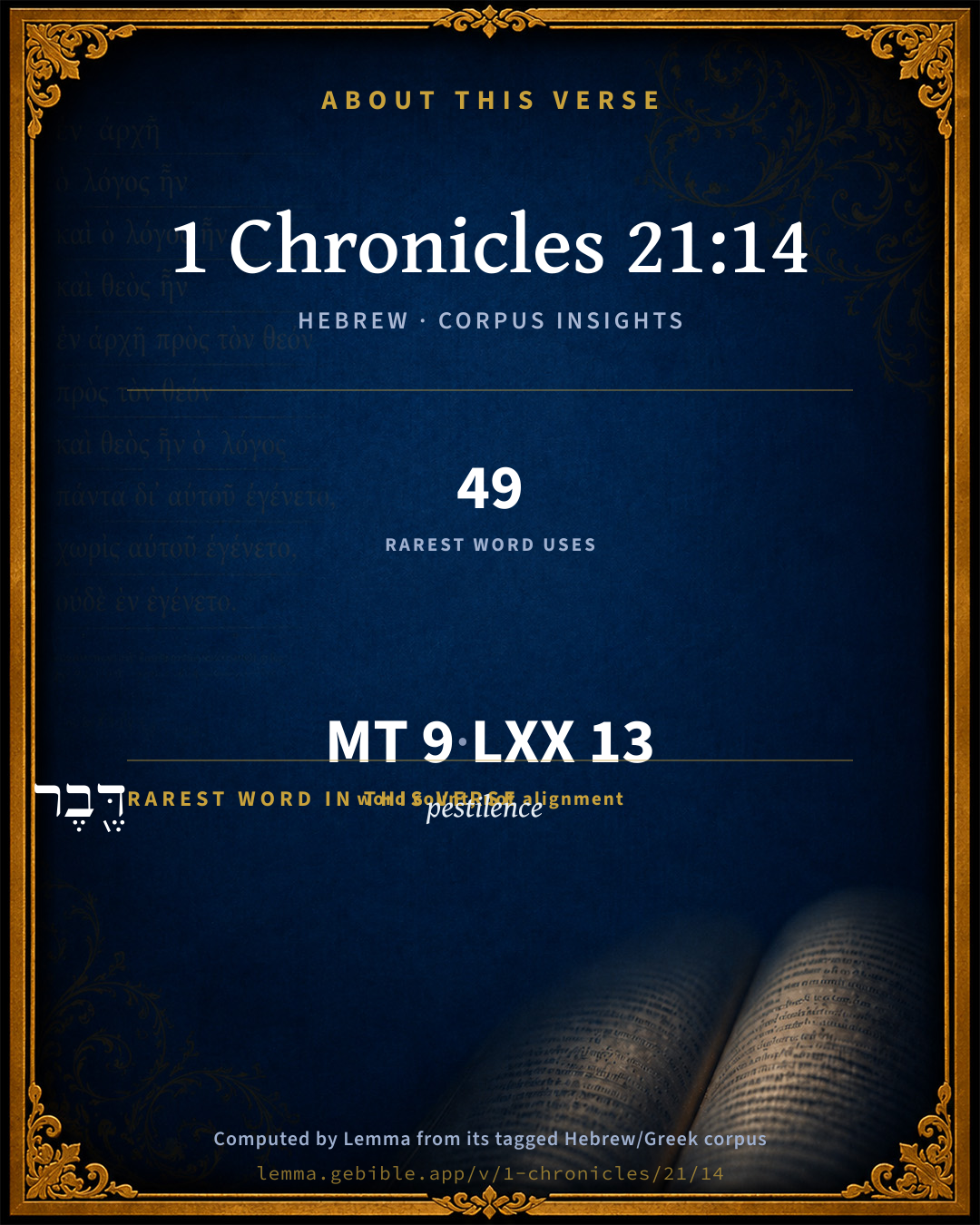
דֶּ֖בֶר pestilence H1698 occurs in 48 verses of the Hebrew Bible. Also found in:

Grammatical profile

  • 2 verbs
  • 5 nouns
  • 2 adjectives

Verb forms

  • וַיִּתֵּ֧ן Qal · Sequential Imperfect
  • וַיִּפֹּל֙ Qal · Sequential Imperfect

Repetition

A word recurs within this verse — often emphatic in Hebrew:

  • בְּיִשְׂרָאֵ֑ל Israel H3478 ×2

Hebrew & Septuagint length

In English translation the verse runs 15 words from the Hebrew and 15 from the Septuagint (LXX English) — the same length.

A rough comparison of the two English renderings, which tokenize alike — not a word-level alignment.

Word counts can differ between the Hebrew and the Greek without any difference in meaning — e.g. the Hebrew direct-object marker אֵת has no separate Greek word, and Greek often adds the article ὁ.

In the original languages it is 9 Hebrew tokens and 13 Greek tokens — but the two are counted differently (Hebrew bundles its prefixes and suffixes into one token; the Greek is in lemma form), so that isn’t a like-for-like length.

Cross-references

7

Topical passages linked to 1 Chronicles 21:14 in the Treasury of Scripture Knowledge — connected by theme and wording, ordered by reader-vote popularity; previews shown in the World English Bible.

  • Exodus 12:30 Pharaoh rose up in the night, he, and all his servants, and all the Egyptians; and there was a great cry in Egypt, for there was not a house where there was not one dead.
  • Numbers 16:46–49 Moses said to Aaron, Take your censer, and put fire therein from off the altar, and lay incense thereon, and carry it quickly to the congregation, and make atonement for them: for there is wrath gone out from Yahweh; the plague is begun.
  • Numbers 25:9 Those who died by the plague were twenty-four thousand.
  • 1 Samuel 6:19 He struck of the men of Beth-shemesh, because they had looked into the ark of Yahweh, he struck of the people fifty thousand seventy men; and the people mourned, because Yahweh had struck the people with a great slaughter.
  • 2 Samuel 24:15 So Yahweh sent a pestilence on Israel from the morning even to the time appointed; and there died of the people from Dan even to Beersheba seventy thousand men.
  • 2 Kings 19:35 It happened that night, that the angel of Yahweh went forth, and struck in the camp of the Assyrians one hundred eighty-five thousand: and when men arose early in the morning, behold, these were all dead bodies.
  • 1 Chronicles 27:24 Joab the son of Zeruiah began to number, but didn't finish; and there came wrath for this on Israel; neither was the number put into the account in the chronicles of king David.

Cross-references courtesy of OpenBible.info (CC BY 4.0).

Hebrew and Greek witnesses Masoretic Hebrew ↔ Greek Septuagint

The same verse in the two great witnesses to the Old Testament, shown verse-for-verse.

These are two independent witnesses, not word-aligned to each other, and the Septuagint is shown in lemma (dictionary) form.

Hebrew 1 Chronicles 21:14 Masoretic · Westminster Leningrad Codex

וַיִּתֵּ֧ן יְהוָ֛ה דֶּ֖בֶר בְּיִשְׂרָאֵ֑ל וַיִּפֹּל֙ מִיִּשְׂרָאֵ֔ל שִׁבְעִ֥ים אֶ֖לֶף אִֽישׁ

So Yahweh sent a pestilence on Israel; and there fell of Israel seventy thousand men.

World English Bible · Public Domain

Greek LXX 1 Chronicles 21:14 Septuagint · lemma form

καί δίδωμι κύριος θάνατος ἐν ἰσραήλ καί πίπτω ἐκ ἰσραήλ ἑβδομήκοντα χιλιάς ἀνήρ

So the Lord brought pestilence upon Israel: and there fell of Israel seventy thousand men.

LXX2012 (modern English Septuagint) · Public Domain

Hebrew: Westminster Leningrad Codex (CC BY 4.0). Greek: Septuagint (public domain); English from LXX2012 (modern English Septuagint) (Public Domain). How the Septuagint differs from the Hebrew →

Commentary

Notes on 1 Chronicles 21:14 from classic Christian and Jewish commentators (each source and its license shown beneath its notes). The classic Christian expositions comment on the surrounding passage and are grouped to its opening verse, so a note may address several verses; the Jewish commentaries on the Tanakh (Rashi and others) are per-verse, so they appear only where the commentator wrote on this verse.

Lemma curates 59 commentaries, every one of them public domain or Creative Commons licensed, each selected and text-cleaned for this edition rather than reprinted as found. About our sources →

Joseph Benson's Commentary

1Ch 21:14. There fell of Israel — He was proud of the number of his people, but God took a course to make them fewer. Justly is that which we are proud of taken from us, or imbittered to us.

Joseph Benson's Commentary on the Old and New Testaments (1811–1818) — public domain. Text from a community e-Sword module.

Jamieson, Fausset & Brown

Robert Jamieson, A. R. Fausset & David Brown

So the Lord . . . sent an angel unto Jerusalem to destroy it--The infliction only of the pestilence is here noticed, without any account of its duration or its ravages, while a minute description is given of the visible appearance and menacing attitude of the destroying angel.

Jamieson, Fausset & Brown — Commentary Critical and Explanatory on the Whole Bible (1871) — public domain (CC PDM 1.0). Text via the HelloAO Bible API.

Ellicott's Commentary for English Readers

(14) So the Lord sent pestilence upon Israel.—So Samuel. The rest of our verse is abridged. From Samuel we learn that the plague raged throughout the land from dawn to the time of the evening sacrifice.

(14-17) The Pestilence.

A Bible Commentary for English Readers, edited by Charles John Ellicott (1878–1897) — public domain. Text from a community e-Sword module.

The Cambridge Bible for Schools and Colleges

gen. ed. J. J. S. Perowne

14. there fell of Israel] 2 Sam. adds, from Dan even to Beer-sheba. The pestilence was throughout the whole land.

The Cambridge Bible for Schools and Colleges (gen. ed. J. J. S. Perowne; Cambridge University Press, 1878–1918) — public domain. Text from a community e-Sword module.

The Pulpit Commentary

So the Lord sent pestilence upon Israel. This sentence is followed in the parallel place by "from the morning even to the time appointed." It has been suggested that "the time appointed" may mean the time of the evening sacrifice, and that God shortened thus the three days to a short one day. There seems nothing sufficient to support the suggestion, unless it might lie in the "repenting" of the Lord, and his "staying" of the angel"s hand, in ver. 15. There fell of Israel seventy thousand men. The whole number of Israel, including women, must have reached near to five millions. On this assumption, the sacrifice of life for Israel would be something like 14 per cent., or fourteen in the thousand.

Vers. 14-27.

The arrested hand.

The hand of Divine wrath was stretched out, and dire calamity ensued. "The Lord sent pestilence upon Israel, and there fell seventy thousand men" (ver. 14). And God sent an angel of destruction to Jerusalem: this terrible messenger stood with drawn sword (ver. 16) over the city of David, and commenced the dread work of death there (ver. 15). But suddenly the hand of God was arrested, the sword of the angel was sheathed, the ravages of the pestilence ceased, Jerusalem was saved. Whence this salvation? It is clear

I THAT GOD"S DIRECT DEALINGS WITH ISRAEL HAD NO SMALL PART IN THE MATTER. The king was vastly more responsible than any other individual in the realm for the coming of the visitation, and he was more concerned in its departure than any other. But the people of Israel were not irresponsible for the one, nor were they without a share in the other. It would have been impossible for us to believe that the multitudes of Israel would suffer as they did for this sin of David, absolutely irrespective of their own deservings; that would have been manifestly unjust. And, similarly, we should have found the greatest difficulty in believing that Divine compassion had nothing to do with the cessation of the plague. But the Scriptures sanction the conclusion of our judgment, if they do not suggest or even affirm it that the coming and the going of the pestilence were partly due to the direct relations of God to Israel, Respecting its coming, we read that, the anger of the Lord was kindled against Israel, and he moved David" against" them," etc... (2Sa_24:1) "Respecting its going, we read that "the Lord beheld, and he repented him of the evil, etc. (ver. 15); i.e. the pity of the Lord was stirred, and he stayed his hand. We may learn here the lessons that God has direct dealings with nations, approving their piety anal their purity, condemning their ingratitude and disobedience, rewarding the one and punishing the other.

II THAT IT WAS LARGELY DUE TO THE KING"S INTERCESSION, (Vers. 16, 17.) Though it is not positively stated that the withdrawal of the angel"s hand was owing to the attitude and action of the king and the elders, yet we may safely assume that in large measure it was so (ver. 27). There was everything in David"s spiritual posture to draw down a Divine response.

1. He was penetrated with a spirit of penitence; he freely and franklyowned that the sin was his: "It is I that have sinned and done evil.

2. He was filled with a pure compassion for his people: "Thesesheep, what have they done? not on thy people," etc. (ver. 17).

3. He was animated by a spirit of noble self-renunciation. No doubt thedesire of founding a royal dynasty had grown strong and intense with years of sovereignty, and must have struck very deep root in David"s heart; yet he offers to resign all his hopes if the people may be spared. "Let thine hand be on me and on my father"s house." When intercession is thus humble, compassionate, and self-renouncing, it is likely to prevail with God.

III THAT IT WAS SUITABLY ATTENDED WITH SACRIFICE, (Vers. 18-26.) David was instructed by Gad to "set up an altar unto the Lord in the threshing-floor of Ornan" (ver. 18). After the usual Oriental ceremonies, the king purchased the site and reared the altar: there he offered sacrifices of propitiation, dedication, and gratitude; there he presented burnt offerings and peace offerings (ver. 26); and Jehovah signified his acceptance of the penitential and sacrificial spirit of his servants by "answering from heaven by fire upon the altar" (ver. 26). There are times when we renew our return unto the Lord, and he renews his acceptance of us. Such a time is the hour when we have sinned and have suffered. Then it becomes us to return once again unto the Lord,

(1) in penitence;

(2) in the exercise of faith in the one atoning sacrifice of the Divine Redeemer;

(3) in rededication of ourselves;

(4) in gratitude for his saving mercy. C.

The Pulpit Commentary (1880–1919), ed. H.D.M. Spence-Jones & Joseph S. Exell — public domain. Text from a community e-Sword module.

John Wesley's Explanatory Notes

There fell, &c. - He was proud of the number of his people, but God took a course to make them fewer. Justly is that we are proud of so, taken from us, or embittered to us.

John Wesley, Explanatory Notes Upon the Whole Bible (1754–1765) — public domain. Text via the GEBible commentary corpus.

Lesson kit

Teaching starters — assembled from the data on this page, not authored interpretation. Every prompt links to the verse data it draws on. Edit before teaching.

1 Chronicles, in the Historical, opens this verse with 9 words (8 distinct Hebrew lemmas). Its most distinctive word is deber (“pestilence”). A historical commentator’s framing appears above. Read the whole chapter for the surrounding context.

Discussion questions

  1. What does “pestilence” (deber) contribute to the verse as a whole?
  2. How does Exodus 5:3, which shares the word «pestilence», read alongside this verse?
  3. What does the repetition of “Israel” (2× in this one verse) do in this verse?
  4. These translations render this verse differently. What is at stake in choosing one wording over another?
  5. «וַיִּתֵּ֧ן» is a Qal Sequential Imperfect verb. How does that grammatical form shape the action described?
  6. Compare how Joseph Benson's Commentary and Jamieson, Fausset & Brown read this verse. Where do they agree or differ?

Things to notice

Reading settings

Reading text

Shown beneath each verse's original-language words.

Old Testament
Old Testament edition

Read the OT as the Masoretic Hebrew (MT) or the Greek Septuagint (LXX).

English shown for the Greek Septuagint (in the Hebrew ↔ Greek comparison).

Comparing translations? Open the Compare panel on any verse page to stack up to four side by side.