
Joshua 23:4

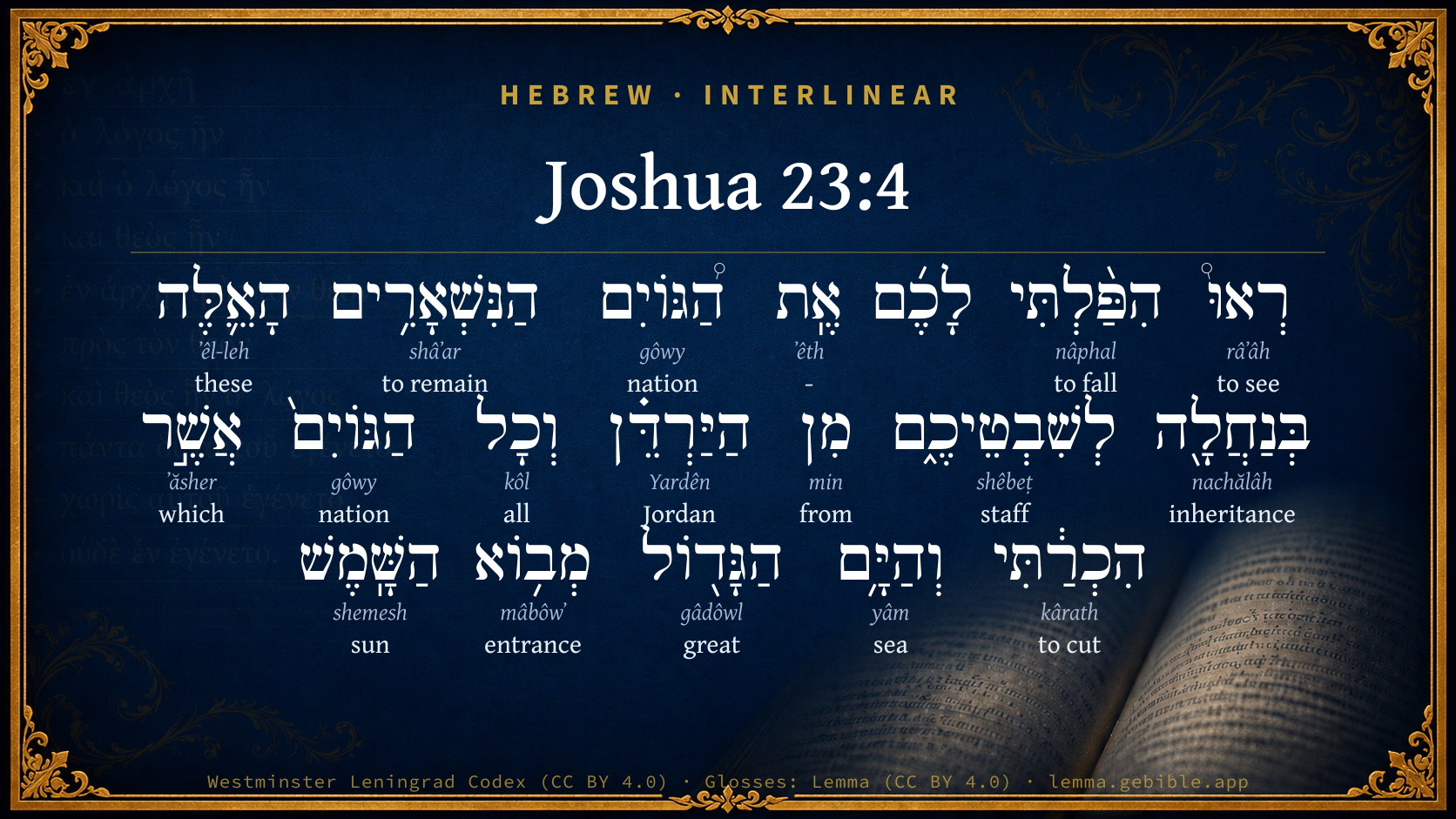
Hebrew (Westminster Leningrad Codex) Joshua 23:4 appears in the Hebrew Old Testament. The text above is from the Westminster Leningrad Codex. Each word links to its Strong’s number, a concise gloss, and parsing drawn from the Open Scriptures Hebrew Bible morphology. Click any word for its full Brown-Driver-Briggs (BDB) entry.
Download image
Cite this verse

Joshua 23:4 (World English Bible). Public Domain. Lemma interlinear Bible study tool, https://lemma.gebible.app/v/joshua/23/4.

Show BibTeX & RIS
BibTeX
RIS
English Translation
Behold, I have allotted to you these nations that remain, to be an inheritance for your tribes, from the Jordan, with all the nations that I have cut off, even to the great sea toward the going down of the sun.
World English Bible · Public Domain
Download a study sheet

One document with this verse’s original text, its word-by-word gloss line, the meaning frame, cross-references with their text, attributed commentary, and full source and license credits — printable, and it pastes into notes with its structure intact.

This verse Autodidact and up

Study sheet (.html) Plain text (.txt)

A passage Seminary Student

Up to 50 verses in one chapter. A passage sheet keeps up to 6 commentary sources and 12 cross-references per verse, in the order this page ranks them, and says so on the sheet whenever that leaves anything out. Ask for a single verse and you get the Autodidact verse sheet above.

Everything on this page stays free to read, with no account — the sheet is a download of what is already on screen, not access to it.

Want to remove ads? Support Godless Engineer
Compare translations 3

The same verse in 3 English versions, stacked beneath the original-language interlinear above. Click any original word for its lexicon entry.

Each is an independent rendering of the whole verse — the interlinear is not word-aligned to these translations.

Highlighted words mark where these versions differ — a whole-verse word diff, not a word-by-word alignment.

  • World English Bible Public Domain
    Behold, I have allotted to you these nations that remain, to be an inheritance for your tribes, from the Jordan, with all the nations that I have cut off, even to the great sea toward the going down of the sun.
  • King James Version Public Domain
    Behold, I have divided unto you by lot these nations that remain, to be an inheritance for your tribes, from Jordan, with all the nations that I have cut off, even unto the great sea westward.
  • unfoldingWord Literal Text CC BY-SA 4.0
    See, I have caused to fall for you these remaining nations as an inheritance for your tribes, from the Jordan, and all of the nations that I cut off, and the Great Sea from the going of the sun.

unfoldingWord Literal Text — © unfoldingWord, licensed CC BY-SA 4.0. Word-aligned USFM3 via Door43 (git.door43.org/unfoldingWord/en_ult).

Versions to compare (up to 4)

3 of 4 selected

Show all 18 translations

Every available English version of this verse, each an independent rendering of the whole verse.

  • World English Bible Public Domain
    Behold, I have allotted to you these nations that remain, to be an inheritance for your tribes, from the Jordan, with all the nations that I have cut off, even to the great sea toward the going down of the sun.
  • Berean Standard Bible Public Domain
    See, I have allotted as an inheritance to your tribes these remaining nations, including all the nations I have already cut off, from the Jordan westward to the Great Sea.
  • Majority Standard Bible Public Domain
    See, I have allotted as an inheritance to your tribes these remaining nations, including all the nations I have already cut off, from the Jordan westward to the Great Sea.
  • King James Version Public Domain
    Behold, I have divided unto you by lot these nations that remain, to be an inheritance for your tribes, from Jordan, with all the nations that I have cut off, even unto the great sea westward.
  • American Standard Version (1901) Public Domain
    Behold, I have allotted unto you these nations that remain, to be an inheritance for your tribes, from the Jordan, with all the nations that I have cut off, even unto the great sea toward the going down of the sun.
  • Revised Version (1885) Public Domain
    Behold, I have allotted unto you these nations that remain, to be an inheritance for your tribes, from Jordan, with all the nations that I have cut off, even unto the great sea toward the going down of the sun.
  • Geneva Bible (1599) Public Domain
    Beholde, I haue deuided vnto you by lot these nations that remaine, to be an inheritance according to your tribes, from Iorden, with all the nations that I haue destroyed, euen vnto the great Sea Westward.
  • Douay-Rheims (1899) Public Domain
    And now since he hath divided to you by lot all the land, from the east of the Jordan unto the great sea, and many nations yet remain:
  • Young's Literal Translation Public Domain
    see, I have caused to fall to you these nations who are left for an inheritance to your tribes, from the Jordan, (and all the nations which I cut off), and the great sea, the going in of the sun.
  • Literal Standard Version CC BY-SA 4.0
    see, I have caused these nations who are left to fall to you for an inheritance to your tribes, from the Jordan (and all the nations which I cut off), and the Great Sea [at] the [setting] sun.
  • Unlocked Literal Bible CC BY-SA 4.0
    Look! I have assigned to you the nations that remain to be conquered as an inheritance for your tribes, along with all the nations I have already destroyed, from the Jordan to the Great Sea in the west.
  • unfoldingWord Literal Text CC BY-SA 4.0
    See, I have caused to fall for you these remaining nations as an inheritance for your tribes, from the Jordan, and all of the nations that I cut off, and the Great Sea from the going of the sun.
  • Darby Bible Public Domain
    Behold, I have divided unto you by lot for an inheritance, according to your tribes, these nations that remain, from the Jordan, as well as all the nations that I have cut off, as far as the great sea toward the sun-setting.
  • World Messianic Bible Public Domain
    Behold, I have allotted to you these nations that remain, to be an inheritance for your tribes, from the Jordan, with all the nations that I have cut off, even to the great sea toward the going down of the sun.
  • Webster's Bible Public Domain
    Behold, I have divided to you by lot these nations that remain, to be an inheritance for your tribes, from Jordan, with all the nations that I have cut off, even to the great sea westward.
  • Free Bible Version CC BY-SA 4.0
    I have allotted the land of the remaining nations for you to own, as well as the nations already conquered, from the Jordan to the Mediterranean Sea.
  • Bible in Basic English Public Domain
    Now I have given to you, as the heritage of your tribes, all these nations which are still in the land, together with those cut off by me, from Jordan as far as the Great Sea on the west.
  • JPS Tanakh (1917) Public Domain
    Behold, I have allotted unto you for an inheritance, according to your tribes, these nations that remain, from the Jordan, with all the nations that I have cut off, even unto the Great Sea toward the going down of the sun.

Literal Standard Version (2020), Covenant Press — licensed CC BY-SA 4.0. Text via the HelloAO Bible API (eBible.org). Unlocked Literal Bible (unfoldingWord) — licensed CC BY-SA 4.0. Text via the HelloAO Bible API (eBible.org). unfoldingWord Literal Text — © unfoldingWord, licensed CC BY-SA 4.0. Word-aligned USFM3 via Door43 (git.door43.org/unfoldingWord/en_ult). Free Bible Version, Dr. Jonathan Gallagher — licensed CC BY-SA 4.0. Text via the HelloAO Bible API (eBible.org).

Word by word

More ways to search: Search by grammar → Find every occurrence → Compare this word →

Practice this passage: Drill this verse → Learn its vocabulary →

מְב֥וֹא
mâbôwʼ
H3996
“entrance of”
Noun, Common, Masculine, Singular, Construct
Part of Speech
Noun
Type
Common
Gender
Masculine
Number
Singular
State
Construct
Full BDB Definition

Origin: from H935

TWOT: 212b

entrance, a coming in, entering - sunset - sunset - sunset, west
  1. רְאוּ֩ râʼâh H7200 “see” Verb, Qal, Imperative, 2nd Person, Masculine, Plural
  2. הִפַּ֨לְתִּי nâphal H5307 “to fall” Verb, Hiphil, Perfect, 1st Person, Common, Singular
  3. אֶֽת ʼêth H853 “-” Particle, Direct Object
  4. הַ֠גּוֹיִם gôwy H1471 “the · nations” Particle, Definite Article + Noun, Common, Masculine, Plural, Absolute
  5. הַנִּשְׁאָרִ֥ים shâʼar H7604 “the · remaining” Particle, Definite Article + Verb, Niphal, Participle Active, Masculine, Plural, Absolute
  6. הָאֵ֛לֶּה ʼêl-leh H428 “the · these” Particle, Definite Article + Pronoun, Demonstrative, Common, Plural
  7. בְּנַחֲלָ֖ה nachălâh H5159 “in/at · inheritance” Preposition + Noun, Common, Feminine, Singular, Absolute
  8. לְשִׁבְטֵיכֶ֑ם shêbeṭ H7626 “to/for · staffs · your” Preposition + Noun, Common, Masculine, Plural, Construct + Suffix, Personal, 2nd Person, Masculine, Plural
  9. מִן min H4480 “from” Preposition
  10. הַיַּרְדֵּ֗ן Yardên H3383 “the · Jordan” Particle, Definite Article + Noun, Proper
  11. וְכָל kôl H3605 “and · all of” Conjunction + Noun, Common, Masculine, Singular, Construct
  12. הַגּוֹיִם֙ gôwy H1471 “the · nations” Particle, Definite Article + Noun, Common, Masculine, Plural, Absolute
  13. אֲשֶׁ֣ר ʼăsher H834 “which” Particle, Relative
  14. הִכְרַ֔תִּי kârath H3772 “to cut” Verb, Hiphil, Perfect, 1st Person, Common, Singular
  15. וְהַיָּ֥ם yâm H3220 “and · the · sea” Conjunction + Particle, Definite Article + Noun, Common, Masculine, Singular, Absolute
  16. הַגָּד֖וֹל gâdôwl H1419 “the · great” Particle, Definite Article + Adjective, Adjective, Masculine, Singular, Absolute
  17. הַשָּֽׁמֶשׁ shemesh H8121 “the · sun” Particle, Definite Article + Noun, Common, Both, Singular, Absolute

About this verse

These counts appear in no published source. They are computed here, from the morphology-tagged text and Lemma’s own curated glosses. What Lemma adds →

19
words
17
distinct lemmas
Historical
section

Notable vocabulary

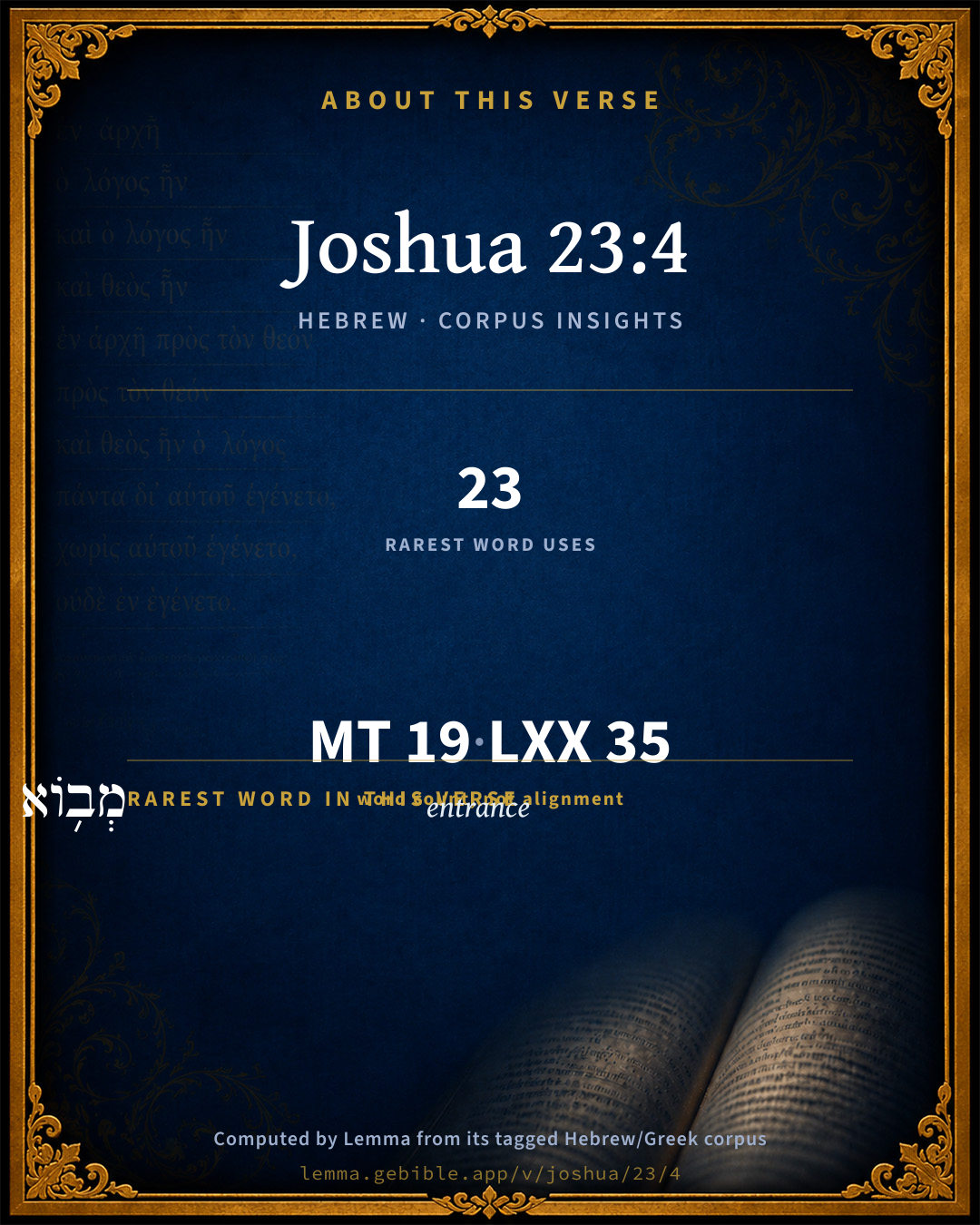
The rarest word here is מְב֥וֹא entrance H3996 — appearing just 23 times in the whole Hebrew Bible.

Shared distinctive vocabulary

מְב֥וֹא entrance H3996 occurs in 23 verses of the Hebrew Bible. Also found in:

Grammatical profile

  • 4 verbs
  • 9 nouns
  • 1 adjective
  • 1 pronoun
  • 2 prepositions
  • 2 particles

Verb forms

  • רְאוּ֩ Qal · Imperative
  • הִפַּ֨לְתִּי Hiphil · Perfect
  • הַנִּשְׁאָרִ֥ים Niphal · Participle Active
  • הִכְרַ֔תִּי Hiphil · Perfect

Repetition

A word recurs within this verse — often emphatic in Hebrew:

  • הַ֠גּוֹיִם nation H1471 ×2

Hebrew & Septuagint length

In English translation the verse runs 41 words from the Hebrew and 40 from the Septuagint (LXX English) — closely comparable.

A rough comparison of the two English renderings, which tokenize alike — not a word-level alignment.

Word counts can differ between the Hebrew and the Greek without any difference in meaning — e.g. the Hebrew direct-object marker אֵת has no separate Greek word, and Greek often adds the article ὁ.

In the original languages it is 19 Hebrew tokens and 35 Greek tokens — but the two are counted differently (Hebrew bundles its prefixes and suffixes into one token; the Greek is in lemma form), so that isn’t a like-for-like length.

Cross-references

3

Topical passages linked to Joshua 23:4 in the Treasury of Scripture Knowledge — connected by theme and wording, ordered by reader-vote popularity; previews shown in the World English Bible.

  • Joshua 13:2 This is the land that yet remains: all the regions of the Philistines, and all the Geshurites;
  • Joshua 13:6–7 all the inhabitants of the hill-country from Lebanon to Misrephoth Maim, even all the Sidonians; them will I drive out from before the children of Israel: only allot you it to Israel for an inheritance, as I have commanded you.
  • Joshua 18:10 Joshua cast lots for them in Shiloh before Yahweh: and there Joshua divided the land to the children of Israel according to their divisions.

Cross-references courtesy of OpenBible.info (CC BY 4.0).

Hebrew and Greek witnesses Masoretic Hebrew ↔ Greek Septuagint

The same verse in the two great witnesses to the Old Testament, shown verse-for-verse.

These are two independent witnesses, not word-aligned to each other, and the Septuagint is shown in lemma (dictionary) form.

Hebrew Joshua 23:4 Masoretic · Westminster Leningrad Codex

רְאוּ֩ הִפַּ֨לְתִּי לָכֶ֜ם אֶֽת הַ֠גּוֹיִם הַנִּשְׁאָרִ֥ים הָאֵ֛לֶּה בְּנַחֲלָ֖ה לְשִׁבְטֵיכֶ֑ם מִן הַיַּרְדֵּ֗ן וְכָל הַגּוֹיִם֙ אֲשֶׁ֣ר הִכְרַ֔תִּי וְהַיָּ֥ם הַגָּד֖וֹל מְב֥וֹא הַשָּֽׁמֶשׁ

Behold, I have allotted to you these nations that remain, to be an inheritance for your tribes, from the Jordan, with all the nations that I have cut off, even to the great sea toward the going down of the sun.

World English Bible · Public Domain

Greek LXX Joshua 23:4 Septuagint · lemma form

ὁράω ὅτι ἐπιῥίπτω σύ ὁ ἔθνος ὁ καταλείπω σύ οὗτος ἐν ὁ κλῆρος εἰς ὁ φυλή σύ ἀπό ὁ ἰορδάνης πᾶς ὁ ἔθνος ὅς ἐκὀλεθρεύω καί ἀπό ὁ θάλασσα ὁ μέγας ὁρίζω ἐπί δυσμή ἥλιος

See, that I have given to you these nations that are left to you by lots to your tribes, all the nations beginning at Jordan; and some I have destroyed; and the boundaries shall be at the great sea westward.

LXX2012 (modern English Septuagint) · Public Domain

Hebrew: Westminster Leningrad Codex (CC BY 4.0). Greek: Septuagint (public domain); English from LXX2012 (modern English Septuagint) (Public Domain). How the Septuagint differs from the Hebrew →

Targum (Aramaic paraphrase)

1

The Targum is the ancient Jewish Aramaic paraphrase of the Hebrew Scriptures — an interpretive translation, not the Hebrew text itself. Onkelos (literal) and Pseudo-Jonathan (expansive) render the Torah, and Jonathan the Prophets. Coverage is partial: where no permissively-licensed English translation exists for a verse, only the Aramaic is shown. This is verse-level text, not a word-by-word alignment to the Hebrew.

  1. Targum Jonathan Prophets (Joshua–Malachi)
    חֲזוֹ דִי פַלְגִית לְכוֹן יַת עַמְמַיָא דִי אִשְׁתָּאֲרוּ הָאִלֵין בְּאַחֲסָנָא לְשִׁבְטֵיכוֹן מִן יַרְדְנָא וְכָל עַמְמַיָא דִי שֵׁיצֵיתִי וְיַמָא רַבָּא מַעֲלָנֵי שִׁמְשָׁא:

    (no public-domain English translation for this verse)

    Targum Jonathan — Aramaic: “Mikraot Gedolot” (public domain). English: “Sefaria Community Translation” (CC0 1.0 (public-domain dedication)); “London "Chaldee Paraphrase," 1871” (public domain). Text via Sefaria.

Commentary

Notes on Joshua 23:4 from classic Christian and Jewish commentators (each source and its license shown beneath its notes). The classic Christian expositions comment on the surrounding passage and are grouped to its opening verse, so a note may address several verses; the Jewish commentaries on the Tanakh (Rashi and others) are per-verse, so they appear only where the commentator wrote on this verse.

Lemma curates 59 commentaries, every one of them public domain or Creative Commons licensed, each selected and text-cleaned for this edition rather than reprinted as found. About our sources →

Ellicott's Commentary for English Readers

(4) Behold, I have divided unto you by lot these nations that remain.—Here, as in Jos_13:1-7, and afterwards, in Jdg_2:23, the preliminary and partial nature of the conquest achieved by Joshua is distinctly recognised. He gave Israel the land to possess, and gave them the vantage-ground from which they might possess it. In Jos_23:4-5 he bids them continue the work which he had begun.

A Bible Commentary for English Readers, edited by Charles John Ellicott (1878–1897) — public domain. Text from a community e-Sword module.

Trapp's Complete Commentary

John Trapp

Jos 23:4 Behold, I have divided unto you by lot these nations that remain, to be an inheritance for your tribes, from Jordan, with all the nations that I have cut off, even unto the great sea westward.

Ver. 4. With all the nations that I have cut off.] That is, God by my hands, {as Jos 23:3} for he it was who taught mine hands to war, and my fingers to fight.

John Trapp, A Commentary or Exposition upon All the Books of the Old and New Testament (1647–1656) — public domain. Text from a community e-Sword module.

The Biblical Illustrator

Joseph S. Exell

Jos_23:4

I have divided unto you by lot these nations.

Joshua the colonist

Great colonists as we are, and greater as, with the growth of our wealth and therefore of our population, we are likely to be, it may prove instructive and also interesting to look at Joshua in the character of a colonist--the leader of the largest band that ever left their old in search of a new home. I remark, then, that the colonisation of Canaan under Joshua was conducted in an orderly manner, on a large scale, and in a way eminently favourable to the happiness of the emigrants and the interests of virtue and religion. It presents us with a model we would do well to copy. The children of Israel entered Canaan to be settled within allotted borders; by families and by tribes. In their case emigration was thus less a change of persons than a change, and a happy change, of place. No broad seas rolled between tile severed members of the same family; there were no bitter partings of parents and the children they feared never more to see: nor did the emigrants, with sad faces and swimming eyes, stand crowded on the ships stern to watch the blue mountains of their dear native land as they sank beneath the wave. A still more important lesson than that taught by the orderly, just, humane, and happy arrangements of this Hebrew colony is taught us by the care Joshua took of its religious interests. These, the greatest, yet considered apparently the least, of all interests, are sadly neglected in many of our foreign stations; and I have often wondered to see with what little reluctance Christian parents could send their children away to lands where more lost their religion than made their fortune. Whatever we do with our religion, the Hebrews did not leave the ark of God behind them. Regarding it as at once their glory and defence, they followed it into the bed of Jordan, and, passing the flood on foot, bore it with them into the adopted land. Wherever they pitched their tents, they set up the altar and tabernacle of their God. Priests and teachers formed part of their train; and making ample provision for the regular ministration of word and ordinance, they laid in holy and pious institutions the foundations of their future commonwealth. Such are some of the points in which Joshua is to be admired, and imitated, as a model colonist. Alas! while neglecting his example in things worthy of imitation, we have followed it but too closely in the one thing where it affords us no precedent to follow. I refer to the fire and sword he carried into the land of Canaan, and his extermination of its original inhabitants. We have too faithfully followed him in this--with no warrant, human or Divine, to do so. In his bloodiest work Joshua was acting under commission. His orders were clear, however terrible they read. God undertakes the whole responsibility. And be it observed that the children of Israel were blamed not because they did, but because they did not, exterminate the Canaanites--slaying them with the sword or driving them out of the land. The duty was painful and stern; but they lived to find, as God had warned them would happen to them, and as happens to us when we spare the sins of which these heathen were the type, that mercy to the Canaanites was cruelty to themselves. But, admitting that the responsibility is shifted from Joshua to God, how, it may be asked, are the sufferings of the Canaanites, their expulsion and bloody extermination from the land, to be reconciled with the character of God, as just and good and righteous? This is like many other of His acts. On attempting to scrutinise them, mystery meets us on the threshold. No wonder!--when we feel constrained to exclaim over a flake of snow, the spore of a fern, the leaf of a tree, the change of a base grub into a winged and painted butterfly, Who can by searching find out God? who can find out the Almighty unto perfection? It is higher than heaven, what can we do? deeper than hell, what can we know? the measure thereof is longer than the earth and-broader than the sea. Dark as the judgment on Canaan seems, a little consideration will show that it is no greater, nor so great, a mystery as many others in the providence of God. The land of Canaan was His--The earth is the Lords, and the fulness thereof. And I ask in turn, is the Sovereign Proprietor of all to be denied the right that ordinary proprietors claim--the right to remove one set of tenants and replace them by another? Besides, the inhabitants of Canaan were not only, so to speak, tenants at will, but tenants of the worst description. Let it be remarked also, that the Canaanites not only deserved, but chose their fate. The fame of what God had done for the tribes of Israel had preceded their arrival in the land of Canaan. Thus its guilty tenants were early warned; got notice to quit; might be considered as summoned out. They refused to go. They chose the chances of resistance rather than quiet removal; and so--for be it observed that the Israelites in the first instance were only ordered to cast them out--they brought destruction on themselves: with their own hands pulling down the house that buried them and their children in its ruins. But the children? the unoffending infants? There is a mystery, I admit, an awful mystery in their destruction; but no new or greater mystery here than meets us everywhere else. The mystery of offspring who suffer through their parents sins is repeated daily in our own streets. It does not alter the case one whir to say that children who die of disease, for instance, die by the laws of nature, while those in Canaan were put to death by the command of God. This is a distinction without a difference; for what are the laws of nature but the ordinances and will of God? Nor is the cloud which here surrounds Gods throne, dark as it seems, without a silver lining. The sword of the Hebrew opens to the babes of Canaan a happy escape from misery and sin--a sharp but short passage to a better and purer world. Thus, and otherwise, we can justify the sternest deeds of which Joshua has been accused. He held a commission from God to enter Canaan and cast out its guilty inhabitants, and, like a woodman who enters the forest axe in hand, to cut them down if they clung like trees to its soil. His conduct admits of the fullest vindication; and though it did not, we should be the last to accuse him. Ours are not the hands to cast a stone at Joshua. A more painful and shameful history than the history of some at least of our colonies was never written. Talk of the extermination of the Canaanites! Where are the Indian tribes our settlers found roaming, in plumed and painted freedom, the forests of the new world? Not more fatal to the Canaanites the irruption of the Hebrews than our arrival in almost every colony to its native population! We have seized their lands; and in a way less honourable, and even merciful, than the swords of Israel, have given them in return nothing but a grave. Professed followers of Him who came not to destroy but to save the world, we have entered the territories of the heathen with fire and sword, and adding murder to robbery, have spoiled the unoffending natives of their lives as well as of their lands. Had we any commission to exterminate? Divine as Joshuas, our commission was as opposite to his as opposing poles to each other. These are its blessed terms, Go ye into all the world and preach the gospel to every creature, baptizing them in the name of the Father, and of the Son, and of the Holy Ghost. Can our country and its Churches read that without a blush of shame and a sense of guilt? Let us repent the errors of the past. Not so much to aggrandise our island, as to Christianise the world by our colonies, is the noble enterprise to which Providence calls us. Go ye in to possess the land--these, if I may say so, were the marching orders under which Joshua and Israel entered Canaan; and however unable they appeared, in point of numbers and ordinary resources, to cope with those who held the soil, and were prepared to fight like men that had their homes and hearths, their wives and children, to defend, yet then, as still, the measure of mans ability is Gods command. Since it is so, what a noble career and rapid conquest were before the children of Israel! Sweeping over Canaan like a resistless flood, they might have carried all before them. What difficulties could prove too great for those who had God to aid them? What need had they of bridge or boats, before whose feet the waters of Jordan fled? of engines of war whose shout, borne on the air, smote the ramparts of Jericho to the ground with an earthquakes reeling shock? of allies, who had Heaven on their side, to hurl down death from the skies on their panic-stricken enemies? How could they lose the fruits of victory over the retreat of whose foes night refused to throw her mantle, while the sun held the sky, nor sunk in darkness till their bloody work was done? (T. Guthrie, D. D.)

The Biblical Illustrator, edited by Joseph S. Exell (c. 1880s–1900s) — public domain. Text from a community e-Sword module.

Tyndale Open Study Notes

Tyndale Open Resources

23:4-5 Some of the land that Joshua had assigned to the various tribes remained unconquered. Israel’s gradual occupation of the land had an ecological reason (see Exod 23:29-30), a military reason (see Judg 1:19), and a theological reason (see Judg 2:20–3:4). Israel’s ensuing unfaithfulness delayed the settlement process by several centuries; instead of driving out the remaining Canaanites, Israel absorbed them, bringing God’s people even greater temptations to unfaithfulness. Joshua knew this to be a real danger (Josh 23:15-16).

Tyndale Open Study Notes — © Tyndale Open Resources, licensed CC BY-SA 4.0. Text via the HelloAO Bible API.

Geneva Bible (1599)

Geneva Bible translators

Or, overthrown those nations.

Hebrew, at the sunset.

Geneva Bible (1599) marginal notes — public domain. Text via Bolls.life.

Adam Clarke's Commentary

Verse 4. I have divided - these nations that remain] The whole of the promised land had been portioned out, as well those parts which had not yet been conquered, as those from which the ancient inhabitants had been expelled. The Canaanitish armies had long ago been broken in pieces, so that they could make no head against the Israelites, but in many districts the old inhabitants remained, more through the supineness of the Israelites, than through their own bravery.

From Jordan - unto the great sea] All the land that lay between the river Jordan, from Phiala, where it rose, to the southern extremity of the Dead Sea, and to the Mediterranean Sea, through the whole extent of its coast, opposite to Jordan.

Adam Clarke's Commentary on the Bible (1810–1826) — public domain. Text from a community e-Sword/MySword module.

The Cambridge Bible for Schools and Colleges

gen. ed. J. J. S. Perowne

4. these nations that remain] Joshua reminds them that not only the nations who had been actually conquered, but the remnants still unsubdued, were delivered into their power.

The Cambridge Bible for Schools and Colleges (gen. ed. J. J. S. Perowne; Cambridge University Press, 1878–1918) — public domain. Text from a community e-Sword module.

John Gill's Exposition

Behold, I have divided to you by lot these nations that remain,.... Who are unsubdued, not yet conquered, as well as those that are

to be an inheritance for your tribes; to be possessed by them and their children for ever:

from Jordan, with all the nations I have cut off, even unto the great sea westward; the phrase, "with all the nations I have cut off", is to be read in connection with "those nations that remain"; both those that were cut off by the sword of Joshua, and those that remained unconquered, being divided by lot to the tribes of Israel; and which reached from Jordan eastward, where Joshua and Israel entered into the land, to the Mediterranean sea, called the great sea in comparison of little ones in Canaan, as the Dead sea, and the sea of Tiberias; and which great sea lay west to the land of Israel, or where the sun sets, as the phrase in the Hebrew text is.

John Gill's Exposition of the Whole Bible (1746–1763) — public domain (CC PDM 1.0). Text via the HelloAO Bible API.

Haydock's Catholic Bible Commentary

And now. Hebrew, "Behold, I have divided unto you by lot these nations, which remain to be subdued, to be an inheritance for your tribes from the Jordan, (these two words are transposed, and should come after; Calmet) with all the nations that I have cut off---even unto the great sea westward." He mildly expostulates with them for not following up his victories, by reducing the few scattered nations whom he had abandoned to them as a prey. (Haydock) --- They ought to be considered not only as the enemies of God, but also as unjust detainers of another’s right, and Josue promises that nothing will be wanting on the part of God to render their reduction easy, if they will but do their duty to Him and to themselves. (Haydock)

George Leo Haydock (1774–1849), Haydock's Catholic Family Bible and Commentary, 1859 edition — public domain. Excludes Psalms (Douay-Rheims chapter numbering differs from Protestant) and Deuterocanonical books (Catholic canon only).

Matthew Poole's English Annotations

These nations that remain, not yet conquered.

to be an inheritance for your tribes; you shall certainly subdue them, and inherit their land, as you have done the rest, if you be not wanting to yourselves.

With all the nations that I have cut off, i.e. with the land of those nations; the people put for their land, as we have seen before; and as sometimes, on the contrary, the land is put for the people.

Westward, where the Philistines, your most formidable adversaries, yet survive; but them also and their land I have given to you, and you shall undoubtedly destroy them, if you will proceed vigorously in your work.

Matthew Poole's English Annotations on the Holy Bible (1683–1685) — public domain. Text from a community e-Sword/MySword module.

Whedon's Commentary on the Bible

Daniel D. Whedon

4. These nations — “The nations are mentioned instead of the land which they possessed, because they were given into the hands of the Israelites to be destroyed.” — Keil.

I have cut off — After ascribing the conquest to Jehovah, the truth of history requires mention of the human instrumentality. The frequent review of God’s mercies is a powerful incentive to gratitude and fidelity to him. It is noticeable how this passage assumes that all the Canaanite nations are cut off and subdued, but not yet exterminated or expelled. This explains the discrepancy often alleged between Jos_11:23, and Jos_13:1.

Daniel D. Whedon (gen. ed.), Commentary on the Old and New Testaments (1874–1909) — public domain. Text from a community e-Sword module.

The Pulpit Commentary

Divided unto you by lot. Literally, caused to fall, the lot being of necessity understood. These nations that remain. Israel had therefore not driven them out. This, however, need not of necessity be imputed to them as a sin. For, as we have seen, the conquest was to be gradual. No doubt there was enough to be done in consolidating the conquests already made, in settling the tribes in their possessions, to occupy all the days of Joshua, and even possibly a longer period. At least we may he sure that, as long as Joshua lived, the heathen settlements were kept distinct from the Israelitish community, that intermarriages were not allowed, nor rights of citizenship granted to any but the Gibeonites. Cut off. Joshua"s speech here exactly agrees with the statements in Jos_6:21 Jos_8:26 Jos_10:28-41 Jos_11:11, Jos_11:14, Jos_11:21. Here at least, if Joshua"s speech and the history were taken from two different sources, neither of them precisely accurate, the first postulate of the destructive criticism, we might have expected some slight discrepancy. But Joshua uses a word which implies total extermination, a feature, be it observed, of the campaigns of Moses and Joshua only, and not of the later Israelitish history. Westward. Literally, the going down of the sun.

The Pulpit Commentary (1880–1919), ed. H.D.M. Spence-Jones & Joseph S. Exell — public domain. Text from a community e-Sword module.

John Wesley's Explanatory Notes

That remain - Not yet conquered. An inheritance - You shall certainly subdue them, and inherit their hand, as you have done the rest, if you be not wanting to yourselves. All the nations - That is, with the land of those nations; the people put for their land, as we have seen before; and as sometimes on the contrary, the land is put for the people. The great sea - Where the Philistines, your most formidable adversaries yet survive; but them also and their land I have given to you, and you shall undoubtedly destroy them, if you will proceed vigourously in your work.

John Wesley, Explanatory Notes Upon the Whole Bible (1754–1765) — public domain. Text via the GEBible commentary corpus.

unfoldingWord translationNotes

Door43 World Missions Community

the Jordan

This is a short name for the Jordan River.

in the west

This indicates the direction of the setting sun.

translationWords

inherit

tribe

the sea

Yahweh

God

possess

promise

unfoldingWord translationNotes — © Distant Shores Media and the Door43 World Missions Community, licensed CC BY-SA 4.0. Source: git.door43.org/Door43/en_tn.

Rashi

Rabbi Shlomo Yitzchaki (Rashi)

You have seen how I have alloted to you. By means of the lot for your inheritance.

The remainder of these nations— that remain to be conquered.

Rashi on the Tanakh — English translations: “The Judaica Press complete Tanach with Rashi, translated by A. J. Rosenberg” (CC BY 4.0); “Pentateuch with Rashi's commentary by M. Rosenbaum and A.M. Silbermann, 1929-1934” (public domain); “The Metsudah Tanach series, Lakewood, N.J” (CC BY 4.0); and “The Book of Joshua, Metsudah Publications, 1997” (CC BY 4.0). Text via Sefaria.

Lesson kit

Teaching starters — assembled from the data on this page, not authored interpretation. Every prompt links to the verse data it draws on. Edit before teaching.

Joshua, in the Historical, opens this verse with 19 words (17 distinct Hebrew lemmas). Its most distinctive word is mâbôwʼ (“entrance”). A historical commentator’s framing appears above. Read the whole chapter for the surrounding context.

Discussion questions

  1. The word mâbôwʼ carries the sense “entrance.” How does it shape the verse?
  2. How does Deuteronomy 11:30, which shares the word «entrance», read alongside this verse?
  3. What does the repetition of “nation” (2× in this one verse) do in this verse?
  4. These translations render this verse differently; the difference is in the English rendering, not the original. What questions does that raise?
  5. «רְאוּ֩» is a Qal Imperative verb. How does that grammatical form shape the action described?
  6. Compare how Ellicott's Commentary for English Readers and Trapp's Complete Commentary read this verse. Where do they agree or differ?

Things to notice

Reading settings

Reading text

Shown beneath each verse's original-language words.

Old Testament
Old Testament edition

Read the OT as the Masoretic Hebrew (MT) or the Greek Septuagint (LXX).

English shown for the Greek Septuagint (in the Hebrew ↔ Greek comparison).

Comparing translations? Open the Compare panel on any verse page to stack up to four side by side.