
1 Chronicles 12:20

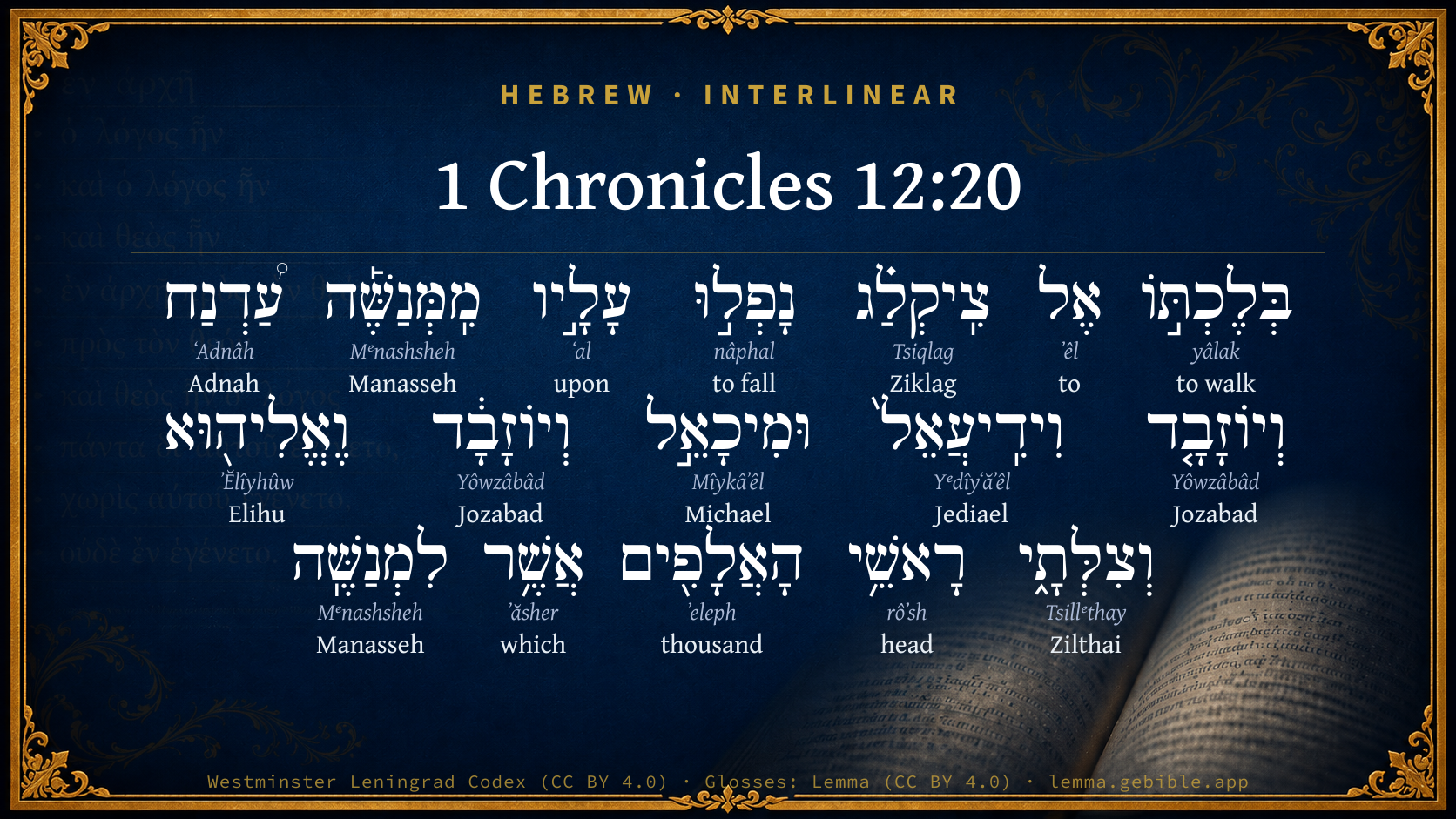
Hebrew (Westminster Leningrad Codex) 1 Chronicles 12:20 appears in the Hebrew Old Testament. The text above is from the Westminster Leningrad Codex. Each word links to its Strong’s number, a concise gloss, and parsing drawn from the Open Scriptures Hebrew Bible morphology. Click any word for its full Brown-Driver-Briggs (BDB) entry.
Download image
Cite this verse

1 Chronicles 12:20 (World English Bible). Public Domain. Lemma interlinear Bible study tool, https://lemma.gebible.app/v/1-chronicles/12/20.

Show BibTeX & RIS
BibTeX
RIS
English Translation
As he went to Ziklag, there fell to him of Manasseh, Adnah, and Jozabad, and Jediael, and Michael, and Jozabad, and Elihu, and Zillethai, captains of thousands who were of Manasseh.
World English Bible · Public Domain
Highlights
  • 1 first appearance in the Hebrew Bible
Full analysis ↓
Download a study sheet

One document with this verse’s original text, its word-by-word gloss line, the meaning frame, cross-references with their text, attributed commentary, and full source and license credits — printable, and it pastes into notes with its structure intact.

This verse Autodidact and up

Study sheet (.html) Plain text (.txt)

A passage Seminary Student

Up to 50 verses in one chapter. A passage sheet keeps up to 6 commentary sources and 12 cross-references per verse, in the order this page ranks them, and says so on the sheet whenever that leaves anything out. Ask for a single verse and you get the Autodidact verse sheet above.

Everything on this page stays free to read, with no account — the sheet is a download of what is already on screen, not access to it.

Want to remove ads? Support Godless Engineer
Compare translations 3

The same verse in 3 English versions, stacked beneath the original-language interlinear above. Click any original word for its lexicon entry.

Each is an independent rendering of the whole verse — the interlinear is not word-aligned to these translations.

Highlighted words mark where these versions differ — a whole-verse word diff, not a word-by-word alignment.

  • World English Bible Public Domain
    As he went to Ziklag, there fell to him of Manasseh, Adnah, and Jozabad, and Jediael, and Michael, and Jozabad, and Elihu, and Zillethai, captains of thousands who were of Manasseh.
  • King James Version Public Domain
    As he went to Ziklag, there fell to him of Manasseh, Adnah, and Jozabad, and Jediael, and Michael, and Jozabad, and Elihu, and Zilthai, captains of the thousands that were of Manasseh.
  • unfoldingWord Literal Text CC BY-SA 4.0
    When he went to Ziklag, they fell to him from Manasseh: Adnah and Jozabad and Jediael and Michael and Jozabad and Elihu and Zillethai, heads of thousands that to Manasseh.

unfoldingWord Literal Text — © unfoldingWord, licensed CC BY-SA 4.0. Word-aligned USFM3 via Door43 (git.door43.org/unfoldingWord/en_ult).

Versions to compare (up to 4)

3 of 4 selected

Show all 18 translations

Every available English version of this verse, each an independent rendering of the whole verse.

  • World English Bible Public Domain
    As he went to Ziklag, there fell to him of Manasseh, Adnah, and Jozabad, and Jediael, and Michael, and Jozabad, and Elihu, and Zillethai, captains of thousands who were of Manasseh.
  • Berean Standard Bible Public Domain
    When David went to Ziklag, these men of Manasseh defected to him: Adnah, Jozabad, Jediael, Michael, Jozabad, Elihu, and Zillethai, chiefs of thousands in Manasseh.
  • Majority Standard Bible Public Domain
    When David went to Ziklag, these men of Manasseh defected to him: Adnah, Jozabad, Jediael, Michael, Jozabad, Elihu, and Zillethai, chiefs of thousands in Manasseh.
  • King James Version Public Domain
    As he went to Ziklag, there fell to him of Manasseh, Adnah, and Jozabad, and Jediael, and Michael, and Jozabad, and Elihu, and Zilthai, captains of the thousands that were of Manasseh.
  • American Standard Version (1901) Public Domain
    As he went to Ziklag, there fell to him of Manasseh, Adnah, and Jozabad, and Jediael, and Michael, and Jozabad, and Elihu, and Zillethai, captains of thousands that were of Manasseh.
  • Revised Version (1885) Public Domain
    As he went to Ziklag, there fell to him of Manasseh, Adnah, and Jozabad, and Jediael, and Michael, and Jozabad, and Elihu, and Zillethai, captains of thousands that were of Manasseh.
  • Geneva Bible (1599) Public Domain
    As he went to Ziklag, there fell to him of Manasseh, Adnah, and Iozabad, and Iediael, and Michael, and Iozabad, and Elihu, and Ziltai, heads of the thousands that were of Manasseh.
  • Douay-Rheims (1899) Public Domain
    So when he went back to Siceleg, m there fled to him of Manasses, Ednas and Jozabad, and Jedihel, and Michael, and Ednas, and Jozabad, and Eliu, and Salathi, captains of thousands in Manasses.
  • Young's Literal Translation Public Domain
    In his going unto Ziglag there have fallen unto him of Manasseh, Adnah, and Jozabad, and Jediael, and Michael, and Jozabad, and Elihu, and Zillthai, heads of the thousands that `are' of Manasseh;
  • Literal Standard Version CC BY-SA 4.0
    In his going to Ziglag there have fallen to him from Manasseh: Adnah, and Jozabad, and Jediael, and Michael, and Jozabad, and Elihu, and Zillthai, heads of the thousands who [are] of Manasseh;
  • Unlocked Literal Bible CC BY-SA 4.0
    When he went to Ziklag, the men of Manasseh who joined him were Adnah, Jozabad, Jediael, Michael, Jozabad, Elihu, and Zillethai, captains over thousands of Manasseh.
  • unfoldingWord Literal Text CC BY-SA 4.0
    When he went to Ziklag, they fell to him from Manasseh: Adnah and Jozabad and Jediael and Michael and Jozabad and Elihu and Zillethai, heads of thousands that to Manasseh.
  • Darby Bible Public Domain
    As he went away to Ziklag, there fell to him of Manasseh: Adnah, and Jozabad, and Jediael, and Michael, and Jozabad, and Elihu, and Zilthai, captains of the thousands that were of Manasseh.
  • World Messianic Bible Public Domain
    As he went to Ziklag, some from Manasseh joined him: Adnah, Jozabad, Jediael, Michael, Jozabad, Elihu, and Zillethai, captains of thousands who were of Manasseh.
  • Webster's Bible Public Domain
    And as he went to Ziklag, there fell to him of Manasseh, Adnah, and Jozabad, and Jediael, and Michael, and Jozabad, and Elihu, and Zilthai, captains of the thousands that were of Manasseh.
  • Free Bible Version CC BY-SA 4.0
    The following is a list of the men from Manasseh who went over to David's side as he returned to Ziklag: Adnah, Jozabad, Jediael, Michael, Jozabad, Elihu, and Zillethai, leaders of thousands in Manasseh.
  • Bible in Basic English Public Domain
    Then when he went back to Ziklag, there came over to him, of the men of Manasseh, Adnah and Jozabad and Jediael and Michael and Jozabad and Elihu and Zillethai, captains of thousands from the armies of Manasseh.
  • JPS Tanakh (1917) Public Domain
    (12-21) As he went to Ziklag, there fell to him of Manasseh, Adnah, and Jozabad, and Jediael, and Michael, and Jozabad, and Elihu, and Zillethai, captains of thousands that were of Manasseh.

Literal Standard Version (2020), Covenant Press — licensed CC BY-SA 4.0. Text via the HelloAO Bible API (eBible.org). Unlocked Literal Bible (unfoldingWord) — licensed CC BY-SA 4.0. Text via the HelloAO Bible API (eBible.org). unfoldingWord Literal Text — © unfoldingWord, licensed CC BY-SA 4.0. Word-aligned USFM3 via Door43 (git.door43.org/unfoldingWord/en_ult). Free Bible Version, Dr. Jonathan Gallagher — licensed CC BY-SA 4.0. Text via the HelloAO Bible API (eBible.org).

Word by word

More ways to search: Search by grammar → Find every occurrence → Compare this word →

Practice this passage: Drill this verse → Learn its vocabulary →

עַ֠דְנַח
ʻAdnâh
H5734
“Adnah”
Noun, Proper
Part of Speech
Noun
Type
Proper
Full BDB Definition

Origin: from H5727

TWOT: None

Adnah = "pleasure" - a Manassite who deserted from Saul and joined David at Ziklag - a captain in charge of over 300,000 men of Judah in the time of Jehoshaphat
  1. בְּלֶכְתּ֣וֹ yâlak H3212 “in/at · to walk · him” Preposition + Verb, Qal, Infinitive Construct + Suffix, Personal, 3rd Person, Masculine, Singular
  2. אֶל ʼêl H413 “to” Preposition
  3. צִֽיקְלַ֗ג Tsiqlag H6860 “Ziklag” Noun, Proper
  4. נָפְל֣וּ nâphal H5307 “to fall” Verb, Qal, Perfect, 3rd Person, Common, Plural
  5. עָלָ֣יו ʻal H5921 “upon · him” Preposition + Suffix, Personal, 3rd Person, Masculine, Singular
  6. מִֽמְּנַשֶּׁ֡ה Mᵉnashsheh H4519 “from · Manasseh” Preposition + Noun, Proper
  7. וְיוֹזָבָ֤ד Yôwzâbâd H3107 “and · Jozabad” Conjunction + Noun, Proper
  8. וִידִֽיעֲאֵל֙ Yᵉdîyʻăʼêl H3043 “and · Jediael” Conjunction + Noun, Proper
  9. וּמִיכָאֵ֣ל Mîykâʼêl H4317 “and · Michael” Conjunction + Noun, Proper
  10. וְיוֹזָבָ֔ד Yôwzâbâd H3107 “and · Jozabad” Conjunction + Noun, Proper
  11. וֶאֱלִיה֖וּא ʼĔlîyhûw H453 “and · Elihu” Conjunction + Noun, Proper
  12. וְצִלְּתָ֑י Tsillᵉthay H6769 “and · Zilthai” Conjunction + Noun, Proper
  13. רָאשֵׁ֥י rôʼsh H7218 “heads of” Noun, Common, Masculine, Plural, Construct
  14. הָאֲלָפִ֖ים ʼeleph H505 “the · thousand” Particle, Definite Article + Adjective, Cardinal number, Both, Plural, Absolute
  15. אֲשֶׁ֥ר ʼăsher H834 “which” Particle, Relative
  16. לִמְנַשֶּֽׁה Mᵉnashsheh H4519 “to/for · Manasseh” Preposition + Noun, Proper

About this verse

These counts appear in no published source. They are computed here, from the morphology-tagged text and Lemma’s own curated glosses. What Lemma adds →

17
words
15
distinct lemmas
Historical
section

Notable vocabulary

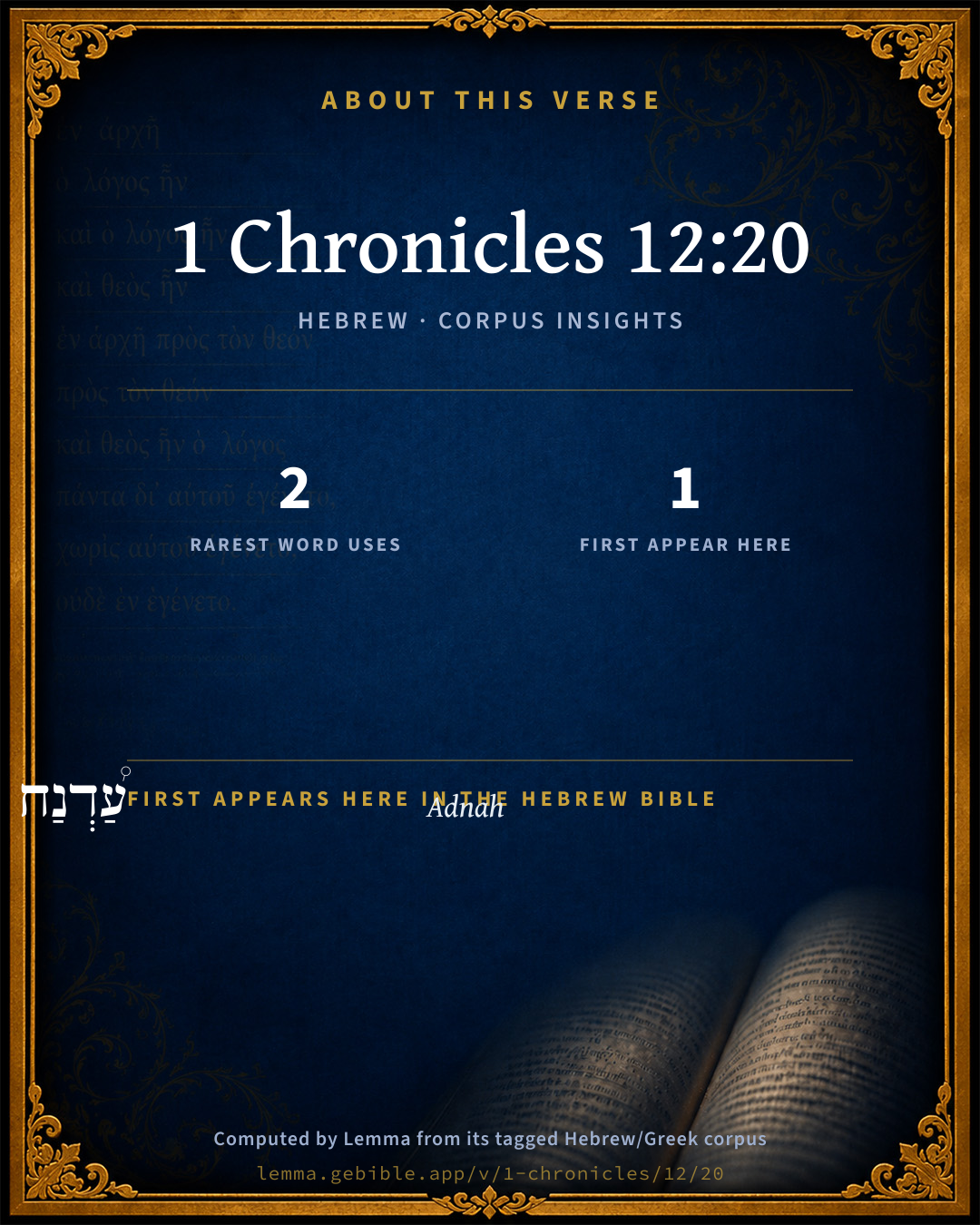
The rarest word here is עַ֠דְנַח Adnah H5734 — appearing just 2 times in the whole Hebrew Bible.

First appearance in Scripture

This word makes its first canonical appearance in the Hebrew Bible here:

  • עַ֠דְנַח Adnah H5734

Shared distinctive vocabulary

עַ֠דְנַח Adnah H5734 occurs in 2 verses of the Hebrew Bible. Also found in:

Grammatical profile

  • 2 verbs
  • 11 nouns
  • 1 adjective
  • 2 prepositions
  • 1 particle

Verb forms

  • בְּלֶכְתּ֣וֹ Qal · Infinitive Construct
  • נָפְל֣וּ Qal · Perfect

Repetition

Words recur within this verse — often emphatic in Hebrew:

  • מִֽמְּנַשֶּׁ֡ה Manasseh H4519 ×2
  • וְיוֹזָבָ֤ד Jozabad H3107 ×2

Hebrew & Septuagint length

In English translation the verse runs 31 words from the Hebrew and 33 from the Septuagint (LXX English) — closely comparable.

A rough comparison of the two English renderings, which tokenize alike — not a word-level alignment.

Word counts can differ between the Hebrew and the Greek without any difference in meaning — e.g. the Hebrew direct-object marker אֵת has no separate Greek word, and Greek often adds the article ὁ.

Cross-references

4

Topical passages linked to 1 Chronicles 12:20 in the Treasury of Scripture Knowledge — connected by theme and wording, ordered by reader-vote popularity; previews shown in the World English Bible.

  • Exodus 18:21 Moreover you shall provide out of all the people able men, such as fear God: men of truth, hating unjust gain; and place such over them, to be rulers of thousands, rulers of hundreds, rulers of fifties, and rulers of tens.
  • Deuteronomy 1:15 So I took the heads of your tribes, wise men, and known, and made them heads over you, captains of thousands, and captains of hundreds, and captains of fifties, and captains of tens, and officers, according to your tribes.
  • Deuteronomy 33:17 The firstborn of his herd, majesty is his; His horns are the horns of the wild-ox: With them he shall push the peoples all of them, [even] the ends of the earth: They are the ten thousands of Ephraim, They are the thousands of Manasseh.
  • 1 Samuel 29:11 So David rose up early, he and his men, to depart in the morning, to return into the land of the Philistines. The Philistines went up to Jezreel.

Cross-references courtesy of OpenBible.info (CC BY 4.0).

Hebrew and Greek witnesses Masoretic Hebrew ↔ Greek Septuagint

The same verse in the two great witnesses to the Old Testament, shown verse-for-verse.

These are two independent witnesses, not word-aligned to each other, and the Septuagint is shown in lemma (dictionary) form.

Hebrew 1 Chronicles 12:20 Masoretic · Westminster Leningrad Codex

בְּלֶכְתּ֣וֹ אֶל צִֽיקְלַ֗ג נָפְל֣וּ עָלָ֣יו מִֽמְּנַשֶּׁ֡ה עַ֠דְנַח וְיוֹזָבָ֤ד וִידִֽיעֲאֵל֙ וּמִיכָאֵ֣ל וְיוֹזָבָ֔ד וֶאֱלִיה֖וּא וְצִלְּתָ֑י רָאשֵׁ֥י הָאֲלָפִ֖ים אֲשֶׁ֥ר לִמְנַשֶּֽׁה

As he went to Ziklag, there fell to him of Manasseh, Adnah, and Jozabad, and Jediael, and Michael, and Jozabad, and Elihu, and Zillethai, captains of thousands who were of Manasseh.

World English Bible · Public Domain

Greek LXX 1 Chronicles 12:20 Septuagint · lemma form

καί ἀπό μανασσή προςχωρέω πρός δαυίδ ἐν ὁ ἔρχομαι ὁ ἀλλόφυλος ἐπί σαούλ εἰς πόλεμος καί οὐ βοηθέω αὐτός ὅτι ἐν βουλή γίγνομαι παρά ὁ στρατηγός ὁ ἀλλόφυλος λέγω ἐν ὁ κεφαλή ὁ ἀνήρ ἐκεῖνος ἐπιστρέφω πρός ὁ κύριος αὐτός σαούλ

When David was going to Sikelag, there came to him of Manasse, Edna and Jozabath, and Rodiel, and Michael, and Josabaith, and Elimuth, and Semathi: these are the captains of thousands of Manasse.

LXX2012 (modern English Septuagint) · Public Domain

Hebrew: Westminster Leningrad Codex (CC BY 4.0). Greek: Septuagint (public domain); English from LXX2012 (modern English Septuagint) (Public Domain). How the Septuagint differs from the Hebrew →

Commentary

Notes on 1 Chronicles 12:20 from classic Christian and Jewish commentators (each source and its license shown beneath its notes). The classic Christian expositions comment on the surrounding passage and are grouped to its opening verse, so a note may address several verses; the Jewish commentaries on the Tanakh (Rashi and others) are per-verse, so they appear only where the commentator wrote on this verse.

Lemma curates 59 commentaries, every one of them public domain or Creative Commons licensed, each selected and text-cleaned for this edition rather than reprinted as found. About our sources →

Jamieson, Fausset & Brown

Robert Jamieson, A. R. Fausset & David Brown

As he went to Ziklag--If those Manassites joined him on his return to Ziklag, after his dismissal from the Philistine army, then their arrival took place before the battle of Gilboa could have been fought (compare Sa1 29:11). Convinced of the desperate state of Saul's affairs, they abandoned him, and resolved to transfer their allegiance to David. But some learned men think that they came as fugitives from that disastrous field [CALMET and EWALD].

captains of the thousands . . . of Manasseh--Those seven were commanders of the large military divisions of their tribe.

Jamieson, Fausset & Brown — Commentary Critical and Explanatory on the Whole Bible (1871) — public domain (CC PDM 1.0). Text via the HelloAO Bible API.

Ellicott's Commentary for English Readers

(20) As he went to Ziklag.—On his dismissal by the Philistine princes, David returned with his men to Ziklag (1Sa_30:1). On the way he was joined by the Manassite chieftains, probably before the battle which decided the fate of Saul and his sons (1Sa_29:11).

Jozabad.—The repetition may be a scribe’s error. (Comp. 1Ch_12:10; 1Ch_12:13, where we find the name Jeremiah given twice over.)

Captains of the thousands that were of Manasseh.—(Comp. Num_31:14; and 1Ch_13:1; 1Ch_15:25; 1Ch_26:26.) The term “thousand” interchanges with “father-house” (clan); and perhaps each clan originally furnished 1,000 warriors to the tribal host.

A Bible Commentary for English Readers, edited by Charles John Ellicott (1878–1897) — public domain. Text from a community e-Sword module.

The Cambridge Bible for Schools and Colleges

gen. ed. J. J. S. Perowne

20. As he went] i.e. As he returned (1Sa_30:1).

Jozabad] This name occurs twice; possibly in the original list different patronymics were attached to the two mentions of the name.

captains of the thousands] R.V. captains of thousands; cp. 1Ch_15:25; Mic_5:2. Tribes were divided into “thousands” which were subdivided into “hundreds.” These divisions were of civil as well as of military significance.

The Cambridge Bible for Schools and Colleges (gen. ed. J. J. S. Perowne; Cambridge University Press, 1878–1918) — public domain. Text from a community e-Sword module.

John Gill's Exposition

And these are the numbers of the bands that were ready armed to the war,.... That were trained up to it, and accounted for it:

and came to David to Hebron; after the death of Ishbosheth and Abner, and when David had reigned seven years in Hebron:

to turn the kingdom of Saul to him; to transfer it to him and his family:

according to the word of the Lord; by Samuel, which they were acquainted with; and the number of those of the children of Judah, who made him their king already, and so there was the less need of a numerous appearance of them, were 6800 armed men, Ch1 12:24, of the tribe of Simeon, valiant men, 7100, Ch1 12:25, of the children of Levi 4600, Ch1 12:26, of the Aaronites or priests, with Jehoiada the son of Benaiah, according to Jarchi and Kimchi, at the head of them, 3700, Ch1 12:27, besides Zadok, a young man of the line of Eleazar, who was made high priest in the time of Solomon, who brought with him twenty two captains, Ch1 12:28 the heads of the courses of the priests, which were afterwards twenty four, Ch1 24:4 of the tribe of Benjamin, the kindred of Saul, the greatest part of whom had been sticklers for the continuance of the kingdom in the family of Saul, 3000, Ch1 12:29, of the tribe of Ephraim, valiant men, 20,800, Ch1 12:30, of the half tribe of Manasseh on this side Jordan, whose names were pricked down, being given, to make David king, 18,000, Ch1 12:31, and of the tribe of Issachar, two hundred of the heads of them; men of knowledge and understanding, either in chronology or astrology, or in the proper seasons for husbandry, or for the fixing the beginning of years and months, and the intercalation of them, for keeping the several festivals; or rather were men of prudence and wisdom, and knew that this was the proper time for making David king, Ishbosheth and Abner his general being dead; and as they were men in high esteem for their parts and abilities, their brethren were at their beck and command, Ch1 12:30, and of the tribe of Zebulun, warlike men, skilful in war, and well armed, 50,000 men; and their numerous appearance showed that they were hearty and sincere, being the greatest number of all the tribes, Ch1 12:33, and of the tribe of Naphtali, 1000 captains, and with them armed men, 37,000, Ch1 12:34 and of the tribe of Dan, men skilled in war, 28,600, Ch1 12:35 and of the tribe of Asher, warlike men, 40,000, Ch1 12:36 and of the Reubenites, Gadites, and half tribe of Manasseh, on the other side Jordan, military men, well armed, 120,000, Ch1 12:37, which in all made 348,800 men, and upwards.

John Gill's Exposition of the Whole Bible (1746–1763) — public domain (CC PDM 1.0). Text via the HelloAO Bible API.

Haydock's Catholic Bible Commentary

Thousands: heads of the principal cities, Micheas v. 2. (Du Hamel)

George Leo Haydock (1774–1849), Haydock's Catholic Family Bible and Commentary, 1859 edition — public domain. Excludes Psalms (Douay-Rheims chapter numbering differs from Protestant) and Deuterocanonical books (Catholic canon only).

Matthew Poole's English Annotations

As he went to Ziklag; as he returned from the camp of the Philistines to Ziklag, 1Sa 29:11.

Matthew Poole's English Annotations on the Holy Bible (1683–1685) — public domain. Text from a community e-Sword/MySword module.

The Pulpit Commentary

Although those of Manasseh who wished to ally themselves with David did not most providentially for David and his Ziklag people have the opportunity of aiding him when, on the eve of Gilboa, he was about to aid Achish the prince of the Philistines against the Israelites and Saul, yet their help must have come in useful when, on his return "to Ziklag on the third day," he found what the Amalekites had done, and pursued. (1Sa_30:1-6, 1Sa_30:11-25) Seven is the number also of Eastern Manasseh mentioned in 1Ch_5:24. Nothing is now said of the men belonging to them joining with them. Jozabad. One manuscript quoted by Kennicott has for this name on its first occurrence Jechabar. It is scarcely likely that the same name should appear twice in this short list, without some qualifying mark being put to one of the two. Nothing else is known of these seven cap-talus of the thousands of Manasseh.

The Pulpit Commentary (1880–1919), ed. H.D.M. Spence-Jones & Joseph S. Exell — public domain. Text from a community e-Sword module.

John Wesley's Explanatory Notes

As - As he returned from the camp of the Philistines to Ziklag.

John Wesley, Explanatory Notes Upon the Whole Bible (1754–1765) — public domain. Text via the GEBible commentary corpus.

Keil & Delitzsch

C. F. Keil & F. Delitzsch

And these are the numbers of the bands that were ready armed to the war,.... That were trained up to it, and accounted for it:

and came to David to Hebron; after the death of Ishbosheth and Abner, and when David had reigned seven years in Hebron:

to turn the kingdom of Saul to him; to transfer it to him and his family:

according to the word of the Lord; by Samuel, which they were acquainted with; and the number of those of the children of Judah, who made him their king already, and so there was the less need of a numerous appearance of them, were 6800 armed men, Ch1 12:24, of the tribe of Simeon, valiant men, 7100, Ch1 12:25, of the children of Levi 4600, Ch1 12:26, of the Aaronites or priests, with Jehoiada the son of Benaiah, according to Jarchi and Kimchi, at the head of them, 3700, Ch1 12:27, besides Zadok, a young man of the line of Eleazar, who was made high priest in the time of Solomon, who brought with him twenty two captains, Ch1 12:28 the heads of the courses of the priests, which were afterwards twenty four, Ch1 24:4 of the tribe of Benjamin, the kindred of Saul, the greatest part of whom had been sticklers for the continuance of the kingdom in the family of Saul, 3000, Ch1 12:29, of the tribe of Ephraim, valiant men, 20,800, Ch1 12:30, of the half tribe of Manasseh on this side Jordan, whose names were pricked down, being given, to make David king, 18,000, Ch1 12:31, and of the tribe of Issachar, two hundred of the heads of them; men of knowledge and understanding, either in chronology or astrology, or in the proper seasons for husbandry, or for the fixing the beginning of years and months, and the intercalation of them, for keeping the several festivals; or rather were men of prudence and wisdom, and knew that this was the proper time for making David king, Ishbosheth and Abner his general being dead; and as they were men in high esteem for their parts and abilities, their brethren were at their beck and command, Ch1 12:30, and of the tribe of Zebulun, warlike men, skilful in war, and well armed, 50,000 men; and their numerous appearance showed that they were hearty and sincere, being the greatest number of all the tribes, Ch1 12:33, and of the tribe of Naphtali, 1000 captains, and with them armed men, 37,000, Ch1 12:34 and of the tribe of Dan, men skilled in war, 28,600, Ch1 12:35 and of the tribe of Asher, warlike men, 40,000, Ch1 12:36 and of the Reubenites, Gadites, and half tribe of Manasseh, on the other side Jordan, military men, well armed, 120,000, Ch1 12:37, which in all made 348,800 men, and upwards.

Keil & Delitzsch — Biblical Commentary on the Old Testament (1861–1891) — public domain (CC PDM 1.0). Text via the HelloAO Bible API. (Old Testament only.)

Rashi

Rabbi Shlomo Yitzchaki (Rashi)

And from Manasseh there defected to David to help him.

when he came with the Philistines against Saul in battle in that war in which Saul was slain.

but they did not help them God forbid that they helped the Philistines, but with a counsel the chiefs of the Philistines sent him away. The chiefs of the Philistines took counsel to send him home because they said, “With our heads he will defect to his master,” an expression similar to “defected to David”

Rashi on the Tanakh — English translations: “The Judaica Press complete Tanach with Rashi, translated by A. J. Rosenberg” (CC BY 4.0); “Pentateuch with Rashi's commentary by M. Rosenbaum and A.M. Silbermann, 1929-1934” (public domain); “The Metsudah Tanach series, Lakewood, N.J” (CC BY 4.0); and “The Book of Joshua, Metsudah Publications, 1997” (CC BY 4.0). Text via Sefaria.

Lesson kit

Teaching starters — assembled from the data on this page, not authored interpretation. Every prompt links to the verse data it draws on. Edit before teaching.

1 Chronicles, in the Historical, opens this verse with 17 words (15 distinct Hebrew lemmas). Its most distinctive word is ʻAdnâh (“Adnah”). A historical commentator’s framing appears above. Read the whole chapter for the surrounding context.

Discussion questions

  1. How does “Adnah” (ʻAdnâh) shape what this verse is saying?
  2. The word “Adnah” first appears here in Scripture. What is being introduced at this debut?
  3. 2 Chronicles 17:14 shares the word «Adnah» with this verse. How do the two illuminate each other?
  4. “Manasseh” occurs 2× in this one verse. What is the effect of the repetition?
  5. These translations render this verse differently. What is at stake in choosing one wording over another?
  6. The verb «בְּלֶכְתּ֣וֹ» is Qal Infinitive Construct. How does its form color the action?
  7. Reading how Jamieson, Fausset & Brown and Ellicott's Commentary for English Readers read this verse, where do the two commentators agree and where do they part?

Things to notice

  • 1 word makes its first canonical appearance in Scripture here.
  • These translations choose different wording for 7 words in this verse.
  • “Manasseh” occurs 2× in this single verse.
  • 15 distinct Hebrew lemmas span 17 words in this verse.

Reading settings

Reading text

Shown beneath each verse's original-language words.

Old Testament
Old Testament edition

Read the OT as the Masoretic Hebrew (MT) or the Greek Septuagint (LXX).

English shown for the Greek Septuagint (in the Hebrew ↔ Greek comparison).

Comparing translations? Open the Compare panel on any verse page to stack up to four side by side.