1 Chronicles 25:8

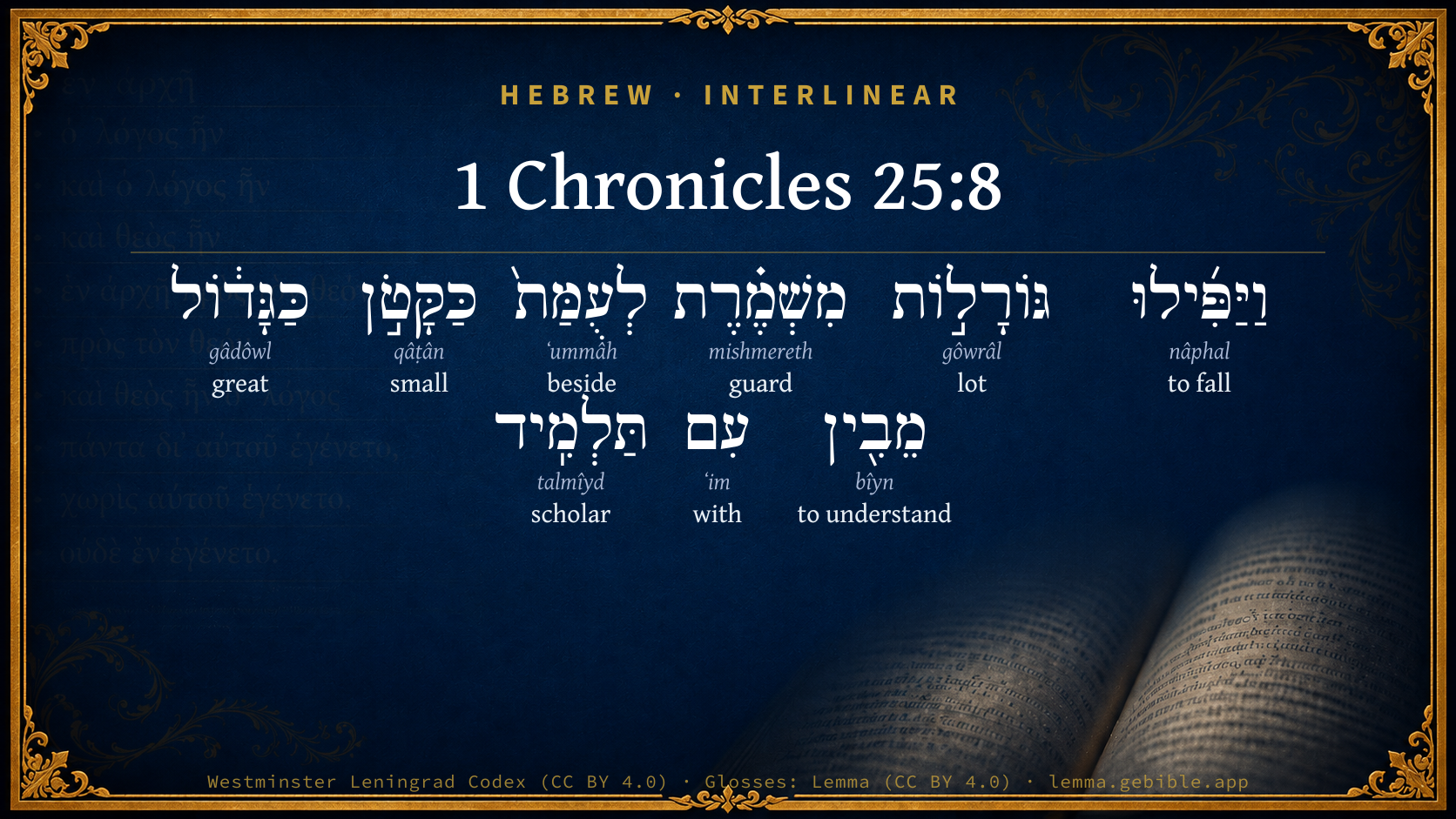
Hebrew (Westminster Leningrad Codex) 1 Chronicles 25:8 appears in the Hebrew Old Testament. The text above is from the Westminster Leningrad Codex. Each word links to its Strong’s number, a concise gloss, and parsing drawn from the Open Scriptures Hebrew Bible morphology. Click any word for its full Brown-Driver-Briggs (BDB) entry.
Download image
Cite this verse

1 Chronicles 25:8 (World English Bible). Public Domain. Lemma interlinear Bible study tool, https://lemma.gebible.app/v/1-chronicles/25/8.

Show BibTeX & RIS
BibTeX
RIS
English Translation
They cast lots for their offices, all alike, as well the small as the great, the teacher as the scholar.
World English Bible · Public Domain
Highlights
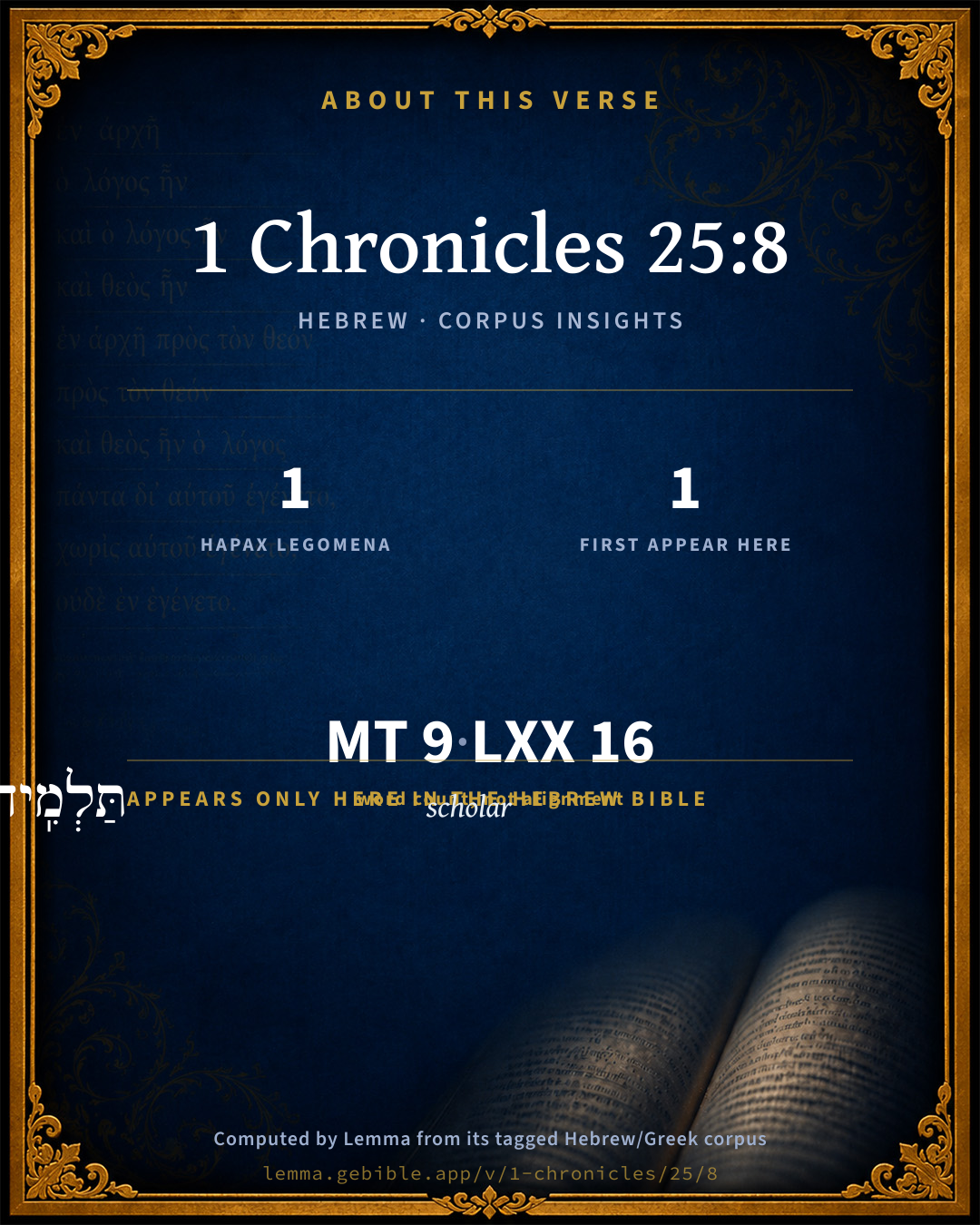
  • 1 hapax legomenon — only here in the Hebrew Bible
  • 1 first appearance in the Hebrew Bible
Full analysis ↓
Download a study sheet

One document with this verse’s original text, its word-by-word gloss line, the meaning frame, cross-references with their text, attributed commentary, and full source and license credits — printable, and it pastes into notes with its structure intact.

This verse Autodidact and up

Study sheet (.html) Plain text (.txt)

A passage Seminary Student

Up to 50 verses in one chapter. A passage sheet keeps up to 6 commentary sources and 12 cross-references per verse, in the order this page ranks them, and says so on the sheet whenever that leaves anything out. Ask for a single verse and you get the Autodidact verse sheet above.

Everything on this page stays free to read, with no account — the sheet is a download of what is already on screen, not access to it.

Want to remove ads? Support Godless Engineer
Compare translations 3

The same verse in 3 English versions, stacked beneath the original-language interlinear above. Click any original word for its lexicon entry.

Each is an independent rendering of the whole verse — the interlinear is not word-aligned to these translations.

Highlighted words mark where these versions differ — a whole-verse word diff, not a word-by-word alignment.

  • World English Bible Public Domain
    They cast lots for their offices, all alike, as well the small as the great, the teacher as the scholar.
  • King James Version Public Domain
    And they cast lots, ward against ward, as well the small as the great, the teacher as the scholar.
  • unfoldingWord Literal Text CC BY-SA 4.0
    And they cast lots for a duty, just as like small, like great, the one understanding with the student.

unfoldingWord Literal Text — © unfoldingWord, licensed CC BY-SA 4.0. Word-aligned USFM3 via Door43 (git.door43.org/unfoldingWord/en_ult).

Versions to compare (up to 4)

3 of 4 selected

Show all 18 translations

Every available English version of this verse, each an independent rendering of the whole verse.

  • World English Bible Public Domain
    They cast lots for their offices, all alike, as well the small as the great, the teacher as the scholar.
  • Berean Standard Bible Public Domain
    They cast lots for their duties, young and old alike, teacher as well as pupil.
  • Majority Standard Bible Public Domain
    They cast lots for their duties, young and old alike, teacher as well as pupil.
  • King James Version Public Domain
    And they cast lots, ward against ward, as well the small as the great, the teacher as the scholar.
  • American Standard Version (1901) Public Domain
    And they cast lots for their offices, all alike, as well the small as the great, the teacher as the scholar.
  • Revised Version (1885) Public Domain
    And they cast lots for their charges, all alike, as well the small as the great, the teacher as the scholar.
  • Geneva Bible (1599) Public Domain
    And they cast lottes, charge against charge, aswel small as great, the cunning man as the scholer.
  • Douay-Rheims (1899) Public Domain
    And they cast lots by their courses, the elder equally with the younger, the learned and the unlearned together.
  • Young's Literal Translation Public Domain
    And they cause to fall lots -- charge over-against `charge', as well the small as the great, the intelligent with the learner.
  • Literal Standard Version CC BY-SA 4.0
    And they cause lots to fall, charge next to [charge], the small as well as the great, the intelligent with the learner.
  • Unlocked Literal Bible CC BY-SA 4.0
    They cast lots for their duties, all alike, the same for the young as well as the old, the teacher as well as the student.
  • unfoldingWord Literal Text CC BY-SA 4.0
    And they cast lots for a duty, just as like small, like great, the one understanding with the student.
  • Darby Bible Public Domain
    And they cast lots with one another over the charges, the small as well as the great, the teacher with the scholar.
  • World Messianic Bible Public Domain
    They cast lots for their offices, all alike, the small as well as the great, the teacher as well as the student.
  • Webster's Bible Public Domain
    And they cast lots, ward against ward, as well the small as the great, the teacher as the scholar.
  • Free Bible Version CC BY-SA 4.0
    They cast lots for whatever responsibility they had, the least important equal to the most important, the teacher to the student.
  • Bible in Basic English Public Domain
    And selection was made of them for their special work, all having equal chances, small as well as great, the teacher as the learner.
  • JPS Tanakh (1917) Public Domain
    And they cast lots ward against ward, as well the small as the great, the teacher as the scholar.

Literal Standard Version (2020), Covenant Press — licensed CC BY-SA 4.0. Text via the HelloAO Bible API (eBible.org). Unlocked Literal Bible (unfoldingWord) — licensed CC BY-SA 4.0. Text via the HelloAO Bible API (eBible.org). unfoldingWord Literal Text — © unfoldingWord, licensed CC BY-SA 4.0. Word-aligned USFM3 via Door43 (git.door43.org/unfoldingWord/en_ult). Free Bible Version, Dr. Jonathan Gallagher — licensed CC BY-SA 4.0. Text via the HelloAO Bible API (eBible.org).

Word by word

More ways to search: Search by grammar → Find every occurrence → Compare this word →

Practice this passage: Drill this verse → Learn its vocabulary →

About this verse

These counts appear in no published source. They are computed here, from the morphology-tagged text and Lemma’s own curated glosses. What Lemma adds →

9
words
9
distinct lemmas
Historical
section

Notable vocabulary

1 hapax legomenon — a word that appears only here in the entire Hebrew Bible:

  • תַּלְמִֽיד scholar H8527

First appearance in Scripture

This word makes its first canonical appearance in the Hebrew Bible here:

  • תַּלְמִֽיד scholar H8527

Shared distinctive vocabulary

לְעֻמַּת֙ beside H5980 occurs in 28 verses of the Hebrew Bible. Also found in:

Grammatical profile

  • 2 verbs
  • 4 nouns
  • 2 adjectives
  • 1 preposition

Verb forms

  • וַיַּפִּ֜ילוּ Hiphil · Sequential Imperfect
  • מֵבִ֖ין Hiphil · Participle Active

Hebrew & Septuagint length

In English translation the verse runs 20 words from the Hebrew and 24 from the Septuagint (LXX English) — closely comparable.

A rough comparison of the two English renderings, which tokenize alike — not a word-level alignment.

Word counts can differ between the Hebrew and the Greek without any difference in meaning — e.g. the Hebrew direct-object marker אֵת has no separate Greek word, and Greek often adds the article ὁ.

In the original languages it is 9 Hebrew tokens and 16 Greek tokens — but the two are counted differently (Hebrew bundles its prefixes and suffixes into one token; the Greek is in lemma form), so that isn’t a like-for-like length.

Cross-references

11

Topical passages linked to 1 Chronicles 25:8 in the Treasury of Scripture Knowledge — connected by theme and wording, ordered by reader-vote popularity; previews shown in the World English Bible.

  • 1 Chronicles 26:13 They cast lots, the small as well as the great, according to their fathers' houses, for every gate.
  • Proverbs 16:33 The lot is cast into the lap, But its every decision is from Yahweh.
  • Leviticus 16:8 Aaron shall cast lots for the two goats; one lot for Yahweh, and the other lot for the scapegoat.
  • 1 Samuel 14:41–42 Therefore Saul said to Yahweh, the God of Israel, Show the right. Jonathan and Saul were taken [by lot]; but the people escaped.
  • 1 Chronicles 15:22 Chenaniah, chief of the Levites, was over the song: he instructed about the song, because he was skillful.
  • 1 Chronicles 24:5 Thus were they divided impartially by drawing lots; for there were princes of the sanctuary, and princes of God, both of the sons of Eleazar, and of the sons of Ithamar.
  • 1 Chronicles 24:31 These likewise cast lots even as their brothers the sons of Aaron in the presence of David the king, and Zadok, and Ahimelech, and the heads of the fathers' [houses] of the priests and of the Levites; the fathers' [houses] of the chief even as those of his younger brother.
  • 1 Chronicles 26:16 To Shuppim and Hosah westward, by the gate of Shallecheth, at the causeway that goes up, watch against watch.
  • 2 Chronicles 23:13 and she looked, and, behold, the king stood by his pillar at the entrance, and the captains and the trumpets by the king; and all the people of the land rejoiced, and blew trumpets; the singers also [played] on instruments of music, and led the singing of praise. Then Athaliah tore her clothes, and said, Treason! treason!
  • Nehemiah 12:24 The chiefs of the Levites: Hashabiah, Sherebiah, and Jeshua the son of Kadmiel, with their brothers over against them, to praise and give thanks, according to the commandment of David the man of God, watch next to watch.
  • Acts 1:26 They drew lots for them, and the lot fell on Matthias, and he was numbered with the eleven apostles.

Cross-references courtesy of OpenBible.info (CC BY 4.0).

Hebrew and Greek witnesses Masoretic Hebrew ↔ Greek Septuagint

The same verse in the two great witnesses to the Old Testament, shown verse-for-verse.

These are two independent witnesses, not word-aligned to each other, and the Septuagint is shown in lemma (dictionary) form.

Hebrew 1 Chronicles 25:8 Masoretic · Westminster Leningrad Codex

וַיַּפִּ֜ילוּ גּוֹרָל֣וֹת מִשְׁמֶ֗רֶת לְעֻמַּת֙ כַּקָּטֹ֣ן כַּגָּד֔וֹל מֵבִ֖ין עִם תַּלְמִֽיד

They cast lots for their offices, all alike, as well the small as the great, the teacher as the scholar.

World English Bible · Public Domain

Greek LXX 1 Chronicles 25:8 Septuagint · lemma form

καί βάλλω καί αὐτός κλῆρος ἐφημερία κατά ὁ μικρός καί κατά ὁ μέγας τέλειος καί μανθάνω

And they also cast lots for the daily courses, for the great and the small of them, of the perfect ones and the learners.

LXX2012 (modern English Septuagint) · Public Domain

On this verse, Ellicott's Commentary for English Readers discusses the Septuagint’s reading. Read the note in Commentary ↓

Hebrew: Westminster Leningrad Codex (CC BY 4.0). Greek: Septuagint (public domain); English from LXX2012 (modern English Septuagint) (Public Domain). How the Septuagint differs from the Hebrew →

Commentary

Notes on 1 Chronicles 25:8 from classic Christian and Jewish commentators (each source and its license shown beneath its notes). The classic Christian expositions comment on the surrounding passage and are grouped to its opening verse, so a note may address several verses; the Jewish commentaries on the Tanakh (Rashi and others) are per-verse, so they appear only where the commentator wrote on this verse.

Lemma curates 59 commentaries, every one of them public domain or Creative Commons licensed, each selected and text-cleaned for this edition rather than reprinted as found. About our sources →

Matthew Henry's Commentary

Twenty-four persons are named in the beginning of this chapter as sons of those three great men, Asaph, Heman, and Jeduthun. Ethan was the third (Ch1 6:44), but probably he was dead before the establishment was perfected and Jeduthun came in his room. [Or perhaps Ethan and Jeduthun were two names for the same person.] Of these three Providence so ordered it that Asaph had four sons, Jeduthun six [only five are mentioned Ch1 25:3; Shimei, mentioned Ch1 25:17, is supposed to have been the sixth], and Heman fourteen, in all twenty-four (who were named, Ch1 25:2-4), who were all qualified for the service and called to it. But the question was, In what order must they serve? This was determined by lot, to prevent strife for precedency, a sin which most easily besets many that otherwise are good people.

I. The lot was thrown impartially. They were placed in twenty-four companies, twelve in a company, in two rows, twelve companies in a row, and so they cast lots, ward against ward, putting them all upon a level, small and great, teacher and scholar. They did not go according to their age, or according to their standing, or the degrees they had taken in the music-schools; but it was referred to God, Ch1 25:8. Small and great, teachers and scholars, stand alike before God, who goes not according to our rules of distinction and precedency. See Mat 20:23.

II. God determined it as he pleased, taking account, it is probable, of the respective merits of the persons, which are of much more importance than seniority of age or priority of birth. Let us compare them with the preceding catalogue and we shall find that, 1. Josephus was the second son of Asaph. 2. Gedaliah the eldest son of Jeduthun. 3. Zaccur the eldest of Asaph. 4. Izri the second of Jeduthun. 5. Nethaniah the third of Asaph. 6. Bukkiah the eldest of Heman. 7. Jesharelah the youngest of Asaph. 8. Jeshaiah the third of Jeduthun. 9. Mattaniah the second of Heman. 10. Shimei the youngest of Jeduthun. 11. Azareel the third of Heman. 12. Hashabiah the fourth of Jeduthun. 13. Shubael the fourth of Heman. 14. Mattithiah the fifth of Jeduthun. 15. Jeremoth the fifth of Heman. 16. Hananiah the sixth of Heman. 17. Joshbekashah the eleventh of Heman. 18. Hanani the seventh of Heman. 19. Mallothi the twelfth of Heman. 20. Eliathah the eighth of Heman. 21. Hothir the thirteenth of Heman. 22. Giddalti the ninth of Heman. 23. Mehazioth the fourteenth of Heman. And, lastly, Romamti-ezer, the tenth of Heman. See how God increased some and preferred the younger before the elder.

III. Each of these had in his chorus the number of twelve, called their sons and their brethren, because they observed them as sons, and concurred with them as brethren. Probably twelve, some for the voice and others for the instrument, made up the concert. Let us learn with one mind and one mouth to glorify God, and that will be the best concert.

Matthew Henry's Commentary on the Whole Bible (1708–1710) — public domain (CC PDM 1.0). Text via the HelloAO Bible API.

Jamieson, Fausset & Brown

Robert Jamieson, A. R. Fausset & David Brown

THEIR DIVISION BY LOT INTO FOUR AND TWENTY ORDERS. (1Ch. 25:8-31)

they cast lots, ward against ward--"Ward" is an old English word for "division" or "company." The lot was cast to determine the precedence of the classes or divisions over which the musical leaders presided; and, in order to secure an impartial arrangement of their order, the master and his assistants, the teacher and his scholars, in each class or company took part in this solemn casting of lots. In the first catalogue given in this chapter the courses are classed according to their employment as musicians. In the second, they are arranged in the order of their service.

Next: 1 Chronicles Chapter 26

Jamieson, Fausset & Brown — Commentary Critical and Explanatory on the Whole Bible (1871) — public domain (CC PDM 1.0). Text via the HelloAO Bible API.

Trapp's Complete Commentary

John Trapp

1Ch 25:8 And they cast lots, ward against [ward], as well the small as the great, the teacher as the scholar.

Ver. 8. As well the small as the great.] Heb., Sicut parvus sicut magnus; doctor cum discipulo: there was no privilege of precedency.

John Trapp, A Commentary or Exposition upon All the Books of the Old and New Testament (1647–1656) — public domain. Text from a community e-Sword module.

Joseph Benson's Commentary

1Ch 25:8. Ward against ward — A course of Levites answerable to one of the priests, upon whom the Levites were to wait in their holy ministrations, 1Ch 23:28. As well the teacher as the scholar — Without any respect to their different ages or abilities.

Joseph Benson's Commentary on the Old and New Testaments (1811–1818) — public domain. Text from a community e-Sword module.

Tyndale Open Study Notes

Tyndale Open Resources

25:8 As with the priests, the order of the musicians by families was decided by sacred lots so that no preference would be shown (see 24:5, 31).

Tyndale Open Study Notes — © Tyndale Open Resources, licensed CC BY-SA 4.0. Text via the HelloAO Bible API.

Geneva Bible (1599)

Geneva Bible translators

Who should be in every company and course.

Without respect to age or cunning.

Geneva Bible (1599) marginal notes — public domain. Text via Bolls.life.

Ellicott's Commentary for English Readers

(8) And they cast lots, ward against ward.—Rather, And they cast lots of charge, that is, for determining the order in which each of the twenty-four guilds, or classes, should take charge of the services. (Comp, the LXX., κλήρους ἐφημερίων, “lots of courses;” and see Luk_1:6.) Some Hebrew MSS. and the Targum repeat the word “ward” (mishmèreth, “charge”), whence the reading of the Authorised Version. The ancient versions omit the word altogether.

As well the small as the great.—Heb., exactly as the small (or, the younger), so the great (or, the elder). (Comp. the Vulg., “ex aequo tam major quam minor.”) But perhaps leummath is here used absolutely: “They cast lots in like manner” (1Ch_24:31). The senior houses, or guilds, had no advantage over the juniors, the order of rotation being decided by lot. (Comp. 1Ch_24:31.)

The teacher as the scholar.—Literally, cunning (1Ch_25:7) with learner. According to 1Ch_23:5, the whole number of Levites appointed for the service of song was 4,000. These were all included in the twenty-four classes, 288 of them being “cunning” men, that is, masters in their art, and the remaining 3,712 forming the rank and file of the choirs under the training of the proficients. The Aramaic word talmid (scholar) occurs nowhere else in the Old Testament. It is the term used of the disciples of the Rabbis in the Talmud, and is the exact equivalent of the New Testament word, μαθητής.

A Bible Commentary for English Readers, edited by Charles John Ellicott (1878–1897) — public domain. Text from a community e-Sword module.

The Cambridge Bible for Schools and Colleges

gen. ed. J. J. S. Perowne

8–31. The Allotment of the Courses

8. ward against ward] R.V. (guessing the sense rightly) for their charges (i.e. duties), all alike. The Hebrew text however is faulty.

the teacher as the scholar] LXX. τελείων καὶ μανθανόντων (i.e. the initiated and the learners). For “the teacher” we should perhaps render “the skilful” as in 1Ch_25:7, R.V.; the Heb. word is the same. It is to be noted that we have here twenty-four courses of singers corresponding with the twenty-four courses of the priests.

The Cambridge Bible for Schools and Colleges (gen. ed. J. J. S. Perowne; Cambridge University Press, 1878–1918) — public domain. Text from a community e-Sword module.

John Gill's Exposition

And they cast lots, ward against ward,.... That is, which ward or course of the singers should answer to and attend on the first ward or course of the priests in their weekly service, and which the second, and so on:

as well the small as the great, the teacher as the scholar; no regard was had to the age of a person, his being the firstborn or a younger brother, or to his office and station, whether as a teacher or a learner in the science of singing; he was made the head of a course, as the lot came up; and it may easily be observed, by comparing the lots in the following verses with the sons of the chief singers, according to the order of them in Ch1 25:2 that the younger are often preferred in the courses by lot to the elder, of which even the first lot is an instance.

John Gill's Exposition of the Whole Bible (1746–1763) — public domain (CC PDM 1.0). Text via the HelloAO Bible API.

Albert Barnes' Notes on the Bible

As well the small as the great - Compare 1Ch 24:31. The lot was not applied indiscriminately to all the 24 courses, but was only used to settle which course of Asaph, which of Jeduthun, and which of Heman, should on each occasion be taken. Asaph was given the precedence over his brethren, and his four courses were assigned the first, and then each alternate place. Jeduthun took rank next, and received alternate places, first with Asaph, and then with Heman, until his courses were exhausted. After this, all the later places fell necessarily to Heman, whose courses continue without interruption from the 15th.

Albert Barnes' Notes on the Bible (1834–1885) — public domain. Text from a community e-Sword/MySword module.

Haydock's Catholic Bible Commentary

Unlearned. Hebrew and Septuagint, "the scholars." (Haydock) --- After the singers had been distributed into twenty-four classes, pretty equal in number, lots decided which of then should serve first, (Menochius) as had been done with the priests, chap. xxiv. 31. See chap. xxvi. 13.

George Leo Haydock (1774–1849), Haydock's Catholic Family Bible and Commentary, 1859 edition — public domain. Excludes Psalms (Douay-Rheims chapter numbering differs from Protestant) and Deuterocanonical books (Catholic canon only).

Matthew Poole's English Annotations

Ward against ward, i.e. a ward, or rank, or course of Levites answerable to one of the priests, upon whom the Levites were to wait in their holy ministrations, 1Ch 23:28. As well the small as the great, the teacher as the scholar, without any respect to their different ages or abilities.

Matthew Poole's English Annotations on the Holy Bible (1683–1685) — public domain. Text from a community e-Sword/MySword module.

Whedon's Commentary on the Bible

Daniel D. Whedon

8. They cast lots, ward against ward — The word rendered ward means a charge, a guardianship or superintendency. They cast lots to determine the order in which these different classes of singers should serve in the holy service, one class having charge until succeeded in the regular order by another. Our translators have repeated the word ward, but the Hebrew text reads literally: They cast lots for the charge, in the same manner as the small so the great, the skilled with the scholar. Of the four thousand Levites appointed for the service of song, (1Ch_23:5,) the two hundred and eighty eight represented in 1Ch_25:9-31 were the skilled ones, (“all that were cunning,” 1Ch_25:7.) And these were so arranged and distributed by lot that the rest of the four thousand (3,712) were amply supplied with teachers, there being one teacher for about thirteen scholars. So both the small and great, (that is, the older and the younger, comp. 1Ch_24:31,) the teachers and the scholars, were divided into classes, and distributed by lot.

Daniel D. Whedon (gen. ed.), Commentary on the Old and New Testaments (1874–1909) — public domain. Text from a community e-Sword module.

The Pulpit Commentary

This verse should be translated, And they cast lots of attendance, small and great equally, teacher with scholar. The Septuagint translates trmvimi twOlrwOg by the words klhrouv ejfhmeriwn.

Small and great, teacher and scholar.

We have here an enumeration of the several courses of the Levites, appointed by lot to minister in due order. In the words which precede the enumeration, we have summarized the variety of ages and classes, all of whom were employed and accepted by the Lord in his service.

I AN EPITOME OF HUMAN SOCIETY AS CONSTITUTED BY God. Our common humanity is consistent with great variety and intermixture of elements. It has pleased God not only that generation should succeed generation, but that members of the human race of all ages should exist together in human society. It is obviously his will that mankind should be composed of those who teach and those who learn.

II AN ARRANGEMENT TO WHICH THE PROVISIONS OF REDEMPTION EXACTLY CORRESPOND. If the same God rules in providence and saves in redemption, we may expect to find a suitable provision made for the varied wants of varied classes. Accordingly we find that the Bible is equally adapted to young and old; that the redemption of Christ is limited to no age or class; that the Holy Spirit is poured out from above without regard to the distinctions Upon which men often lay an undue stress; that religion is equally intended for the benefit of all mankind.

III THAT SOCIETY SHOULD BE SO CONSTITUTED IS PRODUCTIVE OF MUTUAL ADVANTAGE. The great serve the small, and the small the great; the scholar is indebted to the teacher, who in turn derives many benefits from his pupils. There is no member of the human race who is not both a benefactor and a beneficiary. It is well that all should live in voluntary and cheerful compliance with this Divine ordinance.

IV ALL CLASSES AND AGES MAY CO-OPERATE FOE THE SPREAD OF THE GOSPEL AND THE SERVICE OF GOD. The cause of Christ is one which the feeblest child may help to advance, and which may employ the abilities of the greatest and most learned. Our Lord disdains not the lowliest service; and the loftiest are honoured in being permitted to do his will and glorify his Name. T.

The Pulpit Commentary (1880–1919), ed. H.D.M. Spence-Jones & Joseph S. Exell — public domain. Text from a community e-Sword module.

John Wesley's Explanatory Notes

Ward - A course of Levites answerable to one of the priests, upon whom the Levites were to wait in their holy ministrations, chap. xxiii, 28. The scholar - Without any respect to their different ages or abilities.

John Wesley, Explanatory Notes Upon the Whole Bible (1754–1765) — public domain. Text via the GEBible commentary corpus.

Keil & Delitzsch

C. F. Keil & F. Delitzsch

And they cast lots, ward against ward,.... That is, which ward or course of the singers should answer to and attend on the first ward or course of the priests in their weekly service, and which the second, and so on:

as well the small as the great, the teacher as the scholar; no regard was had to the age of a person, his being the firstborn or a younger brother, or to his office and station, whether as a teacher or a learner in the science of singing; he was made the head of a course, as the lot came up; and it may easily be observed, by comparing the lots in the following verses with the sons of the chief singers, according to the order of them in Ch1 25:2 that the younger are often preferred in the courses by lot to the elder, of which even the first lot is an instance.

Keil & Delitzsch — Biblical Commentary on the Old Testament (1861–1891) — public domain (CC PDM 1.0). Text via the HelloAO Bible API. (Old Testament only.)

Kretzmann's Popular Commentary

Paul E. Kretzmann

Divisions of the Singers into Orders

v. 8. And they cast lots, ward against ward, as well the small as the great, the teacher as the scholar. The lot was cast over the divisions or companies to determine their arrangement according to master and assistants, so that nothing was left to capricious choice.

v. 9. Now, the first lot came forth for Asaph to Joseph; the second to Gedaliah, who with his brethren and sons, his companions in the art of music and singing, were twelve;

v. 10. the third to Saccur; he, his sons, and his brethren were twelve;

v. 11. the fourth to Izri; he, his sons, and his brethren were twelve;

v. 12. the fifth to Nethaniah; he, his sons, and his brethren were twelve;

v. 13. the sixth to Bukkiah; he, his sons, and his brethren were twelve;

v. 14. the seventh to Jesharelah; he, his sons, and his brethren were twelve;

v. 15. the eighth to Jeshaiah; he, his sons, and his brethren were twelve;

v. 16. the ninth to Mattaniah; he, his sons, and his brethren were twelve;

v. 17. the tenth to Shimei; he, his sons, and his brethren were twelve;

v. 18. the eleventh to Azareel; he, his sons, and his brethren were twelve;

v. 19. the twelfth to Hashabiah; he, his sons, and his brethren were twelve;

v. 20. the thirteenth to Shubael; he, his sons, and his brethren were twelve;

v. 21. the fourteenth to Mattithiah; he, his sons, and his brethren were twelve;

v. 22. the fifteenth to Jeremoth; he, his sons, and his brethren were twelve;

v. 23. the sixteenth to Hananiah; he, his sons, and his brethren were twelve;

v. 24. the seventeenth to Joshbekashah; he, his sons, and his brethren were twelve;

v. 25. the eighteenth to Hanani; he, his sons, and his brethren were twelve;

v. 26. the nineteenth to Mallothi; he, his sons, and his brethren were twelve;

v. 27. the twentieth to Eliathah; he, his sons, and his brethren were twelve;

v. 28. the one and twentieth to Hothir; he, his sons, and his brethren were twelve;

v. 29. the two and twentieth to Giddalti; he, his sons, and his brethren were twelve;

v. 30. the three and twentieth to Mahazioth; he, his sons, and his brethren were twelve;

v. 31. the four and twentieth to Romamti-ezer; he, his sons, and his brethren were twelve. This was the way in which the musicians were arranged in the order of their service, all in agreement with the principle that God is a God of order, and that all disturbing elements should be kept from church services, in order not to interfere with the devotion of the worshipers.

Paul E. Kretzmann, Popular Commentary of the Bible (1921–1924) — public domain. Text from a community e-Sword module.

Rashi

Rabbi Shlomo Yitzchaki (Rashi)

And they cast lots, a watch against The meaning is a watch against a watch, and a similar [case] is [found] above (16:5): “... but I have walked from tent to tent and from tabernacle,” which means: “and from tabernacle to tabernacle.”

like the small one so the great one, scholar with pupil The meaning is that they cast lots for the watches, this one against that one, a watch against a watch, the small one was like the great one, the expert master with the pupil, all of them were equal in this, for the one on whom the first lot fell, if to the small one, he would come first to be the first one, and if last, he would be the last one, and so all of them, whether a scholar or a pupil, whether a small person or a great one. And these watches of the Levites followed the watches of the priests: the one to whom the first lot fell had the first lot, and his watch was with the watch of Jehoiarib the priest, and the one to whom the second lot fell waited, and his watch was with the watch of Jedaiah the priest.

Rashi on the Tanakh — English translations: “The Judaica Press complete Tanach with Rashi, translated by A. J. Rosenberg” (CC BY 4.0); “Pentateuch with Rashi's commentary by M. Rosenbaum and A.M. Silbermann, 1929-1934” (public domain); “The Metsudah Tanach series, Lakewood, N.J” (CC BY 4.0); and “The Book of Joshua, Metsudah Publications, 1997” (CC BY 4.0). Text via Sefaria.

Lesson kit

Teaching starters — assembled from the data on this page, not authored interpretation. Every prompt links to the verse data it draws on. Edit before teaching.

1 Chronicles, in the Historical, opens this verse with 9 words (9 distinct Hebrew lemmas). Its most distinctive word is talmîyd (“scholar”). A historical commentator’s framing appears above. Read the whole chapter for the surrounding context.

Discussion questions

  1. How does “scholar” (talmîyd) shape what this verse is saying?
  2. This verse holds 1 word here found nowhere else in the Hebrew Bible. What might the rare word draw attention to?
  3. The word “scholar” first appears here in Scripture. What is being introduced at this debut?
  4. Exodus 25:27 shares the word «beside» with this verse. How do the two illuminate each other?
  5. The translations on this page render this verse differently — a whole-verse word diff, not a word-by-word alignment. What might account for the different wordings?
  6. The verb «וַיַּפִּ֜ילוּ» is Hiphil Sequential Imperfect. How does its form color the action?
  7. Reading how Matthew Henry's Commentary and Jamieson, Fausset & Brown read this verse, where do the two commentators agree and where do they part?

Things to notice

Reading settings

Reading text

Shown beneath each verse's original-language words.

Old Testament
Old Testament edition

Read the OT as the Masoretic Hebrew (MT) or the Greek Septuagint (LXX).

English shown for the Greek Septuagint (in the Hebrew ↔ Greek comparison).

Comparing translations? Open the Compare panel on any verse page to stack up to four side by side.