
Ezekiel 3:23

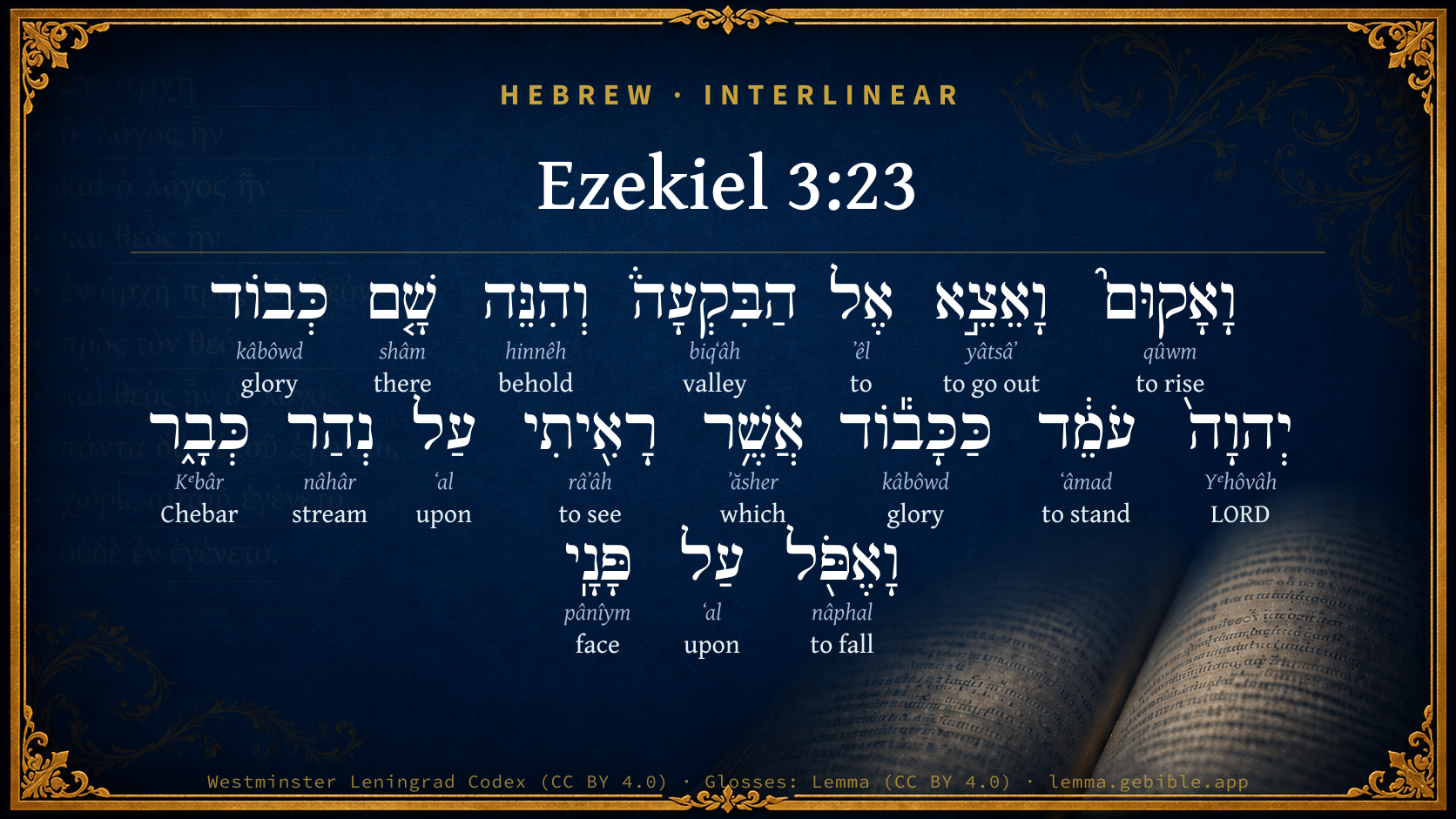
Hebrew (Westminster Leningrad Codex) Ezekiel 3:23 appears in the Hebrew Old Testament. The text above is from the Westminster Leningrad Codex. Each word links to its Strong’s number, a concise gloss, and parsing drawn from the Open Scriptures Hebrew Bible morphology. Click any word for its full Brown-Driver-Briggs (BDB) entry.
Download image
Cite this verse

Ezekiel 3:23 (World English Bible). Public Domain. Lemma interlinear Bible study tool, https://lemma.gebible.app/v/ezekiel/3/23.

Show BibTeX & RIS
BibTeX
RIS
English Translation
Then I arose, and went forth into the plain: and, behold, the glory of Yahweh stood there, as the glory which I saw by the river Chebar; and I fell on my face.
World English Bible · Public Domain
Download a study sheet

One document with this verse’s original text, its word-by-word gloss line, the meaning frame, cross-references with their text, attributed commentary, and full source and license credits — printable, and it pastes into notes with its structure intact.

This verse Autodidact and up

Study sheet (.html) Plain text (.txt)

A passage Seminary Student

Up to 50 verses in one chapter. A passage sheet keeps up to 6 commentary sources and 12 cross-references per verse, in the order this page ranks them, and says so on the sheet whenever that leaves anything out. Ask for a single verse and you get the Autodidact verse sheet above.

Everything on this page stays free to read, with no account — the sheet is a download of what is already on screen, not access to it.

Want to remove ads? Support Godless Engineer
Compare translations 3

The same verse in 3 English versions, stacked beneath the original-language interlinear above. Click any original word for its lexicon entry.

Each is an independent rendering of the whole verse — the interlinear is not word-aligned to these translations.

Highlighted words mark where these versions differ — a whole-verse word diff, not a word-by-word alignment.

  • World English Bible Public Domain
    Then I arose, and went forth into the plain: and, behold, the glory of Yahweh stood there, as the glory which I saw by the river Chebar; and I fell on my face.
  • King James Version Public Domain
    Then I arose, and went forth into the plain: and, behold, the glory of the LORD stood there, as the glory which I saw by the river of Chebar: and I fell on my face.
  • unfoldingWord Literal Text CC BY-SA 4.0
    I arose and went out into the plain, and there the glory of Yahweh was staying, like the glory that I had seen beside the Kebar Canal; so I fell on my face.

unfoldingWord Literal Text — © unfoldingWord, licensed CC BY-SA 4.0. Word-aligned USFM3 via Door43 (git.door43.org/unfoldingWord/en_ult).

Versions to compare (up to 4)

3 of 4 selected

Show all 18 translations

Every available English version of this verse, each an independent rendering of the whole verse.

  • World English Bible Public Domain
    Then I arose, and went forth into the plain: and, behold, the glory of Yahweh stood there, as the glory which I saw by the river Chebar; and I fell on my face.
  • Berean Standard Bible Public Domain
    So I got up and went out to the plain, and behold, the glory of the LORD was present there, like the glory I had seen by the River Kebar, and I fell facedown.
  • Majority Standard Bible Public Domain
    So I got up and went out to the plain, and behold, the glory of the LORD was present there, like the glory I had seen by the River Kebar, and I fell facedown.
  • King James Version Public Domain
    Then I arose, and went forth into the plain: and, behold, the glory of the LORD stood there, as the glory which I saw by the river of Chebar: and I fell on my face.
  • American Standard Version (1901) Public Domain
    Then I arose, and went forth into the plain: and, behold, the glory of Jehovah stood there, as the glory which I saw by the river Chebar; and I fell on my face.
  • Revised Version (1885) Public Domain
    Then I arose, and went forth into the plain: and, behold, the glory of the LORD stood there, as the glory which I saw by the river Chebar: and I fell on my face.
  • Geneva Bible (1599) Public Domain
    So when I had risen vp, and gone foorth into the fielde, beholde, the glorie of the Lord stoode there, as the glorie which I sawe by the riuer Chebar, and I fell downe vpon my face.
  • Douay-Rheims (1899) Public Domain
    And I rose up, and went forth into the plain: and behold the glory of the Lord stood there, like the glory which I saw by the river Chobar: and I fell upon my face.
  • Young's Literal Translation Public Domain
    And I rise and go forth unto the valley, and lo, there the honour of Jehovah is standing as the honour that I had seen by the river Chebar, and I fall on my face.
  • Literal Standard Version CC BY-SA 4.0
    And I rise and go forth to the valley, and behold, there the glory of YHWH is standing as the glory that I had seen by the river Chebar, and I fall on my face.
  • Unlocked Literal Bible CC BY-SA 4.0
    I arose and went out into the plain, and there the glory of Yahweh was staying, like the glory that I had seen beside the Kebar Canal; so I fell on my face.
  • unfoldingWord Literal Text CC BY-SA 4.0
    I arose and went out into the plain, and there the glory of Yahweh was staying, like the glory that I had seen beside the Kebar Canal; so I fell on my face.
  • Darby Bible Public Domain
    And I arose, and went forth into the valley, and behold, the glory of Jehovah stood there, like the glory which I saw by the river Chebar; and I fell on my face.
  • World Messianic Bible Public Domain
    Then I arose, and went out into the plain, and behold, the LORD’s glory stood there, like the glory which I saw by the river Chebar. Then I fell on my face.
  • Webster's Bible Public Domain
    Then I arose, and went forth into the plain; and behold, the glory of the LORD stood there, as the glory which I saw by the river of Kebar: and I fell on my face.
  • Free Bible Version CC BY-SA 4.0
    So I got up and went to the valley, and there I saw the Lord's glory. It was like the glory I had seen by the River Kebar. I fell facedown on the ground.
  • Bible in Basic English Public Domain
    Then I got up and went out into the valley; and I saw the glory of the Lord resting there as I had seen it by the river Chebar; and I went down on my face.
  • JPS Tanakh (1917) Public Domain
    Then I arose, and went forth into the plain; and, behold, the glory of the LORD stood there, as the glory which I saw by the river Chebar; and I fell on my face.

Literal Standard Version (2020), Covenant Press — licensed CC BY-SA 4.0. Text via the HelloAO Bible API (eBible.org). Unlocked Literal Bible (unfoldingWord) — licensed CC BY-SA 4.0. Text via the HelloAO Bible API (eBible.org). unfoldingWord Literal Text — © unfoldingWord, licensed CC BY-SA 4.0. Word-aligned USFM3 via Door43 (git.door43.org/unfoldingWord/en_ult). Free Bible Version, Dr. Jonathan Gallagher — licensed CC BY-SA 4.0. Text via the HelloAO Bible API (eBible.org).

Word by word

More ways to search: Search by grammar → Find every occurrence → Compare this word →

Practice this passage: Drill this verse → Learn its vocabulary →

כְּבָ֑ר
Kᵉbâr
H3529
“Chebar”
Noun, Proper
Part of Speech
Noun
Type
Proper
Full BDB Definition

Origin: the same as H3528

TWOT: 947d

Chebar = "far-off" - a Babylonian river near which many Israelite exiles settled; maybe the 'Habor' or the 'Royal Canal' of Nebuchadnezzar
  1. וָאָקוּם֮ qûwm H6965 “and · to rise” Conjunction + Verb, Qal, Sequential Imperfect, 1st Person, Common, Singular
  2. וָאֵצֵ֣א yâtsâʼ H3318 “and · to go out” Conjunction + Verb, Qal, Sequential Imperfect, 1st Person, Common, Singular
  3. אֶל ʼêl H413 “to” Preposition
  4. הַבִּקְעָה֒ biqʻâh H1237 “the · valley” Particle, Definite Article + Noun, Common, Feminine, Singular, Absolute
  5. וְהִנֵּה hinnêh H2009 “and · behold” Conjunction + Particle, Demonstrative
  6. שָׁ֤ם shâm H8033 “there” Adverb
  7. כְּבוֹד kâbôwd H3519 “glory of” Noun, Common, Both, Singular, Construct
  8. יְהוָה֙ Yᵉhôvâh H3068 “LORD” Noun, Proper
  9. עֹמֵ֔ד ʻâmad H5975 “standing” Verb, Qal, Participle Active, Masculine, Singular, Absolute
  10. כַּכָּב֕וֹד kâbôwd H3519 “like/as the · glory” Preposition, Determined + Noun, Common, Both, Singular, Absolute
  11. אֲשֶׁ֥ר ʼăsher H834 “which” Particle, Relative
  12. רָאִ֖יתִי râʼâh H7200 “to see” Verb, Qal, Perfect, 1st Person, Common, Singular
  13. עַל ʻal H5921 “upon” Preposition
  14. נְהַר nâhâr H5104 “stream of” Noun, Common, Masculine, Singular, Construct
  15. וָאֶפֹּ֖ל nâphal H5307 “and · to fall” Conjunction + Verb, Qal, Sequential Imperfect, 1st Person, Common, Singular
  16. עַל ʻal H5921 “upon” Preposition
  17. פָּנָֽי pânîym H6440 “face(s) · my” Noun, Common, Both, Plural, Construct + Suffix, Personal, 1st Person, Common, Singular

About this verse

These counts appear in no published source. They are computed here, from the morphology-tagged text and Lemma’s own curated glosses. What Lemma adds →

18
words
16
distinct lemmas
Prophets
section

Notable vocabulary

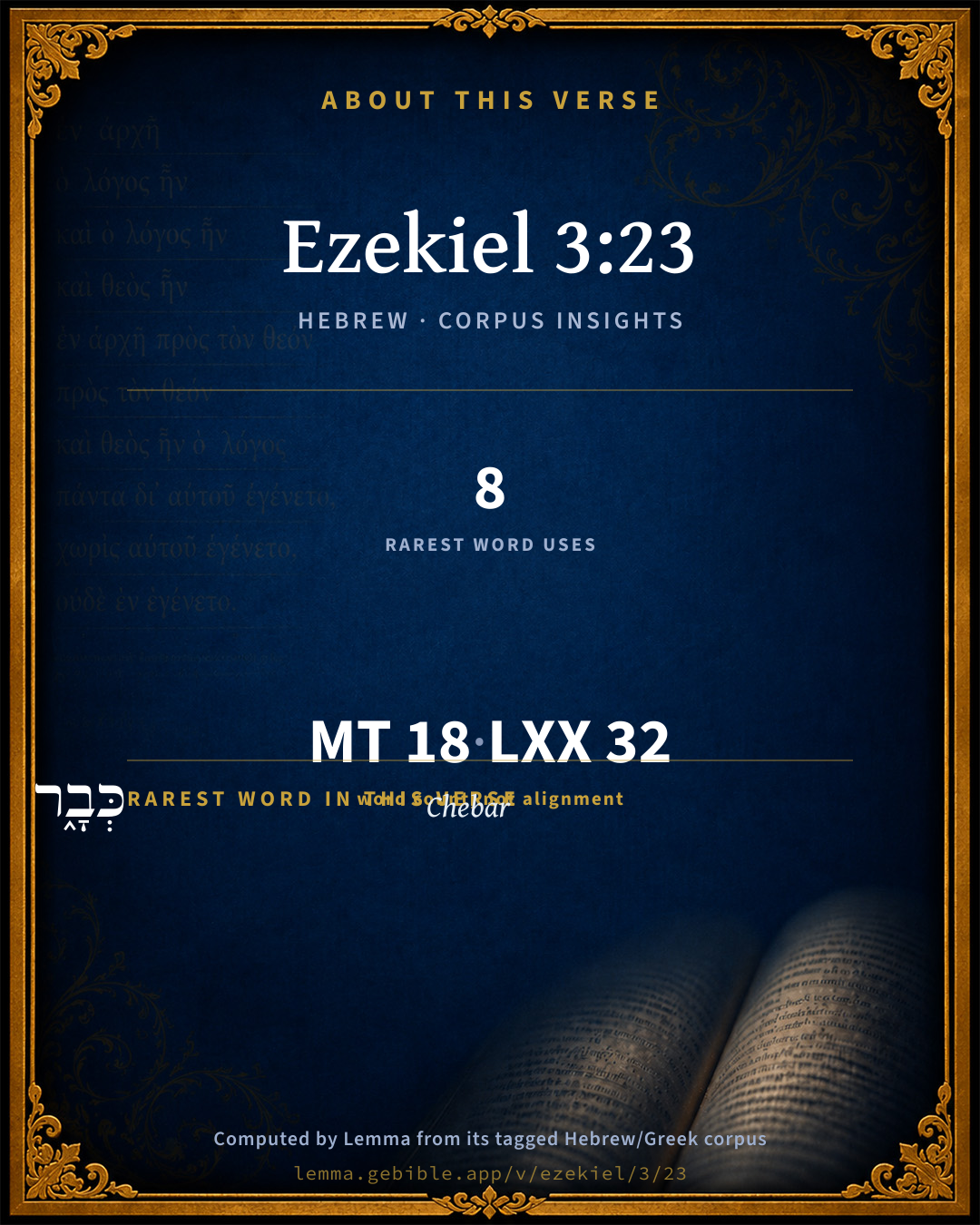
The rarest word here is כְּבָ֑ר Chebar H3529 — appearing just 8 times in the whole Hebrew Bible.

Shared distinctive vocabulary

כְּבָ֑ר Chebar H3529 occurs in 8 verses of the Hebrew Bible. Also found in:

Grammatical profile

  • 5 verbs
  • 7 nouns
  • 3 prepositions
  • 1 adverb
  • 2 particles

Verb forms

  • וָאָקוּם֮ Qal · Sequential Imperfect
  • וָאֵצֵ֣א Qal · Sequential Imperfect
  • עֹמֵ֔ד Qal · Participle Active
  • רָאִ֖יתִי Qal · Perfect
  • וָאֶפֹּ֖ל Qal · Sequential Imperfect

Repetition

Words recur within this verse — often emphatic in Hebrew:

  • כְּבוֹד glory H3519 ×2
  • עַל upon H5921 ×2

Hebrew & Septuagint length

In English translation the verse runs 33 words from the Hebrew and 44 from the Septuagint (LXX English) — closely comparable.

A rough comparison of the two English renderings, which tokenize alike — not a word-level alignment.

Word counts can differ between the Hebrew and the Greek without any difference in meaning — e.g. the Hebrew direct-object marker אֵת has no separate Greek word, and Greek often adds the article ὁ.

In the original languages it is 18 Hebrew tokens and 32 Greek tokens — but the two are counted differently (Hebrew bundles its prefixes and suffixes into one token; the Greek is in lemma form), so that isn’t a like-for-like length.

Cross-references

13

Topical passages linked to Ezekiel 3:23 in the Treasury of Scripture Knowledge — connected by theme and wording, ordered by reader-vote popularity; previews shown in the World English Bible.

  • Ezekiel 1:28 As the appearance of the bow that is in the cloud in the day of rain, so was the appearance of the brightness round about. This was the appearance of the likeness of the glory of Yahweh. When I saw it, I fell on my face, and I heard a voice of one that spoke.
  • Acts 7:55 But he, being full of the Holy Spirit, looked up steadfastly into heaven, and saw the glory of God, and Jesus standing on the right hand of God,
  • Revelation 1:17 When I saw him, I fell at his feet like a dead man. He laid his right hand on me, saying, "Don't be afraid. I am the first and the last,
  • Numbers 16:19 Korah assembled all the congregation against them to the door of the tent of meeting: and the glory of Yahweh appeared to all the congregation.
  • Numbers 16:42 It happened, when the congregation was assembled against Moses and against Aaron, that they looked toward the tent of meeting: and, behold, the cloud covered it, and the glory of Yahweh appeared.
  • Ezekiel 1:1–4 Now it happened in the thirtieth year, in the fourth [month], in the fifth [day] of the month, as I was among the captives by the river Chebar, that the heavens were opened, and I saw visions of God.
  • Ezekiel 9:3 The glory of the God of Israel was gone up from the cherub, whereupon it was, to the threshold of the house: and he called to the man clothed in linen, who had the writer's inkhorn by his side.
  • Ezekiel 10:18 The glory of Yahweh went forth from over the threshold of the house, and stood over the cherubim.
  • Daniel 8:17 So he came near where I stood; and when he came, I was frightened, and fell on my face: but he said to me, Understand, son of man; for the vision belongs to the time of the end.
  • Daniel 10:8–9 So I was left alone, and saw this great vision, and there remained no strength in me; for my comeliness was turned in me into corruption, and I retained no strength.
  • Revelation 4:10 the twenty-four elders fall down before him who sits on the throne, and worship him who lives forever and ever, and throw their crowns before the throne, saying,
  • Revelation 5:8 Now when he had taken the book, the four living creatures and the twenty-four elders fell down before the Lamb, each one having a harp, and golden bowls full of incense, which are the prayers of the saints.
  • Revelation 5:14 The four living creatures said, "Amen!" The elders fell down and worshiped.

Cross-references courtesy of OpenBible.info (CC BY 4.0).

Hebrew and Greek witnesses Masoretic Hebrew ↔ Greek Septuagint

The same verse in the two great witnesses to the Old Testament, shown verse-for-verse.

These are two independent witnesses, not word-aligned to each other, and the Septuagint is shown in lemma (dictionary) form.

Hebrew Ezekiel 3:23 Masoretic · Westminster Leningrad Codex

וָאָקוּם֮ וָאֵצֵ֣א אֶל הַבִּקְעָה֒ וְהִנֵּה שָׁ֤ם כְּבוֹד יְהוָה֙ עֹמֵ֔ד כַּכָּב֕וֹד אֲשֶׁ֥ר רָאִ֖יתִי עַל נְהַר כְּבָ֑ר וָאֶפֹּ֖ל עַל פָּנָֽי

Then I arose, and went forth into the plain: and, behold, the glory of Yahweh stood there, as the glory which I saw by the river Chebar; and I fell on my face.

World English Bible · Public Domain

Greek LXX Ezekiel 3:23 Septuagint · lemma form

καί ἀναἵστημι καί ἐκἔρχομαι εἰς ὁ πεδίον καί ἰδού ἐκεῖ δόξα κύριος ἵστημι καθώς ὁ ὅρασις καί καθώς ὁ δόξα ὅς ὁράω ἐπί ὁ ποταμός ὁ χοβαρ καί πίπτω ἐπί πρόσωπον ἐγώ

And I arose, and went forth to the plain: and, behold, the glory of the Lord stood there, according to the vision, and according to the glory of the Lord, which I saw by the river of Chobar: and I fell on my face.

LXX2012 (modern English Septuagint) · Public Domain

Hebrew: Westminster Leningrad Codex (CC BY 4.0). Greek: Septuagint (public domain); English from LXX2012 (modern English Septuagint) (Public Domain). How the Septuagint differs from the Hebrew →

Targum (Aramaic paraphrase)

1

The Targum is the ancient Jewish Aramaic paraphrase of the Hebrew Scriptures — an interpretive translation, not the Hebrew text itself. Onkelos (literal) and Pseudo-Jonathan (expansive) render the Torah, and Jonathan the Prophets. Coverage is partial: where no permissively-licensed English translation exists for a verse, only the Aramaic is shown. This is verse-level text, not a word-by-word alignment to the Hebrew.

  1. Targum Jonathan Prophets (Joshua–Malachi)
    וְקָמֵית וּנְפָקֵית לְבִקְעֲתָא וְהָא תַמָן יְקָרָא דַייָ שַׁרְיָא כִּיקָרָא דַחֲזֵיתִי עַל נְהַר כְּבָר וְאִשְׁתַּטְחֵית עַל אַפָּי:

    (no public-domain English translation for this verse)

    Targum Jonathan — Aramaic: “Mikraot Gedolot” (public domain). English: “Sefaria Community Translation” (CC0 1.0 (public-domain dedication)); “London "Chaldee Paraphrase," 1871” (public domain). Text via Sefaria.

Commentary

Notes on Ezekiel 3:23 from classic Christian and Jewish commentators (each source and its license shown beneath its notes). The classic Christian expositions comment on the surrounding passage and are grouped to its opening verse, so a note may address several verses; the Jewish commentaries on the Tanakh (Rashi and others) are per-verse, so they appear only where the commentator wrote on this verse.

Lemma curates 59 commentaries, every one of them public domain or Creative Commons licensed, each selected and text-cleaned for this edition rather than reprinted as found. About our sources →

Trapp's Complete Commentary

John Trapp

Eze 3:23 Then I arose, and went forth into the plain: and, behold, the glory of the LORD stood there, as the glory which I saw by the river of Chebar: and I fell on my face.

Ver. 23. Then I arose and went forth.] Such prompt and present obedience meeteth with mercies unexpected.

As the glory which I saw.] The same as before for the prophet’s further confirmation. So Act 10:10, and so God sealeth to us again and again in the sacrament of the supper, showing us all his goodness. {as Exo 33:19}

And I fell on my face.] The nearer any one draweth to God, the more doth rottenness enter into his bones.

John Trapp, A Commentary or Exposition upon All the Books of the Old and New Testament (1647–1656) — public domain. Text from a community e-Sword module.

Geneva Bible (1599)

Geneva Bible translators

Meaning, the vision of the Cherubims, and the wheels.

Geneva Bible (1599) marginal notes — public domain. Text via Bolls.life.

Jamieson, Fausset & Brown

Robert Jamieson, A. R. Fausset & David Brown

glory of the Lord-- (Eze 1:28).

Jamieson, Fausset & Brown — Commentary Critical and Explanatory on the Whole Bible (1871) — public domain (CC PDM 1.0). Text via the HelloAO Bible API.

Ellicott's Commentary for English Readers

(23) Went forth into the plain.—As he was now again to see the same vision as at the first, it was fitting that he should leave the thickly-peopled Tel-abib and seek a place of solitude, and in that solitude God promises him, “I will there talk with thee.” The vision reappeared; again the prophet fell on his face, and again the Spirit set him upon his feet, and talked with him.

A Bible Commentary for English Readers, edited by Charles John Ellicott (1878–1897) — public domain. Text from a community e-Sword module.

John Gill's Exposition

Then I arose and went forth into the plain,.... He was obedient to the heavenly vision, which was owing to the hand of the Lord being upon him; the power of the Spirit and grace of God influences and engages to obedience; he went forth where he was ordered, though he knew not what would be said to him, or what he should see there:

and, behold, the glory of the Lord stood there; the glorious Person described in Eze 1:26;

as the glory which I saw by the river of Chebar; Eze 1:1; which vision was repeated for greater certainty, and to confirm the prophecies delivered to him, and to encourage him in the performance of his office:

and I fell on my face; as he did before, when he first saw this glorious object, Eze 1:28.

John Gill's Exposition of the Whole Bible (1746–1763) — public domain (CC PDM 1.0). Text via the HelloAO Bible API.

Albert Barnes' Notes on the Bible

A fresh revelation of the glory of the Lord, to impress upon Ezekiel another characteristic of his mission. Now he is to learn that there is “a time to be silent” as well as “a time to speak,” and that both are appointed by God. This represents forcibly the authoritative character and divine origin of the utterances of the Hebrew prophets.

Albert Barnes' Notes on the Bible (1834–1885) — public domain. Text from a community e-Sword/MySword module.

Matthew Poole's English Annotations

Then; so soon as commanded.

The glory of the Lord: see Eze 1:28, with foregoing verses.

Stood there; in the plain whither he is now come.

As the glory which I saw by the river; it overpowered him now as then, and he could bear it no more now than before he could.

Matthew Poole's English Annotations on the Holy Bible (1683–1685) — public domain. Text from a community e-Sword/MySword module.

Whedon's Commentary on the Bible

Daniel D. Whedon

23. Once more the prophet falls upon his face amazed before the wondrous glory of Jehovah. (See chaps. 1 and 10.)

Daniel D. Whedon (gen. ed.), Commentary on the Old and New Testaments (1874–1909) — public domain. Text from a community e-Sword module.

John Wesley's Explanatory Notes

As the glory - We are not now to expect such visions. But we have a favour done us nothing inferior, if we by faith behold the glory of the Lord, so as to be changed into the same image. And this honour have all his saints.

John Wesley, Explanatory Notes Upon the Whole Bible (1754–1765) — public domain. Text via the GEBible commentary corpus.

Rashi

Rabbi Shlomo Yitzchaki (Rashi)

and behold, there the glory of the Lord we standing He went there before me, [thereby demonstrating] a trait of extreme humility, such as is not conventional for a flesh and blood person to practice: [As a rule,] the disciple awaits the Master, whereas here, the Master awaits the disciple.

Rashi on the Tanakh — English translations: “The Judaica Press complete Tanach with Rashi, translated by A. J. Rosenberg” (CC BY 4.0); “Pentateuch with Rashi's commentary by M. Rosenbaum and A.M. Silbermann, 1929-1934” (public domain); “The Metsudah Tanach series, Lakewood, N.J” (CC BY 4.0); and “The Book of Joshua, Metsudah Publications, 1997” (CC BY 4.0). Text via Sefaria.

Lesson kit

Teaching starters — assembled from the data on this page, not authored interpretation. Every prompt links to the verse data it draws on. Edit before teaching.

Ezekiel, in the Prophets, opens this verse with 18 words (16 distinct Hebrew lemmas). Its most distinctive word is Kᵉbâr (“Chebar”). A historical commentator’s framing appears above. Read the whole chapter for the surrounding context.

Discussion questions

  1. How does “Chebar” (Kᵉbâr) shape what this verse is saying?
  2. How does Ezekiel 1:1, which shares the word «Chebar», read alongside this verse?
  3. What does the repetition of “glory” (2× in this one verse) do in this verse?
  4. These translations render this verse differently; the difference is in the English rendering, not the original. What questions does that raise?
  5. «וָאָקוּם֮» is a Qal Sequential Imperfect verb. How does that grammatical form shape the action described?
  6. Compare how Trapp's Complete Commentary and Geneva Bible (1599) read this verse. Where do they agree or differ?

Things to notice

Reading settings

Reading text

Shown beneath each verse's original-language words.

Old Testament
Old Testament edition

Read the OT as the Masoretic Hebrew (MT) or the Greek Septuagint (LXX).

English shown for the Greek Septuagint (in the Hebrew ↔ Greek comparison).

Comparing translations? Open the Compare panel on any verse page to stack up to four side by side.