
Leviticus 9:24

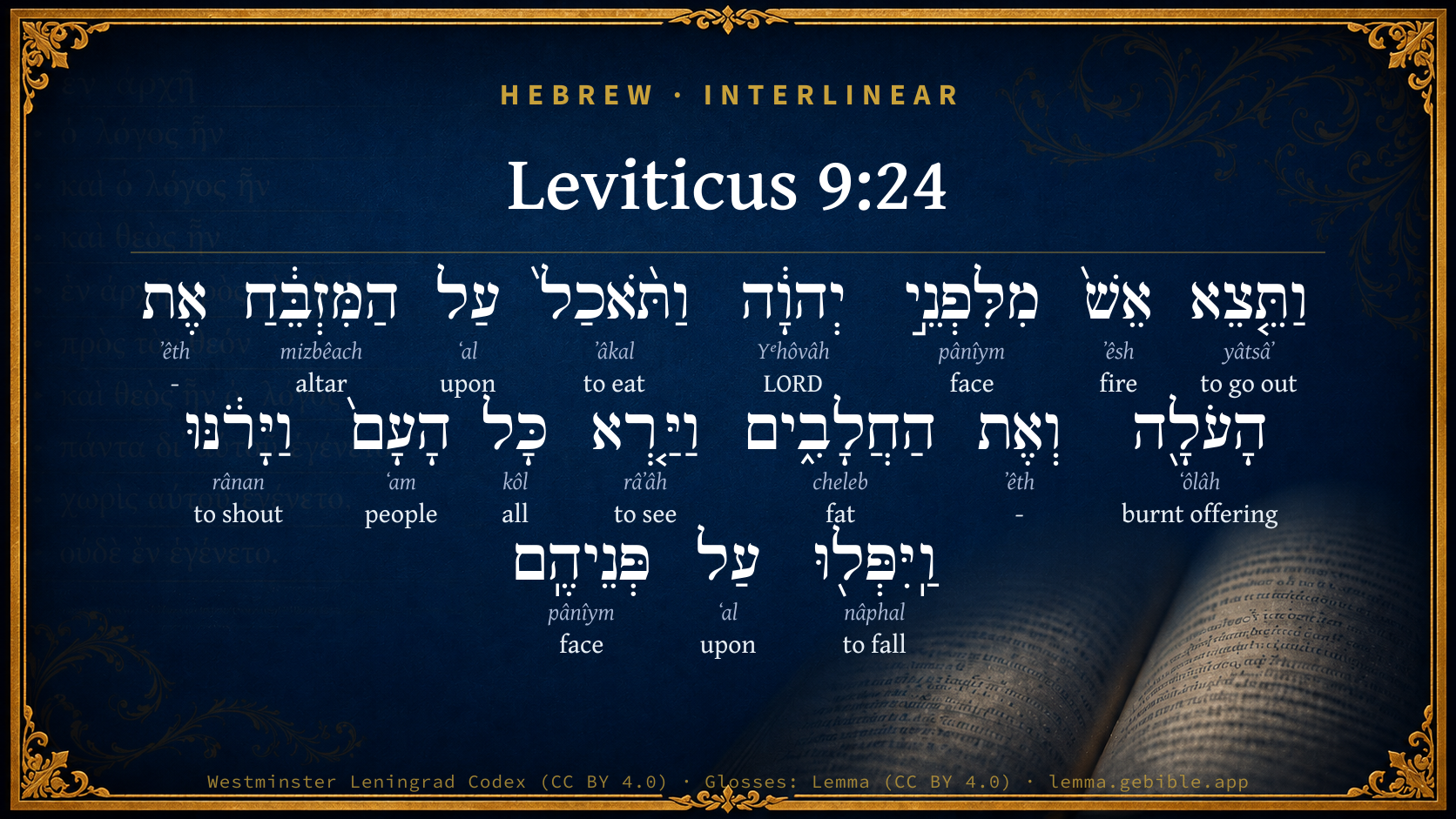
Hebrew (Westminster Leningrad Codex) Leviticus 9:24 appears in the Hebrew Old Testament. The text above is from the Westminster Leningrad Codex. Each word links to its Strong’s number, a concise gloss, and parsing drawn from the Open Scriptures Hebrew Bible morphology. Click any word for its full Brown-Driver-Briggs (BDB) entry.
Download image
Cite this verse

Leviticus 9:24 (World English Bible). Public Domain. Lemma interlinear Bible study tool, https://lemma.gebible.app/v/leviticus/9/24.

Show BibTeX & RIS
BibTeX
RIS
English Translation
There came forth fire from before Yahweh, and consumed the burnt offering and the fat upon the altar: and when all the people saw it, they shouted, and fell on their faces.
World English Bible · Public Domain
Highlights
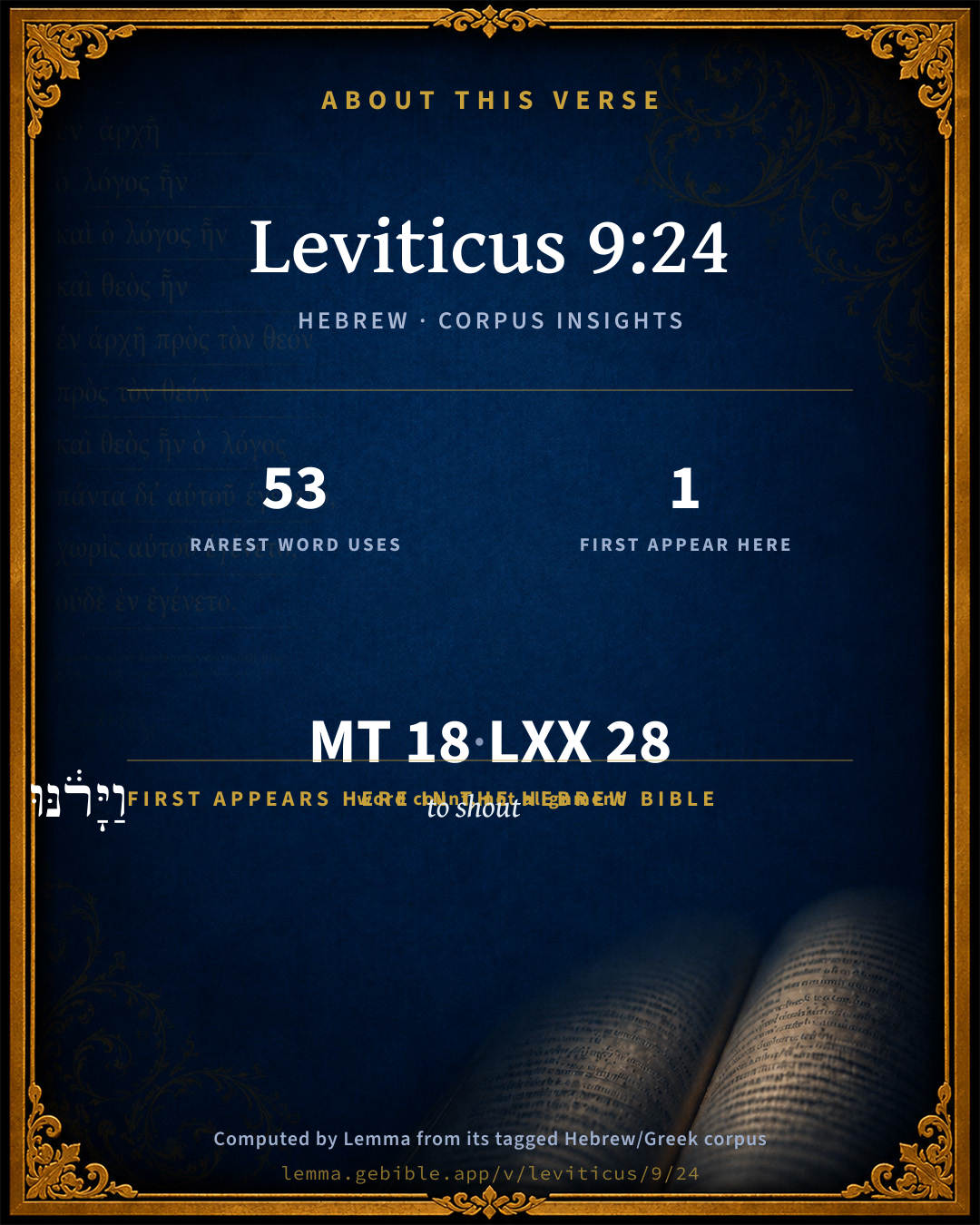
  • 1 first appearance in the Hebrew Bible
Full analysis ↓
Download a study sheet

One document with this verse’s original text, its word-by-word gloss line, the meaning frame, cross-references with their text, attributed commentary, and full source and license credits — printable, and it pastes into notes with its structure intact.

This verse Autodidact and up

Study sheet (.html) Plain text (.txt)

A passage Seminary Student

Up to 50 verses in one chapter. A passage sheet keeps up to 6 commentary sources and 12 cross-references per verse, in the order this page ranks them, and says so on the sheet whenever that leaves anything out. Ask for a single verse and you get the Autodidact verse sheet above.

Everything on this page stays free to read, with no account — the sheet is a download of what is already on screen, not access to it.

Want to remove ads? Support Godless Engineer
Compare translations 3

The same verse in 3 English versions, stacked beneath the original-language interlinear above. Click any original word for its lexicon entry.

Each is an independent rendering of the whole verse — the interlinear is not word-aligned to these translations.

Highlighted words mark where these versions differ — a whole-verse word diff, not a word-by-word alignment.

  • World English Bible Public Domain
    There came forth fire from before Yahweh, and consumed the burnt offering and the fat upon the altar: and when all the people saw it, they shouted, and fell on their faces.
  • King James Version Public Domain
    And there came a fire out from before the LORD, and consumed upon the altar the burnt offering and the fat: which when all the people saw, they shouted, and fell on their faces.
  • unfoldingWord Literal Text CC BY-SA 4.0
    And fire went forth before the face of Yahweh, and it consumed the burnt offering and the fat on the altar. And all the people saw, and they shouted, and they fell on their faces.

unfoldingWord Literal Text — © unfoldingWord, licensed CC BY-SA 4.0. Word-aligned USFM3 via Door43 (git.door43.org/unfoldingWord/en_ult).

Versions to compare (up to 4)

3 of 4 selected

Show all 18 translations

Every available English version of this verse, each an independent rendering of the whole verse.

  • World English Bible Public Domain
    There came forth fire from before Yahweh, and consumed the burnt offering and the fat upon the altar: and when all the people saw it, they shouted, and fell on their faces.
  • Berean Standard Bible Public Domain
    Fire came out from the presence of the LORD and consumed the burnt offering and the fat portions on the altar. And when all the people saw it, they shouted for joy and fell facedown.
  • Majority Standard Bible Public Domain
    Fire came out from the presence of the LORD and consumed the burnt offering and the fat portions on the altar. And when all the people saw it, they shouted for joy and fell facedown.
  • King James Version Public Domain
    And there came a fire out from before the LORD, and consumed upon the altar the burnt offering and the fat: which when all the people saw, they shouted, and fell on their faces.
  • American Standard Version (1901) Public Domain
    And there came forth fire from before Jehovah, and consumed upon the altar the burnt-offering and the fat: and when all the people saw it, they shouted, and fell on their faces.
  • Revised Version (1885) Public Domain
    And there came forth fire from before the LORD, and consumed upon the altar the burnt offering and the fat: and when all the people saw it, they shouted, and fell on their faces.
  • Geneva Bible (1599) Public Domain
    And there came a fire out from the Lord and consumed vpon the Altar the burnt offring and the fatte: which when all the people sawe, they gaue thankes, and fell on their faces.
  • Douay-Rheims (1899) Public Domain
    And behold a fire, coming forth from the Lord, devoured the holocaust, and the fat that was upon the altar: which when the multitude saw, they praised the Lord, falling on their faces.
  • Young's Literal Translation Public Domain
    and fire cometh out from before Jehovah, and consumeth on the altar the burnt-offering, and the fat; and all the people see, and cry aloud, and fall on their faces.
  • Literal Standard Version CC BY-SA 4.0
    and fire comes out from before YHWH, and consumes the burnt-offering and the fat on the altar; and all the people see, and cry aloud, and fall on their faces.
  • Unlocked Literal Bible CC BY-SA 4.0
    Fire came out from Yahweh and consumed the burnt offering and the fat on the altar. When all the people saw this, they shouted and lay facedown.
  • unfoldingWord Literal Text CC BY-SA 4.0
    And fire went forth before the face of Yahweh, and it consumed the burnt offering and the fat on the altar. And all the people saw, and they shouted, and they fell on their faces.
  • Darby Bible Public Domain
    And there went out fire from before Jehovah, and consumed on the altar the burnt-offering, and the pieces of fat; and all the people saw it, and they shouted, and fell on their face.
  • World Messianic Bible Public Domain
    Fire came out from before the LORD, and consumed the burnt offering and the fat upon the altar. When all the people saw it, they shouted, and fell on their faces.
  • Webster's Bible Public Domain
    And there came out a fire from before the LORD, and consumed upon the altar the burnt-offering and the fat: which, when all the people saw, they shouted, and fell on their faces.
  • Free Bible Version CC BY-SA 4.0
    Fire came from the presence of the Lord and burned up the burnt offering and the fat portions on the altar. When everyone saw this, they shouted for joy and fell down with their faces to the ground.
  • Bible in Basic English Public Domain
    And fire came out from before the Lord, burning up the offering on the altar and the fat: and when all the people saw it, they gave a loud cry, falling down on their faces.
  • JPS Tanakh (1917) Public Domain
    And there came forth fire from before the LORD, and consumed upon the altar the burnt-offering and the fat; and when all the people saw it, they shouted, and fell on their faces.

Literal Standard Version (2020), Covenant Press — licensed CC BY-SA 4.0. Text via the HelloAO Bible API (eBible.org). Unlocked Literal Bible (unfoldingWord) — licensed CC BY-SA 4.0. Text via the HelloAO Bible API (eBible.org). unfoldingWord Literal Text — © unfoldingWord, licensed CC BY-SA 4.0. Word-aligned USFM3 via Door43 (git.door43.org/unfoldingWord/en_ult). Free Bible Version, Dr. Jonathan Gallagher — licensed CC BY-SA 4.0. Text via the HelloAO Bible API (eBible.org).

Word by word

More ways to search: Search by grammar → Find every occurrence → Compare this word →

Practice this passage: Drill this verse → Learn its vocabulary →

וַיָּרֹ֔נּוּ
rânan
H7442
“and · to shout”
Conjunction + Verb, Qal, Sequential Imperfect, 3rd Person, Masculine, Plural
Part of Speech
Conjunction + Verb
Stem
Qal
Form
Sequential Imperfect
Person
3rd Person
Gender
Masculine
Number
Plural
Full BDB Definition

Origin: a primitive root

TWOT: 2134 , 2179

to overcome - (Hithpolel) to be overcome - to cry out, shout for joy, give a ringing cry - (Qal) - to give a ringing cry (in joy, exaltation, distress) - to cry aloud (in summons, exhortation of wisdom) - (Piel) to give a ringing cry (in joy, exultation, praise - (Pual) ringing cry, singing out (passive) - (Hiphil) to cause to ring or sing out (for joy) - (Hithpolel) rejoicing (participle)
  1. וַתֵּ֤צֵא yâtsâʼ H3318 “and · to go out” Conjunction + Verb, Qal, Sequential Imperfect, 3rd Person, Feminine, Singular
  2. אֵשׁ֙ ʼêsh H784 “fire” Noun, Common, Both, Singular, Absolute
  3. מִלִּפְנֵ֣י pânîym H6440 “from · to/for · face(s) of” Preposition + Preposition + Noun, Common, Both, Plural, Construct
  4. יְהוָ֔ה Yᵉhôvâh H3068 “LORD” Noun, Proper
  5. וַתֹּ֨אכַל֙ ʼâkal H398 “and · to eat” Conjunction + Verb, Qal, Sequential Imperfect, 3rd Person, Feminine, Singular
  6. עַל ʻal H5921 “upon” Preposition
  7. הַמִּזְבֵּ֔חַ mizbêach H4196 “the · altar” Particle, Definite Article + Noun, Common, Masculine, Singular, Absolute
  8. אֶת ʼêth H853 “-” Particle, Direct Object
  9. הָעֹלָ֖ה ʻôlâh H5930 “the · burnt offering” Particle, Definite Article + Noun, Common, Feminine, Singular, Absolute
  10. וְאֶת ʼêth H853 “and · -” Conjunction + Particle, Direct Object
  11. הַחֲלָבִ֑ים cheleb H2459 “the · fat” Particle, Definite Article + Noun, Common, Masculine, Plural, Absolute
  12. וַיַּ֤רְא râʼâh H7200 “and · to see” Conjunction + Verb, Qal, Sequential Imperfect, 3rd Person, Masculine, Singular
  13. כָּל kôl H3605 “all of” Noun, Common, Masculine, Singular, Construct
  14. הָעָם֙ ʻam H5971 “the · people” Particle, Definite Article + Noun, Common, Masculine, Singular, Absolute
  15. וַֽיִּפְּל֖וּ nâphal H5307 “and · to fall” Conjunction + Verb, Qal, Sequential Imperfect, 3rd Person, Masculine, Plural
  16. עַל ʻal H5921 “upon” Preposition
  17. פְּנֵיהֶֽם pânîym H6440 “face(s) · their” Noun, Common, Both, Plural, Construct + Suffix, Personal, 3rd Person, Masculine, Plural

About this verse

These counts appear in no published source. They are computed here, from the morphology-tagged text and Lemma’s own curated glosses. What Lemma adds →

18
words
15
distinct lemmas
Pentateuch
section

First appearance in Scripture

This word makes its first canonical appearance in the Hebrew Bible here:

  • וַיָּרֹ֔נּוּ to shout H7442

Shared distinctive vocabulary

וַיָּרֹ֔נּוּ to shout H7442 occurs in 53 verses of the Hebrew Bible. Also found in:

Grammatical profile

  • 5 verbs
  • 9 nouns
  • 2 prepositions
  • 2 particles

Verb forms

  • וַתֵּ֤צֵא Qal · Sequential Imperfect
  • וַתֹּ֨אכַל֙ Qal · Sequential Imperfect
  • וַיַּ֤רְא Qal · Sequential Imperfect
  • וַיָּרֹ֔נּוּ Qal · Sequential Imperfect
  • וַֽיִּפְּל֖וּ Qal · Sequential Imperfect

Repetition

Words recur within this verse — often emphatic in Hebrew:

  • מִלִּפְנֵ֣י face H6440 ×2
  • עַל upon H5921 ×2

Hebrew & Septuagint length

In English translation the verse runs 32 words from the Hebrew and 35 from the Septuagint (LXX English) — closely comparable.

A rough comparison of the two English renderings, which tokenize alike — not a word-level alignment.

Word counts can differ between the Hebrew and the Greek without any difference in meaning — e.g. the Hebrew direct-object marker אֵת has no separate Greek word, and Greek often adds the article ὁ.

In the original languages it is 18 Hebrew tokens and 28 Greek tokens — but the two are counted differently (Hebrew bundles its prefixes and suffixes into one token; the Greek is in lemma form), so that isn’t a like-for-like length.

Cross-references

22

Topical passages linked to Leviticus 9:24 in the Treasury of Scripture Knowledge — connected by theme and wording, ordered by reader-vote popularity; previews shown in the World English Bible.

  • Judges 6:21 Then the angel of Yahweh put forth the end of the staff that was in his hand, and touched the flesh and the unleavened cakes; and there went up fire out of the rock, and consumed the flesh and the unleavened cakes; and the angel of Yahweh departed out of his sight.
  • 1 Kings 18:38–39 Then the fire of Yahweh fell, and consumed the burnt offering, and the wood, and the stones, and the dust, and licked up the water that was in the trench.
  • 1 Chronicles 21:26 David built there an altar to Yahweh, and offered burnt offerings and peace-offerings, and called on Yahweh; and he answered him from the sky by fire on the altar of burnt offering.
  • Exodus 3:2 The angel of Yahweh appeared to him in a flame of fire out of the midst of a bush. He looked, and behold, the bush burned with fire, and the bush was not consumed.
  • Judges 13:19–20 So Manoah took the kid with the meal-offering, and offered it on the rock to Yahweh: and [the angel] did wondrously, and Manoah and his wife looked on.
  • Genesis 15:17 It came to pass that, when the sun went down, and it was dark, behold, a smoking furnace, and a flaming torch passed between these pieces.
  • 2 Chronicles 7:1–3 Now when Solomon had made an end of praying, the fire came down from heaven, and consumed the burnt offering and the sacrifices; and the glory of Yahweh filled the house.
  • Leviticus 6:13 Fire shall be kept burning on the altar continually; it shall not go out.
  • Judges 13:23 But his wife said to him, If Yahweh were pleased to kill us, he wouldn't have received a burnt offering and a meal-offering at our hand, neither would he have shown us all these things, nor would at this time have told such things as these.
  • Psalms 20:3–4 Remember all your offerings, And accept your burnt sacrifice. Selah.
  • Psalms 80:1 Hear us, Shepherd of Israel, You who lead Joseph like a flock, You who sit above the cherubim, shine forth.
  • Ezra 3:11 They sang one to another in praising and giving thanks to Yahweh, [saying], For he is good, for his loving kindness endures forever toward Israel. All the people shouted with a great shout, when they praised Yahweh, because the foundation of the house of Yahweh was laid.
  • Matthew 26:39 He went forward a little, fell on his face, and prayed, saying, "My Father, if it is possible, let this cup pass away from me; nevertheless, not what I desire, but what you desire."
  • Revelation 5:8 Now when he had taken the book, the four living creatures and the twenty-four elders fell down before the Lamb, each one having a harp, and golden bowls full of incense, which are the prayers of the saints.
  • Revelation 7:11 All the angels were standing around the throne, the elders, and the four living creatures; and they fell on their faces before his throne, and worshiped God,
  • Genesis 4:3–4 As time passed, it happened that Cain brought an offering to Yahweh from the fruit of the ground.
  • Genesis 17:3 Abram fell on his face. God talked with him, saying,
  • Numbers 14:5 Then Moses and Aaron fell on their faces before all the assembly of the congregation of the children of Israel.
  • Numbers 16:22 They fell on their faces, and said, God, the God of the spirits of all flesh, shall one man sin, and will you be angry with all the congregation?
  • 2 Kings 19:15 Hezekiah prayed before Yahweh, and said, Yahweh, the God of Israel, who sit [above] the cherubim, you are the God, even you alone, of all the kingdoms of the earth; you have made heaven and earth.
  • 2 Chronicles 6:2 But I have built you a house of habitation, and a place for you to dwell in forever.
  • Revelation 4:9 When the living creatures give glory, honor, and thanks to him who sits on the throne, to him who lives forever and ever,

Cross-references courtesy of OpenBible.info (CC BY 4.0).

Hebrew and Greek witnesses Masoretic Hebrew ↔ Greek Septuagint

The same verse in the two great witnesses to the Old Testament, shown verse-for-verse.

These are two independent witnesses, not word-aligned to each other, and the Septuagint is shown in lemma (dictionary) form.

Hebrew Leviticus 9:24 Masoretic · Westminster Leningrad Codex

וַתֵּ֤צֵא אֵשׁ֙ מִלִּפְנֵ֣י יְהוָ֔ה וַתֹּ֨אכַל֙ עַל הַמִּזְבֵּ֔חַ אֶת הָעֹלָ֖ה וְאֶת הַחֲלָבִ֑ים וַיַּ֤רְא כָּל הָעָם֙ וַיָּרֹ֔נּוּ וַֽיִּפְּל֖וּ עַל פְּנֵיהֶֽם

There came forth fire from before Yahweh, and consumed the burnt offering and the fat upon the altar: and when all the people saw it, they shouted, and fell on their faces.

World English Bible · Public Domain

Greek LXX Leviticus 9:24 Septuagint · lemma form

καί ἐκἔρχομαι πῦρ παρά κύριος καί καταἐσθίω ὁ ἐπί ὁ θυσιαστήριον ὁ τε ὁλοκαύτωμα καί ὁ στέαρ καί ὁράω πᾶς ὁ λαός καί ἐκἵστημι καί πίπτω ἐπί πρόσωπον

And fire came forth from the Lord, and devoured the offerings on the altar, both the whole burnt offerings and the fat; and all the people saw, and were amazed, and fell upon their faces.

LXX2012 (modern English Septuagint) · Public Domain

On this verse, The Cambridge Bible for Schools and Colleges discusses the Septuagint’s reading. Read the note in Commentary ↓

Hebrew: Westminster Leningrad Codex (CC BY 4.0). Greek: Septuagint (public domain); English from LXX2012 (modern English Septuagint) (Public Domain). How the Septuagint differs from the Hebrew →

Targum (Aramaic paraphrase)

2

The Targum is the ancient Jewish Aramaic paraphrase of the Hebrew Scriptures — an interpretive translation, not the Hebrew text itself. Onkelos (literal) and Pseudo-Jonathan (expansive) render the Torah, and Jonathan the Prophets. Coverage is partial: where no permissively-licensed English translation exists for a verse, only the Aramaic is shown. This is verse-level text, not a word-by-word alignment to the Hebrew.

  1. Targum Onkelos Torah (Genesis–Deuteronomy)
    וּנְפָקַת אֶשָׁתָא מִן קֳדָם יְיָ וַאֲכָלַת עַל מַדְבְּחָא יָת עֲלָתָא וְיָת תַּרְבַּיָא וַחֲזָא כָּל עַמָא וְשַׁבָּחוּ וּנְפָלוּ עַל אַפֵּיהוֹן

    (no public-domain English translation for this verse)

    Targum Onkelos — Aramaic: “Onkelos Genesis” (public domain); “Onkelos Exodus” (public domain); “Onkelos Leviticus” (public domain); “Onkelos Numbers” (public domain); “Onkelos Deuteronomy” (public domain). English: “Sefaria Community Translation” (CC0 1.0 (public-domain dedication)); “J.W. Etheridge. The Targums of Onkelos and Jonathan Ben Uzziel on the Pentateuch. London: Longmans, Green, 1862” (public domain). Text via Sefaria.

  2. Targum Pseudo-Jonathan Torah (Genesis–Deuteronomy)
    וּנְפָקַת אֵישָׁתָא מִן קֳדָם יְיָ וְאַכְלַת עַל מַדְבְּחָא יַת עָלָתָא יַת תַּרְבַּיָא וְחָמוּן כָּל עַמָא וְאוֹדוּן וְאִיתְרְכִינוּ בִּצְלוֹ עַל אַנְפֵּיהוֹן

    and the Fire came forth from the Presence of the Lord and consumed upon the altar the sacrifice and the fat. And all the people saw, and gave praise, and bowed in prayer upon their faces.

    Targum Pseudo-Jonathan — Aramaic: “Targum Jonathan on Genesis” (public domain); “Targum Jonathan on Exodus” (public domain); “Targum Jonathan on Leviticus” (public domain); “Targum Jonathan on Numbers” (public domain); “Targum Jonathan on Deuteronomy” (public domain). English: “The Targum of Jonathan ben Uzziel, trans. J. W. Etheridge, London, 1862” (public domain). Text via Sefaria.

Commentary

Notes on Leviticus 9:24 from classic Christian and Jewish commentators (each source and its license shown beneath its notes). The classic Christian expositions comment on the surrounding passage and are grouped to its opening verse, so a note may address several verses; the Jewish commentaries on the Tanakh (Rashi and others) are per-verse, so they appear only where the commentator wrote on this verse.

Lemma curates 59 commentaries, every one of them public domain or Creative Commons licensed, each selected and text-cleaned for this edition rather than reprinted as found. About our sources →

Trapp's Complete Commentary

John Trapp

Lev 9:24 And there came a fire out from before the LORD, and consumed upon the altar the burnt offering and the fat: [which] when all the people saw, they shouted, and fell on their faces.

Ver. 24. They shouted, and fell on their faces.] The consideration of God’s gracious acceptation of us in Christ should make us to lift many a humble, joyful, and thankful heart to God.

John Trapp, A Commentary or Exposition upon All the Books of the Old and New Testament (1647–1656) — public domain. Text from a community e-Sword module.

Albert Barnes' Notes on the Bible

The very ancient Jewish tradition has been widely adopted that the sacred fire of the altar originated in this divine act, and that it was afterward preserved on the altar of the tabernacle until the dedication of the temple, when fire again “came down from heaven.” 2Ch 7:1. But according to the sacred narrative the altar-fire had been lighted in a natural way before this occasion. (Compare Lev 8:16; Lev 9:10, Lev 9:13, etc.; Exo 40:29.) It would therefore seem that the fire which “came out from before the Lord” manifested itself, according to the words of Lev 9:24, not in kindling the fuel on the altar, but in the sudden consuming of the victim. For the like testimony to the acceptance of a sacrifice, see Jdg 13:19-20; 1Ki 18:38; 1Ch 21:26, and probably Gen 4:4. The phrase to turn a sacrifice to ashes, became equivalent to accepting it (Psa 20:3, see the margin). The fire of the altar was maintained in accordance with Lev 6:13.

Albert Barnes' Notes on the Bible (1834–1885) — public domain. Text from a community e-Sword/MySword module.

Joseph Benson's Commentary

Lev 9:24. And there came a fire — In token of God’s approbation of the priesthood now instituted, and the sacrifices offered, and consequently of others of the like nature. And this fire now given was to be carefully kept, and not suffered to go out, (Lev 6:13,) and therefore was carried in a peculiar vessel in their journeys in the wilderness. It is said to have lasted till the time of Solomon, when God sent fire anew from heaven to consume the sacrifices offered at the dedication of the temple. And that again is said to have been preserved till the destruction of that first temple. From before the Lord — Or, From the presence of the Lord; that is, from the place where God was in a special manner present, either from heaven or from the holy of holies. They shouted — As wondering at, rejoicing in, and blessing God for, this gracious discovery of himself, and his favour.

This also was a figure of good things to come. Thus the Spirit descended in fire upon the apostles, so ratifying their commission, as this did that of the priests. And the descent of this holy fire into our souls, to kindle in them devout affections, and such a holy zeal as burns up all unholiness, is a certain token of God’s gracious acceptance.

Joseph Benson's Commentary on the Old and New Testaments (1811–1818) — public domain. Text from a community e-Sword module.

Tyndale Open Study Notes

Tyndale Open Resources

9:24 Fire blazed forth from the Lord’s presence, indicating that God had accepted the offerings, the atonement, and the priesthood (9:7; cp. 1 Kgs 18:36-38).

Tyndale Open Study Notes — © Tyndale Open Resources, licensed CC BY-SA 4.0. Text via the HelloAO Bible API.

Geneva Bible (1599)

Geneva Bible translators

Or, gave a shout for joy.

Geneva Bible (1599) marginal notes — public domain. Text via Bolls.life.

Jamieson, Fausset & Brown

Robert Jamieson, A. R. Fausset & David Brown

there came a fire out from . . . the Lord--A flame emanating from that resplendent light that filled the holy place flashed upon the brazen altar and kindled the sacrifices. This miraculous fire--for the descent of which the people had probably been prepared, and which the priests were enjoined never to let go out (Lev 6:13) --was a sign, not only of the acceptance of the offerings and of the establishment of Aaron's authority, but of God's actual residence in that chosen dwelling-place. The moment the solemn though welcome spectacle was seen, a simultaneous shout of joy and gratitude burst from the assembled congregation, and in the attitude of profoundest reverence they worshipped "a present Deity."

Next: Leviticus Chapter 10

Jamieson, Fausset & Brown — Commentary Critical and Explanatory on the Whole Bible (1871) — public domain (CC PDM 1.0). Text via the HelloAO Bible API.

Adam Clarke's Commentary

Verse 24. When all the people saw, they shouted, and fell on their faces.]

1. The miracle was done in such a way as gave the fullest conviction to the people of its reality.

2. They exulted in the thought that the God of almighty power and energy had taken up his abode among them.

3. They prostrated themselves in his presence, thereby intimating the deep sense they had of HIS goodness, of their unworthiness, and of the obligation they were under to live in subjection to his authority, and obedience to his will. -

This celestial fire was carefully preserved among the Israelites till the time of Solomon, when it was renewed, and continued among them till the Babylonish captivity. This Divine fire was the emblem of the Holy Spirit. And as no sacrifice could be acceptable to God which was not salted, i. e., seasoned and rendered pleasing, by this fire, as our Lord says, Mr 9:49, so no soul can offer acceptable sacrifices to God, but through the influences of the Divine Spirit. Hence the promise of the Spirit under the emblem of fire, Mt 3:11, and its actual descent in this similitude on the day of pentecost, Ac 2:3-4.

THE most remarkable circumstance in this chapter is the manifestation of the presence of God, and the consuming of the victims by the miraculous fire. We have already seen that the chief design of these sacrificial rites was to obtain reconciliation to God, that the Divine Presence might dwell and be manifested among them. To encourage the people to make the necessary preparations, to offer the sacrifices in a proper spirit, and to expect especial mercies from the hand of God, Moses promises, Le 9:4, that the Lord would appear unto them on the morrow, and that his glory should appear, Le 9:6. In hope or expectation of this, the priest, the elders, and the people purified themselves by offering the different sacrifices which God had appointed; and when this was done God did appear, and gave the fullest proofs of his approbation, by miraculously consuming the sacrifices which were prepared on the occasion. Does not St. John evidently refer to these circumstances, 1Jo 3:2-3: "Beloved, now are we the sons of God; and it doth not yet appear what we shall be; but we know that when he shall appear, we shall be like him, for we shall see him as he is; and every man that hath this hope in him, purifieth himself, even as he is pure." This manifestation of God in the tabernacle was a type of his presence, first, in the Church militant on earth; and secondly, in the Church triumphant in heaven. They who expect to have the presence of God here, must propitiate his throne of justice by the only available sacrifice; they who wish to enjoy everlasting felicity, must be purified from all unrighteousness, for without holiness none can see the Lord. If we hope to see him as he is, we must resemble him. How vain is the expectation of glory, where there is no meetness for the place! And how can we enter into the holiest but by the blood of Jesus? Heb 10:19. And of what use can this sacrifice be to those who do not properly believe in it? And can any faith, even in that sacrifice, be effectual to salvation, that does not purify the heart? Reader! earnestly pray to God that thou hold not the truth in unrighteousness.

Adam Clarke's Commentary on the Bible (1810–1826) — public domain. Text from a community e-Sword/MySword module.

Ellicott's Commentary for English Readers

(24) And there came a fire.—As a further indication of His acceptance of all the forementioned rites, the Lord sent forth from the luminous cloud flashes of fire, which, on this occasion, suddenly consumed in the sight of the people the victims that ordinarily continued smouldering on the altar all the day and all the night. In this manner God afterwards testified His acceptance of the sacrifice of Gideon (Jdg_6:20-21), of Elijah, (1Ki_18:28), and of the sacrifices of Solomon at the dedication of the Temple (2Ch_7:1-2). Tradition assures us that the sacred fire which thus issued forth from the immediate presence of God continued to be nourished on the altar with the fuel especially provided by the congregation, and constituted the perpetual fire. (See Lev_6:13.)

They shouted, and fell on their faces.—On seeing these visible tokens of the Divine acceptance of the services, the people expressed their thankfulness in the same manner as they showed it on a similar occasion. Thus we are told—“When all the sons of Israel saw how the fire came down, and the glory of the Lord shone upon the house, they bowed themselves with their faces to the ground upon the pavement, and worshipped and praised the Lord, saying, For he is good, for his mercy endureth for ever” (2Ch_27:3).

A Bible Commentary for English Readers, edited by Charles John Ellicott (1878–1897) — public domain. Text from a community e-Sword module.

The Cambridge Bible for Schools and Colleges

gen. ed. J. J. S. Perowne

24. A second blessing follows after Moses and Aaron come out from the temple. God’s approval is signified, for His servant has returned from His presence with gifts of grace for His people. It is further signified by the appearance of the glory of the Lord (cp. Lev_9:4; Lev_9:6), and the fire from before the Lord which consumes the Burnt-Offering and the fat. Similar manifestations of approval are recorded in Jdg_6:21; 1Ki_18:38; 1Ch_21:26. In 2Ch_7:1 the fire comes down from heaven.

24 a is perhaps an interpolation. In Lev_9:13; Lev_9:16 (cp. Lev_8:20) the ‘fat’ is not mentioned in connexion with the Burnt-Offerings, while it is stated (Lev_9:13) that Aaron burnt the pieces one by one. Moreover, the sacrifice was already ended (Lev_9:22), so that there is difficulty in supposing the fat and burnt-offering to be still upon the altar.

Perhaps the LXX.’s ‘offered’ and ‘put’ for ‘burnt’ in Lev_9:13; Lev_9:17; Lev_9:20 may be influenced by this consideration. This is, however, a somewhat precarious deduction.

The Cambridge Bible for Schools and Colleges (gen. ed. J. J. S. Perowne; Cambridge University Press, 1878–1918) — public domain. Text from a community e-Sword module.

Haydock's Catholic Bible Commentary

The Lord: 2 Machabees ii. 10, explains this text. Fire came down from heaven, appearing like a flash of lightning, in the midst of the victims. (Josephus, Antiquities iii. 9.) (Calmet)

George Leo Haydock (1774–1849), Haydock's Catholic Family Bible and Commentary, 1859 edition — public domain. Excludes Psalms (Douay-Rheims chapter numbering differs from Protestant) and Deuterocanonical books (Catholic canon only).

Matthew Poole's English Annotations

There came a fire, in token of God’s acceptation and approbation of the priesthood now instituted, and the sacrifices now offered, and consequently of others of the like nature. See the like instances, Jdg 6:21; 13:19,20; 1Ch 21:26. And this fire now given was to be carefully kept, and not suffered to go out, Lev 6:13, and therefore was carried in a peculiar vessel in their journeys in the wilderness.

From before the Lord; or, from the face or presence of the Lord; i.e. from the place where God was in a special manner present: either,

1. From heaven, as 1Ki 18:38; 2Ch 7:1, which is oft called God’s dwelling-place, as Deu 26:15; Isa 63:15. Or,

2. From the holy of holies, where also God is said to dwell, 2Ki 19:15; 2Ch 6:2; Psa 80:1. And what is done before the ark is said to be done before God, as 1Ch 13:8,10; 16:1, &c. And this may seem more probable by comparing this with Lev 10:2.

They shouted; as wondering at, rejoicing in, and blessing God for this wonderful and gracious discovery of himself, and of his favour to them therein.

Matthew Poole's English Annotations on the Holy Bible (1683–1685) — public domain. Text from a community e-Sword/MySword module.

Whedon's Commentary on the Bible

Daniel D. Whedon

24. There came a fire out from before the Lord — This supernatural fire was the divine ratification of the priesthood, and acceptance of their first offering. According to the Jews, it couched upon the altar like a lion; it was bright as the sun; the flame was pure and solid, emitting no smoke, and consuming wet and dry things alike. Says Oehler, “The Shekinah shows its reality in the sanctuary by means of actions of power which go out from it.” See Lev_10:2, note. The command to keep this heavenly fire is recorded in Lev_6:13. See note for the period during which it was preserved.

They shouted — This was the shout of victory — the prostration of worship. All was now complete — the sacrifice, the robed and mitred priest, the priestly family associated with their head, the priestly benediction, the appearance of the King and Priest, and the outflashing of the divine glory — a marvellously beautiful shadow of things to come.

Ever since the Son of God was glorified on high as our High Priest, and his sending down the Paraclete, has the earth resounded with the shouts of souls filled with the Holy Ghost. All true service is gladdened by the divine acceptance, and glorified by the divine presence.

Daniel D. Whedon (gen. ed.), Commentary on the Old and New Testaments (1874–1909) — public domain. Text from a community e-Sword module.

The Pulpit Commentary

And there came a fire out from before the Lord. The sacrifices were already smouldering on the altar, a ram, a calf, and a lamb, besides the internal fat of a young bull, a kid, a bullock, and a ram, and a handful of flour. They would have continued smouldering all the day and the night, but a miraculous fire issued from the tabernacle, and consumed the whole in the sight of the people. So fire fell and consumed Solomon"s sacrifice at the dedication of the temple. Jewish tradition reports that the fire was always kept alive until the reign of Manasseh, when it became extinguished. When the people saw this sight, they shouted, and fell on their faces. They had been standing in a state of intense expectation, awaiting the fulfillment of the promise that the Lord would appear unto them today, and watching the acts of the two brothers; and their feelings are now raised to the utmost enthusiasm and awe by the appearance of the glory of the Lord and the notion of the Divine fire. See 2Ch_8:3.

Miraculous confirmation of the new polity is given by a fire issuing from the presence of God.

I INSTANCES OF A LIKE KIND OF DIVINE AGENCY BY FIRE.

1. The case of Gideon. "And the angel of God said unto him, Take the flesh and the unleavened cakes, and lay them upon this rock, and pour out the broth. And he did so. Then the angel of the Lord put forth the end of the staff that was in his hand, and touched the flesh and the unleavened cakes; and there rose up fire out of the rock, and consumed the flesh and the unleavened cakes". (Jud_1:6:20, 21)

2. The case of Elijah. "Call ye on the name of your gods, and I will call on the Name of the Lord: and the God that answereth by fire, let him be God. And all the people answered and said, It is well spoken.... Then the fire of the Lord fell, and consumed the burnt sacrifice and the wood, and the stones, and the dust, and licked up the water that was in the trench". (1Ki_18:24-38)

3. The case of Solomon. "Now when Solomon had made an end of praying, the fire came down from heaven, and consumed the burnt offering and the sacrifices; and the glory of the Lord filled the house. And the priests could not enter into the house of the Lord, because the glory of the Lord had filled the Lord"s house". (2Ch_7:1, 2Ch_7:2)

II THE RESULT IS EACH CASE IS AWE.

1. "Gideon said, Alas, O Lord God! for because I have seen an angel of the Lord face to face. And the Lord said unto him, Peace be unto thee; fear not: thou shalt not die". (Jud_1:6:22, 23)

2. "And when all the people saw it, they fell on their hoes: and they said, The Lord, he is the God; the Lord, he is the God". (1Ki_18:39)

3. "And when all the children of Israel saw how the fire came down, and the glory of the Lord upon the house, they bowed themselves with their faces to the ground upon the pavement, and worshipped, and praised the Lord, saying, For he is good; for his mercy endureth for ever". (2Ch_7:3)

III THE PRESENT A FITTING OCCASION FOR A MIRACULOUS INTERVENTION. A miracle is to be expected at the introduction of any new system which emanates from God, because it is a means of showing Divine approval which cannot be gainsaid; but it is not to be expected frequently afterwards, or it would lose its special effect of impressing By its strangeness. The institution of the Law is such an occasion, and accordingly fire and smoke and earthquake showed the presence of God on Sinai. The institution of an hereditary priesthood was a part of the legislation which, being a vast change on the previously existing system, specially required a sign of God"s approval which all might see. The erection of Solomon"s temple was a like occasion. So at the institution of the Christian dispensation, miraculous gifts were vouchsafed to the apostles speaking with tongues, prophecy, gifts of healing, and the rest which were not intended to continue, and died out as soon as the Church was regarded as no longer coming into being, but fully formed. No new doctrine must be accepted except upon the testimony of miracle, hut a succession of miracles is not required to certify doctrine which has been once confirmed by miraculous means.

IV SIMILARITY YET DIFFERENCE OF THE PENTECOSTAL FINE. It was given at the institution of the new apostolic ministry. It was a confirmation of its authority to the minds of the recipients as well as others. But it indicated more than a mere Divine approval of a new system. It symbolized the gift of the Holy Ghost, and therefore it did not consume a sacrifice, but "it sat upon each" of those who were to be the instruments of the Holy Ghost in converting the world, and the ministers of the new dispensation. The fire of jealousy, which struck to the earth those who approached the Divine presence unbidden, has become the fire of love.

The Pulpit Commentary (1880–1919), ed. H.D.M. Spence-Jones & Joseph S. Exell — public domain. Text from a community e-Sword module.

John Wesley's Explanatory Notes

And there came a fire - In token of God's approbation of the priesthood now instituted, and the sacrifices offered, and consequently of others of the like nature. And this fire now given was to be carefully kept, and not suffered to go out, chap. vi, 13, and therefore was carried in a peculiar vessel in their journeys in the wilderness. From before the Lord - Or, from the presence of the Lord, that is, from the place where God was in a special manner present, either from heaven or from the holy of holies. They shouted - As wondering at, rejoicing in, and blessing God for this gracious discovery of himself, and his favour. This also was a figure of good things to come. Thus the Spirit descended in fire upon the apostles, so ratifying their commission, as this does that of the priests. And the descent of this holy fire into our souls, to kindle in them devout affections, and such an holy zeal as burns up all unholiness, is a certain token of God's gracious acceptance.

John Wesley, Explanatory Notes Upon the Whole Bible (1754–1765) — public domain. Text via the GEBible commentary corpus.

Rashi

Rabbi Shlomo Yitzchaki (Rashi)

וירנו Understand this as the Targum does: and they praised God.

Rashi on the Tanakh — English translations: “The Judaica Press complete Tanach with Rashi, translated by A. J. Rosenberg” (CC BY 4.0); “Pentateuch with Rashi's commentary by M. Rosenbaum and A.M. Silbermann, 1929-1934” (public domain); “The Metsudah Tanach series, Lakewood, N.J” (CC BY 4.0); and “The Book of Joshua, Metsudah Publications, 1997” (CC BY 4.0). Text via Sefaria.

Lesson kit

Teaching starters — assembled from the data on this page, not authored interpretation. Every prompt links to the verse data it draws on. Edit before teaching.

Leviticus, in the Pentateuch, opens this verse with 18 words (15 distinct Hebrew lemmas). Its most distinctive word is rânan (“to shout”). A historical commentator’s framing appears above. Read the whole chapter for the surrounding context.

Discussion questions

  1. The word rânan carries the sense “to shout.” How does it shape the verse?
  2. This is the first place “to shout” appears in Scripture (first appears here). What does its debut here establish?
  3. How does Deuteronomy 32:43, which shares the word «to shout», read alongside this verse?
  4. What does the repetition of “face” (2× in this one verse) do in this verse?
  5. The translations on this page render this verse differently — a whole-verse word diff, not a word-by-word alignment. What might account for the different wordings?
  6. «וַתֵּ֤צֵא» is a Qal Sequential Imperfect verb. How does that grammatical form shape the action described?
  7. Compare how Trapp's Complete Commentary and Albert Barnes' Notes on the Bible read this verse. Where do they agree or differ?

Things to notice

Reading settings

Reading text

Shown beneath each verse's original-language words.

Old Testament
Old Testament edition

Read the OT as the Masoretic Hebrew (MT) or the Greek Septuagint (LXX).

English shown for the Greek Septuagint (in the Hebrew ↔ Greek comparison).

Comparing translations? Open the Compare panel on any verse page to stack up to four side by side.