
Ezekiel 31:12

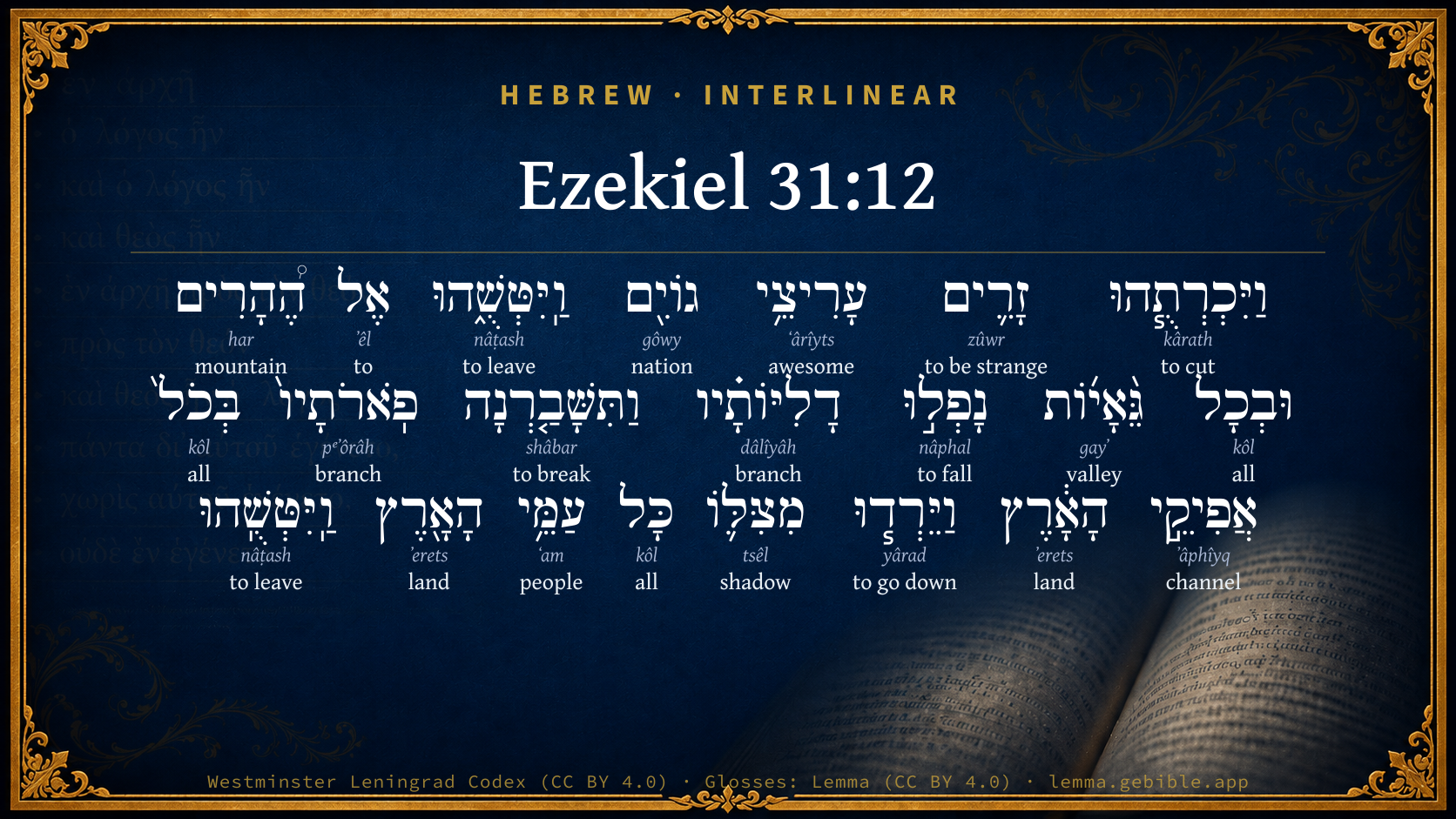
Hebrew (Westminster Leningrad Codex) Ezekiel 31:12 appears in the Hebrew Old Testament. The text above is from the Westminster Leningrad Codex. Each word links to its Strong’s number, a concise gloss, and parsing drawn from the Open Scriptures Hebrew Bible morphology. Click any word for its full Brown-Driver-Briggs (BDB) entry.
Download image
Cite this verse

Ezekiel 31:12 (World English Bible). Public Domain. Lemma interlinear Bible study tool, https://lemma.gebible.app/v/ezekiel/31/12.

Show BibTeX & RIS
BibTeX
RIS
English Translation
Strangers, the terrible of the nations, have cut him off, and have left him: on the mountains and in all the valleys his branches are fallen, and his boughs are broken by all the watercourses of the land; and all the peoples of the earth are gone down from his shadow, and have left him.
World English Bible · Public Domain
Download a study sheet

One document with this verse’s original text, its word-by-word gloss line, the meaning frame, cross-references with their text, attributed commentary, and full source and license credits — printable, and it pastes into notes with its structure intact.

This verse Autodidact and up

Study sheet (.html) Plain text (.txt)

A passage Seminary Student

Up to 50 verses in one chapter. A passage sheet keeps up to 6 commentary sources and 12 cross-references per verse, in the order this page ranks them, and says so on the sheet whenever that leaves anything out. Ask for a single verse and you get the Autodidact verse sheet above.

Everything on this page stays free to read, with no account — the sheet is a download of what is already on screen, not access to it.

Want to remove ads? Support Godless Engineer
Compare translations 3

The same verse in 3 English versions, stacked beneath the original-language interlinear above. Click any original word for its lexicon entry.

Each is an independent rendering of the whole verse — the interlinear is not word-aligned to these translations.

Highlighted words mark where these versions differ — a whole-verse word diff, not a word-by-word alignment.

  • World English Bible Public Domain
    Strangers, the terrible of the nations, have cut him off, and have left him: on the mountains and in all the valleys his branches are fallen, and his boughs are broken by all the watercourses of the land; and all the peoples of the earth are gone down from his shadow, and have left him.
  • King James Version Public Domain
    And strangers, the terrible of the nations, have cut him off, and have left him: upon the mountains and in all the valleys his branches are fallen, and his boughs are broken by all the rivers of the land; and all the people of the earth are gone down from his shadow, and have left him.
  • unfoldingWord Literal Text CC BY-SA 4.0
    Foreigners who were the terror of all the nations cut it off and left it to die. Its branches fell on the mountains and all the valleys, and its boughs lay broken in all the ravines of the land. Then all the nations on earth came out from under its shade and they went away from it.

unfoldingWord Literal Text — © unfoldingWord, licensed CC BY-SA 4.0. Word-aligned USFM3 via Door43 (git.door43.org/unfoldingWord/en_ult).

Versions to compare (up to 4)

3 of 4 selected

Show all 18 translations

Every available English version of this verse, each an independent rendering of the whole verse.

  • World English Bible Public Domain
    Strangers, the terrible of the nations, have cut him off, and have left him: on the mountains and in all the valleys his branches are fallen, and his boughs are broken by all the watercourses of the land; and all the peoples of the earth are gone down from his shadow, and have left him.
  • Berean Standard Bible Public Domain
    Foreigners, the most ruthless of the nations, cut it down and left it. Its branches have fallen on the mountains and in every valley; its boughs lay broken in all the earth’s ravines. And all the peoples of the earth left its shade and abandoned it.
  • Majority Standard Bible Public Domain
    Foreigners, the most ruthless of the nations, cut it down and left it. Its branches have fallen on the mountains and in every valley; its boughs lay broken in all the earth’s ravines. And all the peoples of the earth left its shade and abandoned it.
  • King James Version Public Domain
    And strangers, the terrible of the nations, have cut him off, and have left him: upon the mountains and in all the valleys his branches are fallen, and his boughs are broken by all the rivers of the land; and all the people of the earth are gone down from his shadow, and have left him.
  • American Standard Version (1901) Public Domain
    And strangers, the terrible of the nations, have cut him off, and have left him: upon the mountains and in all the valleys his branches are fallen, and his boughs are broken by all the watercourses of the land; and all the peoples of the earth are gone down from his shadow, and have left him.
  • Revised Version (1885) Public Domain
    And strangers, the terrible of the nations, have cut him off, and have left him: upon the mountains and in all the valleys his branches are fallen, and his boughs are broken by all the watercourses of the land; and all the peoples of the earth are gone down from his shadow, and have left him.
  • Geneva Bible (1599) Public Domain
    And the strangers haue destroyed him, euen the terrible nations, and they haue left him vpon the mountaines, and in all the valleis his branches are fallen, and his boughes are broken by all the riuers of the land: and all the people of the earth are departed from his shadowe, and haue forsaken him.
  • Douay-Rheims (1899) Public Domain
    And strangers, and the most cruel of the nations shall cut him down, and cast him away upon the mountains, and his boughs shall fall in every valley, and his branches shall be broken on every rock of the country: and all the people of the earth shall depart from his shadow, and leave him.
  • Young's Literal Translation Public Domain
    And cut him off do strangers, The terrible of nations, and they leave him, On the mountains and in all valleys have his thin shoots fallen, And broken are his boughs at all streams of the land, And go down from his shade do all peoples of the land, and they leave him.
  • Literal Standard Version CC BY-SA 4.0
    And strangers cut him off, || The terrible of nations, and they leave him, || His thin shoots have fallen on the mountains and in all valleys, || And his boughs are broken at all streams of the land, || And all peoples of the land go down from his shade, and they leave him.
  • Unlocked Literal Bible CC BY-SA 4.0
    Foreigners who were the terror of all the nations cut it off and left it to die. Its branches fell on the mountains and all the valleys, and its boughs lay broken in all the ravines of the land. Then all the nations on earth came out from under its shade and they went away from it.
  • unfoldingWord Literal Text CC BY-SA 4.0
    Foreigners who were the terror of all the nations cut it off and left it to die. Its branches fell on the mountains and all the valleys, and its boughs lay broken in all the ravines of the land. Then all the nations on earth came out from under its shade and they went away from it.
  • Darby Bible Public Domain
    And strangers, the terrible of the nations, have cut him off and have left him; upon the mountains and in all the valleys his branches are fallen, and his boughs are broken in all the watercourses of the land; and all the peoples of the earth are gone down from his shadow, and have left him.
  • World Messianic Bible Public Domain
    Foreigners, the tyrants of the nations, have cut him off and have left him. His branches have fallen on the mountains and in all the valleys, and his boughs are broken by all the watercourses of the land. All the peoples of the earth have gone down from his shadow and have left him.
  • Webster's Bible Public Domain
    And strangers, the terrible of the nations, have cut him off, and have left him: upon the mountains and in all the valleys his branches are fallen, and his boughs are broken by all the rivers of the land; and all the people of the earth have gone down from his shade, and have left him.
  • Free Bible Version CC BY-SA 4.0
    Foreigners from the cruelest of all the nations chopped it down and left it lying there. Its branches lie fallen and broken in the mountains and valleys of the countryside. Everybody in earth came out of its shadow and abandoned it.
  • Bible in Basic English Public Domain
    And men from strange lands, who are to be feared among the nations, after cutting him off, have let him be: on the mountains and in all the valleys his branches have come down; his arms are broken by all the waterways of the land; all the peoples of the earth have gone from his shade, and have let him be.
  • JPS Tanakh (1917) Public Domain
    And strangers, the terrible of the nations, do cut him off, and cast him down; upon the mountains and in all the valleys his branches are fallen, and his boughs lie broken in all the channels of the land; and all the peoples of the earth do go down from his shadow, and do leave him.

Literal Standard Version (2020), Covenant Press — licensed CC BY-SA 4.0. Text via the HelloAO Bible API (eBible.org). Unlocked Literal Bible (unfoldingWord) — licensed CC BY-SA 4.0. Text via the HelloAO Bible API (eBible.org). unfoldingWord Literal Text — © unfoldingWord, licensed CC BY-SA 4.0. Word-aligned USFM3 via Door43 (git.door43.org/unfoldingWord/en_ult). Free Bible Version, Dr. Jonathan Gallagher — licensed CC BY-SA 4.0. Text via the HelloAO Bible API (eBible.org).

Word by word

More ways to search: Search by grammar → Find every occurrence → Compare this word →

Practice this passage: Drill this verse → Learn its vocabulary →

דָלִיּוֹתָ֗יו
dâlîyâh
H1808
“branches · his”
Noun, Common, Feminine, Plural, Construct + Suffix, Personal, 3rd Person, Masculine, Singular
Part of Speech
Noun
Type
Common
Gender
Feminine
Number
Plural
State
Construct
Full BDB Definition

Origin: from H1802

TWOT: 431d

branch, bough - of Israel (figuratively) (used with olive tree, vine, cedar tree)
  1. וַיִּכְרְתֻ֧הוּ kârath H3772 “and · to cut · him” Conjunction + Verb, Qal, Sequential Imperfect, 3rd Person, Masculine, Plural + Suffix, Personal, 3rd Person, Masculine, Singular
  2. זָרִ֛ים zûwr H2114 “strange” Adjective, Adjective, Masculine, Plural, Absolute
  3. עָרִיצֵ֥י ʻârîyts H6184 “awesome of” Adjective, Adjective, Masculine, Plural, Construct
  4. גוֹיִ֖ם gôwy H1471 “nations” Noun, Common, Masculine, Plural, Absolute
  5. וַֽיִּטְּשֻׁ֑הוּ nâṭash H5203 “and · to leave · him” Conjunction + Verb, Qal, Sequential Imperfect, 3rd Person, Masculine, Plural + Suffix, Personal, 3rd Person, Masculine, Singular
  6. אֶל ʼêl H413 “to” Preposition
  7. הֶ֠הָרִים har H2022 “the · mountains” Particle, Definite Article + Noun, Common, Masculine, Plural, Absolute
  8. וּבְכָל kôl H3605 “and · in/at · all of” Conjunction + Preposition + Noun, Common, Masculine, Singular, Construct
  9. גֵּ֨אָי֜וֹת gayʼ H1516 “valleys” Noun, Common, Both, Plural, Absolute
  10. נָפְל֣וּ nâphal H5307 “to fall” Verb, Qal, Perfect, 3rd Person, Common, Plural
  11. וַתִּשָּׁבַ֤רְנָה shâbar H7665 “and · to break” Conjunction + Verb, Niphal, Sequential Imperfect, 3rd Person, Feminine, Plural
  12. פֹֽארֹתָיו֙ pᵉʼôrâh H6288 “branches · his” Noun, Common, Feminine, Plural, Construct + Suffix, Personal, 3rd Person, Masculine, Singular
  13. בְּכֹל֙ kôl H3605 “in/at · all of” Preposition + Noun, Common, Masculine, Singular, Construct
  14. אֲפִיקֵ֣י ʼâphîyq H650 “channels of” Noun, Common, Masculine, Plural, Construct
  15. הָאָ֔רֶץ ʼerets H776 “the · land” Particle, Definite Article + Noun, Common, Both, Singular, Absolute
  16. וַיֵּרְד֧וּ yârad H3381 “and · to go down” Conjunction + Verb, Qal, Sequential Imperfect, 3rd Person, Masculine, Plural
  17. מִצִּלּ֛וֹ tsêl H6738 “from · shadow · his” Preposition + Noun, Common, Masculine, Singular, Construct + Suffix, Personal, 3rd Person, Masculine, Singular
  18. כָּל kôl H3605 “all of” Noun, Common, Masculine, Singular, Construct
  19. עַמֵּ֥י ʻam H5971 “peoples of” Noun, Common, Masculine, Plural, Construct
  20. הָאָ֖רֶץ ʼerets H776 “the · land” Particle, Definite Article + Noun, Common, Both, Singular, Absolute
  21. וַֽיִּטְּשֻֽׁהוּ nâṭash H5203 “and · to leave · him” Conjunction + Verb, Qal, Sequential Imperfect, 3rd Person, Masculine, Plural + Suffix, Personal, 3rd Person, Masculine, Singular

About this verse

These counts appear in no published source. They are computed here, from the morphology-tagged text and Lemma’s own curated glosses. What Lemma adds →

22
words
18
distinct lemmas
Prophets
section

Notable vocabulary

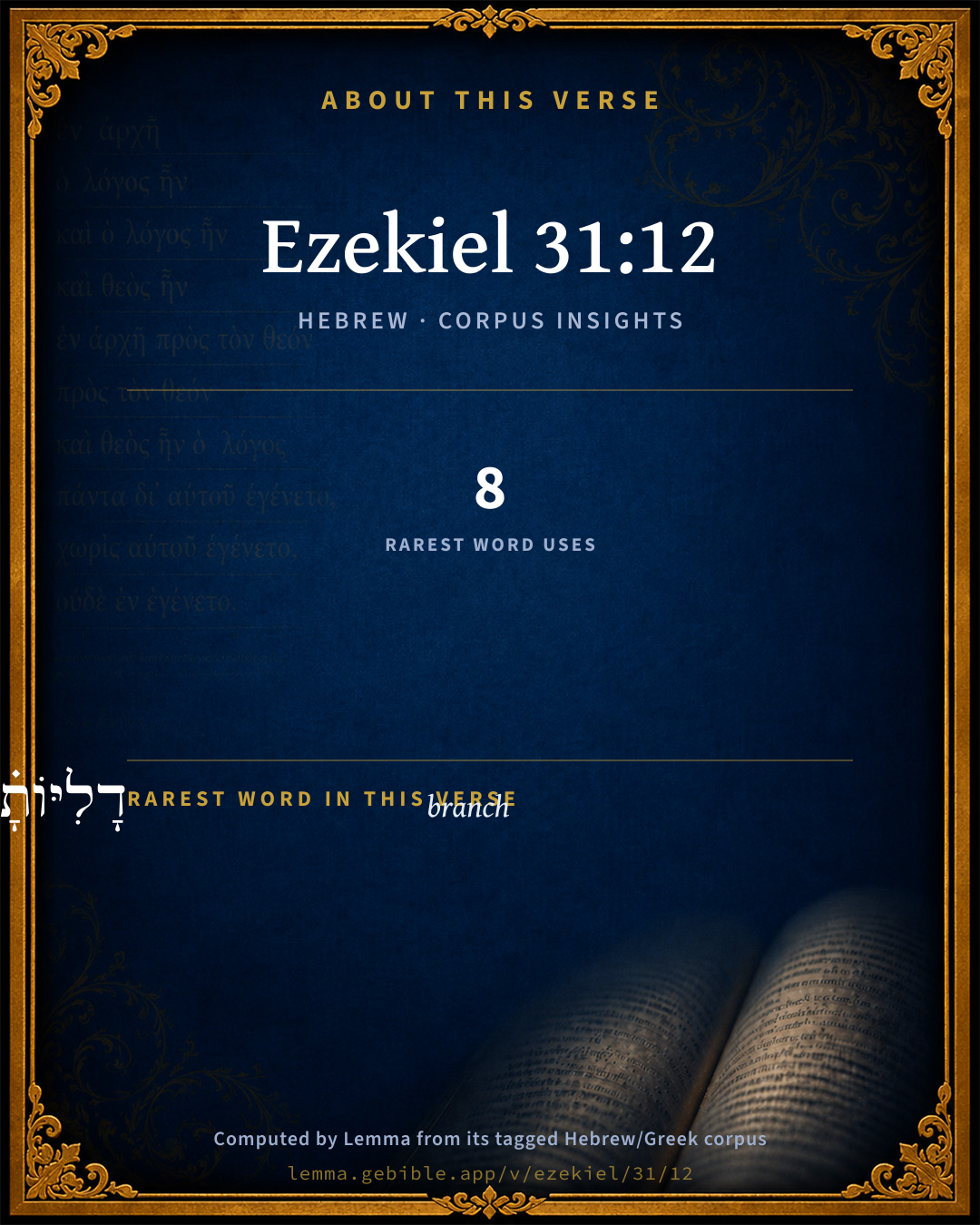
The rarest word here is דָלִיּוֹתָ֗יו branch H1808 — appearing just 8 times in the whole Hebrew Bible.

Shared distinctive vocabulary

דָלִיּוֹתָ֗יו branch H1808 occurs in 8 verses of the Hebrew Bible. Also found in:

Grammatical profile

  • 6 verbs
  • 13 nouns
  • 2 adjectives
  • 1 preposition

Verb forms

  • וַיִּכְרְתֻ֧הוּ Qal · Sequential Imperfect
  • וַֽיִּטְּשֻׁ֑הוּ Qal · Sequential Imperfect
  • נָפְל֣וּ Qal · Perfect
  • וַתִּשָּׁבַ֤רְנָה Niphal · Sequential Imperfect
  • וַיֵּרְד֧וּ Qal · Sequential Imperfect
  • וַֽיִּטְּשֻֽׁהוּ Qal · Sequential Imperfect

Repetition

Words recur within this verse — often emphatic in Hebrew:

  • וּבְכָל all H3605 ×3
  • וַֽיִּטְּשֻׁ֑הוּ to leave H5203 ×2
  • הָאָ֔רֶץ land H776 ×2

Hebrew & Septuagint length

In English translation the verse runs 55 words from the Hebrew and 53 from the Septuagint (LXX English) — closely comparable.

A rough comparison of the two English renderings, which tokenize alike — not a word-level alignment.

Word counts can differ between the Hebrew and the Greek without any difference in meaning — e.g. the Hebrew direct-object marker אֵת has no separate Greek word, and Greek often adds the article ὁ.

Cross-references

13

Topical passages linked to Ezekiel 31:12 in the Treasury of Scripture Knowledge — connected by theme and wording, ordered by reader-vote popularity; previews shown in the World English Bible.

  • Ezekiel 28:7 therefore, behold, I will bring strangers on you, the terrible of the nations; and they shall draw their swords against the beauty of your wisdom, and they shall defile your brightness.
  • Ezekiel 35:8 I will fill its mountains with its slain: in your hills and in your valleys and in all your watercourses shall they fall who are slain with the sword.
  • Ezekiel 30:11 He and his people with him, the terrible of the nations, shall be brought in to destroy the land; and they shall draw their swords against Egypt, and fill the land with the slain.
  • Nahum 3:17–18 Your guards are like the locusts, and your officials like the swarms of locusts, which settle on the walls on a cold day, but when the sun appears, they flee away, and their place is not known where they are.
  • Habakkuk 1:6 For, behold, I raise up the Chaldeans, that bitter and hasty nation, that march through the breadth of the earth, to possess dwelling places that are not theirs.
  • Isaiah 34:5–7 For my sword has drunk its fill in the sky: behold, it shall come down on Edom, and on the people of my curse, to judgment.
  • Ezekiel 32:4–5 I will leave you on the land, I will cast you forth on the open field, and will cause all the birds of the sky to settle on you, and I will satisfy the animals of the whole earth with you.
  • Ezekiel 32:12 By the swords of the mighty will I cause your multitude to fall; the terrible of the nations are they all: and they shall bring to nothing the pride of Egypt, and all the multitude of it shall be destroyed.
  • Ezekiel 35:5 Because you have had a perpetual enmity, and have given over the children of Israel to the power of the sword in the time of their calamity, in the time of the iniquity of the end;
  • Ezekiel 39:4 You shall fall on the mountains of Israel, you, and all your hordes, and the peoples who are with you: I will give you to the ravenous birds of every sort, and to the animals of the field to be devoured.
  • Daniel 4:12–14 The leaves of it were beautiful, and the fruit of it much, and in it was food for all: the animals of the field had shadow under it, and the birds of the sky lived in the branches of it, and all flesh was fed from it.
  • Habakkuk 1:11 Then he sweeps by like the wind, and goes on. He is indeed guilty, whose strength is his god."
  • Revelation 17:16 The ten horns which you saw, and the beast, these will hate the prostitute, and will make her desolate, and will make her naked, and will eat her flesh, and will burn her utterly with fire.

Cross-references courtesy of OpenBible.info (CC BY 4.0).

Hebrew and Greek witnesses Masoretic Hebrew ↔ Greek Septuagint

The same verse in the two great witnesses to the Old Testament, shown verse-for-verse.

These are two independent witnesses, not word-aligned to each other, and the Septuagint is shown in lemma (dictionary) form.

Hebrew Ezekiel 31:12 Masoretic · Westminster Leningrad Codex

וַיִּכְרְתֻ֧הוּ זָרִ֛ים עָרִיצֵ֥י גוֹיִ֖ם וַֽיִּטְּשֻׁ֑הוּ אֶל הֶ֠הָרִים וּבְכָל גֵּ֨אָי֜וֹת נָפְל֣וּ דָלִיּוֹתָ֗יו וַתִּשָּׁבַ֤רְנָה פֹֽארֹתָיו֙ בְּכֹל֙ אֲפִיקֵ֣י הָאָ֔רֶץ וַיֵּרְד֧וּ מִצִּלּ֛וֹ כָּל עַמֵּ֥י הָאָ֖רֶץ וַֽיִּטְּשֻֽׁהוּ

Strangers, the terrible of the nations, have cut him off, and have left him: on the mountains and in all the valleys his branches are fallen, and his boughs are broken by all the watercourses of the land; and all the peoples of the earth are gone down from his shadow, and have left him.

World English Bible · Public Domain

Greek LXX Ezekiel 31:12 Septuagint · lemma form

καί ἐκὀλεθρεύω αὐτός ἀλλότριος λοιμός ἀπό ἔθνος καί καταβάλλω αὐτός ἐπί ὁ ὄρος ἐν πᾶς ὁ φάραγξ πίπτω ὁ κλάδος αὐτός καί συντρίβω ὁ στέλεχος αὐτός ἐν πᾶς πεδίον ὁ γῆ καί καταβαίνω ἀπό ὁ σκέπης αὐτός πᾶς ὁ λαός ὁ ἔθνος καί ἐδαφίζω αὐτός

And ravaging strangers from the nations have destroyed him, and have cast him down upon the mountains: his branches fell in all the valleys, and his boughs were broken in every field of the land; and all the people of the nations are gone down from their shelter, and have laid him low.

LXX2012 (modern English Septuagint) · Public Domain

Hebrew: Westminster Leningrad Codex (CC BY 4.0). Greek: Septuagint (public domain); English from LXX2012 (modern English Septuagint) (Public Domain). How the Septuagint differs from the Hebrew →

Targum (Aramaic paraphrase)

1

The Targum is the ancient Jewish Aramaic paraphrase of the Hebrew Scriptures — an interpretive translation, not the Hebrew text itself. Onkelos (literal) and Pseudo-Jonathan (expansive) render the Torah, and Jonathan the Prophets. Coverage is partial: where no permissively-licensed English translation exists for a verse, only the Aramaic is shown. This is verse-level text, not a word-by-word alignment to the Hebrew.

  1. Targum Jonathan Prophets (Joshua–Malachi)
    וְשֵׁיצָיוֹהִי נוּכְרָאִין תַּקִיפֵי עַמְמַיָא וְרַטְשׁוּהִי עַל טוּרַיָא וּבְכָל חֵילַיָא נָפְלָא מַשִׁרְיָתֵיהּ וְאִתְבַּדָרוּ סוּמְכְוָתֵיהּ בְּכָל פַּצִידֵי אַרְעָא וּנְחָתוּ מִטְלַל מַלְכוּתֵיהּ כָּל עַמְמֵי אַרְעָא וְרַטְשׁוֹהִי:

    (no public-domain English translation for this verse)

    Targum Jonathan — Aramaic: “Mikraot Gedolot” (public domain). English: “Sefaria Community Translation” (CC0 1.0 (public-domain dedication)); “London "Chaldee Paraphrase," 1871” (public domain). Text via Sefaria.

Commentary

Notes on Ezekiel 31:12 from classic Christian and Jewish commentators (each source and its license shown beneath its notes). The classic Christian expositions comment on the surrounding passage and are grouped to its opening verse, so a note may address several verses; the Jewish commentaries on the Tanakh (Rashi and others) are per-verse, so they appear only where the commentator wrote on this verse.

Lemma curates 59 commentaries, every one of them public domain or Creative Commons licensed, each selected and text-cleaned for this edition rather than reprinted as found. About our sources →

The Cambridge Bible for Schools and Colleges

gen. ed. J. J. S. Perowne

12. The tenses in Eze_31:12-13 are perfects of threatening: the fut. would be plainer in Eze_31:12 as A.V. Eze_31:13. On “terrible” cf. Eze_28:7.

have left him] cast him down, ch. Eze_32:4; Amo_5:2. His great trunk covers the land and fills the watercourses. The nations who dwelt under his shadow, seeking his protection, have fled away from him (Dan_4:11). For people, peoples.

have left him] and (or, for) they have cast him down. The words seem emphatic repetition from the beginning of the verse.

The Cambridge Bible for Schools and Colleges (gen. ed. J. J. S. Perowne; Cambridge University Press, 1878–1918) — public domain. Text from a community e-Sword module.

Trapp's Complete Commentary

John Trapp

Eze 31:12 And strangers, the terrible of the nations, have cut him off, and have left him: upon the mountains and in all the valleys his branches are fallen, and his boughs are broken by all the rivers of the land; and all the people of the earth are gone down from his shadow, and have left him.

Ver. 12. And strangers have cut him off.] The greater wealth the greater spoil awaiteth a man; as each one desireth to lop the tree that hath thick and large boughs and branches.

And his boughs are broken,] i.e., His vassals, homagers, and auxiliaries.

And all the people of the earth.] Who once sheltered under his shadow. But the rule is,

“ Arbor honoretur cuius nos umbra tuetur. ”

And have left him.] And joined themselves to the Babylonian.

“ Sic cum fortuna statque caditque fides. ” - Ovid.

John Trapp, A Commentary or Exposition upon All the Books of the Old and New Testament (1647–1656) — public domain. Text from a community e-Sword module.

Tyndale Open Study Notes

Tyndale Open Resources

31:12-14 Egypt’s fate would teach the other nations that however high they set themselves, eventually they were all doomed to die and go down to the pit.

Tyndale Open Study Notes — © Tyndale Open Resources, licensed CC BY-SA 4.0. Text via the HelloAO Bible API.

Geneva Bible (1599)

Geneva Bible translators

Hereby is signified the destruction of the power of the Assyrians by the Babylonians.

Geneva Bible (1599) marginal notes — public domain. Text via Bolls.life.

Jamieson, Fausset & Brown

Robert Jamieson, A. R. Fausset & David Brown

from his shadow--under which they had formerly dwelt as their covert (Eze 31:6).

Jamieson, Fausset & Brown — Commentary Critical and Explanatory on the Whole Bible (1871) — public domain (CC PDM 1.0). Text via the HelloAO Bible API.

Ellicott's Commentary for English Readers

(12) Gone down.—Because the cedar is represented as growing upon the height of Lebanon. Yet “the people of the earth” is literal.

A Bible Commentary for English Readers, edited by Charles John Ellicott (1878–1897) — public domain. Text from a community e-Sword module.

John Gill's Exposition

And strangers, the terrible of the nations, have cut him off,.... Cut off the boughs and branches of this cedar, and cut him down to the ground; that is, utterly destroyed him, his empire and monarchy: these "strangers" were the Medes, who lived in a country distant from Assyria; and "the terrible of the nations", the cruel and merciless Chaldeans, the soldiers of the king of Babylon's army; see Eze 30:11,

and have left him upon the mountains, like a tree cut down there, and its boughs and branches lopped off, which roll down from thence into the valleys, and by the rivers of water signifying his depression from a high and exalted state to a very low one, as follows:

and in all the valley his branches are fallen, and his boughs are broken by all the rivers of the land; signifying that many provinces and countries under his dominion were broken off, and by force taken away from him; or they broke off and revolted of themselves, and either set up for themselves, and recovered their former power and authority; or gave up themselves to the conqueror. The Targum is,

"and in all valleys his army fell, and his auxiliaries were scattered by all the rivers of the land:''

and all the people of the earth are gone down from his shadow, and have left him: those that joined themselves to his empire, put themselves under his protection, or sought his friendship and alliance, now withdrew themselves from him, and left him alone to shift for himself; as frightened birds and beasts will do, when a tree is cut down and fallen, in the boughs or under the shadow of which they dwelt. The Targum paraphrases it,

"from the shadow of his kingdom.''

John Gill's Exposition of the Whole Bible (1746–1763) — public domain (CC PDM 1.0). Text via the HelloAO Bible API.

Haydock's Catholic Bible Commentary

Strangers; revolted Assyrians. See Psalm xvii. 46.

George Leo Haydock (1774–1849), Haydock's Catholic Family Bible and Commentary, 1859 edition — public domain. Excludes Psalms (Douay-Rheims chapter numbering differs from Protestant) and Deuterocanonical books (Catholic canon only).

Matthew Poole's English Annotations

Strangers; foreigners, who regard neither justice nor mercy, such were those who made up his army of Arbaces the Mede.

The terrible; so these were for their strength and valour much, but for their numbers and barbarity more, to be dreaded.

Have cut him off; not shall, for it was done before Ezekiel’s time, about the time Hezekiah was born, and about two hundred and forty years before the destruction of Jerusalem and the Babylonish captivity.

Left him; revolted or forsaken Sardanapalus.

Upon the mountains: as a tree, growing on the mountains which hang over the valleys, when it falls breaks, and its branches are scattered in the lower ground, on the banks of rivers that run in the bottom; so is this mighty cedar, this king and kingdom, fallen from highest power and honour into deepest contempt and impotence, not able to repel his adversaries or escape out of their hands.

Have left him; all that were tributary to him have withdrawn their tribute, and rejected his dominion; and such as were his allies, and depended on his patronage, have quit their leagues and dependences, and left his shadow.

Matthew Poole's English Annotations on the Holy Bible (1683–1685) — public domain. Text from a community e-Sword/MySword module.

Whedon's Commentary on the Bible

Daniel D. Whedon

12. Compare Eze_31:6; Eze_28:7; Eze_30:11. The people who once humbly dwelt under its branches have now left the shadowless trunk and broken limbs or else walk over them without honor or fear (Eze_31:13).

Daniel D. Whedon (gen. ed.), Commentary on the Old and New Testaments (1874–1909) — public domain. Text from a community e-Sword module.

The Pulpit Commentary

Strangers, the terrible of the nations. We note the recurrence of the phrase of Eze_30:11, as pointing, here as there, to the Chaldean invaders. The branches of the tree were broken, the people of the earth no longer dwelt under its shadow. (Dan_4:11)

The Pulpit Commentary (1880–1919), ed. H.D.M. Spence-Jones & Joseph S. Exell — public domain. Text from a community e-Sword module.

John Wesley's Explanatory Notes

Strangers - Foreigners.

John Wesley, Explanatory Notes Upon the Whole Bible (1754–1765) — public domain. Text via the GEBible commentary corpus.

unfoldingWord translationNotes

Door43 World Missions Community

General Information:

Yahweh's parable about the cedar continues.

who were the terror of all the nations

The abstract noun "terror" can be stated as "afraid." And here "nations" represents the people of the nations. AT: "who made the people of all the nations afraid" (See: Abstract Nouns and Metonymy)

cut it off

"cut the cedar down"

its boughs lay broken

"the foreigners broke the boughs of the cedar"

boughs

Boughs are very large branches that grow on trees. Usually, many smaller branches grow on the boughs.

came out from under its shade

"left the shade of the cedar"

translationWords

alien

terror

cut off

earth

unfoldingWord translationNotes — © Distant Shores Media and the Door43 World Missions Community, licensed CC BY-SA 4.0. Source: git.door43.org/Door43/en_tn.

Rashi

Rabbi Shlomo Yitzchaki (Rashi)

cast it down [Heb. וַיִטְשֻּׁהוּ,] and they cast it down to the earth, like (Num. 11:31): “and let them down (וַיִטשּׁ) upon the camp.”

Rashi on the Tanakh — English translations: “The Judaica Press complete Tanach with Rashi, translated by A. J. Rosenberg” (CC BY 4.0); “Pentateuch with Rashi's commentary by M. Rosenbaum and A.M. Silbermann, 1929-1934” (public domain); “The Metsudah Tanach series, Lakewood, N.J” (CC BY 4.0); and “The Book of Joshua, Metsudah Publications, 1997” (CC BY 4.0). Text via Sefaria.

Lesson kit

Teaching starters — assembled from the data on this page, not authored interpretation. Every prompt links to the verse data it draws on. Edit before teaching.

Ezekiel, in the Prophets, opens this verse with 22 words (18 distinct Hebrew lemmas). Its most distinctive word is dâlîyâh (“branch”). A historical commentator’s framing appears above. Read the whole chapter for the surrounding context.

Discussion questions

  1. What does “branch” (dâlîyâh) contribute to the verse as a whole?
  2. Jeremiah 11:16 shares the word «branch» with this verse. How do the two illuminate each other?
  3. “all” occurs 3× in this one verse. What is the effect of the repetition?
  4. These translations render this verse differently. What is at stake in choosing one wording over another?
  5. The verb «וַיִּכְרְתֻ֧הוּ» is Qal Sequential Imperfect. How does its form color the action?
  6. Reading how The Cambridge Bible for Schools and Colleges and Trapp's Complete Commentary read this verse, where do the two commentators agree and where do they part?

Things to notice

Reading settings

Reading text

Shown beneath each verse's original-language words.

Old Testament
Old Testament edition

Read the OT as the Masoretic Hebrew (MT) or the Greek Septuagint (LXX).

English shown for the Greek Septuagint (in the Hebrew ↔ Greek comparison).

Comparing translations? Open the Compare panel on any verse page to stack up to four side by side.