
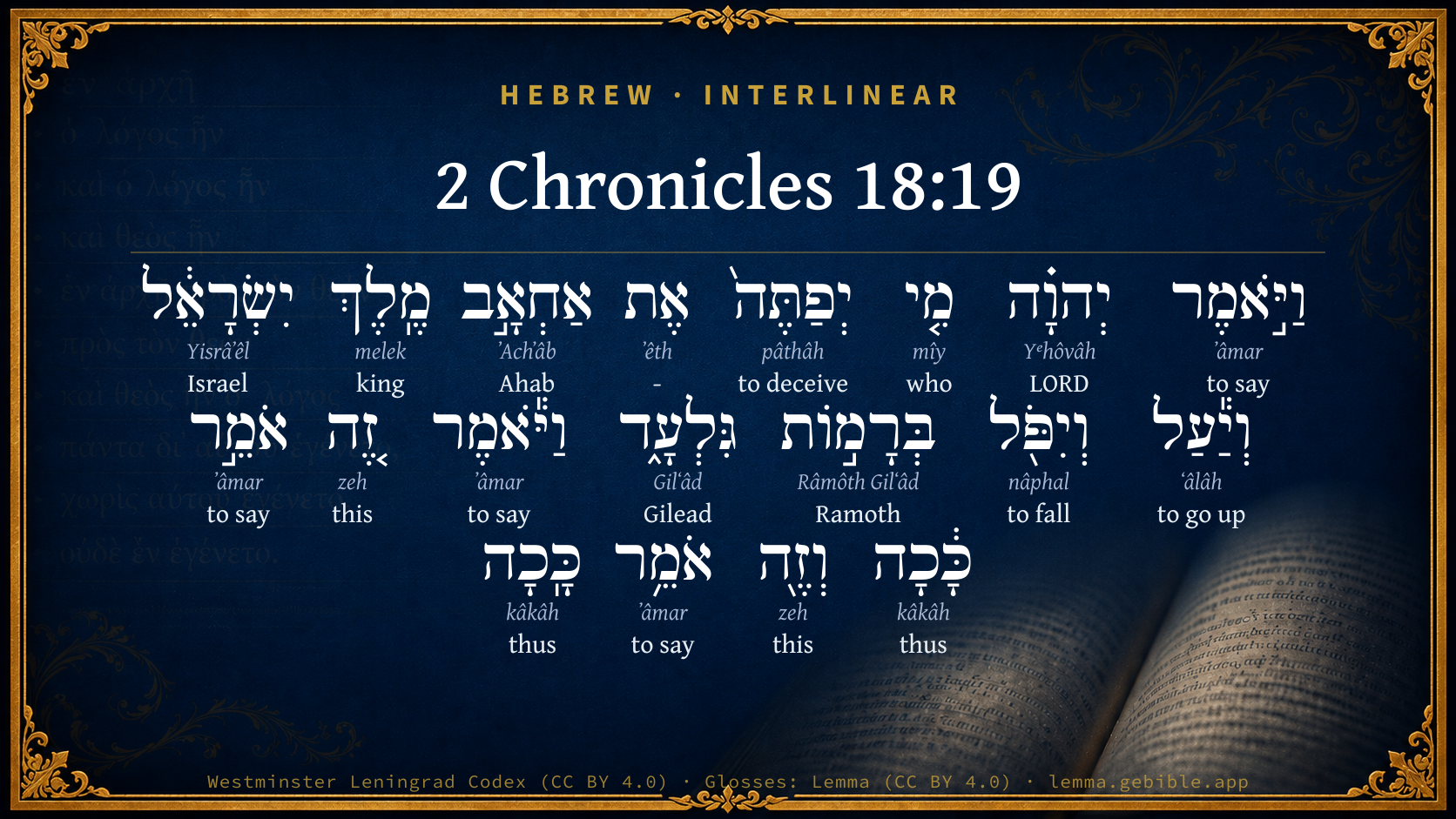
2 Chronicles 18:19

Hebrew (Westminster Leningrad Codex) 2 Chronicles 18:19 appears in the Hebrew Old Testament. The text above is from the Westminster Leningrad Codex. Each word links to its Strong’s number, a concise gloss, and parsing drawn from the Open Scriptures Hebrew Bible morphology. Click any word for its full Brown-Driver-Briggs (BDB) entry.
Download image
Cite this verse

2 Chronicles 18:19 (World English Bible). Public Domain. Lemma interlinear Bible study tool, https://lemma.gebible.app/v/2-chronicles/18/19.

Show BibTeX & RIS
BibTeX
RIS
English Translation
Yahweh said, Who shall entice Ahab king of Israel, that he may go up and fall at Ramoth-gilead? One spoke saying after this manner, and another saying after that manner.
World English Bible · Public Domain
Download a study sheet

One document with this verse’s original text, its word-by-word gloss line, the meaning frame, cross-references with their text, attributed commentary, and full source and license credits — printable, and it pastes into notes with its structure intact.

This verse Autodidact and up

Study sheet (.html) Plain text (.txt)

A passage Seminary Student

Up to 50 verses in one chapter. A passage sheet keeps up to 6 commentary sources and 12 cross-references per verse, in the order this page ranks them, and says so on the sheet whenever that leaves anything out. Ask for a single verse and you get the Autodidact verse sheet above.

Everything on this page stays free to read, with no account — the sheet is a download of what is already on screen, not access to it.

Want to remove ads? Support Godless Engineer
Compare translations 3

The same verse in 3 English versions, stacked beneath the original-language interlinear above. Click any original word for its lexicon entry.

Each is an independent rendering of the whole verse — the interlinear is not word-aligned to these translations.

Highlighted words mark where these versions differ — a whole-verse word diff, not a word-by-word alignment.

  • World English Bible Public Domain
    Yahweh said, Who shall entice Ahab king of Israel, that he may go up and fall at Ramoth-gilead? One spoke saying after this manner, and another saying after that manner.
  • King James Version Public Domain
    And the LORD said, Who shall entice Ahab king of Israel, that he may go up and fall at Ramothgilead? And one spake saying after this manner, and another saying after that manner.
  • unfoldingWord Literal Text CC BY-SA 4.0
    And Yahweh said, ‘Who will entice Ahab, the king of Israel, so he will go up, and he will fall at Ramoth Gilead?’ And this speaker said thus, and this speaker thus.

unfoldingWord Literal Text — © unfoldingWord, licensed CC BY-SA 4.0. Word-aligned USFM3 via Door43 (git.door43.org/unfoldingWord/en_ult).

Versions to compare (up to 4)

3 of 4 selected

Show all 18 translations

Every available English version of this verse, each an independent rendering of the whole verse.

  • World English Bible Public Domain
    Yahweh said, Who shall entice Ahab king of Israel, that he may go up and fall at Ramoth-gilead? One spoke saying after this manner, and another saying after that manner.
  • Berean Standard Bible Public Domain
    And the LORD said, ‘Who will entice Ahab king of Israel to march up and fall at Ramoth-gilead?’ And one suggested this, and another that.
  • Majority Standard Bible Public Domain
    And the LORD said, ‘Who will entice Ahab king of Israel to march up and fall at Ramoth-gilead?’ And one suggested this, and another that.
  • King James Version Public Domain
    And the LORD said, Who shall entice Ahab king of Israel, that he may go up and fall at Ramothgilead? And one spake saying after this manner, and another saying after that manner.
  • American Standard Version (1901) Public Domain
    And Jehovah said, Who shall entice Ahab king of Israel, that he may go up and fall at Ramoth-gilead? And one spake saying after this manner, and another saying after that manner.
  • Revised Version (1885) Public Domain
    And the LORD said, Who shall entice Ahab king of Israel, that he may go up and fall at Ramoth-gilead? And one spake saying after this manner, and another saying after that manner.
  • Geneva Bible (1599) Public Domain
    And the Lord sayd, Who shall perswade Ahab King of Israel, that he may go vp, and fall at Ramoth Gilead? And one spake and said thus, and another said that.
  • Douay-Rheims (1899) Public Domain
    And the Lord said: Who shall deceive Achab king of Israel, that he may go up and fall in Ramoth Galaad? And when one spoke in this manner, and another otherwise:
  • Young's Literal Translation Public Domain
    and Jehovah saith, Who doth entice Ahab king of Israel, and he doth go up and fall in Ramoth-Gilead? And this speaker saith thus, and that speaker thus.
  • Literal Standard Version CC BY-SA 4.0
    and YHWH says, Who entices Ahab king of Israel, and he goes up and falls in Ramoth-Gilead? And this speaker says thus, and that speaker thus.
  • Unlocked Literal Bible CC BY-SA 4.0
    Yahweh said, 'Who will entice Ahab, king of Israel, so that he may go up and fall at Ramoth Gilead?' One said this and another that.
  • unfoldingWord Literal Text CC BY-SA 4.0
    And Yahweh said, ‘Who will entice Ahab, the king of Israel, so he will go up, and he will fall at Ramoth Gilead?’ And this speaker said thus, and this speaker thus.
  • Darby Bible Public Domain
    and Jehovah said, Who shall entice Ahab king of Israel that he may go up and fall at Ramoth-Gilead? And one spoke saying after this manner, and another saying after that manner.
  • World Messianic Bible Public Domain
    The LORD said, ‘Who will entice Ahab king of Israel, that he may go up and fall at Ramoth Gilead?’ One spoke saying in this way, and another saying in that way.
  • Webster's Bible Public Domain
    And the LORD said, Who shall entice Ahab king of Israel, that he may go up and fall at Ramoth-gilead? And one spoke saying after this manner, and another saying after that manner.
  • Free Bible Version CC BY-SA 4.0
    The Lord asked, ‘Who will trick Ahab, king of Israel, into attacking Ramoth-gilead so he will be killed there?’ One said this, another said that, and another said something else.
  • Bible in Basic English Public Domain
    And the Lord said, How may Ahab, king of Israel, be tricked into going up to Ramoth-gilead to his death? And one said one thing and one another.
  • JPS Tanakh (1917) Public Domain
    And the LORD said: who shall entice Ahab king of Israel, that he may go up and fall at Ramoth-gilead? And one spoke saying after this manner, and another saying after that manner.

Literal Standard Version (2020), Covenant Press — licensed CC BY-SA 4.0. Text via the HelloAO Bible API (eBible.org). Unlocked Literal Bible (unfoldingWord) — licensed CC BY-SA 4.0. Text via the HelloAO Bible API (eBible.org). unfoldingWord Literal Text — © unfoldingWord, licensed CC BY-SA 4.0. Word-aligned USFM3 via Door43 (git.door43.org/unfoldingWord/en_ult). Free Bible Version, Dr. Jonathan Gallagher — licensed CC BY-SA 4.0. Text via the HelloAO Bible API (eBible.org).

Word by word

More ways to search: Search by grammar → Find every occurrence → Compare this word →

Practice this passage: Drill this verse → Learn its vocabulary →

בְּרָמ֣וֹת
Râmôth Gilʻâd
H7433
“in/at · Ramoth”
Preposition + Noun, Proper
Part of Speech
Preposition + Noun
Type
Proper
Full BDB Definition

Origin: from the pl. of H7413 and H1568

TWOT: None

Ramoth = "heights" - an Israelite who had a foreign wife in the time of Ezra (noun proper masculine) - Ramoth-gilead - a place in Gilead (noun proper locative) - site dubious
  1. וַיֹּ֣אמֶר ʼâmar H559 “and · to say” Conjunction + Verb, Qal, Sequential Imperfect, 3rd Person, Masculine, Singular
  2. יְהוָ֗ה Yᵉhôvâh H3068 “LORD” Noun, Proper
  3. מִ֤י mîy H4310 “who” Particle, Interrogative
  4. יְפַתֶּה֙ pâthâh H6601 “to deceive” Verb, Piel, Imperfect, 3rd Person, Masculine, Singular
  5. אֶת ʼêth H853 “-” Particle, Direct Object
  6. אַחְאָ֣ב ʼAchʼâb H256 “Ahab” Noun, Proper
  7. מֶֽלֶךְ melek H4428 “king of” Noun, Common, Masculine, Singular, Construct
  8. יִשְׂרָאֵ֔ל Yisrâʼêl H3478 “Israel” Noun, Proper
  9. וְיַ֕עַל ʻâlâh H5927 “and · to go up” Conjunction + Verb, Qal, Jussive, 3rd Person, Masculine, Singular
  10. וְיִפֹּ֖ל nâphal H5307 “and · to fall” Conjunction + Verb, Qal, Imperfect, 3rd Person, Masculine, Singular
  11. גִּלְעָ֑ד Gilʻâd H1568 “Gilead” Noun, Proper
  12. וַיֹּ֕אמֶר ʼâmar H559 “and · to say” Conjunction + Verb, Qal, Sequential Imperfect, 3rd Person, Masculine, Singular
  13. זֶ֚ה zeh H2088 “this” Pronoun, Demonstrative, Masculine, Singular
  14. אֹמֵ֣ר ʼâmar H559 “saying” Verb, Qal, Participle Active, Masculine, Singular, Absolute
  15. כָּ֔כָה kâkâh H3602 “thus” Adverb
  16. וְזֶ֖ה zeh H2088 “and · this” Conjunction + Pronoun, Demonstrative, Masculine, Singular
  17. אֹמֵ֥ר ʼâmar H559 “saying” Verb, Qal, Participle Active, Masculine, Singular, Absolute
  18. כָּֽכָה kâkâh H3602 “thus” Adverb

About this verse

These counts appear in no published source. They are computed here, from the morphology-tagged text and Lemma’s own curated glosses. What Lemma adds →

19
words
14
distinct lemmas
Historical
section

Notable vocabulary

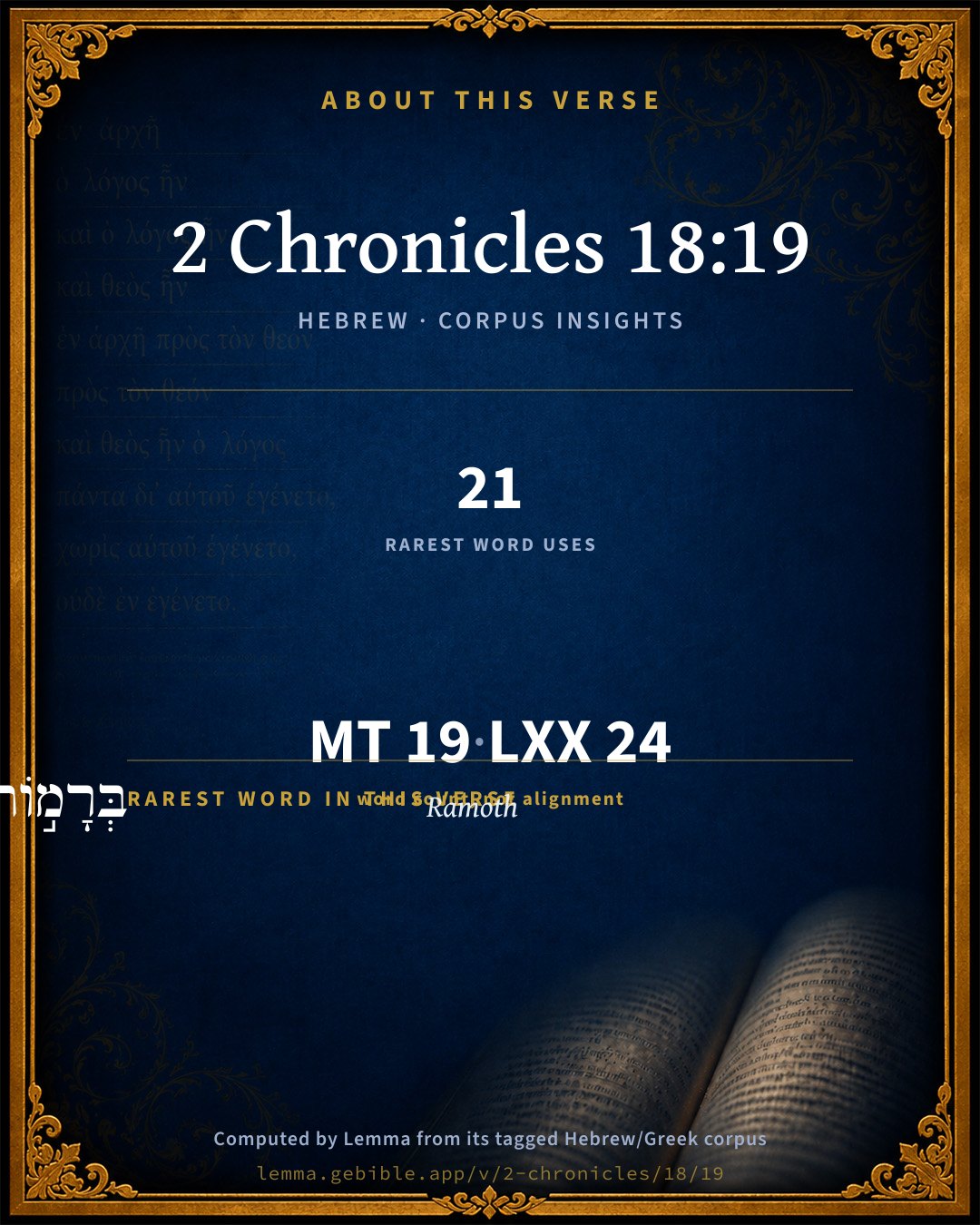
The rarest word here is בְּרָמ֣וֹת Ramoth H7433 — appearing just 21 times in the whole Hebrew Bible.

Shared distinctive vocabulary

בְּרָמ֣וֹת Ramoth H7433 occurs in 21 verses of the Hebrew Bible. Also found in:

Grammatical profile

  • 7 verbs
  • 6 nouns
  • 2 pronouns
  • 2 adverbs
  • 2 particles

Verb forms

  • וַיֹּ֣אמֶר Qal · Sequential Imperfect
  • יְפַתֶּה֙ Piel · Imperfect
  • וְיַ֕עַל Qal · Jussive
  • וְיִפֹּ֖ל Qal · Imperfect
  • וַיֹּ֕אמֶר Qal · Sequential Imperfect
  • אֹמֵ֣ר Qal · Participle Active
  • אֹמֵ֥ר Qal · Participle Active

Repetition

Words recur within this verse — often emphatic in Hebrew:

  • וַיֹּ֣אמֶר to say H559 ×4
  • כָּ֔כָה thus H3602 ×2
  • זֶ֚ה this H2088 ×2

Hebrew & Septuagint length

In English translation the verse runs 30 words from the Hebrew and 31 from the Septuagint (LXX English) — closely comparable.

A rough comparison of the two English renderings, which tokenize alike — not a word-level alignment.

Word counts can differ between the Hebrew and the Greek without any difference in meaning — e.g. the Hebrew direct-object marker אֵת has no separate Greek word, and Greek often adds the article ὁ.

In the original languages it is 19 Hebrew tokens and 24 Greek tokens — but the two are counted differently (Hebrew bundles its prefixes and suffixes into one token; the Greek is in lemma form), so that isn’t a like-for-like length.

Cross-references

10

Topical passages linked to 2 Chronicles 18:19 in the Treasury of Scripture Knowledge — connected by theme and wording, ordered by reader-vote popularity; previews shown in the World English Bible.

  • 1 Kings 22:20 Yahweh said, Who shall entice Ahab, that he may go up and fall at Ramoth-gilead? One said on this manner; and another said on that manner.
  • 2 Chronicles 25:8 But if you will go, do [valiantly], be strong for the battle: God will cast you down before the enemy; for God has power to help, and to cast down.
  • 2 Chronicles 25:19 You say, Behold, you have struck Edom; and your heart lifts you up to boast: abide now at home; why should you meddle to [your] hurt, that you should fall, even you, and Judah with you?
  • Job 12:16 With him is strength and wisdom; The deceived and the deceiver are his.
  • Proverbs 11:5 The righteousness of the blameless will direct his way, But the wicked shall fall by his own wickedness.
  • Isaiah 6:9–10 He said, "Go, and tell this people, 'You hear indeed, But don't understand; And you see indeed, But don't perceive.'
  • Isaiah 54:16 Behold, I have created the smith who blows the fire of coals, and brings forth a weapon for his work; and I have created the waster to destroy.
  • Ezekiel 14:9 If the prophet be deceived and speak a word, I, Yahweh, have deceived that prophet, and I will stretch out my hand on him, and will destroy him from the midst of my people Israel.
  • 2 Thessalonians 2:11–12 Because of this, God sends them a working of error, that they should believe a lie;
  • James 1:13–14 Let no man say when he is tempted, "I am tempted by God," for God can't be tempted by evil, and he himself tempts no one.

Cross-references courtesy of OpenBible.info (CC BY 4.0).

Hebrew and Greek witnesses Masoretic Hebrew ↔ Greek Septuagint

The same verse in the two great witnesses to the Old Testament, shown verse-for-verse.

These are two independent witnesses, not word-aligned to each other, and the Septuagint is shown in lemma (dictionary) form.

Hebrew 2 Chronicles 18:19 Masoretic · Westminster Leningrad Codex

וַיֹּ֣אמֶר יְהוָ֗ה מִ֤י יְפַתֶּה֙ אֶת אַחְאָ֣ב מֶֽלֶךְ יִשְׂרָאֵ֔ל וְיַ֕עַל וְיִפֹּ֖ל בְּרָמ֣וֹת גִּלְעָ֑ד וַיֹּ֕אמֶר זֶ֚ה אֹמֵ֣ר כָּ֔כָה וְזֶ֖ה אֹמֵ֥ר כָּֽכָה

Yahweh said, Who shall entice Ahab king of Israel, that he may go up and fall at Ramoth-gilead? One spoke saying after this manner, and another saying after that manner.

World English Bible · Public Domain

Greek LXX 2 Chronicles 18:19 Septuagint · lemma form

καί εἶπον κύριος τίς ἀπατάω ὁ αχααβ βασιλεύς ἰσραήλ καί ἀναβαίνω καί πίπτω ἐν ραμωθ γαλαάδ καί εἶπον οὗτος οὕτως καί οὗτος εἶπον οὕτως

And the Lord said, Who will deceive Achaab king of Israel, that he may go up, and fall in Ramoth Galaad? And one spoke this way, and another spoke that way.

LXX2012 (modern English Septuagint) · Public Domain

Hebrew: Westminster Leningrad Codex (CC BY 4.0). Greek: Septuagint (public domain); English from LXX2012 (modern English Septuagint) (Public Domain). How the Septuagint differs from the Hebrew →

Commentary

Notes on 2 Chronicles 18:19 from classic Christian and Jewish commentators (each source and its license shown beneath its notes). The classic Christian expositions comment on the surrounding passage and are grouped to its opening verse, so a note may address several verses; the Jewish commentaries on the Tanakh (Rashi and others) are per-verse, so they appear only where the commentator wrote on this verse.

Lemma curates 59 commentaries, every one of them public domain or Creative Commons licensed, each selected and text-cleaned for this edition rather than reprinted as found. About our sources →

Geneva Bible (1599)

Geneva Bible translators

Or, deceive.

Geneva Bible (1599) marginal notes — public domain. Text via Bolls.life.

Ellicott's Commentary for English Readers

(19) And one spake, saying.—Literally, and one said (i.e., it was spoken), this one saying thus, and that one saying thus. The text is certainly right.

After this manner.—Kâhhâh. Kings, bĕkhôh. Kings has, and this one said in this wise, and that one was saying in that wise.

A Bible Commentary for English Readers, edited by Charles John Ellicott (1878–1897) — public domain. Text from a community e-Sword module.

The Cambridge Bible for Schools and Colleges

gen. ed. J. J. S. Perowne

19. Who shall entice Ahab] So 1 Kin. (R.V.). The same Heb. word is used in Jer_20:7, “thou hast deceived (mg. ‘enticed’) me,” where Jeremiah complains that he has been called to the fruitless labour of a hated prophet. For the underlying thought that delusion is sometimes a preliminary part of Divine punishment cp. 2Th_2:11 (cp. 2Th_2:9). It should be noted however that the “lying spirit” in the month of the 400 prophets played only a subordinate part in Ahab’s fall, and indeed could have played no part at all, but for the fact that the king was more than willing to be enticed. Ahab had already made up his mind; he consulted the 400 only as an afterthought to satisfy Jehoshaphat (2Ch_18:4), he excluded the plain-speaking Micaiah until Jehoshaphat insisted on his presence (2Ch_18:6-7), and he scorned the true prophet’s warning of the falseness of the 400 (2Ch_18:26). Delusion as a Divine punishment comes only upon the man who is willing to be deluded.

The Cambridge Bible for Schools and Colleges (gen. ed. J. J. S. Perowne; Cambridge University Press, 1878–1918) — public domain. Text from a community e-Sword module.

Haydock's Catholic Bible Commentary

CHAPTER XVIII.

George Leo Haydock (1774–1849), Haydock's Catholic Family Bible and Commentary, 1859 edition — public domain. Excludes Psalms (Douay-Rheims chapter numbering differs from Protestant) and Deuterocanonical books (Catholic canon only).

The Pulpit Commentary

Who shall entice, etc.? Hebrew piel future jt; p; This and the following three verses must have told, manifestly did tell, with fearful force of faithful preaching, upon the unreal prophets and the wicked king. How it was that their contents did not avail with Jehoshaphat to throw full energy again into his conscience, and to enable him to break at once with Ahab and his expedition, is inexplicable (and the more as it was his own pressing suggestion that the true prophet should be summoned), except as another illustration of the fearful difficulty that lies so often to human weakness, in the way of retracing a false step. Both these visions (vers. 16, 18-22) well illustrate how God revealed his truth, will and specific messages to his true prophets in vision. The vision of the throne, grand in all the majesty of its simplicity, of the psalmists (9, 11., 45., 103.), of Isaiah, (Isa_6:1-5) of Ezekiel, (Eze_1:26) of Daniel, (Dan_7:9) of Stephen, (Act_7:56) of St. John, (Rev_4:2) is part of heaven"s own stamp of authentication of the Bible.

The Pulpit Commentary (1880–1919), ed. H.D.M. Spence-Jones & Joseph S. Exell — public domain. Text from a community e-Sword module.

unfoldingWord translationNotes

Door43 World Missions Community

entice

This means to attract someone by offering something appealing.

fall at Ramoth Gilead

Ahab dying in battle is spoken of as if he will fall. AT: "die at Ramoth Gilead" (See: Metaphor and Euphemism)

One said this and another that

This indicates that there was more than one opinion. The words "One ... and another" refer to two or more angels in the heavenly host who were responding to Yahweh's question in the previous verse.

translationWords

Ahab

unfoldingWord translationNotes — © Distant Shores Media and the Door43 World Missions Community, licensed CC BY-SA 4.0. Source: git.door43.org/Door43/en_tn.

Lesson kit

Teaching starters — assembled from the data on this page, not authored interpretation. Every prompt links to the verse data it draws on. Edit before teaching.

2 Chronicles, in the Historical, opens this verse with 19 words (14 distinct Hebrew lemmas). Its most distinctive word is Râmôth Gilʻâd (“Ramoth”). A historical commentator’s framing appears above. Read the whole chapter for the surrounding context.

Discussion questions

  1. What does “Ramoth” (Râmôth Gilʻâd) contribute to the verse as a whole?
  2. How does Joshua 21:38, which shares the word «Ramoth», read alongside this verse?
  3. What does the repetition of “to say” (4× in this one verse) do in this verse?
  4. These translations render this verse differently; the difference is in the English rendering, not the original. What questions does that raise?
  5. «וַיֹּ֣אמֶר» is a Qal Sequential Imperfect verb. How does that grammatical form shape the action described?
  6. Compare how Geneva Bible (1599) and Ellicott's Commentary for English Readers read this verse. Where do they agree or differ?

Things to notice

Reading settings

Reading text

Shown beneath each verse's original-language words.

Old Testament
Old Testament edition

Read the OT as the Masoretic Hebrew (MT) or the Greek Septuagint (LXX).

English shown for the Greek Septuagint (in the Hebrew ↔ Greek comparison).

Comparing translations? Open the Compare panel on any verse page to stack up to four side by side.