
Ruth 3:18

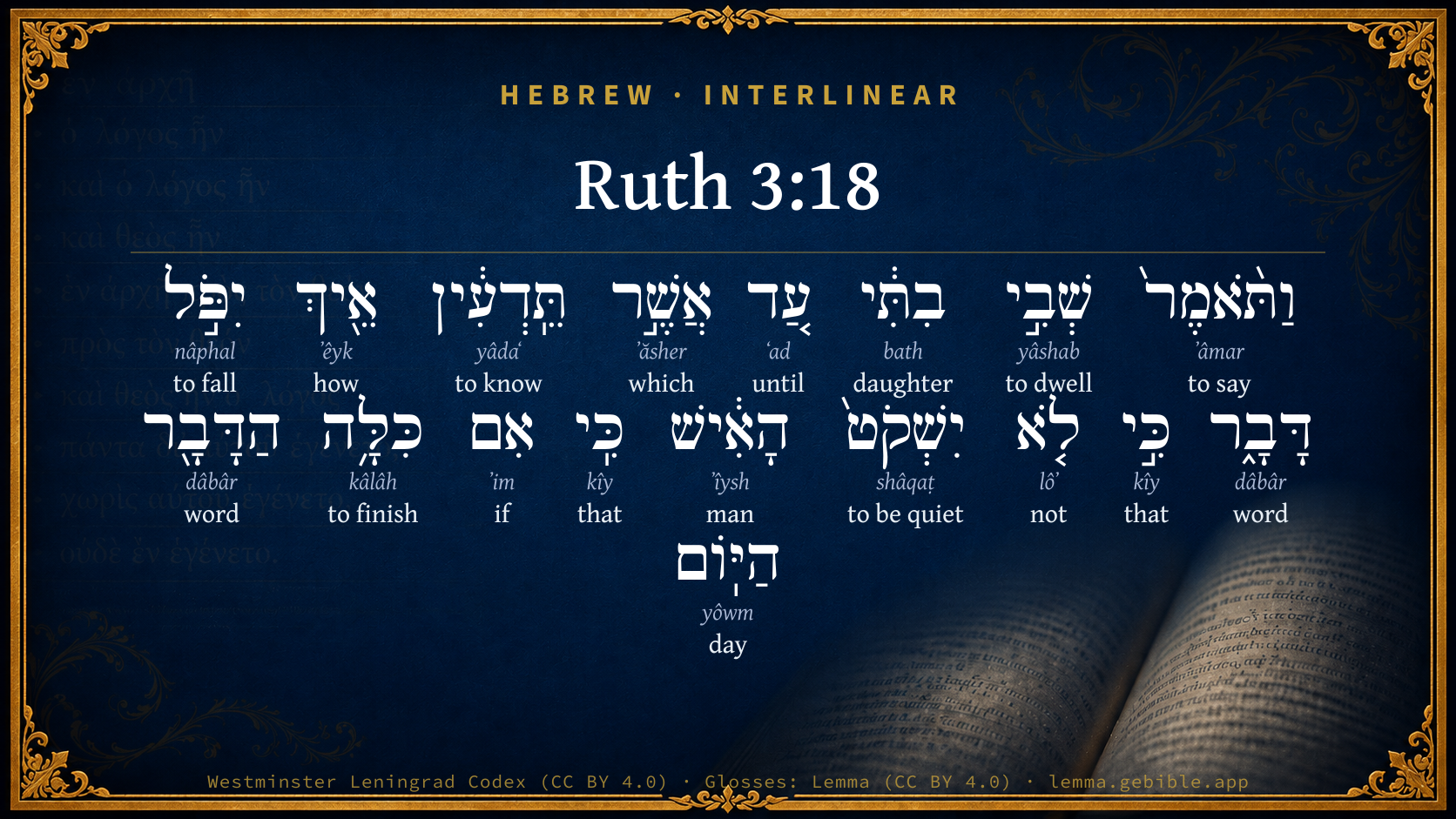
Hebrew (Westminster Leningrad Codex) Ruth 3:18 appears in the Hebrew Old Testament. The text above is from the Westminster Leningrad Codex. Each word links to its Strong’s number, a concise gloss, and parsing drawn from the Open Scriptures Hebrew Bible morphology. Click any word for its full Brown-Driver-Briggs (BDB) entry.
Download image
Cite this verse

Ruth 3:18 (World English Bible). Public Domain. Lemma interlinear Bible study tool, https://lemma.gebible.app/v/ruth/3/18.

Show BibTeX & RIS
BibTeX
RIS
English Translation
Then said she, "Sit still, my daughter, until you know how the matter will fall; for the man will not rest, until he has finished the thing this day."
World English Bible · Public Domain
Download a study sheet

One document with this verse’s original text, its word-by-word gloss line, the meaning frame, cross-references with their text, attributed commentary, and full source and license credits — printable, and it pastes into notes with its structure intact.

This verse Autodidact and up

Study sheet (.html) Plain text (.txt)

A passage Seminary Student

Up to 50 verses in one chapter. A passage sheet keeps up to 6 commentary sources and 12 cross-references per verse, in the order this page ranks them, and says so on the sheet whenever that leaves anything out. Ask for a single verse and you get the Autodidact verse sheet above.

Everything on this page stays free to read, with no account — the sheet is a download of what is already on screen, not access to it.

Want to remove ads? Support Godless Engineer
Compare translations 3

The same verse in 3 English versions, stacked beneath the original-language interlinear above. Click any original word for its lexicon entry.

Each is an independent rendering of the whole verse — the interlinear is not word-aligned to these translations.

Highlighted words mark where these versions differ — a whole-verse word diff, not a word-by-word alignment.

  • World English Bible Public Domain
    Then said she, "Sit still, my daughter, until you know how the matter will fall; for the man will not rest, until he has finished the thing this day."
  • King James Version Public Domain
    Then said she, Sit still, my daughter, until thou know how the matter will fall: for the man will not be in rest, until he have finished the thing this day.
  • unfoldingWord Literal Text CC BY-SA 4.0
    Then she said, “Sit, my daughter, until the time when you know how the matter falls. For the man will not rest unless he has finished this matter today.”

unfoldingWord Literal Text — © unfoldingWord, licensed CC BY-SA 4.0. Word-aligned USFM3 via Door43 (git.door43.org/unfoldingWord/en_ult).

Versions to compare (up to 4)

3 of 4 selected

Show all 18 translations

Every available English version of this verse, each an independent rendering of the whole verse.

  • World English Bible Public Domain
    Then said she, "Sit still, my daughter, until you know how the matter will fall; for the man will not rest, until he has finished the thing this day."
  • Berean Standard Bible Public Domain
    “Wait, my daughter,” said Naomi, “until you find out how things go, for he will not rest unless he has resolved the matter today.”
  • Majority Standard Bible Public Domain
    “Wait, my daughter,” said Naomi, “until you find out how things go, for he will not rest unless he has resolved the matter today.”
  • King James Version Public Domain
    Then said she, Sit still, my daughter, until thou know how the matter will fall: for the man will not be in rest, until he have finished the thing this day.
  • American Standard Version (1901) Public Domain
    Then said she, Sit still, my daughter, until thou know how the matter will fall; for the man will not rest, until he have finished the thing this day.
  • Revised Version (1885) Public Domain
    Then said she, Sit still, my daughter, until thou know how the matter will fall: for the man will not rest, until he have finished the thing this day.
  • Geneva Bible (1599) Public Domain
    Then sayd she, My daughter, sit still, vntill thou knowe how the thing will fall: for the man wil not be in rest, vntill he hath finished the matter this same day.
  • Douay-Rheims (1899) Public Domain
    And Noemi said: Wait my daughter, till we see what end the thing will have. For the man will not rest until he have accomplished what he hath said.
  • Young's Literal Translation Public Domain
    And she saith, `Sit still, my daughter, till thou dost know how the matter falleth, for the man doth not rest except he hath completed the matter to-day.'
  • Literal Standard Version CC BY-SA 4.0
    And she says, “Sit still, my daughter, until you know how the matter falls, for the man does not rest except he has completed the matter today.”
  • Unlocked Literal Bible CC BY-SA 4.0
    Then Naomi said, “Stay here, my daughter, until you know how the matter will turn out, for the man will not rest until he has finished this thing today.”
  • unfoldingWord Literal Text CC BY-SA 4.0
    Then she said, “Sit, my daughter, until the time when you know how the matter falls. For the man will not rest unless he has finished this matter today.”
  • Darby Bible Public Domain
    Then she said, Be still, my daughter, until thou know how the matter will fall; for the man will not rest until he have completed the matter this day.
  • World Messianic Bible Public Domain
    Then she said, “Wait, my daughter, until you know what will happen; for the man will not rest until he has settled this today.”
  • Webster's Bible Public Domain
    Then said she, Sit still, my daughter, until thou knowest how the matter will fall: for the man will not be in rest, until he hath finished the thing this day.
  • Free Bible Version CC BY-SA 4.0
    Naomi said to Ruth, “Wait patiently, my daughter, until you find out how it all works out. Boaz won't rest until he has it settled today.”
  • Bible in Basic English Public Domain
    Then she said, Do nothing now, my daughter, till you see what will come of this; for the man will take no rest till he has put this thing through.
  • JPS Tanakh (1917) Public Domain
    Then said she: 'Sit still, my daughter, until thou know how the matter will fall; for the man will not rest, until he have finished the thing this day.'

Literal Standard Version (2020), Covenant Press — licensed CC BY-SA 4.0. Text via the HelloAO Bible API (eBible.org). Unlocked Literal Bible (unfoldingWord) — licensed CC BY-SA 4.0. Text via the HelloAO Bible API (eBible.org). unfoldingWord Literal Text — © unfoldingWord, licensed CC BY-SA 4.0. Word-aligned USFM3 via Door43 (git.door43.org/unfoldingWord/en_ult). Free Bible Version, Dr. Jonathan Gallagher — licensed CC BY-SA 4.0. Text via the HelloAO Bible API (eBible.org).

Word by word

More ways to search: Search by grammar → Find every occurrence → Compare this word →

Practice this passage: Drill this verse → Learn its vocabulary →

יִשְׁקֹט֙
shâqaṭ
H8252
“to be quiet”
Verb, Qal, Imperfect, 3rd Person, Masculine, Singular
Part of Speech
Verb
Stem
Qal
Form
Imperfect
Person
3rd Person
Gender
Masculine
Number
Singular
Full BDB Definition

Origin: a primitive root

TWOT: 2453

to be quiet, be tranquil, be at peace, be quiet, rest, lie still, be undisturbed - (Qal) - to be quiet, be undisturbed - to be at peace (of land) - to be quiet, be inactive - (Hiphil) - to show quietness - quietness, display of quietness (substantive) - to quiet, be quiet - to cause quietness, pacify, allay
  1. וַתֹּ֨אמֶר֙ ʼâmar H559 “and · to say” Conjunction + Verb, Qal, Sequential Imperfect, 3rd Person, Feminine, Singular
  2. שְׁבִ֣י yâshab H3427 “dwell” Verb, Qal, Imperative, 2nd Person, Feminine, Singular
  3. בִתִּ֔י bath H1323 “daughter · my” Noun, Common, Feminine, Singular, Construct + Suffix, Personal, 1st Person, Common, Singular
  4. עַ֚ד ʻad H5704 “until” Preposition
  5. אֲשֶׁ֣ר ʼăsher H834 “which” Particle, Relative
  6. תֵּֽדְעִ֔ין yâdaʻ H3045 “to know” Verb, Qal, Imperfect, 2nd Person, Feminine, Singular + Suffix, n
  7. אֵ֖יךְ ʼêyk H349 “how” Particle, Interrogative
  8. יִפֹּ֣ל nâphal H5307 “to fall” Verb, Qal, Imperfect, 3rd Person, Masculine, Singular
  9. דָּבָ֑ר dâbâr H1697 “word” Noun, Common, Masculine, Singular, Absolute
  10. כִּ֣י kîy H3588 “that” Conjunction
  11. לֹ֤א lôʼ H3808 “not” Particle, Negative
  12. הָאִ֔ישׁ ʼîysh H376 “the · man” Particle, Definite Article + Noun, Common, Masculine, Singular, Absolute
  13. כִּֽי kîy H3588 “that” Conjunction
  14. אִם ʼim H518 “if” Conjunction
  15. כִּלָּ֥ה kâlâh H3615 “to finish” Verb, Piel, Perfect, 3rd Person, Masculine, Singular
  16. הַדָּבָ֖ר dâbâr H1697 “the · word” Particle, Definite Article + Noun, Common, Masculine, Singular, Absolute
  17. הַיּֽוֹם yôwm H3117 “the · day” Particle, Definite Article + Noun, Common, Masculine, Singular, Absolute

About this verse

These counts appear in no published source. They are computed here, from the morphology-tagged text and Lemma’s own curated glosses. What Lemma adds →

18
words
16
distinct lemmas
Historical
section

Shared distinctive vocabulary

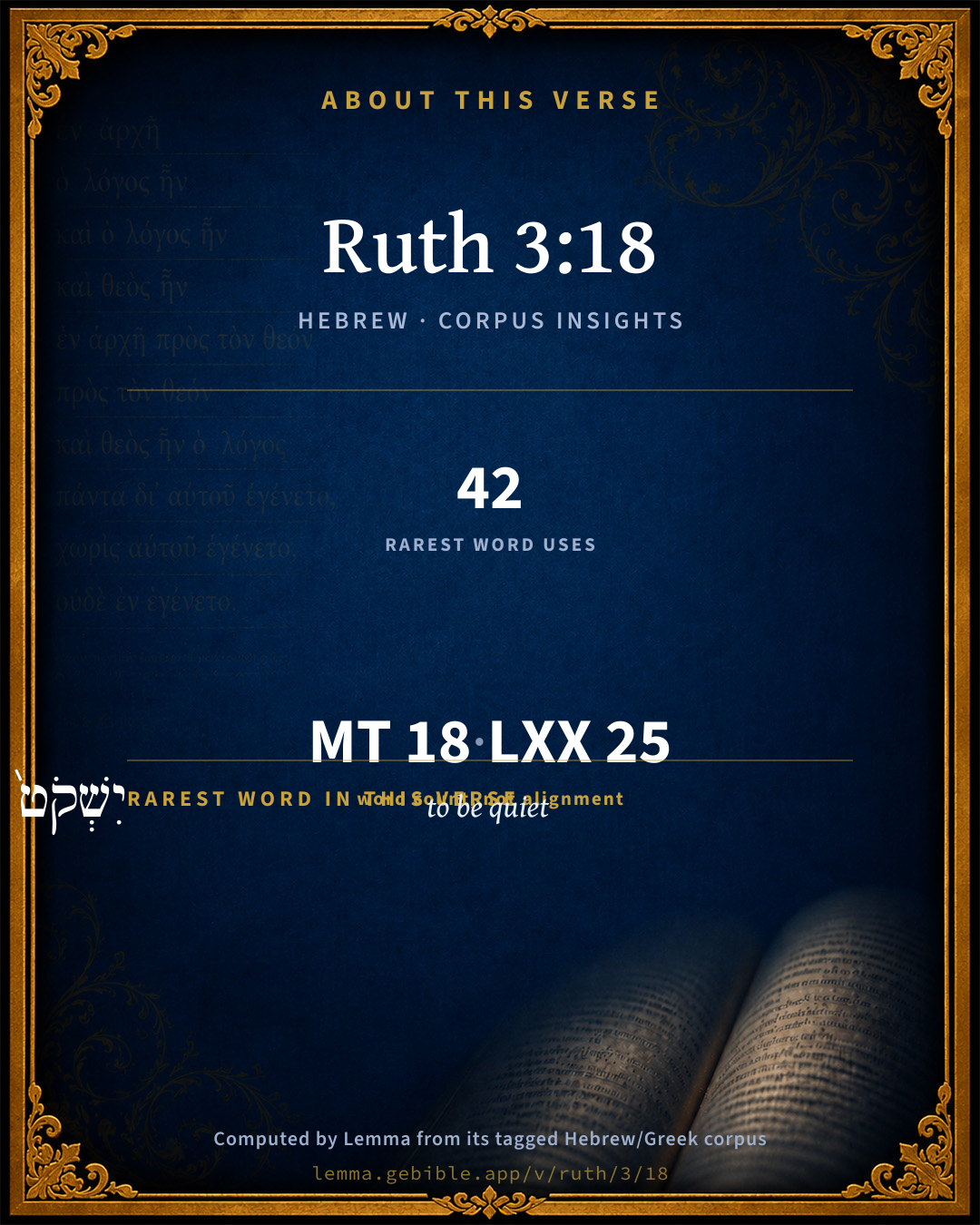
יִשְׁקֹט֙ to be quiet H8252 occurs in 41 verses of the Hebrew Bible. Also found in:

Grammatical profile

  • 6 verbs
  • 5 nouns
  • 1 preposition
  • 3 conjunctions
  • 3 particles

Verb forms

  • וַתֹּ֨אמֶר֙ Qal · Sequential Imperfect
  • שְׁבִ֣י Qal · Imperative
  • תֵּֽדְעִ֔ין Qal · Imperfect
  • יִפֹּ֣ל Qal · Imperfect
  • יִשְׁקֹט֙ Qal · Imperfect
  • כִּלָּ֥ה Piel · Perfect

Repetition

Words recur within this verse — often emphatic in Hebrew:

  • דָּבָ֑ר word H1697 ×2
  • כִּ֣י that H3588 ×2

Hebrew & Septuagint length

In English translation the verse runs 29 words from the Hebrew and 30 from the Septuagint (LXX English) — closely comparable.

A rough comparison of the two English renderings, which tokenize alike — not a word-level alignment.

Word counts can differ between the Hebrew and the Greek without any difference in meaning — e.g. the Hebrew direct-object marker אֵת has no separate Greek word, and Greek often adds the article ὁ.

In the original languages it is 18 Hebrew tokens and 25 Greek tokens — but the two are counted differently (Hebrew bundles its prefixes and suffixes into one token; the Greek is in lemma form), so that isn’t a like-for-like length.

Cross-references

3

Topical passages linked to Ruth 3:18 in the Treasury of Scripture Knowledge — connected by theme and wording, ordered by reader-vote popularity; previews shown in the World English Bible.

  • Psalms 37:3–5 Trust in Yahweh, and do good. Dwell in the land, and enjoy safe pasture.
  • Isaiah 28:16 therefore thus says the Lord Yahweh, Behold, I lay in Zion for a foundation a stone, a tried stone, a precious corner -[stone] of sure foundation: he who believes shall not be in haste.
  • Isaiah 30:7 For Egypt helps in vain, and to no purpose: therefore have I called her Rahab who sits still.

Cross-references courtesy of OpenBible.info (CC BY 4.0).

Hebrew and Greek witnesses Masoretic Hebrew ↔ Greek Septuagint

The same verse in the two great witnesses to the Old Testament, shown verse-for-verse.

These are two independent witnesses, not word-aligned to each other, and the Septuagint is shown in lemma (dictionary) form.

Hebrew Ruth 3:18 Masoretic · Westminster Leningrad Codex

וַתֹּ֨אמֶר֙ שְׁבִ֣י בִתִּ֔י עַ֚ד אֲשֶׁ֣ר תֵּֽדְעִ֔ין אֵ֖יךְ יִפֹּ֣ל דָּבָ֑ר כִּ֣י לֹ֤א יִשְׁקֹט֙ הָאִ֔ישׁ כִּֽי אִם כִּלָּ֥ה הַדָּבָ֖ר הַיּֽוֹם

Then said she, "Sit still, my daughter, until you know how the matter will fall; for the man will not rest, until he has finished the thing this day."

World English Bible · Public Domain

Greek LXX Ruth 3:18 Septuagint · lemma form

ὁ δέ εἶπον καταἧμαι θυγάτηρ ἕως ὁ ἐπιγιγνώσκω σύ πῶς οὐ πίπτω ῥῆμα οὐ γάρ μή ἡσυχάζω ὁ ἀνήρ ἕως ἄν τελέω ὁ ῥῆμα σήμερον

And she said, Sit still, my daughter, until you shall know how the matter will fall out; for the man will not rest until the matter be accomplished this day.

LXX2012 (modern English Septuagint) · Public Domain

Hebrew: Westminster Leningrad Codex (CC BY 4.0). Greek: Septuagint (public domain); English from LXX2012 (modern English Septuagint) (Public Domain). How the Septuagint differs from the Hebrew →

Commentary

Notes on Ruth 3:18 from classic Christian and Jewish commentators (each source and its license shown beneath its notes). The classic Christian expositions comment on the surrounding passage and are grouped to its opening verse, so a note may address several verses; the Jewish commentaries on the Tanakh (Rashi and others) are per-verse, so they appear only where the commentator wrote on this verse.

Lemma curates 59 commentaries, every one of them public domain or Creative Commons licensed, each selected and text-cleaned for this edition rather than reprinted as found. About our sources →

Trapp's Complete Commentary

John Trapp

Rth 3:18 Then said she, Sit still, my daughter, until thou know how the matter will fall: for the man will not be in rest, until he have finished the thing this day.

Ver. 18. Sit still, my daughter.] Stir not abroad, divulge not the business, - some women cannot but be tattling, - but wait upon God, and be ready whensoever thou art called to the accomplishment of this marriage.

How the matter will fall.] How God’s providence will work. Commit thyself to God in well doing. {Psa 37:5} "Cast thy care upon him." {1Pe 5:7} It is thy work to cast care: God’s work to take care: let him alone with his work, which is then only well done, when done by himself.

For the man will not be in rest, &c.] Naomi knew him to be homo quadratus, a right honest man, such a one as accounted promise to be due debt, and would not rest till he had paid it.

John Trapp, A Commentary or Exposition upon All the Books of the Old and New Testament (1647–1656) — public domain. Text from a community e-Sword module.

The Biblical Illustrator

Joseph S. Exell

Rth_3:18

Sit still, my daughter.

Wailing upon Providence

1. When lawful means are rightly used, then should we wait upon God for the end. The care of the means belongs to us, but the care of the end belongs to God. We must commit ourselves in all well-doing to the Lord (Psa_37:5; 1Pe_4:19).Until thou know how the matter shall fall.

2. All matters concerning mankind are appointed by a Divine decree in heaven, before they be accomplished by a Divine Providence upon earth. Even all matches and marriages are made in heaven, before ever they come to be solemnised on earth (Psa_55:22). It is our work to cast care, and it is Gods work to take care (1Pe_5:7). We must let God alone with His own work, which is then only well done, when it is done by Himself. The man will not be at rest.

3. Conscientious persons should be restless until they make good payment of their promises. Alas, how few Boazs are in the world, who pay what they promise! (C. Ness.)

Avoid over-haste in the plans of life

I want to give you old Naomis advice. Listen, let older heads speak to you, even let God, speak to you: He who was, and is, and is to come, the Almighty God, speak a word like this: Do not get fretful; do not get desponding; do not get over-eager; do not lag behind, but do not run too far forward; take care of taking things too much into your own hands. You are only in the middle of things. Life is a plan; there is a purpose giving shape, aye, and blessedness to it all. Have you seen and understood? There is a clue to the maze, and that is the Man on the field, to whom all belongs, the mighty man of wealth. Do you know Him, and is His arm working for you? Well, dont rush now; just go on steadily; sit still, my daughter. Sit still, nay heart, wait on thy God, leave God to order all thy ways, and trust in Him whateer betide. Be sure of it that He who has begun, in the way of infinite wisdom, has not done yet. Your days are only in the beginning, you are not at the end--wait on God. Be of good courage, he shall strengthen your heart--wait, I say, on the Lord. He who has begun a good work will carry it on until the day of Jesus Christ. Look back and see what He has done already; strengthen, and calm, and steady your hot and feverish soul; and let me say this for your encouragement, what Naomi said to Ruth: Ah,she as good as said, I know this man. Are you a little eager? Does your soul, sometimes in spite of yourself, haste forward to the consummation? Much more does His. He has set His mighty heart upon you; He loves you with an everlasting love; He is weary to get you, and He is shaping and controlling all things in heaven and earth for just one thing--to finish His redeeming work, and to get you home with rejoicing to be with Himself for ever and ever. (J. McNeill.)

The man will not be in rest.

Duty done at the right time

I. If this is to be our characteristic and habit, there are certain rules the observance of which is indispensable. We must not undertake more work, or ambitiously grasp at more engagements, than there is a fair and reasonable likelihood of our being able to accomplish. We must endeavour, by plan and forethought, so to dispose of our time as to make the most of every hour that is given us to work in. Then there must be no indolent procrastination, or giving way before little difficulties, or sitting down or turning aside because we think we see lions in the way; but rather the putting forth of vigorous effort in order to realise our plans and to keep ourselves master of our circumstances, instead of allowing our circumstances to master us. The benefits which grow out of this ordering of our time, and doing the work of each day in the day, are various and great. It helps to secure that whatever we undertake to do shall be well done, by our having abundance of time in which to do it. It saves our consciences from the reproach and our characters from the shame of promise-breaking; for when the work of to-day is thrown over upon to-morrow, it is likely that much will fail to be done at all, according to the old Spanish proverb that the street of By-and-By leads to the house of Never. It preserves us from that fretting of the temper which is the certain effect of hurry, and enables us to maintain more tranquillity of mind, and self-control, and self-respect.

II. next let us apply the principle in these words to some things in detail. There is especially one direction in which it is pre-eminently applicable. Suppose a man to have the consciousness awakened in him that he has never given earnest attention to the matter of his personal salvation; that he is under the displeasure of God, with a life of unforgiven sins accusing him; and that the near and solemn eternity is all unprovided for. This ought surely to become his immediate and paramount concern. The man should not be in rest until he hath finished the thing this day. Who would sing songs to a man that was sinking and perishing in the fearful pit and the miry clay? Get him out of the pit first. He would be a fool who should propose to paint his ship while it was toiling and straining in the storm. Bring it first into calm waters and the safe harbour. But let us assume that the supreme interest has been cared for; and there are two observations which it is natural to connect with these suggestive words of Naomi.

1. There are certain duties which regularly fall to be performed by us, and which may be described as the work of every day. There are, for example, the duties of our stated secular vocation, whether they consist in headwork or in handiwork, or in both combined. In these we are daily summoned anew to serve God; and very much of the Christians everyday religion consists in his discharging these common services in a Christian spirit. And daily mingling with these, and shedding down hallowed influences upon them, there are the more direct exercises of religion, especially those of secret devotion, on the morning and evening of every day. And scarcely less congenial with the tastes of his new nature will be his daily perusal of some chosen portion of Holy Scripture. And must we not further claim from the Christian heads of families that domestic devotion shall form an essential part of each days round of service, in which every days wants shall be turned to prayer, and every days mercies to praise; in which family affection shall be nurtured and sanctified; in which the parents shall become more venerable and the children more endeared, and home become as one of the gates of heaven?

2. There is another large class of duties of a more special kind, which are not of daily recurrence, but are rather appropriate to particular times and circumstances, and may be said to grow out of them.

(1) Observation of the weekly day of rest.

(2) Making your will.

(3) Making up quarrels.

(4) Speaking words in season.

Do not withhold yourself from doing good because your sphere of beneficent action is narrow. If you cannot do a prophets work, yet give a cup of cold water to one of Christs little ones. If you have not the means of founding or endowing a hospital, you can take a flower, perchance, and give it to some sister or brother who is pining in one of its wards, and you can give kind words and sunny looks along with it. The world around is full of opportunities of usefulness, if we would but seize them. We can scarcely stretch forth our hand without touching some form of human misery which we could mitigate or relieve. Whatsoever thy hand findeth to do, do it.(A. Thomson, D. D.)

.

The Biblical Illustrator, edited by Joseph S. Exell (c. 1880s–1900s) — public domain. Text from a community e-Sword module.

Adam Clarke's Commentary

Verse 18. Until thou know how the matter will fall] That is, whether he who is nearer of kin than Boaz will take thee to wife; do not return again till this thing is determined. Boaz lost no time to bring this to an issue, as we shall see in the following chapter.

Adam Clarke's Commentary on the Bible (1810–1826) — public domain. Text from a community e-Sword/MySword module.

Ellicott's Commentary for English Readers

(18) Will not be in rest.—i.e., will not keep quiet.

IV.

A Bible Commentary for English Readers, edited by Charles John Ellicott (1878–1897) — public domain. Text from a community e-Sword module.

John Gill's Exposition

Then, said she, sit still, my daughter,.... Keep at home, say nothing of this affair to any person, be easy about it, take no other steps in it, wait the issue of it:

until thou know how the matter will fall; not that she thought it was a chance matter, a fortuitous and contingent event with respect to God; for all decrees come from heaven, as Aben Ezra on the text says, and particularly marriages are decreed in heaven, and come about according to such decrees; so the Targum,"sit, my daughter, with me, in the house, until the time thou shall know how it is decreed from heaven:"

for the man will not be at rest until he have finished the thing this day; which she concluded, partly from his known integrity and faithfulness, diligence and industry, and partly from his affection to Ruth, and her interest in it; for she perceived, she had got his heart, both by what he had said to her, and by the present he had sent by her, and she was satisfied he would not be easy until he knew whether he should have her or not.

Next: Ruth Chapter 4

John Gill's Exposition of the Whole Bible (1746–1763) — public domain (CC PDM 1.0). Text via the HelloAO Bible API.

Whedon's Commentary on the Bible

Daniel D. Whedon

18. Sit still — Stay quietly at home.

How the matter will fall — Whether that nearer kinsman will redeem thee, or yield his right to Boaz.

The man will not be in rest — His actions and his oath (Rth_3:13) show that he will quickly bring the matter to an issue.

Daniel D. Whedon (gen. ed.), Commentary on the Old and New Testaments (1874–1909) — public domain. Text from a community e-Sword module.

The Pulpit Commentary

And she said, Sit still, my daughter, till that thou know how the affair will fall out, for the man will not rest unless he complete the affair today. In saying, Sit still, my daughter, it is as if Naomi had said, "There is no occasion for restless anxiety. Let your heart be at ease till that thou know how the affair will fall out." In the Hebrew the noun is without the article. But in English it must be supplied, unless a plural be employed "things" will fall out." rbD, thing, i.e. think. Compare the corresponding relation between the German sache and sagen.

Naomi, as it were, said to Ruth and to her own heart, Peace, peace. All will be well. All is well. The hand of the Almighty is dealing sweetly," not bitterly, with all the parties concerned.

Sit still!

Naomi showed in her whole conduct not only tender feeling and sympathy, and sincere piety, but much shrewdness, foresight, tact, and knowledge of human nature. When there was anything for Ruth to do she was forward in urging her to action. But she knew that there is always a time to wait, as well as a time to work; and she reminded Ruth that now events must be left to others indeed, must be left to God!

I The OCCASION for sitting still. According to some, the belief that God works is inconsistent with the obligation to work ourselves. The whole idea of the religious life, as apprehended by some mistaken minds, is to do nothing, and to leave God to do everything. And some, who do not go so far as this, still are blind to the privilege of being "workers together with God." When we have done our part, then is the time to sit still. The workman has first to labor, then to rest. The day of toil comes first, and the night of repose follows. When we can do no more, then is the time to sit still. Ask yourself whether you have or have not this reason for refraining from effort. We sometimes come to the end of our ability; we have done our part, and for us nothing now remains to do.

II MOTIVES which should induce thus to sit still. We have to consider that in certain cases to do otherwise would be utterly useless. In these cases it is a waste of power to make further effort, and a waste of feeling to allow anxiety to distress the heart. Thus any other course would be injurious, would destroy or disturb our peace of mind. And there are occasions when to be quiet is to trust in the providential rule and care of God. So it was with Ruth at this conjuncture. The example of Christ should not be overlooked. There came a time when he was silent before his foes.

III The BLESSING which follows sitting still.

1. Peace of heart. "Rest in the Lord.

2. Strength. "Your strength is to sit still." "In quietness and confidence shall be your strength.

3. If God will, prosperity. "He shall give thee thy heart"s desire.

4. In any case the glory of God, who desires that his people should do his will, and leave results to him. T.

The Pulpit Commentary (1880–1919), ed. H.D.M. Spence-Jones & Joseph S. Exell — public domain. Text from a community e-Sword module.

Rashi

Rabbi Shlomo Yitzchaki (Rashi)

until he has resolved [i.e., until] the man [has resolved] the matter today.

Rashi on the Tanakh — English translations: “The Judaica Press complete Tanach with Rashi, translated by A. J. Rosenberg” (CC BY 4.0); “Pentateuch with Rashi's commentary by M. Rosenbaum and A.M. Silbermann, 1929-1934” (public domain); “The Metsudah Tanach series, Lakewood, N.J” (CC BY 4.0); and “The Book of Joshua, Metsudah Publications, 1997” (CC BY 4.0). Text via Sefaria.

Ibn Ezra

Rabbi Abraham ibn Ezra

"How the matter will fall. Because all decrees come from heaven, therefore it will fall. And if not, not one thing from his words would fall."

Ibn Ezra on the Tanakh — English translations: “Sefaria Community Translation” (CC0 1.0 (public-domain dedication)); “Yalkut, Sifsei Chachomim Chumash, Metsudah Publications, 2009” (CC BY 4.0); and “Commentary of Ibn Ezra on Isaiah - trans. by M. Friedlander, 1873” (public domain). Text via Sefaria.

Lesson kit

Teaching starters — assembled from the data on this page, not authored interpretation. Every prompt links to the verse data it draws on. Edit before teaching.

Ruth, in the Historical, opens this verse with 18 words (16 distinct Hebrew lemmas). Its most distinctive word is shâqaṭ (“to be quiet”). A historical commentator’s framing appears above. Read the whole chapter for the surrounding context.

Discussion questions

  1. What does “to be quiet” (shâqaṭ) contribute to the verse as a whole?
  2. How does Joshua 11:23, which shares the word «to be quiet», read alongside this verse?
  3. What does the repetition of “word” (2× in this one verse) do in this verse?
  4. These translations render this verse differently. What is at stake in choosing one wording over another?
  5. «וַתֹּ֨אמֶר֙» is a Qal Sequential Imperfect verb. How does that grammatical form shape the action described?
  6. Compare how Trapp's Complete Commentary and The Biblical Illustrator read this verse. Where do they agree or differ?

Things to notice

Reading settings

Reading text

Shown beneath each verse's original-language words.

Old Testament
Old Testament edition

Read the OT as the Masoretic Hebrew (MT) or the Greek Septuagint (LXX).

English shown for the Greek Septuagint (in the Hebrew ↔ Greek comparison).

Comparing translations? Open the Compare panel on any verse page to stack up to four side by side.