Zechariah 11:2

Hebrew (Westminster Leningrad Codex) Zechariah 11:2 appears in the Hebrew Old Testament. The text above is from the Westminster Leningrad Codex. Each word links to its Strong’s number, a concise gloss, and parsing drawn from the Open Scriptures Hebrew Bible morphology. Click any word for its full Brown-Driver-Briggs (BDB) entry.
Download image
Cite this verse

Zechariah 11:2 (World English Bible). Public Domain. Lemma interlinear Bible study tool, https://lemma.gebible.app/v/zechariah/11/2.

Show BibTeX & RIS
BibTeX
RIS
English Translation
Wail, fir tree, for the cedar has fallen, Because the stately ones are destroyed. Wail, you oaks of Bashan, For the strong forest has come down.
World English Bible · Public Domain
Highlights
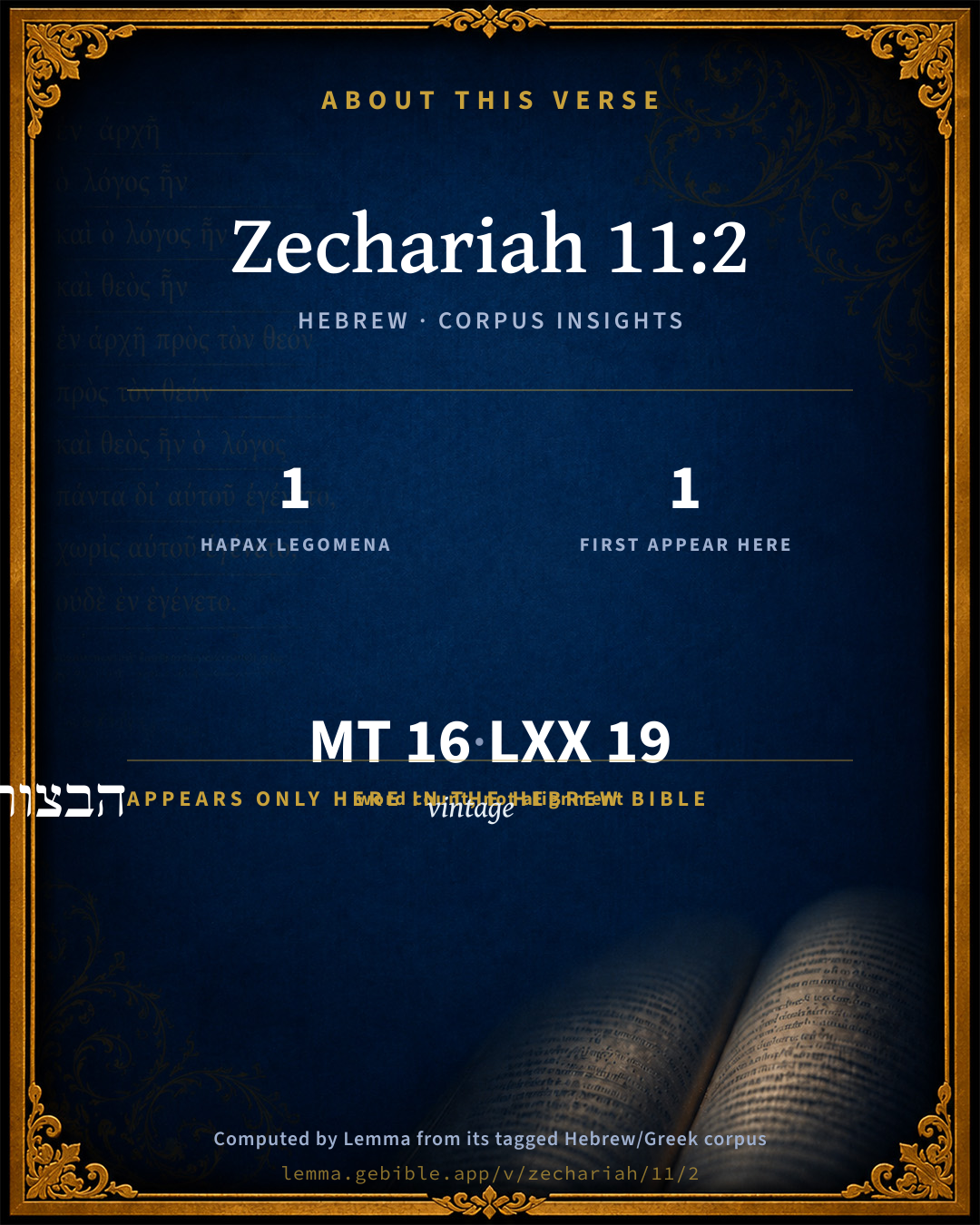
  • 1 hapax legomenon — only here in the Hebrew Bible
  • 1 first appearance in the Hebrew Bible
Full analysis ↓
Download a study sheet

One document with this verse’s original text, its word-by-word gloss line, the meaning frame, cross-references with their text, attributed commentary, and full source and license credits — printable, and it pastes into notes with its structure intact.

This verse Autodidact and up

Study sheet (.html) Plain text (.txt)

A passage Seminary Student

Up to 50 verses in one chapter. A passage sheet keeps up to 6 commentary sources and 12 cross-references per verse, in the order this page ranks them, and says so on the sheet whenever that leaves anything out. Ask for a single verse and you get the Autodidact verse sheet above.

Everything on this page stays free to read, with no account — the sheet is a download of what is already on screen, not access to it.

Want to remove ads? Support Godless Engineer
Compare translations 3

The same verse in 3 English versions, stacked beneath the original-language interlinear above. Click any original word for its lexicon entry.

Each is an independent rendering of the whole verse — the interlinear is not word-aligned to these translations.

Highlighted words mark where these versions differ — a whole-verse word diff, not a word-by-word alignment.

  • World English Bible Public Domain
    Wail, fir tree, for the cedar has fallen, Because the stately ones are destroyed. Wail, you oaks of Bashan, For the strong forest has come down.
  • King James Version Public Domain
    Howl, fir tree; for the cedar is fallen; because the mighty are spoiled: howl, O ye oaks of Bashan; for the forest of the vintage is come down.
  • unfoldingWord Literal Text CC BY-SA 4.0
    Lament, cypress trees, for the cedar have fallen! What was majestic has been devastated! Lament, you oaks of Bashan, for the strong forest has gone down.

unfoldingWord Literal Text — © unfoldingWord, licensed CC BY-SA 4.0. Word-aligned USFM3 via Door43 (git.door43.org/unfoldingWord/en_ult).

Versions to compare (up to 4)

3 of 4 selected

Show all 18 translations

Every available English version of this verse, each an independent rendering of the whole verse.

  • World English Bible Public Domain
    Wail, fir tree, for the cedar has fallen, Because the stately ones are destroyed. Wail, you oaks of Bashan, For the strong forest has come down.
  • Berean Standard Bible Public Domain
    Wail, O cypress, for the cedar has fallen; the majestic trees are ruined! Wail, O oaks of Bashan, for the dense forest has been cut down!
  • Majority Standard Bible Public Domain
    Wail, O cypress, for the cedar has fallen; the majestic trees are ruined! Wail, O oaks of Bashan, for the dense forest has been cut down!
  • King James Version Public Domain
    Howl, fir tree; for the cedar is fallen; because the mighty are spoiled: howl, O ye oaks of Bashan; for the forest of the vintage is come down.
  • American Standard Version (1901) Public Domain
    Wail, O fir-tree, for the cedar is fallen, because the goodly ones are destroyed: wail, O ye oaks of Bashan, for the strong forest is come down.
  • Revised Version (1885) Public Domain
    Howl, O fir tree, for the cedar is fallen, because the goodly ones are spoiled: howl, O ye oaks of Bashan, for the strong forest is come down.
  • Geneva Bible (1599) Public Domain
    Houle, firre trees: for the cedar is fallen, because all the mightie are destroyed: houle ye, O okes of Bashan, for ye defesed forest is cut downe.
  • Douay-Rheims (1899) Public Domain
    Howl, thou fir tree, for the cedar is fallen, for the mighty are laid waste: howl, ye oaks of Basan, because the fenced forest is cut down.
  • Young's Literal Translation Public Domain
    Howl, O fir, for fallen hath the cedar, For their honourable ones were destroyed, Howl, ye oaks of Bashan, For come down hath the fenced forest,
  • Literal Standard Version CC BY-SA 4.0
    Howl, O fir, for the cedar has fallen, || For their majestic ones were destroyed, || Howl, you oaks of Bashan, || For the enclosed forest has come down,
  • Unlocked Literal Bible CC BY-SA 4.0
    Lament, cypress trees, for the cedar trees have fallen! What was majestic has been devastated! Lament, you oaks of Bashan, for the strong forest has gone down.
  • unfoldingWord Literal Text CC BY-SA 4.0
    Lament, cypress trees, for the cedar have fallen! What was majestic has been devastated! Lament, you oaks of Bashan, for the strong forest has gone down.
  • Darby Bible Public Domain
    Howl, cypress, for the cedar is fallen; because the noble ones are spoiled. Howl, ye oaks of Bashan; for the strong forest is come down.
  • World Messianic Bible Public Domain
    Wail, cypress tree, for the cedar has fallen, because the stately ones are destroyed. Wail, you oaks of Bashan, for the strong forest has come down.
  • Webster's Bible Public Domain
    Howl, fir-tree, for the cedar is fallen; because the mighty are laid waste: howl, O ye oaks of Bashan; for the forest of the vintage is come down.
  • Free Bible Version CC BY-SA 4.0
    Weep, juniper, because the cedar has fallen, the majestic trees are ruined! Weep, oaks of Bashan, for the thick forest has been cut down!
  • Bible in Basic English Public Domain
    Give a cry of grief, O fir-tree, for the fall of the cedar, because the great ones have been made low: give cries of grief, O you oaks of Bashan, for the strong trees of the wood have come down.
  • JPS Tanakh (1917) Public Domain
    Wail, O cypress-tree, for the cedar is fallen; because the glorious ones are spoiled; wail, O ye oaks of Bashan, for the strong forest is come down.

Literal Standard Version (2020), Covenant Press — licensed CC BY-SA 4.0. Text via the HelloAO Bible API (eBible.org). Unlocked Literal Bible (unfoldingWord) — licensed CC BY-SA 4.0. Text via the HelloAO Bible API (eBible.org). unfoldingWord Literal Text — © unfoldingWord, licensed CC BY-SA 4.0. Word-aligned USFM3 via Door43 (git.door43.org/unfoldingWord/en_ult). Free Bible Version, Dr. Jonathan Gallagher — licensed CC BY-SA 4.0. Text via the HelloAO Bible API (eBible.org).

Word by word

More ways to search: Search by grammar → Find every occurrence → Compare this word →

Practice this passage: Drill this verse → Learn its vocabulary →

הבצור
bâtsôwr
H1208
“the · vintage”
Particle, Definite Article + Verb, Qal, Participle Passive, Masculine, Singular, Absolute
Part of Speech
Particle + Verb
Stem
Qal
Form
Participle Passive
Gender
Masculine
Number
Singular
State
Absolute
Full BDB Definition

Origin: from H1219

TWOT: 270f

vintage - (CLBL) inaccessible
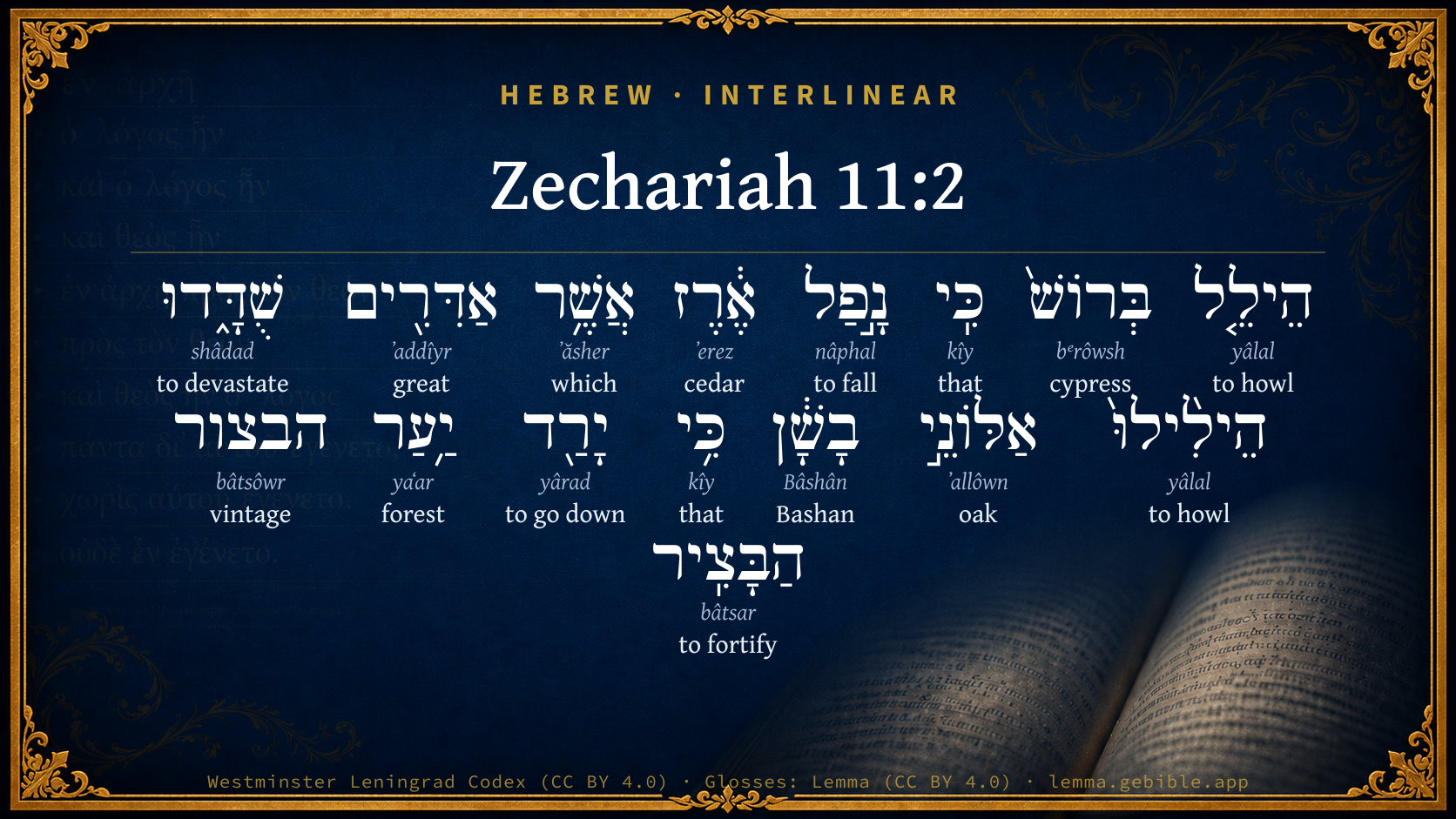
  1. הֵילֵ֤ל yâlal H3213 “howl” Verb, Hiphil, Imperative, 2nd Person, Masculine, Singular
  2. בְּרוֹשׁ֙ bᵉrôwsh H1265 “cypress” Noun, Common, Masculine, Singular, Absolute
  3. כִּֽי kîy H3588 “that” Conjunction
  4. נָ֣פַל nâphal H5307 “to fall” Verb, Qal, Perfect, 3rd Person, Masculine, Singular
  5. אֶ֔רֶז ʼerez H730 “cedar” Noun, Common, Masculine, Singular, Absolute
  6. אֲשֶׁ֥ר ʼăsher H834 “which” Particle, Relative
  7. אַדִּרִ֖ים ʼaddîyr H117 “great” Adjective, Adjective, Masculine, Plural, Absolute
  8. שֻׁדָּ֑דוּ shâdad H7703 “to devastate” Verb, Pual, Perfect, 3rd Person, Common, Plural
  9. הֵילִ֨ילוּ֙ yâlal H3213 “howl” Verb, Hiphil, Imperative, 2nd Person, Masculine, Plural
  10. אַלּוֹנֵ֣י ʼallôwn H437 “oaks of” Noun, Common, Masculine, Plural, Construct
  11. בָשָׁ֔ן Bâshân H1316 “Bashan” Noun, Proper
  12. כִּ֥י kîy H3588 “that” Conjunction
  13. יָרַ֖ד yârad H3381 “to go down” Verb, Qal, Perfect, 3rd Person, Masculine, Singular
  14. יַ֥עַר yaʻar H3293 “forest of” Noun, Common, Masculine, Singular, Construct
  15. הַבָּצִֽיר bâtsar H1219 “the · fortified” Particle, Definite Article + Noun, Common, Masculine, Singular, Absolute

About this verse

These counts appear in no published source. They are computed here, from the morphology-tagged text and Lemma’s own curated glosses. What Lemma adds →

16
words
14
distinct lemmas
Prophets
section

Notable vocabulary

1 hapax legomenon — a word that appears only here in the entire Hebrew Bible:

  • הבצור vintage H1208

First appearance in Scripture

This word makes its first canonical appearance in the Hebrew Bible here:

  • הבצור vintage H1208

Shared distinctive vocabulary

אַלּוֹנֵ֣י oak H437 occurs in 8 verses of the Hebrew Bible. Also found in:

Grammatical profile

  • 6 verbs
  • 6 nouns
  • 1 adjective
  • 2 conjunctions
  • 1 particle

Verb forms

  • הֵילֵ֤ל Hiphil · Imperative
  • נָ֣פַל Qal · Perfect
  • שֻׁדָּ֑דוּ Pual · Perfect
  • הֵילִ֨ילוּ֙ Hiphil · Imperative
  • יָרַ֖ד Qal · Perfect
  • הבצור Qal · Participle Passive

Repetition

Words recur within this verse — often emphatic in Hebrew:

  • הֵילֵ֤ל to howl H3213 ×2
  • כִּֽי that H3588 ×2

Hebrew & Septuagint length

In English translation the verse runs 26 words from the Hebrew and 34 from the Septuagint (LXX English) — closely comparable.

A rough comparison of the two English renderings, which tokenize alike — not a word-level alignment.

Word counts can differ between the Hebrew and the Greek without any difference in meaning — e.g. the Hebrew direct-object marker אֵת has no separate Greek word, and Greek often adds the article ὁ.

In the original languages it is 16 Hebrew tokens and 19 Greek tokens — but the two are counted differently (Hebrew bundles its prefixes and suffixes into one token; the Greek is in lemma form), so that isn’t a like-for-like length.

Cross-references

9

Topical passages linked to Zechariah 11:2 in the Treasury of Scripture Knowledge — connected by theme and wording, ordered by reader-vote popularity; previews shown in the World English Bible.

  • Luke 23:31 For if they do these things in the green tree, what will be done in the dry?"
  • Isaiah 2:12–17 For there will be a day of Yahweh of Hosts for all that is proud and haughty, And for all that is lifted up; And it shall be brought low:
  • Isaiah 10:33–34 Behold, the Lord, Yahweh of Hosts, will lop the boughs with terror: and the high of stature shall be hewn down, and the lofty shall be brought low.
  • Isaiah 32:15–19 until the Spirit be poured on us from on high, and the wilderness become a fruitful field, and the fruitful field be esteemed as a forest.
  • Ezekiel 20:46 Son of man, set your face toward the south, and drop [your word] toward the south, and prophesy against the forest of the field in the South;
  • Ezekiel 31:2–3 Son of man, tell Pharaoh king of Egypt, and to his multitude: Whom are you like in your greatness?
  • Ezekiel 31:17 They also went down into Sheol with him to those who are slain by the sword; yes, those who were his arm, [that] lived under his shadow in the midst of the nations.
  • Amos 6:1 Woe to those who are at ease in Zion, And to those who are secure on the mountain of Samaria, The notable men of the chief of the nations, To whom the house of Israel come!
  • Nahum 3:8–19 Are you better than No-Amon, who was situated among the rivers, who had the waters around her; whose rampart was the sea, and her wall was of the sea?

Cross-references courtesy of OpenBible.info (CC BY 4.0).

Hebrew and Greek witnesses Masoretic Hebrew ↔ Greek Septuagint

The same verse in the two great witnesses to the Old Testament, shown verse-for-verse.

These are two independent witnesses, not word-aligned to each other, and the Septuagint is shown in lemma (dictionary) form.

Hebrew Zechariah 11:2 Masoretic · Westminster Leningrad Codex

הֵילֵ֤ל בְּרוֹשׁ֙ כִּֽי נָ֣פַל אֶ֔רֶז אֲשֶׁ֥ר אַדִּרִ֖ים שֻׁדָּ֑דוּ הֵילִ֨ילוּ֙ אַלּוֹנֵ֣י בָשָׁ֔ן כִּ֥י יָרַ֖ד יַ֥עַר הבצור הַבָּצִֽיר

Wail, fir tree, for the cedar has fallen, Because the stately ones are destroyed. Wail, you oaks of Bashan, For the strong forest has come down.

World English Bible · Public Domain

Greek LXX Zechariah 11:2 Septuagint · lemma form

ὀλολύζω πίτυς διότι πίπτω κέδρος ὅτι μεγάλως μεγιστάν ταλαιπωρέω ὀλολύζω δρῦς ὁ βασανίτις ὅτι κατασπάω ὁ δρυμός ὁ σύμφυτος

Let the pine howl, because the cedar has fallen; for the mighty men have been greatly afflicted: howl, you⌃ oaks of the land of Basan; for the thickly planted forest has been torn down.

LXX2012 (modern English Septuagint) · Public Domain

On this verse, Haydock's Catholic Bible Commentary discusses the Septuagint’s reading. Read the note in Commentary ↓

Hebrew: Westminster Leningrad Codex (CC BY 4.0). Greek: Septuagint (public domain); English from LXX2012 (modern English Septuagint) (Public Domain). How the Septuagint differs from the Hebrew →

Targum (Aramaic paraphrase)

1

The Targum is the ancient Jewish Aramaic paraphrase of the Hebrew Scriptures — an interpretive translation, not the Hebrew text itself. Onkelos (literal) and Pseudo-Jonathan (expansive) render the Torah, and Jonathan the Prophets. Coverage is partial: where no permissively-licensed English translation exists for a verse, only the Aramaic is shown. This is verse-level text, not a word-by-word alignment to the Hebrew.

  1. Targum Jonathan Prophets (Joshua–Malachi)
    אַיְלִילוּ מַלְכַיָא אֲרֵי אִתְּבָרוּ שִׁלְטוֹנַיָא דְעַתִּירֵי נִכְסַיָא מִתְבַּזְזִין אַיְלִילוּ טוּרָנֵי מְדִינָתָא אֲרֵי אִתְבְּזִיז מְחוֹז תּוּקְפְכוֹן:

    (no public-domain English translation for this verse)

    Targum Jonathan — Aramaic: “Mikraot Gedolot” (public domain). English: “Sefaria Community Translation” (CC0 1.0 (public-domain dedication)); “London "Chaldee Paraphrase," 1871” (public domain). Text via Sefaria.

Commentary

Notes on Zechariah 11:2 from classic Christian and Jewish commentators (each source and its license shown beneath its notes). The classic Christian expositions comment on the surrounding passage and are grouped to its opening verse, so a note may address several verses; the Jewish commentaries on the Tanakh (Rashi and others) are per-verse, so they appear only where the commentator wrote on this verse.

Lemma curates 59 commentaries, every one of them public domain or Creative Commons licensed, each selected and text-cleaned for this edition rather than reprinted as found. About our sources →

Trapp's Complete Commentary

John Trapp

Zec 11:2 Howl, fir tree; for the cedar is fallen; because the mighty are spoiled: howl, O ye oaks of Bashan; for the forest of the vintage is come down.

Ver. 2. Howl, fir tree] That is, ye of lower rank, or ye meaner cities, those daughters of Jerusalem, that felt the Roman’s force; howl, take up a loud outcry, a doleful ditty, after the manner of those that are carried captive by the enemy, Psa 137:3. For there they that carried us away captive required of us a song; and they that wasted us, qui contumulabant nos, that threw us on heaps (so Tremellius rendereth it, confer Isa 25:2), or those that made us howl, ululatores nostri (so Schindler), required of us mirth.

Because all the mighty are spoiled] The magnificos, the men of power, as they are called, Psa 76:5, stout-hearted and every way able for strength, courage, and riches; which often take away the life of the owners, Pro 1:19, and expose them to spoil; as every man desireth to lop the tree that hath thick and large boughs and branches.

Howl, O ye oaks of Bashan] Og’s country, who only remained of the remnant of giants, Deu 3:11. The Jews fable that he escaped in the flood by riding astride on the ark. By the oaks of his country understand the strong and eminent. The Chaldee rendereth it, Satrapae provinciarum, ye provincial governors.

For the forest of the vintage] Or, the defenced forest, viz. of Lebanon, i.e. Jerusalem, that seemed impregnable, but at length came down, ruit alto a culmine, as a cedar that is felled by a mighty one, Isa 10:34. Death hewed its way through a wood or forest of men in a minute of time from the mouth of a murdering piece, or some such warlike engine. When the sword is once sharpened it makes a sore slaughter; "it contemneth the rod," Eze 21:10; q.d. what does this silly rod do here? these lesser and lighter judgments? let me come, I will make work among them; down with these oaks, down with this defenced forest, &c.

John Trapp, A Commentary or Exposition upon All the Books of the Old and New Testament (1647–1656) — public domain. Text from a community e-Sword module.

Joseph Benson's Commentary

Zec 11:2-3. Howl, fir-tree — By the several sorts of trees here mentioned, seem to be meant the several orders and degrees of men, who should be sharers in the common destruction: see Isa 2:13; Isa 10:33-34; and the notes. The fir-tree seems to denote the lower people, who are bid to howl because even their superiors, signified by the cedar, could not withstand the storm. Howl, O ye oaks of Bashan — O ye rich, great, and powerful people of the land; Bashan was famous for its stately oaks. For the forest of the vintage — Or rather, a forest, the fenced one, is come down — “As the inhabitants are represented under the image of the trees, the city is aptly denoted by a forest; to which is added by way of distinction הבצר, the fenced one, the article הbeing emphatic, and marking the extraordinary strength of its fortifications, or fence, which, however, proves insufficient for its security.” There is a voice of the howling of the shepherds — That is, of the princes and rulers of the people. For their glory is spoiled — Their magnificent houses are destroyed. A voice of the roaring of young lions — Those who are in the foregoing sentence called shepherds, are here called young lions, because they were devourers of the people by their extortions and oppressions. The pride of Jordan is spoiled — By the pride of Jordan, those woods and thickets are primarily intended that rose proudly above the banks of that river, and greatly decorated the scene. But as those were the receptacles of lions, they are here, in a secondary and metaphorical sense, put for the residences of those princes and grandees, who are denominated lions in the preceding clause for the reason now mentioned.

Joseph Benson's Commentary on the Old and New Testaments (1811–1818) — public domain. Text from a community e-Sword module.

Tyndale Open Study Notes

Tyndale Open Resources

11:2 Like Lebanon, Bashan had superb stands of timber. Lebanon and Bashan are often paired (Isa 2:13; Jer 22:20-22; Ezek 27:5-6) in representing nations that God would judge when he would regather and restore the people of Israel (see Zech 10:11).

Tyndale Open Study Notes — © Tyndale Open Resources, licensed CC BY-SA 4.0. Text via the HelloAO Bible API.

Geneva Bible (1599)

Geneva Bible translators

Showing, that if the strong men were destroyed, the weaker were not able to resist.

Seeing that Lebanon was destroyed, which was the strongest munition, the weaker places could not think to hold out.

Geneva Bible (1599) marginal notes — public domain. Text via Bolls.life.

Jamieson, Fausset & Brown

Robert Jamieson, A. R. Fausset & David Brown

fir tree . . . cedar--if even the cedars (the highest in the state) are not spared, how much less the fir trees (the lowest)!

forest of . . . vintage--As the vines are stripped of their grapes in the vintage (compare Joe 3:13), so the forest of Lebanon "is come down," stripped of all its beauty. Rather, "the fortified" or "inaccessible forest" [MAURER]; that is, Jerusalem dense with houses as a thick forest is with trees, and "fortified" with a wall around. Compare Mic 3:12, where its desolate state is described as a forest.

Jamieson, Fausset & Brown — Commentary Critical and Explanatory on the Whole Bible (1871) — public domain (CC PDM 1.0). Text via the HelloAO Bible API.

Adam Clarke's Commentary

Verse 2. Howl, fir tree] This seems to point out the fall and destruction of all the mighty men.

Adam Clarke's Commentary on the Bible (1810–1826) — public domain. Text from a community e-Sword/MySword module.

John Calvin's Commentaries

He then adds, Howl thou, fir-tree, for the cedar has fallen. No doubt the Prophet by naming Lebanon, mentioning a part for the whole, meant the whole of Judea: and it appears evident from the context that the most remarkable places are here mentioned; but yet the Prophet’s design was to show, that God would punish the whole people, so as not to spare Jerusalem or any other place. And then by the fir-trees and cedars he meant whatever then excelled in Judea or in other places; and for this reason he compares them to the cedars of Lebanon, as though he had said, “There is no reason for the fir-trees to regard themselves as beyond the reach of danger; for if he spares not the cedars what will become of the fir-trees, which possess no such stateliness and grandeur?”

We now then perceive the Prophet’s meaning as to the trees: but he includes, as I have said, under one kind, whatever was valuable in Judea; and this we learn more clearly from what follows: for he adds, Fallen have, or laid waste have been, the strong Some read in the neuter gender, “Laid waste have been splendid things;” but I am inclined to regard persons as intended. The Prophet then now simply declares, that the vengeance of God was nigh all the great ones, whom dignity sheltered, so that they thought themselves in no danger. And for the same purpose he adds, Howl, ye oaks of Bashan. He joins, as we see, Bashan to Lebanon; there is then no reason for allegorising only one of the words, when they are both connected. And he says, For fallen has the fortified forest. Either this may be applied to Lebanon, or the Prophet may be viewed as saying in general, that there was no place so difficult of access, which would not be penetrated into, when the Lord should give liberty to enemies to destroy all things. Though then the density of trees protected these mountains, yet the Prophet says that nothing would obstruct God’s vengeance from penetrating into the inmost recesses of strongholds.

John Calvin's Commentaries (1540-1563) — public domain. Text from the Calvin Translation Society English edition (1840s-50s) via the Christian Classics Ethereal Library (ccel.org). Calvin's coverage is partial (roughly two-thirds of the Bible); uncommented books and verses are honest gaps, never fabricated. The 19th-century editor's footnotes and remarks are omitted so the notes are faithfully Calvin's own voice.

The Cambridge Bible for Schools and Colleges

gen. ed. J. J. S. Perowne

2. fir tree] or cypress. It is uncertain what tree is meant. See Dict. of Bible, Art. “Cypress.”

for the cedar is fallen] Grand trees as were the firs, or cypresses, the cedars were grander still. The fall therefore of the latter might well make the former howl in despair at their own assured fate. “Nam si cedris haud parcitur, aliis arboribus, quæ minoris quam illæ pretii sunt, multo minus parcetur.” Rosenm.

the mighty] i.e. the mighty trees, “præstantes scil. arbores, cedri,” Rosenm., who compares, “a goodly cedar,” Eze_17:23, where the Heb. word is the same. Possibly, however (especially as the clause is additional or parenthetical and mars the symmetry of the parallelism), it is thrown in to suggest the figurative or allegorical reference to the rulers and chiefs of Israel which lies behind and goes together with the literal reference. The goodly ones, R. V.

Bashan] Compare the association of “Gilead and Lebanon,” chap. Zec_10:10. “From the heights of Lebanon the destructive storm sweeps down on the land of Bashan, and the oaks, the pride of the land (with their kindly shade from the burning heat), are likewise felled by the enemy to meet the wants of the invading army, and to construct his means of offence and defence.” Wright.

forest of the vintage] Rather, inaccessible forest.

The Cambridge Bible for Schools and Colleges (gen. ed. J. J. S. Perowne; Cambridge University Press, 1878–1918) — public domain. Text from a community e-Sword module.

John Gill's Exposition

Howl, fir tree; for the cedar is fallen,.... By which are designed the princes, nobles, and magistrates of the land: so the Targum interprets them of kings and princes; see Nah 2:3,

because all the mighty are spoiled; which is an explanation of the figurative expressions in the former clause, and in the following; and designs rich men, as the Targum paraphrases it, who at this time would be spoiled of their wealth and substance.

Howl, O ye oaks of Bashan; which the Targum interprets of governors of provinces; and men of power and authority are doubtless intended; see Isa 2:13,

for the forest of the vintage is come down; or rather, "the fortified forest"; meaning the city of Jerusalem, which was a fortified place, and like a forest full of trees, for number of inhabitants, but now cut down and destroyed; see Isa 10:16.

John Gill's Exposition of the Whole Bible (1746–1763) — public domain (CC PDM 1.0). Text via the HelloAO Bible API.

Albert Barnes' Notes on the Bible

Howl, O cypress, for the cedar is fallen - Jerusalem or the temple having been likened to Lebanon and its cedars, the prophet carries on the image, speaking of the priests princes and people, under the title of firs, cypresses and oaks, trees inferior, but magnificent. He shows that it is imagery, by ascribing to them the feelings of people. The more glorious and stately, “the cedars,” were destroyed. Woe then to the rest, “the cypress;” as our Lord says, “If they do these things in the green tree, what shall be done, in the dry?” Luk 23:31, and Peter, “If the righteous scarcely be saved, where shall the ungodly and the sinner appear?” 1Pe 4:18.

For the defensed forest is come down - That which was closed and inaccessible to the enemy. All which was high and lifted up was brought low, “came down,” even to the ground .

Albert Barnes' Notes on the Bible (1834–1885) — public domain. Text from a community e-Sword/MySword module.

Haydock's Catholic Bible Commentary

Fir and oak may signify the cities and towns of the Jews. --- Fenced. Septuagint, "well planted;" (Calmet) or "forest, planted all at once." (Haydock) --- "The temple was like a fortress." (Tacitus)

George Leo Haydock (1774–1849), Haydock's Catholic Family Bible and Commentary, 1859 edition — public domain. Excludes Psalms (Douay-Rheims chapter numbering differs from Protestant) and Deuterocanonical books (Catholic canon only).

Matthew Poole's English Annotations

Howl, fir tree; either mean men, or houses and towns built with firs.

For the cedar is fallen; the greater and better escape not, much less shall the meaner and worse.

Because the mighty is spoiled; howl because the mighty men, cities, fortresses, and munitions are taken, sacked, and ruined; or else held by enemies, which is worse, and of defences and safety to us, are become our greatest annoyances and dangers.

Oaks of Bashan; oaks either literally, as they were used in that country, for building palaces, cities, towns, and fortresses; or else figuratively, the great men of that country, a land very fruitful and pleasant, of which Nah 1:4.

The forest of the vintage; either all strong places which were for guarding and defending the vineyards; or Jerusalem itself, compared to a forest in regard of the many and tall houses in it; this best pleaseth most interpreters. In short, all are called to weep, and cry, and howl for the miseries that will come upon all sorts, high and low, on-them and theirs.

Is come down; is laid desolate.

Matthew Poole's English Annotations on the Holy Bible (1683–1685) — public domain. Text from a community e-Sword/MySword module.

The Pulpit Commentary

Howl, fir tree. A species of cypress is intended, or, as some say, the Aleppo pine. It is the tree of which Solomon made floors, doom, and ceiling in his temple, (1Ki_6:15, 1Ki_6:34) and David harps. (2Sa_6:5) The prophet dramatically calls on this tree to wail for the fate of the cedar, as being about to suffer the same destruction. The mighty; megistanev , "the chieftains" (Septuagint). Trees are being spoken of, and so the primary sense is, "the goodly" (Eze_17:23) or "glorious trees." Metaphorically, the chiefs of Israel may be intended. Bashan, famous for its oaks, is next visited by the invading force, and its trees are felled for the use of the enemy. The forest of the vintage. The Authorized Version here follows, very inappropriately, the correction of the Keri. The original reading should be retained and translated, "the inaccessible forest an expression appropriate to Lebanon. If Lebanon is not spared, much less shall Bashan escape. LXX, oo drumomfutov , "the close-planted wood;" Vulgate, saltus munitus, "defenced forest.

HOMILIES BY W. FORSYTH Ver. 2. Grief for the fall of a leader.

"Howl." This may be held to express

I SENSE OF A GREAT LOSS. The death of a good man is always a loss. But there are differences. Some stand higher than others in society. Not only "firs," but "cedars." Great men leaders in Church and state. Hence more deeply missed and mourned. There is not only loss of their work, counsel, prayers, but of their personal influence. There are times when the feeling is intensified. Some great work to do, some difficult enterprise to be carried out; or a national crisis, demanding the service of the wisest and the best.

II COMPLAINT OF GRIEVOUS WRONG. Death is the lot of all. When it comes in the order of nature, may grieve, but cannot justly complain. But often death comes not of necessity, but through violence and crime. The "axe," which belongs of right to justice, is seized and foully used by tyrants and assassins. So with many of the prophets and apostles. So often in the history of nations William the Silent, President Lincoln. So in the Massacre of St. Bartholomew, when so many great and good men were cruelly murdered.

III PRESAGE OF DIRE CALAMITY. Dark cloud. The stroke falls. Forecasts the storm. Greater disasters. If the first, the noblest, the usefullest are struck down, who shall escape? "Freedom shrieked as Kosciusko fell.

LESSONS.

1. Call to activity. Close ranks.

2. Challenge to the living to look to themselves. We must all fall, but how and with what results? Robert Hall said of Robinson that "he fell like a noble tree." We should live so as to be missed. Better be mourned for, as friends and well doers gone before, than die unhonoured and unblest. F.

The Pulpit Commentary (1880–1919), ed. H.D.M. Spence-Jones & Joseph S. Exell — public domain. Text from a community e-Sword module.

John Wesley's Explanatory Notes

Fir-tree - Houses and towns built with firs. The cedar - Much less shall ye escape. Ye Oaks - Used in that country for building palaces, cities, towns, and fortresses. The forest - Jerusalem, compared to a forest, in regard of the many and tall houses in it. In short, all are called to cry, for the miseries that will come upon all. Come down - Is laid desolate.

John Wesley, Explanatory Notes Upon the Whole Bible (1754–1765) — public domain. Text via the GEBible commentary corpus.

Rashi

Rabbi Shlomo Yitzchaki (Rashi)

Wail, O cypress, for the cedar has fallen [The cedar,] which is bigger than the cypress, [has fallen]. Howl, O rulers, for the kings of the nations have fallen.

Wail, O oaks of the Bashan Kesnes or chesnes in Old French, chenes in Modern French.

for... has gone down For it has been broken. Similar to [this expression] is (Isa. 32:19), “And He shall hail down the breaking of the forest.”

the fortified forest The fortified forest, the strong walled cities.

Rashi on the Tanakh — English translations: “The Judaica Press complete Tanach with Rashi, translated by A. J. Rosenberg” (CC BY 4.0); “Pentateuch with Rashi's commentary by M. Rosenbaum and A.M. Silbermann, 1929-1934” (public domain); “The Metsudah Tanach series, Lakewood, N.J” (CC BY 4.0); and “The Book of Joshua, Metsudah Publications, 1997” (CC BY 4.0). Text via Sefaria.

Lesson kit

Teaching starters — assembled from the data on this page, not authored interpretation. Every prompt links to the verse data it draws on. Edit before teaching.

Zechariah, in the Prophets, opens this verse with 16 words (14 distinct Hebrew lemmas). Its most distinctive word is bâtsôwr (“vintage”). A historical commentator’s framing appears above. Read the whole chapter for the surrounding context.

Discussion questions

  1. The word bâtsôwr carries the sense “vintage.” How does it shape the verse?
  2. 1 word here appears nowhere else in the Hebrew Bible. Why might the author reach for such rare wording?
  3. This is the first place “vintage” appears in Scripture (first appears here). What does its debut here establish?
  4. How does Genesis 35:8, which shares the word «oak», read alongside this verse?
  5. What does the repetition of “to howl” (2× in this one verse) do in this verse?
  6. These translations render this verse differently; the difference is in the English rendering, not the original. What questions does that raise?
  7. «הֵילֵ֤ל» is a Hiphil Imperative verb. How does that grammatical form shape the action described?
  8. Compare how Trapp's Complete Commentary and Joseph Benson's Commentary read this verse. Where do they agree or differ?

Things to notice

  • 1 word in this verse appears nowhere else in the Hebrew Bible.
  • 1 word makes its first canonical appearance in Scripture here.
  • This verse counts 16 Hebrew ↔ 19 Greek words.
  • These translations choose different wording for 25 words in this verse.
  • “to howl” occurs 2× in this single verse.

Reading settings

Reading text

Shown beneath each verse's original-language words.

Old Testament
Old Testament edition

Read the OT as the Masoretic Hebrew (MT) or the Greek Septuagint (LXX).

English shown for the Greek Septuagint (in the Hebrew ↔ Greek comparison).

Comparing translations? Open the Compare panel on any verse page to stack up to four side by side.