1 Kings 22:20

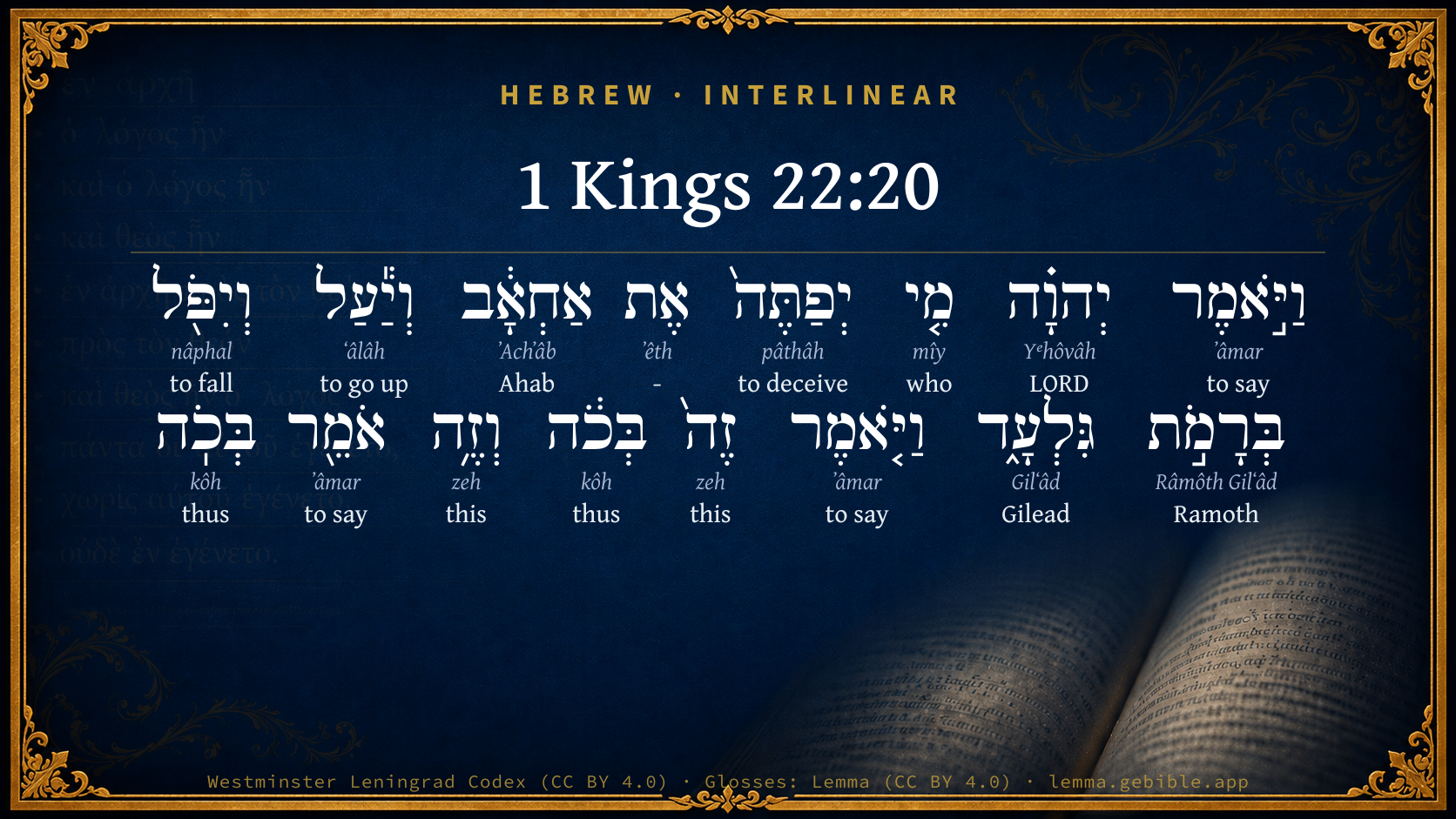
Hebrew (Westminster Leningrad Codex) 1 Kings 22:20 appears in the Hebrew Old Testament. The text above is from the Westminster Leningrad Codex. Each word links to its Strong’s number, a concise gloss, and parsing drawn from the Open Scriptures Hebrew Bible morphology. Click any word for its full Brown-Driver-Briggs (BDB) entry.
Download image
Cite this verse

1 Kings 22:20 (World English Bible). Public Domain. Lemma interlinear Bible study tool, https://lemma.gebible.app/v/1-kings/22/20.

Show BibTeX & RIS
BibTeX
RIS
English Translation
Yahweh said, Who shall entice Ahab, that he may go up and fall at Ramoth-gilead? One said on this manner; and another said on that manner.
World English Bible · Public Domain
Download a study sheet

One document with this verse’s original text, its word-by-word gloss line, the meaning frame, cross-references with their text, attributed commentary, and full source and license credits — printable, and it pastes into notes with its structure intact.

This verse Autodidact and up

Study sheet (.html) Plain text (.txt)

A passage Seminary Student

Up to 50 verses in one chapter. A passage sheet keeps up to 6 commentary sources and 12 cross-references per verse, in the order this page ranks them, and says so on the sheet whenever that leaves anything out. Ask for a single verse and you get the Autodidact verse sheet above.

Everything on this page stays free to read, with no account — the sheet is a download of what is already on screen, not access to it.

Want to remove ads? Support Godless Engineer
Compare translations 3

The same verse in 3 English versions, stacked beneath the original-language interlinear above. Click any original word for its lexicon entry.

Each is an independent rendering of the whole verse — the interlinear is not word-aligned to these translations.

Highlighted words mark where these versions differ — a whole-verse word diff, not a word-by-word alignment.

  • World English Bible Public Domain
    Yahweh said, Who shall entice Ahab, that he may go up and fall at Ramoth-gilead? One said on this manner; and another said on that manner.
  • King James Version Public Domain
    And the LORD said, Who shall persuade Ahab, that he may go up and fall at Ramothgilead? And one said on this manner, and another said on that manner.
  • unfoldingWord Literal Text CC BY-SA 4.0
    And Yahweh said, ‘Who will deceive Ahab so that he may go up and fall Ramoth Gilead?’ And this said, ‘By thus,’ while that was saying, ‘By thus.’

unfoldingWord Literal Text — © unfoldingWord, licensed CC BY-SA 4.0. Word-aligned USFM3 via Door43 (git.door43.org/unfoldingWord/en_ult).

Versions to compare (up to 4)

3 of 4 selected

Show all 18 translations

Every available English version of this verse, each an independent rendering of the whole verse.

  • World English Bible Public Domain
    Yahweh said, Who shall entice Ahab, that he may go up and fall at Ramoth-gilead? One said on this manner; and another said on that manner.
  • Berean Standard Bible Public Domain
    And the LORD said, ‘Who will entice Ahab to march up and fall at Ramoth-gilead?’ And one suggested this, and another that.
  • Majority Standard Bible Public Domain
    And the LORD said, ‘Who will entice Ahab to march up and fall at Ramoth-gilead?’ And one suggested this, and another that.
  • King James Version Public Domain
    And the LORD said, Who shall persuade Ahab, that he may go up and fall at Ramothgilead? And one said on this manner, and another said on that manner.
  • American Standard Version (1901) Public Domain
    And Jehovah said, Who shall entice Ahab, that he may go up and fall at Ramoth-gilead? And one said on this manner; and another said on that manner.
  • Revised Version (1885) Public Domain
    And the LORD said, Who shall entice Ahab, that he may go up and fall at Ramoth-gilead? And one said on this manner; and another said on that manner.
  • Geneva Bible (1599) Public Domain
    And the Lord sayd, Who shall entise Ahab that he may go and fall at Ramoth Gilead? And one said on this maner, and another sayd on that maner.
  • Douay-Rheims (1899) Public Domain
    And the Lord said: Who shall deceive Achab king of Israel, that he may go up, and fall at Ramoth Galaad? And one spoke words of this manner, and another otherwise.
  • Young's Literal Translation Public Domain
    and Jehovah saith, Who doth entice Ahab, and he doth go up and fall in Ramoth-Gilead? and this one saith thus, and that one is saying thus.
  • Literal Standard Version CC BY-SA 4.0
    and YHWH says, Who entices Ahab, and he goes up and falls in Ramoth-Gilead? And this one says thus, and that one is saying thus.
  • Unlocked Literal Bible CC BY-SA 4.0
    Yahweh said, 'Who will entice Ahab, so that he may go up and fall at Ramoth Gilead?' One of them said this and another one said that.
  • unfoldingWord Literal Text CC BY-SA 4.0
    And Yahweh said, ‘Who will deceive Ahab so that he may go up and fall Ramoth Gilead?’ And this said, ‘By thus,’ while that was saying, ‘By thus.’
  • Darby Bible Public Domain
    and Jehovah said, Who shall entice Ahab that he may go up and fall at Ramoth-Gilead? And one said after this manner, and another said after that manner.
  • World Messianic Bible Public Domain
    The LORD said, ‘Who will entice Ahab, that he may go up and fall at Ramoth Gilead?’ One said one thing, and another said another.
  • Webster's Bible Public Domain
    And the LORD said, Who shall persuade Ahab, that he may go up and fall at Ramoth-gilead? And one said in this manner, and another said in that manner.
  • Free Bible Version CC BY-SA 4.0
    The Lord asked, ‘Who will trick Ahab, king of Israel, into attacking Ramoth-gilead so he will be killed there?’ One said this, another said that, and another said something else.
  • Bible in Basic English Public Domain
    And the Lord said, How may Ahab be tricked into going up to Ramoth-gilead to his death? And one said one thing and one another.
  • JPS Tanakh (1917) Public Domain
    And the LORD said: Who shall entice Ahab, that he may go up and fall at Ramoth-gilead. And one said: On this manner; and another said: On that manner.

Literal Standard Version (2020), Covenant Press — licensed CC BY-SA 4.0. Text via the HelloAO Bible API (eBible.org). Unlocked Literal Bible (unfoldingWord) — licensed CC BY-SA 4.0. Text via the HelloAO Bible API (eBible.org). unfoldingWord Literal Text — © unfoldingWord, licensed CC BY-SA 4.0. Word-aligned USFM3 via Door43 (git.door43.org/unfoldingWord/en_ult). Free Bible Version, Dr. Jonathan Gallagher — licensed CC BY-SA 4.0. Text via the HelloAO Bible API (eBible.org).

Word by word

More ways to search: Search by grammar → Find every occurrence → Compare this word →

Practice this passage: Drill this verse → Learn its vocabulary →

בְּרָמֹ֣ת
Râmôth Gilʻâd
H7433
“in/at · Ramoth”
Preposition + Noun, Proper
Part of Speech
Preposition + Noun
Type
Proper
Full BDB Definition

Origin: from the pl. of H7413 and H1568

TWOT: None

Ramoth = "heights" - an Israelite who had a foreign wife in the time of Ezra (noun proper masculine) - Ramoth-gilead - a place in Gilead (noun proper locative) - site dubious
  1. וַיֹּ֣אמֶר ʼâmar H559 “and · to say” Conjunction + Verb, Qal, Sequential Imperfect, 3rd Person, Masculine, Singular
  2. יְהוָ֗ה Yᵉhôvâh H3068 “LORD” Noun, Proper
  3. מִ֤י mîy H4310 “who” Particle, Interrogative
  4. יְפַתֶּה֙ pâthâh H6601 “to deceive” Verb, Piel, Imperfect, 3rd Person, Masculine, Singular
  5. אֶת ʼêth H853 “-” Particle, Direct Object
  6. אַחְאָ֔ב ʼAchʼâb H256 “Ahab” Noun, Proper
  7. וְיַ֕עַל ʻâlâh H5927 “and · to go up” Conjunction + Verb, Qal, Jussive, 3rd Person, Masculine, Singular
  8. וְיִפֹּ֖ל nâphal H5307 “and · to fall” Conjunction + Verb, Qal, Jussive, 3rd Person, Masculine, Singular
  9. גִּלְעָ֑ד Gilʻâd H1568 “Gilead” Noun, Proper
  10. וַיֹּ֤אמֶר ʼâmar H559 “and · to say” Conjunction + Verb, Qal, Sequential Imperfect, 3rd Person, Masculine, Singular
  11. זֶה֙ zeh H2088 “this” Pronoun, Demonstrative, Masculine, Singular
  12. בְּכֹ֔ה kôh H3541 “in/at · thus” Preposition + Adverb
  13. וְזֶ֥ה zeh H2088 “and · this” Conjunction + Pronoun, Demonstrative, Masculine, Singular
  14. אֹמֵ֖ר ʼâmar H559 “saying” Verb, Qal, Participle Active, Masculine, Singular, Absolute
  15. בְּכֹֽה kôh H3541 “in/at · thus” Preposition + Adverb

About this verse

These counts appear in no published source. They are computed here, from the morphology-tagged text and Lemma’s own curated glosses. What Lemma adds →

16
words
12
distinct lemmas
Historical
section

Notable vocabulary

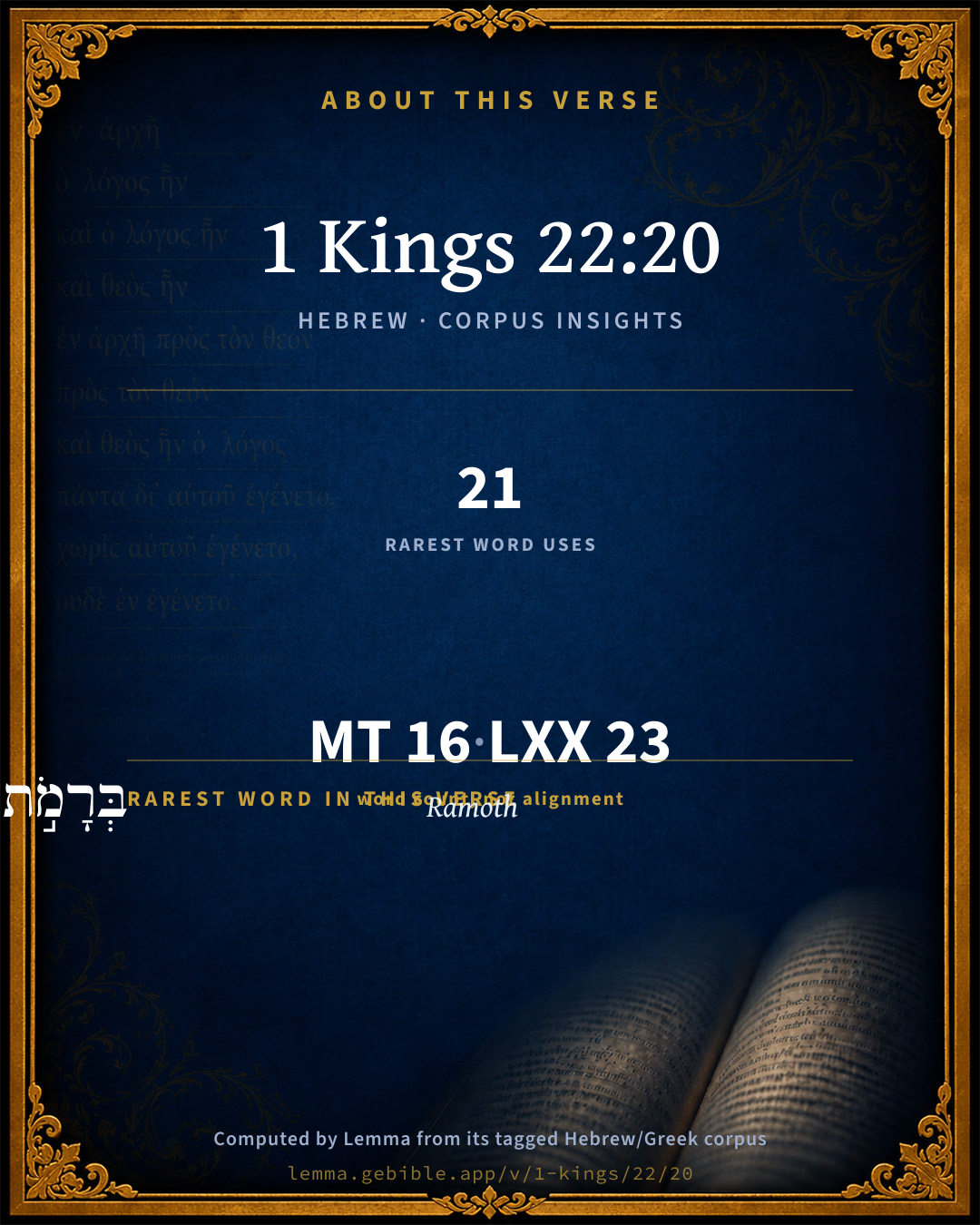
The rarest word here is בְּרָמֹ֣ת Ramoth H7433 — appearing just 21 times in the whole Hebrew Bible.

Shared distinctive vocabulary

בְּרָמֹ֣ת Ramoth H7433 occurs in 21 verses of the Hebrew Bible. Also found in:

Grammatical profile

  • 6 verbs
  • 4 nouns
  • 2 pronouns
  • 2 adverbs
  • 2 particles

Verb forms

  • וַיֹּ֣אמֶר Qal · Sequential Imperfect
  • יְפַתֶּה֙ Piel · Imperfect
  • וְיַ֕עַל Qal · Jussive
  • וְיִפֹּ֖ל Qal · Jussive
  • וַיֹּ֤אמֶר Qal · Sequential Imperfect
  • אֹמֵ֖ר Qal · Participle Active

Repetition

Words recur within this verse — often emphatic in Hebrew:

  • וַיֹּ֣אמֶר to say H559 ×3
  • בְּכֹ֔ה thus H3541 ×2
  • זֶה֙ this H2088 ×2

Hebrew & Septuagint length

In English translation the verse runs 26 words from the Hebrew and 30 from the Septuagint (LXX English) — closely comparable.

A rough comparison of the two English renderings, which tokenize alike — not a word-level alignment.

Word counts can differ between the Hebrew and the Greek without any difference in meaning — e.g. the Hebrew direct-object marker אֵת has no separate Greek word, and Greek often adds the article ὁ.

In the original languages it is 16 Hebrew tokens and 23 Greek tokens — but the two are counted differently (Hebrew bundles its prefixes and suffixes into one token; the Greek is in lemma form), so that isn’t a like-for-like length.

Cross-references

3

Topical passages linked to 1 Kings 22:20 in the Treasury of Scripture Knowledge — connected by theme and wording, ordered by reader-vote popularity; previews shown in the World English Bible.

  • Ezekiel 14:9 If the prophet be deceived and speak a word, I, Yahweh, have deceived that prophet, and I will stretch out my hand on him, and will destroy him from the midst of my people Israel.
  • Job 12:16 With him is strength and wisdom; The deceived and the deceiver are his.
  • Jeremiah 4:10 Then said I, Ah, Lord Yahweh! surely you have greatly deceived this people and Jerusalem, saying, You shall have peace; whereas the sword reaches to the life.

Cross-references courtesy of OpenBible.info (CC BY 4.0).

Hebrew and Greek witnesses Masoretic Hebrew ↔ Greek Septuagint

The same verse in the two great witnesses to the Old Testament, shown verse-for-verse.

These are two independent witnesses, not word-aligned to each other, and the Septuagint is shown in lemma (dictionary) form.

Hebrew 1 Kings 22:20 Masoretic · Westminster Leningrad Codex

וַיֹּ֣אמֶר יְהוָ֗ה מִ֤י יְפַתֶּה֙ אֶת אַחְאָ֔ב וְיַ֕עַל וְיִפֹּ֖ל בְּרָמֹ֣ת גִּלְעָ֑ד וַיֹּ֤אמֶר זֶה֙ בְּכֹ֔ה וְזֶ֥ה אֹמֵ֖ר בְּכֹֽה

Yahweh said, Who shall entice Ahab, that he may go up and fall at Ramoth-gilead? One said on this manner; and another said on that manner.

World English Bible · Public Domain

Greek LXX 1 Kings 22:20 Septuagint · lemma form

καί εἶπον κύριος τίς ἀπατάω ὁ αχααβ βασιλεύς ἰσραήλ καί ἀναβαίνω καί πίπτω ἐν ρεμμαθ γαλαάδ καί εἶπον οὗτος οὕτως καί οὗτος οὕτως

And the Lord said, Who will deceive Achaab king of Israel, that he may go up and fall in Remmath Galaad? and one spoke one way, and another another way.

LXX2012 (modern English Septuagint) · Public Domain

Hebrew: Westminster Leningrad Codex (CC BY 4.0). Greek: Septuagint (public domain); English from LXX2012 (modern English Septuagint) (Public Domain). How the Septuagint differs from the Hebrew →

Targum (Aramaic paraphrase)

1

The Targum is the ancient Jewish Aramaic paraphrase of the Hebrew Scriptures — an interpretive translation, not the Hebrew text itself. Onkelos (literal) and Pseudo-Jonathan (expansive) render the Torah, and Jonathan the Prophets. Coverage is partial: where no permissively-licensed English translation exists for a verse, only the Aramaic is shown. This is verse-level text, not a word-by-word alignment to the Hebrew.

  1. Targum Jonathan Prophets (Joshua–Malachi)
    וַאֲמַר יְיָ מַן יַטְעֵי יַת אַחְאָב וְיִסַק וְיִפּוֹק בְּרָמוֹת גִלְעָד וַאֲמַר דֵין בִּכְדֵין וְדֵין אֲמַר בִּכְדֵין:

    (no public-domain English translation for this verse)

    Targum Jonathan — Aramaic: “Mikraot Gedolot” (public domain). English: “Sefaria Community Translation” (CC0 1.0 (public-domain dedication)); “London "Chaldee Paraphrase," 1871” (public domain). Text via Sefaria.

Commentary

Notes on 1 Kings 22:20 from classic Christian and Jewish commentators (each source and its license shown beneath its notes). The classic Christian expositions comment on the surrounding passage and are grouped to its opening verse, so a note may address several verses; the Jewish commentaries on the Tanakh (Rashi and others) are per-verse, so they appear only where the commentator wrote on this verse.

Lemma curates 59 commentaries, every one of them public domain or Creative Commons licensed, each selected and text-cleaned for this edition rather than reprinted as found. About our sources →

Trapp's Complete Commentary

John Trapp

1Ki 22:20 And the LORD said, Who shall persuade Ahab, that he may go up and fall at Ramothgilead? And one said on this manner, and another said on that manner.

Ver. 20. And one said on this manner, &c.] God cannot want a weapon to beat his rebels with; he hath store of plagues and treasures of wrath for the vessels of wrath; whom he can easily deliver up to strong delusions, vile affections, just damnation. "The deceiver and the deceived are both with him." {Job 12:16} {See Trapp on "Job 12:16"}

John Trapp, A Commentary or Exposition upon All the Books of the Old and New Testament (1647–1656) — public domain. Text from a community e-Sword module.

Joseph Benson's Commentary

1Ki 22:20-22. The Lord said, Who shall persuade Ahab, &c. — This is not to be understood grossly, as if God were at a loss to find out an expedient to accomplish his own designs; nor is it to be supposed that there was really any such consultation, before the Divine Majesty, as who should be employed to persuade Ahab to undo himself. But this is a symbolical representation, to signify that the Lord resolved to suffer Ahab to be deceived and perish at Ramoth-Gilead rather than in any other place; in order that he, who sinfully suffered Ben-hadad to escape, might be punished by Ben-hadad. And there came forth a spirit — An evil one; and stood before the Lord — This is not to be taken literally. There are, however, evil spirits who are very forward to entice men to their own destruction, and have power so to do, if the Lord do not hinder them. He said, I will be a lying spirit in the mouth of all his prophets — I will suggest to them that which will deceive them. And he said, Thou shalt persuade him, and prevail also — I will give them up into thy hands, and leave them to their own ignorance and wickedness. Go forth, and do so — This is not a command, but only a permission. If we suppose this to be any thing more than a symbolical vision, we must say God permitted this evil spirit to follow his own inclinations, which he knew would have success, and prevail with Ahab to believe he should prosper in this war, wherein God intended he should perish. Ahab’s prophets had observed how prosperous he had been in former wars with the king of Syria, and that made them forward to promise him the same success in this also. And Ahab was as forward to believe as they were to promise.

Joseph Benson's Commentary on the Old and New Testaments (1811–1818) — public domain. Text from a community e-Sword module.

Geneva Bible (1599)

Geneva Bible translators

Or, persuade and deceive.

Geneva Bible (1599) marginal notes — public domain. Text via Bolls.life.

The Cambridge Bible for Schools and Colleges

gen. ed. J. J. S. Perowne

20. Who shall persuade [R.V. entice] Ahab] The same change also is made in the two following verses. ‘Entice’ is the rendering in 2 Chronicles, and it represents much better the sense of the verb in the original, which implies flattery and deception; and this it was which was to lead Ahab to his ruin.

The Cambridge Bible for Schools and Colleges (gen. ed. J. J. S. Perowne; Cambridge University Press, 1878–1918) — public domain. Text from a community e-Sword module.

John Gill's Exposition

Now therefore behold, the Lord hath put a lying spirit in the mouths of all these thy prophets,.... That is, suffered the lying spirit to suggest a lie to them, and sent them strong delusions to believe that lie, whose minds were disposed at any rate to flatter Ahab, to whom they told it; which was the way designed to bring him to the ruin appointed for him:

and the Lord hath spoken evil concerning thee: he had decreed it in himself, declared it by Micaiah his prophet, and suffered all those steps to be taken by Satan and the false prophets, to bring him to it.

John Gill's Exposition of the Whole Bible (1746–1763) — public domain (CC PDM 1.0). Text via the HelloAO Bible API.

Haydock's Catholic Bible Commentary

The Lord said, &c. God standeth not in need of any counsellor; nor are we suppose, that things pass in heaven in the manner here described: but this representation was made to the prophet, to be delivered by min in a manner adopted to the common ways and notions of men. (Challoner) (St. Gregory, Mor. ii. 21., &c.) (Worthington) --- God did not enable the king to discern the falsehood. (Bellarmine ii. 13. Grat. Amis.)

George Leo Haydock (1774–1849), Haydock's Catholic Family Bible and Commentary, 1859 edition — public domain. Excludes Psalms (Douay-Rheims chapter numbering differs from Protestant) and Deuterocanonical books (Catholic canon only).

Matthew Poole's English Annotations

This is not to be grossly understood, as if God did ask and take counsel from his creatures, or were at a loss to find out an expedient to accomplish his own will; did consider several ways, and then close with that which upon debate appeared to be best; all which it is ridiculous to imagine concerning a God of perfect and infinite knowledge; but only to bring down Divine things to our shallow capacities, and to express the various means which God hath to execute his own designs.

Matthew Poole's English Annotations on the Holy Bible (1683–1685) — public domain. Text from a community e-Sword/MySword module.

Whedon's Commentary on the Bible

Daniel D. Whedon

20. Who shall persuade Ahab — Here in the light of Divine counsels we see Jehovah giving over an incorrigible sinner to judicial blindness and ruin. Ahab had rejected the truth, and hardened his heart against the force of the most convincing miracles of Divine power, and for this cause God sent him “strong delusion that he should believe a lie.” 2Th_2:11.

Daniel D. Whedon (gen. ed.), Commentary on the Old and New Testaments (1874–1909) — public domain. Text from a community e-Sword module.

The Pulpit Commentary

And the Lord said, Who shall persuade Same word in Exo_22:16, Hebrews; Jud_1:14:15 16:5; Pro_1:10, etc.; in all of which instances it is translated "entice." (Compare with this question that of Isa_6:8) Ahab, that he may go up and fan at Ramoth-Gilead? The meaning is that Ahab"s death in battle had been decreed in the counsels of God, and that the Divine Wisdom had devised means for accomplishing His purpose. And one said on this manner, and another said Heb. saying on that manner. Bahr again quotes from Peter Martyr: Innuit varies providentiae Dei modos, quibus decreta sua ad exitum perducit, and adds that in this vision "inner and spiritual processes are regarded as real phenomena, nay, even as persons."

The Pulpit Commentary (1880–1919), ed. H.D.M. Spence-Jones & Joseph S. Exell — public domain. Text from a community e-Sword module.

John Wesley's Explanatory Notes

Who shall - This is not to be grossly understood, as if God were at a loss to find out an expedient to accomplish his own will; but only to bring down divine things to our shallow capacities, and to express the various means which God hath to execute his own designs.

John Wesley, Explanatory Notes Upon the Whole Bible (1754–1765) — public domain. Text via the GEBible commentary corpus.

Lesson kit

Teaching starters — assembled from the data on this page, not authored interpretation. Every prompt links to the verse data it draws on. Edit before teaching.

1 Kings, in the Historical, opens this verse with 16 words (12 distinct Hebrew lemmas). Its most distinctive word is Râmôth Gilʻâd (“Ramoth”). A historical commentator’s framing appears above. Read the whole chapter for the surrounding context.

Discussion questions

  1. How does “Ramoth” (Râmôth Gilʻâd) shape what this verse is saying?
  2. How does Joshua 21:38, which shares the word «Ramoth», read alongside this verse?
  3. What does the repetition of “to say” (3× in this one verse) do in this verse?
  4. These translations render this verse differently. What is at stake in choosing one wording over another?
  5. «וַיֹּ֣אמֶר» is a Qal Sequential Imperfect verb. How does that grammatical form shape the action described?
  6. Compare how Trapp's Complete Commentary and Joseph Benson's Commentary read this verse. Where do they agree or differ?

Things to notice

Reading settings

Reading text

Shown beneath each verse's original-language words.

Old Testament
Old Testament edition

Read the OT as the Masoretic Hebrew (MT) or the Greek Septuagint (LXX).

English shown for the Greek Septuagint (in the Hebrew ↔ Greek comparison).

Comparing translations? Open the Compare panel on any verse page to stack up to four side by side.