
1 Samuel 17:49

Hebrew (Westminster Leningrad Codex) 1 Samuel 17:49 appears in the Hebrew Old Testament. The text above is from the Westminster Leningrad Codex. Each word links to its Strong’s number, a concise gloss, and parsing drawn from the Open Scriptures Hebrew Bible morphology. Click any word for its full Brown-Driver-Briggs (BDB) entry.
Download image
Cite this verse

1 Samuel 17:49 (World English Bible). Public Domain. Lemma interlinear Bible study tool, https://lemma.gebible.app/v/1-samuel/17/49.

Show BibTeX & RIS
BibTeX
RIS
English Translation
David put his hand in his bag, and took there a stone, and slang it, and struck the Philistine in his forehead; and the stone sank into his forehead, and he fell on his face to the earth.
World English Bible · Public Domain
Download a study sheet

One document with this verse’s original text, its word-by-word gloss line, the meaning frame, cross-references with their text, attributed commentary, and full source and license credits — printable, and it pastes into notes with its structure intact.

This verse Autodidact and up

Study sheet (.html) Plain text (.txt)

A passage Seminary Student

Up to 50 verses in one chapter. A passage sheet keeps up to 6 commentary sources and 12 cross-references per verse, in the order this page ranks them, and says so on the sheet whenever that leaves anything out. Ask for a single verse and you get the Autodidact verse sheet above.

Everything on this page stays free to read, with no account — the sheet is a download of what is already on screen, not access to it.

Want to remove ads? Support Godless Engineer
Compare translations 3

The same verse in 3 English versions, stacked beneath the original-language interlinear above. Click any original word for its lexicon entry.

Each is an independent rendering of the whole verse — the interlinear is not word-aligned to these translations.

Highlighted words mark where these versions differ — a whole-verse word diff, not a word-by-word alignment.

  • World English Bible Public Domain
    David put his hand in his bag, and took there a stone, and slang it, and struck the Philistine in his forehead; and the stone sank into his forehead, and he fell on his face to the earth.
  • King James Version Public Domain
    And David put his hand in his bag, and took thence a stone, and slang it, and smote the Philistine in his forehead, that the stone sunk into his forehead; and he fell upon his face to the earth.
  • unfoldingWord Literal Text CC BY-SA 4.0
    And David put his hand into the bag and took a stone from there, and he slung. And it struck the Philistine on his forehead. And the stone sank into his forehead, and he fell on his face to the ground.

unfoldingWord Literal Text — © unfoldingWord, licensed CC BY-SA 4.0. Word-aligned USFM3 via Door43 (git.door43.org/unfoldingWord/en_ult).

Versions to compare (up to 4)

3 of 4 selected

Show all 18 translations

Every available English version of this verse, each an independent rendering of the whole verse.

  • World English Bible Public Domain
    David put his hand in his bag, and took there a stone, and slang it, and struck the Philistine in his forehead; and the stone sank into his forehead, and he fell on his face to the earth.
  • Berean Standard Bible Public Domain
    Then David reached into his bag, took out a stone, and slung it, striking the Philistine on the forehead. The stone sank into his forehead, and he fell facedown on the ground.
  • Majority Standard Bible Public Domain
    Then David reached into his bag, took out a stone, and slung it, striking the Philistine on the forehead. The stone sank into his forehead, and he fell facedown on the ground.
  • King James Version Public Domain
    And David put his hand in his bag, and took thence a stone, and slang it, and smote the Philistine in his forehead, that the stone sunk into his forehead; and he fell upon his face to the earth.
  • American Standard Version (1901) Public Domain
    And David put his hand in his bag, and took thence a stone, and slang it, and smote the Philistine in his forehead; and the stone sank into his forehead, and he fell upon his face to the earth.
  • Revised Version (1885) Public Domain
    And David put his hand in his bag, and took thence a stone, and slang it, and smote the Philistine in his forehead; and the stone sank into his forehead, and he fell upon his face to the earth.
  • Geneva Bible (1599) Public Domain
    And Dauid put his hande in his bagge, and tooke out a stone, and slang it, and smote the Philistim in his forehead, that the stone sticked in his forehead, and he fell groueling to the earth.
  • Douay-Rheims (1899) Public Domain
    And he put his hand into his scrip, and took a stone, and cast it with the sling, and fetching it about struck the Philistine in the forehead: and the stone was fixed in his forehead, and he fell on his face upon the earth.
  • Young's Literal Translation Public Domain
    and David putteth forth his hand unto the vessel, and taketh thence a stone, and slingeth, and smiteth the Philistine on his forehead, and the stone sinketh into his forehead, and he falleth on his face to the earth.
  • Literal Standard Version CC BY-SA 4.0
    and David puts forth his hand into the vessel, and takes a stone from there, and slings, and strikes the Philistine on his forehead, and the stone sinks into his forehead, and he falls on his face to the earth.
  • Unlocked Literal Bible CC BY-SA 4.0
    David put his hand in his bag, took a stone from it, slung it, and hit the Philistine in the forehead. The stone sank into the Philistine's forehead, and he fell on his face to the ground.
  • unfoldingWord Literal Text CC BY-SA 4.0
    And David put his hand into the bag and took a stone from there, and he slung. And it struck the Philistine on his forehead. And the stone sank into his forehead, and he fell on his face to the ground.
  • Darby Bible Public Domain
    And David put his hand into the bag, and took thence a stone, and slang it, and smote the Philistine in his forehead, and the stone sank into his forehead; and he fell on his face to the earth.
  • World Messianic Bible Public Domain
    David put his hand in his bag, took a stone and slung it, and struck the Philistine in his forehead. The stone sank into his forehead, and he fell on his face to the earth.
  • Webster's Bible Public Domain
    And David put his hand in his bag, and took thence a stone, and hurled it with his sling, and smote the Philistine in his forehead, that the stone sunk into his forehead; and he fell upon his face to the earth.
  • Free Bible Version CC BY-SA 4.0
    David reached into his bag, took out a stone, and fired it from his sling, hitting the Philistine on the forehead. The stone went into his forehead, and he collapsed facedown on the ground.
  • Bible in Basic English Public Domain
    And David put his hand in his bag and took out a stone and sent it from his leather band straight at the Philistine, and the stone went deep into his brow, and he went down to the earth, falling on his face.
  • JPS Tanakh (1917) Public Domain
    And David put his hand in his bag, and took thence a stone, and slung it, and smote the Philistine in his forehead; and the stone sank into his forehead, and he fell upon his face to the earth.

Literal Standard Version (2020), Covenant Press — licensed CC BY-SA 4.0. Text via the HelloAO Bible API (eBible.org). Unlocked Literal Bible (unfoldingWord) — licensed CC BY-SA 4.0. Text via the HelloAO Bible API (eBible.org). unfoldingWord Literal Text — © unfoldingWord, licensed CC BY-SA 4.0. Word-aligned USFM3 via Door43 (git.door43.org/unfoldingWord/en_ult). Free Bible Version, Dr. Jonathan Gallagher — licensed CC BY-SA 4.0. Text via the HelloAO Bible API (eBible.org).

Word by word

More ways to search: Search by grammar → Find every occurrence → Compare this word →

Practice this passage: Drill this verse → Learn its vocabulary →

וַיְקַלַּ֔ע
qâlaʻ
H7049
“and · to sling”
Conjunction + Verb, Piel, Sequential Imperfect, 3rd Person, Masculine, Singular
Part of Speech
Conjunction + Verb
Stem
Piel
Form
Sequential Imperfect
Person
3rd Person
Gender
Masculine
Number
Singular
Full BDB Definition

Origin: a primitive root

TWOT: 2030 , 2031

to sling, hurl forth - (Qal) - to sling - slinger (participle) - (Piel) to sling - (Qal) to carve
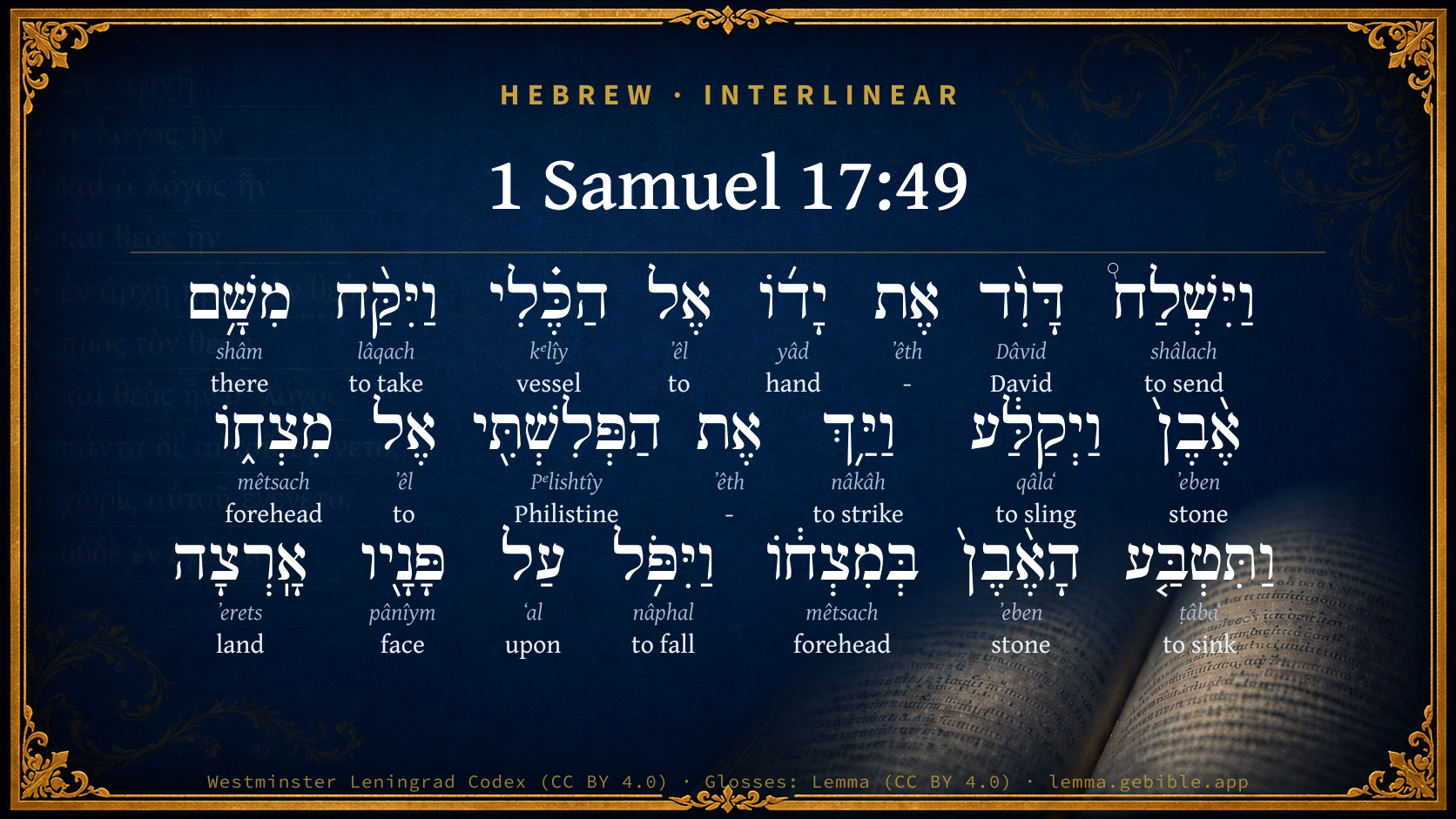
  1. וַיִּשְׁלַח֩ shâlach H7971 “and · to send” Conjunction + Verb, Qal, Sequential Imperfect, 3rd Person, Masculine, Singular
  2. דָּוִ֨ד Dâvid H1732 “David” Noun, Proper
  3. אֶת ʼêth H853 “-” Particle, Direct Object
  4. יָד֜וֹ yâd H3027 “hand · his” Noun, Common, Both, Singular, Construct + Suffix, Personal, 3rd Person, Masculine, Singular
  5. אֶל ʼêl H413 “to” Preposition
  6. הַכֶּ֗לִי kᵉlîy H3627 “the · vessel” Particle, Definite Article + Noun, Common, Masculine, Singular, Absolute
  7. וַיִּקַּ֨ח lâqach H3947 “and · to take” Conjunction + Verb, Qal, Sequential Imperfect, 3rd Person, Masculine, Singular
  8. מִשָּׁ֥ם shâm H8033 “from · there” Preposition + Adverb
  9. אֶ֨בֶן֙ ʼeben H68 “stone” Noun, Common, Feminine, Singular, Absolute
  10. וַיַּ֥ךְ nâkâh H5221 “and · to strike” Conjunction + Verb, Hiphil, Sequential Imperfect, 3rd Person, Masculine, Singular
  11. אֶת ʼêth H853 “-” Particle, Direct Object
  12. הַפְּלִשְׁתִּ֖י Pᵉlishtîy H6430 “the · Philistine” Particle, Definite Article + Noun, Gentilic, Masculine, Singular, Absolute
  13. אֶל ʼêl H413 “to” Preposition
  14. מִצְח֑וֹ mêtsach H4696 “forehead · his” Noun, Common, Masculine, Singular, Construct + Suffix, Personal, 3rd Person, Masculine, Singular
  15. וַתִּטְבַּ֤ע ṭâbaʻ H2883 “and · to sink” Conjunction + Verb, Qal, Sequential Imperfect, 3rd Person, Feminine, Singular
  16. הָאֶ֨בֶן֙ ʼeben H68 “the · stone” Particle, Definite Article + Noun, Common, Feminine, Singular, Absolute
  17. בְּמִצְח֔וֹ mêtsach H4696 “in/at · forehead · his” Preposition + Noun, Common, Masculine, Singular, Construct + Suffix, Personal, 3rd Person, Masculine, Singular
  18. וַיִּפֹּ֥ל nâphal H5307 “and · to fall” Conjunction + Verb, Qal, Sequential Imperfect, 3rd Person, Masculine, Singular
  19. עַל ʻal H5921 “upon” Preposition
  20. פָּנָ֖יו pânîym H6440 “face(s) · his” Noun, Common, Both, Plural, Construct + Suffix, Personal, 3rd Person, Masculine, Singular
  21. אָֽרְצָה ʼerets H776 “land · toward” Noun, Common, Both, Singular, Absolute + Suffix, Demonstrative

About this verse

These counts appear in no published source. They are computed here, from the morphology-tagged text and Lemma’s own curated glosses. What Lemma adds →

22
words
18
distinct lemmas
Historical
section

Notable vocabulary

The rarest word here is וַיְקַלַּ֔ע to sling H7049 — appearing just 7 times in the whole Hebrew Bible.

Shared distinctive vocabulary

וַיְקַלַּ֔ע to sling H7049 occurs in 7 verses of the Hebrew Bible. Also found in:

Grammatical profile

  • 6 verbs
  • 10 nouns
  • 3 prepositions
  • 1 adverb
  • 2 particles

Verb forms

  • וַיִּשְׁלַח֩ Qal · Sequential Imperfect
  • וַיִּקַּ֨ח Qal · Sequential Imperfect
  • וַיְקַלַּ֔ע Piel · Sequential Imperfect
  • וַיַּ֥ךְ Hiphil · Sequential Imperfect
  • וַתִּטְבַּ֤ע Qal · Sequential Imperfect
  • וַיִּפֹּ֥ל Qal · Sequential Imperfect

Repetition

Words recur within this verse — often emphatic in Hebrew:

  • אֶ֨בֶן֙ stone H68 ×2
  • מִצְח֑וֹ forehead H4696 ×2
  • אֶל to H413 ×2

Hebrew & Septuagint length

In English translation the verse runs 38 words from the Hebrew and 43 from the Septuagint (LXX English) — closely comparable.

A rough comparison of the two English renderings, which tokenize alike — not a word-level alignment.

Word counts can differ between the Hebrew and the Greek without any difference in meaning — e.g. the Hebrew direct-object marker אֵת has no separate Greek word, and Greek often adds the article ὁ.

Cross-references

3

Topical passages linked to 1 Samuel 17:49 in the Treasury of Scripture Knowledge — connected by theme and wording, ordered by reader-vote popularity; previews shown in the World English Bible.

  • 1 Corinthians 1:27–28 but God chose the foolish things of the world that he might put to shame those who are wise. God chose the weak things of the world, that he might put to shame the things that are strong;
  • 1 Kings 22:34 A certain man drew his bow at a venture, and struck the king of Israel between the joints of the armor: therefore he said to the driver of his chariot, Turn your hand, and carry me out of the host; for I am severely wounded.
  • 2 Kings 9:24 Jehu drew his bow with his full strength, and struck Joram between his arms; and the arrow went out at his heart, and he sunk down in his chariot.

Cross-references courtesy of OpenBible.info (CC BY 4.0).

Hebrew and Greek witnesses Masoretic Hebrew ↔ Greek Septuagint

The same verse in the two great witnesses to the Old Testament, shown verse-for-verse.

These are two independent witnesses, not word-aligned to each other, and the Septuagint is shown in lemma (dictionary) form.

Hebrew 1 Samuel 17:49 Masoretic · Westminster Leningrad Codex

וַיִּשְׁלַח֩ דָּוִ֨ד אֶת יָד֜וֹ אֶל הַכֶּ֗לִי וַיִּקַּ֨ח מִשָּׁ֥ם אֶ֨בֶן֙ וַיְקַלַּ֔ע וַיַּ֥ךְ אֶת הַפְּלִשְׁתִּ֖י אֶל מִצְח֑וֹ וַתִּטְבַּ֤ע הָאֶ֨בֶן֙ בְּמִצְח֔וֹ וַיִּפֹּ֥ל עַל פָּנָ֖יו אָֽרְצָה

David put his hand in his bag, and took there a stone, and slang it, and struck the Philistine in his forehead; and the stone sank into his forehead, and he fell on his face to the earth.

World English Bible · Public Domain

Greek LXX 1 Samuel 17:49 Septuagint · lemma form
And David stretched out his hand to his scrip, and took thence a stone, and slang it, and struck the Philistine on his forehead, and the stone penetrated through the helmet into his forehead, and he fell upon his face to the ground.

LXX2012 (modern English Septuagint) · Public Domain

On this verse, Adam Clarke's Commentary discusses the Septuagint’s reading. Read the note in Commentary ↓

Hebrew: Westminster Leningrad Codex (CC BY 4.0). Greek: Septuagint (public domain); English from LXX2012 (modern English Septuagint) (Public Domain). How the Septuagint differs from the Hebrew →

Targum (Aramaic paraphrase)

1

The Targum is the ancient Jewish Aramaic paraphrase of the Hebrew Scriptures — an interpretive translation, not the Hebrew text itself. Onkelos (literal) and Pseudo-Jonathan (expansive) render the Torah, and Jonathan the Prophets. Coverage is partial: where no permissively-licensed English translation exists for a verse, only the Aramaic is shown. This is verse-level text, not a word-by-word alignment to the Hebrew.

  1. Targum Jonathan Prophets (Joshua–Malachi)
    וְאוֹשִׁיט דָוִד יַת יְדֵיהּ לְמָנָא וּנְסִיב מִתַּמָן אַבְנָא וְאַקְלַע בִּקִלְעָא וּמְחָא יַת פְּלִשְׁתָּאָה עַל בֵּית עֵינוֹהִי וּטְבָעַת אַבְנָא בְּבֵית עֵינוֹהִי וּנְפַל עַל אַפּוֹהִי עַל אַרְעָא:

    (no public-domain English translation for this verse)

    Targum Jonathan — Aramaic: “Mikraot Gedolot” (public domain). English: “Sefaria Community Translation” (CC0 1.0 (public-domain dedication)); “London "Chaldee Paraphrase," 1871” (public domain). Text via Sefaria.

Commentary

Notes on 1 Samuel 17:49 from classic Christian and Jewish commentators (each source and its license shown beneath its notes). The classic Christian expositions comment on the surrounding passage and are grouped to its opening verse, so a note may address several verses; the Jewish commentaries on the Tanakh (Rashi and others) are per-verse, so they appear only where the commentator wrote on this verse.

Lemma curates 59 commentaries, every one of them public domain or Creative Commons licensed, each selected and text-cleaned for this edition rather than reprinted as found. About our sources →

Trapp's Complete Commentary

John Trapp

1Sa 17:49 And David put his hand in his bag, and took thence a stone, and slang [it], and smote the Philistine in his forehead, that the stone sunk into his forehead; and he fell upon his face to the earth.

Ver. 49. And smote the Philistine in his forehead.] That seat of pride and impudency; there being no other part of Goliath capable of danger; the rest of him was defenced with a brazen wall. This was the Lord’s own work, and it is justly marvellous in our eyes.

That the stone sunk into his forehead.] And, through that, into his brain, whereby he, being presently deprived of sense and motion, fell to the ground in the fulness of his stature, as it is afterwards said of Saul. {1Sa 28:20}

“Dουπησεν δε πεσων, ” - Hom.

There lay the greatness af Goliath.

John Trapp, A Commentary or Exposition upon All the Books of the Old and New Testament (1647–1656) — public domain. Text from a community e-Sword module.

The Biblical Illustrator

Joseph S. Exell

1Sa_17:49

And David put his hand in his bag, and took thence a stone, and smote the Philistine in his forehead.

Faith working wisely

It would be interesting to dwell on the various personages that appear prominently in this historic scene. They are Saul, Eliab, Goliath, and David; the dismayed monarch, the envious brother, the scornful enemy, and the man of God. Whatever Sauls sins had been, he acted well on this occasion. He did not despise the rumour of Davids words but sent for him; and when he professed his readiness to fight the Philistine, Saul said unto David, Go, and the Lord be with thee. There is something very affecting in these words. Saul had violated the principles of the theocracy; he had been rejected by God, and the sentence of rejection bad gone forth; the Spirit of the Lord had departed from him; and yet he could recognise the workings of that Spirit, be touched with expressions of godly trust, and bid God-speed to another in an exploit forbidden to himself. Poor Saul! In Eliab we have a characteristic display of genuine human nature. Goliath stands before us as a type of brute power and blustering self-confidence. What shall we say of David? What simplicity and strength of heart appear throughout! what meekness before his angry brother, what modest dignity before Saul, what courage before Goliath, what humility and confidence before God!

I. David possessed a strong and unwavering confidence in God. From whatever grounds that assurance proceeded, he felt it; and it was the secret of his calmness and strength. The inquiry may occur to us, How came David to have this faith? We do not read of any Divine declaration made to him on the subject; it is not written that God told him that he should triumph: whence then did it proceed? was it holy trust, or vain presumption? It is possible to possess a sure confidence of success, and to succeed in consequence of that confidence, and yet to have no just grounds for it; and David might have felt securely and wrought gloriously without any reasonable basis for his trust. The only ground he himself assigned was past Providence. But in connection with something else, that deliverance would have a special argumentative force. Along with his predicted destiny it would be valuable. The Lord had said, Arise anoint him: for this is he. Thus set apart by the prophet, immunity was assured him; and the immunity already granted would justly bear the character, not of a mere fact, but of a kind of pledge and guarantee. And might there not be something more still? Is it unlawful to suppose Divine suggestion and impression? We are told, in connection with his selection as Sauls successor, that the Spirit of the Lord came upon David from that day forward. A like confidence may be possessed as to particular events. Who has not read of instances of strong presentiment in men having no religion, in relation to their worldly destiny, or the success of their enterprises? They were determined to reach a certain goal; they felt that they could reach it; and they did reach it: power and purpose became prophecy. The history of saints furnishes like instances.

II. Davids faith worked wisely. If he had confidence in God that victory would be his, he expected victory in the way of applying his own powers and resources. It was not a miracle, but a natural operation, that he looked to for triumph. God must be in it, but not in it so as to dispense with means. The opinion is very prevalent, and the impression still more so--though neither so prevalent as they used to be--that God is in the habit of employing unlikely instruments; that, for the purpose of revealing His all-sufficiency and bringing honour to Himself, He delights to contrast results with their secondary causes, and to disappoint the calculations founded on the supposed efficiency of human agents. To hear some men talk, you might conclude that God cannot be properly said to employ instruments at all; that in Nature, and still more in Providence, and most of all in grace, they are not so much instruments that He employs as obstacles, not so much things having a tendency and fitness to accomplish His designs as things altogether unsuitable and inappropriate. Now this belief or feeling is entirely erroneous and woefully mischievous. Many are the connections in which this important truth is lost sight of, and men imagine that they do honour to God by denying or ignoring it Sometimes the grand central truth of the Gospel is adduced as an illustration of important results brought about by unlikely means; and Pauls statements respecting the foolishness of preaching are made to sanction this use of the doctrine of the cross. Yet surely this is to mistake the matter altogether. We admit and maintain the need of Divine influence to render even this truth effectual--and that influence is one of the most glorious proofs of the virtue of Christs death--but we also assert that never was truth more adapted to produce the effects proposed, to open the deep fountain of human affections, than the truth of Christ; crucified. Much the same may be said of faith, as the appointed instrument end condition of spiritual blessing. The importance attached to faith in the Bible, and the marvellous virtue ascribed to it, are often regarded as a proof a mere arbitrariness on the part of God, having nothing to do with its inherent qualities and powers. And truly, if faith were what many deem it, a simple reception of historical facts or theological opinions, it might properly be so regarded. But if faith is, as any careful student of the New Testament may easily ascertain it to be, spiritual insight and sympathy as well as intellectual credence; if it is the reception of Gospel facts in their moral meaning and relations; it would be difficult to discover how anything except faith could realise the effects which Christ came into the world to secure. How can truth operate except by being believed? How can spiritual truth operate but through spiritual faith? The truth we are now asserting requires to be applied to spiritual human agency. Many need to be convinced of the propriety of this application of it; they do not see that the power of Christian workers has a regular relation to their qualifications. Doubtless in Greek and Roman and even Jewish eyes, the agency which Christ appointed and honoured was feeble and worthless, ridiculously so; considered simply as of the world, and in connection with merely worldly works and aims, it was foolish, weak, base, yea nothing at all: but that is very different from saying that in Gods eye, and according to spiritual laws, and for the production of spiritual effects, it was so. The doctrine we have in hand should be recognised in the sphere of physical and secular affairs. We are not perhaps in most danger here; it is in the department of Gods spiritual works that we cleave to the faith and expectation of the irregular and unusual: yet is there on some minds an impression that law does not preside over our material and worldly interests, and that God does interfere to avert the natural consequences of actions and conditions. David had confidence in God, the simplest and firmest, that he would overthrow Goliath, but in the strength of that confidence he employed his familiar weapons of offence. He did just what he would have done if he had sought the destruction of the giant without any confidence in God: but his confidence doubtless enabled him to do it better than with a faithless heart he could have done it; it was an inspiring, a strengthening principle. And true faith is always such. (A. J. Morris.)

Common things in capable hands

A short time ago a geologist heard of a builders yard where an enormous heap of stones might be purchased. The man of science bought the whole stock for a few pounds, and had the collection removed to his own premises. From the heap the geologist was able to discover many unique specimens of fossils, and today several of our leading museums have been enriched and smaller museums supplied with collections worth in all a large sum. Common weapons in the hand of a good man are often used by the Lord to achieve victory. God can use the simplest gifts of His workers if consecrated to His service. (Sunday Companion.)

The Biblical Illustrator, edited by Joseph S. Exell (c. 1880s–1900s) — public domain. Text from a community e-Sword module.

Tyndale Open Study Notes

Tyndale Open Resources

17:49 Goliath’s forehead remained exposed beneath his enormous helmet. • stumbled and fell face down: The stone only incapacitated Goliath; David killed him by decapitating him (17:51).

Tyndale Open Study Notes — © Tyndale Open Resources, licensed CC BY-SA 4.0. Text via the HelloAO Bible API.

Jamieson, Fausset & Brown

Robert Jamieson, A. R. Fausset & David Brown

smote the Philistine in his forehead--At the opening for the eyes--that was the only exposed part of his body.

Jamieson, Fausset & Brown — Commentary Critical and Explanatory on the Whole Bible (1871) — public domain (CC PDM 1.0). Text via the HelloAO Bible API.

Adam Clarke's Commentary

Verse 49. Smote the Philistine in his forehead] Except his face, Goliath was everywhere covered over with strong armour. Either he had no beaver to his helmet, or it was lifted up so as to expose his forehead; but it does not appear that the ancient helmets had any covering for the face. The Septuagint however supposes that the stone passed through the helmet, and sank into his forehead: Και διεδυ ὁ λιθος δια της περικεφαλαιας εις το μετωπον αυτου, "and the stone passed through his helmet, and sank into his skull." To some this has appeared perfectly improbable; but we are assured by ancient writers that scarcely any thing could resist the force of the sling.

Diodorus Siculus, lib. v., c. 18, p. 287, edit. Bipont, says "The Baleares, in time of war, sling greater stones than any other people, and with such force, that they seem as if projected from a catapult. Διο και κατα τας τειχομαχιας εν ταις προσβολαις τυπτοντες τους προ των επαλξεων εφεστωτας κατατραυματιζουσιν· εν δε ταις παραταξεσι τους τε θυρεους, και τα κρανη, και παν σκεπαστηριον ὁπλον συντριβουσι. Κατα δε την ευστοχιαν οὑτως ακριβεις εισιν, ὡστε κατα το πλειστον μη ἁμαρτανειν του προκειμενου σκοπου. Therefore, in assaults made on fortified towns, they grievously wound the besieged; and in battle they break in pieces the shields, helmets, and every species of armour by which the body is defended. And they are such exact marksmen that they scarcely ever miss that at which they aim."

The historian accounts for their great accuracy and power in the use of the sling, from this circumstance: Αιτιαι δε τουτων, κ.τ.λ. "They attain to this perfection by frequent exercise from their childhood; for while they are young and under their mother's care, they are obliged to learn to sling; for they fasten bread for a mark at the top of the pole; and till the child hit the bread he must remain fasting; and when he has hit it, the mother gives it to him to eat."-Ibid.

I have given these passages at large, because they contain several curious facts, and sufficiently account for the force and accuracy with which David slung his stone at Goliath. We find also in the μη αμαρτανειν, not miss the mark, of the historian, the true notion of αμαρτανειν, to sin, which I have contended for elsewhere. He who sins, though he aims thereby at his gratification and profit, misses the mark of present and eternal felicity.

Adam Clarke's Commentary on the Bible (1810–1826) — public domain. Text from a community e-Sword/MySword module.

Ellicott's Commentary for English Readers

(49) And smote the Philistine in the forehead.—The LXX. add the words “through the helm” The Greek translators could not understand the fact of the forehead being unprotected. But the head-pieces of the armour then do not appear to have possessed “visors;” the face was covered with the heavy shield, which was borne, we are told (1Sa_17:7), before him. No doubt the Philistine, utterly despising his youthful “unarmed” antagonist, advanced towards him without using, as was customary, the face protection of the shield.

Slinging stones had been brought among the Israelites to an extraordinary perfection. Many years before this time we read that in the tribe of Benjamin were “700 chosen men left-handed; every one could sling stones at an hair’s breadth, and not miss” (Jdg_20:16).

A work by W. Vischer, on “Ancient Slings” (Basel, 1866), quoted by Lange, speaks of slingers who could hit the part of the enemy’s face at which they aimed.

A Bible Commentary for English Readers, edited by Charles John Ellicott (1878–1897) — public domain. Text from a community e-Sword module.

John Gill's Exposition

And David put his hand in his bag,.... The shepherd's scrip, in which he had put the five stones he took out of the brook:

and took thence a stone; and put it into his sling he had in his hand:

and slang it, and smote the Philistine in his forehead; it is made a difficulty of how he should smite him on his forehead, when he had a helmet of brass upon his head, Sa1 17:5; in answer to this Kimchi observes, that some say, that when David said he would give his flesh to the fowls of the air, at the mention of that he looked upwards, and what was upon his forehead fell backwards, and then David slung and smote him; or he might put back his helmet to talk with David, and hear and be heard the better; and having nothing to fear from an unarmed man, might neglect to put it forward again; or there might be some open space left in the helmet for him to look through, in at which the stone might pass; so the Targum renders it, he smote him in the house of his eyes, so the stone passed through the eye hole into his brain: but after all, supposing his forehead ever so well covered, as the stone slung by David was under a divine direction, so as to hit a person in motion, it came with a divine power, which nothing could resist; and supposing this, of which there need no doubt, it could as easily pass through the helmet of brass, as pierce into his forehead and sink there; nor can this be thought the least incredible, if what Diodorus Siculus (m) relates of the Baleares be true, that they were so dexterous at slinging, that they not only would sling stones bigger than others could, and were so directed, that they seldom missed their mark, being inured to it from their youth, but would even in battle break in pieces shields, helmets, and all kinds of armour, with which bodies were covered:

that the stone sunk into his forehead; and so into his brain, as a stone is immersed and sinks in water, when thrown into it; with such force did it go, and with so much ease did it make its way, through the direction and power of God:

and he fell upon his face to the earth; Jarchi observes, that it was most natural for him to have fallen backwards, being struck upon his forehead; but so it was, that David might have no trouble to cut off his head, for by this means he fell nearer to him.

(m) Bibliothec. l. 5. p. 298.

John Gill's Exposition of the Whole Bible (1746–1763) — public domain (CC PDM 1.0). Text via the HelloAO Bible API.

Haydock's Catholic Bible Commentary

Forehead. "The soul....more probably resides in the callous body of the brain," (Eyre, Thesis 1797,) between the eyes. (Haydock) --- Earth, quite lifeless, (Salien) or unable to resist. (Menochius) --- The Balearic slingers scarcely ever missed their mark. (Livy, viii. 4.) The Chaldean supposes that David hit the eye, which was not covered with brass: but the stone might penetrate or kill Goliath through his helmet. Even a buckler is not capable of withstanding their violence. (Diodorus, v. 207.) See Judges xx. 16. (Calmet) --- Pride sits on the forehead, and manifests itself by impudent behaviour. We must destroy it by humility, and by the cross of Christ. (St. Augustine) (Worthington)

George Leo Haydock (1774–1849), Haydock's Catholic Family Bible and Commentary, 1859 edition — public domain. Excludes Psalms (Douay-Rheims chapter numbering differs from Protestant) and Deuterocanonical books (Catholic canon only).

Matthew Poole's English Annotations

Either,

1. The stone pierced through his helmet; which such stones being slung would not seldom do; as even Diodorus Siculus relates. Or,

2. The stone might get in through one of those holes which are left in helmets, that he that wears it may see his way, and how to direct his blows. Or rather,

3. The proud giant had lift up that part of his helmet which covered his forehead; and that in contempt of David and his weapons, and by the singular direction of God’s providence.

Matthew Poole's English Annotations on the Holy Bible (1683–1685) — public domain. Text from a community e-Sword/MySword module.

Whedon's Commentary on the Bible

Daniel D. Whedon

49. In his forehead — The only unprotected portion of his body. According to the Septuagint, however, the stone passed through Goliath’s helmet.

Daniel D. Whedon (gen. ed.), Commentary on the Old and New Testaments (1874–1909) — public domain. Text from a community e-Sword module.

John Wesley's Explanatory Notes

Forehead - Probably the proud giant had lift up that part of his helmet which covered his fore-head; in contempt of David and his weapons, and by the singular direction of providence.

John Wesley, Explanatory Notes Upon the Whole Bible (1754–1765) — public domain. Text via the GEBible commentary corpus.

Rashi

Rabbi Shlomo Yitzchaki (Rashi)

And he fell face downward. He should have fallen backwards since he had been struck on his forehead. But, in order that Dovid should not be troubled to walk [the extra distance] and cut off his head, for Dovid now saved twelve amos and two zeres; for his height was six amos and a zeres, Dovid saved [walking] his entire height back and hs entire height forward.

Rashi on the Tanakh — English translations: “The Judaica Press complete Tanach with Rashi, translated by A. J. Rosenberg” (CC BY 4.0); “Pentateuch with Rashi's commentary by M. Rosenbaum and A.M. Silbermann, 1929-1934” (public domain); “The Metsudah Tanach series, Lakewood, N.J” (CC BY 4.0); and “The Book of Joshua, Metsudah Publications, 1997” (CC BY 4.0). Text via Sefaria.

Lesson kit

Teaching starters — assembled from the data on this page, not authored interpretation. Every prompt links to the verse data it draws on. Edit before teaching.

1 Samuel, in the Historical, opens this verse with 22 words (18 distinct Hebrew lemmas). Its most distinctive word is qâlaʻ (“to sling”). A historical commentator’s framing appears above. Read the whole chapter for the surrounding context.

Discussion questions

  1. The word qâlaʻ carries the sense “to sling.” How does it shape the verse?
  2. How does Judges 20:16, which shares the word «to sling», read alongside this verse?
  3. What does the repetition of “stone” (2× in this one verse) do in this verse?
  4. These translations render this verse differently. What is at stake in choosing one wording over another?
  5. «וַיִּשְׁלַח֩» is a Qal Sequential Imperfect verb. How does that grammatical form shape the action described?
  6. Compare how Trapp's Complete Commentary and The Biblical Illustrator read this verse. Where do they agree or differ?

Things to notice

Reading settings

Reading text

Shown beneath each verse's original-language words.

Old Testament
Old Testament edition

Read the OT as the Masoretic Hebrew (MT) or the Greek Septuagint (LXX).

English shown for the Greek Septuagint (in the Hebrew ↔ Greek comparison).

Comparing translations? Open the Compare panel on any verse page to stack up to four side by side.