Numbers 35:23

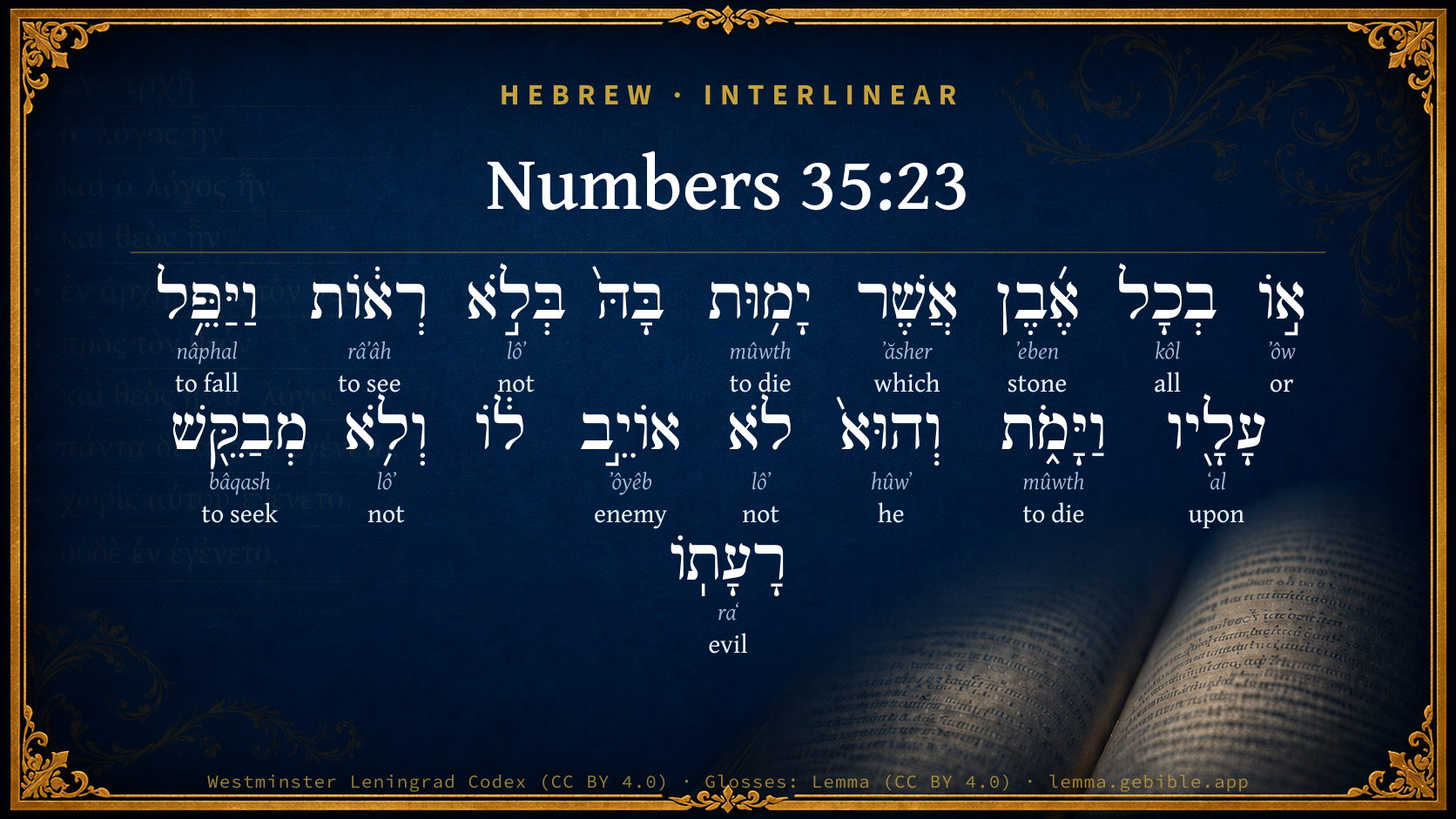
Hebrew (Westminster Leningrad Codex) Numbers 35:23 appears in the Hebrew Old Testament. The text above is from the Westminster Leningrad Codex. Each word links to its Strong’s number, a concise gloss, and parsing drawn from the Open Scriptures Hebrew Bible morphology. Click any word for its full Brown-Driver-Briggs (BDB) entry.
Download image
Cite this verse

Numbers 35:23 (World English Bible). Public Domain. Lemma interlinear Bible study tool, https://lemma.gebible.app/v/numbers/35/23.

Show BibTeX & RIS
BibTeX
RIS
English Translation
or with any stone, by which a man may die, not seeing him, and cast it on him, so that he died, and he was not his enemy, neither sought his harm;
World English Bible · Public Domain
Download a study sheet

One document with this verse’s original text, its word-by-word gloss line, the meaning frame, cross-references with their text, attributed commentary, and full source and license credits — printable, and it pastes into notes with its structure intact.

This verse Autodidact and up

Study sheet (.html) Plain text (.txt)

A passage Seminary Student

Up to 50 verses in one chapter. A passage sheet keeps up to 6 commentary sources and 12 cross-references per verse, in the order this page ranks them, and says so on the sheet whenever that leaves anything out. Ask for a single verse and you get the Autodidact verse sheet above.

Everything on this page stays free to read, with no account — the sheet is a download of what is already on screen, not access to it.

Want to remove ads? Support Godless Engineer
Compare translations 3

The same verse in 3 English versions, stacked beneath the original-language interlinear above. Click any original word for its lexicon entry.

Each is an independent rendering of the whole verse — the interlinear is not word-aligned to these translations.

Highlighted words mark where these versions differ — a whole-verse word diff, not a word-by-word alignment.

  • World English Bible Public Domain
    or with any stone, by which a man may die, not seeing him, and cast it on him, so that he died, and he was not his enemy, neither sought his harm;
  • King James Version Public Domain
    Or with any stone, wherewith a man may die, seeing him not, and cast it upon him, that he die, and was not his enemy, neither sought his harm:
  • unfoldingWord Literal Text CC BY-SA 4.0
    or if with any stone by which one could die without seeing he drops it on him and he dies and he was not an enemy to him and was not seeking his harm,

unfoldingWord Literal Text — © unfoldingWord, licensed CC BY-SA 4.0. Word-aligned USFM3 via Door43 (git.door43.org/unfoldingWord/en_ult).

Versions to compare (up to 4)

3 of 4 selected

Show all 18 translations

Every available English version of this verse, each an independent rendering of the whole verse.

  • World English Bible Public Domain
    or with any stone, by which a man may die, not seeing him, and cast it on him, so that he died, and he was not his enemy, neither sought his harm;
  • Berean Standard Bible Public Domain
    or without looking drops a heavy stone that kills him, but he was not an enemy and did not intend to harm him,
  • Majority Standard Bible Public Domain
    or without looking drops a heavy stone that kills him, but he was not an enemy and did not intend to harm him,
  • King James Version Public Domain
    Or with any stone, wherewith a man may die, seeing him not, and cast it upon him, that he die, and was not his enemy, neither sought his harm:
  • American Standard Version (1901) Public Domain
    or with any stone, whereby a man may die, seeing him not, and cast it upon him, so that he died, and he was not his enemy, neither sought his harm;
  • Revised Version (1885) Public Domain
    or with any stone, whereby a man may die, seeing him not, and cast it upon him, so that he died, and he was not his enemy, neither sought his harm:
  • Geneva Bible (1599) Public Domain
    Or any stone (whereby he might be slaine) and sawe him not, or caused it to fall vpon him, and he die, and was not his enemie, neither sought him any harme,
  • Douay-Rheims (1899) Public Domain
    And enmity, he do any of these things,
  • Young's Literal Translation Public Domain
    or with any stone wherewith he dieth, without seeing, and causeth `it' to fall upon him, and he dieth, and he `is' not his enemy, nor seeking his evil;
  • Literal Standard Version CC BY-SA 4.0
    or with any stone with which he could die, without seeing, indeed, causes [it] to fall on him, and he dies, and he [is] not his enemy, nor seeking his evil,
  • Unlocked Literal Bible CC BY-SA 4.0
    or if he throws a stone that could kill a victim without seeing the victim, then the accused was not the victim's enemy; he was not trying to hurt the victim. But this is what to do if the victim dies anyway.
  • unfoldingWord Literal Text CC BY-SA 4.0
    or if with any stone by which one could die without seeing he drops it on him and he dies and he was not an enemy to him and was not seeking his harm,
  • Darby Bible Public Domain
    or [have smitten him] with any stone wherewith one may die, without seeing him, and have cast it upon him so that he die, and he was not his enemy, neither sought his harm:
  • World Messianic Bible Public Domain
    or with any stone, by which a man may die, not seeing him, and cast it on him so that he died, and he was not his enemy and not seeking his harm,
  • Webster's Bible Public Domain
    Or with any stone, by which a man may die, seeing him not, and shall cast it upon him, that he die, and was not his enemy, neither sought his harm:
  • Free Bible Version CC BY-SA 4.0
    or carelessly drops a heavy stone that kills them, but not as an enemy or intending to harm them,
  • Bible in Basic English Public Domain
    Or has given him a blow with a stone, without seeing him, so causing his death, though he had nothing against him and no desire to do him evil:
  • JPS Tanakh (1917) Public Domain
    or with any stone, whereby a man may die, seeing him not, and cast it upon him, so that he died, and he was not his enemy, neither sought his harm;

Literal Standard Version (2020), Covenant Press — licensed CC BY-SA 4.0. Text via the HelloAO Bible API (eBible.org). Unlocked Literal Bible (unfoldingWord) — licensed CC BY-SA 4.0. Text via the HelloAO Bible API (eBible.org). unfoldingWord Literal Text — © unfoldingWord, licensed CC BY-SA 4.0. Word-aligned USFM3 via Door43 (git.door43.org/unfoldingWord/en_ult). Free Bible Version, Dr. Jonathan Gallagher — licensed CC BY-SA 4.0. Text via the HelloAO Bible API (eBible.org).

Word by word

More ways to search: Search by grammar → Find every occurrence → Compare this word →

Practice this passage: Drill this verse → Learn its vocabulary →

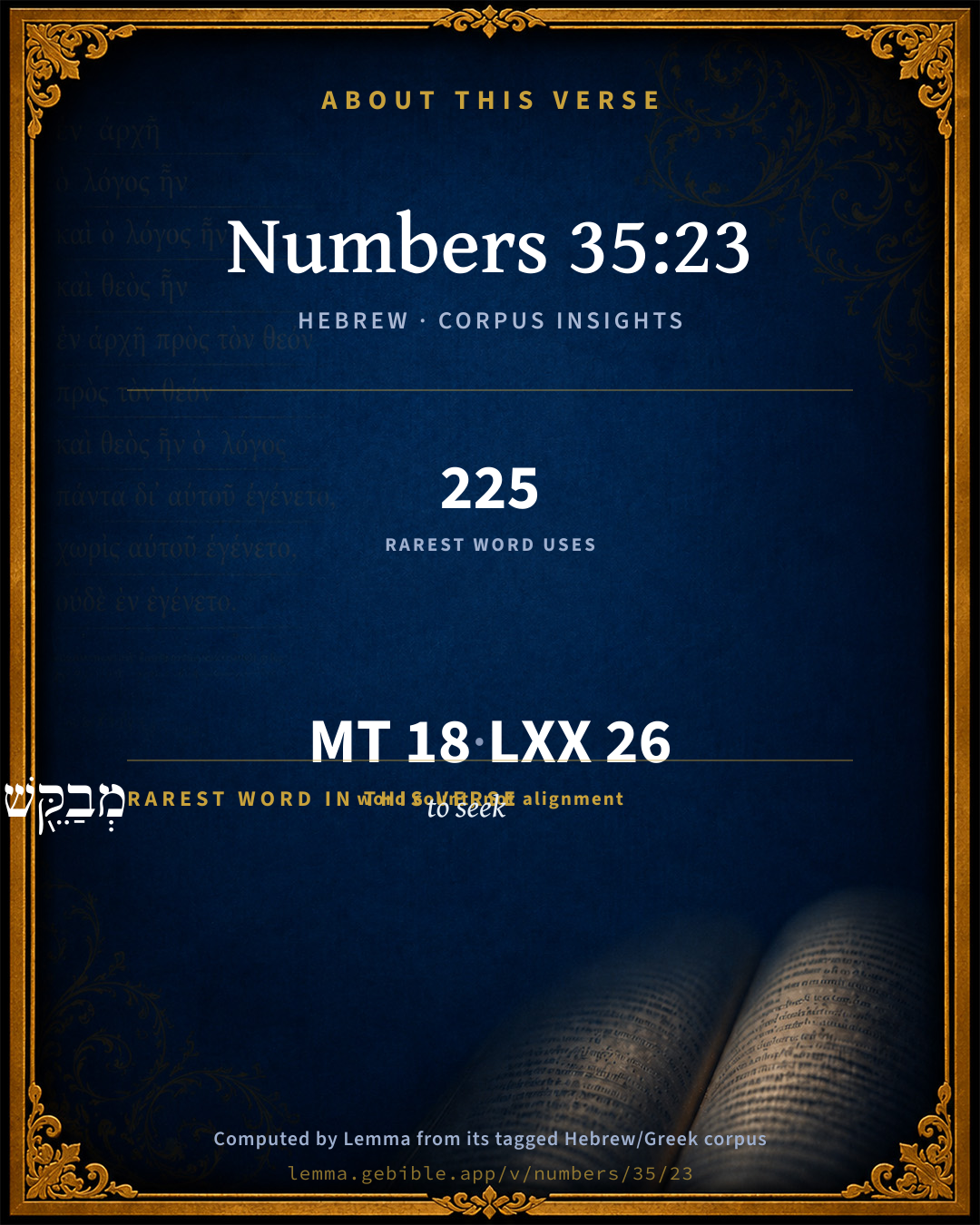
מְבַקֵּ֖שׁ
bâqash
H1245
“seeking”
Verb, Piel, Participle Active, Masculine, Singular, Absolute
Part of Speech
Verb
Stem
Piel
Form
Participle Active
Gender
Masculine
Number
Singular
State
Absolute
Full BDB Definition

Origin: a primitive root

TWOT: 276

to seek, require, desire, exact, request - (Piel) - to seek to find - to seek to secure - to seek the face - to desire, demand - to require, exact - to ask, request - (Pual) to be sought
  1. א֣וֹ ʼôw H176 “or” Conjunction
  2. בְכָל kôl H3605 “in/at · all of” Preposition + Noun, Common, Masculine, Singular, Construct
  3. אֶ֜בֶן ʼeben H68 “stone” Noun, Common, Feminine, Singular, Absolute
  4. אֲשֶׁר ʼăsher H834 “which” Particle, Relative
  5. יָמ֥וּת mûwth H4191 “to die” Verb, Qal, Imperfect, 3rd Person, Masculine, Singular
  6. בְּלֹ֣א lôʼ H3808 “in/at · not” Preposition + Particle, Negative
  7. רְא֔וֹת râʼâh H7200 “to see” Verb, Qal, Infinitive Construct
  8. וַיַּפֵּ֥ל nâphal H5307 “and · to fall” Conjunction + Verb, Hiphil, Sequential Imperfect, 3rd Person, Masculine, Singular
  9. עָלָ֖יו ʻal H5921 “upon · him” Preposition + Suffix, Personal, 3rd Person, Masculine, Singular
  10. וַיָּמֹ֑ת mûwth H4191 “and · to die” Conjunction + Verb, Qal, Sequential Imperfect, 3rd Person, Masculine, Singular
  11. וְהוּא֙ hûwʼ H1931 “and · he” Conjunction + Pronoun, Personal, 3rd Person, Masculine, Singular
  12. לֹא lôʼ H3808 “not” Particle, Negative
  13. אוֹיֵ֣ב ʼôyêb H341 “enemy” Verb, Qal, Participle Active, Masculine, Singular, Absolute
  14. וְלֹ֥א lôʼ H3808 “and · not” Conjunction + Particle, Negative
  15. רָעָתֽוֹ raʻ H7451 “evil · his” Noun, Common, Feminine, Singular, Construct + Suffix, Personal, 3rd Person, Masculine, Singular

About this verse

These counts appear in no published source. They are computed here, from the morphology-tagged text and Lemma’s own curated glosses. What Lemma adds →

18
words
13
distinct lemmas
Pentateuch
section

Grammatical profile

  • 6 verbs
  • 3 nouns
  • 1 pronoun
  • 3 prepositions
  • 1 conjunction
  • 4 particles

Verb forms

  • יָמ֥וּת Qal · Imperfect
  • רְא֔וֹת Qal · Infinitive Construct
  • וַיַּפֵּ֥ל Hiphil · Sequential Imperfect
  • וַיָּמֹ֑ת Qal · Sequential Imperfect
  • אוֹיֵ֣ב Qal · Participle Active
  • מְבַקֵּ֖שׁ Piel · Participle Active

Repetition

Words recur within this verse — often emphatic in Hebrew:

  • יָמ֥וּת to die H4191 ×2
  • בְּלֹ֣א not H3808 ×3

Hebrew & Septuagint length

In English translation the verse runs 32 words from the Hebrew and 33 from the Septuagint (LXX English) — closely comparable.

A rough comparison of the two English renderings, which tokenize alike — not a word-level alignment.

Word counts can differ between the Hebrew and the Greek without any difference in meaning — e.g. the Hebrew direct-object marker אֵת has no separate Greek word, and Greek often adds the article ὁ.

In the original languages it is 18 Hebrew tokens and 26 Greek tokens — but the two are counted differently (Hebrew bundles its prefixes and suffixes into one token; the Greek is in lemma form), so that isn’t a like-for-like length.

Hebrew and Greek witnesses Masoretic Hebrew ↔ Greek Septuagint

The same verse in the two great witnesses to the Old Testament, shown verse-for-verse.

These are two independent witnesses, not word-aligned to each other, and the Septuagint is shown in lemma (dictionary) form.

Hebrew Numbers 35:23 Masoretic · Westminster Leningrad Codex

א֣וֹ בְכָל אֶ֜בֶן אֲשֶׁר יָמ֥וּת בָּהּ֙ בְּלֹ֣א רְא֔וֹת וַיַּפֵּ֥ל עָלָ֖יו וַיָּמֹ֑ת וְהוּא֙ לֹא אוֹיֵ֣ב ל֔וֹ וְלֹ֥א מְבַקֵּ֖שׁ רָעָתֽוֹ

or with any stone, by which a man may die, not seeing him, and cast it on him, so that he died, and he was not his enemy, neither sought his harm;

World English Bible · Public Domain

Greek LXX Numbers 35:23 Septuagint · lemma form

ἤ πᾶς λίθος ἐν ὅς ἀποθνήσκω ἐν αὐτός οὐ οἶδα καί ἐπιπίπτω ἐπί αὐτός καί ἀποθνήσκω αὐτός δέ οὐ ἐχθρός αὐτός εἰμί οὐδέ ζητέω κακοποιέω αὐτός

or strike him with any stone, whereby a man may die, unawares, and it should fall upon him, and he should die, but he was not his enemy, nor sought to hurt him;

LXX2012 (modern English Septuagint) · Public Domain

Hebrew: Westminster Leningrad Codex (CC BY 4.0). Greek: Septuagint (public domain); English from LXX2012 (modern English Septuagint) (Public Domain). How the Septuagint differs from the Hebrew →

Targum (Aramaic paraphrase)

2

The Targum is the ancient Jewish Aramaic paraphrase of the Hebrew Scriptures — an interpretive translation, not the Hebrew text itself. Onkelos (literal) and Pseudo-Jonathan (expansive) render the Torah, and Jonathan the Prophets. Coverage is partial: where no permissively-licensed English translation exists for a verse, only the Aramaic is shown. This is verse-level text, not a word-by-word alignment to the Hebrew.

  1. Targum Onkelos Torah (Genesis–Deuteronomy)
    אוֹ בְּכָל אַבְנָא דְהִיא כְמִסַת דִי יְמוּת בָּהּ בְּלָא חָזֵי וּרְמָא עֲלוֹהִי וְקָטְלֵהּ וְהוּא לָא סָנֵי לֵיהּ וְלָא תָבַע בִּישְׁתֵיהּ

    (no public-domain English translation for this verse)

    Targum Onkelos — Aramaic: “Onkelos Genesis” (public domain); “Onkelos Exodus” (public domain); “Onkelos Leviticus” (public domain); “Onkelos Numbers” (public domain); “Onkelos Deuteronomy” (public domain). English: “Sefaria Community Translation” (CC0 1.0 (public-domain dedication)); “J.W. Etheridge. The Targums of Onkelos and Jonathan Ben Uzziel on the Pentateuch. London: Longmans, Green, 1862” (public domain). Text via Sefaria.

  2. Targum Pseudo-Jonathan Torah (Genesis–Deuteronomy)
    אוֹ בְּכָל אַבְנָא דְהִיא כְּמִיסַת דִימוּת בְּלָא מִתְכַוִין וְטָלַק עֲלוֹי מִדַעַם וְקַטְלֵיהּ וְהוּא לָא סָנֵי לֵיהּ וְלָא תָּבַע בִּשְׁתֵּיהּ

    or if without intention he let a stone sufficient to kill any one, or any other thing, fall upon him, and kill him, without having hated, or purposed to do him harm,

    Targum Pseudo-Jonathan — Aramaic: “Targum Jonathan on Genesis” (public domain); “Targum Jonathan on Exodus” (public domain); “Targum Jonathan on Leviticus” (public domain); “Targum Jonathan on Numbers” (public domain); “Targum Jonathan on Deuteronomy” (public domain). English: “The Targum of Jonathan ben Uzziel, trans. J. W. Etheridge, London, 1862” (public domain). Text via Sefaria.

Commentary

Notes on Numbers 35:23 from classic Christian and Jewish commentators (each source and its license shown beneath its notes). The classic Christian expositions comment on the surrounding passage and are grouped to its opening verse, so a note may address several verses; the Jewish commentaries on the Tanakh (Rashi and others) are per-verse, so they appear only where the commentator wrote on this verse.

Lemma curates 59 commentaries, every one of them public domain or Creative Commons licensed, each selected and text-cleaned for this edition rather than reprinted as found. About our sources →

Trapp's Complete Commentary

John Trapp

Num 35:23 Or with any stone, wherewith a man may die, seeing [him] not, and cast [it] upon him, that he die, and [was] not his enemy, neither sought his harm:

Ver. 23. Or with any stone.] As at the funeral solemnities of Queen Anne, a scholar was slain by the fall of a letter of stone, thrust down from the battlements of the Earl of Northampton’s house, by one that was a spectator.

John Trapp, A Commentary or Exposition upon All the Books of the Old and New Testament (1647–1656) — public domain. Text from a community e-Sword module.

John Gill's Exposition

Or with any stone wherewith a man may die,.... Which is sufficient to kill a man, if thrown at him:

seeing him not; and so without intention: the Jews (s) from hence gather, that a blind man is to be acquitted and dismissed, and not banished and so stands in no need of a city of refuge; though others say he is to be banished, and needs it, and ought to have the privilege of it:

and cast it upon him that he die; casting, it upon another account, and with another view, but yet falling upon a man, it kills him:

and was not his enemy, neither sought him harm; it was never known that they were at variance, or that the slayer had ever by any overt act discovered any malice and enmity against the deceased, by word or deed, or ever sought to do him any injury, either to his person or property.

(s) Misn. Maccot, c. 2. sect. 3.

John Gill's Exposition of the Whole Bible (1746–1763) — public domain (CC PDM 1.0). Text via the HelloAO Bible API.

Whedon's Commentary on the Bible

Daniel D. Whedon

23. Stone… cast it upon him — Here is a case of anacoluthon, or want of grammatical sequence, in the Hebrew. The writer evidently begins the sentence with the word “smite” (Num_35:17) in his mind, and discovering its inappropriateness substitutes let fall, too strongly rendered in the English by cast it upon. The case of casual killing is more clearly illustrated in Deu_19:4-5.

Daniel D. Whedon (gen. ed.), Commentary on the Old and New Testaments (1874–1909) — public domain. Text from a community e-Sword module.

Rashi

Rabbi Shlomo Yitzchaki (Rashi)

או בכל אבן אשר ימות בה OR WITH ANY STONE WHEREBY ONE MAY DIE, he smote him.

בלא ראות — i.e. that he (the slayer) did not see him (Not: without anyone having seen him, i.e. that there were no witnesses).

ויפל עליו AND HE CAST IT UPON HIM — From here (i.e. from these words) they (the Rabbis) said: he who kills inadvertently by way of a falling movement goes into exile (i.e. must escape to and reside in a city of refuge); he who kills by way of an upward movement does not go into exile (Makkot 7b; cf. our Note on Exodus 21:13).

Rashi on the Tanakh — English translations: “The Judaica Press complete Tanach with Rashi, translated by A. J. Rosenberg” (CC BY 4.0); “Pentateuch with Rashi's commentary by M. Rosenbaum and A.M. Silbermann, 1929-1934” (public domain); “The Metsudah Tanach series, Lakewood, N.J” (CC BY 4.0); and “The Book of Joshua, Metsudah Publications, 1997” (CC BY 4.0). Text via Sefaria.

Lesson kit

Teaching starters — assembled from the data on this page, not authored interpretation. Every prompt links to the verse data it draws on. Edit before teaching.

Numbers, in the Pentateuch, opens this verse with 18 words (13 distinct Hebrew lemmas). Its most distinctive word is bâqash (“to seek”). A historical commentator’s framing appears above. Read the whole chapter for the surrounding context.

Discussion questions

  1. The word bâqash carries the sense “to seek.” How does it shape the verse?
  2. What does the repetition of “to die” (2× in this one verse) do in this verse?
  3. The translations on this page render this verse differently — a whole-verse word diff, not a word-by-word alignment. What might account for the different wordings?
  4. «יָמ֥וּת» is a Qal Imperfect verb. How does that grammatical form shape the action described?
  5. Compare how Trapp's Complete Commentary and John Gill's Exposition read this verse. Where do they agree or differ?

Things to notice

Reading settings

Reading text

Shown beneath each verse's original-language words.

Old Testament
Old Testament edition

Read the OT as the Masoretic Hebrew (MT) or the Greek Septuagint (LXX).

English shown for the Greek Septuagint (in the Hebrew ↔ Greek comparison).

Comparing translations? Open the Compare panel on any verse page to stack up to four side by side.