
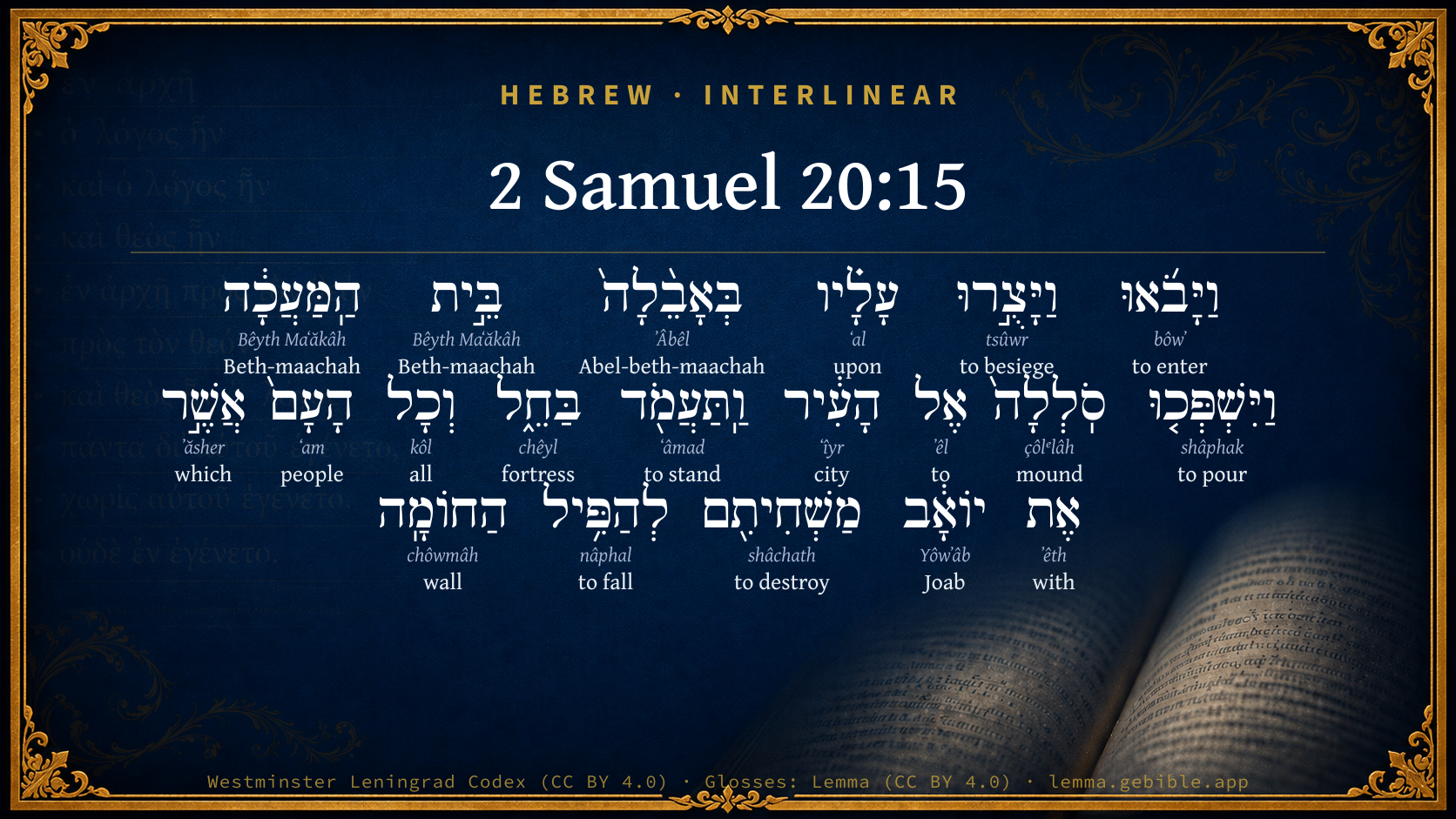
2 Samuel 20:15

Hebrew (Westminster Leningrad Codex) 2 Samuel 20:15 appears in the Hebrew Old Testament. The text above is from the Westminster Leningrad Codex. Each word links to its Strong’s number, a concise gloss, and parsing drawn from the Open Scriptures Hebrew Bible morphology. Click any word for its full Brown-Driver-Briggs (BDB) entry.
Download image
Cite this verse

2 Samuel 20:15 (World English Bible). Public Domain. Lemma interlinear Bible study tool, https://lemma.gebible.app/v/2-samuel/20/15.

Show BibTeX & RIS
BibTeX
RIS
English Translation
They came and besieged him in Abel of Beth Maacah, and they cast up a mound against the city, and it stood against the rampart; and all the people who were with Joab battered the wall, to throw it down.
World English Bible · Public Domain
Highlights
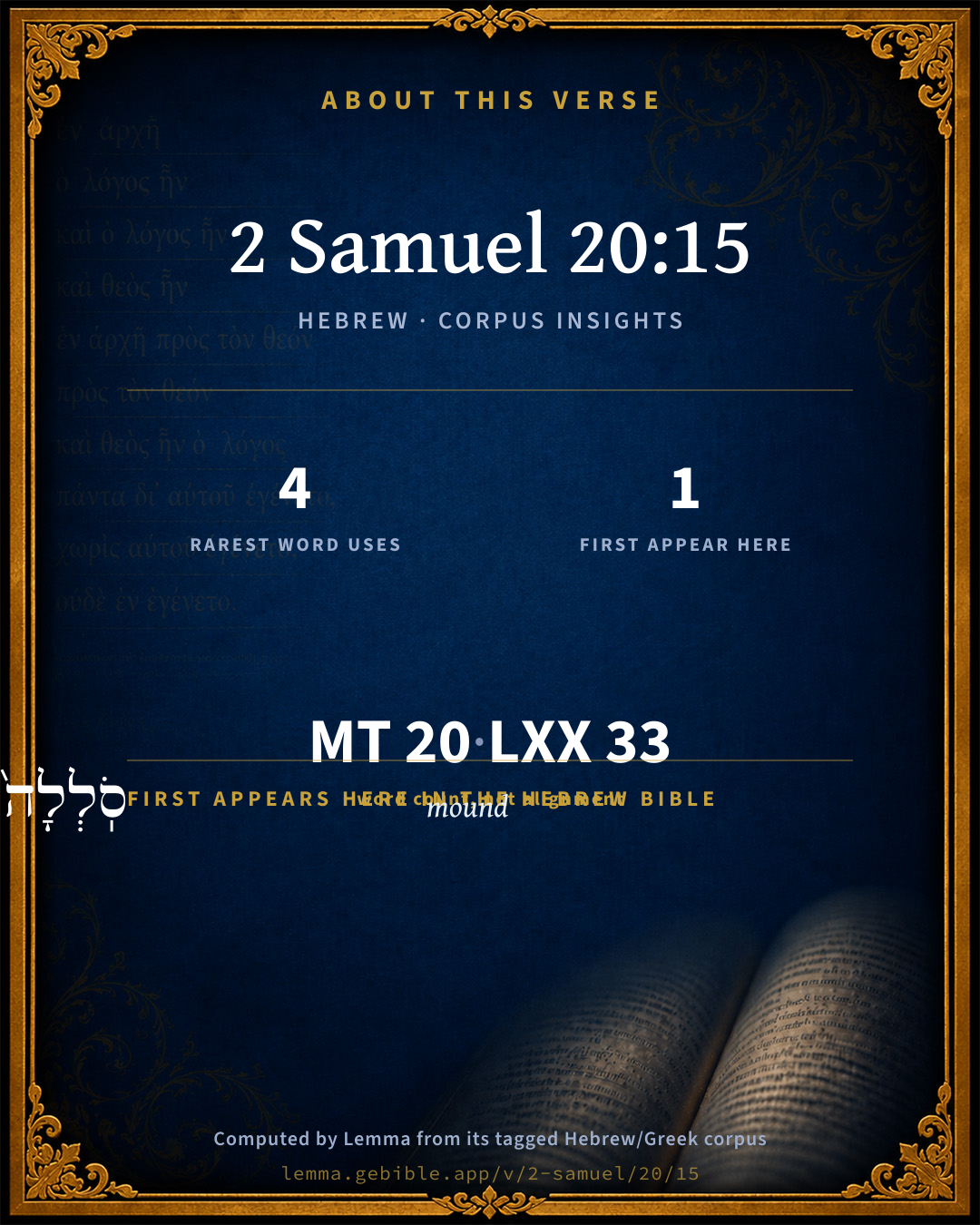
  • 1 first appearance in the Hebrew Bible
Full analysis ↓
Download a study sheet

One document with this verse’s original text, its word-by-word gloss line, the meaning frame, cross-references with their text, attributed commentary, and full source and license credits — printable, and it pastes into notes with its structure intact.

This verse Autodidact and up

Study sheet (.html) Plain text (.txt)

A passage Seminary Student

Up to 50 verses in one chapter. A passage sheet keeps up to 6 commentary sources and 12 cross-references per verse, in the order this page ranks them, and says so on the sheet whenever that leaves anything out. Ask for a single verse and you get the Autodidact verse sheet above.

Everything on this page stays free to read, with no account — the sheet is a download of what is already on screen, not access to it.

Want to remove ads? Support Godless Engineer
Compare translations 3

The same verse in 3 English versions, stacked beneath the original-language interlinear above. Click any original word for its lexicon entry.

Each is an independent rendering of the whole verse — the interlinear is not word-aligned to these translations.

Highlighted words mark where these versions differ — a whole-verse word diff, not a word-by-word alignment.

  • World English Bible Public Domain
    They came and besieged him in Abel of Beth Maacah, and they cast up a mound against the city, and it stood against the rampart; and all the people who were with Joab battered the wall, to throw it down.
  • King James Version Public Domain
    And they came and besieged him in Abel of Bethmaachah, and they cast up a bank against the city, and it stood in the trench: and all the people that were with Joab battered the wall, to throw it down.
  • unfoldingWord Literal Text CC BY-SA 4.0
    And they came, and they besieged against him in Abel Beth Maacah. And they poured out a mound against the city, and it stood against the rampart. And all of the people who with Joab were destroying to make the wall fall.

unfoldingWord Literal Text — © unfoldingWord, licensed CC BY-SA 4.0. Word-aligned USFM3 via Door43 (git.door43.org/unfoldingWord/en_ult).

Versions to compare (up to 4)

3 of 4 selected

Show all 18 translations

Every available English version of this verse, each an independent rendering of the whole verse.

  • World English Bible Public Domain
    They came and besieged him in Abel of Beth Maacah, and they cast up a mound against the city, and it stood against the rampart; and all the people who were with Joab battered the wall, to throw it down.
  • Berean Standard Bible Public Domain
    And Joab’s troops came and besieged Sheba in Abel-beth-maacah and built a siege ramp against the outer rampart of the city. As all the troops with Joab were battering the wall to topple it,
  • Majority Standard Bible Public Domain
    And Joab’s troops came and besieged Sheba in Abel-beth-maacah and built a siege ramp against the outer rampart of the city. As all the troops with Joab were battering the wall to topple it,
  • King James Version Public Domain
    And they came and besieged him in Abel of Bethmaachah, and they cast up a bank against the city, and it stood in the trench: and all the people that were with Joab battered the wall, to throw it down.
  • American Standard Version (1901) Public Domain
    And they came and besieged him in Abel of Beth-maacah, and they cast up a mound against the city, and it stood against the rampart; and all the people that were with Joab battered the wall, to throw it down.
  • Revised Version (1885) Public Domain
    And they came and besieged him in Abel of Beth-maacah, and they cast up a mount against the city, and it stood against the rampart: and all the people that were with Joab battered the wall, to throw it down.
  • Geneva Bible (1599) Public Domain
    So they came, and besieged him in Abel, neere to Bethmaachah: and they cast vp a mount against the citie, and the people thereof stood on the ramper, and al the people that was with Ioab, destroyed and cast downe the wall.
  • Douay-Rheims (1899) Public Domain
    And they came, and besieged him in Abela, and in Bethmaacha, and they cast up works round the city, and the city was besieged: and all the people that were with Joab, laboured to throw down the walls.
  • Young's Literal Translation Public Domain
    and they go in and lay siege against him, in Abel of Beth-Maachah, and cast up a mount against the city, and it standeth in a trench, and all the people who are `are' with Joab are destroying, to cause the wall to fall.
  • Literal Standard Version CC BY-SA 4.0
    and they go in and lay siege against him, in Abel of Beth-Maachah, and cast up a mound against the city, and it stands in a trench, and all the people who are [are] with Joab are destroying, to cause the wall to fall.
  • Unlocked Literal Bible CC BY-SA 4.0
    They caught up with him and besieged him in Abel of Beth Maacah. They built up a siege ramp against the city against the wall. All the army who were with Joab battered the wall to knock it down.
  • unfoldingWord Literal Text CC BY-SA 4.0
    And they came, and they besieged against him in Abel Beth Maacah. And they poured out a mound against the city, and it stood against the rampart. And all of the people who with Joab were destroying to make the wall fall.
  • Darby Bible Public Domain
    And they came and besieged him in Abel-Beth-Maacah, and they cast up a bank against the city, and it was raised in the trench; and all the people that were with Joab sapped the wall, to throw it down.
  • World Messianic Bible Public Domain
    They came and besieged him in Abel of Beth Maacah, and they cast up a mound against the city, and it stood against the rampart; and all the people who were with Joab battered the wall to throw it down.
  • Webster's Bible Public Domain
    And they came and besieged him in Abel of Beth-maachah, and they cast up a bank against the city, and it stood in the trench: and all the people that were with Joab battered the wall, to throw it down.
  • Free Bible Version CC BY-SA 4.0
    Joab's army came and besieged Sheba in Abel-beth-maacah. They built a siege ramp against the town's outer wall. While all of Joab's army was battering the wall to knock it down,
  • Bible in Basic English Public Domain
    And Joab and his men got him shut up in Abel of Beth-maacah, and put up an earthwork against the town: and all Joab's men did their best to get the wall broken down.
  • JPS Tanakh (1917) Public Domain
    And they came and besieged him in Abel of Beth-maacah, and they cast up a mound against the city, and it stood in the moat; and all the people that were with Joab battered the wall, to throw it down.

Literal Standard Version (2020), Covenant Press — licensed CC BY-SA 4.0. Text via the HelloAO Bible API (eBible.org). Unlocked Literal Bible (unfoldingWord) — licensed CC BY-SA 4.0. Text via the HelloAO Bible API (eBible.org). unfoldingWord Literal Text — © unfoldingWord, licensed CC BY-SA 4.0. Word-aligned USFM3 via Door43 (git.door43.org/unfoldingWord/en_ult). Free Bible Version, Dr. Jonathan Gallagher — licensed CC BY-SA 4.0. Text via the HelloAO Bible API (eBible.org).

Word by word

More ways to search: Search by grammar → Find every occurrence → Compare this word →

Practice this passage: Drill this verse → Learn its vocabulary →

בְּאָבֵ֨לָה֙
ʼÂbêl
H59
“in/at · Abel-beth-maachah · toward”
Preposition + Noun, Proper + Suffix, Demonstrative
Part of Speech
Preposition + Noun
Type
Proper
Full BDB Definition

Origin: from H58

TWOT: None

city in northern Israel near Bethmaachah - the place where the ark rested in the field of Joshua at Bethshemesh
  1. וַיָּבֹ֜אוּ bôwʼ H935 “and · to enter” Conjunction + Verb, Qal, Sequential Imperfect, 3rd Person, Masculine, Plural
  2. וַיָּצֻ֣רוּ tsûwr H6696 “and · to besiege” Conjunction + Verb, Qal, Sequential Imperfect, 3rd Person, Masculine, Plural
  3. עָלָ֗יו ʻal H5921 “upon · him” Preposition + Suffix, Personal, 3rd Person, Masculine, Singular
  4. בֵּ֣ית Bêyth Maʻăkâh H1038 “Beth-maachah” Noun, Proper
  5. הַֽמַּעֲכָ֔ה Bêyth Maʻăkâh H1038 “Beth-maachah” Noun, Proper
  6. וַיִּשְׁפְּכ֤וּ shâphak H8210 “and · to pour” Conjunction + Verb, Qal, Sequential Imperfect, 3rd Person, Masculine, Plural
  7. סֹֽלְלָה֙ çôlᵉlâh H5550 “mound” Noun, Common, Feminine, Singular, Absolute
  8. אֶל ʼêl H413 “to” Preposition
  9. הָעִ֔יר ʻîyr H5892 “the · city” Particle, Definite Article + Noun, Common, Feminine, Singular, Absolute
  10. וַֽתַּעֲמֹ֖ד ʻâmad H5975 “and · to stand” Conjunction + Verb, Qal, Sequential Imperfect, 3rd Person, Feminine, Singular
  11. בַּחֵ֑ל chêyl H2426 “in/at the · fortress” Preposition, Determined + Noun, Common, Masculine, Singular, Absolute
  12. וְכָל kôl H3605 “and · all of” Conjunction + Noun, Common, Masculine, Singular, Construct
  13. הָעָם֙ ʻam H5971 “the · people” Particle, Definite Article + Noun, Common, Masculine, Singular, Absolute
  14. אֲשֶׁ֣ר ʼăsher H834 “which” Particle, Relative
  15. אֶת ʼêth H854 “with” Preposition
  16. יוֹאָ֔ב Yôwʼâb H3097 “Joab” Noun, Proper
  17. מַשְׁחִיתִ֖ם shâchath H7843 “destroying” Verb, Hiphil, Participle Active, Masculine, Plural, Absolute
  18. לְהַפִּ֥יל nâphal H5307 “to fall” Preposition + Verb, Hiphil, Infinitive Construct
  19. הַחוֹמָֽה chôwmâh H2346 “the · wall” Particle, Definite Article + Noun, Common, Feminine, Singular, Absolute

About this verse

These counts appear in no published source. They are computed here, from the morphology-tagged text and Lemma’s own curated glosses. What Lemma adds →

20
words
19
distinct lemmas
Historical
section

Notable vocabulary

The rarest word here is בְּאָבֵ֨לָה֙ Abel-beth-maachah H59 — appearing just 4 times in the whole Hebrew Bible.

First appearance in Scripture

This word makes its first canonical appearance in the Hebrew Bible here:

  • סֹֽלְלָה֙ mound H5550

Shared distinctive vocabulary

בְּאָבֵ֨לָה֙ Abel-beth-maachah H59 occurs in 4 verses of the Hebrew Bible. Also found in:

Grammatical profile

  • 6 verbs
  • 10 nouns
  • 3 prepositions
  • 1 particle

Verb forms

  • וַיָּבֹ֜אוּ Qal · Sequential Imperfect
  • וַיָּצֻ֣רוּ Qal · Sequential Imperfect
  • וַיִּשְׁפְּכ֤וּ Qal · Sequential Imperfect
  • וַֽתַּעֲמֹ֖ד Qal · Sequential Imperfect
  • מַשְׁחִיתִ֖ם Hiphil · Participle Active
  • לְהַפִּ֥יל Hiphil · Infinitive Construct

Repetition

A word recurs within this verse — often emphatic in Hebrew:

  • בֵּ֣ית Beth-maachah H1038 ×2

Hebrew & Septuagint length

In English translation the verse runs 40 words from the Hebrew and 37 from the Septuagint (LXX English) — closely comparable.

A rough comparison of the two English renderings, which tokenize alike — not a word-level alignment.

Word counts can differ between the Hebrew and the Greek without any difference in meaning — e.g. the Hebrew direct-object marker אֵת has no separate Greek word, and Greek often adds the article ὁ.

In the original languages it is 20 Hebrew tokens and 33 Greek tokens — but the two are counted differently (Hebrew bundles its prefixes and suffixes into one token; the Greek is in lemma form), so that isn’t a like-for-like length.

Cross-references

9

Topical passages linked to 2 Samuel 20:15 in the Treasury of Scripture Knowledge — connected by theme and wording, ordered by reader-vote popularity; previews shown in the World English Bible.

  • 2 Kings 19:32 Therefore thus says Yahweh concerning the king of Assyria, He shall not come to this city, nor shoot an arrow there, neither shall he come before it with shield, nor cast up a mound against it.
  • Jeremiah 32:24 Behold, the mounds, they are come to the city to take it; and the city is given into the hand of the Chaldeans who fight against it, because of the sword, and of the famine, and of the pestilence; and what you have spoken has happened; and, behold, you see it.
  • 1 Kings 15:20 Ben Hadad listened to king Asa, and sent the captains of his armies against the cities of Israel, and struck Ijon, and Dan, and Abel Beth Maacah, and all Chinneroth, with all the land of Naphtali.
  • 2 Kings 15:29 In the days of Pekah king of Israel came Tiglath Pileser king of Assyria, and took Ijon, and Abel Beth Maacah, and Janoah, and Kedesh, and Hazor, and Gilead, and Galilee, all the land of Naphtali; and he carried them captive to Assyria.
  • Isaiah 37:33 Therefore thus says Yahweh concerning the king of Assyria, He shall not come to this city, nor shoot an arrow there, neither shall he come before it with shield, nor cast up a mound against it.
  • Jeremiah 6:6 For thus has Yahweh of Hosts said, Hew you down trees, and cast up a mound against Jerusalem: this is the city to be visited; she is wholly oppression in the midst of her.
  • Jeremiah 33:4 For thus says Yahweh, the God of Israel, concerning the houses of this city, and concerning the houses of the kings of Judah, which are broken down [to make a defense] against the mounds and against the sword;
  • Ezekiel 4:2 and lay siege against it, and build forts against it, and cast up a mound against it; set camps also against it, and plant battering rams against it round about.
  • Luke 19:43 For the days will come on you, when your enemies will throw up a barricade against you, surround you, hem you in on every side,

Cross-references courtesy of OpenBible.info (CC BY 4.0).

Hebrew and Greek witnesses Masoretic Hebrew ↔ Greek Septuagint

The same verse in the two great witnesses to the Old Testament, shown verse-for-verse.

These are two independent witnesses, not word-aligned to each other, and the Septuagint is shown in lemma (dictionary) form.

Hebrew 2 Samuel 20:15 Masoretic · Westminster Leningrad Codex

וַיָּבֹ֜אוּ וַיָּצֻ֣רוּ עָלָ֗יו בְּאָבֵ֨לָה֙ בֵּ֣ית הַֽמַּעֲכָ֔ה וַיִּשְׁפְּכ֤וּ סֹֽלְלָה֙ אֶל הָעִ֔יר וַֽתַּעֲמֹ֖ד בַּחֵ֑ל וְכָל הָעָם֙ אֲשֶׁ֣ר אֶת יוֹאָ֔ב מַשְׁחִיתִ֖ם לְהַפִּ֥יל הַחוֹמָֽה

They came and besieged him in Abel of Beth Maacah, and they cast up a mound against the city, and it stood against the rampart; and all the people who were with Joab battered the wall, to throw it down.

World English Bible · Public Domain

Greek LXX 2 Samuel 20:15 Septuagint · lemma form

καί παραγίγνομαι καί πολιορκέω ἐπί αὐτός ὁ αβελ καί ὁ βαιθμαχα καί ἐκχέω πρόσχωμα πρός ὁ πόλις καί ἵστημι ἐν ὁ προτείχισμα καί πᾶς ὁ λαός ὁ μετά ιωαβ νοέω καταβάλλω ὁ τεῖχος

And they came and besieged him in Abel and Phermacha: and they raised a mound against the city and it stood close to the wall; and all the people with Joab proposed to throw down the wall.

LXX2012 (modern English Septuagint) · Public Domain

On this verse, The Pulpit Commentary discusses the Septuagint’s reading. Read the note in Commentary ↓

Hebrew: Westminster Leningrad Codex (CC BY 4.0). Greek: Septuagint (public domain); English from LXX2012 (modern English Septuagint) (Public Domain). How the Septuagint differs from the Hebrew →

Targum (Aramaic paraphrase)

1

The Targum is the ancient Jewish Aramaic paraphrase of the Hebrew Scriptures — an interpretive translation, not the Hebrew text itself. Onkelos (literal) and Pseudo-Jonathan (expansive) render the Torah, and Jonathan the Prophets. Coverage is partial: where no permissively-licensed English translation exists for a verse, only the Aramaic is shown. This is verse-level text, not a word-by-word alignment to the Hebrew.

  1. Targum Jonathan Prophets (Joshua–Malachi)
    וַאֲתוֹ וְצָרוּ עֲלוֹהִי בְּאָבֵל בֵית מַעֲכָה וּצְבָרוּ מַלְיָתָא עַל קַרְתָּא וְאַקְפָהּ מַשִׁרְיָן וְכָל עַמָא דְעִם יוֹאָב מִתְעַשְׁתִּין לְחַבָּלָא שׁוּרָא:

    (no public-domain English translation for this verse)

    Targum Jonathan — Aramaic: “Mikraot Gedolot” (public domain). English: “Sefaria Community Translation” (CC0 1.0 (public-domain dedication)); “London "Chaldee Paraphrase," 1871” (public domain). Text via Sefaria.

Commentary

Notes on 2 Samuel 20:15 from classic Christian and Jewish commentators (each source and its license shown beneath its notes). The classic Christian expositions comment on the surrounding passage and are grouped to its opening verse, so a note may address several verses; the Jewish commentaries on the Tanakh (Rashi and others) are per-verse, so they appear only where the commentator wrote on this verse.

Lemma curates 59 commentaries, every one of them public domain or Creative Commons licensed, each selected and text-cleaned for this edition rather than reprinted as found. About our sources →

Trapp's Complete Commentary

John Trapp

2Sa 20:15 And they came and besieged him in Abel of Bethmaachah, and they cast up a bank against the city, and it stood in the trench: and all the people that [were] with Joab battered the wall, to throw it down.

Ver. 15. And they came and besieged him.] Who now probably repented him of his bold and treacherous enterprise; sicut Leo cassibus irretitus ait, Si praescivissem?

Battered the wall to throw it down.] It had been pity those walls should have stood, if they had been too high to throw a traitor’s head over. Sheba, likely, thought himself very safe when gotten into a walled city: but what said the voice from heaven to Phocas the traitor? - if Nicephorus may be believed - Though thou build thy walls as high as heaven, and as strong as thou canst make them, yet sin lying at the bottom will easily undermine and overturn them: ευαλωτος η απολις, the city of thy defence will soon be taken.

John Trapp, A Commentary or Exposition upon All the Books of the Old and New Testament (1647–1656) — public domain. Text from a community e-Sword module.

Joseph Benson's Commentary

2Sa 20:15. They came and besieged him — Joab and his army pursued him thither. And cast up a bank — They raised a very large mound of earth, equal, probably, to the height of the walls, from whence they might either batter the walls, or throw darts, or shoot at those that defended them. It stood in the trench — This bank or mound was carried on so far, that it now stood in or near to the trench and foot of the wall; so that the city was in great danger of being taken.

Joseph Benson's Commentary on the Old and New Testaments (1811–1818) — public domain. Text from a community e-Sword module.

Tyndale Open Study Notes

Tyndale Open Resources

20:15 A siege ramp was often an earthen ramp built up against the wall, a well-known tactic for breaching a walled city’s defenses (see also 2 Kgs 25:1; Jer 52:4).

Tyndale Open Study Notes — © Tyndale Open Resources, licensed CC BY-SA 4.0. Text via the HelloAO Bible API.

Geneva Bible (1599)

Geneva Bible translators

That is, he went about to overthrow it.

Geneva Bible (1599) marginal notes — public domain. Text via Bolls.life.

Jamieson, Fausset & Brown

Robert Jamieson, A. R. Fausset & David Brown

Abel of Beth-maachah--a verdant place--the addition of "Maachah" betokening that it belonged to the district Maachah, which lay far up the Jordan at the foot of Lebanon.

Jamieson, Fausset & Brown — Commentary Critical and Explanatory on the Whole Bible (1871) — public domain (CC PDM 1.0). Text via the HelloAO Bible API.

Adam Clarke's Commentary

Verse 15. They cast up a bank against the city] The word סללה solelah, which we render bank, means, most probably, a battering engine of some kind, or a tower overlooking the walls, on which archers and slingers could stand and annoy the inhabitants, while others of the besiegers could proceed to sap the walls. That it cannot be a bank that stood in the trench, is evident from the circumstance thus expressed.

Adam Clarke's Commentary on the Bible (1810–1826) — public domain. Text from a community e-Sword/MySword module.

Ellicott's Commentary for English Readers

(15)Abel of Beth-maachah.—Omit the preposition “of.” (See 2Sa_20:14.)

Stood in the trench.—The “trench” is the space between the wall of the city and the lower outer wall. When the besiegers had succeeded in planting the mounds for their battering engines in this space they had already gained an important advantage.

A Bible Commentary for English Readers, edited by Charles John Ellicott (1878–1897) — public domain. Text from a community e-Sword module.

The Cambridge Bible for Schools and Colleges

gen. ed. J. J. S. Perowne

15. cast up a bank] The besiegers erected a mound of earth against the city wall to enable them to batter the upper and weaker part of it. This stood in “the trench” or outwork of the city: a term which includes the low outer wall and the space between it and the main wall. For mention of siege mounds see 2Ki_19:32; Isa_29:3; Jer_6:6; Jer_32:24; Jer_33:4; Eze_4:2; Eze_17:17; Eze_21:22; Eze_26:8; Dan_11:15. They are represented on the bas-reliefs depicting the siege of Lachish which were found at Kouyunjik. Layard’s Monuments of Nineveh, Vol. II. PI. 18, 21.

The Cambridge Bible for Schools and Colleges (gen. ed. J. J. S. Perowne; Cambridge University Press, 1878–1918) — public domain. Text from a community e-Sword module.

John Gill's Exposition

And they came and besieged him in Abel of Bethmaachah,.... That is, Joab and Abishai, with the forces under them, who pursued him hither:

and they cast up a bank against the city; which some understand of a warlike machine or engine, with which stones were cast; but it rather seems to be a bank of earth thrown up, for the better working of such engines to more advantage against the city, by throwing from thence darts into the city, or stones against the walls of it, to batter it down; such banks were used in sieges, as that Caesar's soldiers raised in twenty five days, which was three hundred thirty feet broad, and eighty feet high (z); Kimchi interprets this of filling up the ditches round about the city with dust and earth, and so making it level, whereby they could come the more easily to the walls and batter them, or scale them, and take the city by storm:

and it stood in the trench; the army under Joab stood where the trench round the city had been, now filled up:

and all the people that were with Joab battered the wall to throw it down; with their engines, or whatever battering instruments they had; so, often, as Hesiod (a) says, a whole city suffers for one bad man.

(z) Caesar. Comment. l. 7. c. 24. (a) Opera & Dies, l. 1. ver. 236.

John Gill's Exposition of the Whole Bible (1746–1763) — public domain (CC PDM 1.0). Text via the HelloAO Bible API.

Albert Barnes' Notes on the Bible

Cast up a bank - See the marginal references. The throwing up of mounds against the walls of besieged places by the besiegers is well illustrated in the Assyrian sculptures.

The trench - The “pomoerium,” or fortified space outside the wall. When the mound was planted in the pomoerium the battering engines were able to approach close to the wall to make a breach.

Albert Barnes' Notes on the Bible (1834–1885) — public domain. Text from a community e-Sword/MySword module.

Haydock's Catholic Bible Commentary

Works. Hebrew, a bank, or terrace against the city, and it stood in the trench; (Haydock) so that the town ditch was filled up, (Grotius) or terraces were raised, from which archers assailed the besieged. Joab made a ditch to defend his men from foreign assailants; and he had already taken the outward wall, so that the town could not hold out for any length of time. --- The walls. St. Jerome thinks with battering rams: but they were not yet invented. (Calmet) --- They undermined the walls, while some attempted to pull them down with hooks and ropes, chap. xvii. 13. (Haydock)

George Leo Haydock (1774–1849), Haydock's Catholic Family Bible and Commentary, 1859 edition — public domain. Excludes Psalms (Douay-Rheims chapter numbering differs from Protestant) and Deuterocanonical books (Catholic canon only).

Matthew Poole's English Annotations

They came, i.e. Joab and his army, which is easily understood, both from the foregoing and following verses.

They cast up a bank; from whence they might either batter the wall, or shoot at those who defended it against them who should assault it. See 2Ki 19:32; Jer 32:24; 33:4. Otherwise, they threw down the bank of the city, which they had raised up to defend the city on the weakest side.

It stood in the trench, i.e. the bank stood in or near to the trench, or wall of the city; so that the city was in great danger of being taken. Otherwise, the city stood within the trench, or wall, being defended only by a single trench, or a weak wall; the bank which was raised up there to defend it being thrown down.

Matthew Poole's English Annotations on the Holy Bible (1683–1685) — public domain. Text from a community e-Sword/MySword module.

Whedon's Commentary on the Bible

Daniel D. Whedon

15. A bank against the city — A mound or rampart on which the besieging forces might easily approach the city wall.

It stood in the trench — The marginal reading is better, it stood against the outmost wall; that is, the embankment or rampart just mentioned stood against or near by the exterior fortification (pomoerium) which the inhabitants of Abel had built around the wall of their city. The building of an embankment against these outer works of the city enabled the besieging army to batter the wall with engines.

Battered the wall — What methods or instruments they used for destroying these walls it is difficult to tell. The engines invented during Uzziah’s reign (2Ch_26:15) were not then in use; but perhaps they used something resembling the battering ram of the ancient Romans.

Daniel D. Whedon (gen. ed.), Commentary on the Old and New Testaments (1874–1909) — public domain. Text from a community e-Sword module.

The Pulpit Commentary

It stood in the trench. This is a literal translation, and yet gives a wrong sense. The Hebrew "stood" means "rose up to," "stood level with;" and the "trench" is what in modern fortifications is called "the glacis," and includes the outer wall of defence. The Revised Version renders, "it stood against the rampart." The usual way of capturing cities in ancient times was to cast up a bank or mound of earth against them (Isa_29:3 Isa_37:33; Jer_6:6) and Joab"s work had advanced so far as to be level with the outer line of defence. The name of the city in the Hebrew is not Abel of Beth-Maachah, but Abel-beth-Maachah. Battered. This is a word taken from Roman warfare. The Hebrew says, "And all the people that were with Joab were destroying the wall to make it fall," most probably by undermining it. Ewald even asserts that this is the meaning of the verb, and translates, "were digging pits under the wall." The Revised Version adopts this for the margin, where it gives "undermined." The Septuagint and Chaldee have a different and probable reading, "And all Joab"s people were devising (contriving) means to throw down the wall." This would be the next operation after the mound had been carried up to a level with it.

Vers. 15-22. (ABEL-BETH-MAACAH.)

A peacemaker.

"Then cried a wise woman out of the city, Hear! hear?" (ver. 16).

1. Hard pressed by the forces of Joab, Sheba threw himself into the fortified city of Abel-beth-Maachah (in the northwest extremity of Palestine). The feelings of its inhabitants toward him are not stated. But Joab soon appeared; and, without entering into any negotiations with them, made preparations for attack. "Taking advantage of an oblong knoll of natural rock that rises above the surrounding plain, the original inhabitants raised a high mound sufficiently large for the city. With a deep trench and

2. strong wall it must have been almost impregnable. The besiegers cast up a mount against the city, "and it stood in the trench etc. (Thomson, "The Land and the Book"). A deadly conflict was imminent.

3. At this juncture a wise woman presented herself at the wall; and, havingobtained a hearing, sought to make peace; nor was her endeavour fruitless. "There was a little city," etc.. (Ecc_9:14, Ecc_9:15) "Wisdom is better than strength. Wisdom is better than weapons of war; but one sinner destroyeth much good". (Ecc_9:16, Ecc_9:18) As one bad man exposed the city to destruction, so one good woman effected its deliverance.

4. There is often much need of a peacemaker to heal the strife that arises between individuals, families, cities, Churches, and nations. Regarded as an example to others, this "wise woman" of Abel

I POSSESSED AN EXCELLENT SPIRIT; observant, prudent, sagacious, peaceful, faithful, just, and benevolent. Hence she was prompted to go of her own accord, individually and independently, to "seek peace, and pursue it" (1Pe_3:11; Psa_34:12-16; Gen_13:8, Gen_13:9)

1. Being grieved at the sight of strife between brethren, and the prospect of the miseries which they were about to inflict on each other.

2. Being desirous of preventing the evil which threatened them, and promoting their welfare. Her chief concern was about her own city, which was likely to be the greater sufferer; but she was also (like Joab, ver. 20) concerned about others, and the general good of Israel, in which Abel was "a mother city," a part of "the inheritance of Jehovah" (ver. 19).

3. Having faith in the common sense of men, their regard for their own interest (when they saw it, not blinded by prejudice), their love of justice, their generally good intentions (when not under the influence of wrath and revenge), and their susceptibility to the power of persuasion.

4. Being determined to make every possible effort and sacrifice, and undergo any personal risk and suffering for the sake of peace. She was doubtless willing (as others have been) to lay down her own life if thereby the lives of others might be spared. "Peacemakers are fire quenchers, who, although they may with plying of engines and much ado, rescue a pile of buildings from the flames, yet their eyes will be sure to smart with the smoke" (R. Harris).

II ADOPTED AN ADMIRABLE METHOD; thereby justifying the "wisdom" with which she was credited. Perceiving that there was some misunderstanding between the contending parties, her aim was to clear it up; if there were any real cause of contention, to remove it; and thus dispose them to peace. This she endeavoured to effect by:

1. Seizing the opportune moment for interposition; promptly availing herself of the pause before the attack. Instead of "battered the wall" (Authorized Version), read, "were devising to throw down the wall." There is generally such a time for the work of a peacemaker, which, if it be neglected, may be afterwards too late.

2. Making use of courteous, gentle, reasonable, and impressive speech. "Hear the words of thine handmaid." Like the woman of Tekoah, (2Sa_14:4) she was a mistress in the art of persuasion. "The tongue of the wise is health"; (Pro_12:18) "a tree of life". (Pro_15:4 Pro_10:20 Pro_18:21)

3. Ascertaining the nature of the misunderstanding, and the occasion of complaint; and, for this purpose, going directly and separately to the persons concerned, and learning it from their own lips. She knew the sentiments of her people, especially that they felt aggrieved that no communications should have been made to them by Joab, and suspected his destructive and merciless designs. And now she sought to discover what were his real thoughts and purposes in relation to them. How much mischief would be prevented if contending parties would only be at pains to understand one another!

1. Removing all misconception, and producing the conviction in each party of the just aims and good intentions of the other. To Joab she said, "You evidently deem this city deficient in good sense; whereas it has been always noted for its wisdom and conciliatory disposition and counsel. You think the people contentious and rebellious; I assure you in their name that we are among the most peaceable and faithful in Israel. Yet, without any communication with us, so as to ascertain our feelings, and without any reasonable cause, you are about to give an important city of Israel to the devouring sword. Why will you bring to ruin what belongs to the Lord?" On the other hand, from his reply, it was made apparent that he was not desirous of their destruction (as they supposed), but only sought to inflict a just punishment on a notorious traitor in their midst, and was under the necessity (if, as he had supposed, they harboured him, participated with him in rebellion, and resolved to defend him to the utmost) of making an

2. attack upon them for that purpose. "Far be it, far be it from me The matter is not so," etc. (vers. 20, 21). Misunderstanding was now at an end, but a real occasion of difference remained.

3. Obtaining needful concessions on both sides. "Deliver him only, and I will depart from the city... Behold, his head shall be thrown to thee through the wall." If (as is doubtful) the people had (from whatever reason) at first shown favour to the cause of Sheba, they were now persuaded by her to do otherwise, "and so they ended the matter.

4. Requiring no sacrifice of principle; but only urging a course conformable to "goodness, righteousness, and truth," and consistent with professed obedience to the will of the Lord. "The just punishment of one atrocious criminal is frequently mercy to great numbers" (Scott). "Follow peace with all men, and holiness" (Heb_12:14; Rom_14:19; Jam_3:17, Jam_3:18)

III ACHIEVED AN EMINENT TRIUMPH the triumph of peace. "And he blew the trumpet" (ver. 22) summoning to peace, as Sheba had blown it summoning to war (ver. 1). It was a victory over error, distrust, wilfulness, wrath, injustice, rebellion; and one by which:

1. An immense evil was prevented.

2. The general good was promoted.

3. The Divine kingdom (as represented in the government of David) wasconfirmed.

4. The peacemaker"s joy was fulfilled. The wise woman accomplished whatshe had set her heart upon; and in blessing others was herself blessed. "Blessed are the peacemakers," etc.. (Mat_5:9) "Of the following things," said a Jewish rabbi, "men reap the fruits both in the present and the future life honouring father and mother, bestowing benefits, and making peace between men.

REMARKS.

1. It is hardly possible to estimate too highly the worth of peace amongmen.

2. Those who would make peace between others must themselves be atpeace with God, with their own hearts, and with their neighbours. The peacemaker must not be a peacebreaker.

3. The greatest Peacemaker the world has ever seer. is Jesus Christ, who is"our Peace". (Eph_2:14)

4. In proportion as we partake of his spirit we shall endeavour to heal allunholy strife and promote "peace on earth." D.

The Pulpit Commentary (1880–1919), ed. H.D.M. Spence-Jones & Joseph S. Exell — public domain. Text from a community e-Sword module.

John Wesley's Explanatory Notes

They - That is, Joab and his army. A bank - From whence they might either batter the wall, or shoot at those who defended it. It stood - The bank stood in, or near to the trench, or the wall of the city; so that the city was in great danger of being taken.

John Wesley, Explanatory Notes Upon the Whole Bible (1754–1765) — public domain. Text via the GEBible commentary corpus.

Rashi

Rabbi Shlomo Yitzchaki (Rashi)

And it [the city] held by virtue of its inner wall. [Yonoson translates:] "They surrounded it strongly." Some interpret וַתַּעֲמדׁ בַּחֵל to have a meaning like "the inner wall and the outer wall". They had [already] cause the outer wall to fall and it [the city] fortified itself to hold fast by virtue of the inner wall.

Rashi on the Tanakh — English translations: “The Judaica Press complete Tanach with Rashi, translated by A. J. Rosenberg” (CC BY 4.0); “Pentateuch with Rashi's commentary by M. Rosenbaum and A.M. Silbermann, 1929-1934” (public domain); “The Metsudah Tanach series, Lakewood, N.J” (CC BY 4.0); and “The Book of Joshua, Metsudah Publications, 1997” (CC BY 4.0). Text via Sefaria.

Lesson kit

Teaching starters — assembled from the data on this page, not authored interpretation. Every prompt links to the verse data it draws on. Edit before teaching.

2 Samuel, in the Historical, opens this verse with 20 words (19 distinct Hebrew lemmas). Its most distinctive word is ʼÂbêl (“Abel-beth-maachah”). A historical commentator’s framing appears above. Read the whole chapter for the surrounding context.

Discussion questions

  1. What does “Abel-beth-maachah” (ʼÂbêl) contribute to the verse as a whole?
  2. This is the first place “mound” appears in Scripture (first appears here). What does its debut here establish?
  3. How does 1 Samuel 6:18, which shares the word «Abel-beth-maachah», read alongside this verse?
  4. What does the repetition of “Beth-maachah” (2× in this one verse) do in this verse?
  5. These translations render this verse differently; the difference is in the English rendering, not the original. What questions does that raise?
  6. «וַיָּבֹ֜אוּ» is a Qal Sequential Imperfect verb. How does that grammatical form shape the action described?
  7. Compare how Trapp's Complete Commentary and Joseph Benson's Commentary read this verse. Where do they agree or differ?

Things to notice

Reading settings

Reading text

Shown beneath each verse's original-language words.

Old Testament
Old Testament edition

Read the OT as the Masoretic Hebrew (MT) or the Greek Septuagint (LXX).

English shown for the Greek Septuagint (in the Hebrew ↔ Greek comparison).

Comparing translations? Open the Compare panel on any verse page to stack up to four side by side.