
Numbers 6:12

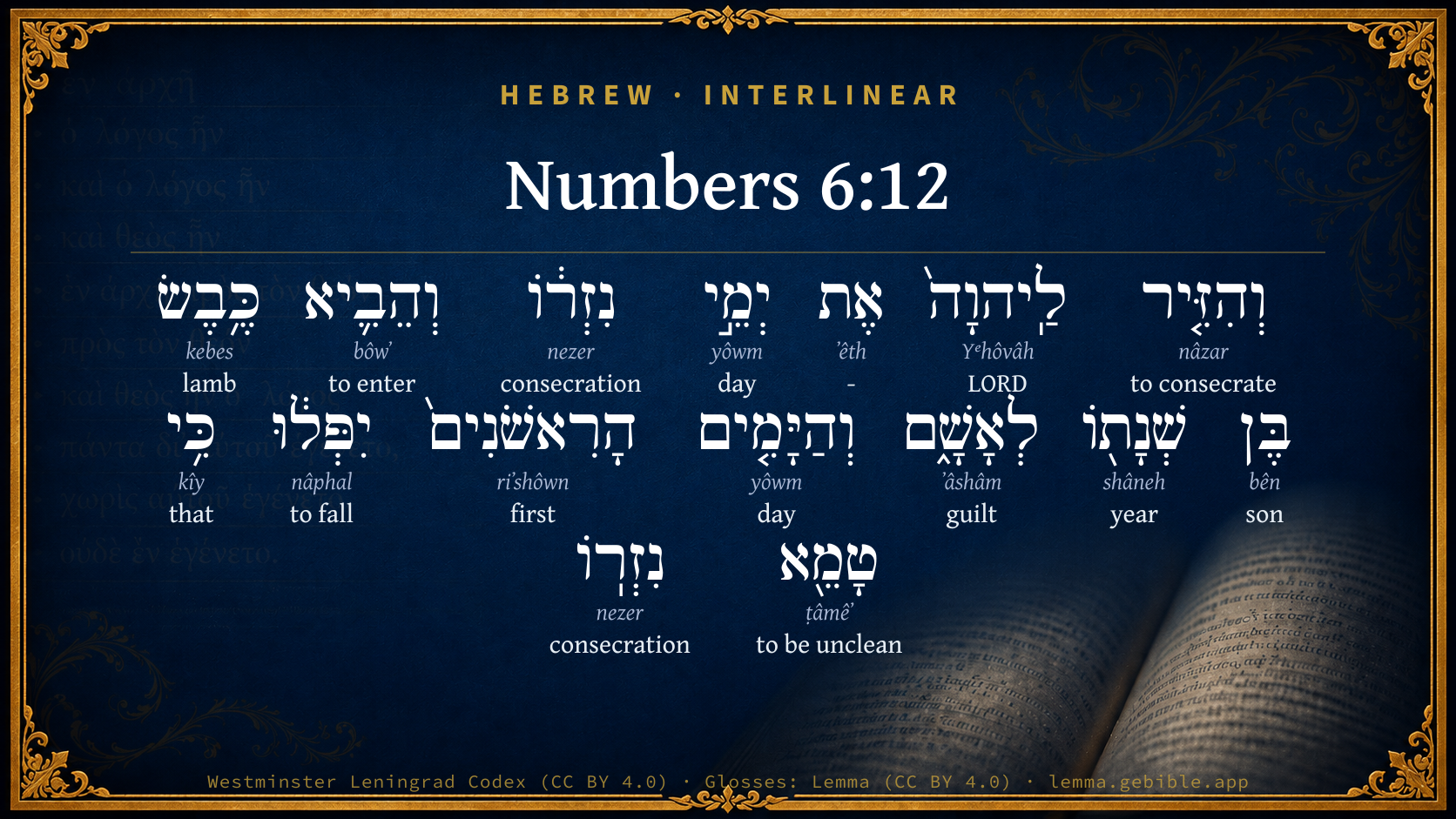
Hebrew (Westminster Leningrad Codex) Numbers 6:12 appears in the Hebrew Old Testament. The text above is from the Westminster Leningrad Codex. Each word links to its Strong’s number, a concise gloss, and parsing drawn from the Open Scriptures Hebrew Bible morphology. Click any word for its full Brown-Driver-Briggs (BDB) entry.
Download image
Cite this verse

Numbers 6:12 (World English Bible). Public Domain. Lemma interlinear Bible study tool, https://lemma.gebible.app/v/numbers/6/12.

Show BibTeX & RIS
BibTeX
RIS
English Translation
He shall separate to Yahweh the days of his separation, and shall bring a male lamb a year old for a trespass offering; but the former days shall be void, because his separation was defiled.
World English Bible · Public Domain
Download a study sheet

One document with this verse’s original text, its word-by-word gloss line, the meaning frame, cross-references with their text, attributed commentary, and full source and license credits — printable, and it pastes into notes with its structure intact.

This verse Autodidact and up

Study sheet (.html) Plain text (.txt)

A passage Seminary Student

Up to 50 verses in one chapter. A passage sheet keeps up to 6 commentary sources and 12 cross-references per verse, in the order this page ranks them, and says so on the sheet whenever that leaves anything out. Ask for a single verse and you get the Autodidact verse sheet above.

Everything on this page stays free to read, with no account — the sheet is a download of what is already on screen, not access to it.

Want to remove ads? Support Godless Engineer
Compare translations 3

The same verse in 3 English versions, stacked beneath the original-language interlinear above. Click any original word for its lexicon entry.

Each is an independent rendering of the whole verse — the interlinear is not word-aligned to these translations.

Highlighted words mark where these versions differ — a whole-verse word diff, not a word-by-word alignment.

  • World English Bible Public Domain
    He shall separate to Yahweh the days of his separation, and shall bring a male lamb a year old for a trespass offering; but the former days shall be void, because his separation was defiled.
  • King James Version Public Domain
    And he shall consecrate unto the LORD the days of his separation, and shall bring a lamb of the first year for a trespass offering: but the days that were before shall be lost, because his separation was defiled.
  • unfoldingWord Literal Text CC BY-SA 4.0
    And he shall make separate to Yahweh the days of his separation, and he shall bring a male lamb, a son of his year, for a guilt offering. And the first days shall fall, because his separation was made unclean.

unfoldingWord Literal Text — © unfoldingWord, licensed CC BY-SA 4.0. Word-aligned USFM3 via Door43 (git.door43.org/unfoldingWord/en_ult).

Versions to compare (up to 4)

3 of 4 selected

Show all 18 translations

Every available English version of this verse, each an independent rendering of the whole verse.

  • World English Bible Public Domain
    He shall separate to Yahweh the days of his separation, and shall bring a male lamb a year old for a trespass offering; but the former days shall be void, because his separation was defiled.
  • Berean Standard Bible Public Domain
    He must rededicate his time of separation to the LORD and bring a year-old male lamb as a guilt offering. But the preceding days shall not be counted, because his separation was defiled.
  • Majority Standard Bible Public Domain
    He must rededicate his time of separation to the LORD and bring a year-old male lamb as a guilt offering. But the preceding days shall not be counted, because his separation was defiled.
  • King James Version Public Domain
    And he shall consecrate unto the LORD the days of his separation, and shall bring a lamb of the first year for a trespass offering: but the days that were before shall be lost, because his separation was defiled.
  • American Standard Version (1901) Public Domain
    And he shall separate unto Jehovah the days of his separation, and shall bring a he-lamb a year old for a trespass-offering; but the former days shall be void, because his separation was defiled.
  • Revised Version (1885) Public Domain
    And he shall separate unto the LORD the days of his separation, and shall bring a he-lamb of the first year for a guilt offering: but the former days shall be void, because his separation was defiled.
  • Geneva Bible (1599) Public Domain
    And he shall consecrate vnto the Lord the dayes of his separation, and shall bring a lambe of a yeere olde for a trespasse offering, and the first dayes shalbe voide: for his consecration was defiled.
  • Douay-Rheims (1899) Public Domain
    And shall consecrate to the Lord the days of his separation, offering a lamb of one year for sin: yet so that the former days be made void, because his sanctification was profaned.
  • Young's Literal Translation Public Domain
    and he hath separated to Jehovah the days of his separation, and he hath brought in a lamb, a son of a year, for a guilt-offering, and the former days are fallen, for his separation hath been defiled.
  • Literal Standard Version CC BY-SA 4.0
    and he has separated to YHWH the days of his separation, and he has brought in a lamb, a son of a year, for a guilt-offering, and the former days are fallen, for his separation has been defiled.
  • Unlocked Literal Bible CC BY-SA 4.0
    He must set himself apart to Yahweh for the days of his consecration. He must bring a male lamb one year old as a guilt offering. The days before he defiled himself must not be counted, because his consecration was defiled.
  • unfoldingWord Literal Text CC BY-SA 4.0
    And he shall make separate to Yahweh the days of his separation, and he shall bring a male lamb, a son of his year, for a guilt offering. And the first days shall fall, because his separation was made unclean.
  • Darby Bible Public Domain
    And he shall [again] consecrate to Jehovah the days of his separation, and shall bring a yearling lamb for a trespass-offering. But the first days are forfeited, for his consecration hath been defiled.
  • World Messianic Bible Public Domain
    He shall separate to the LORD the days of his separation, and shall bring a male lamb a year old for a trespass offering; but the former days shall be void, because his separation was defiled.
  • Webster's Bible Public Domain
    And he shall consecrate to the LORD the days of his separation, and shall bring a lamb of the first year for a trespass-offering: but the days that were before shall be lost, because his separation was defiled.
  • Free Bible Version CC BY-SA 4.0
    They must re-dedicate themselves to the Lord for the full time they originally promised and bring a one-year-old male lamb as a guilt offering. The previous days don't count towards the time of dedication because they became unclean.
  • Bible in Basic English Public Domain
    And he will give to the Lord his days of being separate, offering a he-lamb of the first year as an offering for error: but the earlier days will be a loss, because he became unclean.
  • JPS Tanakh (1917) Public Domain
    And he shall consecrate unto the LORD the days of his Naziriteship, and shall bring a he-lamb of the first year for a guilt-offering; but the former days shall be void, because his consecration was defiled.

Literal Standard Version (2020), Covenant Press — licensed CC BY-SA 4.0. Text via the HelloAO Bible API (eBible.org). Unlocked Literal Bible (unfoldingWord) — licensed CC BY-SA 4.0. Text via the HelloAO Bible API (eBible.org). unfoldingWord Literal Text — © unfoldingWord, licensed CC BY-SA 4.0. Word-aligned USFM3 via Door43 (git.door43.org/unfoldingWord/en_ult). Free Bible Version, Dr. Jonathan Gallagher — licensed CC BY-SA 4.0. Text via the HelloAO Bible API (eBible.org).

Word by word

More ways to search: Search by grammar → Find every occurrence → Compare this word →

Practice this passage: Drill this verse → Learn its vocabulary →

וְהִזִּ֤יר
nâzar
H5144
“and · to consecrate”
Conjunction + Verb, Hiphil, Sequential Perfect, 3rd Person, Masculine, Singular
Part of Speech
Conjunction + Verb
Stem
Hiphil
Form
Sequential Perfect
Person
3rd Person
Gender
Masculine
Number
Singular
Full BDB Definition

Origin: a primitive root

TWOT: 1340

to dedicate, consecrate, separate - (Niphal) to dedicate oneself, devote oneself - (Hiphil) to keep sacredly separate - (Hiphil) to be a Nazarite, live as a Nazarite
  1. לַֽיהוָה֙ Yᵉhôvâh H3068 “to/for · LORD” Preposition + Noun, Proper
  2. אֶת ʼêth H853 “-” Particle, Direct Object
  3. יְמֵ֣י yôwm H3117 “days of” Noun, Common, Masculine, Plural, Construct
  4. נִזְר֔וֹ nezer H5145 “consecration · his” Noun, Common, Masculine, Singular, Construct + Suffix, Personal, 3rd Person, Masculine, Singular
  5. וְהֵבִ֛יא bôwʼ H935 “and · to enter” Conjunction + Verb, Hiphil, Sequential Perfect, 3rd Person, Masculine, Singular
  6. כֶּ֥בֶשׂ kebes H3532 “lamb” Noun, Common, Masculine, Singular, Absolute
  7. בֶּן bên H1121 “son of” Noun, Common, Masculine, Singular, Construct
  8. שְׁנָת֖וֹ shâneh H8141 “year · his” Noun, Common, Feminine, Singular, Construct + Suffix, Personal, 3rd Person, Masculine, Singular
  9. לְאָשָׁ֑ם ʼâshâm H817 “to/for · guilt” Preposition + Noun, Common, Masculine, Singular, Absolute
  10. וְהַיָּמִ֤ים yôwm H3117 “and · the · days” Conjunction + Particle, Definite Article + Noun, Common, Masculine, Plural, Absolute
  11. הָרִאשֹׁנִים֙ riʼshôwn H7223 “the · first” Particle, Definite Article + Adjective, Adjective, Masculine, Plural, Absolute
  12. יִפְּל֔וּ nâphal H5307 “to fall” Verb, Qal, Imperfect, 3rd Person, Masculine, Plural
  13. כִּ֥י kîy H3588 “that” Conjunction
  14. טָמֵ֖א ṭâmêʼ H2930 “to be unclean” Verb, Qal, Perfect, 3rd Person, Masculine, Singular
  15. נִזְרֽוֹ nezer H5145 “consecration · his” Noun, Common, Masculine, Singular, Construct + Suffix, Personal, 3rd Person, Masculine, Singular

About this verse

These counts appear in no published source. They are computed here, from the morphology-tagged text and Lemma’s own curated glosses. What Lemma adds →

16
words
14
distinct lemmas
Pentateuch
section

Notable vocabulary

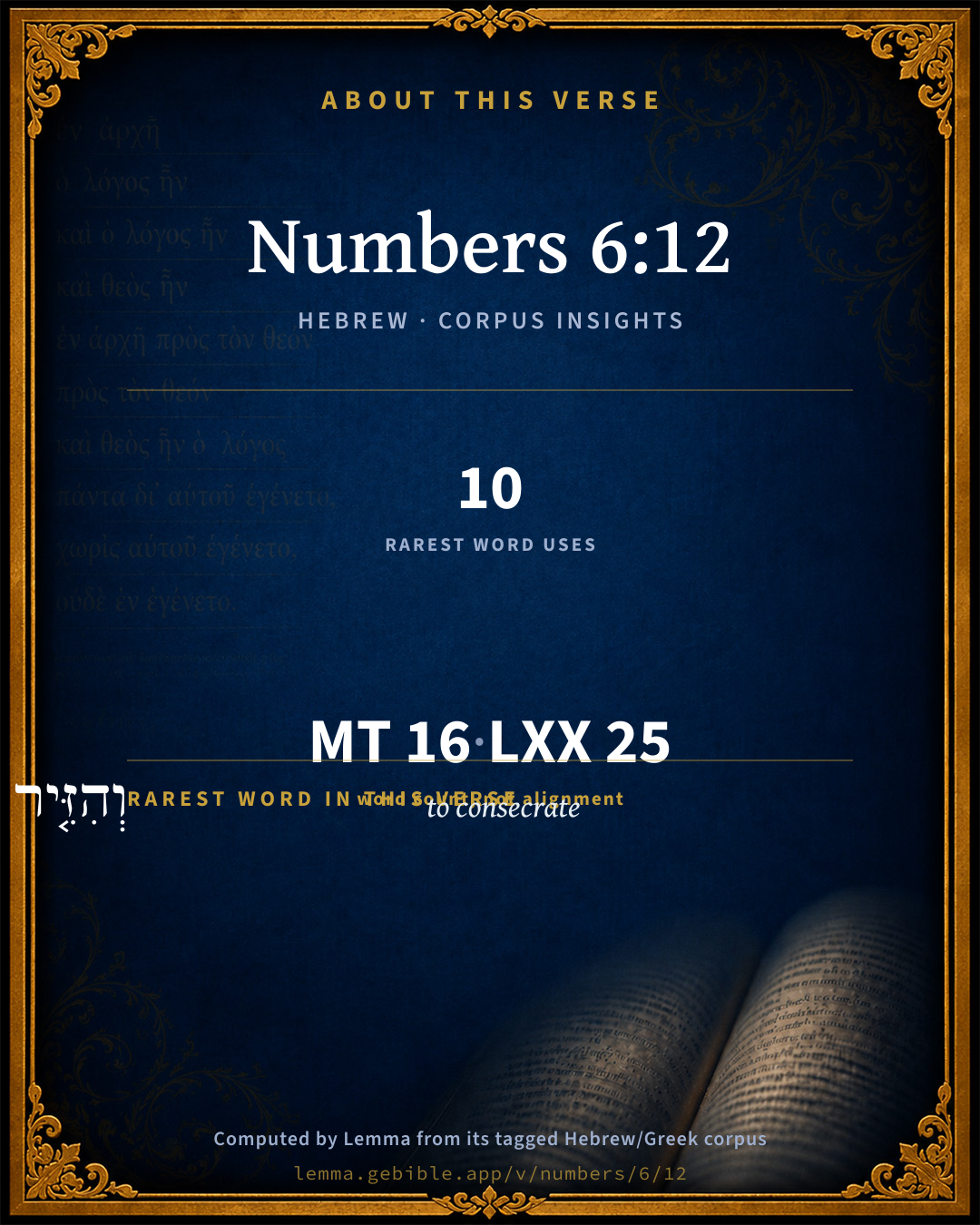
The rarest word here is וְהִזִּ֤יר to consecrate H5144 — appearing just 10 times in the whole Hebrew Bible.

Shared distinctive vocabulary

וְהִזִּ֤יר to consecrate H5144 occurs in 10 verses of the Hebrew Bible. Also found in:

Grammatical profile

  • 4 verbs
  • 9 nouns
  • 1 adjective
  • 1 conjunction
  • 1 particle

Verb forms

  • וְהִזִּ֤יר Hiphil · Sequential Perfect
  • וְהֵבִ֛יא Hiphil · Sequential Perfect
  • יִפְּל֔וּ Qal · Imperfect
  • טָמֵ֖א Qal · Perfect

Repetition

Words recur within this verse — often emphatic in Hebrew:

  • יְמֵ֣י day H3117 ×2
  • נִזְר֔וֹ consecration H5145 ×2

Hebrew & Septuagint length

In English translation the verse runs 35 words from the Hebrew and 43 from the Septuagint (LXX English) — closely comparable.

A rough comparison of the two English renderings, which tokenize alike — not a word-level alignment.

Word counts can differ between the Hebrew and the Greek without any difference in meaning — e.g. the Hebrew direct-object marker אֵת has no separate Greek word, and Greek often adds the article ὁ.

In the original languages it is 16 Hebrew tokens and 25 Greek tokens — but the two are counted differently (Hebrew bundles its prefixes and suffixes into one token; the Greek is in lemma form), so that isn’t a like-for-like length.

Cross-references

8

Topical passages linked to Numbers 6:12 in the Treasury of Scripture Knowledge — connected by theme and wording, ordered by reader-vote popularity; previews shown in the World English Bible.

  • Leviticus 5:6 and he shall bring his trespass offering to Yahweh for his sin which he has sinned, a female from the flock, a lamb or a goat, for a sin offering; and the priest shall make atonement for him concerning his sin.
  • Leviticus 14:24 The priest shall take the lamb of the trespass offering, and the log of oil, and the priest shall wave them for a wave offering before Yahweh.
  • Ezekiel 18:24 But when the righteous turns away from his righteousness, and commits iniquity, and does according to all the abominations that the wicked man does, shall he live? None of his righteous deeds that he has done shall be remembered: in his trespass that he has trespassed, and in his sin that he has sinned, in them shall he die.
  • Matthew 3:15 But Jesus, answering, said to him, "Allow it now, for this is the fitting way for us to fulfill all righteousness." Then he allowed him.
  • Matthew 24:13 But he who endures to the end, the same will be saved.
  • John 8:29–31 He who sent me is with me. The Father hasn't left me alone, for I always do the things that are pleasing to him."
  • James 2:10 For whoever shall keep the whole law, and yet stumble in one point, he has become guilty of all.
  • 2 John 1:8 Watch yourselves, that we don't lose the things which we have accomplished, but that we receive a full reward.

Cross-references courtesy of OpenBible.info (CC BY 4.0).

Hebrew and Greek witnesses Masoretic Hebrew ↔ Greek Septuagint

The same verse in the two great witnesses to the Old Testament, shown verse-for-verse.

These are two independent witnesses, not word-aligned to each other, and the Septuagint is shown in lemma (dictionary) form.

Hebrew Numbers 6:12 Masoretic · Westminster Leningrad Codex

וְהִזִּ֤יר לַֽיהוָה֙ אֶת יְמֵ֣י נִזְר֔וֹ וְהֵבִ֛יא כֶּ֥בֶשׂ בֶּן שְׁנָת֖וֹ לְאָשָׁ֑ם וְהַיָּמִ֤ים הָרִאשֹׁנִים֙ יִפְּל֔וּ כִּ֥י טָמֵ֖א נִזְרֽוֹ

He shall separate to Yahweh the days of his separation, and shall bring a male lamb a year old for a trespass offering; but the former days shall be void, because his separation was defiled.

World English Bible · Public Domain

Greek LXX Numbers 6:12 Septuagint · lemma form

ὅς ἁγιάζω κύριος ὁ ἡμέρα ὁ εὐχή καί προςἄγω ἀμνός ἐνιαύσιος εἰς πλημμέλεια καί ὁ ἡμέρα ὁ πρότερος ἄλογος εἰμί ὅτι μιαίνω κεφαλή εὐχή αὐτός

in which he was consecrated to the Lord, all the days of his vow; and he shall bring a lamb of a year old for a trespass-offering; and the former days shall not be reckoned, because the head of his vow was polluted.

LXX2012 (modern English Septuagint) · Public Domain

On this verse, The Pulpit Commentary discusses the Septuagint’s reading. Read the note in Commentary ↓

Hebrew: Westminster Leningrad Codex (CC BY 4.0). Greek: Septuagint (public domain); English from LXX2012 (modern English Septuagint) (Public Domain). How the Septuagint differs from the Hebrew →

Targum (Aramaic paraphrase)

2

The Targum is the ancient Jewish Aramaic paraphrase of the Hebrew Scriptures — an interpretive translation, not the Hebrew text itself. Onkelos (literal) and Pseudo-Jonathan (expansive) render the Torah, and Jonathan the Prophets. Coverage is partial: where no permissively-licensed English translation exists for a verse, only the Aramaic is shown. This is verse-level text, not a word-by-word alignment to the Hebrew.

  1. Targum Onkelos Torah (Genesis–Deuteronomy)
    וְיַזֵר קֳדָם יְיָ יָת יוֹמֵי נִזְרֵהּ וְיַיְתִי אִמַר בַּר שַׁתֵּהּ לַאֲשָׁמָא וְיוֹמַיָא קַדְמָאֵי יִבְטְלוּן אֲרֵי אִסְתָּאַב נִזְרֵהּ

    (no public-domain English translation for this verse)

    Targum Onkelos — Aramaic: “Onkelos Genesis” (public domain); “Onkelos Exodus” (public domain); “Onkelos Leviticus” (public domain); “Onkelos Numbers” (public domain); “Onkelos Deuteronomy” (public domain). English: “Sefaria Community Translation” (CC0 1.0 (public-domain dedication)); “J.W. Etheridge. The Targums of Onkelos and Jonathan Ben Uzziel on the Pentateuch. London: Longmans, Green, 1862” (public domain). Text via Sefaria.

  2. Targum Pseudo-Jonathan Torah (Genesis–Deuteronomy)
    וְיַפְרֵשׁ קֳדָם יְיָ יַת יוֹמֵי נִזְרֵיהּ וְיַיְתֵי אִמַר בַּר שַׁתֵּיהּ לְאַשָׁמָא וְיוֹמַיָא קַדְמָאֵי יְבַטְלוּן אֲרוּם אִסְתָּאֵב נִזְרֵיהּ

    And let him dedicate before the Lord the days of his nazirate (afresh), and bring a lamb of the year for a trespass offering; but the former days will have been in vain, because he had defiled his nazirate.

    Targum Pseudo-Jonathan — Aramaic: “Targum Jonathan on Genesis” (public domain); “Targum Jonathan on Exodus” (public domain); “Targum Jonathan on Leviticus” (public domain); “Targum Jonathan on Numbers” (public domain); “Targum Jonathan on Deuteronomy” (public domain). English: “The Targum of Jonathan ben Uzziel, trans. J. W. Etheridge, London, 1862” (public domain). Text via Sefaria.

Commentary

Notes on Numbers 6:12 from classic Christian and Jewish commentators (each source and its license shown beneath its notes). The classic Christian expositions comment on the surrounding passage and are grouped to its opening verse, so a note may address several verses; the Jewish commentaries on the Tanakh (Rashi and others) are per-verse, so they appear only where the commentator wrote on this verse.

Lemma curates 59 commentaries, every one of them public domain or Creative Commons licensed, each selected and text-cleaned for this edition rather than reprinted as found. About our sources →

Trapp's Complete Commentary

John Trapp

Num 6:12 And he shall consecrate unto the LORD the days of his separation, and shall bring a lamb of the first year for a trespass offering: but the days that were before shall be lost, because his separation was defiled.

Ver. 12. And he shall consecrate.] He shall begin the world anew: so must we, after some foul fall especially: "Repent and do thy first works," {Rev 2:5} as the Shulamite did. {Son 5:2, &c.}

John Trapp, A Commentary or Exposition upon All the Books of the Old and New Testament (1647–1656) — public domain. Text from a community e-Sword module.

Geneva Bible (1599)

Geneva Bible translators

So that he shall begin his vow anew.

Beginning at the eighth day, when he is purified.

Geneva Bible (1599) marginal notes — public domain. Text via Bolls.life.

The Cambridge Bible for Schools and Colleges

gen. ed. J. J. S. Perowne

12. he shall separate &c.] He shall separate anew the whole period of the vow upon which he had originally entered.

a guilt-offering] This was the most expensive part of the ritual. Opinions differ as to the exact force attaching to it. But the distinctive feature of the offering in other cases seems to have been that it involved an act of reparation for wrong done (see on Num_5:6-8). In the present case it is probably reparation for the delay in the completion of the vow and therefore of the sacrifices which consummated it.

The Cambridge Bible for Schools and Colleges (gen. ed. J. J. S. Perowne; Cambridge University Press, 1878–1918) — public domain. Text from a community e-Sword module.

John Gill's Exposition

And this is the law of the Nazarite,.... This has respect either to what goes before; those are the things he is obliged to that vows the vow of a Nazarite; what he is to abstain from during the time of his vow, and what he is to do in case of any defilement; or to what follows after, what is binding upon him, what offerings he is to bring, and what rites and ceremonies are to be observed by him when he has finished his vow:

when the days of his separation, or Nazariteship:

are fulfilled; whether more or fewer; when the time is quite up, and he has gone through his vow without any breach of it:

he shall be brought unto the door of the tabernacle of the congregation; it is not said by whom he should be brought, whether by himself or by the priest; the Targum of Jonathan is,"he shall bring himself;''that is, present himself; and so Jarchi and Aben Ezra; which latter adds, or the priest shall bring him by command, whether he will or not, to offer his offering.

John Gill's Exposition of the Whole Bible (1746–1763) — public domain (CC PDM 1.0). Text via the HelloAO Bible API.

Matthew Poole's English Annotations

The days of his separation; as many days as he had before separated or vowed unto God. Lost, i.e. not reckoned or imputed to him. Heb. full, to wit, to the ground, i.e. be void or of none effect.

Matthew Poole's English Annotations on the Holy Bible (1683–1685) — public domain. Text from a community e-Sword/MySword module.

Whedon's Commentary on the Bible

Daniel D. Whedon

12. Consecrate — Separate. The term of his original vow must begin anew, and the previous days count for nothing. For the spiritual lesson, see Eze_33:13.

Trespass offering — See Lev_5:6, note, and introductory note. This was the proper offering for an inadvertent sin. See Lev_5:15, note. He has become delinquent “for having prolonged the days of separation through his carelessness with regard to the defilement; that is to say, for having extended the time during which he led a separate, retired, and inactive life, and suspended his duties to his own family and the congregation, thus doing injury to them, and incurring a debt in relation to them through his neglect.” — Knobel.

Daniel D. Whedon (gen. ed.), Commentary on the Old and New Testaments (1874–1909) — public domain. Text from a community e-Sword module.

The Pulpit Commentary

For a trespass offering. Rather, "for a guilt offering." Hebrew, asham. (see Le 5) The asham always implied guilt, even though it might be purely legal, and it was to be offered in this case in acknowledgment of the offence involved in the involuntary breach of vow. In the education of conscience, on anything lower than the "perfect law of liberty," it was only possible to secure thoroughness and consistency at the cost of introducing much that was arbitrary and destined to pass away. Something similar must always be tolerated in the moral education of children. The days that were before shall be lost. Literally, "shall fall." Septuagint, alogoi esontai , "shall not be counted."

The Pulpit Commentary (1880–1919), ed. H.D.M. Spence-Jones & Joseph S. Exell — public domain. Text from a community e-Sword module.

John Wesley's Explanatory Notes

The days of his separation - As many days as he had before vowed to God. Lost - Hebrew. fall, to the ground, that is, be void or of none effect.

John Wesley, Explanatory Notes Upon the Whole Bible (1754–1765) — public domain. Text via the GEBible commentary corpus.

unfoldingWord translationNotes

Door43 World Missions Community

for the days of his consecration

"during the time he is being set apart again"

He must bring a male lamb ... as a guilt offering

The man is to bring the lamb to the priest so that it can be sacrificed. The full meaning of this statement can be made explicit. AT: "He must bring a male lamb one year old to the priest as a guilt offering" (See: Assumed Knowledge and Implicit Information)

The days before he defiled himself must not be counted

This can be stated in active form. AT: "He must not count the days before he defiled himself" (See: Active or Passive)

his consecration was defiled

This can be stated in active form. AT: "he defiled himself" or "he made himself unacceptable" (See: Active or Passive)

translationWords

Yahweh

lamb

guilt offering

defile

God

unfoldingWord translationNotes — © Distant Shores Media and the Door43 World Missions Community, licensed CC BY-SA 4.0. Source: git.door43.org/Door43/en_tn.

Rashi

Rabbi Shlomo Yitzchaki (Rashi)

'והדר לה את ימי נזרו AND HE SHALL CONSECRATE IN HONOUR OF THE LORD THE DAYS OF HIS NAZARITEHOOD — i.e., he shall again count the days of his Nazaritehood as though for the first time (i.e., he must begin the counting of the period of his Nazaritehood from the first day, not resume it at the point where it was broken off).

והימים הראשנים יפלו AND THE DAYS THAT WERE BEFORE SHALL BE LOST — i.e. shall not come into account.

Rashi on the Tanakh — English translations: “The Judaica Press complete Tanach with Rashi, translated by A. J. Rosenberg” (CC BY 4.0); “Pentateuch with Rashi's commentary by M. Rosenbaum and A.M. Silbermann, 1929-1934” (public domain); “The Metsudah Tanach series, Lakewood, N.J” (CC BY 4.0); and “The Book of Joshua, Metsudah Publications, 1997” (CC BY 4.0). Text via Sefaria.

Lesson kit

Teaching starters — assembled from the data on this page, not authored interpretation. Every prompt links to the verse data it draws on. Edit before teaching.

Numbers, in the Pentateuch, opens this verse with 16 words (14 distinct Hebrew lemmas). Its most distinctive word is nâzar (“to consecrate”). A historical commentator’s framing appears above. Read the whole chapter for the surrounding context.

Discussion questions

  1. The word nâzar carries the sense “to consecrate.” How does it shape the verse?
  2. How does Leviticus 15:31, which shares the word «to consecrate», read alongside this verse?
  3. What does the repetition of “day” (2× in this one verse) do in this verse?
  4. These translations render this verse differently. What is at stake in choosing one wording over another?
  5. «וְהִזִּ֤יר» is a Hiphil Sequential Perfect verb. How does that grammatical form shape the action described?
  6. Compare how Trapp's Complete Commentary and Geneva Bible (1599) read this verse. Where do they agree or differ?

Things to notice

Reading settings

Reading text

Shown beneath each verse's original-language words.

Old Testament
Old Testament edition

Read the OT as the Masoretic Hebrew (MT) or the Greek Septuagint (LXX).

English shown for the Greek Septuagint (in the Hebrew ↔ Greek comparison).

Comparing translations? Open the Compare panel on any verse page to stack up to four side by side.