
1 Samuel 31:8

Hebrew (Westminster Leningrad Codex) 1 Samuel 31:8 appears in the Hebrew Old Testament. The text above is from the Westminster Leningrad Codex. Each word links to its Strong’s number, a concise gloss, and parsing drawn from the Open Scriptures Hebrew Bible morphology. Click any word for its full Brown-Driver-Briggs (BDB) entry.
Download image
Cite this verse

1 Samuel 31:8 (World English Bible). Public Domain. Lemma interlinear Bible study tool, https://lemma.gebible.app/v/1-samuel/31/8.

Show BibTeX & RIS
BibTeX
RIS
English Translation
It happened on the next day, when the Philistines came to strip the slain, that they found Saul and his three sons fallen on Mount Gilboa.
World English Bible · Public Domain
Download a study sheet

One document with this verse’s original text, its word-by-word gloss line, the meaning frame, cross-references with their text, attributed commentary, and full source and license credits — printable, and it pastes into notes with its structure intact.

This verse Autodidact and up

Study sheet (.html) Plain text (.txt)

A passage Seminary Student

Up to 50 verses in one chapter. A passage sheet keeps up to 6 commentary sources and 12 cross-references per verse, in the order this page ranks them, and says so on the sheet whenever that leaves anything out. Ask for a single verse and you get the Autodidact verse sheet above.

Everything on this page stays free to read, with no account — the sheet is a download of what is already on screen, not access to it.

Want to remove ads? Support Godless Engineer
Compare translations 3

The same verse in 3 English versions, stacked beneath the original-language interlinear above. Click any original word for its lexicon entry.

Each is an independent rendering of the whole verse — the interlinear is not word-aligned to these translations.

Highlighted words mark where these versions differ — a whole-verse word diff, not a word-by-word alignment.

  • World English Bible Public Domain
    It happened on the next day, when the Philistines came to strip the slain, that they found Saul and his three sons fallen on Mount Gilboa.
  • King James Version Public Domain
    And it came to pass on the morrow, when the Philistines came to strip the slain, that they found Saul and his three sons fallen in mount Gilboa.
  • unfoldingWord Literal Text CC BY-SA 4.0
    And it happened on the next day that the Philistines came to strip the pierced. And they found Saul and the three of his sons fallen on Mount Gilboa.

unfoldingWord Literal Text — © unfoldingWord, licensed CC BY-SA 4.0. Word-aligned USFM3 via Door43 (git.door43.org/unfoldingWord/en_ult).

Versions to compare (up to 4)

3 of 4 selected

Show all 18 translations

Every available English version of this verse, each an independent rendering of the whole verse.

  • World English Bible Public Domain
    It happened on the next day, when the Philistines came to strip the slain, that they found Saul and his three sons fallen on Mount Gilboa.
  • Berean Standard Bible Public Domain
    The next day, when the Philistines came to strip the dead, they found Saul and his three sons fallen on Mount Gilboa.
  • Majority Standard Bible Public Domain
    The next day, when the Philistines came to strip the dead, they found Saul and his three sons fallen on Mount Gilboa.
  • King James Version Public Domain
    And it came to pass on the morrow, when the Philistines came to strip the slain, that they found Saul and his three sons fallen in mount Gilboa.
  • American Standard Version (1901) Public Domain
    And it came to pass on the morrow, when the Philistines came to strip the slain, that they found Saul and his three sons fallen in mount Gilboa.
  • Revised Version (1885) Public Domain
    And it came to pass on the morrow, when the Philistines came to strip the slain, that they found Saul and his three sons fallen in mount Gilboa.
  • Geneva Bible (1599) Public Domain
    And on the morowe when the Philistims were come to spoyle them that were slaine, they founde Saul and his three sonnes lying in mount Gilboa,
  • Douay-Rheims (1899) Public Domain
    And on the morrow the Philistines came to strip the slain, and they found Saul and his three sons lying in mount Gelboe.
  • Young's Literal Translation Public Domain
    And it cometh to pass on the morrow, that the Philistines come to strip the wounded, and they find Saul and his three sons fallen on mount Gilboa,
  • Literal Standard Version CC BY-SA 4.0
    And it comes to pass on the next day, that the Philistines come to strip the wounded, and they find Saul and his three sons fallen on Mount Gilboa,
  • Unlocked Literal Bible CC BY-SA 4.0
    It came about on the next day, when the Philistines came to strip the dead, that they found Saul and his three sons fallen on Mount Gilboa.
  • unfoldingWord Literal Text CC BY-SA 4.0
    And it happened on the next day that the Philistines came to strip the pierced. And they found Saul and the three of his sons fallen on Mount Gilboa.
  • Darby Bible Public Domain
    And it came to pass the next day, that the Philistines came to strip the slain, and they found Saul and his three sons fallen on mount Gilboa.
  • World Messianic Bible Public Domain
    On the next day, when the Philistines came to strip the slain, they found Saul and his three sons fallen on Mount Gilboa.
  • Webster's Bible Public Domain
    And it came to pass on the morrow, when the Philistines came to strip the slain, that they found Saul and his three sons fallen in mount Gilboa.
  • Free Bible Version CC BY-SA 4.0
    The next day, when the Philistines went to strip the dead, they found Saul and his three sons lying on Mount Gilboa.
  • Bible in Basic English Public Domain
    Now on the day after, when the Philistines came to take their goods from the dead, they saw Saul and his three sons dead on the earth in Mount Gilboa.
  • JPS Tanakh (1917) Public Domain
    And it came to pass on the morrow, when the Philistines came to strip the slain, that they found Saul and his three sons fallen in mount Gilboa.

Literal Standard Version (2020), Covenant Press — licensed CC BY-SA 4.0. Text via the HelloAO Bible API (eBible.org). Unlocked Literal Bible (unfoldingWord) — licensed CC BY-SA 4.0. Text via the HelloAO Bible API (eBible.org). unfoldingWord Literal Text — © unfoldingWord, licensed CC BY-SA 4.0. Word-aligned USFM3 via Door43 (git.door43.org/unfoldingWord/en_ult). Free Bible Version, Dr. Jonathan Gallagher — licensed CC BY-SA 4.0. Text via the HelloAO Bible API (eBible.org).

Word by word

More ways to search: Search by grammar → Find every occurrence → Compare this word →

Practice this passage: Drill this verse → Learn its vocabulary →

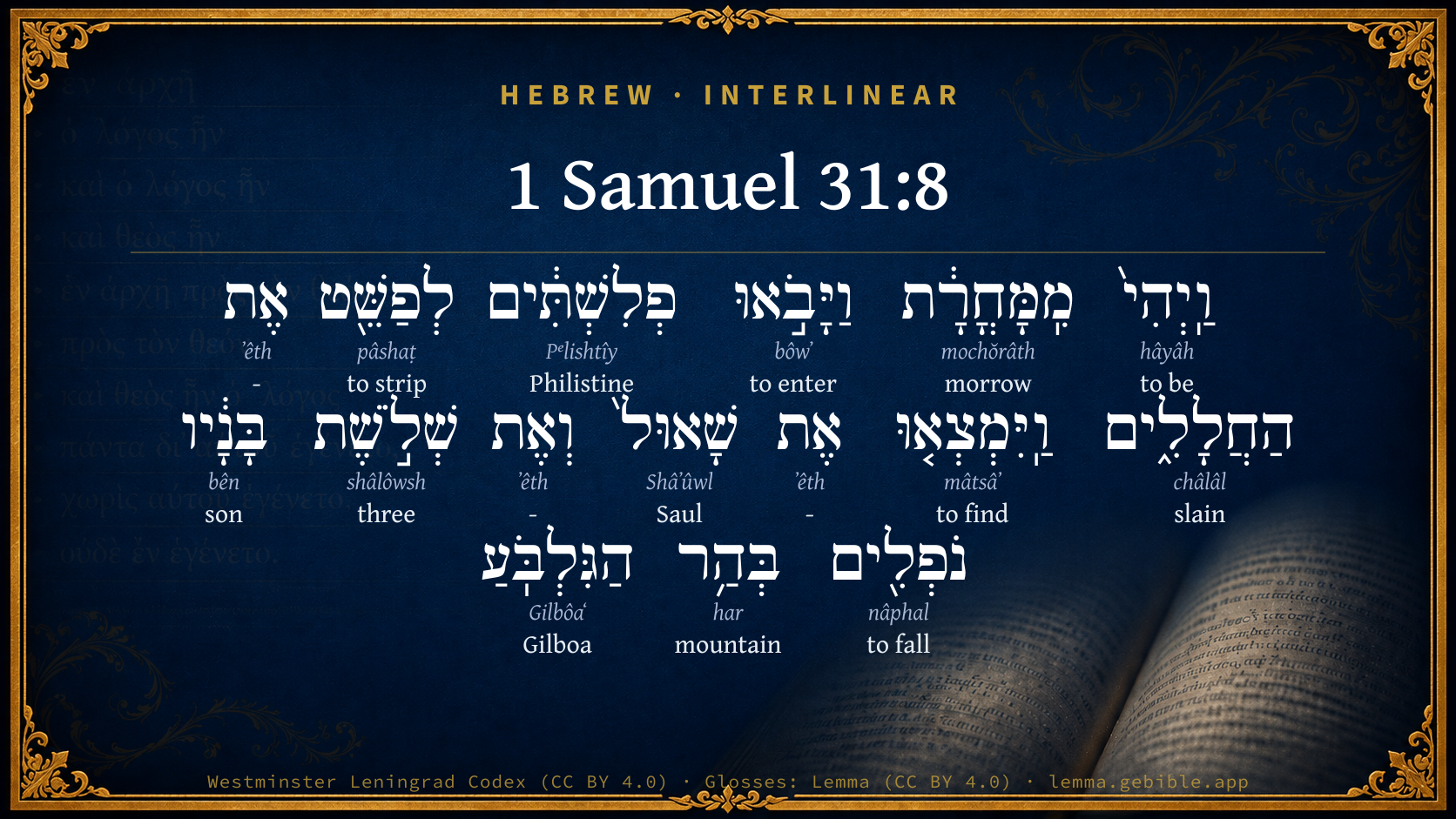
הַגִּלְבֹּֽעַ
Gilbôaʻ
H1533
“the · Gilboa”
Particle, Definite Article + Noun, Proper
Part of Speech
Particle + Noun
Type
Proper
Full BDB Definition

Origin: from H1530 and H1158

TWOT: None

Gilboa = "swollen heap" - a mountain-ridge at the southeastern end of the plain of Jezreel, site of the death of Saul and Jonathan
  1. וַֽיְהִי֙ hâyâh H1961 “and · to be” Conjunction + Verb, Qal, Sequential Imperfect, 3rd Person, Masculine, Singular
  2. מִֽמָּחֳרָ֔ת mochŏrâth H4283 “from · morrow” Preposition + Noun, Common, Feminine, Singular, Absolute
  3. וַיָּבֹ֣אוּ bôwʼ H935 “and · to enter” Conjunction + Verb, Qal, Sequential Imperfect, 3rd Person, Masculine, Plural
  4. פְלִשְׁתִּ֔ים Pᵉlishtîy H6430 “Philistines” Noun, Gentilic, Masculine, Plural, Absolute
  5. לְפַשֵּׁ֖ט pâshaṭ H6584 “to strip” Preposition + Verb, Piel, Infinitive Construct
  6. אֶת ʼêth H853 “-” Particle, Direct Object
  7. הַחֲלָלִ֑ים châlâl H2491 “the · slain” Particle, Definite Article + Adjective, Adjective, Masculine, Plural, Absolute
  8. וַֽיִּמְצְא֤וּ mâtsâʼ H4672 “and · to find” Conjunction + Verb, Qal, Sequential Imperfect, 3rd Person, Masculine, Plural
  9. אֶת ʼêth H853 “-” Particle, Direct Object
  10. שָׁאוּל֙ Shâʼûwl H7586 “Saul” Noun, Proper
  11. וְאֶת ʼêth H853 “and · -” Conjunction + Particle, Direct Object
  12. שְׁלֹ֣שֶׁת shâlôwsh H7969 “three” Adjective, Cardinal number, Masculine, Singular, Construct
  13. בָּנָ֔יו bên H1121 “sons · his” Noun, Common, Masculine, Plural, Construct + Suffix, Personal, 3rd Person, Masculine, Singular
  14. נֹפְלִ֖ים nâphal H5307 “falling” Verb, Qal, Participle Active, Masculine, Plural, Absolute
  15. בְּהַ֥ר har H2022 “in/at · mountain of” Preposition + Noun, Common, Masculine, Singular, Construct

About this verse

These counts appear in no published source. They are computed here, from the morphology-tagged text and Lemma’s own curated glosses. What Lemma adds →

16
words
14
distinct lemmas
Historical
section

Notable vocabulary

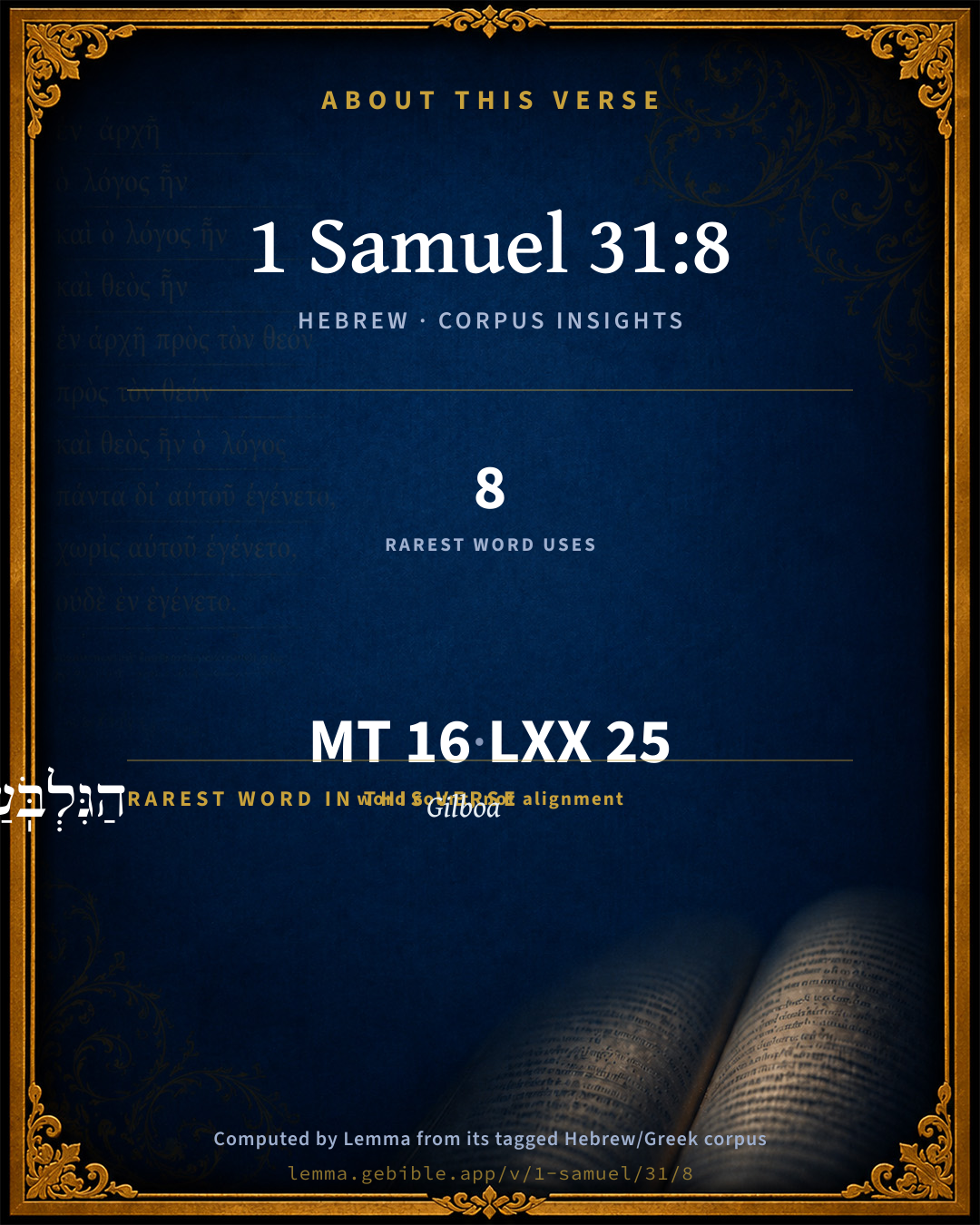
The rarest word here is הַגִּלְבֹּֽעַ Gilboa H1533 — appearing just 8 times in the whole Hebrew Bible.

Shared distinctive vocabulary

הַגִּלְבֹּֽעַ Gilboa H1533 occurs in 8 verses of the Hebrew Bible. Also found in:

Grammatical profile

  • 5 verbs
  • 6 nouns
  • 2 adjectives
  • 3 particles

Verb forms

  • וַֽיְהִי֙ Qal · Sequential Imperfect
  • וַיָּבֹ֣אוּ Qal · Sequential Imperfect
  • לְפַשֵּׁ֖ט Piel · Infinitive Construct
  • וַֽיִּמְצְא֤וּ Qal · Sequential Imperfect
  • נֹפְלִ֖ים Qal · Participle Active

Hebrew & Septuagint length

In English translation the verse runs 26 words from the Hebrew and 30 from the Septuagint (LXX English) — closely comparable.

A rough comparison of the two English renderings, which tokenize alike — not a word-level alignment.

Word counts can differ between the Hebrew and the Greek without any difference in meaning — e.g. the Hebrew direct-object marker אֵת has no separate Greek word, and Greek often adds the article ὁ.

In the original languages it is 16 Hebrew tokens and 25 Greek tokens — but the two are counted differently (Hebrew bundles its prefixes and suffixes into one token; the Greek is in lemma form), so that isn’t a like-for-like length.

Cross-references

2

Topical passages linked to 1 Samuel 31:8 in the Treasury of Scripture Knowledge — connected by theme and wording, ordered by reader-vote popularity; previews shown in the World English Bible.

  • 1 Chronicles 10:8 It happened on the next day, when the Philistines came to strip the slain, that they found Saul and his sons fallen on Mount Gilboa.
  • 2 Chronicles 20:25 When Jehoshaphat and his people came to take the spoil of them, they found among them in abundance both riches and dead bodies, and precious jewels, which they stripped off for themselves, more than they could carry away: and they were three days in taking the spoil, it was so much.

Cross-references courtesy of OpenBible.info (CC BY 4.0).

Hebrew and Greek witnesses Masoretic Hebrew ↔ Greek Septuagint

The same verse in the two great witnesses to the Old Testament, shown verse-for-verse.

These are two independent witnesses, not word-aligned to each other, and the Septuagint is shown in lemma (dictionary) form.

Hebrew 1 Samuel 31:8 Masoretic · Westminster Leningrad Codex

וַֽיְהִי֙ מִֽמָּחֳרָ֔ת וַיָּבֹ֣אוּ פְלִשְׁתִּ֔ים לְפַשֵּׁ֖ט אֶת הַחֲלָלִ֑ים וַֽיִּמְצְא֤וּ אֶת שָׁאוּל֙ וְאֶת שְׁלֹ֣שֶׁת בָּנָ֔יו נֹפְלִ֖ים בְּהַ֥ר הַגִּלְבֹּֽעַ

It happened on the next day, when the Philistines came to strip the slain, that they found Saul and his three sons fallen on Mount Gilboa.

World English Bible · Public Domain

Greek LXX 1 Samuel 31:8 Septuagint · lemma form

καί γίγνομαι ὁ ἐπαύριον καί ἔρχομαι ὁ ἀλλόφυλος ἐκδιδύσκω ὁ νεκρός καί εὑρίσκω ὁ σαούλ καί ὁ τρεῖς υἱός αὐτός πίπτω ἐπί ὁ ὄρος γελβουε

And it came to pass on the morrow that the Philistines come to strip the dead, and they find Saul and his three sons fallen on the mountains of Gelbue.

LXX2012 (modern English Septuagint) · Public Domain

Hebrew: Westminster Leningrad Codex (CC BY 4.0). Greek: Septuagint (public domain); English from LXX2012 (modern English Septuagint) (Public Domain). How the Septuagint differs from the Hebrew →

Targum (Aramaic paraphrase)

1

The Targum is the ancient Jewish Aramaic paraphrase of the Hebrew Scriptures — an interpretive translation, not the Hebrew text itself. Onkelos (literal) and Pseudo-Jonathan (expansive) render the Torah, and Jonathan the Prophets. Coverage is partial: where no permissively-licensed English translation exists for a verse, only the Aramaic is shown. This is verse-level text, not a word-by-word alignment to the Hebrew.

  1. Targum Jonathan Prophets (Joshua–Malachi)
    וַהֲוָה בְּיוֹמָא דְבַתְרוֹהִי וַאֲתוֹ פְלִשְׁתָּאֵי לְחַלָצָא קְטִילַיָא וְאַשְׁכָּחוּ יַת שָׁאוּל וְיַת תְּלָתָא בְּנוֹהִי קַטִילִין רְמָן בְּטוּרָא דְגִלְבּוֹעַ:

    (no public-domain English translation for this verse)

    Targum Jonathan — Aramaic: “Mikraot Gedolot” (public domain). English: “Sefaria Community Translation” (CC0 1.0 (public-domain dedication)); “London "Chaldee Paraphrase," 1871” (public domain). Text via Sefaria.

Commentary

Notes on 1 Samuel 31:8 from classic Christian and Jewish commentators (each source and its license shown beneath its notes). The classic Christian expositions comment on the surrounding passage and are grouped to its opening verse, so a note may address several verses; the Jewish commentaries on the Tanakh (Rashi and others) are per-verse, so they appear only where the commentator wrote on this verse.

Lemma curates 59 commentaries, every one of them public domain or Creative Commons licensed, each selected and text-cleaned for this edition rather than reprinted as found. About our sources →

Matthew Henry's Commentary

The scripture makes no mention of the souls of Saul and his sons, what became of them after they were dead (secret things belong not to us), but of their bodies only.

I. How they were basely abused by the Philistines. The day after the battle, when they had recovered their fatigue, they came to strip the slain, and, among the rest, found the bodies of Saul and his three sons, Sa1 31:8. Saul's armour-bearer perhaps intended to honour his master by following the example of his self-murder, and to show thereby how well he loved him; but, if he had consulted his reason more than his passions, he would have spared that foolish compliment, not only in justice to his own life, but in kindness to his master, to whom, by the opportunity of survivorship, he might have done all the service that could be done him by any man after he was dead; for he might, in the night, have conveyed away his body, and those of his sons, and buried them decently. But such false and foolish notions these vain men have (though they would be wise) of giving and receiving honour. Nay, it should seem, Saul might have saved himself the fatal thrust and have made his escape: for the pursuers (in fear of whom he slew himself) came not to the place where he was till the next day. But whom God will destroy he infatuates and utterly consumes with his terrors. See Job 18:5, etc. Finding Saul's body (which now that it lay extended on the bloody turf was distinguishable from the rest by its length, as it was, while erect, by its height, when he proudly overlooked the surrounding crowd), they will, in that, triumph over Israel's crown, and meanly gratify a barbarous and brutish revenge by insulting the deserted corpse, which, when alive, they had stood in awe of. 1. They cut off his head. Had they designed in this to revenge the cutting off of Goliath's head they would rather have cut off the head of David, who did that execution, when he was in their country. They intended it, in general, for a reproach to Israel, who promised themselves that a crowned and an anointed head would save them from the Philistines, and a particular reproach to Saul, who was taller by the head than other men (which perhaps he was wont to boast of), but was now shorter by the head. 2. They stripped him of his armour (Sa1 31:9), and sent that to be set up as a trophy of their victory, in the house of Ashtaroth their goddess (Sa1 31:10); and we are told, Ch1 10:10 (though it is omitted here), that they fastened his head in the temple of Dagon. Thus did they ascribe the honour of their victory, not as they ought to have done to the real justice of the true God, but to the imaginary power of their false gods, and by this respect paid to pretended deities shame those who give not the praise of their achievements to the living God. Ashtaroth, the idol that Israel had many a time gone a whoring after, now triumphs over them. 3. They sent expresses throughout their country, and ordered public notice to be given in the houses of their gods of the victory they had obtained (Sa1 31:9), that public rejoicings might be made and thanks given to their gods. This David regretted sorely, Sa2 1:20. Tell it not in Gath. 4. They fastened his body and the bodies of his sons (as appears, Sa1 31:12) to the wall of Bethshan, a city that lay not far from Gilboa and very near to the river Jordan. Hither the dead bodies were dragged and here hung up in chains, to be devoured by the birds of prey. Saul slew himself to avoid being abused by the Philistines, and never was royal corpse so abused as his was, perhaps the more if they understood that he slew himself for that reason. He that thinks to save his honour by sin will certainly lose it. See to what a height of insolence the Philistines had arrived just before David was raised up, who perfectly subdued them. Now that they had slain Saul and his sons they thought the land of Israel was their own for ever, but they soon found themselves deceived. When God has accomplished his whole work by them he will accomplish it upon them. See Isa 10:6, Isa 10:7.

II. How they were bravely rescued by the men of Jabesh-Gilead. Little more than the river Jordan lay between Beth-shan and Jabesh-Gilead, and Jordan was in that place passable by its fords; a bold adventure was therefore made by the valiant men of that city, who in the night passed the river, took down the dead bodies, and gave them decent burial, Sa1 31:11, Sa1 31:13. This they did, 1. Out of a common concern for the honour of Israel, or the land of Israel, which ought not to be defiled by the exposing of any dead bodies, and especially of the crown of Israel, which was thus profaned by the uncircumcised. 2. Out of a particular sense of gratitude to Saul, for his zeal and forwardness to rescue them from the Ammonites when he first came to the throne, Sa1 11:1-15. It is an evidence of a generous spirit and an encouragement to beneficence when the remembrance of kindnesses is thus retained, and they are thus returned in an extremity. The men of Jabesh-Gilead would have done Saul better service if they had sent their valiant men to him sooner, to strengthen him against the Philistines. But his day had come to fall, and now this is all the service they can do him, in honour to his memory. We find not that any general mourning was made for the death of Saul, as was for the death of Samuel (Sa1 25:1), only those Gileadites of Jabesh did him honour at his death; for, (1.) They made a burning for the bodies, to perfume them. So some understand the burning of them. They burnt spices over them, Sa1 11:12. And that it was usual thus to do honour to their deceased friends, at least their princes, appears by the account of Asa's funeral (Ch2 16:14), that they made a very great burning for him. Or (as some think) they burnt the flesh, because it began to putrefy. (2.) They buried the bodies, when, by burning over them, they had sweetened them (or, if they burnt them, they buried the bones and ashes), under a tree, which served for a grave-stone and monument. And, (3.) They fasted seven days, that is, each day of the seven they fasted till the evening; thus they lamented the death of Saul and the present distracted state of Israel, and perhaps joined prayers with their fasting for the re-establishment of their shattered state. Though, when the wicked perish there is shouting (that is, it is to be hoped a better state of things will ensue, which will be matter of joy), yet humanity obliges us to show a decent respect to dead bodies, especially those of princes.

This book began with the birth of Samuel, but now it ends with the burial of Saul, the comparing of which two together will teach us to prefer the honour that comes from God before any of the honours which this world pretends to have the disposal of.

Matthew Henry's Commentary on the Whole Bible (1708–1710) — public domain (CC PDM 1.0). Text via the HelloAO Bible API.

Jamieson, Fausset & Brown

Robert Jamieson, A. R. Fausset & David Brown

THE PHILISTINES TRIUMPH OVER THEIR DEAD BODIES. (Sa1 31:8-10)

on the morrow, when the Philistines came to strip the slain, that they found Saul and his three sons fallen--On discovering the corpses of the slaughtered princes on the battlefield, the enemy reserved them for special indignities. They consecrated the armor of the king and his sons to the temple of Ashtaroth fastened their bodies on the temple of Shen, while they fixed the royal heads ignominiously in the temple of Dagon (Ch1 10:10); thus dividing the glory among their several deities.

Jamieson, Fausset & Brown — Commentary Critical and Explanatory on the Whole Bible (1871) — public domain (CC PDM 1.0). Text via the HelloAO Bible API.

Trapp's Complete Commentary

John Trapp

1Sa 31:8 And it came to pass on the morrow, when the Philistines came to strip the slain, that they found Saul and his three sons fallen in mount Gilboa.

Ver. 8. And it came to pass on the morrow.] They made sure work of the victory before they fell upon the spoil: so did not Pirinninus. {See Trapp on "1Sa 30:16"}

John Trapp, A Commentary or Exposition upon All the Books of the Old and New Testament (1647–1656) — public domain. Text from a community e-Sword module.

The Biblical Illustrator

Joseph S. Exell

1Sa_31:8

The Philistines came to strip the slain.

After the battle

Is there any sadder sight than a battlefield after the guns have stopped firing? A similar scene is described in our text. Before I get through today, I will show you that the same process is going on all the world over, and every day, and that when men have fallen, Satan and the world, so far from pitying them or helping them, go to work remorselessly to take what little there is left, thus stripping the slain. There are tens of thousands of young men every year coming from the country to our great cities. They come with brave hearts and grand expectations. But our young man has a fine position in a dry-goods store. The month is overse He gets his wages. He is not accustomed to have so much money belonging to himself. He is a little excited, and does not know exactly what to do with it, and he spends it in some places where he ought not. Soon there come up new companions and acquaintances from the barrooms and the saloons of the city. Soon that young man begins to waver in the battle of temptation, and soon his soul goes down. In a few months, or few years, he has fallen. He is morally dead. Why do the low fellows of the city now stick to him so closely? Is it to help him back to a moral and spiritual life? Oh, no! I will tell you why they stay; they are Philistines stripping the slain. The point I want to make is this: Sin is hard, cruel, and merciless. Instead of helping a man up, it helps him down; it will come and steal your sword and helmet and shield, leaving you to the jackal and the crow. But the world and Satan do not do all their work with the outcast and abandoned. A respectable impenitent man comes to die. He could not get up if the house was on fire. What does Satan do for such a man? Wily, he fetches up all the inapt, disagreeable and harrowing things in his life. He says: Do you remember those chances you had for heaven, and missed them? Do you remember all those lapses in conduct? And then he takes all the past and empties it on that death bed, as the mail bags are emptied on the post office floor. The man is sick. He cannot get away from them. Come, now, I will tear off from you the last rag of expectation. I will rend away from your soul the last hope. I will leave you bare for the beating of the storm. It is my business to strip the slain. Sin is a luxury now; it is exhilaration now; it is victory now. But after a while it is collision; it is defeat; it is extermination; it is jackalism; it is robbing the dead; it is stripping the slain. Give it up today--give it up! (T. De Witt Talmage, D. D.)

The Biblical Illustrator, edited by Joseph S. Exell (c. 1880s–1900s) — public domain. Text from a community e-Sword module.

The Preacher's Complete Homiletical Commentary

Joseph S. Exell (gen. ed.)

CRITICAL AND EXPOSITORY NOTES—

1Sa_31:9. “And sent.” Hebrew scholars here read sent them, i.e., the weapons and the head of Saul and probably those of his sons.

1Sa_31:10. “Ashtaroth.” The plural form of Ashtoreth, the principal female divinity of the Phœnicians, as Baal was the principal male divinity, identical with the Astarte of the Greeks and Romans, who was by many ancient writers identified with the goddess Venus, as well as also with the planet of that name. (See Smith’s Bib. Diet.) “Beth-shan.” The present Beisan, in the Jordan valley, twelve miles south of the Sea of Galilee and four miles west of the Jordan. The royal heads, we learn from 1Ch_10:10, were fixed in the temple of Dagon. “Thus the trophies of their great victory were divided among their several deities.” (Jamieson.)

1Sa_31:11. “Jabesh-Gilead.” See on 1Sa_11:1.

1Sa_31:12. “Went all night.” “Considering that Bethshan is about three hours distance, and by a narrow upland passage to the west of the Jordan, the whole being a journey of about twelve miles, they must have made all expedition to travel thither, to carry off the headless bodies and return to their own side of the Jordan in the course of a single night.” (Jamieson.) “Burnt them.” This was not a Hebrew custom, and was either resorted to to prevent any further insult from the Philistines or, more likely, seeing that only the flesh was burned, because of the mangled and decomposed condition of the corpses.

1Sa_31:13. “A tree,” rather the tamarisk, the article indicating that the site was well-known. David afterwards caused the bones to be removed to Saul’s family burial place (2Sa_21:11-14).

MAIN HOMILETICS OF THE PARAGRAPH.—1Sa_31:8-13

THE GRATITUDE OF THE MEN OF JABESH GILEAD

I. The courageous impulses of grateful hearts. Gratitude may be almost regarded as an instinct of human nature, for it springs up spontaneously in the breast of man in answer to benefits received. He who does not experience this emotion must be hardened below the brute, for even some of the lower animals will remember benefits conferred, and love him who has done them a service, But the strength and length of the gratitude will depend much on the disposition and character. All men are prone to forget benefits conferred long ago, and only true and loyal hearts keep their memory green, and are found willing to recognise them at their own risk. Many years had passed since Saul earned the gratitude of the men of Jabesh Gilead, and his later life had tended rather to efface than to perpetuate the recollection of that act of bravery. And very considerable must have been the danger which they now encountered in rendering. him this last service—the only one which could now be rendered to one who had put himself beyond any other. But their gratitude and courage were equal to the occasion, and shed the only ray of light that brightens this dark picture.

II. The lasting influence of a good deed. The life that had begun in so much promise had ended in gloom, and it seems almost impossible to recognise in this fearful and despairing man the brave soldier-king by whom, at Jabesh, “the Lord had wrought salvation in Israel” (1Sa_11:13). But in this day of his shame, and when he is justly reaping the reward of his evil deeds, this good one is not to be forgotten but receives its reward. Truly,

“The evil that men do lives after them,”

but so also, happily, does the good.

OUTLINES AND SUGGESTIVE COMMENTS

This book began with the birth of Samuel, but now it ends with the death of Saul, the comparing of which two together will teach us to prefer the honour that comes from God before any of the honours which this world pretends to have the disposal of.—Henry.

In the greatness and the reverse of the house of Saul is the culmination and catastrophe of the tribe of Benjamin. The Christian fathers used to dwell on the old prediction which describes the character of that tribe, “Benjamin shall ravin as a wolf: in the morning he shall devour the prey, and in the evening he shall devour the spoil.” These words well sum up the strange union of fierceness and of gentleness, of sudden resolves for good or evil, which run, as hereditary qualities do often run, through the whole history of that frontier clan. Such were its wild adventures in the times of the Judges; such was Saul, its first king; such was Shemei, of the house of Saul, in his bitterness and his repentance; such was the divided allegiance of the tribe to the rival houses of Judah and Ephraim; such was the union of tenderness and vindictiveness in the character of Mordecai and Esther, if not actual descendants of Shemei and Kish, as they appear in the history of Saul, at least claiming to be of the same tribe, and reckoning among the list of their ancestors the same renowned names. And is it a mere fancy to trace with those same Christian writers the last faint likeness of this mixed history, when, after a lapse of many centuries, the tribe once more for a moment rises to our view; in the second Saul, also of the tribe of Benjamin? Saul of Tarsus, who, like the first, was at one time moved by a zeal bordering almost upon frenzy, and who, like the first, startled all his contemporaries by appearing among the Prophets the herald of the faith which once he destroyed; but, unlike the first, persevered in that faith to the end the likeness in the Christian Church, not of what Saul was, but of what he might have been.—Stanley.

The Preacher's Complete Homiletical Commentary (gen. ed. Joseph S. Exell; Funk & Wagnalls, c. 1892) — public domain (pre-1929). A full-Bible homiletical/sermon-outline anthology covering 65 of 66 books (2 John is absent from the source module). Text from a community e-Sword module.

Tyndale Open Study Notes

Tyndale Open Resources

31:8 The victorious army would strip the dead to search for anything valuable (such as clothing, weapons, or jewelry) on the corpses.

Tyndale Open Study Notes — © Tyndale Open Resources, licensed CC BY-SA 4.0. Text via the HelloAO Bible API.

Adam Clarke's Commentary

Verse 8. On the morrow] It is very likely that the battle and pursuit continued till the night, so that there was no time till the next day to strip and plunder the slain.

Adam Clarke's Commentary on the Bible (1810–1826) — public domain. Text from a community e-Sword/MySword module.

Ellicott's Commentary for English Readers

(8) They found Saul and his three sons fallen in Mount Gilboa.—It is expressly stated that the Philistines only found the royal corpses on the morrow of the great fight. So desperate had been the valour with which the King and his gallant sons had defended their last positions on the hill, that night had fallen ere the din of battle ceased. Nor were the enemy aware of the completeness of their success until the morning dawn revealed to the soldiers as they went over the scene, the great ones who were numbered among the slain. In the mean time the Amalekite had found and carried off the crown and royal bracelet. Only the bodies of Saul and the princes, and the armourbearer, are spoken of here. The crown royal, which would have formed so splendid a trophy, was already taken.

“O Saul,

How ghastly didst thou look, on thine own sword

Expiring: in Gilboa, from that hour

Ne’er visited with rain from heaven, nor dew.”

DANTE: Pura. 12

The curse of barrenness alluded to by the great Italian poet was called down on the hill where the first anointed of the Lord fell, and where the body was stripped and dismembered by the triumphant foe (2Sa_1:21). Quickly the tidings were told, we learn, in the capital of Gath, and proclaimed through the streets of Askelon.

The historian with extreme brevity records the savage treatment of the royal remains, which, after all, was but a reprisal. The same generation had witnessed similar barbarous procedure in the case of Goliath, the great Philistine champion!

A Bible Commentary for English Readers, edited by Charles John Ellicott (1878–1897) — public domain. Text from a community e-Sword module.

John Gill's Exposition

And it came to pass on the morrow,.... The day after the battle, which perhaps was fought till night came on:

when the Philistines came to strip the slain; of their clothes, and take from them whatever was valuable, as their booty:

that they found Saul and his sons fallen in Mount Gilboa; to which they had betaken themselves, when the battle went against them in the valley; of which see Sa1 28:4.

John Gill's Exposition of the Whole Bible (1746–1763) — public domain (CC PDM 1.0). Text via the HelloAO Bible API.

Whedon's Commentary on the Bible

Daniel D. Whedon

8. On the morrow — They did not pause in the heat of battle or in the first flush of victory to gather up their trophies.

They found Saul and his three sons — They probably knew that he had fallen, or at all events had not escaped with the fugitives of Israel, but until now they had not stopped their pursuit to search for his dead body.

Daniel D. Whedon (gen. ed.), Commentary on the Old and New Testaments (1874–1909) — public domain. Text from a community e-Sword module.

The Pulpit Commentary

MALTREATMENT OF THE BODIES OF SAUL AND HIS SONS (vers. 8-10).

It came to pass on the morrow. The previous verse gave us the results of the victory as they were in course of time developed. We now return to the narrative of the battle and its immediate consequences. As the spoiling was deferred till the morrow, the struggle must have been obstinately contested, and decided only just before nightfall.

The Pulpit Commentary (1880–1919), ed. H.D.M. Spence-Jones & Joseph S. Exell — public domain. Text from a community e-Sword module.

John Wesley's Explanatory Notes

Saul and his three sons - "The scripture, as Mr. Henry well observes, makes no mention of the souls of Saul and his sons, what became of them after they were dead: secret things belong not to us."

John Wesley, Explanatory Notes Upon the Whole Bible (1754–1765) — public domain. Text via the GEBible commentary corpus.

Keil & Delitzsch

C. F. Keil & F. Delitzsch

On the day following the battle, when the Philistines tripped the slain, they found Saul and his three sons lying upon Gilboa; and having cut off their heads and plundered their weapons, they went them (the heads and weapons) as trophies into the land of the Philistines, i.e., round about to the different towns and hamlets of their land, to announce the joyful news in their idol-temples (the writer of the Chronicles mentions the idols themselves) and to the people, and then deposited their weapons (the weapons of Saul and his sons) in the Astarte-houses. But the corpses they fastened to the town-wall of Beth-shean, i.e., Beisan, in the valley of the Jordan (see at Jos 17:11). Beth-azabbim and Beth-ashtaroth are composite words; the first part is indeclinable, and the plural form is expressed by the second word: idol-houses and Astarte-houses, like beth-aboth (father's-houses: see at Exo 6:14). On the Astartes, see at Jdg 2:13. It is not expressly stated indeed in Sa1 31:9, Sa1 31:10, that the Philistines plundered the bodies of Saul's sons as well, and mutilated them by cutting off their heads; but ראשׁו and כּליו, his (i.e., Saul's) head and his weapons, alone are mentioned. At the same time, it is every evident from Sa1 31:12, where the Jabeshites are said to have taken down from the wall of Beth-shean not Saul's body only, but the bodies of his sons also, that the Philistines had treated the corpses of Saul's sons in just the same manner as that of Saul himself. The writer speaks distinctly of the abuse of Saul's body only, because it was his death that he had chiefly in mind at the time. To the word וישׁלּחוּ we must supply in thought the object ראשׁו and כּליו from the preceding clause. גּויּת and גּויּת (Sa1 31:10 and Sa1 31:12) are the corpses without the heads. The fact that the Philistines nailed them to the town-wall of Beth-shean presupposes the capture of that city, from which it is evident that they had occupied the land as far as the Jordan. The definite word Beth-ashtaroth is changed by the writer of the Chronicles into Beth-elohim, temples of the gods; or rather he has interpreted it in this manner without altering the sense, as the Astartes are merely mentioned as the principal deities for the idols generally. The writer of the Chronicles has also omitted to mention the nailing of the corpses to the wall of Beth-shean, but he states instead that "they fastened his skull in the temple of Dagon," a fact which is passed over in the account before us. From this we may see how both writers have restricted themselves to the principal points, or those which appeared to them of the greatest importance (vid., Bertheau on Ch1 10:10).

Keil & Delitzsch — Biblical Commentary on the Old Testament (1861–1891) — public domain (CC PDM 1.0). Text via the HelloAO Bible API. (Old Testament only.)

Lesson kit

Teaching starters — assembled from the data on this page, not authored interpretation. Every prompt links to the verse data it draws on. Edit before teaching.

1 Samuel, in the Historical, opens this verse with 16 words (14 distinct Hebrew lemmas). Its most distinctive word is Gilbôaʻ (“Gilboa”). A historical commentator’s framing appears above. Read the whole chapter for the surrounding context.

Discussion questions

  1. What does “Gilboa” (Gilbôaʻ) contribute to the verse as a whole?
  2. 1 Samuel 28:4 shares the word «Gilboa» with this verse. How do the two illuminate each other?
  3. These translations render this verse differently; the difference is in the English rendering, not the original. What questions does that raise?
  4. The verb «וַֽיְהִי֙» is Qal Sequential Imperfect. How does its form color the action?
  5. Reading how Matthew Henry's Commentary and Jamieson, Fausset & Brown read this verse, where do the two commentators agree and where do they part?

Things to notice

Reading settings

Reading text

Shown beneath each verse's original-language words.

Old Testament
Old Testament edition

Read the OT as the Masoretic Hebrew (MT) or the Greek Septuagint (LXX).

English shown for the Greek Septuagint (in the Hebrew ↔ Greek comparison).

Comparing translations? Open the Compare panel on any verse page to stack up to four side by side.