
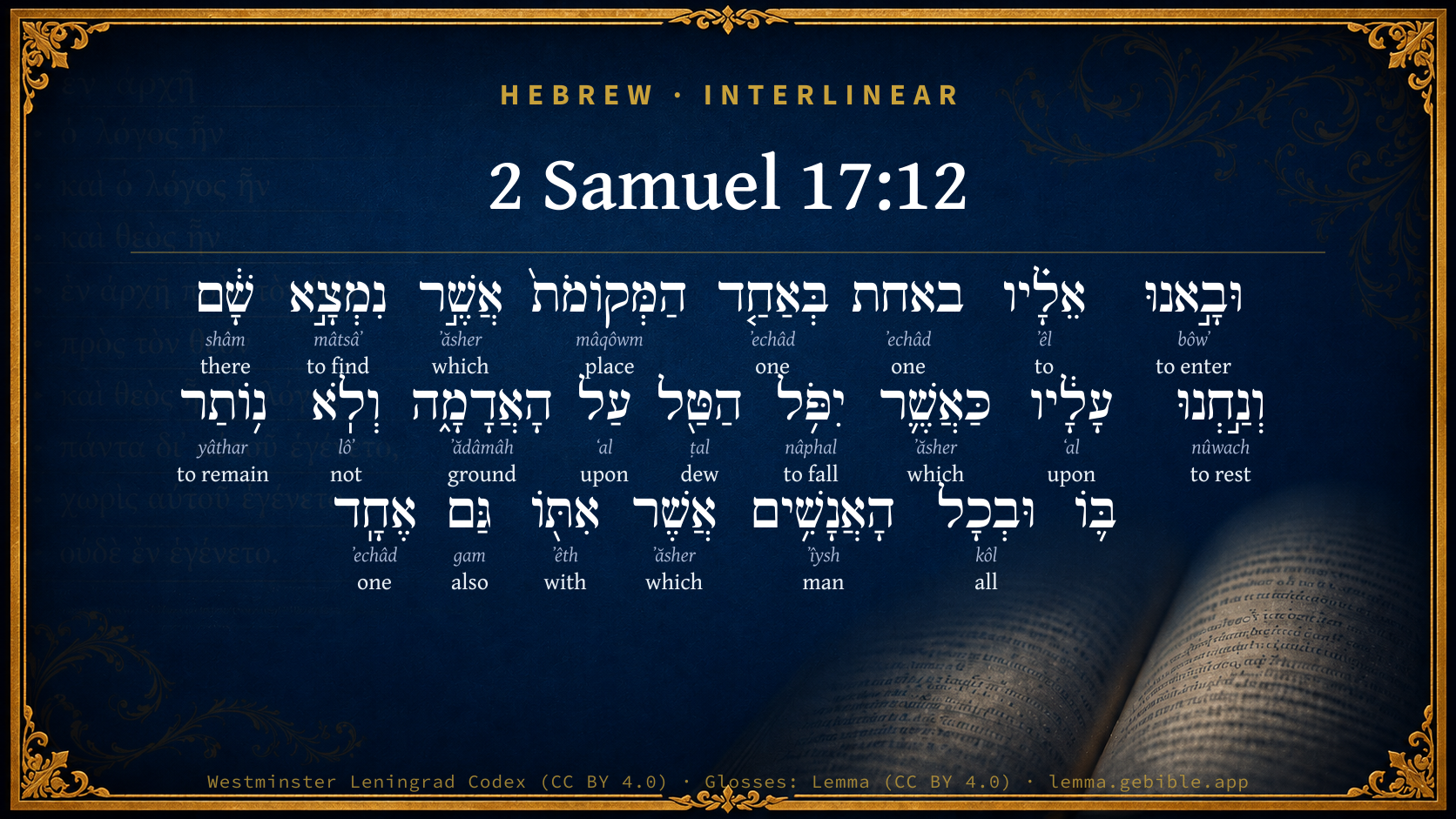
2 Samuel 17:12

Hebrew (Westminster Leningrad Codex) 2 Samuel 17:12 appears in the Hebrew Old Testament. The text above is from the Westminster Leningrad Codex. Each word links to its Strong’s number, a concise gloss, and parsing drawn from the Open Scriptures Hebrew Bible morphology. Click any word for its full Brown-Driver-Briggs (BDB) entry.
Download image
Cite this verse

2 Samuel 17:12 (World English Bible). Public Domain. Lemma interlinear Bible study tool, https://lemma.gebible.app/v/2-samuel/17/12.

Show BibTeX & RIS
BibTeX
RIS
English Translation
So shall we come on him in some place where he shall be found, and we will light on him as the dew falls on the ground; and of him and of all the men who are with him we will not leave so much as one.
World English Bible · Public Domain
Download a study sheet

One document with this verse’s original text, its word-by-word gloss line, the meaning frame, cross-references with their text, attributed commentary, and full source and license credits — printable, and it pastes into notes with its structure intact.

This verse Autodidact and up

Study sheet (.html) Plain text (.txt)

A passage Seminary Student

Up to 50 verses in one chapter. A passage sheet keeps up to 6 commentary sources and 12 cross-references per verse, in the order this page ranks them, and says so on the sheet whenever that leaves anything out. Ask for a single verse and you get the Autodidact verse sheet above.

Everything on this page stays free to read, with no account — the sheet is a download of what is already on screen, not access to it.

Want to remove ads? Support Godless Engineer
Compare translations 3

The same verse in 3 English versions, stacked beneath the original-language interlinear above. Click any original word for its lexicon entry.

Each is an independent rendering of the whole verse — the interlinear is not word-aligned to these translations.

Highlighted words mark where these versions differ — a whole-verse word diff, not a word-by-word alignment.

  • World English Bible Public Domain
    So shall we come on him in some place where he shall be found, and we will light on him as the dew falls on the ground; and of him and of all the men who are with him we will not leave so much as one.
  • King James Version Public Domain
    So shall we come upon him in some place where he shall be found, and we will light upon him as the dew falleth on the ground: and of him and of all the men that are with him there shall not be left so much as one.
  • unfoldingWord Literal Text CC BY-SA 4.0
    And we will come upon him in one of the places where he may be found there, and we upon him just as the dew falls upon the ground. And not even one will be left of him or of any of the men who with him.

unfoldingWord Literal Text — © unfoldingWord, licensed CC BY-SA 4.0. Word-aligned USFM3 via Door43 (git.door43.org/unfoldingWord/en_ult).

Versions to compare (up to 4)

3 of 4 selected

Show all 18 translations

Every available English version of this verse, each an independent rendering of the whole verse.

  • World English Bible Public Domain
    So shall we come on him in some place where he shall be found, and we will light on him as the dew falls on the ground; and of him and of all the men who are with him we will not leave so much as one.
  • Berean Standard Bible Public Domain
    Then we will attack David wherever we find him, and we will descend on him like dew on the ground. And of all the men with him, not even one will remain.
  • Majority Standard Bible Public Domain
    Then we will attack David wherever we find him, and we will descend on him like dew on the ground. And of all the men with him, not even one will remain.
  • King James Version Public Domain
    So shall we come upon him in some place where he shall be found, and we will light upon him as the dew falleth on the ground: and of him and of all the men that are with him there shall not be left so much as one.
  • American Standard Version (1901) Public Domain
    So shall we come upon him in some place where he shall be found, and we will light upon him as the dew falleth on the ground; and of him and of all the men that are with him we will not leave so much as one.
  • Revised Version (1885) Public Domain
    So shall we come upon him in some place where he shall be found, and we will light upon him as the dew falleth on the ground: and of him and of all the men that are with him we will not leave so much as one.
  • Geneva Bible (1599) Public Domain
    So shall we come vpon him in some place, where we shall finde him, and we will vpon him as the dewe falleth on the ground: and of all the men that are with him, wee will not leaue him one.
  • Douay-Rheims (1899) Public Domain
    And we shall come upon him in what place soever he shall be found: and we shall cover him, as the dew falleth upon the ground, and we shall not leave of the men that are with him, not so much as one.
  • Young's Literal Translation Public Domain
    and we have come in unto him in one of the places where he is found, and we `are' upon him as the dew falleth on the ground, and there hath not been left of him and of all the men who `are' with him even one.
  • Literal Standard Version CC BY-SA 4.0
    and we have come to him in one of the places where he is found, and we [are] on him as the dew falls on the ground, and there has not been left of him and of all the men who [are] with him even one.
  • Unlocked Literal Bible CC BY-SA 4.0
    Then we will come on him wherever he may be found, and we will cover him as the dew falls on the ground. We will not leave even one of his men, or him himself, alive.
  • unfoldingWord Literal Text CC BY-SA 4.0
    And we will come upon him in one of the places where he may be found there, and we upon him just as the dew falls upon the ground. And not even one will be left of him or of any of the men who with him.
  • Darby Bible Public Domain
    And we shall come upon him in some place where he shall be found, and we will light upon him as the dew falls on the ground; and of him and of all the men that are with him there shall not be left so much as one.
  • World Messianic Bible Public Domain
    So we will come on him in some place where he will be found, and we will light on him as the dew falls on the ground, then we will not leave so much as one of him and of all the men who are with him.
  • Webster's Bible Public Domain
    So shall we come upon him in some place where he shall be found, and we will light upon him as the dew falleth on the ground: and of him and of all the men that are with him there shall not be left so much as one.
  • Free Bible Version CC BY-SA 4.0
    Then we'll attack David wherever he is, and we'll fall on him as dew falls on the ground. Neither he nor a single one of all the men with him will be left alive!
  • Bible in Basic English Public Domain
    Then we will come on him in some place, wherever he may be, falling on him as the dew comes on the earth: and of him and all the men who are with him not one will get away with his life.
  • JPS Tanakh (1917) Public Domain
    So shall we come upon him in some place where he shall be found, and we will light upon him as the dew falleth on the ground; and of him and of all the men that are with him we will not leave so much as one.

Literal Standard Version (2020), Covenant Press — licensed CC BY-SA 4.0. Text via the HelloAO Bible API (eBible.org). Unlocked Literal Bible (unfoldingWord) — licensed CC BY-SA 4.0. Text via the HelloAO Bible API (eBible.org). unfoldingWord Literal Text — © unfoldingWord, licensed CC BY-SA 4.0. Word-aligned USFM3 via Door43 (git.door43.org/unfoldingWord/en_ult). Free Bible Version, Dr. Jonathan Gallagher — licensed CC BY-SA 4.0. Text via the HelloAO Bible API (eBible.org).

Word by word

More ways to search: Search by grammar → Find every occurrence → Compare this word →

Practice this passage: Drill this verse → Learn its vocabulary →

הַטַּ֖ל
ṭal
H2919
“the · dew”
Particle, Definite Article + Noun, Common, Masculine, Singular, Absolute
Part of Speech
Particle + Noun
Type
Common
Gender
Masculine
Number
Singular
State
Absolute
Full BDB Definition

Origin: from H2926

TWOT: 807a

dew, night mist
  1. וּבָ֣אנוּ bôwʼ H935 “and · to enter” Conjunction + Verb, Qal, Sequential Perfect, 1st Person, Common, Plural
  2. אֵלָ֗יו ʼêl H413 “to · him” Preposition + Suffix, Personal, 3rd Person, Masculine, Singular
  3. באחת ʼechâd H259 “in/at · one” Preposition + Adjective, Cardinal number, Feminine, Singular, Construct
  4. בְּאַחַ֤ד ʼechâd H259 “in/at · one” Preposition + Adjective, Cardinal number, Masculine, Singular, Construct
  5. הַמְּקוֹמֹת֙ mâqôwm H4725 “the · places” Particle, Definite Article + Noun, Common, Masculine, Plural, Absolute
  6. אֲשֶׁ֣ר ʼăsher H834 “which” Particle, Relative
  7. נִמְצָ֣א mâtsâʼ H4672 “to find” Verb, Niphal, Perfect, 3rd Person, Masculine, Singular
  8. שָׁ֔ם shâm H8033 “there” Adverb
  9. וְנַ֣חְנוּ nûwach H5117 “and · to rest” Conjunction + Verb, Qal, Sequential Perfect, 1st Person, Common, Plural
  10. עָלָ֔יו ʻal H5921 “upon · him” Preposition + Suffix, Personal, 3rd Person, Masculine, Singular
  11. כַּאֲשֶׁ֛ר ʼăsher H834 “like/as · which” Preposition + Particle, Relative
  12. יִפֹּ֥ל nâphal H5307 “to fall” Verb, Qal, Imperfect, 3rd Person, Masculine, Singular
  13. עַל ʻal H5921 “upon” Preposition
  14. הָאֲדָמָ֑ה ʼădâmâh H127 “the · ground” Particle, Definite Article + Noun, Common, Feminine, Singular, Absolute
  15. וְלֹֽא lôʼ H3808 “and · not” Conjunction + Particle, Negative
  16. נ֥וֹתַר yâthar H3498 “to remain” Verb, Niphal, Perfect, 3rd Person, Masculine, Singular
  17. וּבְכָל kôl H3605 “and · in/at · all of” Conjunction + Preposition + Noun, Common, Masculine, Singular, Construct
  18. הָאֲנָשִׁ֥ים ʼîysh H376 “the · men” Particle, Definite Article + Noun, Common, Masculine, Plural, Absolute
  19. אֲשֶׁר ʼăsher H834 “which” Particle, Relative
  20. אִתּ֖וֹ ʼêth H854 “with · him” Preposition + Suffix, Personal, 3rd Person, Masculine, Singular
  21. גַּם gam H1571 “also” Particle, Accusative
  22. אֶחָֽד ʼechâd H259 “one” Adjective, Cardinal number, Masculine, Singular, Absolute

About this verse

These counts appear in no published source. They are computed here, from the morphology-tagged text and Lemma’s own curated glosses. What Lemma adds →

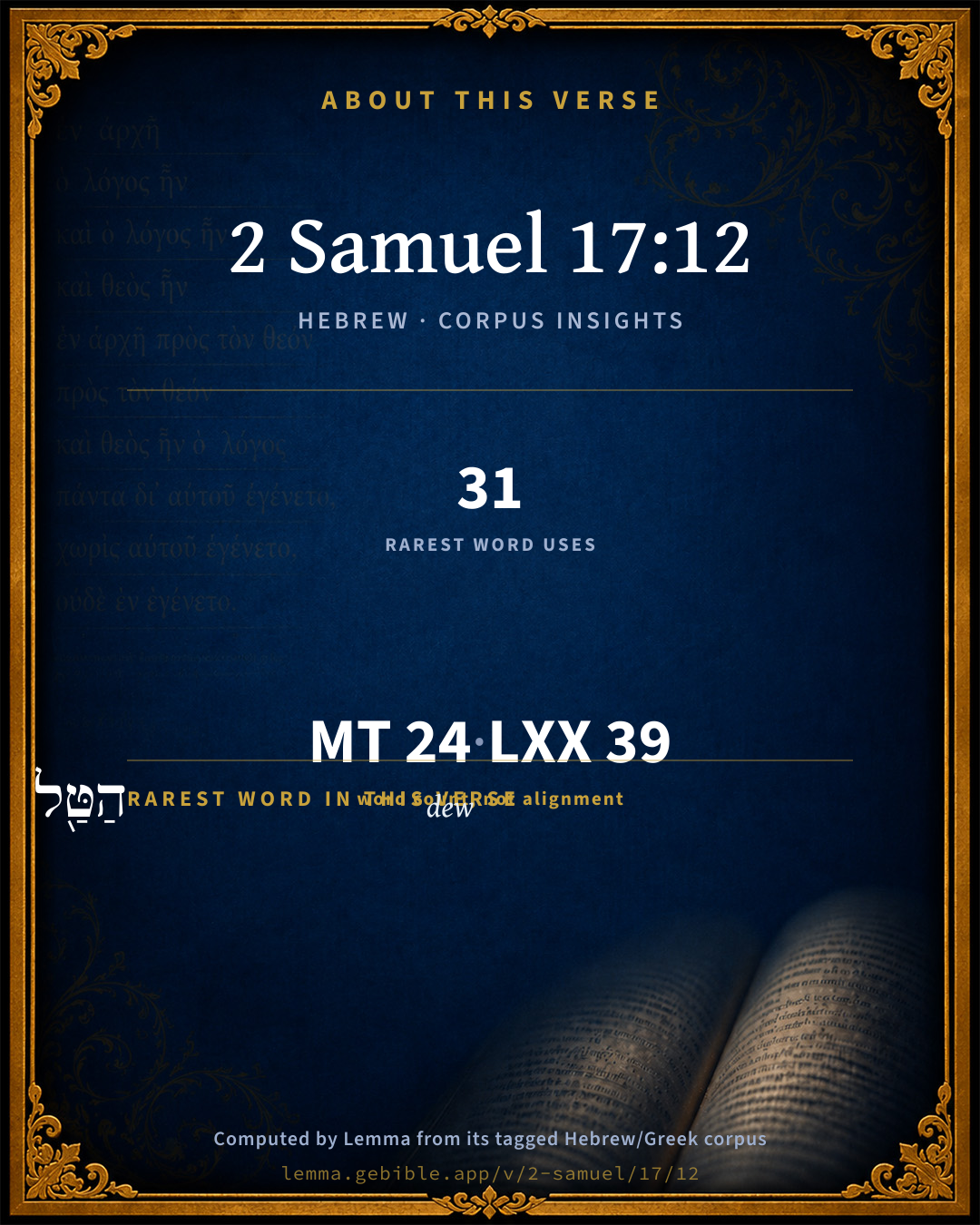
24
words
18
distinct lemmas
Historical
section

Shared distinctive vocabulary

הַטַּ֖ל dew H2919 occurs in 30 verses of the Hebrew Bible. Also found in:

Grammatical profile

  • 5 verbs
  • 5 nouns
  • 3 adjectives
  • 5 prepositions
  • 1 adverb
  • 5 particles

Verb forms

  • וּבָ֣אנוּ Qal · Sequential Perfect
  • נִמְצָ֣א Niphal · Perfect
  • וְנַ֣חְנוּ Qal · Sequential Perfect
  • יִפֹּ֥ל Qal · Imperfect
  • נ֥וֹתַר Niphal · Perfect

Repetition

Words recur within this verse — often emphatic in Hebrew:

  • באחת one H259 ×3
  • עָלָ֔יו upon H5921 ×2
  • אֲשֶׁ֣ר which H834 ×3

Hebrew & Septuagint length

In English translation the verse runs 47 words from the Hebrew and 44 from the Septuagint (LXX English) — closely comparable.

A rough comparison of the two English renderings, which tokenize alike — not a word-level alignment.

Word counts can differ between the Hebrew and the Greek without any difference in meaning — e.g. the Hebrew direct-object marker אֵת has no separate Greek word, and Greek often adds the article ὁ.

In the original languages it is 24 Hebrew tokens and 39 Greek tokens — but the two are counted differently (Hebrew bundles its prefixes and suffixes into one token; the Greek is in lemma form), so that isn’t a like-for-like length.

Cross-references

6

Topical passages linked to 2 Samuel 17:12 in the Treasury of Scripture Knowledge — connected by theme and wording, ordered by reader-vote popularity; previews shown in the World English Bible.

  • 1 Samuel 23:23 See therefore, and take knowledge of all the lurking-places where he hides himself, and come you again to me of a certainty, and I will go with you: and it shall happen, if he be in the land, that I will search him out among all the thousands of Judah.
  • 1 Kings 20:10 Ben Hadad sent to him, and said, The gods do so to me, and more also, if the dust of Samaria shall suffice for handfuls for all the people who follow me.
  • 2 Kings 18:23 Now therefore, Please give pledges to my master the king of Assyria, and I will give you two thousand horses, if you are able on your part to set riders on them.
  • 2 Kings 19:24 I have dug and drunk strange waters, and with the sole of my feet will I dry up all the rivers of Egypt.
  • Isaiah 10:13–14 For he has said, By the strength of my hand I have done it, and by my wisdom; for I have understanding: and I have removed the bounds of the peoples, and have robbed their treasures, and like a valiant man I have brought down those who sit [on thrones]:
  • Obadiah 1:3 The pride of your heart has deceived you, you who dwell in the clefts of the rock, whose habitation is high, who says in his heart, 'Who will bring me down to the ground?'

Cross-references courtesy of OpenBible.info (CC BY 4.0).

Hebrew and Greek witnesses Masoretic Hebrew ↔ Greek Septuagint

The same verse in the two great witnesses to the Old Testament, shown verse-for-verse.

These are two independent witnesses, not word-aligned to each other, and the Septuagint is shown in lemma (dictionary) form.

Hebrew 2 Samuel 17:12 Masoretic · Westminster Leningrad Codex

וּבָ֣אנוּ אֵלָ֗יו באחת בְּאַחַ֤ד הַמְּקוֹמֹת֙ אֲשֶׁ֣ר נִמְצָ֣א שָׁ֔ם וְנַ֣חְנוּ עָלָ֔יו כַּאֲשֶׁ֛ר יִפֹּ֥ל הַטַּ֖ל עַל הָאֲדָמָ֑ה וְלֹֽא נ֥וֹתַר בּ֛וֹ וּבְכָל הָאֲנָשִׁ֥ים אֲשֶׁר אִתּ֖וֹ גַּם אֶחָֽד

So shall we come on him in some place where he shall be found, and we will light on him as the dew falls on the ground; and of him and of all the men who are with him we will not leave so much as one.

World English Bible · Public Domain

Greek LXX 2 Samuel 17:12 Septuagint · lemma form

καί ἥκω πρός αὐτός εἰς εἷς ὁ τόπος ὅς ἐάν εὑρίσκω αὐτός ἐκεῖ καί παρα ἐνβάλλω ἐπί αὐτός ὡς πίπτω ὁ δρόσος ἐπί ὁ γῆ καί οὐ ὑπολείπω ἐν αὐτός καί ὁ ἀνήρ ὁ μετά αὐτός καί γέ εἷς

And we will come upon him in one of the places where we shall find him, and we will encamp against him, as the dew falls upon the earth; and we will not leave of him and of his men so much as one.

LXX2012 (modern English Septuagint) · Public Domain

Hebrew: Westminster Leningrad Codex (CC BY 4.0). Greek: Septuagint (public domain); English from LXX2012 (modern English Septuagint) (Public Domain). How the Septuagint differs from the Hebrew →

Targum (Aramaic paraphrase)

1

The Targum is the ancient Jewish Aramaic paraphrase of the Hebrew Scriptures — an interpretive translation, not the Hebrew text itself. Onkelos (literal) and Pseudo-Jonathan (expansive) render the Torah, and Jonathan the Prophets. Coverage is partial: where no permissively-licensed English translation exists for a verse, only the Aramaic is shown. This is verse-level text, not a word-by-word alignment to the Hebrew.

  1. Targum Jonathan Prophets (Joshua–Malachi)
    וּנְהַךְ עֲלוֹהִי בְּחַד מִן אַתְרַיָא דִנְהַךְ לְתַמָן וְנִשְׁרֵי עֲלוֹהִי כְּמָא דְשָׁרֵי טַלָא עַל אַרְעָא וְלָא נַשְׁאַר בֵּיהּ וּבְכָל גַבְרַיָא דִי עִימֵיהּ אַף חָד:

    (no public-domain English translation for this verse)

    Targum Jonathan — Aramaic: “Mikraot Gedolot” (public domain). English: “Sefaria Community Translation” (CC0 1.0 (public-domain dedication)); “London "Chaldee Paraphrase," 1871” (public domain). Text via Sefaria.

Commentary

Notes on 2 Samuel 17:12 from classic Christian and Jewish commentators (each source and its license shown beneath its notes). The classic Christian expositions comment on the surrounding passage and are grouped to its opening verse, so a note may address several verses; the Jewish commentaries on the Tanakh (Rashi and others) are per-verse, so they appear only where the commentator wrote on this verse.

Lemma curates 59 commentaries, every one of them public domain or Creative Commons licensed, each selected and text-cleaned for this edition rather than reprinted as found. About our sources →

Trapp's Complete Commentary

John Trapp

2Sa 17:12 So shall we come upon him in some place where he shall be found, and we will light upon him as the dew falleth on the ground: and of him and of all the men that [are] with him there shall not be left so much as one.

Ver. 12. So shall we come upon him.] We: q.d., I also will be one of the first and forwardest: that he might not seem to come short of Ahithophel, who had offered Absalom his service, both as a counsellor and as a commander.

There shall not be left so much as one.] Thus in every point he opposeth himself to Ahithophel, {2Sa 17:2} and is the rather heard.

John Trapp, A Commentary or Exposition upon All the Books of the Old and New Testament (1647–1656) — public domain. Text from a community e-Sword module.

Joseph Benson's Commentary

2Sa 17:12. We will light upon him as the dew falleth upon the ground — Plenteously, suddenly, irresistibly, and on all sides; for so the dew falls. This is very beautiful and expressive. “The dew in Palestine, as in several other climates, falls fast and sudden; and is therefore an apt emblem of an active and expeditious soldiery. And it was, perhaps, for this reason that the Romans called their light armed forces, rorarii. The dew falls upon every spot of the earth; not a blade of grass escapes it. A numerous army resembles it in this respect; it is able to search everywhere.” — Delaney.

Joseph Benson's Commentary on the Old and New Testaments (1811–1818) — public domain. Text from a community e-Sword module.

Geneva Bible (1599)

Geneva Bible translators

Or, we will camp against him.

Geneva Bible (1599) marginal notes — public domain. Text via Bolls.life.

Jamieson, Fausset & Brown

Robert Jamieson, A. R. Fausset & David Brown

we will light upon him as the dew falleth on the ground--No image could have symbolized the sudden onset of an enemy so graphically to an Oriental mind as the silent, irresistible, and rapid descent of this natural moisture on every field and blade of grass.

Jamieson, Fausset & Brown — Commentary Critical and Explanatory on the Whole Bible (1871) — public domain (CC PDM 1.0). Text via the HelloAO Bible API.

The Cambridge Bible for Schools and Colleges

gen. ed. J. J. S. Perowne

12. as the dew] As the innumerable drops of dew settle on the ground unseen and unheard, so will our vast army completely overwhelm him without perceptible effort.

The Cambridge Bible for Schools and Colleges (gen. ed. J. J. S. Perowne; Cambridge University Press, 1878–1918) — public domain. Text from a community e-Sword module.

John Gill's Exposition

Moreover, if he be gotten into a city,.... A strong fortified place, thinking to secure himself there, where he might hold out against those that were risen against him; the former part of the account supposes him in the field, where he would soon be detected, if hidden in a pit or any other place, or if he appeared openly would quickly be overthrown by the numerous forces of Absalom; and here it suggests, should he betake himself to a city for shelter:

then shall all Israel bring ropes to that city; scaling ropes, and thereby get upon and over the walls of it, and take it by storm; or engines worked with ropes, used for the demolishing of cities; so Tacitus speaks of "vincula tormentorum", the bands or ropes of engines, as Grotius observes; the Targum renders it by "armies", thus,"all Israel shall be gathered against the city, and surround it with armies,''besiege it in form, and so surround it that David could not possibly make his escape out of it, nor could it hold out long against such numerous forces; or this is an hyperbolical expression, as Kimchi calls it, signifying that their numbers would be so many, that they could soon and easily demolish it:

and we will draw it into the river; by the side of which it was built, or the ditch or trench around it, or the valley near it, that being built on an hill; and by this boasting, bragging, hyperbolical expression, he signifies that they should be able easily and utterly to destroy its walls, buildings, and towers, as if a number of men were to fasten a rope about anything, and by their main strength, and through their numbers, draw it down whither they pleased:

until there be not one small stone found there; and this being the case, David and his men must inevitably fall into their hands, and none escape.

John Gill's Exposition of the Whole Bible (1746–1763) — public domain (CC PDM 1.0). Text via the HelloAO Bible API.

Albert Barnes' Notes on the Bible

As the dew - Like the drops of dew, in the vast number of our host, and in our irresistible and unavoidable descent upon our enemies.

Albert Barnes' Notes on the Bible (1834–1885) — public domain. Text from a community e-Sword/MySword module.

Haydock's Catholic Bible Commentary

Dew, which there falleth every night, in summer, like rain, Deuteronomy xxxiii. 28. Some of the light armed troops of the Romans were called Rorarii, because they fell upon the enemy, and began the battle.

George Leo Haydock (1774–1849), Haydock's Catholic Family Bible and Commentary, 1859 edition — public domain. Excludes Psalms (Douay-Rheims chapter numbering differs from Protestant) and Deuterocanonical books (Catholic canon only).

Matthew Poole's English Annotations

As the dew falleth on the ground, i. e. plenteously, suddenly, irresistibly, and on all sides; for so the dew falls.

Matthew Poole's English Annotations on the Holy Bible (1683–1685) — public domain. Text from a community e-Sword/MySword module.

The Pulpit Commentary

In some place; Hebrew, in one of the places; one of the fortified camps already described in ver. 9.

The Pulpit Commentary (1880–1919), ed. H.D.M. Spence-Jones & Joseph S. Exell — public domain. Text from a community e-Sword module.

John Wesley's Explanatory Notes

As dew - That is, plenteously, suddenly, irresistibly, and on all sides; for so the dew falls.

John Wesley, Explanatory Notes Upon the Whole Bible (1754–1765) — public domain. Text via the GEBible commentary corpus.

Keil & Delitzsch

C. F. Keil & F. Delitzsch

"And come we to him (if we come upon him) in one of the places where he is found, we let ourselves down upon him, as the dew falls upon the earth; and of him and all the men with him there will not be one left." נחנוּ might be a contraction of אנחנוּ, as in Gen 42:11; Exo 16:7-8, etc.: "so we upon him," equivalent to "so shall we come upon him." But if this were the meaning, we should expect עליו והינוּ. It is more correct, therefore, to take נחנוּ ekat ot as the first pers. perf. of נוּח, as the early translators have done: so do we let ourselves down upon him. (For נוּח as applied to an army encamping, see Isa 7:2, Isa 7:19; and as denoting the swarming of flies and grasshoppers, Isa 7:19 and Exo 10:14.) In Ahithophel's opinion, it would be possible with a very small army to crush David and his little band, however brave his followers might be, and in fact to annihilate them altogether.

Keil & Delitzsch — Biblical Commentary on the Old Testament (1861–1891) — public domain (CC PDM 1.0). Text via the HelloAO Bible API. (Old Testament only.)

Rashi

Rabbi Shlomo Yitzchaki (Rashi)

And we will encamp upon him. We will encamp upon him language [denoting] camping as [we find], "It camped within the entire boorder of Mitzraim" [and] "Arom has camped opposite Ephraim."

Rashi on the Tanakh — English translations: “The Judaica Press complete Tanach with Rashi, translated by A. J. Rosenberg” (CC BY 4.0); “Pentateuch with Rashi's commentary by M. Rosenbaum and A.M. Silbermann, 1929-1934” (public domain); “The Metsudah Tanach series, Lakewood, N.J” (CC BY 4.0); and “The Book of Joshua, Metsudah Publications, 1997” (CC BY 4.0). Text via Sefaria.

Lesson kit

Teaching starters — assembled from the data on this page, not authored interpretation. Every prompt links to the verse data it draws on. Edit before teaching.

2 Samuel, in the Historical, opens this verse with 24 words (18 distinct Hebrew lemmas). Its most distinctive word is ṭal (“dew”). A historical commentator’s framing appears above. Read the whole chapter for the surrounding context.

Discussion questions

  1. The word ṭal carries the sense “dew.” How does it shape the verse?
  2. Genesis 27:28 shares the word «dew» with this verse. How do the two illuminate each other?
  3. “one” occurs 3× in this one verse. What is the effect of the repetition?
  4. The translations on this page render this verse differently — a whole-verse word diff, not a word-by-word alignment. What might account for the different wordings?
  5. The verb «וּבָ֣אנוּ» is Qal Sequential Perfect. How does its form color the action?
  6. Reading how Trapp's Complete Commentary and Joseph Benson's Commentary read this verse, where do the two commentators agree and where do they part?

Things to notice

Reading settings

Reading text

Shown beneath each verse's original-language words.

Old Testament
Old Testament edition

Read the OT as the Masoretic Hebrew (MT) or the Greek Septuagint (LXX).

English shown for the Greek Septuagint (in the Hebrew ↔ Greek comparison).

Comparing translations? Open the Compare panel on any verse page to stack up to four side by side.