
1 Kings 20:30

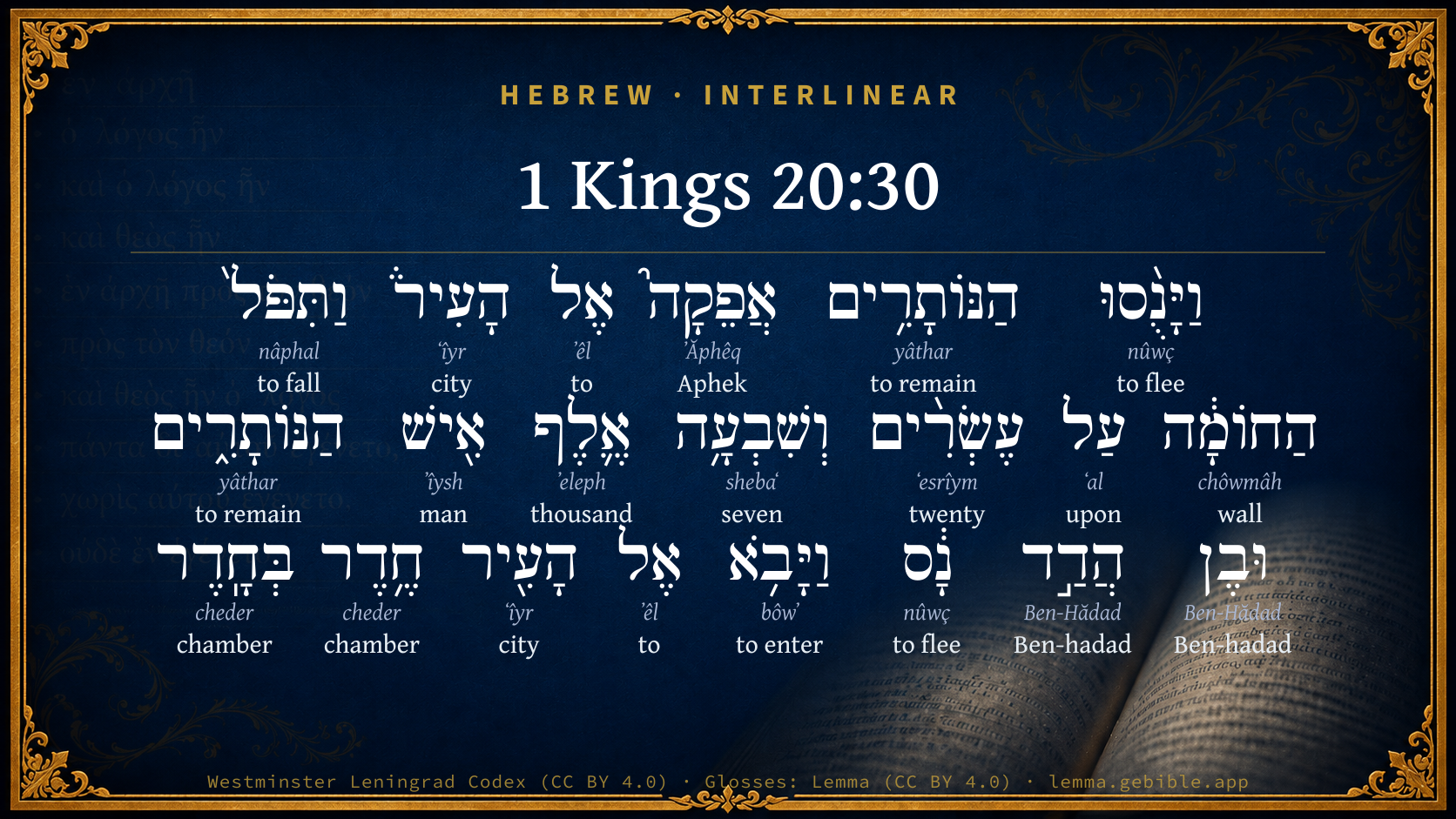
Hebrew (Westminster Leningrad Codex) 1 Kings 20:30 appears in the Hebrew Old Testament. The text above is from the Westminster Leningrad Codex. Each word links to its Strong’s number, a concise gloss, and parsing drawn from the Open Scriptures Hebrew Bible morphology. Click any word for its full Brown-Driver-Briggs (BDB) entry.
Download image
Cite this verse

1 Kings 20:30 (World English Bible). Public Domain. Lemma interlinear Bible study tool, https://lemma.gebible.app/v/1-kings/20/30.

Show BibTeX & RIS
BibTeX
RIS
English Translation
But the rest fled to Aphek, into the city; and the wall fell on twenty-seven thousand men who were left. Ben Hadad fled, and came into the city, into an inner chamber.
World English Bible · Public Domain
Download a study sheet

One document with this verse’s original text, its word-by-word gloss line, the meaning frame, cross-references with their text, attributed commentary, and full source and license credits — printable, and it pastes into notes with its structure intact.

This verse Autodidact and up

Study sheet (.html) Plain text (.txt)

A passage Seminary Student

Up to 50 verses in one chapter. A passage sheet keeps up to 6 commentary sources and 12 cross-references per verse, in the order this page ranks them, and says so on the sheet whenever that leaves anything out. Ask for a single verse and you get the Autodidact verse sheet above.

Everything on this page stays free to read, with no account — the sheet is a download of what is already on screen, not access to it.

Want to remove ads? Support Godless Engineer
Compare translations 3

The same verse in 3 English versions, stacked beneath the original-language interlinear above. Click any original word for its lexicon entry.

Each is an independent rendering of the whole verse — the interlinear is not word-aligned to these translations.

Highlighted words mark where these versions differ — a whole-verse word diff, not a word-by-word alignment.

  • World English Bible Public Domain
    But the rest fled to Aphek, into the city; and the wall fell on twenty-seven thousand men who were left. Ben Hadad fled, and came into the city, into an inner chamber.
  • King James Version Public Domain
    But the rest fled to Aphek, into the city; and there a wall fell upon twenty and seven thousand of the men that were left. And Benhadad fled, and came into the city, into an inner chamber.
  • unfoldingWord Literal Text CC BY-SA 4.0
    And the remaining ones fled to Aphek, into the city, and the wall fell on 27,000 remaining men. And Ben Hadad fled and entered into the city, a chamber in a chamber.

unfoldingWord Literal Text — © unfoldingWord, licensed CC BY-SA 4.0. Word-aligned USFM3 via Door43 (git.door43.org/unfoldingWord/en_ult).

Versions to compare (up to 4)

3 of 4 selected

Show all 18 translations

Every available English version of this verse, each an independent rendering of the whole verse.

  • World English Bible Public Domain
    But the rest fled to Aphek, into the city; and the wall fell on twenty-seven thousand men who were left. Ben Hadad fled, and came into the city, into an inner chamber.
  • Berean Standard Bible Public Domain
    The rest of them fled into the city of Aphek, where the wall fell on twenty-seven thousand of the remaining men. Ben-hadad also fled to the city and hid in an inner room.
  • Majority Standard Bible Public Domain
    The rest of them fled into the city of Aphek, where the wall fell on twenty-seven thousand of the remaining men. Ben-hadad also fled to the city and hid in an inner room.
  • King James Version Public Domain
    But the rest fled to Aphek, into the city; and there a wall fell upon twenty and seven thousand of the men that were left. And Benhadad fled, and came into the city, into an inner chamber.
  • American Standard Version (1901) Public Domain
    But the rest fled to Aphek, into the city; and the wall fell upon twenty and seven thousand men that were left. And Ben-hadad fled, and came into the city, into an inner chamber.
  • Revised Version (1885) Public Domain
    But the rest fled to Aphek, into the city; and the wall fell upon twenty and seven thousand men that were left. And Ben-hadad fled, and came into the city, into an inner chamber.
  • Geneva Bible (1599) Public Domain
    But the rest fled to Aphek into the citie: and there fel a wall vpon seuen and twentie thousand men that were left: and Ben-hadad fled into the citie, and came into a secret chamber.
  • Douay-Rheims (1899) Public Domain
    And they that remained fled to Aphec, into the city: and the wall fell upon seven and twenty thousand men, that were left. And Benadad fleeing went into the city, into a chamber that was within a chamber.
  • Young's Literal Translation Public Domain
    And those left flee to Aphek, unto the city, and the wall falleth on twenty and seven chief men who are left, and Ben-Hadad hath fled, and cometh in unto the city, into the innermost part.
  • Literal Standard Version CC BY-SA 4.0
    And those left flee to Aphek, into the city, and the wall falls on twenty-seven chief men who are left, and Ben-Hadad has fled, and comes into the city, into the innermost part.
  • Unlocked Literal Bible CC BY-SA 4.0
    The rest fled to Aphek, into the city, and the wall fell on twenty-seven thousand men who were left. Ben Hadad fled and went into the city, into an inner room.
  • unfoldingWord Literal Text CC BY-SA 4.0
    And the remaining ones fled to Aphek, into the city, and the wall fell on 27,000 remaining men. And Ben Hadad fled and entered into the city, a chamber in a chamber.
  • Darby Bible Public Domain
    And the rest fled to Aphek, into the city; and the wall fell on twenty-seven thousand men of them that were left. And Ben-Hadad fled, and came into the city, [from] chamber to chamber.
  • World Messianic Bible Public Domain
    But the rest fled to Aphek, into the city; and the wall fell on twenty-seven thousand men who were left. Ben Hadad fled and came into the city, into an inner room.
  • Webster's Bible Public Domain
    But the rest fled to Aphek, into the city; and there a wall fell upon twenty and seven thousand of the men that were left. And Ben-hadad fled, and came into the city, into an inner chamber.
  • Free Bible Version CC BY-SA 4.0
    The rest ran away to the town of Aphek, where a wall collapsed on 27,000 of those that remained. Ben-hadad also ran to the town and hid in an inside room.
  • Bible in Basic English Public Domain
    But the rest went in flight to Aphek, into the town, where a wall came down on the twenty-seven thousand who were still living. And Ben-hadad went in flight into the town, into an inner room.
  • JPS Tanakh (1917) Public Domain
    But the rest fled to Aphek, into the city; and the wall fell upon twenty and seven thousand men that were left. And Ben-hadad fled, and came into the city, into an inner chamber.

Literal Standard Version (2020), Covenant Press — licensed CC BY-SA 4.0. Text via the HelloAO Bible API (eBible.org). Unlocked Literal Bible (unfoldingWord) — licensed CC BY-SA 4.0. Text via the HelloAO Bible API (eBible.org). unfoldingWord Literal Text — © unfoldingWord, licensed CC BY-SA 4.0. Word-aligned USFM3 via Door43 (git.door43.org/unfoldingWord/en_ult). Free Bible Version, Dr. Jonathan Gallagher — licensed CC BY-SA 4.0. Text via the HelloAO Bible API (eBible.org).

Word by word

More ways to search: Search by grammar → Find every occurrence → Compare this word →

Practice this passage: Drill this verse → Learn its vocabulary →

אֲפֵקָה֮
ʼĂphêq
H663
“Aphek · toward”
Noun, Proper + Suffix, Demonstrative
Part of Speech
Noun
Type
Proper
Full BDB Definition

Origin: from H662 (in the sense of strength)

TWOT: None

Aphek or Aphik = "enclosure" - a Canaanite city near Jezreel - a city in territory of Asher - a city northeast of Beirut in Transjordan
  1. וַיָּנֻ֨סוּ nûwç H5127 “and · to flee” Conjunction + Verb, Qal, Sequential Imperfect, 3rd Person, Masculine, Plural
  2. הַנּוֹתָרִ֥ים yâthar H3498 “the · remaining” Particle, Definite Article + Verb, Niphal, Participle Active, Masculine, Plural, Absolute
  3. אֶל ʼêl H413 “to” Preposition
  4. הָעִיר֒ ʻîyr H5892 “the · city” Particle, Definite Article + Noun, Common, Feminine, Singular, Absolute
  5. וַתִּפֹּל֙ nâphal H5307 “and · to fall” Conjunction + Verb, Qal, Sequential Imperfect, 3rd Person, Feminine, Singular
  6. הַחוֹמָ֔ה chôwmâh H2346 “the · wall” Particle, Definite Article + Noun, Common, Feminine, Singular, Absolute
  7. עַל ʻal H5921 “upon” Preposition
  8. עֶשְׂרִ֨ים ʻesrîym H6242 “twenty” Adjective, Cardinal number, Both, Plural, Absolute
  9. וְשִׁבְעָ֥ה shebaʻ H7651 “and · seven” Conjunction + Adjective, Cardinal number, Masculine, Singular, Absolute
  10. אֶ֛לֶף ʼeleph H505 “thousand” Adjective, Cardinal number, Both, Singular, Absolute
  11. אִ֖ישׁ ʼîysh H376 “man” Noun, Common, Masculine, Singular, Absolute
  12. הַנּוֹתָרִ֑ים yâthar H3498 “the · remaining” Particle, Definite Article + Verb, Niphal, Participle Active, Masculine, Plural, Absolute
  13. וּבֶן Ben-Hădad H1130 “and · Ben-hadad” Conjunction + Noun, Proper
  14. הֲדַ֣ד Ben-Hădad H1130 “Ben-hadad” Noun, Proper
  15. נָ֔ס nûwç H5127 “to flee” Verb, Qal, Perfect, 3rd Person, Masculine, Singular
  16. וַיָּבֹ֥א bôwʼ H935 “and · to enter” Conjunction + Verb, Qal, Sequential Imperfect, 3rd Person, Masculine, Singular
  17. אֶל ʼêl H413 “to” Preposition
  18. הָעִ֖יר ʻîyr H5892 “the · city” Particle, Definite Article + Noun, Common, Feminine, Singular, Absolute
  19. חֶ֥דֶר cheder H2315 “chamber” Noun, Common, Masculine, Singular, Absolute
  20. בְּחָֽדֶר cheder H2315 “in/at · chamber” Preposition + Noun, Common, Masculine, Singular, Absolute

About this verse

These counts appear in no published source. They are computed here, from the morphology-tagged text and Lemma’s own curated glosses. What Lemma adds →

21
words
15
distinct lemmas
Historical
section

Notable vocabulary

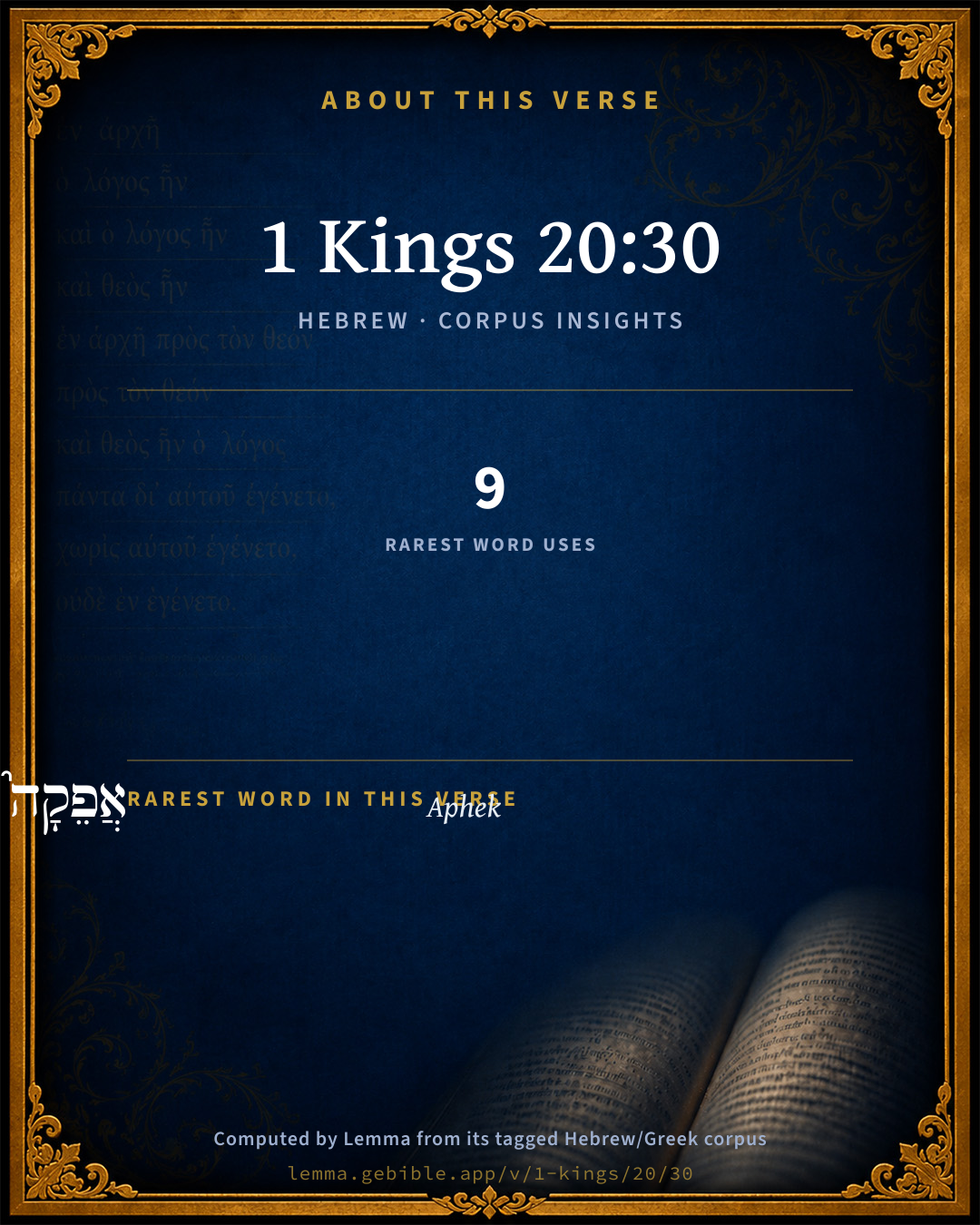
The rarest word here is אֲפֵקָה֮ Aphek H663 — appearing just 9 times in the whole Hebrew Bible.

Shared distinctive vocabulary

אֲפֵקָה֮ Aphek H663 occurs in 9 verses of the Hebrew Bible. Also found in:

Grammatical profile

  • 6 verbs
  • 9 nouns
  • 3 adjectives
  • 3 prepositions

Verb forms

  • וַיָּנֻ֨סוּ Qal · Sequential Imperfect
  • הַנּוֹתָרִ֥ים Niphal · Participle Active
  • וַתִּפֹּל֙ Qal · Sequential Imperfect
  • הַנּוֹתָרִ֑ים Niphal · Participle Active
  • נָ֔ס Qal · Perfect
  • וַיָּבֹ֥א Qal · Sequential Imperfect

Repetition

Words recur within this verse — often emphatic in Hebrew:

  • וַיָּנֻ֨סוּ to flee H5127 ×2
  • הַנּוֹתָרִ֥ים to remain H3498 ×2
  • הָעִיר֒ city H5892 ×2
  • וּבֶן Ben-hadad H1130 ×2
  • חֶ֥דֶר chamber H2315 ×2
  • אֶל to H413 ×2

Cross-references

13

Topical passages linked to 1 Kings 20:30 in the Treasury of Scripture Knowledge — connected by theme and wording, ordered by reader-vote popularity; previews shown in the World English Bible.

  • 1 Kings 22:25 Micaiah said, Behold, you shall see on that day, when you shall go into an inner chamber to hide yourself.
  • 2 Chronicles 18:24 Micaiah said, Behold, you shall see on that day, when you shall go into an inner chamber to hide yourself.
  • 1 Kings 20:26 It happened at the return of the year, that Ben Hadad mustered the Syrians, and went up to Aphek, to fight against Israel.
  • Luke 13:4 Or those eighteen, on whom the tower in Siloam fell, and killed them; do you think that they were worse offenders than all the men who dwell in Jerusalem?
  • 1 Kings 20:10 Ben Hadad sent to him, and said, The gods do so to me, and more also, if the dust of Samaria shall suffice for handfuls for all the people who follow me.
  • 1 Kings 20:20 They killed everyone his man; and the Syrians fled, and Israel pursued them: and Ben Hadad the king of Syria escaped on a horse with horsemen.
  • Psalms 18:25 With the merciful you will show yourself merciful. With the perfect man, you will show yourself perfect.
  • Isaiah 24:18 It shall happen, that he who flees from the noise of the fear shall fall into the pit; and he who comes up out of the midst of the pit shall be taken in the snare: for the windows on high are opened, and the foundations of the earth tremble.
  • Jeremiah 48:44 He who flees from the fear shall fall into the pit; and he who gets up out of the pit shall be taken in the snare: for I will bring on him, even on Moab, the year of their visitation, says Yahweh.
  • Daniel 4:37 Now I, Nebuchadnezzar, praise and extol and honor the King of heaven; for all his works are truth, and his ways justice; and those who walk in pride he is able to abase.
  • Amos 2:14–15 Flight will perish from the swift; And the strong won't strengthen his force; Neither shall the mighty deliver himself;
  • Amos 5:19 As if a man fled from a lion, And a bear met him; Or he went into the house and leaned his hand on the wall, And a snake bit him.
  • Amos 9:3 Though they hide themselves in the top of Carmel, I will search and take them out there; and though they be hid from my sight in the bottom of the sea, there I will command the serpent, and it will bite them.

Cross-references courtesy of OpenBible.info (CC BY 4.0).

Hebrew and Greek witnesses Masoretic Hebrew ↔ Greek Septuagint

The same verse in the two great witnesses to the Old Testament, shown verse-for-verse.

These are two independent witnesses, not word-aligned to each other, and the Septuagint is shown in lemma (dictionary) form.

Hebrew 1 Kings 20:30 Masoretic · Westminster Leningrad Codex

וַיָּנֻ֨סוּ הַנּוֹתָרִ֥ים אֲפֵקָה֮ אֶל הָעִיר֒ וַתִּפֹּל֙ הַחוֹמָ֔ה עַל עֶשְׂרִ֨ים וְשִׁבְעָ֥ה אֶ֛לֶף אִ֖ישׁ הַנּוֹתָרִ֑ים וּבֶן הֲדַ֣ד נָ֔ס וַיָּבֹ֥א אֶל הָעִ֖יר חֶ֥דֶר בְּחָֽדֶר

But the rest fled to Aphek, into the city; and the wall fell on twenty-seven thousand men who were left. Ben Hadad fled, and came into the city, into an inner chamber.

World English Bible · Public Domain

On this verse, The Cambridge Bible for Schools and Colleges discusses the Septuagint’s reading. Read the note in Commentary ↓

Hebrew: Westminster Leningrad Codex (CC BY 4.0). Greek: Septuagint (public domain); English from a public-domain English Septuagint. How the Septuagint differs from the Hebrew →

Targum (Aramaic paraphrase)

1

The Targum is the ancient Jewish Aramaic paraphrase of the Hebrew Scriptures — an interpretive translation, not the Hebrew text itself. Onkelos (literal) and Pseudo-Jonathan (expansive) render the Torah, and Jonathan the Prophets. Coverage is partial: where no permissively-licensed English translation exists for a verse, only the Aramaic is shown. This is verse-level text, not a word-by-word alignment to the Hebrew.

  1. Targum Jonathan Prophets (Joshua–Malachi)
    וְאַפָּכוּ דְאִשְׁתַּאֲרוּ לַאֲפֵק לְקַרְתָּא וּנְפַל שׁוֹרָא עַל עַשְׂרִין וְשִׁבְעָה אַלְפִין גַבְרָא דְאִשְׁתַּאֲרוּ וּבַר הֲדַד עֲרַק וְעַל לְקַרְתָּא תָּוָן בְּגוֹ תָוָן:

    (no public-domain English translation for this verse)

    Targum Jonathan — Aramaic: “Mikraot Gedolot” (public domain). English: “Sefaria Community Translation” (CC0 1.0 (public-domain dedication)); “London "Chaldee Paraphrase," 1871” (public domain). Text via Sefaria.

Commentary

Notes on 1 Kings 20:30 from classic Christian and Jewish commentators (each source and its license shown beneath its notes). The classic Christian expositions comment on the surrounding passage and are grouped to its opening verse, so a note may address several verses; the Jewish commentaries on the Tanakh (Rashi and others) are per-verse, so they appear only where the commentator wrote on this verse.

Lemma curates 59 commentaries, every one of them public domain or Creative Commons licensed, each selected and text-cleaned for this edition rather than reprinted as found. About our sources →

Trapp's Complete Commentary

John Trapp

1Ki 20:30 But the rest fled to Aphek, into the city; and [there] a wall fell upon twenty and seven thousand of the men [that were] left. And Benhadad fled, and came into the city, into an inner chamber.

Ver. 30. But the rest fled to Aphek.] See on 1Ki 20:26. No place can secure a blasphemer from the divine vengeance.

And there a wall fell] By some earthquake, likely, or other immediate hand of God, for their insolency against him. The stones in the wall of Aphek shall sooner turn executioners, than a blasphemous Aramite shall escape unrevenged. At the coronation of Pope Clement V, John, duke of Brittany, with others, were in like sort slain by the fall of a wall at Lyons; Philip, king of France, was thereby also wounded; the Pope himself was struck off his horse, his crown struck off his head, and a carbuncle of very great price lost out of it. {a} A fair warning to that foul sinner who had upon his head the names of blasphemy. {Rev 13:1; Rev 13:5-6}

Into an inner chamber.] Into a chamber within a chamber, glad to hide himself in any hole. So Manasseh that faced the heavens in his prosperity, in trouble basely hides his head among the bushes. {2Ch 33:12} Gidlimer overcome by Bellisarius, and besieged, sent to beg of him three things; (1.) A piece of bread to ease his hunger; (2.) A sponge to dry his eyes; (3.) A harp to cheer up his heart, well-nigh broke with grief.

{a} Jac. Revius.

John Trapp, A Commentary or Exposition upon All the Books of the Old and New Testament (1647–1656) — public domain. Text from a community e-Sword module.

Joseph Benson's Commentary

1Ki 20:30. A wall fell upon twenty and seven thousand — The wall of the city under which they lay, ready to defend it; or the walls (the singular number being put for the plural, than which nothing is more frequent) of some great castle or fort, in or near the city in which they were now fortifying themselves; or of some part of the city where they lay. This might possibly happen through natural causes; but most probably was effected by the mighty power of God, sending some earthquake, or violent storm, which threw down the walls upon them: and if ever a miracle was to be wrought, now seems to have been the proper season for it; when the blasphemous Syrians denied the sovereign power of God, and thereby in some sort obliged him to give a proof of it; and to show, that he was the God of the plains, as well as of the mountains; and that he could as effectually destroy them in their strongest holds, as in the open fields; and make the very walls, to whose strength they trusted for their defence, to be the instruments of their ruin. But it may be further observed, that it is not said, that all these were killed by the fall of this wall; but only that the wall fell upon them, killing some, and wounding others.

Joseph Benson's Commentary on the Old and New Testaments (1811–1818) — public domain. Text from a community e-Sword module.

Geneva Bible (1599)

Geneva Bible translators

Hebrew, from chamber, to chamber.

Geneva Bible (1599) marginal notes — public domain. Text via Bolls.life.

Adam Clarke's Commentary

Verse 30. A wall fell upon twenty and seven thousand] From the first view of this text it would appear that when the Syrians fled to Aphek, and shut themselves within the walls, the Israelites immediately brought all hands, and sapped the walls, in consequence of which a large portion fell, and buried twenty-seven thousand men. But perhaps the hand of God was more immediately in this disaster; probably a burning wind is meant. See at the end of the chapter. 1Kg 20:43.

Came into the city, into an inner chamber.] However the passage above may be understood, the city was now, in effect, taken; and Ben-hadad either betook himself with his few followers to the citadel or to some secret hiding-place, where he held the council with his servants immediately mentioned.

Adam Clarke's Commentary on the Bible (1810–1826) — public domain. Text from a community e-Sword/MySword module.

Ellicott's Commentary for English Readers

(30) A wall—properly, the wall of the city, whether falling by earthquake, or in the storming of the place, by Israel. The numbers in the text are very large, as in many other instances. It is possible (see Introduction) that there may be corruption, although the same numbers are found in the ancient versions. But the massing in small space of Oriental armies, and the extra ordinary slaughter consequent on it, are well illustrated in history; as, for instance, in the Greek wars with Persia or even our own experience in India.

A Bible Commentary for English Readers, edited by Charles John Ellicott (1878–1897) — public domain. Text from a community e-Sword module.

The Cambridge Bible for Schools and Colleges

gen. ed. J. J. S. Perowne

30. and there a [R.V. and the] wall fell upon twenty and seven thousand of the [R.V. omits of the] men] The noun is definite in the original, and must refer to the city wall of Aphek. The narrative gives no clue to the cause of the disaster. But the divine promise of victory seems to warrant us in concluding that it was by divine interposition, through an earthquake it may be, that a destruction so tremendous was wrought among the enemy. The small number of Israel could not have availed even for the slaughter of those who fell in the battle.

And Ben-hadad fled] He was probably on or near the walls when the great disaster occurred, and in terror gat him to the more central parts of the city.

into an inner chamber] Literally, ‘a chamber within a chamber’. The LXX. has εἰς τὸν οἷκον τοῦ κοιτῶνος εἰς τὸ ταμιεῖον, ‘into the bedchamber, even into the innermost room’. Josephus says ‘an underground room’. What is meant is no doubt some room as far removed from the entrance as possible, so that he might be hidden for a good while at all events, and perhaps remain altogether undiscovered.

The Cambridge Bible for Schools and Colleges (gen. ed. J. J. S. Perowne; Cambridge University Press, 1878–1918) — public domain. Text from a community e-Sword module.

John Gill's Exposition

But the rest fled to Aphek, into the city,.... Which perhaps was in the hands of the Syrians, and was designed for a retreat for them, should they be beaten:

and there a wall fell upon twenty seven thousand of the men that were left; not slain in the battle; here again the Lord might be seen, who, as Abarbinel observes, fought from heaven, and either by a violent wind, or an earthquake, threw down the wall upon them just as they had got under it for shelter:

and Benhadad fled, and came into the city into an inner chamber; or, "into a chamber within a chamber" (q), for greater secrecy.

(q) "cubiculo in cubiculum", Pagninus, Montanus.

John Gill's Exposition of the Whole Bible (1746–1763) — public domain (CC PDM 1.0). Text via the HelloAO Bible API.

Albert Barnes' Notes on the Bible

A wall - “The wall,” i. e., the wall of the town. We may suppose a terrific earthquake during the siege of the place, while the Syrians were manning the defenses in full force, which threw down the wall where they were most thickly crowded upon it, and buried them in its ruins. Ben-hadad fled from the wall, where he had been at the time of the disaster, into the inner parts of the city - probably to some massive stronghold - and there concealed himself.

Albert Barnes' Notes on the Bible (1834–1885) — public domain. Text from a community e-Sword/MySword module.

Haydock's Catholic Bible Commentary

Went, or had gone before, and commanded his men to defend the walls of Aphec. (Haydock) --- But the slaughter of these 27,000 is joined to the preceding. (Menochius) --- God caused the walls to fall, as he had done those of Jericho; or the Israelites beat them down with battering rams, and the defendants perished in the ruins. --- Chamber. Josephus observes that it was under ground. Micheas told Benadad that he would have thus to hide himself again, chap. xxii. 25. (Calmet)

George Leo Haydock (1774–1849), Haydock's Catholic Family Bible and Commentary, 1859 edition — public domain. Excludes Psalms (Douay-Rheims chapter numbering differs from Protestant) and Deuterocanonical books (Catholic canon only).

Matthew Poole's English Annotations

The wall, or, the walls, (the singular number for the plural, than which nothing more frequent,) of the city; or of some great castle or fort in or near the city, in which they were now fortifying themselves; or of some part of the city where they lay. Which might possibly happen through natural causes; but most probably was effected by the mighty power of God, then sending some sudden earthquake, or violent storm of wind, which threw down the wall, or walls, upon them; or doing this by the ministry of angels; which cannot be incredible to any man, except to him that denies the truth of all the miracles recorded in the Old and New Testament; which being attested, many of them, by Jews and heathens, it is the height of folly and impudence to deny. For if ever miracle was to be wrought, now seems to have been the proper time and season for it; when the blasphemous Syrians denied the sovereign and infinite power of God, and thereby in some sort obliged him, for his own honour, to give a proof of it; and to show that he was the God of the plains as well as of the mountains, and that he could as effectually destroy them in their strongest holds as in the open fields, and make the very walls, to whose strength they trusted for their defence, to be the instruments of their ruin. But it may be further observed, that it is not said that all these were killed by the fall of this wall; but only that the wall fell upon them, killing some, and wounding others, as is usual in those cases. Nor is it necessary that the wall should fall upon every individual person; but it is sufficient to justify this phrase, if it fell upon the main body of them; for the words in the Hebrew ran thus,

the wall fell upon twenty-seven thousand (not of the men that are left, as we render it, but) which were left of that great army. Into the city; either,

1. Out of the fields, as the rest of his army did; which is distinctly and particularly noted of him, because he was the most eminent person in it, and the head of it. Compare the title of Psa 18:1. Or,

2. At and from the noise and report of that terrible fall of the wall, or walls; which possibly might be in the outside or suburbs of the city; from whence he fled further into the city.

Into an inner chamber; or, a chamber within a chamber; where he supposed he might lie hid, till he had an opportunity of making an escape, or of obtaining mercy.

Matthew Poole's English Annotations on the Holy Bible (1683–1685) — public domain. Text from a community e-Sword/MySword module.

Whedon's Commentary on the Bible

Daniel D. Whedon

30. A wall fell upon twenty and seven thousand — “This tremendous destruction was caused, as I suppose, by an earthquake; and, after having seen the effects of an earthquake in Safed and Tiberias, I can easily understand and readily credit this narrative. We are not required to limit the catastrophe to the falling of a single wall; or, if this be insisted upon, we have only to suppose that it was the wall of the city, and a little consideration will convince any one familiar with Oriental fortifications that it might overwhelm a whole army. Those ramparts were very lofty and massive. An open space was always left along their base, and this would be packed full and tight, from end to end, by the remnants of Ben-hadad’s mighty host, and escape from the falling towers would be impossible.” — Thomson.

An inner chamber — Margin, more literally, a chamber within a chamber; that is, the innermost hiding place he could find. Keil takes the meaning to be that he fled from one room to another.

Daniel D. Whedon (gen. ed.), Commentary on the Old and New Testaments (1874–1909) — public domain. Text from a community e-Sword module.

The Pulpit Commentary

But the rest Plainly those not claim It cannot mean those not defeated fled to Aphek It is clear that this fortress was then in the possession of the Syrians, as they took refuge within its walls, into the city; and there a wall Heb. the wall, i.e., the city wall fell upon twenty and seven thousand of the men that were left. The Hebrew implies that these were practically all who survived the battle, wONh" is the word translated above, "the rest." We have here surely an exaggeration, even more obvious than that of ver. 39. For even if we suppose an earthquake, it is difficult to believe that the walls of a place like Aphek could bury so large a number in their ruins. Rawlinson suggests that the Syrians at the time were "manning the defences in full force," and that the earthquake "threw down the wall where they were most thickly crowded upon it;" hut the question arises whether it is possible to mass 27, 000 men upon any part of a wall, or all the walls, especially of an ancient village fortress. Thenius hints that the fall of the wall may have been occasioned by the Israelites undermining it during the night, but it seems hardly likely that so small a force could undertake operations of that kind against so formidable a body of troops. Keil objects to this view on another ground, viz., that its object is to negative the idea of a Divine interposition. But the text does not ascribe the fall of the wall to any such interposition, and we know that the sacred writers are not slow to recognize the finger of God whenever it is exerted. And Ben-hadad fled, and came into Heb. to the city i.e. , Aphek. Rawlinson interprets this statement to mean that he "fled from the wall, where he had been at the time of the disaster, into the inner parts of the city," but this is extremely doubtful. Observe the words, "fled and cane to the city words almost identical with those used of the fugitives above, into an inner chamber. Heb. into a chamber within a chamber, 1Ki_22:25. This cannot mean from chamber to chamber," as marg. It is to be observed that rd,j, alone signifies properly an inner chamber. See Gen_43:30; Jud_1:16:9, 12. Rawlinson thinks that a secret chamber may be meant "a chamber in the wall, or one beneath the floor of another.

A wall fell," etc. (Cf. Act_28:4; Hab_2:11) "A dead wall in Aphek shall revenge God on the rest that remained." Where they sought shelter and thought themselves secure, they found death (cf. Amo_5:19 Amo_9:3; Psa_139:7-10; Luk_19:40)

Vers. 30-43.

False Mercy.

The first army with which Ben-hadad invaded Israel was defeated with "great slaughter," and the king saved himself by flight. The defeat of the second was even more complete, when 127, 000 men were destroyed and the king had to surrender at discretion. But Ahab, for his false mercy in sparing the life of Ben-hadad, brought judgment upon himself and upon his people.

I MERCY IS FALSE WHEN IT OPPOSES THE RIGHTEOUSNESS OF GOD.

1. That righteousness dooms the incorrigible to death.

(1) "The wages of sin." The incorrigible will certainly find this in the "damnation of hell". (Psa_9:17)

(2) Their time also in this life is shortened either by the sword of the magistrate or by the judgment of God. They get sufficient space for repentance; but the space so given, if misimproved, aggravates the terror of their death. Protracted probationary existence under such conditions, therefore, becomes a doubtful mercy.

(3) It is also the reverse of mercy to their contemporaries, because the influence of the wicked is mischievous. It is, therefore, a considerate judgment that they do "not live out half their days". (Psa_55:23)

(4) The difference between good and evil cannot be too strongly marked. The good must have no fellowship with the wicked. In eternity their separation is complete. (Mat_25:46; Luk_16:26) The more perfect the separation here, the more of heaven upon earth will the good enjoy; and the more of hell upon earth, the wicked.

2. Ben-hadad was obnoxious to that doom.

(1) He was guilty of the highest crimes against humanity. In his offensive wars he was not only a public robber, but also a wholesale murderer. But murder at least is held to be a capital crime (see Gen_9:5; Exo_21:12, Exo_21:14; Lev_24:17. See also Mat_26:52; Rev_13:10)

(2) He was guilty likewise of the highest crimes against God. He was not only a gross idolater, but also a blasphemer of Jehovah. tie localized and limited Him as "Elohim of the hills" and defied Him in the plains. But such blasphemy also was punishable with death. (Lev_24:11-16)

(3) He committed all these offences in the land of Israel, where they were capital crimes, and the God of Israel delivered him into the hand of Ahab that he might suffer the penalty.

3. But Ahab opposed his mercy to the righteousness of God.

(1) But is there no mercy for the penitent? Certainly there is. In repentance there is no encouragement to evil; on the contrary, in it evil is condemned. Faith in Christ is the perfection of repentance since therein only can we be effectually delivered from sin. Repentance must be genuine.

(2) Ben-hadad"s repentance was not genuine. His servants "girded sackcloth on their loins, and put ropes on their heads, and came to the king of Israel, and said, Thy servant Ben-hadad saith, I pray thee, let me live." (Sir John Froissart relates that the inhabitants of Calais acted in a similar manner when they surrendered their city to Edward III in 1346). All this was intensely mortifying to Ben-hadad, whose tone was so different when he thought himself in the position of a dictator (see vers. 3-6). The haughtiest in prosperity are often the meanest in adversity.

(3) But here is no show of repentance towards God. He confesses that he deserves to be hanged for invading the land, but not a word about his blasphemy against the Elohim of Israel. Yet Ahab granted him his life.

II THOSE WHO SHOW SUCH MERCY ENCOUNTER THE JUDGMENT OF GOD.

1. Because thereby they encourage evil.

(1) If sin be committed with impunity it will soon lose its character. Men are naturally inclined to sin, and are restrained chiefly by fear of its penalties. If these are remitted, offences against the law of God will come to be justified.

(2) The estimate of goodness would consequently be lowered, for we judge of qualities by contrasts. Heaven is seen in its strongest light as the antithesis of hell Remove from sin its sinfulness, and goodness will be distorted into weakness or folly.

(3) Such confounding of right and wrong must be fatal to all law and order, and tend to inaugurate the wildest confusion and the deepest misery. All this flows from the principle of false or indiscriminate mercy.

2. Hence Ahab was held to be an accomplice with Ben-hadad.

(1) He had an unworthy sympathy with. this blaspheming monarch. "Is he yet alive? He is my brother." "Brother king, though not brother Israelite. Ahab valued himself more on his royalty than on his religion" (Henry). Would Ben-hadad have called Ahab his brother had he been victorious?

(2) "He caused him to come up into the chariot." This was a sign of cordial friendship. (see 2Ki_10:15, 2Ki_10:16) "The friendship of the world is enmity against God." So instead of imposing terms, he accepted those proposed by Ben-hadad (ver. 34).

(3) "So he made a covenant with him and sent him away." The form of these covenants was to cut a sacrifice in twain, and the persons entering into the compact walked between the pieces and were sprinkled, together with the articles of agreement, with the blood, to express that if they failed to fulfil their pledge God might treat them as the sacrifice had been treated.

3. Ahab in consequence was doomed to die.

(1) This was signified to him by another prophet. He is by the Jews supposed to have been Micaiah, and with some reason perhaps. (compare 1Ki_22:8)

(2) This prophet, after the example of Nathan, (2Sa 12) made Ahab pronounce his own sentence (vers. 37-42). In the doom of the prophet who, for disobedience to the word of the Lord in not smiting his fellow, was destroyed by the lion, Ahab could also read his doom for not obeying the word of the Lord when he should have smitten ben-hadad to death (vers. 35, 36).

(3) The prophecy came true. Ahab was slain fighting against the Syrians to recover Ramoth in Gilead. (1Ki_22:35) And by the hands of the Syrians, under Hazael, the children of Israel suffered severely. (see 2Ki_8:12 2Ki_10:32, 2Ki_10:33)

(4) In anticipation of these things Ahab "went to his house heavy and displeased." Heavy at the tidings and displeased with the prophet. It would have been more to his advantage had he gone to the house of God in contrition for the sins of his wicked life. J.A.M.

The Pulpit Commentary (1880–1919), ed. H.D.M. Spence-Jones & Joseph S. Exell — public domain. Text from a community e-Sword module.

John Wesley's Explanatory Notes

The wall - Or, the walls (the singular number, for the plural) of the city; in which they were now fortifying themselves. This might possibly happen thro' natural causes; but most probably, was effected by the mighty power of God, sending some earthquake, or violent storm which threw down the walls upon them; or doing this by the ministry of angels. And if ever miracle was to be wrought, now seems to have been the proper season for it; when the blasphemous Syrians denied the sovereign power of God, and thereby in some sort obliged him, to give a proof of it; and to shew, that he was the God of the plains, as well as of the mountains; and that he could as effectually destroy them in their strongest holds, as in the open fields; and make the very walls, to whose strength they trusted for their defense, to be the instruments of their ruin. But it may be farther observed, that it is not said, that all these were killed by the fall of this wall; but only that the wall fell upon them, killing some, and wounding others.

John Wesley, Explanatory Notes Upon the Whole Bible (1754–1765) — public domain. Text via the GEBible commentary corpus.

Scofield Reference Notes

C. I. Scofield

inner

Heb. "a chamber in a chamber." 1Ki 22:25.

The Scofield Reference Bible (1917 edition), notes by C. I. Scofield — public domain. Text from a community e-Sword module.

Lesson kit

Teaching starters — assembled from the data on this page, not authored interpretation. Every prompt links to the verse data it draws on. Edit before teaching.

1 Kings, in the Historical, opens this verse with 21 words (15 distinct Hebrew lemmas). Its most distinctive word is ʼĂphêq (“Aphek”). A historical commentator’s framing appears above. Read the whole chapter for the surrounding context.

Discussion questions

  1. The word ʼĂphêq carries the sense “Aphek.” How does it shape the verse?
  2. Joshua 12:18 shares the word «Aphek» with this verse. How do the two illuminate each other?
  3. “to flee” occurs 2× in this one verse. What is the effect of the repetition?
  4. The translations on this page render this verse differently — a whole-verse word diff, not a word-by-word alignment. What might account for the different wordings?
  5. The verb «וַיָּנֻ֨סוּ» is Qal Sequential Imperfect. How does its form color the action?
  6. Reading how Trapp's Complete Commentary and Joseph Benson's Commentary read this verse, where do the two commentators agree and where do they part?

Things to notice

Reading settings

Reading text

Shown beneath each verse's original-language words.

Old Testament
Old Testament edition

Read the OT as the Masoretic Hebrew (MT) or the Greek Septuagint (LXX).

English shown for the Greek Septuagint (in the Hebrew ↔ Greek comparison).

Comparing translations? Open the Compare panel on any verse page to stack up to four side by side.