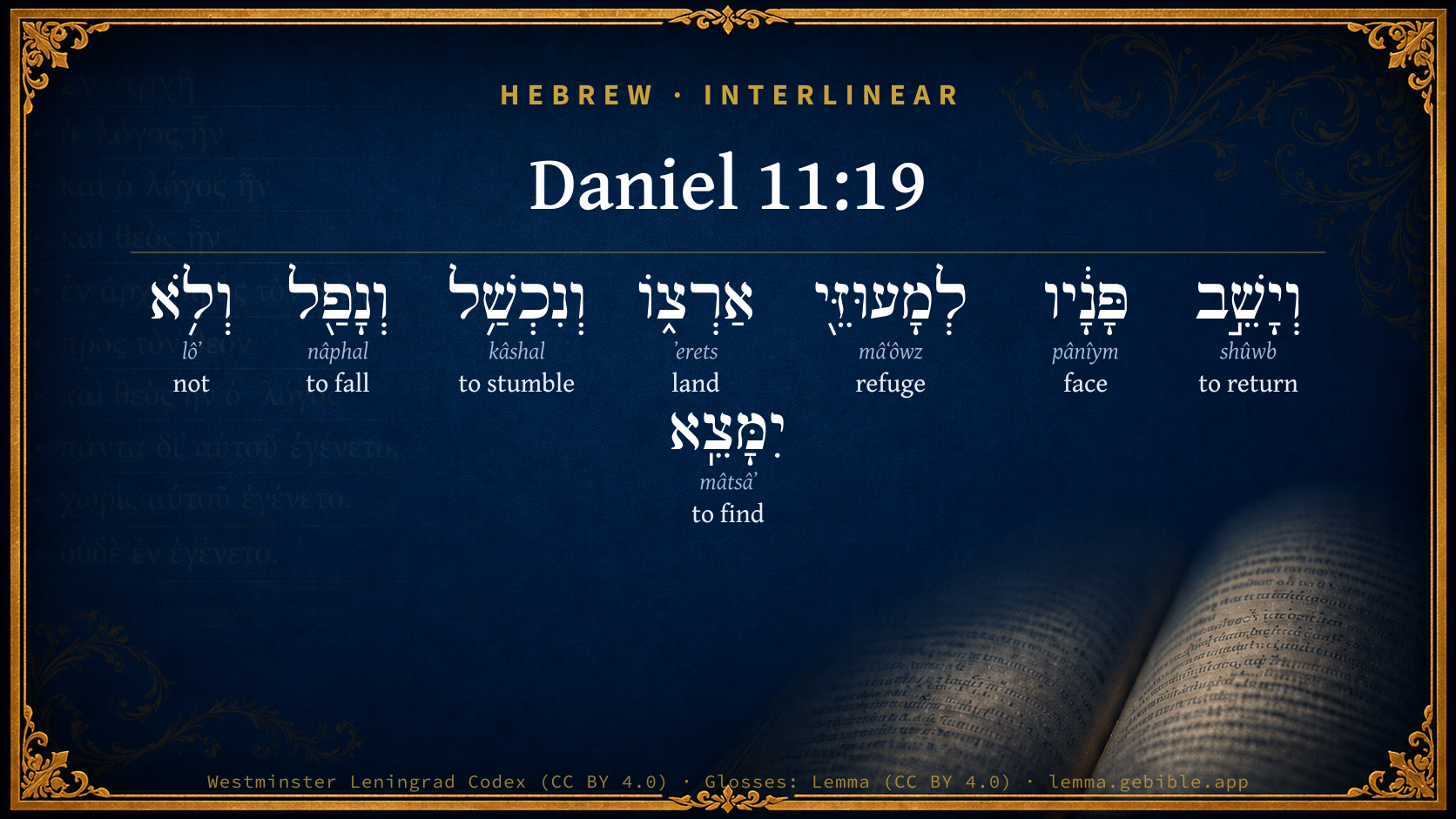
Daniel 11:19

Hebrew (Westminster Leningrad Codex) Daniel 11:19 appears in the Hebrew Old Testament. The text above is from the Westminster Leningrad Codex. Each word links to its Strong’s number, a concise gloss, and parsing drawn from the Open Scriptures Hebrew Bible morphology. Click any word for its full Brown-Driver-Briggs (BDB) entry.
Download image
Cite this verse

Daniel 11:19 (World English Bible). Public Domain. Lemma interlinear Bible study tool, https://lemma.gebible.app/v/daniel/11/19.

Show BibTeX & RIS
BibTeX
RIS
English Translation
Then he shall turn his face toward the fortresses of his own land; but he shall stumble and fall, and shall not be found.
World English Bible · Public Domain
Download a study sheet

One document with this verse’s original text, its word-by-word gloss line, the meaning frame, cross-references with their text, attributed commentary, and full source and license credits — printable, and it pastes into notes with its structure intact.

This verse Autodidact and up

Study sheet (.html) Plain text (.txt)

A passage Seminary Student

Up to 50 verses in one chapter. A passage sheet keeps up to 6 commentary sources and 12 cross-references per verse, in the order this page ranks them, and says so on the sheet whenever that leaves anything out. Ask for a single verse and you get the Autodidact verse sheet above.

Everything on this page stays free to read, with no account — the sheet is a download of what is already on screen, not access to it.

Want to remove ads? Support Godless Engineer
Compare translations 3

The same verse in 3 English versions, stacked beneath the original-language interlinear above. Click any original word for its lexicon entry.

Each is an independent rendering of the whole verse — the interlinear is not word-aligned to these translations.

Highlighted words mark where these versions differ — a whole-verse word diff, not a word-by-word alignment.

  • World English Bible Public Domain
    Then he shall turn his face toward the fortresses of his own land; but he shall stumble and fall, and shall not be found.
  • King James Version Public Domain
    Then he shall turn his face toward the fort of his own land: but he shall stumble and fall, and not be found.
  • unfoldingWord Literal Text CC BY-SA 4.0
    Then he will turn his face toward the fortresses of his own land, but he will stumble and fall and not be found.

unfoldingWord Literal Text — © unfoldingWord, licensed CC BY-SA 4.0. Word-aligned USFM3 via Door43 (git.door43.org/unfoldingWord/en_ult).

Versions to compare (up to 4)

3 of 4 selected

Show all 18 translations

Every available English version of this verse, each an independent rendering of the whole verse.

  • World English Bible Public Domain
    Then he shall turn his face toward the fortresses of his own land; but he shall stumble and fall, and shall not be found.
  • Berean Standard Bible Public Domain
    After this, he will turn back toward the fortresses of his own land, but he will stumble and fall and be no more.
  • Majority Standard Bible Public Domain
    After this, he will turn back toward the fortresses of his own land, but he will stumble and fall and be no more.
  • King James Version Public Domain
    Then he shall turn his face toward the fort of his own land: but he shall stumble and fall, and not be found.
  • American Standard Version (1901) Public Domain
    Then he shall turn his face toward the fortresses of his own land; but he shall stumble and fall, and shall not be found.
  • Revised Version (1885) Public Domain
    Then he shall turn his face toward the fortresses of his own land: but he shall stumble and fall, and shall not be found.
  • Geneva Bible (1599) Public Domain
    For he shall turne his face toward the fortes of his owne land: but he shall be ouerthrowen and fall, and be no more founde.
  • Douay-Rheims (1899) Public Domain
    And he shall turn his face to the empire of his own land, and he shall stumble, and fall, and shall not be found.
  • Young's Literal Translation Public Domain
    And he turneth back his face to the strongholds of his land, and hath stumbled and fallen, and is not found.
  • Literal Standard Version CC BY-SA 4.0
    And he turns back his face to the strongholds of his land, and has stumbled and fallen, and is not found.
  • Unlocked Literal Bible CC BY-SA 4.0
    Then he will pay attention to the fortresses of his own land, but he will stumble and fall; he will not be found.
  • unfoldingWord Literal Text CC BY-SA 4.0
    Then he will turn his face toward the fortresses of his own land, but he will stumble and fall and not be found.
  • Darby Bible Public Domain
    And he shall turn his face toward the fortresses of his own land; and he shall stumble and fall, and not be found.
  • World Messianic Bible Public Domain
    Then he will turn his face toward the fortresses of his own land; but he will stumble and fall, and won’t be found.
  • Webster's Bible Public Domain
    Then he shall turn his face towards the fort of his own land: but he shall stumble and fall, and not be found.
  • Free Bible Version CC BY-SA 4.0
    He will return to the fortresses of his own land, but he will stumble and fall, and will be gone.
  • Bible in Basic English Public Domain
    Then his face will be turned to the strong places of his land: but his way will be stopped, causing his downfall, and he will not be seen again.
  • JPS Tanakh (1917) Public Domain
    Then he shall turn his face toward the strongholds of his own land; but he shall stumble and fall, and shall not be found.

Literal Standard Version (2020), Covenant Press — licensed CC BY-SA 4.0. Text via the HelloAO Bible API (eBible.org). Unlocked Literal Bible (unfoldingWord) — licensed CC BY-SA 4.0. Text via the HelloAO Bible API (eBible.org). unfoldingWord Literal Text — © unfoldingWord, licensed CC BY-SA 4.0. Word-aligned USFM3 via Door43 (git.door43.org/unfoldingWord/en_ult). Free Bible Version, Dr. Jonathan Gallagher — licensed CC BY-SA 4.0. Text via the HelloAO Bible API (eBible.org).

Word by word

More ways to search: Search by grammar → Find every occurrence → Compare this word →

Practice this passage: Drill this verse → Learn its vocabulary →

לְמָעוּזֵּ֖י
mâʻôwz
H4581
“to/for · refuges of”
Preposition + Noun, Common, Masculine, Plural, Construct
Part of Speech
Preposition + Noun
Type
Common
Gender
Masculine
Number
Plural
State
Construct
Full BDB Definition

Origin: from H5810

TWOT: 1578a

place or means of safety, protection, refuge, stronghold - place of safety, fastness, harbour, stronghold - refuge (of God) (figuratively) - human protection (figuratively)
  1. וְיָשֵׁ֣ב shûwb H7725 “and · to return” Conjunction + Verb, Hiphil, Jussive, 3rd Person, Masculine, Singular
  2. פָּנָ֔יו pânîym H6440 “face(s) · his” Noun, Common, Both, Plural, Construct + Suffix, Personal, 3rd Person, Masculine, Singular
  3. אַרְצ֑וֹ ʼerets H776 “land · his” Noun, Common, Both, Singular, Construct + Suffix, Personal, 3rd Person, Masculine, Singular
  4. וְנִכְשַׁ֥ל kâshal H3782 “and · to stumble” Conjunction + Verb, Niphal, Sequential Perfect, 3rd Person, Masculine, Singular
  5. וְנָפַ֖ל nâphal H5307 “and · to fall” Conjunction + Verb, Qal, Sequential Perfect, 3rd Person, Masculine, Singular
  6. וְלֹ֥א lôʼ H3808 “and · not” Conjunction + Particle, Negative
  7. יִמָּצֵֽא mâtsâʼ H4672 “to find” Verb, Niphal, Imperfect, 3rd Person, Masculine, Singular

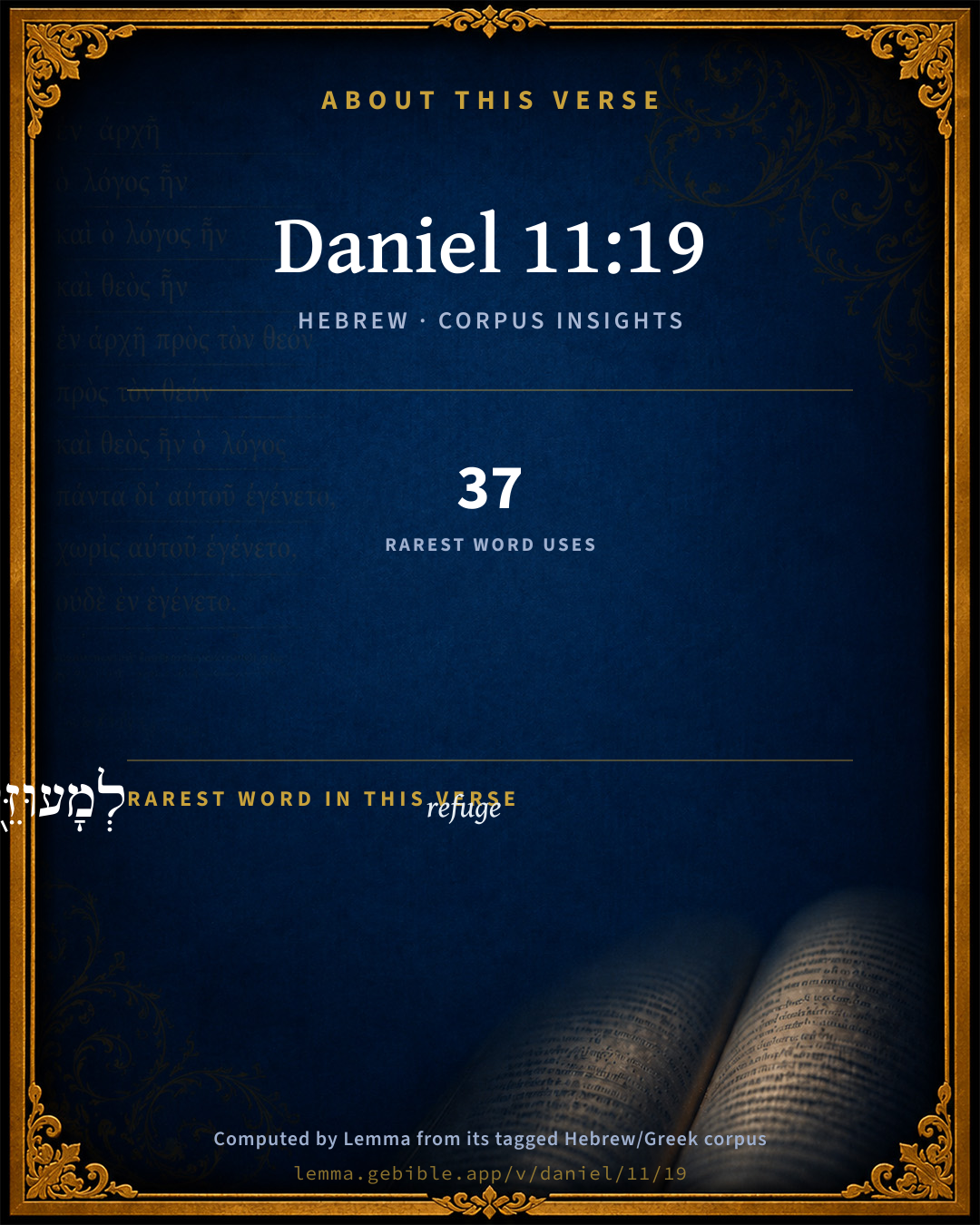
About this verse

These counts appear in no published source. They are computed here, from the morphology-tagged text and Lemma’s own curated glosses. What Lemma adds →

8
words
8
distinct lemmas
Prophets
section

Shared distinctive vocabulary

לְמָעוּזֵּ֖י refuge H4581 occurs in 35 verses of the Hebrew Bible. Also found in:

Grammatical profile

  • 4 verbs
  • 3 nouns
  • 1 particle

Verb forms

  • וְיָשֵׁ֣ב Hiphil · Jussive
  • וְנִכְשַׁ֥ל Niphal · Sequential Perfect
  • וְנָפַ֖ל Qal · Sequential Perfect
  • יִמָּצֵֽא Niphal · Imperfect

Hebrew & Septuagint length

In English translation the verse runs 24 words from the Hebrew and 25 from the Septuagint (LXX English) — closely comparable.

A rough comparison of the two English renderings, which tokenize alike — not a word-level alignment.

Word counts can differ between the Hebrew and the Greek without any difference in meaning — e.g. the Hebrew direct-object marker אֵת has no separate Greek word, and Greek often adds the article ὁ.

Cross-references

5

Topical passages linked to Daniel 11:19 in the Treasury of Scripture Knowledge — connected by theme and wording, ordered by reader-vote popularity; previews shown in the World English Bible.

  • Ezekiel 26:21 I will make you a terror, and you shall no more have any being; though you are sought for, yet shall you never be found again, says the Lord Yahweh.
  • Psalms 37:36 But he passed away, and, behold, he was not. Yes, I sought him, but he could not be found.
  • Job 20:8 He shall fly away as a dream, and shall not be found: Yes, he shall be chased away like a vision of the night.
  • Psalms 27:2 When evil-doers came at me to eat up my flesh, Even my adversaries and my foes, they stumbled and fell.
  • Jeremiah 46:6 Don't let the swift flee away, nor the mighty man escape; in the north by the river Euphrates have they stumbled and fallen.

Cross-references courtesy of OpenBible.info (CC BY 4.0).

Hebrew and Greek witnesses Masoretic Hebrew ↔ Greek Septuagint

The same verse in the two great witnesses to the Old Testament, shown verse-for-verse.

These are two independent witnesses, not word-aligned to each other, and the Septuagint is shown in lemma (dictionary) form.

Hebrew Daniel 11:19 Masoretic · Westminster Leningrad Codex

וְיָשֵׁ֣ב פָּנָ֔יו לְמָעוּזֵּ֖י אַרְצ֑וֹ וְנִכְשַׁ֥ל וְנָפַ֖ל וְלֹ֥א יִמָּצֵֽא

Then he shall turn his face toward the fortresses of his own land; but he shall stumble and fall, and shall not be found.

World English Bible · Public Domain

Greek LXX Daniel 11:19 Septuagint · lemma form

ἐπιστρέφω ὁ πρόσωπον αὐτός εἰς ὁ καταἰσχύω ὁ χώρα αὐτός καί προςκόπτω καί πίπτω καί οὐ εὑρίσκω

Then he shall turn back his face to the strength of his own land: but he shall become weak, and fall, and not be found.

LXX2012 (modern English Septuagint) · Public Domain

Hebrew: Westminster Leningrad Codex (CC BY 4.0). Greek: Septuagint (public domain); English from LXX2012 (modern English Septuagint) (Public Domain). How the Septuagint differs from the Hebrew →

Commentary

Notes on Daniel 11:19 from classic Christian and Jewish commentators (each source and its license shown beneath its notes). The classic Christian expositions comment on the surrounding passage and are grouped to its opening verse, so a note may address several verses; the Jewish commentaries on the Tanakh (Rashi and others) are per-verse, so they appear only where the commentator wrote on this verse.

Lemma curates 59 commentaries, every one of them public domain or Creative Commons licensed, each selected and text-cleaned for this edition rather than reprinted as found. About our sources →

Trapp's Complete Commentary

John Trapp

Dan 11:19 Then he shall turn his face toward the fort of his own land: but he shall stumble and fall, and not be found.

Ver. 19. Then he shall turn his face.] Not accepting the aforesaid hard conditions; till, beaten again by the Romans, he was forced so to do. He fled into the utmost parts of his kingdom of Syria, and there kept him in forts, not daring to wage war any more.

But he shall stumble and fall, and not be found.] He and his army shall be hewn in pieces by the rude rabble in the Elymeans’ country, while he went about to rob the temple of their Jupiter Bolus. {a}

{a} Strabo, lib. xvi.

John Trapp, A Commentary or Exposition upon All the Books of the Old and New Testament (1647–1656) — public domain. Text from a community e-Sword module.

Joseph Benson's Commentary

Dan 11:19. Then he shall turn his face toward the fort of his own land — The word rendered fort, מעוזי, is plural, and would be more properly rendered, the fortresses. It is intended to signify, that he should return after the battle to some of his fortified towns. And accordingly we find that he fled away that night, first to Sardes, and from thence to Apamea, and the next day came into Syria to Antioch, a fortress of his own land; from whence he sent ambassadors to sue for peace; and within a few days after peace was granted, he sent part of the money demanded, and the hostages, to the Roman consul at Ephesus. Being under great difficulties how to raise the money which he had stipulated to pay to the Romans, he marched into the eastern provinces, to collect there the arrears of tribute, and amass what treasure he could; and attempting to plunder the rich temple of Jupiter Belus in Elymais. he was assaulted by the inhabitants of the country, and slain, together with his attendants. Such is the account given of the circumstances of his death by Diodorus Siculus, Strabo, Justin, and Jerome. Aurelius Victor, however, reports it otherwise, affirming that he was slain by some of his companions, whom, in his liquor, he had beaten at a banquet; but this account deserves not so much credit as the concurrent testimony of earlier historians. However it was, his death was inglorious; he stumbled, and fell, and was no more found. — Bishop Newton.

Joseph Benson's Commentary on the Old and New Testaments (1811–1818) — public domain. Text from a community e-Sword module.

Tyndale Open Study Notes

Tyndale Open Resources

11:19 Antiochus III thereafter remained within his own fortresses, where he was assassinated in 187 BC.

Tyndale Open Study Notes — © Tyndale Open Resources, licensed CC BY-SA 4.0. Text via the HelloAO Bible API.

Geneva Bible (1599)

Geneva Bible translators

For fear of the Romans he shall flee to his holds.

For when as under the pretence of poverty he would have robbed the Temple of Jupiter Dodomeus, the countrymen slew him.

Geneva Bible (1599) marginal notes — public domain. Text via Bolls.life.

Jamieson, Fausset & Brown

Robert Jamieson, A. R. Fausset & David Brown

Then he shall turn . . . toward . . . his own land--Compelled by Rome to relinquish all his territory west of the Taurus, and defray the expenses of the war, he garrisoned the cities left to him.

stumble . . . not be found--Attempting to plunder the temple of Jupiter at Elymais by night, whether through avarice, or the want of money to pay the tribute imposed by Rome (a thousand talents), he was slain with his soldiers in an insurrection of the inhabitants [JUSTIN, 32.2].

Jamieson, Fausset & Brown — Commentary Critical and Explanatory on the Whole Bible (1871) — public domain (CC PDM 1.0). Text via the HelloAO Bible API.

Adam Clarke's Commentary

Verse 19. He shall turn his face toward the fort of his own land] After this shameful defeat, Antiochus fled to Sardis, thence to Apamea, and the next day got into Syria, and to Antioch, his own fort, whence he sent ambassadors to treat for peace; and was obliged to engage to pay the immense sum of money mentioned above.

But he shall stumble and fall] Being under the greatest difficulties how to raise the stipulated sums, he marched into his eastern provinces to exact the arrears of taxes; and, attempting to plunder the temple of Jupiter Belus at Elymais, he was opposed by the populace, and he and his attendants slain. This is the account that Diodorus Sicules, Strabo, and Justin give of his death. But it is variously related by others; some saying that he was assassinated by some of his own people whom he had punished for being drunk at a feast.-So Aurelius Victor. St. Jerome says he lost his life in a battle against the inhabitants of Elymais. In short, the manner of his death is uncertain; and perhaps even this circumstance is referred to by the prophet, when he says, "He shall stumble and fall, and NOT BE FOUND."

Adam Clarke's Commentary on the Bible (1810–1826) — public domain. Text from a community e-Sword/MySword module.

John Calvin's Commentaries

Here either the base end of Antiochus is denoted, who was slain in a popular tumult while spoiling the temple of Belus, or else the event of the war between him and the Romans is described. This war was conducted under the auspices of Lucius Scipio, because Cneius Scipio, the conqueror of Africa, had offered himself as his brother’s lieutenant-general, and after his death that province was committed to him. But, as we have said, the resources of Antiochus had been cut off before this. He had lost, the cities of Asia, and if he had ceded them at first, he might have quietly retained the greater part of Asia Minor. But as he extended his wings over Greece, and hoped by this means to become completely master of the whole of Greece and Macedonia, he could not be induced to withdraw his garrisons from those cities, but at length was compelled to give up Asia Minor. In this way, then, the angel describes the progress of the war by saying, He will turn his face towards the fortifications of his own land; that is, when compelled to relinquish Greece, he will betake himself to fortified places. He was very safe there, and in a region sufficiently at peace; he had almost impregnable towns on all sides, and appeared to be free from warfare. Historians relate this to have been done by the skill of Cneius Scipio. For his son was then a captive under Antiochus, and he knew him to have greater authority than his brother, although he only possessed the title of lieutenant-general. They record his persuading Antiochus not to try his fortune by any decisive engagement. However it was, it is quite evident that he delayed fighting till he was compelled by a sense of shame, as all men accused him of cowardice in not daring to try the issue of an engagement, when he possessed so large an army. The Romans had scarcely ever taken the field against so strong a force, and yet, according to the narrative of Titus Livius, they never displayed less terror or concern. The extent of the forces of Antiochus is readily apparent from the slaughter which occurred; in one day 50,000 men perished; and this would be almost incredible, unless it were borne out by numerous and trustworthy testimonies. In this way the angel said, Antiochus should return, as he did not go forth to meet Lucius Scipio, but suffered him to pass on. Had he given the least sign of resistance, without doubt Philip had in iris hand and power the whole force of the Romans. Many indeed pronounced the conduct of L. Scipio to be rash, in daring to allow Philip such license, as he had been lately conquered, and was still exasperated in consequence of the loss and disgrace which he had suffered. For if Antiochus had been on the alert to restrain the enemy, it would have been all over with the Roman army in those narrow and rugged defiles; but, as we have stated, he kept his army in idleness and luxury among fortified towns. If another and a probable sense is preferred, the sentence applies to his base retreat to further Asia, where he fell, slain by the rustic population. He shall fall, and shall not be found Antiochus in truth continued to reign from the period of the destruction of his army and of his acceptance of the conditions which the Romans imposed. He obtained peace, but not without the payment of a heavy fine while he retained the name of king. Although he united with the Romans in an honorable treaty, yet he was forced to retire beyond Mount Taurus, to pay a large sum of money on account of the expenses of the war, to give hostages, and to divide the ships equally with the Romans. In this latter case he was grossly and fraudulently deluded, for L. Scipio commanded all the ships to be cut to pieces, and delivered the materials to Antiochus, to whom they were utterly worthless. He knew the man to be deceptive and restless, and so he treated him with barbarity, according to his deserts. As far as the hostages are concerned, we find Antiochus and Demetrius his sons as hostages at Rome even after his death. He was left in peace indeed, but was deprived of the cities of Asia Minor, and was ordered to betake himself beyond Mount Taurus. Those ravines were the boundary of his empire; a part of Asia was assigned to Eumenes, and many cities became independent. Antiochus, by way of concealing his disgrace, made a joke of it, saying he had managed cleverly, for the government of Asia Minor was a great trouble to him. He had another ample and opulent kingdom with which he might well be content: I have hitherto been but a steward in Asia, he used to say, and the Romans have relieved me of that encumbrance.

When, therefore, the angel says, After his fall, he should be no longer king; this may be understood of his ignominious death which followed shortly afterwards. His avarice was insatiable, and when compelled to pay a large tribute to the Romans, he pretended to be reduced to extreme poverty; then he wished to spoil the temple of Jupiter Dodoneus, and was slain there during a tumult. This last word ought properly to be referred to this event, for King Antiochus was not found, because these rustics slew him in the tumult which arose. Thus far concerning Antiochus the Great; Seleucus now follows, who was his first successor. He had three sons, Seleucus whom many call Ceraunus, then Antiochus Epiphanes, and Demetrius. Concerning Seleucus the angel speaks as follows, —

John Calvin's Commentaries (1540-1563) — public domain. Text from the Calvin Translation Society English edition (1840s-50s) via the Christian Classics Ethereal Library (ccel.org). Calvin's coverage is partial (roughly two-thirds of the Bible); uncommented books and verses are honest gaps, never fabricated. The 19th-century editor's footnotes and remarks are omitted so the notes are faithfully Calvin's own voice.

Ellicott's Commentary for English Readers

(19) The fort.—The king of the north is forced to take refuge in his fortresses, and here meets with his end. This is explained of the death of Antiochus the Great at Elymais, where he had profaned a temple.

A Bible Commentary for English Readers, edited by Charles John Ellicott (1878–1897) — public domain. Text from a community e-Sword module.

The Cambridge Bible for Schools and Colleges

gen. ed. J. J. S. Perowne

19. Then he shall turn his face towards the strongholds of his own land; but he shall stumble, &c.] The end of Antiochus (b.c. 187). After his discomfiture at Magnesia he was obliged to retire east of the Taurus, and confine himself to the ‘strongholds of his own land.’ To meet the heavy fine imposed upon him by the Romans[368] (Polyb. xxi. 14; Livy xxxvii. 45), he had to levy contributions where he could, and deemed sacrilege excusable under the circumstances. Having plundered for this purpose a wealthy temple of Bel in Elymais (Persia), he quickly met, says Diodorus (xxix. 15), τῆς προσηκούσης ἐκ θεῶν κολάσεως, being attacked by the inhabitants and slain (cf. Justin xxxii. 2). The last words of the verse allude to this disastrous enterprise, which brought his life to an end.

[368] 15,000 Eubœan talents; 500 at once, 2500 when the Romans ratified the peace, and 1000 yearly for 12 years.

and not be found] implying complete disappearance: Psa_37:36; Job_20:8.

The Cambridge Bible for Schools and Colleges (gen. ed. J. J. S. Perowne; Cambridge University Press, 1878–1918) — public domain. Text from a community e-Sword module.

John Gill's Exposition

Then he shall turn his face towards the fort of his own land,.... After his defeat he fled with a few to Sardis, and from thence to Apamea, so Livy; and to Susa, and to the further parts of his dominions, as Jerom; or rather he betook himself to Antioch his capital city, called here "the fort of his own land", where he was obliged to continue:

but he shall stumble and fall, and not be found; the expenses of the war which Antiochus agreed to pay being reckoned at fifteen thousand Euboean talents, five hundred talents were to be paid down; two thousand five hundred at the ratification of the treaty by the senate of Rome; and the other twelve thousand to be paid yearly, at a thousand talents each year: now, being either in want of money, or through covetousness, he attempted to rob the temple of Jupiter Elymaeus, and went by night thither with his army for that purpose; but the thing being betrayed, the inhabitants got together, and slew him, with all his soldiers, as Justin (l) relates. Strabo (m) says, that Antiochus the great endeavouring to rob the temple of Bel, the barbarians near to (Elymais) rose of themselves, and slew him; and so never returned to Syria any more, but died in the province of Elymais, being slain by the Persians there, as related, and was never found more, or was buried; and this was the end of this great man, of whom so many things are said in this prophecy, and others follow concerning his successors. He died in the thirty seventh year of his reign, and the fifty second of his age (n).

(l) E Trogo, l. 32. c. 2. (m) Geograph. l. 16. p. 512. (n) See the Universal History, vol. 9. p. 270.

John Gill's Exposition of the Whole Bible (1746–1763) — public domain (CC PDM 1.0). Text via the HelloAO Bible API.

Albert Barnes' Notes on the Bible

Then he shall turn his face toward the fort of his own land - The strong fortifications of his own land - for the Hebrew word is in the plural. This he would do, of course, for protection. He would cease his attempts at conquest, and endeavor to find security in his own fortresses. As a matter of fact, after this defeat, Antiochus, in order to replenish his exhausted coffers, and to find the means of meeting the claims of the Romans, went into certain provinces of his empire. He attempted no other foreign wars, but sought security in his own dominions.

But he shall stumble and fall, and not be found - He died in an attempt to plunder the temple of Elymais. In this he provoked the people to an insurrection, and was slain, together with the soldiers who were with him. What was his “motive” for plundering that temple is uncertain, whether it was to meet the demands of the Romans, or whether it was avarice (Justin, xxxii. 2); but it was in this way that he “stumbled and fell,” and passed away. - Jerome, “Com. in loc.;” Diod. Sic., “Fragmenta,” xxvi. 30, 49; Justin, xxxii. 2; Strabo, p. 744. The prophecy respecting him terminates here, and the particulars specified are as minute and accurate as if it had been written “after” the event. Indeed, the whole account is just such as one would prepare now who should undertake to express in a brief compass the principal events in the life of Antiochus the Great.

Albert Barnes' Notes on the Bible (1834–1885) — public domain. Text from a community e-Sword/MySword module.

Haydock's Catholic Bible Commentary

Found. Antiochus plundered the temple of the Elymaites to procure money; but they, (St. Jerome) or the neighbouring barbarous nations, rose up and slew him. (Just. xxxii.)

George Leo Haydock (1774–1849), Haydock's Catholic Family Bible and Commentary, 1859 edition — public domain. Excludes Psalms (Douay-Rheims chapter numbering differs from Protestant) and Deuterocanonical books (Catholic canon only).

Matthew Poole's English Annotations

Being beaten in battle by Scipio, with thirty thousand Romans, he himself having seventy thousand, and rejecting the counsel of Hannibal, he yielded upon dishonourable terms to deliver his ships and elephants to the Romans, and all the places he had taken from them, which turned to his disgrace. Then he turned his face homeward, and was made to be content with the narrow limits of the remotest corner of his kingdom; and though he sported himself with his retirement, yet was he not in safety so, but was slain when he sought to enrich himself by the sacrilegious spoils of the temple. Thus Antiochus called Magnus came to nothing.

Matthew Poole's English Annotations on the Holy Bible (1683–1685) — public domain. Text from a community e-Sword/MySword module.

Whedon's Commentary on the Bible

Daniel D. Whedon

19. The fort — Rather, forts. Having returned to the small dominion still left to him west of the Taurus, he was killed in an insurrection in Elymais (197 B.C.). The tradition is that his death occurred during a sacrilegious night attack upon the temple of Bel, in that city, in order to rob it of its treasures.

Daniel D. Whedon (gen. ed.), Commentary on the Old and New Testaments (1874–1909) — public domain. Text from a community e-Sword module.

The Pulpit Commentary

Then he shall turn his face toward the fort of his own land; but he shall stumble and fall, and not be found. The versions do not present any occasion for remark. After his defeat, Antiochus was not only compelled to submit to the loss of much of his empire, but was adjudged to pay all the expenses of the war, estimated at eighteen thousand Euboeic talents. Justin relates thus the death of Antiochus: "Meanwhile in Syria King Antiochus, being loaded with heavy tribute after his defeat by the Romans, whether urged by want of money or impelled by avarice, flattering himself that, under the plea of necessity, he might with fair excuse commit sacrilege, assaulted with an armed force by night the temple of Jove (Bel) in Elymais But the attempt having been discovered, there was a concourse of the inhabitants, and he was slain with all his forces." The resemblance here between the fate of Antiochus the Great and that of his son Epiphanes is so striking as to throw suspicion on one or other of them.

The Pulpit Commentary (1880–1919), ed. H.D.M. Spence-Jones & Joseph S. Exell — public domain. Text from a community e-Sword module.

John Wesley's Explanatory Notes

Then - Then he turned his face home-ward, yet was he not in safety, but was quickly after killed.

John Wesley, Explanatory Notes Upon the Whole Bible (1754–1765) — public domain. Text via the GEBible commentary corpus.

Rashi

Rabbi Shlomo Yitzchaki (Rashi)

to the strongholds of his land to return to his fortified city.

Rashi on the Tanakh — English translations: “The Judaica Press complete Tanach with Rashi, translated by A. J. Rosenberg” (CC BY 4.0); “Pentateuch with Rashi's commentary by M. Rosenbaum and A.M. Silbermann, 1929-1934” (public domain); “The Metsudah Tanach series, Lakewood, N.J” (CC BY 4.0); and “The Book of Joshua, Metsudah Publications, 1997” (CC BY 4.0). Text via Sefaria.

Lesson kit

Teaching starters — assembled from the data on this page, not authored interpretation. Every prompt links to the verse data it draws on. Edit before teaching.

Daniel, in the Prophets, opens this verse with 8 words (8 distinct Hebrew lemmas). Its most distinctive word is mâʻôwz (“refuge”). A historical commentator’s framing appears above. Read the whole chapter for the surrounding context.

Discussion questions

  1. The word mâʻôwz carries the sense “refuge.” How does it shape the verse?
  2. How does Judges 6:26, which shares the word «refuge», read alongside this verse?
  3. These translations render this verse differently. What is at stake in choosing one wording over another?
  4. «וְיָשֵׁ֣ב» is a Hiphil Jussive verb. How does that grammatical form shape the action described?
  5. Compare how Trapp's Complete Commentary and Joseph Benson's Commentary read this verse. Where do they agree or differ?

Things to notice

Reading settings

Reading text

Shown beneath each verse's original-language words.

Old Testament
Old Testament edition

Read the OT as the Masoretic Hebrew (MT) or the Greek Septuagint (LXX).

English shown for the Greek Septuagint (in the Hebrew ↔ Greek comparison).

Comparing translations? Open the Compare panel on any verse page to stack up to four side by side.