2 Kings 2:13

Hebrew (Westminster Leningrad Codex) 2 Kings 2:13 appears in the Hebrew Old Testament. The text above is from the Westminster Leningrad Codex. Each word links to its Strong’s number, a concise gloss, and parsing drawn from the Open Scriptures Hebrew Bible morphology. Click any word for its full Brown-Driver-Briggs (BDB) entry.
Download image
Cite this verse

2 Kings 2:13 (World English Bible). Public Domain. Lemma interlinear Bible study tool, https://lemma.gebible.app/v/2-kings/2/13.

Show BibTeX & RIS
BibTeX
RIS
English Translation
He took up also the mantle of Elijah that fell from him, and went back, and stood by the bank of the Jordan.
World English Bible · Public Domain
Download a study sheet

One document with this verse’s original text, its word-by-word gloss line, the meaning frame, cross-references with their text, attributed commentary, and full source and license credits — printable, and it pastes into notes with its structure intact.

This verse Autodidact and up

Study sheet (.html) Plain text (.txt)

A passage Seminary Student

Up to 50 verses in one chapter. A passage sheet keeps up to 6 commentary sources and 12 cross-references per verse, in the order this page ranks them, and says so on the sheet whenever that leaves anything out. Ask for a single verse and you get the Autodidact verse sheet above.

Everything on this page stays free to read, with no account — the sheet is a download of what is already on screen, not access to it.

Want to remove ads? Support Godless Engineer
Compare translations 3

The same verse in 3 English versions, stacked beneath the original-language interlinear above. Click any original word for its lexicon entry.

Each is an independent rendering of the whole verse — the interlinear is not word-aligned to these translations.

Highlighted words mark where these versions differ — a whole-verse word diff, not a word-by-word alignment.

  • World English Bible Public Domain
    He took up also the mantle of Elijah that fell from him, and went back, and stood by the bank of the Jordan.
  • King James Version Public Domain
    He took up also the mantle of Elijah that fell from him, and went back, and stood by the bank of Jordan;
  • unfoldingWord Literal Text CC BY-SA 4.0
    And he lifted up the cloak of Elijah that had fallen from on him. And he returned, and he stood on the lip of the Jordan.

unfoldingWord Literal Text — © unfoldingWord, licensed CC BY-SA 4.0. Word-aligned USFM3 via Door43 (git.door43.org/unfoldingWord/en_ult).

Versions to compare (up to 4)

3 of 4 selected

Show all 18 translations

Every available English version of this verse, each an independent rendering of the whole verse.

  • World English Bible Public Domain
    He took up also the mantle of Elijah that fell from him, and went back, and stood by the bank of the Jordan.
  • Berean Standard Bible Public Domain
    Elisha also picked up the cloak that had fallen from Elijah, and he went back and stood on the bank of the Jordan.
  • Majority Standard Bible Public Domain
    Elisha also picked up the cloak that had fallen from Elijah, and he went back and stood on the bank of the Jordan.
  • King James Version Public Domain
    He took up also the mantle of Elijah that fell from him, and went back, and stood by the bank of Jordan;
  • American Standard Version (1901) Public Domain
    He took up also the mantle of Elijah that fell from him, and went back, and stood by the bank of the Jordan.
  • Revised Version (1885) Public Domain
    He took up also the mantle of Elijah that fell from him, and went back, and stood by the bank of Jordan.
  • Geneva Bible (1599) Public Domain
    He tooke vp also the cloke of Eliiah that fell from him, and returned, and stoode by the banke of Iorden.
  • Douay-Rheims (1899) Public Domain
    And he took up the mantle of Elias, that fell from him: and going back, he stood upon the bank of the Jordan,
  • Young's Literal Translation Public Domain
    And he taketh up the robe of Elijah, that fell from off him, and turneth back and standeth on the edge of the Jordan,
  • Literal Standard Version CC BY-SA 4.0
    And he takes up the robe of Elijah that fell from off him, and turns back and stands on the edge of the Jordan,
  • Unlocked Literal Bible CC BY-SA 4.0
    He picked up Elijah's cloak that had fallen off him, and went back to stand by the bank of the Jordan.
  • unfoldingWord Literal Text CC BY-SA 4.0
    And he lifted up the cloak of Elijah that had fallen from on him. And he returned, and he stood on the lip of the Jordan.
  • Darby Bible Public Domain
    And he took up the mantle of Elijah which fell from him, and went back and stood by the bank of the Jordan;
  • World Messianic Bible Public Domain
    He also took up Elijah’s mantle that fell from him, and went back and stood by the bank of the Jordan.
  • Webster's Bible Public Domain
    He took up also the mantle of Elijah that fell from him, and went back, and stood by the bank of Jordan;
  • Free Bible Version CC BY-SA 4.0
    Then Elisha picked up Elijah's cloak that had fallen from him, and went back and stood on the bank of the Jordan.
  • Bible in Basic English Public Domain
    Then he took up Elijah's robe, which had been dropped from him, and went back till he came to the edge of Jordan.
  • JPS Tanakh (1917) Public Domain
    He took up also the mantle of Elijah that fell from him, and went back, and stood by the bank of the Jordan.

Literal Standard Version (2020), Covenant Press — licensed CC BY-SA 4.0. Text via the HelloAO Bible API (eBible.org). Unlocked Literal Bible (unfoldingWord) — licensed CC BY-SA 4.0. Text via the HelloAO Bible API (eBible.org). unfoldingWord Literal Text — © unfoldingWord, licensed CC BY-SA 4.0. Word-aligned USFM3 via Door43 (git.door43.org/unfoldingWord/en_ult). Free Bible Version, Dr. Jonathan Gallagher — licensed CC BY-SA 4.0. Text via the HelloAO Bible API (eBible.org).

Word by word

More ways to search: Search by grammar → Find every occurrence → Compare this word →

Practice this passage: Drill this verse → Learn its vocabulary →

אַדֶּ֣רֶת
ʼaddereth
H155
“glory of”
Noun, Common, Feminine, Singular, Construct
Part of Speech
Noun
Type
Common
Gender
Feminine
Number
Singular
State
Construct
Full BDB Definition

Origin: f of H117

TWOT: 28c

glory, cloak - glory, splendour, magnificence (of a vine, shepherds) - mantle, cloak made of fur or fine material - prophet's garment
  1. וַיָּ֨רֶם֙ rûwm H7311 “and · to rise” Conjunction + Verb, Hiphil, Sequential Imperfect, 3rd Person, Masculine, Singular
  2. אֶת ʼêth H853 “-” Particle, Direct Object
  3. אֵלִיָּ֔הוּ ʼÊlîyâh H452 “Elijah” Noun, Proper
  4. אֲשֶׁ֥ר ʼăsher H834 “which” Particle, Relative
  5. נָפְלָ֖ה nâphal H5307 “to fall” Verb, Qal, Perfect, 3rd Person, Feminine, Singular
  6. מֵעָלָ֑יו ʻal H5921 “from · upon · him” Preposition + Preposition + Suffix, Personal, 3rd Person, Masculine, Singular
  7. וַיָּ֥שָׁב shûwb H7725 “and · to return” Conjunction + Verb, Qal, Sequential Imperfect, 3rd Person, Masculine, Singular
  8. וַֽיַּעֲמֹ֖ד ʻâmad H5975 “and · to stand” Conjunction + Verb, Qal, Sequential Imperfect, 3rd Person, Masculine, Singular
  9. עַל ʻal H5921 “upon” Preposition
  10. שְׂפַ֥ת sâphâh H8193 “lip of” Noun, Common, Feminine, Singular, Construct
  11. הַיַּרְדֵּֽן Yardên H3383 “the · Jordan” Particle, Definite Article + Noun, Proper

About this verse

These counts appear in no published source. They are computed here, from the morphology-tagged text and Lemma’s own curated glosses. What Lemma adds →

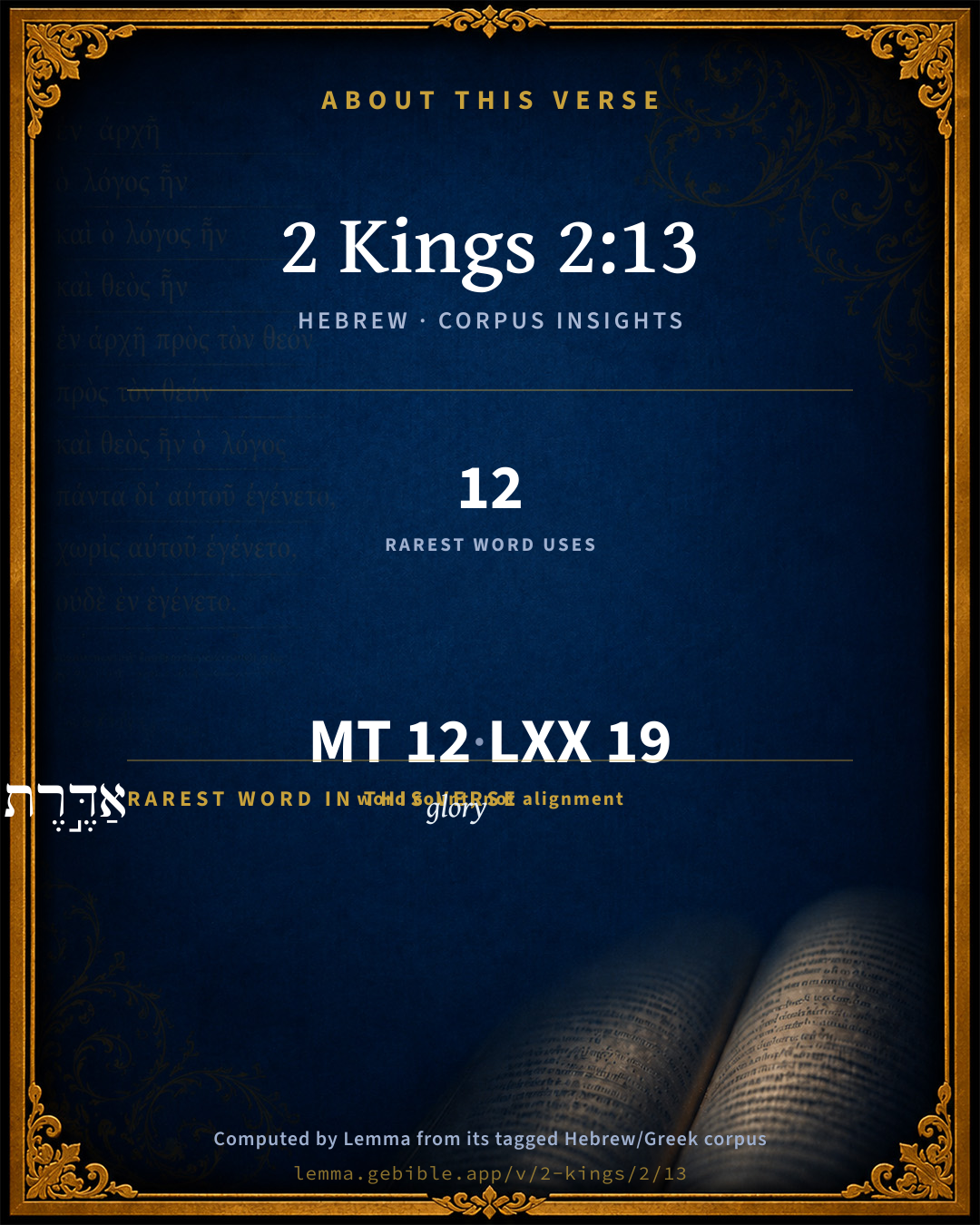
12
words
11
distinct lemmas
Historical
section

Notable vocabulary

The rarest word here is אַדֶּ֣רֶת glory H155 — appearing just 12 times in the whole Hebrew Bible.

Shared distinctive vocabulary

אַדֶּ֣רֶת glory H155 occurs in 12 verses of the Hebrew Bible. Also found in:

Grammatical profile

  • 4 verbs
  • 4 nouns
  • 2 prepositions
  • 2 particles

Verb forms

  • וַיָּ֨רֶם֙ Hiphil · Sequential Imperfect
  • נָפְלָ֖ה Qal · Perfect
  • וַיָּ֥שָׁב Qal · Sequential Imperfect
  • וַֽיַּעֲמֹ֖ד Qal · Sequential Imperfect

Repetition

A word recurs within this verse — often emphatic in Hebrew:

  • מֵעָלָ֑יו upon H5921 ×2

Hebrew & Septuagint length

In English translation the verse runs 23 words from the Hebrew and 25 from the Septuagint (LXX English) — closely comparable.

A rough comparison of the two English renderings, which tokenize alike — not a word-level alignment.

Word counts can differ between the Hebrew and the Greek without any difference in meaning — e.g. the Hebrew direct-object marker אֵת has no separate Greek word, and Greek often adds the article ὁ.

In the original languages it is 12 Hebrew tokens and 19 Greek tokens — but the two are counted differently (Hebrew bundles its prefixes and suffixes into one token; the Greek is in lemma form), so that isn’t a like-for-like length.

Cross-references

2

Topical passages linked to 2 Kings 2:13 in the Treasury of Scripture Knowledge — connected by theme and wording, ordered by reader-vote popularity; previews shown in the World English Bible.

  • 1 Kings 19:19 So he departed there, and found Elisha the son of Shaphat, who was plowing, with twelve yoke [of oxen] before him, and he with the twelfth: and Elijah passed over to him, and cast his mantle on him.
  • 2 Kings 2:8 Elijah took his mantle, and wrapped it together, and struck the waters, and they were divided here and there, so that they two went over on dry ground.

Cross-references courtesy of OpenBible.info (CC BY 4.0).

Hebrew and Greek witnesses Masoretic Hebrew ↔ Greek Septuagint

The same verse in the two great witnesses to the Old Testament, shown verse-for-verse.

These are two independent witnesses, not word-aligned to each other, and the Septuagint is shown in lemma (dictionary) form.

Hebrew 2 Kings 2:13 Masoretic · Westminster Leningrad Codex

וַיָּ֨רֶם֙ אֶת אַדֶּ֣רֶת אֵלִיָּ֔הוּ אֲשֶׁ֥ר נָפְלָ֖ה מֵעָלָ֑יו וַיָּ֥שָׁב וַֽיַּעֲמֹ֖ד עַל שְׂפַ֥ת הַיַּרְדֵּֽן

He took up also the mantle of Elijah that fell from him, and went back, and stood by the bank of the Jordan.

World English Bible · Public Domain

Greek LXX 2 Kings 2:13 Septuagint · lemma form

καί ὑψόω ὁ μηλωτή ηλιου ὅς πίπτω ἐπάνωθεν ελισαιε καί ἐπιστρέφω ελισαιε καί ἵστημι ἐπί ὁ χεῖλος ὁ ἰορδάνης

And Elisaie took up the mantle of Eliu, which fell from off him upon Elisaie; and Elisaie returned, and stood upon the brink of Jordan;

LXX2012 (modern English Septuagint) · Public Domain

On this verse, John Gill's Exposition discusses the Septuagint’s reading. Read the note in Commentary ↓

Hebrew: Westminster Leningrad Codex (CC BY 4.0). Greek: Septuagint (public domain); English from LXX2012 (modern English Septuagint) (Public Domain). How the Septuagint differs from the Hebrew →

Targum (Aramaic paraphrase)

1

The Targum is the ancient Jewish Aramaic paraphrase of the Hebrew Scriptures — an interpretive translation, not the Hebrew text itself. Onkelos (literal) and Pseudo-Jonathan (expansive) render the Torah, and Jonathan the Prophets. Coverage is partial: where no permissively-licensed English translation exists for a verse, only the Aramaic is shown. This is verse-level text, not a word-by-word alignment to the Hebrew.

  1. Targum Jonathan Prophets (Joshua–Malachi)
    וַאֲרֵים יַת שׁוֹשִׁיפָא דְאֵלִיָהוּ דִי נְפָלַת מִנֵיהּ וְתַב וְקָם עַל כֵּיף יַרְדְנָא:

    (no public-domain English translation for this verse)

    Targum Jonathan — Aramaic: “Mikraot Gedolot” (public domain). English: “Sefaria Community Translation” (CC0 1.0 (public-domain dedication)); “London "Chaldee Paraphrase," 1871” (public domain). Text via Sefaria.

Commentary

Notes on 2 Kings 2:13 from classic Christian and Jewish commentators (each source and its license shown beneath its notes). The classic Christian expositions comment on the surrounding passage and are grouped to its opening verse, so a note may address several verses; the Jewish commentaries on the Tanakh (Rashi and others) are per-verse, so they appear only where the commentator wrote on this verse.

Lemma curates 59 commentaries, every one of them public domain or Creative Commons licensed, each selected and text-cleaned for this edition rather than reprinted as found. About our sources →

Matthew Henry's Commentary

We have here an account of what followed immediately after the translation of Elijah.

I. The tokens of God's presence with Elisha, and the marks of his elevation into Elijah's room, to be, as he had been, a father to the sons of the prophets, and the chariots and horsemen of Israel.

1. He was possessed of Elijah's mantle, the badge of his office, which, we may suppose, he put on and wore for his master's sake, Kg2 2:13. When Elijah went to heaven, though he did not let fall his body as others do, he let fall his mantle instead of it; for he was unclothed, that he might be clothed upon with immortality: he was going to a world where he needed not the mantle to adorn him, nor to shelter him from the weather, nor to wrap his face in, as Kg1 19:13. He left his mantle as a legacy to Elisha, and, though in itself it was of small value, yet as it was a token of the descent of the Spirit upon him, it was more than if he had bequeathed to him thousands of gold and silver. Elisha took it up, not as a sacred relic to be worshipped, but as a significant garment to be worn, and a recompence to him for his own garments which he had rent. he loved this cloak ever since it was first cast over him, Kg1 19:19. He that then so cheerfully obeyed the summons of it, and became Elihah's servant, is now dignified with it, and becomes his successor. There are remains of great and good men, which, like this mantle, ought to be gathered up and preserved by the survivors, their sayings, their writings, their examples, that, as their works follow them in the reward of them, they may stay behind in the benefit of them.

2. He was possessed of Elijah's power to divide Jordan, Kg2 2:14. Having parted with his father, he returns to his sons in the schools of the prophets. Jordan was between him and them; it had been divided to make way for Elijah to his glory; he will try whether it will divide to make way for him to his business, and by that he will know that God is with him, and that he has the double portion of Elijah's spirit. Elijah's last miracle shall be Elisha's first; thus he begins where Elijah left off and there is no vacancy. In dividing the waters, (1.) He made use of Elijah's mantle, as Elijah himself had done (Kg2 2:8), to signify that he designed to keep to his master's methods and would not introduce any thing new, as those affect to do that think themselves wiser than their predecessors. (2.) He applied to Elijah's God: Where is the Lord God of Elijah? He does not ask, "Where is Elijah?" as poring upon the loss of him, as if he could not be easy now that he was gone, - or as doubting of his happy state, as if, like the sons of the prophets here, he knew not what had become of him, - or as curiously enquiring concerning him, and the particular of that state he was removed to (no, that is a hidden life, it does not yet appear what we shall be), - nor as expecting help from him; no, Elijah is happy, but is neither omniscient nor omnipotent; but he asks, Where is the Lord God of Elijah? Now that Elijah was taken to heaven God had abundantly proved himself the God of Elijah; if he had not prepared for him that city, and done better for him there than ever he did for him in this world, he would have been ashamed to be called his God, Heb 11:16; Mat 27:31, Mat 27:32. Now that Elijah was taken to heaven Elisha enquired, [1.] After God. When our creature-comforts are removed, we have a God to go to, that lives for ever. [2.] After The God of Elijah, the God that Elijah served, and honoured, and pleaded for, and adhered to when all Israel had deserted him. This honour is done to those who cleave to God in times of general apostasy, that God will be, in a peculiar manner, their God. "The God that owned, and protected, and provided for Elijah, and many ways honoured him, especially now at last, where is he? Lord, am not I promised Elijah's spirit? Make good that promise." The words which next follow in the original, Aph-his - even he, which we join to the following clause, when he also had smitten the waters, some make an answer to this question, Where is Elijah's God? Etiam ille adhuc superest - "He is in being still, and nigh at hand. We have lost Elijah, but we have not lost Elijah's God. He has not forsaken the earth; it is even he that is still with me." Note, First, It is the duty and interest of the saints on earth to enquire after God, and apply to him as the Lord God of the saints that have gone before to heaven, the God of our fathers. Secondly, It is very comfortable to those who enquire of him; it is even he that is in his holy temple (Psa 11:4) and nigh to all who call upon him, Psa 145:18. Thirdly, Those that walk in the spirit and steps of their godly faithful predecessors shall certainly experience the same grace that they experienced; Elijah's God will be Elisha's too. The Lord God of the holy prophets is the same yesterday, today, and for ever; and what will it avail us to have the mantles of those that are gone, their places, their books, if we have not their spirit, their God?

3. He was possessed of Elijah's interest in the sons of the prophets, Kg2 2:15. Some of the fellows of the college at Jericho, who had placed themselves conveniently near Jordan, to see what passed, were surprised to see Jordan divided before Elisha in his return, and took that as a convincing evidence that the spirit of Elijah did rest upon him, and that therefore they ought to pay the same respect and deference to him that they had paid to Elijah. Accordingly they went to meet him, to congratulate him on his safe passage through fire and water, and the honour God had put upon him; and they bowed themselves to the ground before him. They were trained up in the schools; Elisha was taken from the plough; yet when they perceived that God was with him, and that this was the man whom he delighted to honour, they readily submitted to him as their head and father, as the people to Joshua when Moses was dead, Jos 1:17. Those that appear to have God's Spirit and presence with them ought to have our esteem and best affections, notwithstanding the meanness of their extraction and education. This ready submission of the sons of the prophets, no doubt, was a great encouragement to Elisha, and helped to clear his call.

II. The needless search which the sons of the prophets made for Elijah. 1. They suggested that possibly he was dropped, either alive or dead, upon some mountain, or in some valley; and it would be a satisfaction to them if they sent some strong men, whom they had at command, in quest of him, Kg2 2:16. Some of them perhaps started this as a demurrer to the choice of Elisha: "Let us first be sure that Elijah has quite gone. Can we think Elijah thus neglected by heaven, that chosen vessel thus cast away as a vessel in which was no pleasure?" 2. Elisha consented not to their motion till they overcame him with importunity, Kg2 2:17. They urged him till he was ashamed to oppose it any further lest he should be thought wanting in his respect to his old master or loth to resign the mantle again. Wise men may yield to that, for the sake of peace and the good opinion of others, which yet their judgment is against as needless and fruitless. 3. The issue made them as much ashamed of their proposal as they, by their importunity, had made Elisha ashamed of his opposing it. Their messengers, after they had tired themselves with fruitless search, returned with a non est inventus - he is not to be found, and gave Elisha an opportunity of upbraiding his friends with their folly: Did I not say unto you, Go not? Kg2 2:18. This would make them the more willing to acquiesce in his judgment another time. Traversing hills and valleys will never bring us to Elijah, but the imitation of his holy faith and zeal will, in due time.

Matthew Henry's Commentary on the Whole Bible (1708–1710) — public domain (CC PDM 1.0). Text via the HelloAO Bible API.

Trapp's Complete Commentary

John Trapp

2Ki 2:13 He took up also the mantle of Elijah that fell from him, and went back, and stood by the bank of Jordan;

Ver. 13. The mantle of Elisah that fell from him.] This, Elijah let go - the rest of his clothes likely were consumed - ut mundi vestimenta in mundo dimittens, saith Jerome, as showing that in heaven there was no need of clothes. This mantle Elisha gladly took up, not only as a good amends for his own clothes which he had rent in two pieces, {2Ki 2:12} but also as a memorial of his master, and a token that God had designed him his successor, and would clothe him with his spirit, as appeared by the ensuing experiment, Elisha’s first miracle.

John Trapp, A Commentary or Exposition upon All the Books of the Old and New Testament (1647–1656) — public domain. Text from a community e-Sword module.

The Biblical Illustrator

Joseph S. Exell

2Ki_2:13-14

He took also the mantle of Elijah that fell from him.

The mantle of Elijah

when Elijah swept away from the side of Elisha in his chariot of fire, guarded by angelic horsemen, Elisha was for a moment overwhelmed. Ere long his eye fell upon the mantle of Elijah. That was all that was left to him that was physically tangible, but it meant a great deal. As his eyes gazed on it, his heart grew tender and soft as memory carried him back to that morning on his fathers farm, years ago, when that mantle was thrown around his own shoulders and he recognised it as Gods call to the prophetic service. During all the years since that time that mantle had been constantly under his eyes. It had been the indication, the token, of the presence of God with Elijah. But it was only a token; the power was in the God who called Elijah and who strengthened him for his work. So we can imagine what deep pathos, what tender, worshipful emotion there was in the heart and voice of Elisha as with sincerest prayer he cried, Where is the Lord God of Elijah? As he said these words he smote the waters with the mantle, and God answered to his cry, and the waters stood back from the stroke, and he walked across on dry land. There is here:

1. A message for Christians in all ages who long to have in present emergencies the spiritual power known in the past. Our lesson is in this, that we cannot make the conditions of changing life conform to old conditions; but the attitude to God, the relation to God which made men and women the channels of Divine influence and blessing in any age of the world are possible to us. Elisha was a very different man from Elijah. If he had gone about trying to act like Elijah in all sorts of customs and habits of a minor nature he would have made himself the laughing-stock of his time. But we see that from the start Elisha grasped the kernel of the matter. It was not Elijahs mannerisms, nor Elijahs peculiar methods, but Elijahs faith in God that gave him his power. And so his cry is, Where is the Lord God of Elijah? Joseph Parker says that by these words Elisha shows that he is not called to a merely official position, but that he is elected to represent the Divine Majesty upon earth. Had Elisha acted in a way which suggested self-sufficiency, his prophetic office would have been destroyed well-nigh before it was created. It is when we stand back in humility, and from the depths of our souls cry out of our desolateness to God, Where is the Lord God of Elijah? that we begin our work in the right spirit, and only then. Sometimes we hear men and women talking now about the days of Wesley, and of Whitefield, and the early fathers of the great Wesleyan revival and reformation, as though they thought by some change of clothing or change of outward physical living the power of those days could come back. But that cannot be true. That which was at the heart and was the moving centre of the great Wesleyan revival was the same power that made Elijah what he was and that gave Elisha force to continue his work. It was an abiding faith in God. What Christians need to-day, and what we must have if we are to know the power which has made the saints of God mighty in every age of triumph for the church, is the same spirit and the same faith that Elisha had when with the mantle of Elijah he smote the waters of the Jordan and cried from the depths of his soul, Where is the Lord God of Elijah?

2. God never fails to answer when His children call upon Him in faith. He immediately responded to Elishas faith. He will be as faithful to us.

3. When with sincere hearts we serve God and surrender ourselves completely to do His will, God causes others to see. The young men at the prophetic school in Jericho were very quick to discern that the blessing of God rested on Elisha. They at once acknowledged that the spirit of Elijah had fallen on him. (L. A. Banks, D. D.)

The prophets mantle

Elijahs solemn, silent act was sufficiently clear and eloquent to Elisha. When a great teacher dies, says Sir John Malcolm in his History of Persia, he bequeaths his patched mantle to the disciple that he most esteems. And the moment the elect disciple puts on the holy mantle he is vested with the whole power and sanctity of his predecessor. The mantles which were used by ascetics and saints have always been the objects of religions veneration in the East. The holy mans power is founded upon his sacred character, and that rests upon his poverty and contempt of worldly goods. His mantle is his all, and its transfer marks out his heir. (Alex. Whyte, D. D.)

The Biblical Illustrator, edited by Joseph S. Exell (c. 1880s–1900s) — public domain. Text from a community e-Sword module.

Joseph Benson's Commentary

2Ki 2:13. He took up also the mantle of Elijah which fell from him — God appointing it to fall, for Elisha’s comfort, and the strengthening of his faith and as a pledge that, together with this mantle Elijah’s spirit should rest upon him, according to his promise. And Elijah himself was now gone to a place where he needed not the mantle, either to adorn him, or shelter him from the weather, or to wrap his face in.

Joseph Benson's Commentary on the Old and New Testaments (1811–1818) — public domain. Text from a community e-Sword module.

MacLaren's Expositions of Holy Scripture

Alexander MacLaren

2 Kings

GENTLENESS SUCCEEDING STRENGTH

2Ki 2:13 - 2Ki 2:22.

The independent activity of Elisha begins with 2Ki 2:13. How short the gap between the two prophets, and how easily filled it is! Not the greatest are indispensable. God lays aside one tool, but only to take up another. He has inexhaustible stores. The work goes on, though the workers change, and there is little time for mere mourning, and none for idle sorrow. Elisha’s first miracle is almost an experiment. The mantle which lay at his feet had been thrown over him by Elijah when he was called to his service, and it was now a token that office and power had devolved on him. His first steps tread closely in Elijah’s track; as those of wise and humble men, called to higher work, will mostly do. The repetition of the miracle by the same means, and the invocation of the Lord as the ‘God of Elijah,’-a new name, to be set by the side of ‘the God of Abraham and Isaac and Jacob’-express the humility which seeks to shelter itself behind the example of its mighty predecessor. The form of the invocation as a question indicates that Elisha had not yet attained certainty as to his power, as not yet having proved it. ‘Where is the Lord God of Elijah?’ is not the question of unbelief, but neither is it the voice of full confidence, which asks no such question, because it knows Him to be with it. It is the cry, ‘Oh that Thou mayest be here, even with unworthy me! and art Thou not here?’ The faith was real, though young, and clouded with some film of doubt. But, being real, it was answered; and it was because of Elisha’s trust, not Elijah’s mantle, that the waters parted. God will listen to a man pleading that ancient deeds may be repeated to-day, and, by answering the cry addressed to Him as the God of saints and martyrs of old, will embolden us to cry to Him as our very own God. We may learn from that first half-tentative miracle the spirit in which men should take up the work of those that are gone, the lowliness fitting for beginners, the wisdom of seeking to graft new work on the old stock, the encouragement from remembering the divine wonders through His servants in the past, and the true way to assure ourselves of our God-given power; namely, by attempting great things for Him, in dependence on His promise.

The miracle was wrought partly for Elisha, and partly for others who were to acknowledge his authority. These sons of the prophets, who stood on the eastern bank of Jordan, had probably not been witnesses of the translation, even if their position commanded a view of the spot. Purer eyes and more kindred spirits than theirs were needed for that.

But they saw Elisha returning alone, and the waters parting before him, and, no doubt, as he came nearer, would recognise what he bore in his hand-Elijah’s well-known mantle. They hasten to recognise him as the head of the prophets, and their acknowledgment accurately expresses his place and work. Elijah’s spirit rests on him, even though the two men and their careers are very different, and in some respects opposite. Elisha is distinctly secondary to Elijah. He is in no sense an originator, either of fresh revelations or of new impulses to obedience. He but carries on what Elijah had begun, inherits a work, and is Elijah’s ‘Timothy’ and ‘son in the faith.’ The same Spirit was on him, though the form of his character and gifts was in strong contrast to the stormier genius of his mightier predecessor. Elisha had no such work as Elijah-no foot-to-foot and hand-to-hand duels with murderous kings or queens; no single-handed efforts to stop a nation from rushing down a steep place into the sea; no fiery energy; no bursts of despair. He moved among kings and courts as an honoured guest and trusted counsellor. He did not dwell apart, like Elijah, the strong son of the desert; but, born in the fertile valley of the Jordan, he lived a life ‘kindly with his kind,’ and his delights were with the sons of men. His miracles are mostly works of mercy and gentleness, relieving wants and sicknesses, drying tears and giving back dear ones to mourners. He is as complete a contrast to his stern, solitary, forceful predecessor, as the ‘still small voice’ was to the roar of the wind or the crackling hiss of the flames.

But, nevertheless, ‘there are diversities of operations, but the same God.’ It is well to remember that one type of excellence does not exhaust the possibilities of goodness, nor the resources of the inspiring Spirit. The comparative merits of strength and gentleness will always be variously estimated; but God’s work needs them both, and both may join hands as serving the same Lord in diverse ways, which are all needed. We should seek to widen our discernment to the extent of the rich variety of forms of good and of service which God gives. Elijah and Elisha, Paul and Timothy, Luther and Melanchthon, are all His servants. Well is it when the strong can recognise the power of the gentle, and the gentle can discern the tenderness of the strong, and when each is forward to say of the other, ‘He worketh the work of the Lord, as I also do.’

The search after Elijah, insisted on by the sons of the prophets, is of importance only as showing their low thoughts and Elisha’s gentle spirit. He is their head, but he holds the reins loosely. Fancy anybody ‘urging’ Elijah ‘till he was ashamed’! The shame would very soon have mantled the cheek of the urger. But though, no doubt, Elisha would tell what had happened, these ‘prophets’ only think that Elijah has been miraculously borne somewhither, as he had been before, and seem to have no notion of what has really happened. How hard it is to heave heavy men up to any height of spiritual vision! How vulgar minds always take refuge in the most commonplace explanations that they can find of high truths! ‘Gone up to heaven! Not he! He is lying, living or dead, in some gorge or on some hillside. Let us go and look for him!’ There is nothing on which some people pride themselves more than upon being practical-which generally means prosaic, and often means blind to God’s greatest deeds. To go scouring wady and mountain for a man who had been taken up into heaven was practical common sense indeed! But Elisha’s gentleness is to be noted. He let them have their own way. Often that is the only plan for convincing people of their errors. And, when the fifty scouts come back empty-handed, all he says is a quiet ‘Did I no say unto you, Go not?’ ‘The servant of the Lord must not strive,’ but ‘in meekness’ instruct ‘those that oppose themselves’; and the effectual instruction is often to let them take their own course.

The miracle of healing the waters is of the beneficent kind usual with Elisha, inaugurates his course with blessing, and typifies the healing power which God through him would exert on men. Jericho had been recently rebuilt in spite of the curse against its builders. The bitterness of the spring seems to have been part of the malediction; for men would not be so foolish as to rebuild a city which had only impure water to depend on. However that may be, the main lesson of the miracle, beyond its revelation of the spirit of gentle compassion in Elisha, is the symbolical one. The new cruse and the salt are emblems of the divine gift which cleanses the human heart. Salt is an emblem of purification, and its emblematic meaning prevails here over its natural properties; for the last thing to cure a brackish spring was to put salt into it. The very inadequacy, as well as inappropriateness, of the remedy, points the miraculous and symbolical character of the whole. A jar full of salt could do little to a gushing fountain. But it figured the cleansing power which God will bring to bear on us, if we will; and it taught the great truth that sin must be cleansed at the fountain-head in the heart, not half a mile down the stream, in the deeds. Put the salt in the spring, and the outflow will be sweet.

Alexander MacLaren, Expositions of Holy Scripture (1904–1910) — public domain. Text from a community e-Sword module.

Tyndale Open Study Notes

Tyndale Open Resources

2:13-15 Elisha picked up Elijah’s cloak and successfully parted the Jordan River. Elisha was indeed Elijah’s successor, as the other prophets recognized.

Tyndale Open Study Notes — © Tyndale Open Resources, licensed CC BY-SA 4.0. Text via the HelloAO Bible API.

Jamieson, Fausset & Brown

Robert Jamieson, A. R. Fausset & David Brown

He took up also the mantle of Elijah--The transference of this prophetic cloak was, to himself, a pledge of his being appointed successor, and it was an outward token to others of the spirit of Elijah resting upon him.

Jamieson, Fausset & Brown — Commentary Critical and Explanatory on the Whole Bible (1871) — public domain (CC PDM 1.0). Text via the HelloAO Bible API.

Adam Clarke's Commentary

Verse 13. He took - the mantle] The same with which he had been called by Elijah to the prophetic office, and the same by which Elijah divided Jordan. His having the mantle was a proof that he was invested with the authority and influence of his master.

Adam Clarke's Commentary on the Bible (1810–1826) — public domain. Text from a community e-Sword/MySword module.

Ellicott's Commentary for English Readers

(13) The mantle of Elijah.—See 2Ki_2:8, and comp. 1Ki_19:19. The badge of the prophet’s office was naturally transferred to his successor.

The bank.—Literally, lip. So χείλς is used in Greek (Herod. ii. 70).

A Bible Commentary for English Readers, edited by Charles John Ellicott (1878–1897) — public domain. Text from a community e-Sword module.

The Cambridge Bible for Schools and Colleges

gen. ed. J. J. S. Perowne

13. He took up also the mantle of Elijah] Not with any view of using it as clothing, but as a precious memento of the departed master, and as a sort of pledge of the promise which had been made to him. This heirloom was taken of the inheritance on which he was now about to enter.

The Cambridge Bible for Schools and Colleges (gen. ed. J. J. S. Perowne; Cambridge University Press, 1878–1918) — public domain. Text from a community e-Sword module.

John Gill's Exposition

And he took the mantle of Elijah that fell from him, and smote the waters,.... He wrapped it together, as Elijah had done, and smote the waters in like manner, to make trial whether he had the same spirit and power conferred on him:

and said, where is the Lord God of Elijah? let him appear now, and show his power as he did by him; he knew the mantle would not do without the Lord, and the exertion of his might:

and when he also had smitten the waters, they parted hither and thither; as when Elijah smote them. The words "aph-hu", rendered "he also", is left untranslated by the Septuagint, and is interpreted by Theodoret (n) "hidden". They stand immediately after "the God of Elijah", and may be rendered, "yea he", even he himself; meaning not Elijah, as if he was inquired after, or was present and smote the waters; but rather, as we and others, Elisha, even he also smote the waters; though some take it to be the name of God, as "Hu" was, and is with the Arabs to this day; see Gill on Isa 43:13. Athanasius (o) interprets it of God, "Appho"; and so Elisha calls him by his title and attribute, "Aph-hu": but the words may be an answer to the prophet's question, "where is the Lord God of Elijah?" here he is, even he himself, in the faith of which the water, being smitten, parted; and with this agrees Abarbinel's note on the text; the meaning is, though we are deprived of Elijah, yet not of the providence of God; and though the servant is wanting, the Lord or master is not; for even he, the blessed God, is in his room, and his excellency is as it was before; which sense is approved of by Frischmuth (p).

and Elisha went over; the river Jordan, as on dry land.

(n) Apud Flamin. Nobil. in loc. So Suidas in voce (o) De Commun. Essent. Patris, &c. vol. 1. p. 374. See Weemse of the Moral Law, l. 1. c. 7. p. 162. (p) Dissert. de Eliae Nomine, &c. sect. 11, 12.

John Gill's Exposition of the Whole Bible (1746–1763) — public domain (CC PDM 1.0). Text via the HelloAO Bible API.

Haydock's Catholic Bible Commentary

Mantle, as an earnest of his affection. By the imposition of this mantle, he had been called to be a prophet, 3 Kings xix. 19.

George Leo Haydock (1774–1849), Haydock's Catholic Family Bible and Commentary, 1859 edition — public domain. Excludes Psalms (Douay-Rheims chapter numbering differs from Protestant) and Deuterocanonical books (Catholic canon only).

Matthew Poole's English Annotations

God so ordering it for Elisha’s comfort, and the strengthening of his faith, as a pledge that, together with Elijah’s mantle, his office and spirit should rest upon him.

Matthew Poole's English Annotations on the Holy Bible (1683–1685) — public domain. Text from a community e-Sword/MySword module.

Whedon's Commentary on the Bible

Daniel D. Whedon

13. He took up also the mantle of Elijah — The same mantle which the ascended prophet had cast upon him at Abel-meholah as a symbolic call to be prophet in his stead. 1Ki_19:16; 1Ki_19:19. It was thenceforth to be to Elisha what it had been to Elijah, and served to designate him as Elijah’s successor.

Daniel D. Whedon (gen. ed.), Commentary on the Old and New Testaments (1874–1909) — public domain. Text from a community e-Sword module.

The Pulpit Commentary

He took up also the mantle of Elijah that fell from him; and went back, and stood by the bank of Jordan; literally, the lip of the Jordan; that is, the brink of the stream, at the point, probably, where he and his master had crossed it.

Vers. 13-18.

The beginning of Elisha"s work.

I DIVINE POWER TESTED. Elisha wanted a token that God"s presence and power were with him. To obtain this he used Elijah"s mantle as he had seen Elijah use it. He smote the waters, and said, "Where is the Lord God of Elijah?" We learn from this a twofold lesson.

1. The best way to prove the power of Divine grace is to exercise the gifts we have. "Neglect not the gift that is in thee." We shall not accomplish much in the world if we stand gazing up into heaven.

We may not make this world a paradise By walking it together with clasped hands.

2. All effort should be accompanied by prayer. Elisha knew that the mantle of Elijah was of little use, unless the Lord God of Elijah was with him. "Apostolical succession" profits little if there be not also the baptism of the Holy Ghost. If we would succeed in our business, we must look for the Divine guidance, help, and blessing. "Except the Lord build the house, they labor in vain that build it.

II THE DIVINE PRESENCE MANIFESTED. "When he had smitten the waters, they parted hither and thither: and Elisha went over." If we had faith to undertake great things for God, then we might expect great things from God. Are we attempting as much as we might for our Lord? Are we putting his Divine promises and power to the test? Have we not his own assurance, "Lo, I am with you always, even to the end of the world"? Why should our efforts be so feeble, when we have all the resources of Divine grace at our disposal? The Divine presence was manifest not only to Elisha himself, but to the sons of the prophets also. When they saw him, they said, "The spirit of Elijah doth rest on Elisha." If we are walking with God, abiding in Christ, the evidence of it will soon be manifest in our lives.

III DIVINE PURPOSES DOUBTED. Although, as we have seen above, the sons of the prophets knew that Elijah was to be taken from them, yet they were slow to believe in his actual removal. They asked Elisha"s permission to send fifty strong men to seek for Elijah, "lest peradventure the Spirit of the Lord hath taken him up, and cast him upon some mountain, or into some valley." Elisha knew how vain it was, and forbade an expedition so futile. But in response to their urgent and repeated entreaties he gave them permission to send. After the exploring party had been searching for Elijah for three days in vain, they at length gave up the quest and returned to Jericho. So the human heart is ever reluctant to submit to God"s purposes. Because we cannot see the meaning of some good man"s removal, we think it was ill-timed. Yet God"s work does not depend upon the human instruments whom he uses. No doubt there is something beautiful and pathetic about this affection of these young men for their old teacher. But when he was gone, why spend their time in profitless brooding over his loss, instead of showing his spirit, and fulfilling his desires by throwing themselves heartily into their work under Elisha? The Church of Christ best shows its regard for the workers of the past and for their work, not by standing still where they have left off, but by carrying forward and improving the work they have begun. There are ever-new conditions of life opening up, and these must be considered as well as the memories of the past. C.H.I.

The Pulpit Commentary (1880–1919), ed. H.D.M. Spence-Jones & Joseph S. Exell — public domain. Text from a community e-Sword module.

John Wesley's Explanatory Notes

Which fell - God so ordering it for Elisha's comfort, and the strengthening of his faith, as a pledge, that together with Elijah's mantle, his Spirit should rest upon him. And Elijah himself was gone to a place, where he needed not the mantle, either to adorn him, or to shelter him from weather, or to wrap his face in.

John Wesley, Explanatory Notes Upon the Whole Bible (1754–1765) — public domain. Text via the GEBible commentary corpus.

unfoldingWord translationNotes

Door43 World Missions Community

cloak

The cloak was the otter clothing of a prophet. It was the sign of his job. When Elisha took Elijah's cloak he was saying he was taking Elijah's place as prophet.

Where is Yahweh, the God of Elijah?

Elisha is asking if Yahweh is with him as he was with Elijah. AT: "Yahweh, the God of Elijah, are you here with me?" (See: Assumed Knowledge and Implicit Information)

they divided on both sides and Elisha crossed over

The river separated and Elisha walked to the other side on dry ground, the same way he did previously when he was with Elijah.

on both sides

"to the right and the left." This refers to the right and the left of where Elijah struck the water.

translationWords

God

unfoldingWord translationNotes — © Distant Shores Media and the Door43 World Missions Community, licensed CC BY-SA 4.0. Source: git.door43.org/Door43/en_tn.

Lesson kit

Teaching starters — assembled from the data on this page, not authored interpretation. Every prompt links to the verse data it draws on. Edit before teaching.

2 Kings, in the Historical, opens this verse with 12 words (11 distinct Hebrew lemmas). Its most distinctive word is ʼaddereth (“glory”). A historical commentator’s framing appears above. Read the whole chapter for the surrounding context.

Discussion questions

  1. What does “glory” (ʼaddereth) contribute to the verse as a whole?
  2. Genesis 25:25 shares the word «glory» with this verse. How do the two illuminate each other?
  3. “upon” occurs 2× in this one verse. What is the effect of the repetition?
  4. The translations on this page render this verse differently — a whole-verse word diff, not a word-by-word alignment. What might account for the different wordings?
  5. The verb «וַיָּ֨רֶם֙» is Hiphil Sequential Imperfect. How does its form color the action?
  6. Reading how Matthew Henry's Commentary and Trapp's Complete Commentary read this verse, where do the two commentators agree and where do they part?

Things to notice

Reading settings

Reading text

Shown beneath each verse's original-language words.

Old Testament
Old Testament edition

Read the OT as the Masoretic Hebrew (MT) or the Greek Septuagint (LXX).

English shown for the Greek Septuagint (in the Hebrew ↔ Greek comparison).

Comparing translations? Open the Compare panel on any verse page to stack up to four side by side.