
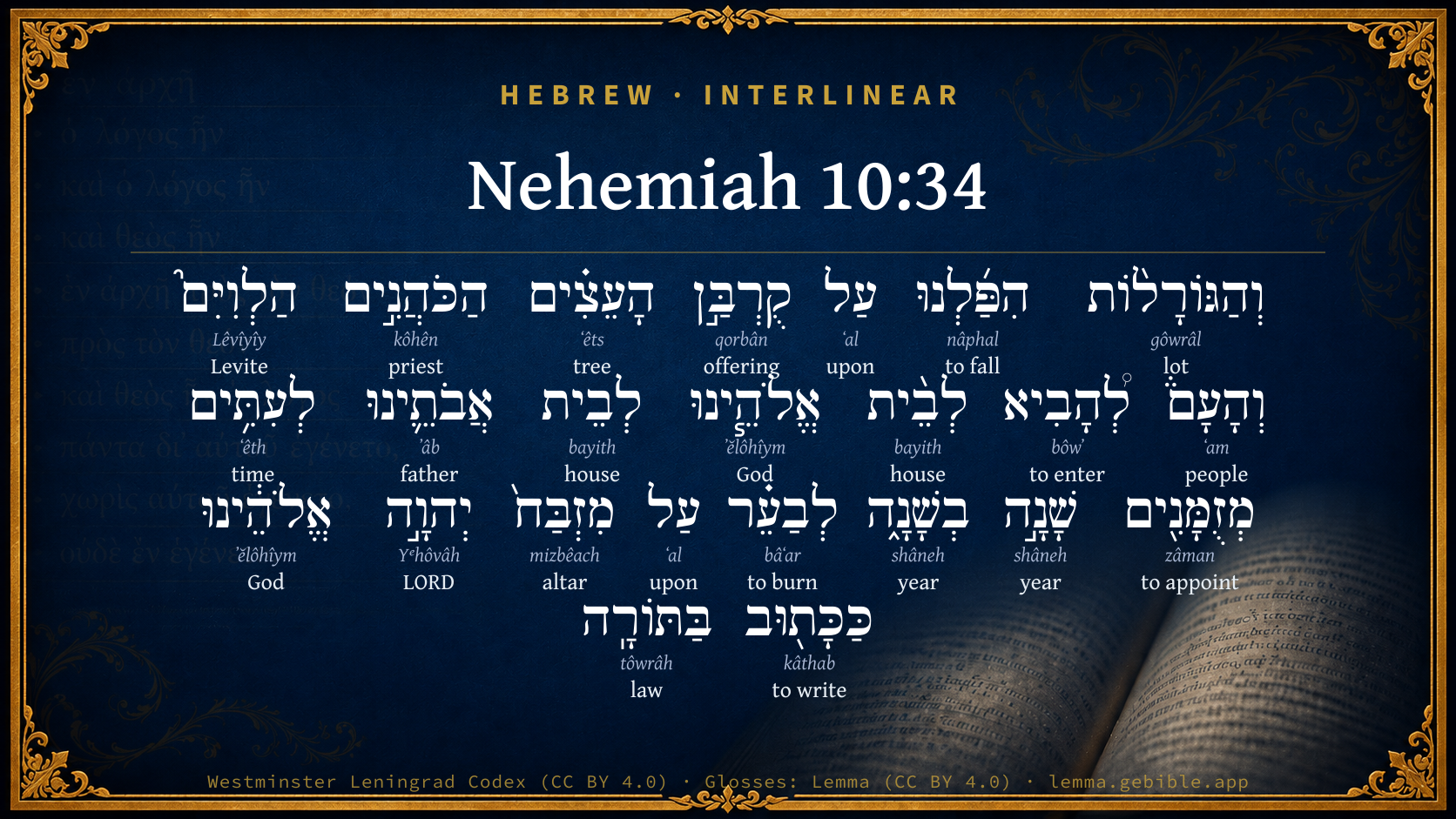
Nehemiah 10:34

Hebrew (Westminster Leningrad Codex) Nehemiah 10:34 appears in the Hebrew Old Testament. The text above is from the Westminster Leningrad Codex. Each word links to its Strong’s number, a concise gloss, and parsing drawn from the Open Scriptures Hebrew Bible morphology. Click any word for its full Brown-Driver-Briggs (BDB) entry.
Download image
Cite this verse

Nehemiah 10:34 (World English Bible). Public Domain. Lemma interlinear Bible study tool, https://lemma.gebible.app/v/nehemiah/10/34.

Show BibTeX & RIS
BibTeX
RIS
English Translation
We cast lots, the priests, the Levites, and the people, for the wood-offering, to bring it into the house of our God, according to our fathers' houses, at times appointed, year by year, to burn on the altar of Yahweh our God, as it is written in the law;
World English Bible · Public Domain
Download a study sheet

One document with this verse’s original text, its word-by-word gloss line, the meaning frame, cross-references with their text, attributed commentary, and full source and license credits — printable, and it pastes into notes with its structure intact.

This verse Autodidact and up

Study sheet (.html) Plain text (.txt)

A passage Seminary Student

Up to 50 verses in one chapter. A passage sheet keeps up to 6 commentary sources and 12 cross-references per verse, in the order this page ranks them, and says so on the sheet whenever that leaves anything out. Ask for a single verse and you get the Autodidact verse sheet above.

Everything on this page stays free to read, with no account — the sheet is a download of what is already on screen, not access to it.

Want to remove ads? Support Godless Engineer
Compare translations 3

The same verse in 3 English versions, stacked beneath the original-language interlinear above. Click any original word for its lexicon entry.

Each is an independent rendering of the whole verse — the interlinear is not word-aligned to these translations.

Highlighted words mark where these versions differ — a whole-verse word diff, not a word-by-word alignment.

  • World English Bible Public Domain
    We cast lots, the priests, the Levites, and the people, for the wood-offering, to bring it into the house of our God, according to our fathers' houses, at times appointed, year by year, to burn on the altar of Yahweh our God, as it is written in the law;
  • King James Version Public Domain
    And we cast the lots among the priests, the Levites, and the people, for the wood offering, to bring it into the house of our God, after the houses of our fathers, at times appointed year by year, to burn upon the altar of the LORD our God, as it is written in the law:
  • unfoldingWord Literal Text CC BY-SA 4.0
    And we cast lots among the priests, the Levites, and the people: concerning the offering of pieces of wood, to bring them to the house of our God, for the house of our fathers at the appointed times year by year, for burning on the altar of Yahweh our God as written in the law;

unfoldingWord Literal Text — © unfoldingWord, licensed CC BY-SA 4.0. Word-aligned USFM3 via Door43 (git.door43.org/unfoldingWord/en_ult).

Versions to compare (up to 4)

3 of 4 selected

Show all 18 translations

Every available English version of this verse, each an independent rendering of the whole verse.

  • World English Bible Public Domain
    We cast lots, the priests, the Levites, and the people, for the wood-offering, to bring it into the house of our God, according to our fathers' houses, at times appointed, year by year, to burn on the altar of Yahweh our God, as it is written in the law;
  • Berean Standard Bible Public Domain
    We have cast lots among the priests, Levites, and people for the donation of wood by our families at the appointed times each year. They are to bring it to the house of our God to burn on the altar of the LORD our God, as it is written in the Law.
  • Majority Standard Bible Public Domain
    We have cast lots among the priests, Levites, and people for the donation of wood by our families at the appointed times each year. They are to bring it to the house of our God to burn on the altar of the LORD our God, as it is written in the Law.
  • King James Version Public Domain
    And we cast the lots among the priests, the Levites, and the people, for the wood offering, to bring it into the house of our God, after the houses of our fathers, at times appointed year by year, to burn upon the altar of the LORD our God, as it is written in the law:
  • American Standard Version (1901) Public Domain
    And we cast lots, the priests, the Levites, and the people, for the wood-offering, to bring it into the house of our God, according to our fathers' houses, at times appointed, year by year, to burn upon the altar of Jehovah our God, as it is written in the law;
  • Revised Version (1885) Public Domain
    And we cast lots, the priests, the Levites, and the people, for the wood offering, to bring it into the house of our God, according to our fathers’ houses, at times appointed, year by year, to burn upon the altar of the LORD our God, as it is written in the law:
  • Geneva Bible (1599) Public Domain
    We cast also lottes for the offering of the wood, euen the Priestes, the Leuites and the people to bring it into the house of our God, by the house of our fathers, yeerely at the times appointed, to burne it vpon the altar of the Lord our God, as it is written in the Lawe,
  • Douay-Rheims (1899) Public Domain
    And we cast lots among the priests, and the Levites, and the people for the offering of wood, that it might be brought into the house of our God by the houses of our fathers at set times, from year to year: to burn upon the altar of the Lord our God, as it is written in the law of Moses:
  • Young's Literal Translation Public Domain
    And the lots we have caused to fall for the offering of wood, `among' the priests, the Levites, and the people, to bring in to the house of our God, by the house of our fathers, at times appointed, year by year, to burn on the altar of Jehovah our God, as it is written in the law,
  • Literal Standard Version CC BY-SA 4.0
    And we have caused the lots to fall for the offering of wood, [among] the priests, the Levites, and the people, to bring into the house of our God, by the house of our fathers, at times appointed, year by year, to burn on the altar of our God YHWH, as it is written in the Law,
  • Unlocked Literal Bible CC BY-SA 4.0
    The priests, the Levites, and the people cast lots for the wood offering. The lots would select which of our families would bring wood into the house of our God at the appointed times each year, to be burned on the altar of Yahweh our God, as it is written in the law.
  • unfoldingWord Literal Text CC BY-SA 4.0
    And we cast lots among the priests, the Levites, and the people: concerning the offering of pieces of wood, to bring them to the house of our God, for the house of our fathers at the appointed times year by year, for burning on the altar of Yahweh our God as written in the law;
  • Darby Bible Public Domain
    And we cast the lots among the priests, the Levites, and the people, for the wood-offering, to bring [it] into the house of our God, according to our fathers' houses, at times appointed year by year, to burn upon the altar of Jehovah our God, as it is written in the law;
  • World Messianic Bible Public Domain
    We, the priests, the Levites, and the people, cast lots for the wood offering, to bring it into the house of our God, according to our fathers’ houses, at times appointed year by year, to burn on the LORD our God’s altar, as it is written in the Torah;
  • Webster's Bible Public Domain
    And we cast the lots among the priests, the Levites, and the people, for the wood-offering, to bring it into the house of our God, after the houses of our fathers, at times appointed year by year, to burn upon the altar of the LORD our God, as it is written in the law:
  • Free Bible Version CC BY-SA 4.0
    We have allocated by lot among the priests, Levites, and the people, to determine who will bring wood to the Temple of our God to burn on the altar of the Lord our God at specific times during the year, as required by the Law.
  • Bible in Basic English Public Domain
    And we, the priests and the Levites and the people, made selection, by the decision of the Lord, of those who were to take the wood offering into the house of God, by families at the regular times, year by year, to be burned on the altar of the Lord our God, as it is recorded in the law;
  • JPS Tanakh (1917) Public Domain
    (10-35) And we cast lots, the priests, the Levites, and the people, for the wood-offering, to bring it into the house of our God, according to our fathers' houses, at times appointed, year by year, to burn upon the altar of the LORD our God, as it is written in the Law;

Literal Standard Version (2020), Covenant Press — licensed CC BY-SA 4.0. Text via the HelloAO Bible API (eBible.org). Unlocked Literal Bible (unfoldingWord) — licensed CC BY-SA 4.0. Text via the HelloAO Bible API (eBible.org). unfoldingWord Literal Text — © unfoldingWord, licensed CC BY-SA 4.0. Word-aligned USFM3 via Door43 (git.door43.org/unfoldingWord/en_ult). Free Bible Version, Dr. Jonathan Gallagher — licensed CC BY-SA 4.0. Text via the HelloAO Bible API (eBible.org).

Word by word

More ways to search: Search by grammar → Find every occurrence → Compare this word →

Practice this passage: Drill this verse → Learn its vocabulary →

מְזֻמָּנִ֖ים
zâman
H2163
“appointed”
Verb, Pual, Participle Passive, Masculine, Plural, Absolute
Part of Speech
Verb
Stem
Pual
Form
Participle Passive
Gender
Masculine
Number
Plural
State
Absolute
Full BDB Definition

Origin: a primitive root

TWOT: 557

to appoint a time, be fixed, be appointed - (Pual) - to be fixed, be appointed - appointed times (participle)
  1. וְהַגּוֹרָל֨וֹת gôwrâl H1486 “and · the · lots” Conjunction + Particle, Definite Article + Noun, Common, Masculine, Plural, Absolute
  2. הִפַּ֜לְנוּ nâphal H5307 “to fall” Verb, Hiphil, Perfect, 1st Person, Common, Plural
  3. עַל ʻal H5921 “upon” Preposition
  4. קֻרְבַּ֣ן qorbân H7133 “offering of” Noun, Common, Masculine, Singular, Construct
  5. הָעֵצִ֗ים ʻêts H6086 “the · trees” Particle, Definite Article + Noun, Common, Masculine, Plural, Absolute
  6. הַכֹּהֲנִ֣ים kôhên H3548 “the · priests” Particle, Definite Article + Noun, Common, Masculine, Plural, Absolute
  7. הַלְוִיִּם֮ Lêvîyîy H3881 “the · Levites” Particle, Definite Article + Noun, Gentilic, Masculine, Plural, Absolute
  8. וְהָעָם֒ ʻam H5971 “and · the · people” Conjunction + Particle, Definite Article + Noun, Common, Masculine, Singular, Absolute
  9. לְ֠הָבִיא bôwʼ H935 “to enter” Preposition + Verb, Hiphil, Infinitive Construct
  10. לְבֵ֨ית bayith H1004 “to/for · house of” Preposition + Noun, Common, Masculine, Singular, Construct
  11. אֱלֹהֵ֧ינוּ ʼĕlôhîym H430 “God(s) · our” Noun, Common, Masculine, Plural, Construct + Suffix, Personal, 1st Person, Common, Plural
  12. לְבֵית bayith H1004 “to/for · house of” Preposition + Noun, Common, Masculine, Singular, Construct
  13. אֲבֹתֵ֛ינוּ ʼâb H1 “fathers · our” Noun, Common, Masculine, Plural, Construct + Suffix, Personal, 1st Person, Common, Plural
  14. לְעִתִּ֥ים ʻêth H6256 “to/for · times” Preposition + Noun, Common, Both, Plural, Absolute
  15. שָׁנָ֣ה shâneh H8141 “year” Noun, Common, Feminine, Singular, Absolute
  16. בְשָׁנָ֑ה shâneh H8141 “in/at · year” Preposition + Noun, Common, Feminine, Singular, Absolute
  17. לְבַעֵ֗ר bâʻar H1197 “to burn” Preposition + Verb, Piel, Infinitive Construct
  18. עַל ʻal H5921 “upon” Preposition
  19. מִזְבַּח֙ mizbêach H4196 “altar of” Noun, Common, Masculine, Singular, Construct
  20. יְהוָ֣ה Yᵉhôvâh H3068 “LORD” Noun, Proper
  21. אֱלֹהֵ֔ינוּ ʼĕlôhîym H430 “God(s) · our” Noun, Common, Masculine, Plural, Construct + Suffix, Personal, 1st Person, Common, Plural
  22. כַּכָּת֖וּב kâthab H3789 “like/as the · written” Preposition, Determined + Verb, Qal, Participle Passive, Masculine, Singular, Absolute
  23. בַּתּוֹרָֽה tôwrâh H8451 “in/at the · law” Preposition, Determined + Noun, Common, Feminine, Singular, Absolute

About this verse

These counts appear in no published source. They are computed here, from the morphology-tagged text and Lemma’s own curated glosses. What Lemma adds →

24
words
20
distinct lemmas
Historical
section

Notable vocabulary

The rarest word here is מְזֻמָּנִ֖ים to appoint H2163 — appearing just 3 times in the whole Hebrew Bible.

Shared distinctive vocabulary

מְזֻמָּנִ֖ים to appoint H2163 occurs in 3 verses of the Hebrew Bible. Also found in:

Grammatical profile

  • 5 verbs
  • 17 nouns
  • 2 prepositions

Verb forms

  • הִפַּ֜לְנוּ Hiphil · Perfect
  • לְ֠הָבִיא Hiphil · Infinitive Construct
  • מְזֻמָּנִ֖ים Pual · Participle Passive
  • לְבַעֵ֗ר Piel · Infinitive Construct
  • כַּכָּת֖וּב Qal · Participle Passive

Repetition

Words recur within this verse — often emphatic in Hebrew:

  • עַל upon H5921 ×2
  • לְבֵ֨ית house H1004 ×2
  • אֱלֹהֵ֧ינוּ God H430 ×2
  • שָׁנָ֣ה year H8141 ×2

Cross-references

10

Topical passages linked to Nehemiah 10:34 in the Treasury of Scripture Knowledge — connected by theme and wording, ordered by reader-vote popularity; previews shown in the World English Bible.

  • Nehemiah 13:31 and for the wood-offering, at times appointed, and for the first fruits. Remember me, my God, for good.
  • Leviticus 6:12–13 The fire on the altar shall be kept burning on it, it shall not go out; and the priest shall burn wood on it every morning: and he shall lay the burnt offering in order upon it, and shall burn on it the fat of the peace offerings.
  • Isaiah 40:16 Lebanon is not sufficient to burn, nor the animals of it sufficient for a burnt offering.
  • Joshua 9:27 That day Joshua made those wood cutters and drawers of water for the congregation, and for the altar of Yahweh, to this day, in the place which he should choose.
  • 1 Chronicles 24:5 Thus were they divided impartially by drawing lots; for there were princes of the sanctuary, and princes of God, both of the sons of Eleazar, and of the sons of Ithamar.
  • 1 Chronicles 24:7 Now the first lot came forth to Jehoiarib, the second to Jedaiah,
  • 1 Chronicles 25:8–9 They cast lots for their offices, all alike, as well the small as the great, the teacher as the scholar.
  • Nehemiah 11:1 The princes of the people lived in Jerusalem: the rest of the people also cast lots, to bring one of ten to dwell in Jerusalem the holy city, and nine parts in the [other] cities.

Cross-references courtesy of OpenBible.info (CC BY 4.0).

Hebrew and Greek witnesses Masoretic Hebrew ↔ Greek Septuagint

The same verse in the two great witnesses to the Old Testament, shown verse-for-verse.

These are two independent witnesses, not word-aligned to each other, and the Septuagint is shown in lemma (dictionary) form.

Hebrew Nehemiah 10:34 Masoretic · Westminster Leningrad Codex

וְהַגּוֹרָל֨וֹת הִפַּ֜לְנוּ עַל קֻרְבַּ֣ן הָעֵצִ֗ים הַכֹּהֲנִ֣ים הַלְוִיִּם֮ וְהָעָם֒ לְ֠הָבִיא לְבֵ֨ית אֱלֹהֵ֧ינוּ לְבֵית אֲבֹתֵ֛ינוּ לְעִתִּ֥ים מְזֻמָּנִ֖ים שָׁנָ֣ה בְשָׁנָ֑ה לְבַעֵ֗ר עַל מִזְבַּח֙ יְהוָ֣ה אֱלֹהֵ֔ינוּ כַּכָּת֖וּב בַּתּוֹרָֽה

We cast lots, the priests, the Levites, and the people, for the wood-offering, to bring it into the house of our God, according to our fathers' houses, at times appointed, year by year, to burn on the altar of Yahweh our God, as it is written in the law;

World English Bible · Public Domain

Greek LXX Structure differs

The Septuagint has no separate book of Nehemiah. Its Greek text is the second half of Esdras B (2 Esdras), chapters 11–23; Ezra is the first half (1–10).

A verse-for-verse comparison isn’t shown here because the chapters and verses don’t line up. Switch to the LXX edition with the MT / LXX toggle above to read the Greek directly.

Hebrew: Westminster Leningrad Codex (CC BY 4.0). Greek: Septuagint (public domain); English from a public-domain English Septuagint. How the Septuagint differs from the Hebrew →

Commentary

Notes on Nehemiah 10:34 from classic Christian and Jewish commentators (each source and its license shown beneath its notes). The classic Christian expositions comment on the surrounding passage and are grouped to its opening verse, so a note may address several verses; the Jewish commentaries on the Tanakh (Rashi and others) are per-verse, so they appear only where the commentator wrote on this verse.

Lemma curates 59 commentaries, every one of them public domain or Creative Commons licensed, each selected and text-cleaned for this edition rather than reprinted as found. About our sources →

Trapp's Complete Commentary

John Trapp

Neh 10:34 And we cast the lots among the priests, the Levites, and the people, for the wood offering, to bring [it] into the house of our God, after the houses of our fathers, at times appointed year by year, to burn upon the altar of the LORD our God, as [it is] written in the law:

Ver. 34. And we cast lots … for the wood offering] Heb. Kurban, or Korban, as the Gospel calleth it, because by offerings they came near to God. This wood offering we read not of till now: the prophet Isaiah telleth us, that if we should sacrifice unto God according to his excellent greatness, Lebanon would not be sufficient to burn, nor the beasts thereof sufficient for a burnt offering, Isa 40:16. There was much use of fuel about the temple; and it was formerly provided out of the public treasury. But that now failing, they take another order, as here; that God might not be unserved, and the daily sacrifice neglected, which they held and called, The abomination of desolation.

John Trapp, A Commentary or Exposition upon All the Books of the Old and New Testament (1647–1656) — public domain. Text from a community e-Sword module.

Joseph Benson's Commentary

Neh 10:34. And we cast lots among the priests, &c. They now determined, by casting lots, how much wood every one should bring in, for his share, to maintain the fire continually upon the altar to burn the sacrifices; and in what order it should be brought; and at what times of the year.

Joseph Benson's Commentary on the Old and New Testaments (1811–1818) — public domain. Text from a community e-Sword module.

Tyndale Open Study Notes

Tyndale Open Resources

10:34 Because the fire on the altar burned continually (Lev 6:12), a good deal of wood was used. The Gibeonites provided it at an earlier time (Josh 9:27), but now it was a joint responsibility.

Tyndale Open Study Notes — © Tyndale Open Resources, licensed CC BY-SA 4.0. Text via the HelloAO Bible API.

Geneva Bible (1599)

Geneva Bible translators

Or, into the house of.

Geneva Bible (1599) marginal notes — public domain. Text via Bolls.life.

Jamieson, Fausset & Brown

Robert Jamieson, A. R. Fausset & David Brown

we cast the lots . . . for the wood offering--The carrying of the wood had formerly been the work of the Nethinims. But few of them having returned, the duty was assigned as stated in the text. The practice afterwards rose into great importance, and JOSEPHUS speaks [The Wars of the Jews, 2.17, sect. 6] of the Xylophoria, or certain stated and solemn times at which the people brought up wood to the temple.

Jamieson, Fausset & Brown — Commentary Critical and Explanatory on the Whole Bible (1871) — public domain (CC PDM 1.0). Text via the HelloAO Bible API.

Adam Clarke's Commentary

Verse 34. Cast the lots -for the wood-offering] There does not appear to have been any wood-offering under the law. It was the business of the Nethinim to procure this; and hence they were called hewers of wood and drawers of water to the congregation. But it is very likely that after the captivity few Nethinim were found; for as such, who were the descendants of the Gibeonites, were considered only as slaves among the Israelites, they would doubtless find it as much, if not more, their interest to abide in the land of their captivity, than to return with their former masters. As there was not enough of such persons to provide wood for the fires of the temple, the people now cast lots, not who should furnish the wood, but what class or district should furnish it at a particular time of the year, so that there might be a constant supply. One district furnished it for one whole year, or for the first month or year; another, for the second month or year; and so on. Now the lot was to determine which district should bring the supply on the first month or year; which on the second; and so on. When the wood was brought, it was delivered to the Levites: they cut, prepared, and stacked it; and when wanted, delivered it to the priests, whose business it was to lay it upon the altar. Perhaps this providing of the wood was done only once a year by one district, the next year by another district, and so on: and this bringing the wood to the temple at last became a great day; and was constituted into a feast, called by Josephus ξυλοφορια, the carrying of the wood.-See De Bell. Jud. lib. ii., cap. xvii., sec. 6, p. 194. This feast is not mentioned in the sacred writings: then there was no need for such an institution, as the Nethinim were sufficiently numerous.

Adam Clarke's Commentary on the Bible (1810–1826) — public domain. Text from a community e-Sword/MySword module.

Ellicott's Commentary for English Readers

(34) As it is written in the law.—Lev_6:12 prescribes that the fire on the altar should be kept burning by wood. But here we have the origin of the “feast of the wood-offering”—a special day, subsequently substituted for the “times appointed year by year.” The lot determined the order in which the various classes should supply the wood.

A Bible Commentary for English Readers, edited by Charles John Ellicott (1878–1897) — public domain. Text from a community e-Sword module.

The Cambridge Bible for Schools and Colleges

gen. ed. J. J. S. Perowne

34. And we cast the lots] R.V. And we cast lots. The use of the article in the Heb. does not here call attention to the use of any peculiarly sacred ‘lots,’ but generally to the means employed for ascertaining the Divine will. For decision by the casting of lots, cf. the choosing of the goat on the day of Atonement (Lev_16:8-10), the distribution of the Promised Land (Jos_14:2; Jos_18:10), the selection of the first king (1Sa_10:19), the distribution of offices among the 24 priestly houses (1Ch_24:5; 1Ch_25:8; 1Ch_26:13), and of the priestly duties among the individual members (Luk_1:9). Here the lot was to decide the succession of the houses, which took it in turn to supply the wood for the sacrifices of the Temple.

for the wood offering] Cf. Neh_13:31. The supply of wood for the enormous number of sacrifices offered at the Temple of Jerusalem must have represented a large annual sum. The difficulty of procuring wood must have been very great: (1) the area of territory occupied by the Jewish community was small, (2) the trees in the neighbourhood must have suffered during the Chaldean invasion and siege.

after the houses of our fathers] R.V. according to our fathers’ houses. Another translation, ‘even into the house of our fathers,’ i.e. ‘into the Temple’ would certainly be possible according to the Hebrew, but is not to be accepted, as its use occurs nowhere else, and after the mention of ‘the house of our God’ there would be no special appropriateness for the employment of another name.

at times appointed] Cf. Neh_13:31; Ezr_10:14. According to the Talmud on nine days in the year.

as it is written in the law] There is no statute in the Levitical code regulating the supply of firewood for the sacrifices. The only reference to the wood of the offering in ‘the Law’ is contained in Lev_6:12-13, ‘And the fire upon the altar shall be kept burning thereon, it shall not go out; and the priest shall burn wood on it every morning; and he shall lay the burnt offering in order upon it, and shall burn thereon the fat of the peace offerings. Fire shall be kept burning upon the altar continually; it shall not go out.’ If the words ‘as it is written in the law’ contain a reference to a passage in the Pentateuch, it must be looked for in connexion with ‘the burning on the altar’ (e.g. Lev_6:12-13), not with ‘the wood-offering.’ Against this it may fairly be urged that ‘the wood offering,’ being the principal subject of the verse, is also the most probable subject for this quotation from Scripture. But if ‘as it is written in the law’ alludes to ‘the wood offering,’ ‘the law’ must be understood in a general sense of the traditional regulations of the priests, which apparently were not all embodied in our Pentateuch. New circumstances necessitated new regulations; and we have to suppose that among the new written regulations of the priests was one relating to ‘the wood offering.’ We may conjecture that after the return from the exile the scarcity and expensiveness of fuel for the sacrifices made it necessary to draw up special regulations by which ‘the houses’ took it in turn to supply the wood. The burden was thus distributed over the community. The new regulation had been committed to writing; but, as appears from our Pentateuch, it was never incorporated in the canonical ‘Thora,’ perhaps from the reason that its history was known to be recent. Josephus (Bell. Jud. ii. 17. 6) mentions that on the 14th day of the 5th month Loos (Ab) was the Festival of Wood-bringing (Ξυλοφόρια), at which every Jew used to bring wood for the altar of burnt offering, that there never might be wanting a supply of fuel for the sacred fire.

The Cambridge Bible for Schools and Colleges (gen. ed. J. J. S. Perowne; Cambridge University Press, 1878–1918) — public domain. Text from a community e-Sword module.

John Gill's Exposition

And to bring the firstfruits of our ground,.... Not that they cast lots to do this, but they bound themselves with an oath, according to the law, to do it; this is the first of all the fruits of the earth, Exo 23:19, though Aben Ezra restrains it to the sheaf of the firstfruits, and to the two wave loaves, Lev 23:10,

and the firstfruits of all fruit of all trees; which, as Aben Ezra observes, their wise men restrain to the seven kinds only mentioned in Deu 8:8.

John Gill's Exposition of the Whole Bible (1746–1763) — public domain (CC PDM 1.0). Text via the HelloAO Bible API.

Albert Barnes' Notes on the Bible

No special provision was made by the Law, by David, or by Solomon, for the supply of wood necessary to keep fire ever burning upon the altar. Nehemiah established a system by which the duty of supplying the wood was laid as a burden in turn on the various clans or families, which were regarded as constituting the nation. The lot was used to determine the order in which the several families should perform the duty. A special day (the 14th of the fifth month, according to Josephus) was appointed for the bringing in of the supply; and this day was after a time regarded as a high festival, and called “the feast of the wood-offering.”

Albert Barnes' Notes on the Bible (1834–1885) — public domain. Text from a community e-Sword/MySword module.

Haydock's Catholic Bible Commentary

Wood. The Nathinites had performed this office till the captivity. But not their numbers were too small. (Calmet) --- The people therefore brought the wood. The Levites, with the Nathinites, carried it into the temple, and the priests laid it upon the altars; all being regulated by lots. (Lyranus) --- Hence the feast called Xylophoria, was instituted about the month of August, as we may gather from Josephus. The Rabbins say that the priests cut the wood, from March till the 15th of July.

George Leo Haydock (1774–1849), Haydock's Catholic Family Bible and Commentary, 1859 edition — public domain. Excludes Psalms (Douay-Rheims chapter numbering differs from Protestant) and Deuterocanonical books (Catholic canon only).

Matthew Poole's English Annotations

We cast the lots, to determine the time and order in which each of them should take the care of the business.

For the wood-offering; for the wood, which was to be spent in great quantity, being used in every sacrifice, and formerly had been supplied out of the temple’s treasures, or by the king; which could not now be done.

Into the house of our God, i.e. into the place appointed to receive it in the buildings adjoining or belonging to the temple.

After the houses of our fathers, i. e. according to our several families, which were to take the charge of it by course.

Matthew Poole's English Annotations on the Holy Bible (1683–1685) — public domain. Text from a community e-Sword/MySword module.

Whedon's Commentary on the Bible

Daniel D. Whedon

34. Cast the lots — See note on Jos_13:6.

The wood offering — Large quantities of wood were necessary to the continual burnt offerings, and some provision must have been made for it from the first. The law (Lev_6:12) said, “The fire upon the altar shall be burning in it; it shall not be put out; and the priest shall burn wood on it every mornings,” etc.; but we find in the law no specific precept for providing wood for the altar. Josephus (Wars of the Jews, Neh_2:17; Neh_2:6) mentions “the festival of Xylophory, (ξυλοφοριων, wood-bearing,) upon which the custom was for every one to bring wood for the altar, that there might never be a want of fuel for that fire which was to be always burning.”

At times appointed year by year — Probably several days each year were set apart for this purpose, for Bertheau’s opinion, that there was but one day in the year for bringing wood, has no support. Keil thinks that “the order was settled for several years, and not that all the different houses contributed in each year.” The Mishna, as quoted by Lightfoot, (Hor. Hebrews, on Mat_1:1,) says: “The seasons for wood-carrying by the priests and people were nine. The first of Nisan, for the sons of Erach, the son of Judah; the twentieth of Tammuz, for the sons of David, the son of Judah; the fifth of Ab, for the sons of Parosh, the son of Judah; the seventh of the same month for the sons of Jonadab, the son of Rechab; the tenth of the same for Sennaah, the son of Benjamin,” etc.

Daniel D. Whedon (gen. ed.), Commentary on the Old and New Testaments (1874–1909) — public domain. Text from a community e-Sword module.

The Pulpit Commentary

We cast the lots for the wood offering. The "wood offering" is now first heard of. Fuel had probably been more plentiful in the times of the monarchy than it had now become, and the temple treasury had been rich enough to provide what was needed in order to keep the altar fire perpetually burning. (Lev_6:13) But times had changed. The hill-country of Judaea had gradually been stripped of its forests. The temple was, comparatively speaking, poor, and some permanent arrangement for the supply of the required fuel had become necessary. It would seem, from the present passage, that the arrangement actually made was one by which different families or districts undertook the duty of furnishing the wood in turn, and lots were cast to determine the order in which they should discharge the office. According to Josephus ("Bell. Jud.," it. 17, the wood needed for a year was brought in on a particular day the fourteenth day of the fifth month which was kept as a festival, and known as the "Xylophoria." At times appointed year by year. It may be gathered from this that, originally, no single day was selected for bringing in all the wood; much less one and the same day appointed for every year. The original system was variable and elastic; but in course of time a rigid uniformity was introduced and established. As it is written in the law. See Lev_6:12.

The Pulpit Commentary (1880–1919), ed. H.D.M. Spence-Jones & Joseph S. Exell — public domain. Text from a community e-Sword module.

unfoldingWord translationNotes

Door43 World Missions Community

General Information:

In these verses, the people continue describing the content of the oath they were making in Nehemiah 10:29.

to be burned

This can be stated in active form. AT: "for the Levites to burn" (See: Active or Passive)

as it is written

This can be stated in active form. AT: "as it states" (See: Active or Passive)

from our soil

"in our soil" or "on our land"

translationWords

priest

Levi

lots

sacrifice

family

house of God

appoint

altar

Yahweh

God

written

law

promise

firstfruits

servant

firstborn

son

flocks

unfoldingWord translationNotes — © Distant Shores Media and the Door43 World Missions Community, licensed CC BY-SA 4.0. Source: git.door43.org/Door43/en_tn.

Rashi

Rabbi Shlomo Yitzchaki (Rashi)

and all the work of the Temple of our God to do with money.

Rashi on the Tanakh — English translations: “The Judaica Press complete Tanach with Rashi, translated by A. J. Rosenberg” (CC BY 4.0); “Pentateuch with Rashi's commentary by M. Rosenbaum and A.M. Silbermann, 1929-1934” (public domain); “The Metsudah Tanach series, Lakewood, N.J” (CC BY 4.0); and “The Book of Joshua, Metsudah Publications, 1997” (CC BY 4.0). Text via Sefaria.

Lesson kit

Teaching starters — assembled from the data on this page, not authored interpretation. Every prompt links to the verse data it draws on. Edit before teaching.

Nehemiah, in the Historical, opens this verse with 24 words (20 distinct Hebrew lemmas). Its most distinctive word is zâman (“to appoint”). A historical commentator’s framing appears above. Read the whole chapter for the surrounding context.

Discussion questions

  1. The word zâman carries the sense “to appoint.” How does it shape the verse?
  2. How does Ezra 10:14, which shares the word «to appoint», read alongside this verse?
  3. What does the repetition of “upon” (2× in this one verse) do in this verse?
  4. These translations render this verse differently. What is at stake in choosing one wording over another?
  5. «הִפַּ֜לְנוּ» is a Hiphil Perfect verb. How does that grammatical form shape the action described?
  6. Compare how Trapp's Complete Commentary and Joseph Benson's Commentary read this verse. Where do they agree or differ?

Things to notice

Reading settings

Reading text

Shown beneath each verse's original-language words.

Old Testament
Old Testament edition

Read the OT as the Masoretic Hebrew (MT) or the Greek Septuagint (LXX).

English shown for the Greek Septuagint (in the Hebrew ↔ Greek comparison).

Comparing translations? Open the Compare panel on any verse page to stack up to four side by side.