
2 Kings 3:19

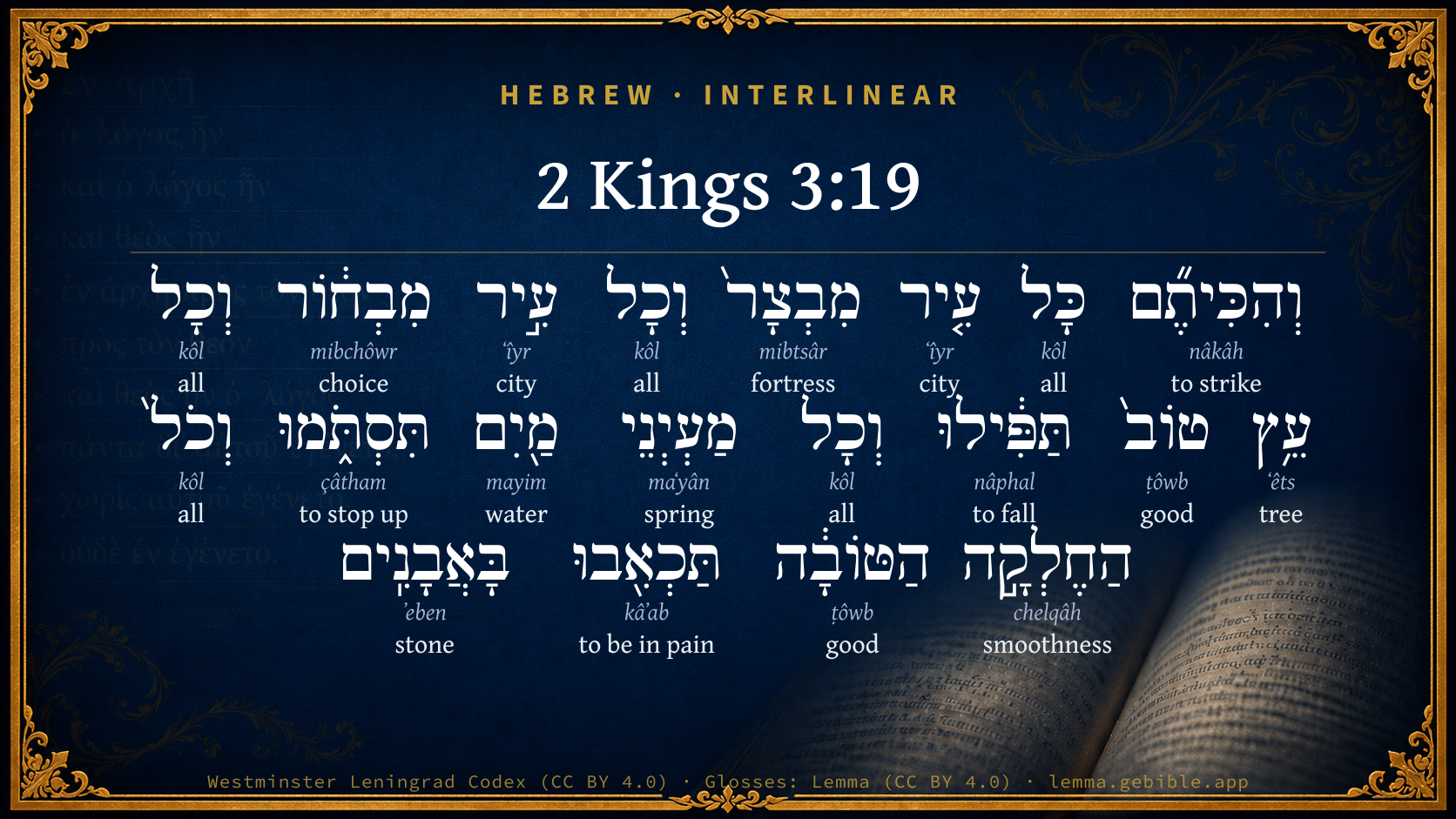
Hebrew (Westminster Leningrad Codex) 2 Kings 3:19 appears in the Hebrew Old Testament. The text above is from the Westminster Leningrad Codex. Each word links to its Strong’s number, a concise gloss, and parsing drawn from the Open Scriptures Hebrew Bible morphology. Click any word for its full Brown-Driver-Briggs (BDB) entry.
Download image
Cite this verse

2 Kings 3:19 (World English Bible). Public Domain. Lemma interlinear Bible study tool, https://lemma.gebible.app/v/2-kings/3/19.

Show BibTeX & RIS
BibTeX
RIS
English Translation
You shall strike every fortified city, and every choice city, and shall fell every good tree, and stop all springs of water, and mar every good piece of land with stones.
World English Bible · Public Domain
Highlights
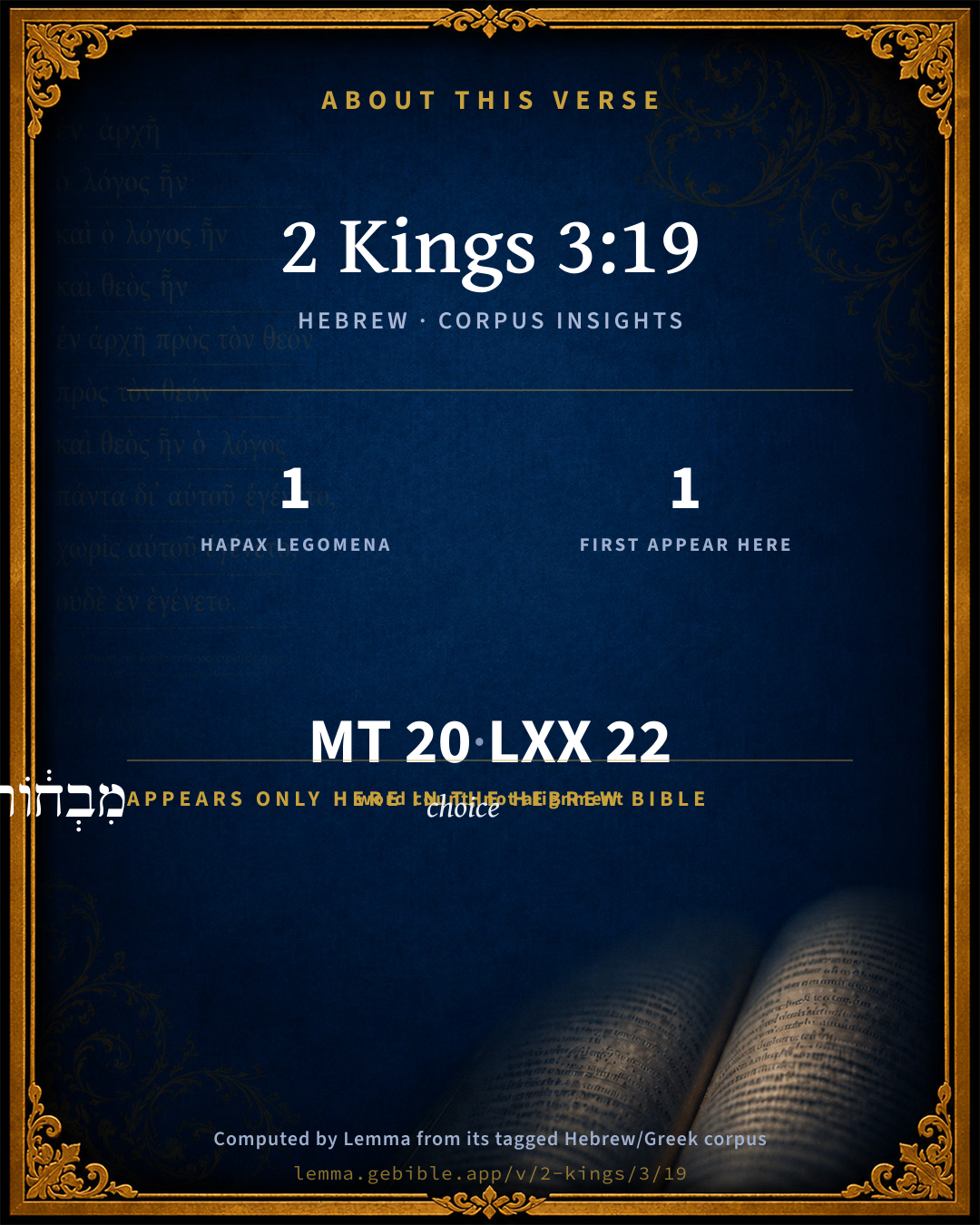
  • 1 hapax legomenon — only here in the Hebrew Bible
  • 1 first appearance in the Hebrew Bible
Full analysis ↓
Download a study sheet

One document with this verse’s original text, its word-by-word gloss line, the meaning frame, cross-references with their text, attributed commentary, and full source and license credits — printable, and it pastes into notes with its structure intact.

This verse Autodidact and up

Study sheet (.html) Plain text (.txt)

A passage Seminary Student

Up to 50 verses in one chapter. A passage sheet keeps up to 6 commentary sources and 12 cross-references per verse, in the order this page ranks them, and says so on the sheet whenever that leaves anything out. Ask for a single verse and you get the Autodidact verse sheet above.

Everything on this page stays free to read, with no account — the sheet is a download of what is already on screen, not access to it.

Want to remove ads? Support Godless Engineer
Compare translations 3

The same verse in 3 English versions, stacked beneath the original-language interlinear above. Click any original word for its lexicon entry.

Each is an independent rendering of the whole verse — the interlinear is not word-aligned to these translations.

Highlighted words mark where these versions differ — a whole-verse word diff, not a word-by-word alignment.

  • World English Bible Public Domain
    You shall strike every fortified city, and every choice city, and shall fell every good tree, and stop all springs of water, and mar every good piece of land with stones.
  • King James Version Public Domain
    And ye shall smite every fenced city, and every choice city, and shall fell every good tree, and stop all wells of water, and mar every good piece of land with stones.
  • unfoldingWord Literal Text CC BY-SA 4.0
    And you will strike every fortified city and every choice city, and you will fell every good tree, and you will stop up all of the springs of water, and you will ruin every good portion with stones.”

unfoldingWord Literal Text — © unfoldingWord, licensed CC BY-SA 4.0. Word-aligned USFM3 via Door43 (git.door43.org/unfoldingWord/en_ult).

Versions to compare (up to 4)

3 of 4 selected

Show all 18 translations

Every available English version of this verse, each an independent rendering of the whole verse.

  • World English Bible Public Domain
    You shall strike every fortified city, and every choice city, and shall fell every good tree, and stop all springs of water, and mar every good piece of land with stones.
  • Berean Standard Bible Public Domain
    And you shall attack every fortified city and every city of importance. You shall cut down every good tree, stop up every spring, and ruin every good field with stones.”
  • Majority Standard Bible Public Domain
    And you shall attack every fortified city and every city of importance. You shall cut down every good tree, stop up every spring, and ruin every good field with stones.”
  • King James Version Public Domain
    And ye shall smite every fenced city, and every choice city, and shall fell every good tree, and stop all wells of water, and mar every good piece of land with stones.
  • American Standard Version (1901) Public Domain
    And ye shall smite every fortified city, and every choice city, and shall fell every good tree, and stop all fountains of water, and mar every good piece of land with stones.
  • Revised Version (1885) Public Domain
    And ye shall smite every fenced city, and every choice city, and shall fell every good tree, and stop all fountains of water, and mar every good piece of land with stones.
  • Geneva Bible (1599) Public Domain
    And ye shall smite euery strong towne and euery chiefe citie, and shall fell euery faire tree, and shall stoppe all the fountaines of water, and marre euery good fielde with stones.
  • Douay-Rheims (1899) Public Domain
    And you shall destroy every fenced city, and every choice city, and shall cut down every fruitful tree, and shall stop up all the springs of waters, and every goodly field you shall cover with stones.
  • Young's Literal Translation Public Domain
    and ye have smitten every fenced city, and every choice city, and every good tree ye cause to fall, and all fountains of waters ye stop, and every good portion ye mar with stones.'
  • Literal Standard Version CC BY-SA 4.0
    and you have struck every fortified city, and every choice city, and you cause every good tree to fall, and you stop all fountains of waters, and you mar every good portion with stones.”
  • Unlocked Literal Bible CC BY-SA 4.0
    You will attack every fortified city and every good city, cut down every good tree, stop up all springs of water, and ruin every good piece of land with rocks.”
  • unfoldingWord Literal Text CC BY-SA 4.0
    And you will strike every fortified city and every choice city, and you will fell every good tree, and you will stop up all of the springs of water, and you will ruin every good portion with stones.”
  • Darby Bible Public Domain
    And ye shall smite every fortified city, and every choice city, and shall fell every good tree, and stop all wells of water, and mar every good piece of land with stones.
  • World Messianic Bible Public Domain
    You shall strike every fortified city and every choice city, and shall fell every good tree, and stop all springs of water, and mar every good piece of land with stones.’”
  • Webster's Bible Public Domain
    And ye shall smite every fortified city, and every choice city, and shall fell every good tree, and stop all wells of water, and mar every good piece of land with stones.
  • Free Bible Version CC BY-SA 4.0
    You will conquer every fortified town, and every important town. You will chop down every good tree, block up every spring, and spoil every good field by throwing stones on them.”
  • Bible in Basic English Public Domain
    And you are to put every walled town to destruction, cutting down every good tree, and stopping up every water-spring, and making all the good land rough with stones.
  • JPS Tanakh (1917) Public Domain
    And ye shall smite every fortified city, and every choice city, and shall fell every good tree, and stop all fountains of water, and mar every good piece of land with stones.'

Literal Standard Version (2020), Covenant Press — licensed CC BY-SA 4.0. Text via the HelloAO Bible API (eBible.org). Unlocked Literal Bible (unfoldingWord) — licensed CC BY-SA 4.0. Text via the HelloAO Bible API (eBible.org). unfoldingWord Literal Text — © unfoldingWord, licensed CC BY-SA 4.0. Word-aligned USFM3 via Door43 (git.door43.org/unfoldingWord/en_ult). Free Bible Version, Dr. Jonathan Gallagher — licensed CC BY-SA 4.0. Text via the HelloAO Bible API (eBible.org).

Word by word

More ways to search: Search by grammar → Find every occurrence → Compare this word →

Practice this passage: Drill this verse → Learn its vocabulary →

מִבְח֔וֹר
mibchôwr
H4004
“choice”
Noun, Common, Masculine, Singular, Absolute
Part of Speech
Noun
Type
Common
Gender
Masculine
Number
Singular
State
Absolute
Full BDB Definition

Origin: from H977

TWOT: 231e

choice
  1. וְהִכִּיתֶ֞ם nâkâh H5221 “and · to strike” Conjunction + Verb, Hiphil, Perfect, 2nd Person, Masculine, Plural
  2. כָּל kôl H3605 “all of” Noun, Common, Masculine, Singular, Construct
  3. עִ֤יר ʻîyr H5892 “city of” Noun, Common, Feminine, Singular, Construct
  4. מִבְצָר֙ mibtsâr H4013 “fortress” Noun, Common, Masculine, Singular, Absolute
  5. וְכָל kôl H3605 “and · all of” Conjunction + Noun, Common, Masculine, Singular, Construct
  6. עִ֣יר ʻîyr H5892 “city of” Noun, Common, Feminine, Singular, Construct
  7. וְכָל kôl H3605 “and · all of” Conjunction + Noun, Common, Masculine, Singular, Construct
  8. עֵ֥ץ ʻêts H6086 “tree” Noun, Common, Masculine, Singular, Absolute
  9. טוֹב֙ ṭôwb H2896 “good” Adjective, Adjective, Masculine, Singular, Absolute
  10. תַּפִּ֔ילוּ nâphal H5307 “to fall” Verb, Hiphil, Imperfect, 2nd Person, Masculine, Plural
  11. וְכָל kôl H3605 “and · all of” Conjunction + Noun, Common, Masculine, Singular, Construct
  12. מַעְיְנֵי maʻyân H4599 “springs of” Noun, Common, Masculine, Plural, Construct
  13. מַ֖יִם mayim H4325 “water(s)” Noun, Common, Masculine, Plural, Absolute
  14. תִּסְתֹּ֑מוּ çâtham H5640 “to stop up” Verb, Qal, Imperfect, 2nd Person, Masculine, Plural
  15. וְכֹל֙ kôl H3605 “and · all of” Conjunction + Noun, Common, Masculine, Singular, Construct
  16. הַחֶלְקָ֣ה chelqâh H2513 “the · smoothness” Particle, Definite Article + Noun, Common, Feminine, Singular, Absolute
  17. הַטּוֹבָ֔ה ṭôwb H2896 “the · good” Particle, Definite Article + Adjective, Adjective, Feminine, Singular, Absolute
  18. תַּכְאִ֖בוּ kâʼab H3510 “to be in pain” Verb, Hiphil, Imperfect, 2nd Person, Masculine, Plural
  19. בָּאֲבָנִֽים ʼeben H68 “in/at the · stones” Preposition, Determined + Noun, Common, Feminine, Plural, Absolute

About this verse

These counts appear in no published source. They are computed here, from the morphology-tagged text and Lemma’s own curated glosses. What Lemma adds →

20
words
14
distinct lemmas
Historical
section

Notable vocabulary

1 hapax legomenon — a word that appears only here in the entire Hebrew Bible:

  • מִבְח֔וֹר choice H4004

First appearance in Scripture

This word makes its first canonical appearance in the Hebrew Bible here:

  • מִבְח֔וֹר choice H4004

Shared distinctive vocabulary

תַּכְאִ֖בוּ to be in pain H3510 occurs in 8 verses of the Hebrew Bible. Also found in:

Grammatical profile

  • 4 verbs
  • 14 nouns
  • 2 adjectives

Verb forms

  • וְהִכִּיתֶ֞ם Hiphil · Perfect
  • תַּפִּ֔ילוּ Hiphil · Imperfect
  • תִּסְתֹּ֑מוּ Qal · Imperfect
  • תַּכְאִ֖בוּ Hiphil · Imperfect

Repetition

Words recur within this verse — often emphatic in Hebrew:

  • כָּל all H3605 ×5
  • עִ֤יר city H5892 ×2
  • טוֹב֙ good H2896 ×2

Hebrew & Septuagint length

In English translation the verse runs 31 words from the Hebrew and 32 from the Septuagint (LXX English) — closely comparable.

A rough comparison of the two English renderings, which tokenize alike — not a word-level alignment.

Word counts can differ between the Hebrew and the Greek without any difference in meaning — e.g. the Hebrew direct-object marker אֵת has no separate Greek word, and Greek often adds the article ὁ.

In the original languages it is 20 Hebrew tokens and 22 Greek tokens — but the two are counted differently (Hebrew bundles its prefixes and suffixes into one token; the Greek is in lemma form), so that isn’t a like-for-like length.

Cross-references

7

Topical passages linked to 2 Kings 3:19 in the Treasury of Scripture Knowledge — connected by theme and wording, ordered by reader-vote popularity; previews shown in the World English Bible.

  • Numbers 24:17 I see him, but not now; I see him, but not near: There shall come forth a star out of Jacob, A scepter shall rise out of Israel, Shall strike through the corners of Moab, Break down all the sons of tumult.
  • Deuteronomy 20:19–20 When you shall besiege a city a long time, in making war against it to take it, you shall not destroy the trees of it by wielding an axe against them; for you may eat of them, and you shall not cut them down; for is the tree of the field man, that it should be besieged of you?
  • Judges 6:16 Yahweh said to him, Surely I will be with you, and you shall strike the Midianites as one man.
  • 1 Samuel 15:3 Now go and strike Amalek, and utterly destroy all that they have, and don't spare them; but kill both man and woman, infant and suckling, ox and sheep, camel and donkey.
  • 1 Samuel 23:2 Therefore David inquired of Yahweh, saying, Shall I go and strike these Philistines? Yahweh said to David, Go, and strike the Philistines, and save Keilah.
  • 2 Kings 3:25 They beat down the cities; and on every good piece of land they cast every man his stone, and filled it; and they stopped all the springs of water, and felled all the good trees, until in Kir Hareseth [only] they left the stones of it; however the men armed with slings went about it, and struck it.
  • 2 Kings 13:17 He said, Open the window eastward; and he opened it. Then Elisha said, Shoot; and he shot. He said, Yahweh's arrow of victory, even the arrow of victory over Syria; for you shall strike the Syrians in Aphek, until you have consumed them.

Cross-references courtesy of OpenBible.info (CC BY 4.0).

Hebrew and Greek witnesses Masoretic Hebrew ↔ Greek Septuagint

The same verse in the two great witnesses to the Old Testament, shown verse-for-verse.

These are two independent witnesses, not word-aligned to each other, and the Septuagint is shown in lemma (dictionary) form.

Hebrew 2 Kings 3:19 Masoretic · Westminster Leningrad Codex

וְהִכִּיתֶ֞ם כָּל עִ֤יר מִבְצָר֙ וְכָל עִ֣יר מִבְח֔וֹר וְכָל עֵ֥ץ טוֹב֙ תַּפִּ֔ילוּ וְכָל מַעְיְנֵי מַ֖יִם תִּסְתֹּ֑מוּ וְכֹל֙ הַחֶלְקָ֣ה הַטּוֹבָ֔ה תַּכְאִ֖בוּ בָּאֲבָנִֽים

You shall strike every fortified city, and every choice city, and shall fell every good tree, and stop all springs of water, and mar every good piece of land with stones.

World English Bible · Public Domain

Greek LXX 2 Kings 3:19 Septuagint · lemma form

καί πατάσσω πᾶς πόλις ὀχυρός καί πᾶς ξύλον ἀγαθός καταβάλλω καί πᾶς πηγή ὕδωρ ἐνφράσσω καί πᾶς μερίς ἀγαθός ἀχρειόω ἐν λίθος

And you⌃ shall strike every strong city, and you⌃ shall cut down every good tree, and you⌃ shall stop all wells of water, and spoil every good piece of land with stones.

LXX2012 (modern English Septuagint) · Public Domain

On this verse, The Cambridge Bible for Schools and Colleges discusses the Septuagint’s reading. Read the note in Commentary ↓

Hebrew: Westminster Leningrad Codex (CC BY 4.0). Greek: Septuagint (public domain); English from LXX2012 (modern English Septuagint) (Public Domain). How the Septuagint differs from the Hebrew →

Targum (Aramaic paraphrase)

1

The Targum is the ancient Jewish Aramaic paraphrase of the Hebrew Scriptures — an interpretive translation, not the Hebrew text itself. Onkelos (literal) and Pseudo-Jonathan (expansive) render the Torah, and Jonathan the Prophets. Coverage is partial: where no permissively-licensed English translation exists for a verse, only the Aramaic is shown. This is verse-level text, not a word-by-word alignment to the Hebrew.

  1. Targum Jonathan Prophets (Joshua–Malachi)
    וְתִמְחוּן כָּל כְּרַךְ תַּקִיף וְכָל קִרְוִין כְּרִיכַן וְכָל אִילָן דְיָאֵי תְּעַקְרִין וְכָל מַבּוּעַי מַיָא תִּסְתְּמוּן וְכָל אַחֲסַנְתָּא שַׁפֶּרְתָּא תְטוּמוּן בְּאַבְנַיָא:

    (no public-domain English translation for this verse)

    Targum Jonathan — Aramaic: “Mikraot Gedolot” (public domain). English: “Sefaria Community Translation” (CC0 1.0 (public-domain dedication)); “London "Chaldee Paraphrase," 1871” (public domain). Text via Sefaria.

Commentary

Notes on 2 Kings 3:19 from classic Christian and Jewish commentators (each source and its license shown beneath its notes). The classic Christian expositions comment on the surrounding passage and are grouped to its opening verse, so a note may address several verses; the Jewish commentaries on the Tanakh (Rashi and others) are per-verse, so they appear only where the commentator wrote on this verse.

Lemma curates 59 commentaries, every one of them public domain or Creative Commons licensed, each selected and text-cleaned for this edition rather than reprinted as found. About our sources →

Trapp's Complete Commentary

John Trapp

2Ki 3:19 And ye shall smite every fenced city, and every choice city, and shall fell every good tree, and stop all wells of water, and mar every good piece of land with stones.

Ver. 19. And ye shall smite every fenced city.] Omnia anathemati devovebitis. Spoiling Moab shall be utterly spoiled. {Isa 33:1}

And mar every good piece of land,] Heb., Grieve or afflict; Nam lapides sunt quaedam pestes agrorum.

John Trapp, A Commentary or Exposition upon All the Books of the Old and New Testament (1647–1656) — public domain. Text from a community e-Sword module.

Joseph Benson's Commentary

2Ki 3:19. Ye shall smite, &c. — If this command seem severe, it must be considered that the Moabites were a very wicked people, perfidious, cruel, and implacable enemies to God’s people upon all occasions, and now in a state of rebellion. But these words are rather to be considered as a prediction of their success, than as a command, enjoining them to do all these things; and thus understood, they imply that their victory should be so full and complete, that they should have it in their power to lay the country of the Moabites waste with fire and sword.

Joseph Benson's Commentary on the Old and New Testaments (1811–1818) — public domain. Text from a community e-Sword module.

Geneva Bible (1599)

Geneva Bible translators

Though God bestow his benefits for a time upon the enemies, yet he hath his seasons, when he will take them away to the intent they might see his vengeance which is prepared against them.

Geneva Bible (1599) marginal notes — public domain. Text via Bolls.life.

Adam Clarke's Commentary

Verse 19. Shall fell every good tree] Every tree by which your enemies may serve themselves for fortifications, c. But surely fruit trees are not intended here for this was positively against the law of God, De 20:19-20: "When thou shalt besiege a city - thou shalt not destroy the trees thereof - for the tree of the field is man's life - only the trees which thou knowest that they be not trees for meat, thou shalt destroy and cut them down."

Stop all wells of water] In those hot countries this would lead sooner than any thing else to reduce an enemy.

Mar every good piece of land with stones.] Such a multitude of men, each throwing a stone on a good field as they passed, would completely destroy it.

Adam Clarke's Commentary on the Bible (1810–1826) — public domain. Text from a community e-Sword/MySword module.

Ellicott's Commentary for English Readers

(19) And ye shall smite . . . shall fell . . .—These verbs are continuative of those in the last verse, i.e., they do not command a course of action, but foretell it. (Comp. 2Ki_8:12-13.) Taken as commands, they appear to conflict with Deu_20:19, where the felling of an enemy’s fruit trees for the purposes of siege-works is forbidden. Keil, however, explains that the law relates to Canaanite territory which the Israelites were to occupy, whereas Moab’s was an enemy’s country, and therefore not to be spared.

Fenced city . . . choice city.—There is a paronomasia, or play on words of similar sound, in the Hebrew: ‘îr mibçâr . . . ‘îr mibhôr.

Every good tree—i.e., fruit-bearing trees.

Stop.—Gen_26:15; Gen_26:18.

Mar.—Literally, make to grieve: a poetical expression. An unfruitful land is said to mourn (Isa_24:4; Jer_12:4).

Every good piece of land.—All the good demesne (literally, portion, allotment).

A Bible Commentary for English Readers, edited by Charles John Ellicott (1878–1897) — public domain. Text from a community e-Sword module.

The Cambridge Bible for Schools and Colleges

gen. ed. J. J. S. Perowne

19. and shall fell every good tree] Some persons have seen in Elisha’s language here a contradiction to Deu_20:19, where in the siege of a city the Israelites are forbidden to cut down the fruit trees. But in that place the reference is to the trees of Canaan, where the people were themselves to settle and live. The land of Moab was not to be occupied by them, therefore they were bidden to destroy everything in it. In Deuteronomy it is expressly said, ‘Thou shalt not destroy them, for thou mayest eat of them’.

stop all wells [R.V. fountains] of water] As water in the east is mostly reached by digging, what is here meant is that all such places should be filled up, so that the work of obtaining water might have all to be done over again. The R.V. gives ‘fountains’ in verse 25 also.

mar every good piece of land] The verb, when used elsewhere, signifies ‘to give, or have, pain’. So Job_5:18, ‘He maketh sore’. Eze_13:22, ‘I have not made sad’. The LXX. translates here, ‘ye shall render useless’. The expression is somewhat poetical, representing the land as mourning because it is rendered unfruitful. But a similar figure, though not the same word, is found Jer_12:4, ‘How long shall the land mourn, and the herbs of every field wither?’

The Cambridge Bible for Schools and Colleges (gen. ed. J. J. S. Perowne; Cambridge University Press, 1878–1918) — public domain. Text from a community e-Sword module.

John Gill's Exposition

And they rose up early in the morning,.... To watch the motions of their enemies, and be upon their guard against them:

and the sun shone upon the water; with which the valley was filled:

and the Moabites saw the water on the other side as red as blood; so it appeared through the rays of the sun reflected on it.

John Gill's Exposition of the Whole Bible (1746–1763) — public domain (CC PDM 1.0). Text via the HelloAO Bible API.

Albert Barnes' Notes on the Bible

Ye shall fell every good tree - This is not an infringement of the rule laid down in Deu 20:19-20. The Israelites were not forbidden to fell the fruit trees in an enemy’s country, as a part of the ravage of war, when they had no thoughts of occupying the country. The plan of thus injuring an enemy was probably in general use among the nations of these parts at the time. We see the destruction represented frequently on the Assyrian monuments and mentioned in the inscriptions of Egypt.

And stop all wells of water - The stoppage of wells was a common feature of ancient, and especially Oriental, warfare (compare Gen 26:15-18).

Mar ... with stones - The exact converse of that suggested in Isa 5:2. The land in and about Palestine is so stony that the first work of the cultivator is to collect the surface stones together into heaps. An army marching through a land could easily undo this work, dispersing the stones thus gathered, and spreading them once more over the fields.

Albert Barnes' Notes on the Bible (1834–1885) — public domain. Text from a community e-Sword/MySword module.

Haydock's Catholic Bible Commentary

Tree. This was an exception from the general law; (Deuteronomy xx. 19.; Calmet) or it might only regard the land of Chanaan, which the Hebrews should occupy. (Menochius) (Worthington) --- Stones, which had been gathered off into heaps, Isaias v. 1. Persius calls a field thus cleared, Exossatus ager; (Calmet) as if the bones were taken out. (Haydock)

George Leo Haydock (1774–1849), Haydock's Catholic Family Bible and Commentary, 1859 edition — public domain. Excludes Psalms (Douay-Rheims chapter numbering differs from Protestant) and Deuterocanonical books (Catholic canon only).

Matthew Poole's English Annotations

This is either, first, A command; and then the last clause is an exception from that law, Deu 20:19, which being delivered by a prophet, might be obeyed. And if this command seem severe, it must be considered that the Moabites were a very wicked people, perfidious, cruel, implacable enemies to God’s people upon all occasions, and now in a state of rebellion. Or rather, secondly, A prediction of their success, that they should have so full and complete a victory, that they should be able to do all which is here expressed.

Matthew Poole's English Annotations on the Holy Bible (1683–1685) — public domain. Text from a community e-Sword/MySword module.

Whedon's Commentary on the Bible

Daniel D. Whedon

19. Fell every good tree — This is by no means a mere prophecy, as Wordsworth says; a simple prediction of what the allied armies would inflict on Moab; but a command as plain and positive as that by which he had formerly authorized the destruction of the idolatrous Canaanites. So utter a destruction of the Moabites did the Lord now authorize that he even suspended the law of Deu_20:19, which forbade the destruction of the fruit-trees of the enemy. The Israelites were not to occupy the land of Moab, as they did the land of the Canaanites, and therefore they had no need to spare the fruit-trees for their own use. But this felling of the good trees would be to the surviving Moabites a memorable woe. Their ruined cities they might speedily rebuild, and unstop their wells, or dig new ones, and clear the land of stones, but years must pass before new fruit-trees could be reared.

Mar… land with stones — Literally, Grieve the land. That is, afflict, disfigure, and injure the land by casting stones upon it so as to make it sterile. A vast host like that led by these three kings could speedily cover a field with stones.

Daniel D. Whedon (gen. ed.), Commentary on the Old and New Testaments (1874–1909) — public domain. Text from a community e-Sword module.

The Pulpit Commentary

And ye shall smite every fenced city, and every choice city. The LXX omit the second clause, perhaps because they could not reproduce in Greek the assonance of the Hebrew, where the words for "fenced" and "choice" (rxbmi and rwOjbmi) have nearly the same sound. And shall fell every good tree. It has been said that the Law forbade this, and argued

(1) that Elisha did not here utter a command, but only a prediction (Pool), not bidding the Israelites to cut down the trees, but only telling them they would do so;

(2) that Elisha intentionally excepted the Moabites from the merciful provision of the Law, (Deu_20:19, Deu_20:20) having authority to do so, and regarding the Moabites as exceptionally wicked (Keil); and

(3) that the Mosaic Law was not observed under the kings, and that Elisha himself had forgotten the provision about fruit trees (Geddes).

But a careful examination of the passage in Deuteronomy will show

(1) that there is no general prohibition of the cutting down of fruit trees, but only a prohibition of their being cut down for siege works;

(2) that the prohibition rests on prudential, not on moral, grounds, and is thus practically limited to eases where the conquest of the country attacked, and its occupation by the conquerors, are looked forward to. The words are, "When thou shalt besiege a city.... thou shalt not destroy the trees thereof by forcing an axe against them: for thou mayest eat of them." The destruction of the fruit trees in an enemy"s country was a common feature of the wars of the period, and was largely practiced, both By the Assyrians and the Egyptians (see Layard"s "Monuments of Nineveh," first series, p. 73; second series, pl. 40; "Nineveh and Babylon," p. 588; and "Records of the Past," vol. 2. pp. 5, 51, etc.). And stop all wells of water. The stoppage of springs and wells was another common practice in ancient times, often employed against enemies and aliens. The Philistines stopped the Hebrew wells in the days of Isaac. (Gen_26:18) Hezekiah stopped the springs of water outside Jerusalem, when he expected to be besieged By the Assyrians. (2Ch_32:3, 2Ch_32:4) The Scythians, when Darius invaded their country, stopped all their own wells as they retired before him (Herod., 4:120). Arsaces III partly stopped, and partly poi-ached, the Persian wells in his war with Antiochus the Great (Polyb., 10:28. The practice was regarded as quite legitimate. And mar every good piece of land with stones; literally, grieve every good piece of land. To clear the stones off a piece of ground was the first step towards preparing it for cultivation in the stony regions on either side of the Jordan. The clearance was generally effected by collecting the stones into heaps. When it was wished to "mar the land," the stones were there to be spread over it afresh.

The Pulpit Commentary (1880–1919), ed. H.D.M. Spence-Jones & Joseph S. Exell — public domain. Text from a community e-Sword module.

John Wesley's Explanatory Notes

Ye shall smite - And if this command seem severe, it must be considered, that the Moabites were a very wicked people, perfidious, cruel, implacable enemies to God's people upon all occasions, and now in a state of rebellion.

John Wesley, Explanatory Notes Upon the Whole Bible (1754–1765) — public domain. Text via the GEBible commentary corpus.

Rashi

Rabbi Shlomo Yitzchaki (Rashi)

And every valuable tree you will chop down. Even though it is stated, “Do not harm any of its trees,” here He permitted it for you, for this is a contemptible and insignificant nation before Him. And so Scripture states, “You shall not pursue their peace and their benefit,” [i.e.,] these are the good trees that are among them.

Fertile field. Sown field, koumici, in O.F.

Rashi on the Tanakh — English translations: “The Judaica Press complete Tanach with Rashi, translated by A. J. Rosenberg” (CC BY 4.0); “Pentateuch with Rashi's commentary by M. Rosenbaum and A.M. Silbermann, 1929-1934” (public domain); “The Metsudah Tanach series, Lakewood, N.J” (CC BY 4.0); and “The Book of Joshua, Metsudah Publications, 1997” (CC BY 4.0). Text via Sefaria.

Lesson kit

Teaching starters — assembled from the data on this page, not authored interpretation. Every prompt links to the verse data it draws on. Edit before teaching.

2 Kings, in the Historical, opens this verse with 20 words (14 distinct Hebrew lemmas). Its most distinctive word is mibchôwr (“choice”). A historical commentator’s framing appears above. Read the whole chapter for the surrounding context.

Discussion questions

  1. What does “choice” (mibchôwr) contribute to the verse as a whole?
  2. 1 word here appears nowhere else in the Hebrew Bible. Why might the author reach for such rare wording?
  3. This is the first place “choice” appears in Scripture (first appears here). What does its debut here establish?
  4. How does Genesis 34:25, which shares the word «to be in pain», read alongside this verse?
  5. What does the repetition of “all” (5× in this one verse) do in this verse?
  6. These translations render this verse differently. What is at stake in choosing one wording over another?
  7. «וְהִכִּיתֶ֞ם» is a Hiphil Perfect verb. How does that grammatical form shape the action described?
  8. Compare how Trapp's Complete Commentary and Joseph Benson's Commentary read this verse. Where do they agree or differ?

Things to notice

  • 1 word in this verse appears nowhere else in the Hebrew Bible.
  • 1 word makes its first canonical appearance in Scripture here.
  • This verse counts 20 Hebrew ↔ 22 Greek words.
  • These translations choose different wording for 15 words in this verse.
  • “all” occurs 5× in this single verse.

Reading settings

Reading text

Shown beneath each verse's original-language words.

Old Testament
Old Testament edition

Read the OT as the Masoretic Hebrew (MT) or the Greek Septuagint (LXX).

English shown for the Greek Septuagint (in the Hebrew ↔ Greek comparison).

Comparing translations? Open the Compare panel on any verse page to stack up to four side by side.