
1 Kings 18:38

Hebrew (Westminster Leningrad Codex) 1 Kings 18:38 appears in the Hebrew Old Testament. The text above is from the Westminster Leningrad Codex. Each word links to its Strong’s number, a concise gloss, and parsing drawn from the Open Scriptures Hebrew Bible morphology. Click any word for its full Brown-Driver-Briggs (BDB) entry.
Download image
Cite this verse

1 Kings 18:38 (World English Bible). Public Domain. Lemma interlinear Bible study tool, https://lemma.gebible.app/v/1-kings/18/38.

Show BibTeX & RIS
BibTeX
RIS
English Translation
Then the fire of Yahweh fell, and consumed the burnt offering, and the wood, and the stones, and the dust, and licked up the water that was in the trench.
World English Bible · Public Domain
Download a study sheet

One document with this verse’s original text, its word-by-word gloss line, the meaning frame, cross-references with their text, attributed commentary, and full source and license credits — printable, and it pastes into notes with its structure intact.

This verse Autodidact and up

Study sheet (.html) Plain text (.txt)

A passage Seminary Student

Up to 50 verses in one chapter. A passage sheet keeps up to 6 commentary sources and 12 cross-references per verse, in the order this page ranks them, and says so on the sheet whenever that leaves anything out. Ask for a single verse and you get the Autodidact verse sheet above.

Everything on this page stays free to read, with no account — the sheet is a download of what is already on screen, not access to it.

Want to remove ads? Support Godless Engineer
Compare translations 3

The same verse in 3 English versions, stacked beneath the original-language interlinear above. Click any original word for its lexicon entry.

Each is an independent rendering of the whole verse — the interlinear is not word-aligned to these translations.

Highlighted words mark where these versions differ — a whole-verse word diff, not a word-by-word alignment.

  • World English Bible Public Domain
    Then the fire of Yahweh fell, and consumed the burnt offering, and the wood, and the stones, and the dust, and licked up the water that was in the trench.
  • King James Version Public Domain
    Then the fire of the LORD fell, and consumed the burnt sacrifice, and the wood, and the stones, and the dust, and licked up the water that was in the trench.
  • unfoldingWord Literal Text CC BY-SA 4.0
    And the fire of Yahweh fell, and it consumed the burnt offering and the wood and the stones and the dust. And it licked up the water that in the trench.

unfoldingWord Literal Text — © unfoldingWord, licensed CC BY-SA 4.0. Word-aligned USFM3 via Door43 (git.door43.org/unfoldingWord/en_ult).

Versions to compare (up to 4)

3 of 4 selected

Show all 18 translations

Every available English version of this verse, each an independent rendering of the whole verse.

  • World English Bible Public Domain
    Then the fire of Yahweh fell, and consumed the burnt offering, and the wood, and the stones, and the dust, and licked up the water that was in the trench.
  • Berean Standard Bible Public Domain
    Then the fire of the LORD fell and consumed the sacrifice, the wood, the stones, and the dust, and it licked up the water in the trench.
  • Majority Standard Bible Public Domain
    Then the fire of the LORD fell and consumed the sacrifice, the wood, the stones, and the dust, and it licked up the water in the trench.
  • King James Version Public Domain
    Then the fire of the LORD fell, and consumed the burnt sacrifice, and the wood, and the stones, and the dust, and licked up the water that was in the trench.
  • American Standard Version (1901) Public Domain
    Then the fire of Jehovah fell, and consumed the burnt-offering, and the wood, and the stones, and the dust, and licked up the water that was in the trench.
  • Revised Version (1885) Public Domain
    Then the fire of the LORD fell, and consumed the burnt offering, and the wood, and the stones, and the dust, and licked up the water that was in the trench.
  • Geneva Bible (1599) Public Domain
    Then the fire of the Lord fell, and consumed the burnt offring, and the wood, and the stones, and the dust, and licked vp the water that was in the ditche.
  • Douay-Rheims (1899) Public Domain
    Then the fire of the Lord fell, and consumed the holocaust, and the wood, and the stones, and the dust, and licked up the water that was in the trench.
  • Young's Literal Translation Public Domain
    And there falleth a fire of Jehovah, and consumeth the burnt-offering, and the wood, and the stones, and the dust, and the water that `is' in the trench it hath licked up.
  • Literal Standard Version CC BY-SA 4.0
    And a fire falls [from] YHWH, and consumes the burnt-offering, and the wood, and the stones, and the dust, and it has licked up the water that [is] in the trench.
  • Unlocked Literal Bible CC BY-SA 4.0
    Then the fire of Yahweh fell and consumed the burnt offering, as well as the wood, the stones, and the dust, and licked up the water that was in the trench.
  • unfoldingWord Literal Text CC BY-SA 4.0
    And the fire of Yahweh fell, and it consumed the burnt offering and the wood and the stones and the dust. And it licked up the water that in the trench.
  • Darby Bible Public Domain
    And the fire of Jehovah fell, and consumed the burnt-offering, and the wood, and the stones, and the dust, and licked up the water that was in the trench.
  • World Messianic Bible Public Domain
    Then the LORD’s fire fell and consumed the burnt offering, the wood, the stones, and the dust; and it licked up the water that was in the trench.
  • Webster's Bible Public Domain
    Then the fire of the LORD fell, and consumed the burnt-sacrifice, and the wood, and the stones, and the dust, and licked up the water that was in the trench.
  • Free Bible Version CC BY-SA 4.0
    Then the fire of the Lord came down and burned up the sacrifice, the wood, the stones, and the soil—it even licked up the water in the ditch!
  • Bible in Basic English Public Domain
    Then the fire of the Lord came down, burning up the offering and the wood and the stones and the dust, and drinking up the water in the drain.
  • JPS Tanakh (1917) Public Domain
    Then the fire of the LORD fell, and consumed the burnt-offering, and the wood, and the stones, and the dust, and licked up the water that was in the trench.

Literal Standard Version (2020), Covenant Press — licensed CC BY-SA 4.0. Text via the HelloAO Bible API (eBible.org). Unlocked Literal Bible (unfoldingWord) — licensed CC BY-SA 4.0. Text via the HelloAO Bible API (eBible.org). unfoldingWord Literal Text — © unfoldingWord, licensed CC BY-SA 4.0. Word-aligned USFM3 via Door43 (git.door43.org/unfoldingWord/en_ult). Free Bible Version, Dr. Jonathan Gallagher — licensed CC BY-SA 4.0. Text via the HelloAO Bible API (eBible.org).

Word by word

More ways to search: Search by grammar → Find every occurrence → Compare this word →

Practice this passage: Drill this verse → Learn its vocabulary →

לִחֵֽכָה
lâchak
H3897
“to lick”
Verb, Piel, Perfect, 3rd Person, Feminine, Singular
Part of Speech
Verb
Stem
Piel
Form
Perfect
Person
3rd Person
Gender
Feminine
Number
Singular
Full BDB Definition

Origin: a primitive root

TWOT: 1103

to lick, lick up - (Qal) to lick up - (Piel) to lick up
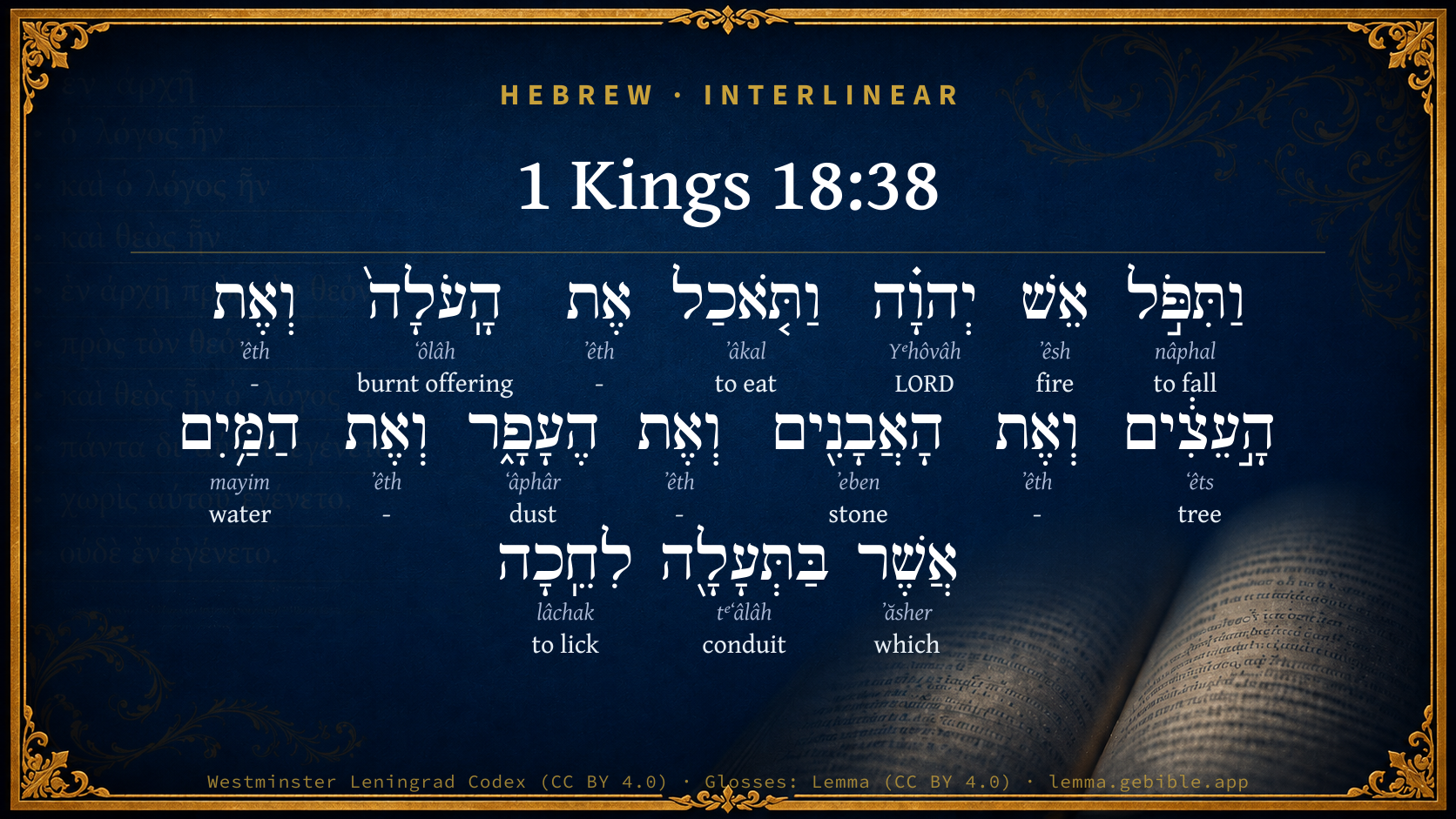
  1. וַתִּפֹּ֣ל nâphal H5307 “and · to fall” Conjunction + Verb, Qal, Sequential Imperfect, 3rd Person, Feminine, Singular
  2. אֵשׁ ʼêsh H784 “fire of” Noun, Common, Both, Singular, Construct
  3. יְהוָ֗ה Yᵉhôvâh H3068 “LORD” Noun, Proper
  4. וַתֹּ֤אכַל ʼâkal H398 “and · to eat” Conjunction + Verb, Qal, Sequential Imperfect, 3rd Person, Feminine, Singular
  5. אֶת ʼêth H853 “-” Particle, Direct Object
  6. הָֽעֹלָה֙ ʻôlâh H5930 “the · burnt offering” Particle, Definite Article + Noun, Common, Feminine, Singular, Absolute
  7. וְאֶת ʼêth H853 “and · -” Conjunction + Particle, Direct Object
  8. הָ֣עֵצִ֔ים ʻêts H6086 “the · trees” Particle, Definite Article + Noun, Common, Masculine, Plural, Absolute
  9. וְאֶת ʼêth H853 “and · -” Conjunction + Particle, Direct Object
  10. הָאֲבָנִ֖ים ʼeben H68 “the · stones” Particle, Definite Article + Noun, Common, Feminine, Plural, Absolute
  11. וְאֶת ʼêth H853 “and · -” Conjunction + Particle, Direct Object
  12. הֶעָפָ֑ר ʻâphâr H6083 “the · dust” Particle, Definite Article + Noun, Common, Masculine, Singular, Absolute
  13. וְאֶת ʼêth H853 “and · -” Conjunction + Particle, Direct Object
  14. הַמַּ֥יִם mayim H4325 “the · water(s)” Particle, Definite Article + Noun, Common, Masculine, Plural, Absolute
  15. אֲשֶׁר ʼăsher H834 “which” Particle, Relative
  16. בַּתְּעָלָ֖ה tᵉʻâlâh H8585 “in/at the · conduit” Preposition, Determined + Noun, Common, Feminine, Singular, Absolute

About this verse

These counts appear in no published source. They are computed here, from the morphology-tagged text and Lemma’s own curated glosses. What Lemma adds →

17
words
13
distinct lemmas
Historical
section

Notable vocabulary

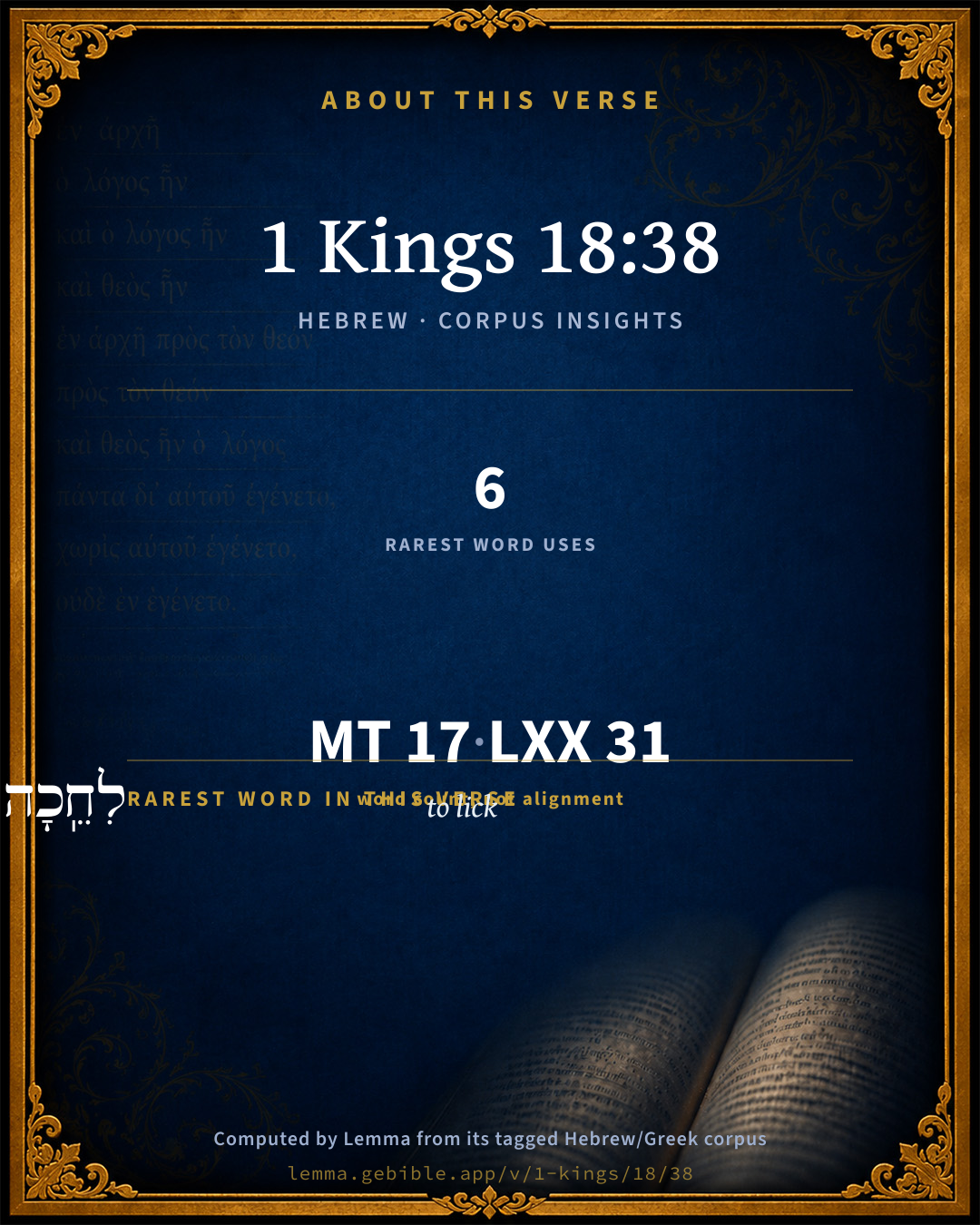
The rarest word here is לִחֵֽכָה to lick H3897 — appearing just 6 times in the whole Hebrew Bible.

Shared distinctive vocabulary

לִחֵֽכָה to lick H3897 occurs in 5 verses of the Hebrew Bible. Also found in:

Grammatical profile

  • 3 verbs
  • 8 nouns
  • 6 particles

Verb forms

  • וַתִּפֹּ֣ל Qal · Sequential Imperfect
  • וַתֹּ֤אכַל Qal · Sequential Imperfect
  • לִחֵֽכָה Piel · Perfect

Hebrew & Septuagint length

In English translation the verse runs 30 words from the Hebrew and 36 from the Septuagint (LXX English) — closely comparable.

A rough comparison of the two English renderings, which tokenize alike — not a word-level alignment.

Word counts can differ between the Hebrew and the Greek without any difference in meaning — e.g. the Hebrew direct-object marker אֵת has no separate Greek word, and Greek often adds the article ὁ.

In the original languages it is 17 Hebrew tokens and 31 Greek tokens — but the two are counted differently (Hebrew bundles its prefixes and suffixes into one token; the Greek is in lemma form), so that isn’t a like-for-like length.

Cross-references

10

Topical passages linked to 1 Kings 18:38 in the Treasury of Scripture Knowledge — connected by theme and wording, ordered by reader-vote popularity; previews shown in the World English Bible.

  • Leviticus 9:24 There came forth fire from before Yahweh, and consumed the burnt offering and the fat upon the altar: and when all the people saw it, they shouted, and fell on their faces.
  • 1 Chronicles 21:26 David built there an altar to Yahweh, and offered burnt offerings and peace-offerings, and called on Yahweh; and he answered him from the sky by fire on the altar of burnt offering.
  • 2 Chronicles 7:1 Now when Solomon had made an end of praying, the fire came down from heaven, and consumed the burnt offering and the sacrifices; and the glory of Yahweh filled the house.
  • Judges 6:21 Then the angel of Yahweh put forth the end of the staff that was in his hand, and touched the flesh and the unleavened cakes; and there went up fire out of the rock, and consumed the flesh and the unleavened cakes; and the angel of Yahweh departed out of his sight.
  • 1 Kings 18:24 You call on the name of your god, and I will call on the name of Yahweh; and the God who answers by fire, let him be God." All the people answered, "It is well said."
  • Leviticus 10:2 And fire came forth from before Yahweh, and devoured them, and they died before Yahweh.
  • 2 Kings 1:12 Elijah answered them, If I be a man of God, let fire come down from the sky, and consume you and your fifty. The fire of God came down from the sky, and consumed him and his fifty.
  • Job 1:16 While he was still speaking, there also came another, and said, "The fire of God has fallen from the sky, and has burned up the sheep and the servants, and consumed them, and I alone have escaped to tell you."
  • Genesis 15:17 It came to pass that, when the sun went down, and it was dark, behold, a smoking furnace, and a flaming torch passed between these pieces.
  • Isaiah 31:9 His rock shall pass away by reason of terror, and his princes shall be dismayed at the ensign, says Yahweh, whose fire is in Zion, and his furnace in Jerusalem.

Cross-references courtesy of OpenBible.info (CC BY 4.0).

Hebrew and Greek witnesses Masoretic Hebrew ↔ Greek Septuagint

The same verse in the two great witnesses to the Old Testament, shown verse-for-verse.

These are two independent witnesses, not word-aligned to each other, and the Septuagint is shown in lemma (dictionary) form.

Hebrew 1 Kings 18:38 Masoretic · Westminster Leningrad Codex

וַתִּפֹּ֣ל אֵשׁ יְהוָ֗ה וַתֹּ֤אכַל אֶת הָֽעֹלָה֙ וְאֶת הָ֣עֵצִ֔ים וְאֶת הָאֲבָנִ֖ים וְאֶת הֶעָפָ֑ר וְאֶת הַמַּ֥יִם אֲשֶׁר בַּתְּעָלָ֖ה לִחֵֽכָה

Then the fire of Yahweh fell, and consumed the burnt offering, and the wood, and the stones, and the dust, and licked up the water that was in the trench.

World English Bible · Public Domain

Greek LXX 1 Kings 18:38 Septuagint · lemma form

καί πίπτω πῦρ παρά κύριος ἐκ ὁ οὐρανός καί καταἐσθίω ὁ ὁλοκαύτωμα καί ὁ σχίδαξ καί ὁ ὕδωρ ὁ ἐν ὁ θααλα καί ὁ λίθος καί ὁ χοῦς ἐκλείχω ὁ πῦρ

Then fire fell from the Lord out of heaven, and devoured the whole burnt offerings, and the wood and the water that was in the trench, and the fire licked up the stones and the earth.

LXX2012 (modern English Septuagint) · Public Domain

On this verse, The Cambridge Bible for Schools and Colleges discusses the Septuagint’s reading. Read the note in Commentary ↓

Hebrew: Westminster Leningrad Codex (CC BY 4.0). Greek: Septuagint (public domain); English from LXX2012 (modern English Septuagint) (Public Domain). How the Septuagint differs from the Hebrew →

Targum (Aramaic paraphrase)

1

The Targum is the ancient Jewish Aramaic paraphrase of the Hebrew Scriptures — an interpretive translation, not the Hebrew text itself. Onkelos (literal) and Pseudo-Jonathan (expansive) render the Torah, and Jonathan the Prophets. Coverage is partial: where no permissively-licensed English translation exists for a verse, only the Aramaic is shown. This is verse-level text, not a word-by-word alignment to the Hebrew.

  1. Targum Jonathan Prophets (Joshua–Malachi)
    וּנְפָלַת אֶשְׁתָּא מִן קֳדָם יְיָ וַאֲכָלַת יַת עֲלָתָא וְיַת אָעַיָא וְיַת אַבְנַיָא וְיַת עַפְרָא וְיַת מַיָא דְמִבְזִיקָתָא לְחֵיכַת:

    (no public-domain English translation for this verse)

    Targum Jonathan — Aramaic: “Mikraot Gedolot” (public domain). English: “Sefaria Community Translation” (CC0 1.0 (public-domain dedication)); “London "Chaldee Paraphrase," 1871” (public domain). Text via Sefaria.

Commentary

Notes on 1 Kings 18:38 from classic Christian and Jewish commentators (each source and its license shown beneath its notes). The classic Christian expositions comment on the surrounding passage and are grouped to its opening verse, so a note may address several verses; the Jewish commentaries on the Tanakh (Rashi and others) are per-verse, so they appear only where the commentator wrote on this verse.

Lemma curates 59 commentaries, every one of them public domain or Creative Commons licensed, each selected and text-cleaned for this edition rather than reprinted as found. About our sources →

Trapp's Complete Commentary

John Trapp

1Ki 18:38 Then the fire of the LORD fell, and consumed the burnt sacrifice, and the wood, and the stones, and the dust, and licked up the water that [was] in the trench.

Ver. 38. Then the fire of the Lord fell.] In answer to the prophet’s prayer, and for the conversion of the people. Plutarch giving a reason why the Cretans pictured Jupiter without ears, saith, Non convenit ab eo audiri quenquam qui omnium sit dominus atque princeps: It is not fit that he should hear any one, who is himself lord of all. But our God taketh no such state upon him; he prepareth his people’s hearts, and then causeth his ears to hear; {Psa 10:17} he is near to his suppliants, and rich in mercy to those that call upon him.

John Trapp, A Commentary or Exposition upon All the Books of the Old and New Testament (1647–1656) — public domain. Text from a community e-Sword module.

Joseph Benson's Commentary

1Ki 18:38. The fire of the Lord fell — And not only, as at other times, (see the margin,) consumed the sacrifice and the wood, in token of God’s acceptance of the offering, but licked up all the water that was in the trench, exhaling and drawing it up as a vapour, to descend (with other water, to be raised from the adjoining sea) in the intended rain, which was to be the fruit of this sacrifice and prayer, more than the product of natural causes. And this was not all. To complete the miracle, the fire consumed the stones of the altar, and the very dust, to show that it was no ordinary fire, and perhaps to intimate that though God accepted this occasional sacrifice from this altar, yet for the future they ought to demolish all the altars on their high places, and for their constant sacrifices make use of that at Jerusalem only. Moses’s altar and Solomon’s were consecrated by fire from heaven; but this was destroyed, because it was to be used no more. We may well imagine, what a terror this fire struck on guilty Ahab, and all the worshippers of Baal, and how they fled from it as far and as fast as they could, saying, in their hearts, Lest it consume us also, Num 16:34.

Joseph Benson's Commentary on the Old and New Testaments (1811–1818) — public domain. Text from a community e-Sword module.

Tyndale Open Study Notes

Tyndale Open Resources

18:38-39 Whether by lightning strike or more supernatural means, the Lord sent fire to consume everything, including all the water in the trench. This was convincing proof that the Lord is God. The continuing story demonstrates conclusively that the Lord, not Baal, has control over fire, water, and the weather.

Tyndale Open Study Notes — © Tyndale Open Resources, licensed CC BY-SA 4.0. Text via the HelloAO Bible API.

Adam Clarke's Commentary

Verse 38. Then the fire of the Lord fell] It did not burst out from the altar; this might still, notwithstanding the water, have afforded some ground for suspicion that fire had been concealed, after the manner of the heathens, under the altar.

Pindar's account of the Rhodians' settling is the isle of Rhodes, and their first sacrifice there, bears a near affinity to the account here given: the shower of gold descending on the sacrifice offered up without fire, to show the approbation of their god, is little more than a poetic account of the above transactions.

Καιτοι γαρ αιθουσας εχοντεςπ

Σπερμ ' ανεβαν φλογος ου

Τευξαν δ ' απυροις ἱεροις

Αλσος εν ακροπολει· κεινοισι μεν ξαν -

θαν αγαγων νεφελαι·

Πολυν ὑσε χρυσον

Pind. Olymp. Od. 7, ver. 86.

The Rhodians, mindful of their sire's behest,

Straight in the citadel an altar reared;

But with imperfect rites the Power addressed,

And without fire their sacrifice prepared;

Yet Jove, approving, o'er the assembly spread

A yellow cloud, that dropped with golden dews.

WEST.

Consumed the burnt-sacrifice] The process of this consumption is very remarkable, and all calculated to remove the possibility of a suspicion that there was any concealed fire.

1. The fire came down from heaven.

2. The pieces of the sacrifice were first consumed.

3. The wood next, to show that it was not even by means of the wood that the flesh was burned.

4. The twelve stones were also consumed, to show that it was no common fire, but one whose agency nothing could resist.

5. The dust, the earth of which the altar was constructed, was burned up.

6. The water that was in the trench was, by the action of this fire, entirely evaporated.

7. The action of this fire was in every case downward, contrary to the nature of all earthly and material fire. Nothing can be more simple and artless than this description, yet how amazingly full and satisfactory is the whole account!

Adam Clarke's Commentary on the Bible (1810–1826) — public domain. Text from a community e-Sword/MySword module.

The Cambridge Bible for Schools and Colleges

gen. ed. J. J. S. Perowne

38. Then the fire of the Lord fell] In the LXX. we have ‘and there fell fire from the Lord out of heaven.’

burnt sacrifice] R.V. burnt-offering as in 1Ki_18:33. To mark the might of Him who sent the fire, it not only consumes the victims and licks up the water, but devoured wood, stones and dust alike.

The Cambridge Bible for Schools and Colleges (gen. ed. J. J. S. Perowne; Cambridge University Press, 1878–1918) — public domain. Text from a community e-Sword module.

John Gill's Exposition

And Elijah said unto them, take the prophets of Baal,.... The four hundred and fifty that were upon the spot; for the number of the people of Israel, now gathered together, were equal to it; nor was it in Ahab's power to hinder it, and he might himself be so far surprised and convicted as not in the least to object to it:

let not one of them escape: that there might be none of them left to seduce the people any more:

and they took them; laid hold on them, everyone of them:

and Elijah brought them down to the brook Kishon; which ran by the side, and at the bottom of Mount Carmel, into the sea; See Gill on Jdg 4:7, Jdg 5:21.

and slew them there; intimating, that it was owing to the idolatry they led the people into that rain had been withheld, and the brooks were dried up, as this might be; or, as Ben Gersom thinks, that the land might not be defiled with their blood, but be carried down the river after it: these he slew not with his own hand, but by others he gave orders to do it; and this not as a private person, but as an extraordinary minister of God, to execute justice according to his law, Deu 13:1 by which law such false prophets were to die; and the rather he was raised up and spirited for this service, as the supreme magistrate was addicted to idolatry himself.

John Gill's Exposition of the Whole Bible (1746–1763) — public domain (CC PDM 1.0). Text via the HelloAO Bible API.

Albert Barnes' Notes on the Bible

The fire of the Lord fell - This cannot have been a flash of lightning. It was altogether, in its nature as well as in its opportuneness, miraculous. Compare the marginal references for the conduct of the people.

Albert Barnes' Notes on the Bible (1834–1885) — public domain. Text from a community e-Sword/MySword module.

Haydock's Catholic Bible Commentary

Trench, as if it had been of an inflammable nature. Julian himself was forced to acknowledge this miracle. "This, says he, once happened under Moses, and, a long while after, again under Elias, the Thesbite."

George Leo Haydock (1774–1849), Haydock's Catholic Family Bible and Commentary, 1859 edition — public domain. Excludes Psalms (Douay-Rheims chapter numbering differs from Protestant) and Deuterocanonical books (Catholic canon only).

Whedon's Commentary on the Bible

Daniel D. Whedon

38. The fire of the Lord fell — See marginal references. This miraculous fire descended from heaven in flaming proof that it was no result of fraudulent practice. Chrysostom says he was personally knowing to fraudulent practices of idolaters whereby fire was kindled on the altar by means of a concealed excavation underneath; and an old tradition says that these priests of Baal had a man hidden under their altar on Carmel, but he was suffocated before he could kindle the fire. “There is an exultant triumph in the words in which the sacred historian describes the completeness of the conflagration. The fragments of the ox on the summit of the altar first disappear; then the pile of wood, heaped from the forests of Carmel; next the very stones of the altar crumble in the flames; then the very dust of the earth that had been thrown out of the trench; and lastly, the water in the trench round the altar is licked up by the fiery tongues, and leaves the whole place bare.” — Stanley.

Daniel D. Whedon (gen. ed.), Commentary on the Old and New Testaments (1874–1909) — public domain. Text from a community e-Sword module.

The Pulpit Commentary

Then the fire of the Lord Jehovah. Not lightning, but supernatural light and heat emanating from God Himself. (Cf. Leviticus 1Ch_21:26; 2Ch_7:1; Heb_12:29) fell, and consumed Heb. ate up, devoured the burnt sacrifice, and the wood, and the stones in calcem redigit, Cler., and the dust Bahr translates die Erde, and understands this to be the earth with which the altar of twelve stones had been packed. Similarly Rawlinson. But it is very doubtful whether rp pulvis, could be used in this sense. It may mean dry earth, but this altar had been deluged with water, and licked up is clearly onomatopoetic, like our lick ; Germ. lecken; Gr. leicw, etc. It expresses well the action of tongues of flame the water that was in the trench.

The Pulpit Commentary (1880–1919), ed. H.D.M. Spence-Jones & Joseph S. Exell — public domain. Text from a community e-Sword module.

John Wesley's Explanatory Notes

Consumed - Solomon's altar was consecrated by fire from heaven; but this was destroyed, because no more to be used.

John Wesley, Explanatory Notes Upon the Whole Bible (1754–1765) — public domain. Text via the GEBible commentary corpus.

unfoldingWord translationNotes

Door43 World Missions Community

the fire of Yahweh fell

"the fire of Yahweh came down"

licked up

The fire is compared to a thirsty person drinking water. (See: Personification)

Yahweh, he is God! Yahweh, he is God!

This phrase is repeated for emphasis.

translationWords

Yahweh

consume

Baal

unfoldingWord translationNotes — © Distant Shores Media and the Door43 World Missions Community, licensed CC BY-SA 4.0. Source: git.door43.org/Door43/en_tn.

Lesson kit

Teaching starters — assembled from the data on this page, not authored interpretation. Every prompt links to the verse data it draws on. Edit before teaching.

1 Kings, in the Historical, opens this verse with 17 words (13 distinct Hebrew lemmas). Its most distinctive word is lâchak (“to lick”). A historical commentator’s framing appears above. Read the whole chapter for the surrounding context.

Discussion questions

  1. What does “to lick” (lâchak) contribute to the verse as a whole?
  2. How does Numbers 22:4, which shares the word «to lick», read alongside this verse?
  3. The translations on this page render this verse differently — a whole-verse word diff, not a word-by-word alignment. What might account for the different wordings?
  4. «וַתִּפֹּ֣ל» is a Qal Sequential Imperfect verb. How does that grammatical form shape the action described?
  5. Compare how Trapp's Complete Commentary and Joseph Benson's Commentary read this verse. Where do they agree or differ?

Things to notice

Reading settings

Reading text

Shown beneath each verse's original-language words.

Old Testament
Old Testament edition

Read the OT as the Masoretic Hebrew (MT) or the Greek Septuagint (LXX).

English shown for the Greek Septuagint (in the Hebrew ↔ Greek comparison).

Comparing translations? Open the Compare panel on any verse page to stack up to four side by side.