Joshua 8:25

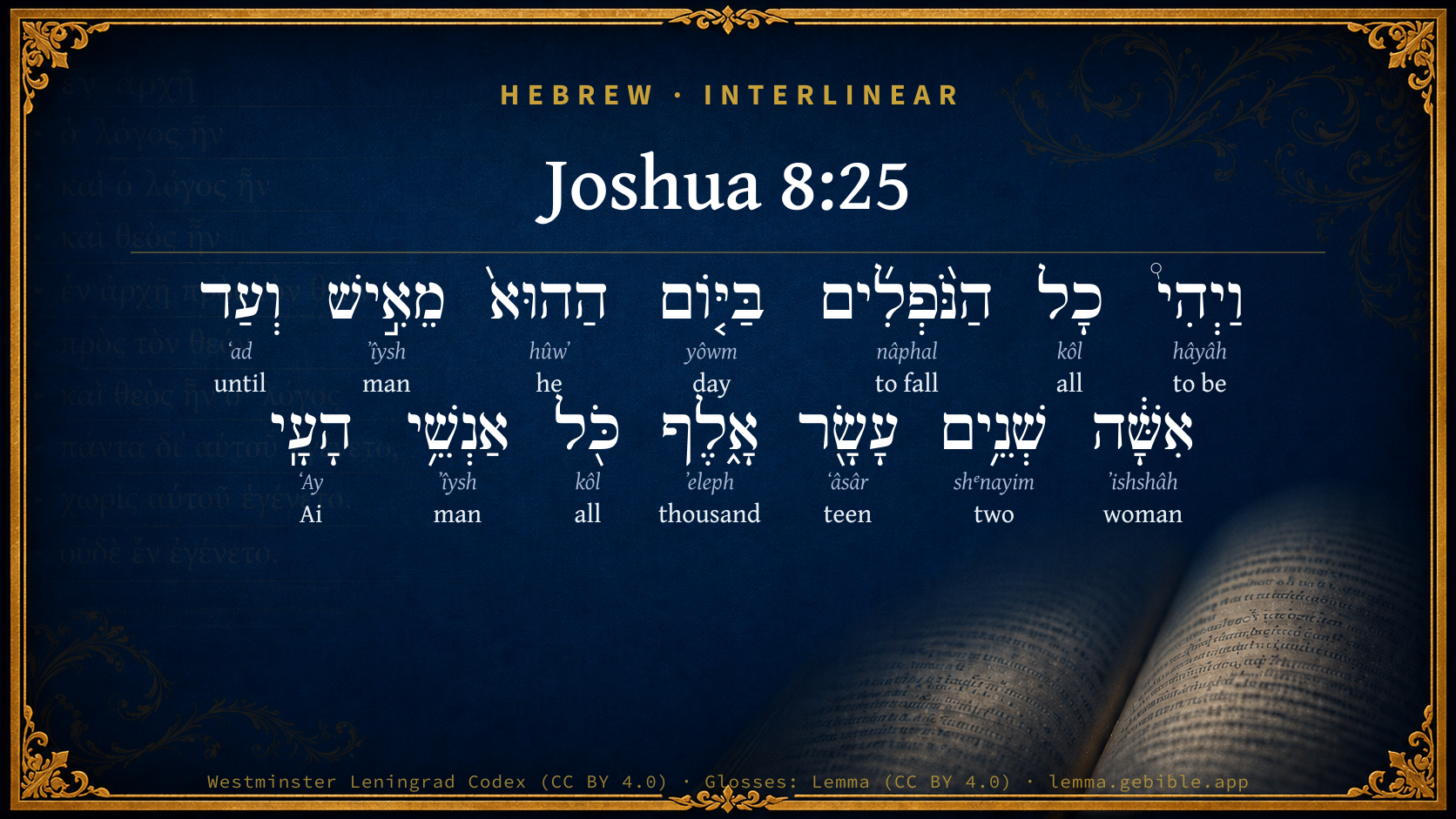
Hebrew (Westminster Leningrad Codex) Joshua 8:25 appears in the Hebrew Old Testament. The text above is from the Westminster Leningrad Codex. Each word links to its Strong’s number, a concise gloss, and parsing drawn from the Open Scriptures Hebrew Bible morphology. Click any word for its full Brown-Driver-Briggs (BDB) entry.
Download image
Cite this verse

Joshua 8:25 (World English Bible). Public Domain. Lemma interlinear Bible study tool, https://lemma.gebible.app/v/joshua/8/25.

Show BibTeX & RIS
BibTeX
RIS
English Translation
All that fell that day, both of men and women, were twelve thousand, even all the men of Ai.
World English Bible · Public Domain
Download a study sheet

One document with this verse’s original text, its word-by-word gloss line, the meaning frame, cross-references with their text, attributed commentary, and full source and license credits — printable, and it pastes into notes with its structure intact.

This verse Autodidact and up

Study sheet (.html) Plain text (.txt)

A passage Seminary Student

Up to 50 verses in one chapter. A passage sheet keeps up to 6 commentary sources and 12 cross-references per verse, in the order this page ranks them, and says so on the sheet whenever that leaves anything out. Ask for a single verse and you get the Autodidact verse sheet above.

Everything on this page stays free to read, with no account — the sheet is a download of what is already on screen, not access to it.

Want to remove ads? Support Godless Engineer
Compare translations 3

The same verse in 3 English versions, stacked beneath the original-language interlinear above. Click any original word for its lexicon entry.

Each is an independent rendering of the whole verse — the interlinear is not word-aligned to these translations.

Highlighted words mark where these versions differ — a whole-verse word diff, not a word-by-word alignment.

  • World English Bible Public Domain
    All that fell that day, both of men and women, were twelve thousand, even all the men of Ai.
  • King James Version Public Domain
    And so it was, that all that fell that day, both of men and women, were twelve thousand, even all the men of Ai.
  • unfoldingWord Literal Text CC BY-SA 4.0
    And it happened that all of the ones falling on that day, from man and unto woman, were 12, 000, all of the men of Ai.

unfoldingWord Literal Text — © unfoldingWord, licensed CC BY-SA 4.0. Word-aligned USFM3 via Door43 (git.door43.org/unfoldingWord/en_ult).

Versions to compare (up to 4)

3 of 4 selected

Show all 18 translations

Every available English version of this verse, each an independent rendering of the whole verse.

  • World English Bible Public Domain
    All that fell that day, both of men and women, were twelve thousand, even all the men of Ai.
  • Berean Standard Bible Public Domain
    A total of twelve thousand men and women fell that day—all the people of Ai.
  • Majority Standard Bible Public Domain
    A total of twelve thousand men and women fell that day—all the people of Ai.
  • King James Version Public Domain
    And so it was, that all that fell that day, both of men and women, were twelve thousand, even all the men of Ai.
  • American Standard Version (1901) Public Domain
    And all that fell that day, both of men and women, were twelve thousand, even all the men of Ai.
  • Revised Version (1885) Public Domain
    And all that fell that day, both of men and women, were twelve thousand, even all the men of Ai.
  • Geneva Bible (1599) Public Domain
    And all that fell that day, both of men and women, were twelue thousande, euen all the men of Ai.
  • Douay-Rheims (1899) Public Domain
    And the number of them that fell that day, both of men and women, was twelve thousand persons all of the city of Hai.
  • Young's Literal Translation Public Domain
    and all who fall during the day, of men and of women, are twelve thousand -- all men of Ai.
  • Literal Standard Version CC BY-SA 4.0
    and all who fall during the day, of men and of women, are twelve thousand—all men of Ai.
  • Unlocked Literal Bible CC BY-SA 4.0
    All those who fell that day, both men and women, were twelve thousand, all the people of Ai.
  • unfoldingWord Literal Text CC BY-SA 4.0
    And it happened that all of the ones falling on that day, from man and unto woman, were 12, 000, all of the men of Ai.
  • Darby Bible Public Domain
    And so it was, that all who fell that day, men as well as women, were twelve thousand, all the people of Ai.
  • World Messianic Bible Public Domain
    All that fell that day, both of men and women, were twelve thousand, even all the people of Ai.
  • Webster's Bible Public Domain
    And so it was, that all that fell that day, both of men and women, were twelve thousand, even all the men of Ai.
  • Free Bible Version CC BY-SA 4.0
    Those who were killed that day numbered twelve thousand, men and women—all the inhabitants of Ai.
  • Bible in Basic English Public Domain
    On that day twelve thousand were put to death, men and women, all the people of Ai.
  • JPS Tanakh (1917) Public Domain
    And all that fell that day, both of men and women, were twelve thousand, even all the men of Ai.

Literal Standard Version (2020), Covenant Press — licensed CC BY-SA 4.0. Text via the HelloAO Bible API (eBible.org). Unlocked Literal Bible (unfoldingWord) — licensed CC BY-SA 4.0. Text via the HelloAO Bible API (eBible.org). unfoldingWord Literal Text — © unfoldingWord, licensed CC BY-SA 4.0. Word-aligned USFM3 via Door43 (git.door43.org/unfoldingWord/en_ult). Free Bible Version, Dr. Jonathan Gallagher — licensed CC BY-SA 4.0. Text via the HelloAO Bible API (eBible.org).

Word by word

More ways to search: Search by grammar → Find every occurrence → Compare this word →

Practice this passage: Drill this verse → Learn its vocabulary →

הָעָֽי
ʻAy
H5857
“the · Ai”
Particle, Definite Article + Noun, Proper
Part of Speech
Particle + Noun
Type
Proper
Full BDB Definition

Origin: for H5856

TWOT: None

Ai or Aija or Aiath or Hai = "heap of ruins" - a city lying east of Bethel and beside Bethaven near Jericho and the 2nd city taken on the invasion of Canaan - a city of the Ammonites on the east of the Jordan and apparently attached to Heshbon
  1. וַיְהִי֩ hâyâh H1961 “and · to be” Conjunction + Verb, Qal, Sequential Imperfect, 3rd Person, Masculine, Singular
  2. כָל kôl H3605 “all of” Noun, Common, Masculine, Singular, Construct
  3. הַנֹּ֨פְלִ֜ים nâphal H5307 “the · falling” Particle, Definite Article + Verb, Qal, Participle Active, Masculine, Plural, Absolute
  4. בַּיּ֤וֹם yôwm H3117 “in/at the · day” Preposition, Determined + Noun, Common, Masculine, Singular, Absolute
  5. הַהוּא֙ hûwʼ H1931 “the · he” Particle, Definite Article + Pronoun, Personal, 3rd Person, Masculine, Singular
  6. מֵאִ֣ישׁ ʼîysh H376 “from · man” Preposition + Noun, Common, Masculine, Singular, Absolute
  7. וְעַד ʻad H5704 “and · until” Conjunction + Preposition
  8. אִשָּׁ֔ה ʼishshâh H802 “woman” Noun, Common, Feminine, Singular, Absolute
  9. שְׁנֵ֥ים shᵉnayim H8147 “two” Adjective, Cardinal number, Masculine, Dual, Absolute
  10. עָשָׂ֖ר ʻâsâr H6240 “teen” Adjective, Cardinal number, Masculine, Singular, Absolute
  11. אָ֑לֶף ʼeleph H505 “thousand” Adjective, Cardinal number, Both, Singular, Absolute
  12. כֹּ֖ל kôl H3605 “all of” Noun, Common, Masculine, Singular, Construct
  13. אַנְשֵׁ֥י ʼîysh H376 “men of” Noun, Common, Masculine, Plural, Construct

About this verse

These counts appear in no published source. They are computed here, from the morphology-tagged text and Lemma’s own curated glosses. What Lemma adds →

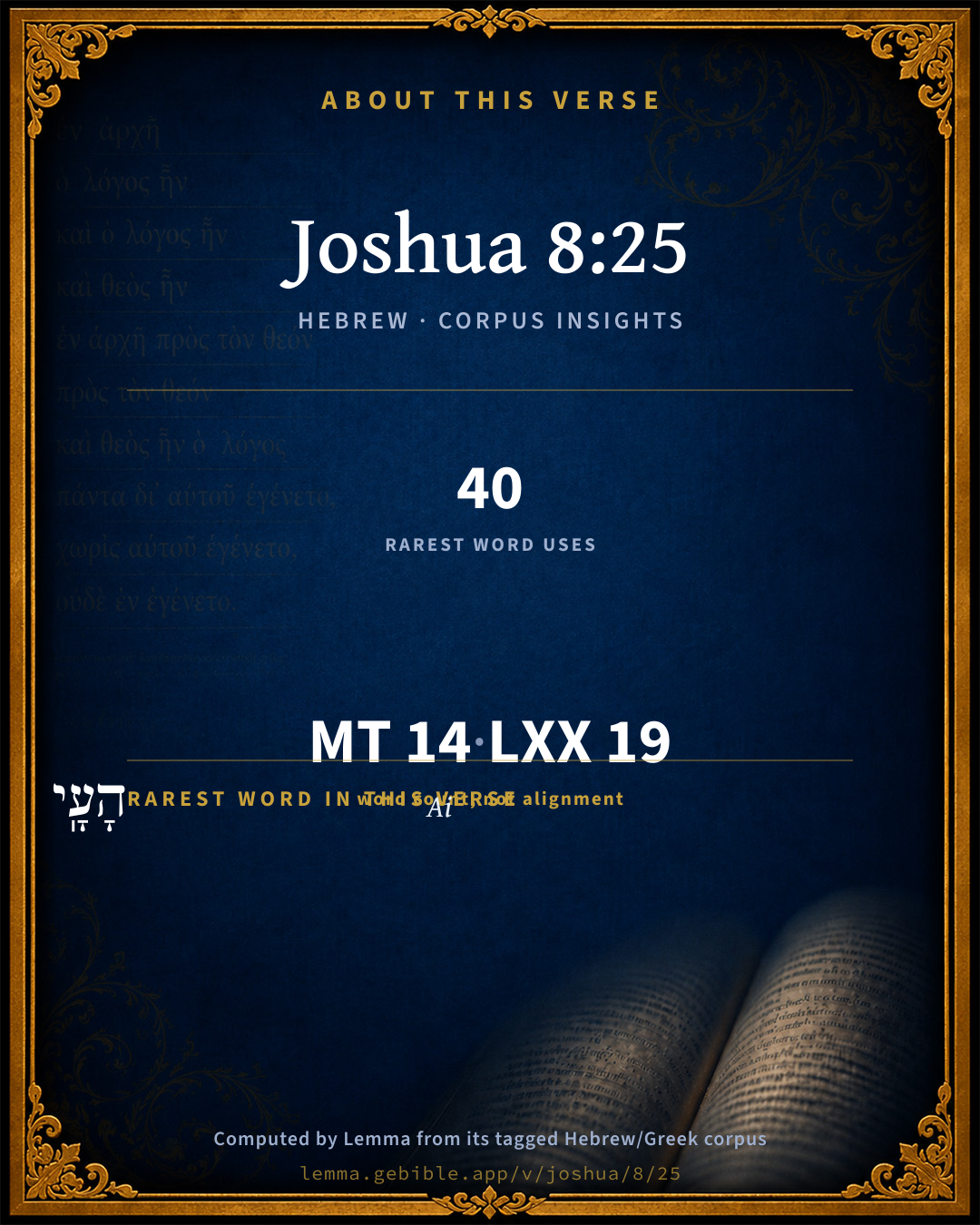
14
words
12
distinct lemmas
Historical
section

Shared distinctive vocabulary

הָעָֽי Ai H5857 occurs in 34 verses of the Hebrew Bible. Also found in:

Grammatical profile

  • 2 verbs
  • 7 nouns
  • 3 adjectives
  • 1 pronoun
  • 1 preposition

Verb forms

  • וַיְהִי֩ Qal · Sequential Imperfect
  • הַנֹּ֨פְלִ֜ים Qal · Participle Active

Repetition

Words recur within this verse — often emphatic in Hebrew:

  • כָל all H3605 ×2
  • מֵאִ֣ישׁ man H376 ×2

Hebrew & Septuagint length

In English translation the verse runs 19 words from the Hebrew and 20 from the Septuagint (LXX English) — closely comparable.

A rough comparison of the two English renderings, which tokenize alike — not a word-level alignment.

Word counts can differ between the Hebrew and the Greek without any difference in meaning — e.g. the Hebrew direct-object marker אֵת has no separate Greek word, and Greek often adds the article ὁ.

In the original languages it is 14 Hebrew tokens and 19 Greek tokens — but the two are counted differently (Hebrew bundles its prefixes and suffixes into one token; the Greek is in lemma form), so that isn’t a like-for-like length.

Cross-references

1

Topical passages linked to Joshua 8:25 in the Treasury of Scripture Knowledge — connected by theme and wording, ordered by reader-vote popularity; previews shown in the World English Bible.

  • Deuteronomy 20:16–18 But of the cities of these peoples, that Yahweh your God gives you for an inheritance, you shall save alive nothing that breathes;

Cross-references courtesy of OpenBible.info (CC BY 4.0).

Hebrew and Greek witnesses Masoretic Hebrew ↔ Greek Septuagint

The same verse in the two great witnesses to the Old Testament, shown verse-for-verse.

These are two independent witnesses, not word-aligned to each other, and the Septuagint is shown in lemma (dictionary) form.

Hebrew Joshua 8:25 Masoretic · Westminster Leningrad Codex

וַיְהִי֩ כָל הַנֹּ֨פְלִ֜ים בַּיּ֤וֹם הַהוּא֙ מֵאִ֣ישׁ וְעַד אִשָּׁ֔ה שְׁנֵ֥ים עָשָׂ֖ר אָ֑לֶף כֹּ֖ל אַנְשֵׁ֥י הָעָֽי

All that fell that day, both of men and women, were twelve thousand, even all the men of Ai.

World English Bible · Public Domain

Greek LXX Joshua 8:25 Septuagint · lemma form

καί γίγνομαι ὁ πίπτω ἐν ὁ ἡμέρα ἐκεῖνος ἀπό ἀνήρ καί ἕως γυνή δώδεκα χιλιάς πᾶς ὁ καταοἰκέω γαι

And they that fell in that day, men and women, were twelve thousand: they killed all the inhabitants of Gai.

LXX2012 (modern English Septuagint) · Public Domain

Hebrew: Westminster Leningrad Codex (CC BY 4.0). Greek: Septuagint (public domain); English from LXX2012 (modern English Septuagint) (Public Domain). How the Septuagint differs from the Hebrew →

Targum (Aramaic paraphrase)

1

The Targum is the ancient Jewish Aramaic paraphrase of the Hebrew Scriptures — an interpretive translation, not the Hebrew text itself. Onkelos (literal) and Pseudo-Jonathan (expansive) render the Torah, and Jonathan the Prophets. Coverage is partial: where no permissively-licensed English translation exists for a verse, only the Aramaic is shown. This is verse-level text, not a word-by-word alignment to the Hebrew.

  1. Targum Jonathan Prophets (Joshua–Malachi)
    וַהֲווֹ כָּל דְאִתְקְטָלוּ בְּיוֹמָא הַהוּא מִגְבַר וְעַד אִתְּתָא תְּרֵי עֲשַׂר אַלְפִין כֹּל אֱנָשֵׁי עָי:

    (no public-domain English translation for this verse)

    Targum Jonathan — Aramaic: “Mikraot Gedolot” (public domain). English: “Sefaria Community Translation” (CC0 1.0 (public-domain dedication)); “London "Chaldee Paraphrase," 1871” (public domain). Text via Sefaria.

Commentary

Notes on Joshua 8:25 from classic Christian and Jewish commentators (each source and its license shown beneath its notes). The classic Christian expositions comment on the surrounding passage and are grouped to its opening verse, so a note may address several verses; the Jewish commentaries on the Tanakh (Rashi and others) are per-verse, so they appear only where the commentator wrote on this verse.

Lemma curates 59 commentaries, every one of them public domain or Creative Commons licensed, each selected and text-cleaned for this edition rather than reprinted as found. About our sources →

Trapp's Complete Commentary

John Trapp

Jos 8:25 And [so] it was, [that] all that fell that day, both of men and women, [were] twelve thousand, [even] all the men of Ai.

Ver. 25. Were twelve thousand.] A poor few to stand out against such an army; but self-confidence undid them.

John Trapp, A Commentary or Exposition upon All the Books of the Old and New Testament (1647–1656) — public domain. Text from a community e-Sword module.

John Calvin's Commentaries

25. And so it was that all that fell that day, etc The meaning is not that all the slain were inhabitants of Ai, but that all who dwelt in it were slain, that not one escaped. It has already been seen that the inhabitants of Bethel were mingled along with them; and as no mention of that city is afterwards made, it may be conjectured with some probability that they had abandoned their own town, which was little fortified, and betaken themselves for greater safety to one which they hoped could be easily defended. The words, therefore, simply mean, that all who had come out of the city and all who were found in it were slain to a man. If any are rather disposed to think that this number of those whose slaughter took place within the walls is confined to the aged, the sick, the women and the children, I will not dispute the matter. Still, if we consider that only a small town was conjoined with a city of no great extent or population, it is more probable that the number comprehends those also who fell in battle.

John Calvin's Commentaries (1540-1563) — public domain. Text from the Calvin Translation Society English edition (1840s-50s) via the Christian Classics Ethereal Library (ccel.org). Calvin's coverage is partial (roughly two-thirds of the Bible); uncommented books and verses are honest gaps, never fabricated. The 19th-century editor's footnotes and remarks are omitted so the notes are faithfully Calvin's own voice.

John Gill's Exposition

And so it was, that all that fell that day,.... Partly in the city, and partly in the field, both by the ambush and the army: both of men and women:

were twelve thousand, even all the men of Ai; so that the city was not a very large one, and the numbers of inhabitants were comparatively but few, as in Jos 7:3.

John Gill's Exposition of the Whole Bible (1746–1763) — public domain (CC PDM 1.0). Text via the HelloAO Bible API.

Matthew Poole's English Annotations

Not strictly, but largely so called, who were now in Ai, either as constant and settled inhabitants, or as sojourners, and such as came to them for their help, such as being confederate with them are esteemed as one with them; for it is evident that the men of Beth-el are included in this number, Jos 8:17, the Israelites who took this number being unable to distinguish who belonged to the one city, and who to the other.

Matthew Poole's English Annotations on the Holy Bible (1683–1685) — public domain. Text from a community e-Sword/MySword module.

Whedon's Commentary on the Bible

Daniel D. Whedon

[25. Twelve thousand — Some expositors have argued that these twelve thousand were only the military force of Ai; but this would imply a population of fifty or sixty thousand; a number far too large for a comparatively small city among the hills. Compare chap. Jos_7:3. This verse clearly affirms that the twelve thousand included all that fell that day, both of men and women.]

25. Joshua drew not his hand back — The uplifted spear was not only a signal for the assault of the city, but also for its continuance till the conquest was completed. We see no good reason for regarding this act as symbolic of prayer, as was the lifting up of Moses’ hands when Israel fought with Amalek. Exo_17:11.

Daniel D. Whedon (gen. ed.), Commentary on the Old and New Testaments (1874–1909) — public domain. Text from a community e-Sword module.

The Pulpit Commentary

All the men of Ai. Clearly all the population, as the context shows.

The Pulpit Commentary (1880–1919), ed. H.D.M. Spence-Jones & Joseph S. Exell — public domain. Text from a community e-Sword module.

John Wesley's Explanatory Notes

Of Ai - Not strictly, but largely so called, who were now in Ai, either as constant and settled inhabitants, or as sojourners and such as came to them for their help.

John Wesley, Explanatory Notes Upon the Whole Bible (1754–1765) — public domain. Text via the GEBible commentary corpus.

Lesson kit

Teaching starters — assembled from the data on this page, not authored interpretation. Every prompt links to the verse data it draws on. Edit before teaching.

Joshua, in the Historical, opens this verse with 14 words (12 distinct Hebrew lemmas). Its most distinctive word is ʻAy (“Ai”). A historical commentator’s framing appears above. Read the whole chapter for the surrounding context.

Discussion questions

  1. The word ʻAy carries the sense “Ai.” How does it shape the verse?
  2. How does Genesis 12:8, which shares the word «Ai», read alongside this verse?
  3. What does the repetition of “all” (2× in this one verse) do in this verse?
  4. These translations render this verse differently. What is at stake in choosing one wording over another?
  5. «וַיְהִי֩» is a Qal Sequential Imperfect verb. How does that grammatical form shape the action described?
  6. Compare how Trapp's Complete Commentary and John Calvin's Commentaries read this verse. Where do they agree or differ?

Things to notice

Reading settings

Reading text

Shown beneath each verse's original-language words.

Old Testament
Old Testament edition

Read the OT as the Masoretic Hebrew (MT) or the Greek Septuagint (LXX).

English shown for the Greek Septuagint (in the Hebrew ↔ Greek comparison).

Comparing translations? Open the Compare panel on any verse page to stack up to four side by side.