1 Chronicles 5:22

Hebrew (Westminster Leningrad Codex) 1 Chronicles 5:22 appears in the Hebrew Old Testament. The text above is from the Westminster Leningrad Codex. Each word links to its Strong’s number, a concise gloss, and parsing drawn from the Open Scriptures Hebrew Bible morphology. Click any word for its full Brown-Driver-Briggs (BDB) entry.
Download image
Cite this verse

1 Chronicles 5:22 (World English Bible). Public Domain. Lemma interlinear Bible study tool, https://lemma.gebible.app/v/1-chronicles/5/22.

Show BibTeX & RIS
BibTeX
RIS
English Translation
For there fell many slain, because the war was of God. They lived in their place until the captivity.
World English Bible · Public Domain
Download a study sheet

One document with this verse’s original text, its word-by-word gloss line, the meaning frame, cross-references with their text, attributed commentary, and full source and license credits — printable, and it pastes into notes with its structure intact.

This verse Autodidact and up

Study sheet (.html) Plain text (.txt)

A passage Seminary Student

Up to 50 verses in one chapter. A passage sheet keeps up to 6 commentary sources and 12 cross-references per verse, in the order this page ranks them, and says so on the sheet whenever that leaves anything out. Ask for a single verse and you get the Autodidact verse sheet above.

Everything on this page stays free to read, with no account — the sheet is a download of what is already on screen, not access to it.

Want to remove ads? Support Godless Engineer
Compare translations 3

The same verse in 3 English versions, stacked beneath the original-language interlinear above. Click any original word for its lexicon entry.

Each is an independent rendering of the whole verse — the interlinear is not word-aligned to these translations.

Highlighted words mark where these versions differ — a whole-verse word diff, not a word-by-word alignment.

  • World English Bible Public Domain
    For there fell many slain, because the war was of God. They lived in their place until the captivity.
  • King James Version Public Domain
    For there fell down many slain, because the war was of God. And they dwelt in their steads until the captivity.
  • unfoldingWord Literal Text CC BY-SA 4.0
    For many fell slain, for the battle from God. And they dwelled in place of them until the exile.

unfoldingWord Literal Text — © unfoldingWord, licensed CC BY-SA 4.0. Word-aligned USFM3 via Door43 (git.door43.org/unfoldingWord/en_ult).

Versions to compare (up to 4)

3 of 4 selected

Show all 18 translations

Every available English version of this verse, each an independent rendering of the whole verse.

  • World English Bible Public Domain
    For there fell many slain, because the war was of God. They lived in their place until the captivity.
  • Berean Standard Bible Public Domain
    and many others fell slain, because the battle belonged to God. And they occupied the land until the exile.
  • Majority Standard Bible Public Domain
    and many others fell slain, because the battle belonged to God. And they occupied the land until the exile.
  • King James Version Public Domain
    For there fell down many slain, because the war was of God. And they dwelt in their steads until the captivity.
  • American Standard Version (1901) Public Domain
    For there fell many slain, because the war was of God. And they dwelt in their stead until the captivity.
  • Revised Version (1885) Public Domain
    For there fell many slain, because the war was of God. And they dwelt in their stead until the captivity.
  • Geneva Bible (1599) Public Domain
    For many fel downe wounded, because the warre was of God. And they dwelt in their steads vntill the captiuitie.
  • Douay-Rheims (1899) Public Domain
    And many fell down slain: for it was the battle of the Lord. And they dwelt in their stead till the captivity.
  • Young's Literal Translation Public Domain
    for many have fallen pierced, for of God `is' the battle; and they dwell in their stead till the removal.
  • Literal Standard Version CC BY-SA 4.0
    for many have fallen pierced, for the battle [is] of God; and they dwell in their stead until the expulsion.
  • Unlocked Literal Bible CC BY-SA 4.0
    Many fell because the battle was from God. They lived in their land until the captivity.
  • unfoldingWord Literal Text CC BY-SA 4.0
    For many fell slain, for the battle from God. And they dwelled in place of them until the exile.
  • Darby Bible Public Domain
    For there fell down many slain, for the war was of God. And they dwelt in their stead until the captivity.
  • World Messianic Bible Public Domain
    For many fell slain, because the war was of God. They lived in their place until the captivity.
  • Webster's Bible Public Domain
    For there fell down many slain, because the war was of God. And they dwelt in their steads until the captivity.
  • Free Bible Version CC BY-SA 4.0
    and many others were killed because the battle belonged to God. They took over the land and lived there until the exile.
  • Bible in Basic English Public Domain
    And a very great number went to their death, because the war was God's purpose. And they went on living in their place till they were taken away as prisoners.
  • JPS Tanakh (1917) Public Domain
    For there fell many slain, because the war was of God. And they dwelt in their stead until the captivity.

Literal Standard Version (2020), Covenant Press — licensed CC BY-SA 4.0. Text via the HelloAO Bible API (eBible.org). Unlocked Literal Bible (unfoldingWord) — licensed CC BY-SA 4.0. Text via the HelloAO Bible API (eBible.org). unfoldingWord Literal Text — © unfoldingWord, licensed CC BY-SA 4.0. Word-aligned USFM3 via Door43 (git.door43.org/unfoldingWord/en_ult). Free Bible Version, Dr. Jonathan Gallagher — licensed CC BY-SA 4.0. Text via the HelloAO Bible API (eBible.org).

Word by word

More ways to search: Search by grammar → Find every occurrence → Compare this word →

Practice this passage: Drill this verse → Learn its vocabulary →

הַגֹּלָֽה
gôwlâh
H1473
“the · exile”
Particle, Definite Article + Noun, Common, Feminine, Singular, Absolute
Part of Speech
Particle + Noun
Type
Common
Gender
Feminine
Number
Singular
State
Absolute
Full BDB Definition

Origin: active participle of H1540

TWOT: 350a

exiles, exile, captivity - exiles (collective) - exile, captivity (abstract)
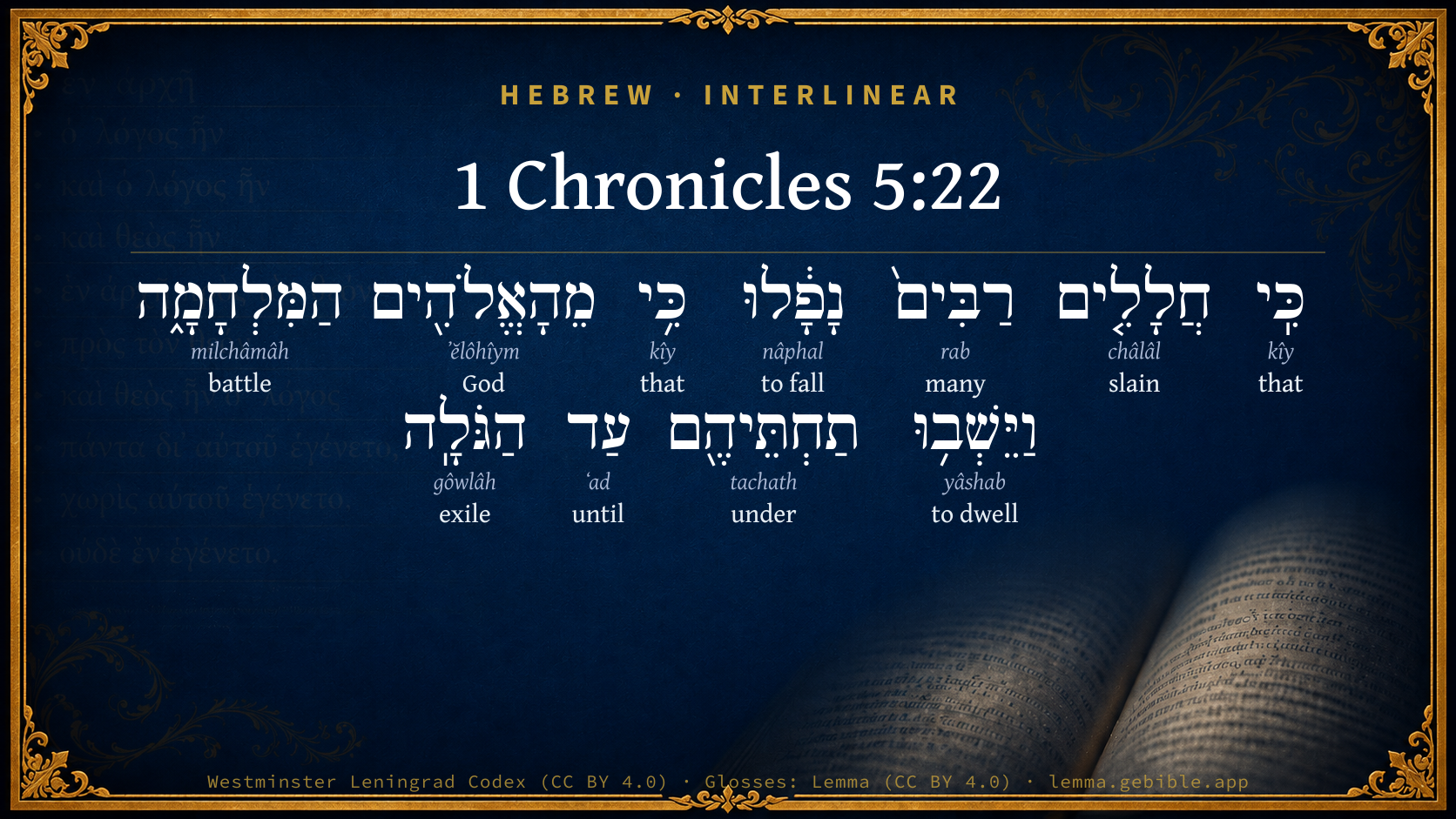
  1. כִּֽי kîy H3588 “that” Conjunction
  2. חֲלָלִ֤ים châlâl H2491 “slain” Adjective, Adjective, Masculine, Plural, Absolute
  3. רַבִּים֙ rab H7227 “many” Adjective, Adjective, Masculine, Plural, Absolute
  4. נָפָ֔לוּ nâphal H5307 “to fall” Verb, Qal, Perfect, 3rd Person, Common, Plural
  5. כִּ֥י kîy H3588 “that” Conjunction
  6. מֵהָאֱלֹהִ֖ים ʼĕlôhîym H430 “from · the · God(s)” Preposition + Particle, Definite Article + Noun, Common, Masculine, Plural, Absolute
  7. הַמִּלְחָמָ֑ה milchâmâh H4421 “the · battle” Particle, Definite Article + Noun, Common, Feminine, Singular, Absolute
  8. וַיֵּשְׁב֥וּ yâshab H3427 “and · to dwell” Conjunction + Verb, Qal, Sequential Imperfect, 3rd Person, Masculine, Plural
  9. תַחְתֵּיהֶ֖ם tachath H8478 “under · them” Preposition + Suffix, Personal, 3rd Person, Masculine, Plural
  10. עַד ʻad H5704 “until” Preposition

About this verse

These counts appear in no published source. They are computed here, from the morphology-tagged text and Lemma’s own curated glosses. What Lemma adds →

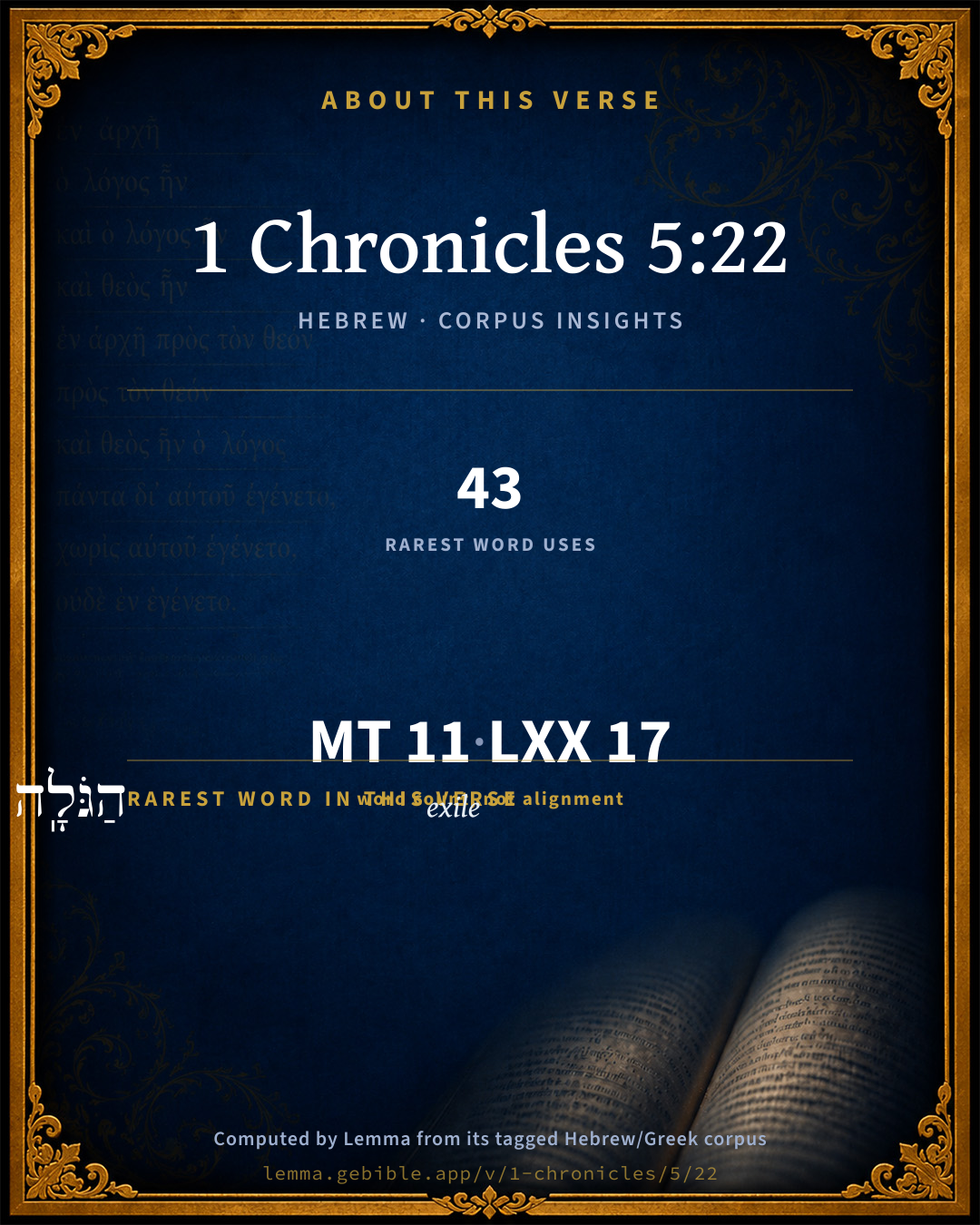
11
words
10
distinct lemmas
Historical
section

Shared distinctive vocabulary

הַגֹּלָֽה exile H1473 occurs in 42 verses of the Hebrew Bible. Also found in:

Grammatical profile

  • 2 verbs
  • 3 nouns
  • 2 adjectives
  • 2 prepositions
  • 2 conjunctions

Verb forms

  • נָפָ֔לוּ Qal · Perfect
  • וַיֵּשְׁב֥וּ Qal · Sequential Imperfect

Repetition

A word recurs within this verse — often emphatic in Hebrew:

  • כִּֽי that H3588 ×2

Hebrew & Septuagint length

In English translation the verse runs 19 words from the Hebrew and 19 from the Septuagint (LXX English) — the same length.

A rough comparison of the two English renderings, which tokenize alike — not a word-level alignment.

Word counts can differ between the Hebrew and the Greek without any difference in meaning — e.g. the Hebrew direct-object marker אֵת has no separate Greek word, and Greek often adds the article ὁ.

In the original languages it is 11 Hebrew tokens and 17 Greek tokens — but the two are counted differently (Hebrew bundles its prefixes and suffixes into one token; the Greek is in lemma form), so that isn’t a like-for-like length.

Cross-references

7

Topical passages linked to 1 Chronicles 5:22 in the Treasury of Scripture Knowledge — connected by theme and wording, ordered by reader-vote popularity; previews shown in the World English Bible.

  • Joshua 23:10 One man of you shall chase a thousand; for Yahweh your God, he it is who fights for you, as he spoke to you.
  • 2 Chronicles 32:8 with him is an arm of flesh; but with us is Yahweh our God to help us, and to fight our battles. The people rested themselves on the words of Hezekiah king of Judah.
  • Romans 8:31 What then shall we say about these things? If God is for us, who can be against us?
  • 2 Kings 15:29 In the days of Pekah king of Israel came Tiglath Pileser king of Assyria, and took Ijon, and Abel Beth Maacah, and Janoah, and Kedesh, and Hazor, and Gilead, and Galilee, all the land of Naphtali; and he carried them captive to Assyria.
  • 2 Kings 17:6 In the ninth year of Hoshea the king of Assyria took Samaria, and carried Israel away to Assyria, and placed them in Halah, and on the Habor, the river of Gozan, and in the cities of the Medes.
  • 1 Chronicles 6:26 As for Elkanah, the sons of Elkanah: Zophai his son, and Nahath his son,
  • 1 Chronicles 4:41 These written by name came in the days of Hezekiah king of Judah, and struck their tents, and the Meunim who were found there, and destroyed them utterly to this day, and lived in their place; because there was pasture there for their flocks.

Cross-references courtesy of OpenBible.info (CC BY 4.0).

Hebrew and Greek witnesses Masoretic Hebrew ↔ Greek Septuagint

The same verse in the two great witnesses to the Old Testament, shown verse-for-verse.

These are two independent witnesses, not word-aligned to each other, and the Septuagint is shown in lemma (dictionary) form.

Hebrew 1 Chronicles 5:22 Masoretic · Westminster Leningrad Codex

כִּֽי חֲלָלִ֤ים רַבִּים֙ נָפָ֔לוּ כִּ֥י מֵהָאֱלֹהִ֖ים הַמִּלְחָמָ֑ה וַיֵּשְׁב֥וּ תַחְתֵּיהֶ֖ם עַד הַגֹּלָֽה

For there fell many slain, because the war was of God. They lived in their place until the captivity.

World English Bible · Public Domain

Greek LXX 1 Chronicles 5:22 Septuagint · lemma form

ὅτι τραυματίας πολύς πίπτω ὅτι παρά ὁ θεός ὁ πόλεμος καί καταοἰκέω ἀντί αὐτός ἕως ὁ μετοικεσία

For many fell slain, because the war was of God. And they lived in their place until the captivity.

LXX2012 (modern English Septuagint) · Public Domain

Hebrew: Westminster Leningrad Codex (CC BY 4.0). Greek: Septuagint (public domain); English from LXX2012 (modern English Septuagint) (Public Domain). How the Septuagint differs from the Hebrew →

Commentary

Notes on 1 Chronicles 5:22 from classic Christian and Jewish commentators (each source and its license shown beneath its notes). The classic Christian expositions comment on the surrounding passage and are grouped to its opening verse, so a note may address several verses; the Jewish commentaries on the Tanakh (Rashi and others) are per-verse, so they appear only where the commentator wrote on this verse.

Lemma curates 59 commentaries, every one of them public domain or Creative Commons licensed, each selected and text-cleaned for this edition rather than reprinted as found. About our sources →

Trapp's Complete Commentary

John Trapp

1Ch 5:22 For there fell down many slain, because the war [was] of God. And they dwelt in their steads until the captivity.

Ver. 22. Because the war was of God,] i.e., It was just and necessary; God also fought therein, as it were personally, against those idolatrous wretches.

John Trapp, A Commentary or Exposition upon All the Books of the Old and New Testament (1647–1656) — public domain. Text from a community e-Sword module.

The Biblical Illustrator

Joseph S. Exell

1Ch_5:22

Because the war was of God.

Gods war

When a man fights against himself, in his lusts, passions, and unauthorised aspirations, he fights a war approved of God, and if he fights that war in the name of God he shall be none other than a victor at the close. When a man fights for the poor, the oppressed, the helpless, he is engaged in a battle over which God holds the banner, and the holding of that banner is the guarantee of triumph. (J. Parker, D. D.)

The war is of God

In speaking on temperance principles and trying to help and encourage temperance workers, this story of Bible history will well illustrate our theme. Consider:

I. The warriors.

1. They were courageous men--valiant men, sons of valour as the original has it.

2. They were skilful.

3. They were united.

II. The weapons which these warriors used.

1. The buckler. This was a weapon of defence, a small hand shield that was fastened to the wrist or to the hand itself, with which the warriors parried the blows of their enemies. Watch and pray, lest ye enter into temptation.

2. The sword. If temperance workers would take the Bible as their sword, they would get on better than with the wooden swords which so many are inclined to use.

3. Bows and arrows. The spiritual parallel is the arrow of conviction.

III. Their warfare. It was distinguished--

1. By faith.

(1) Personal. They trusted in God; we must also have a personal faith in Christ as our Saviour.

(2) Also in the power of the gospel to change the hearts and lives of men.

2. By prayer. They cried to God in the battle.

IV. The victory. (Thomas Spurgeon.)

The Biblical Illustrator, edited by Joseph S. Exell (c. 1880s–1900s) — public domain. Text from a community e-Sword module.

Joseph Benson's Commentary

1Ch 5:22. For there fell down many slain — Besides those taken captive, a great number were slain in the battle. Because the war was of God — Undertaken in his fear, and carried on in a dependance on him. Then we may expect to prosper in any enterprise, and then only, when we take God along with us. And they dwelt in their steads — Most or all of those valiant men who were engaged in this war, who were forty-four thousand seven hundred and sixty, (1Ch 5:18,) settled themselves in the country which they had conquered, and remained there until the captivity, of which see 2Ki 15:29; 2Ki 17:6.

Joseph Benson's Commentary on the Old and New Testaments (1811–1818) — public domain. Text from a community e-Sword module.

Geneva Bible (1599)

Geneva Bible translators

Meaning, the captivity of the ten tribes under Tiglath Pileser.

Geneva Bible (1599) marginal notes — public domain. Text via Bolls.life.

Adam Clarke's Commentary

Verse 22. For there fell down many slain] The hundred thousand men mentioned above were probably made slaves, and were not slain. The Targum says, one hundred thousand souls of men.

The war was of God.] The Targum says, the war was מן מימרא דיי min meymera dayai, "from the WORD of the Lord."

Adam Clarke's Commentary on the Bible (1810–1826) — public domain. Text from a community e-Sword/MySword module.

The Cambridge Bible for Schools and Colleges

gen. ed. J. J. S. Perowne

22. was of God] i.e. was prompted by God; cp. 1Sa_15:2-3.

The Cambridge Bible for Schools and Colleges (gen. ed. J. J. S. Perowne; Cambridge University Press, 1878–1918) — public domain. Text from a community e-Sword module.

John Gill's Exposition

And these were the heads of the house of their fathers,.... Some of the principal men of this half tribe:

even Epher, and Ishi, and Eliel, and Azriel, and Jeremiah, and Hodaviah, and Jahdiel; but of none of these we read elsewhere, excepting Hepher and Azriel, Num 26:31.

mighty men of valour, famous men, and heads of the house of their fathers; men that obtained a name for their strength, courage, and valour, and military exploits, and were the chiefs of the families in this half tribe, and by whom they were denominated; so from Hepher were the family of the Hepherites, and from Azriel the family of the Azrielites, as in the place before quoted.

John Gill's Exposition of the Whole Bible (1746–1763) — public domain (CC PDM 1.0). Text via the HelloAO Bible API.

Haydock's Catholic Bible Commentary

Lord. Very dreadful, and in obedience to God’s orders. --- Captivity, ver. 6. (Calmet)

George Leo Haydock (1774–1849), Haydock's Catholic Family Bible and Commentary, 1859 edition — public domain. Excludes Psalms (Douay-Rheims chapter numbering differs from Protestant) and Deuterocanonical books (Catholic canon only).

Matthew Poole's English Annotations

The war was of God; God put them upon it, and mightily assisted them in it.

They dwelt, i.e. that party of these tribes which went out to this war, being 44,760 men; or part of them by the consent of the rest.

Until the captivity; of which 2Ki 15:29; 17:6.

Matthew Poole's English Annotations on the Holy Bible (1683–1685) — public domain. Text from a community e-Sword/MySword module.

John Wesley's Explanatory Notes

Was of God - Undertaken in his fear, and carried on in a dependence on him. Then we may expect to prosper in any enterprize, and then only, when we take God along with us.

John Wesley, Explanatory Notes Upon the Whole Bible (1754–1765) — public domain. Text via the GEBible commentary corpus.

Keil & Delitzsch

C. F. Keil & F. Delitzsch

And these were the heads of the house of their fathers,.... Some of the principal men of this half tribe:

even Epher, and Ishi, and Eliel, and Azriel, and Jeremiah, and Hodaviah, and Jahdiel; but of none of these we read elsewhere, excepting Hepher and Azriel, Num 26:31.

mighty men of valour, famous men, and heads of the house of their fathers; men that obtained a name for their strength, courage, and valour, and military exploits, and were the chiefs of the families in this half tribe, and by whom they were denominated; so from Hepher were the family of the Hepherites, and from Azriel the family of the Azrielites, as in the place before quoted.

Keil & Delitzsch — Biblical Commentary on the Old Testament (1861–1891) — public domain (CC PDM 1.0). Text via the HelloAO Bible API. (Old Testament only.)

Lesson kit

Teaching starters — assembled from the data on this page, not authored interpretation. Every prompt links to the verse data it draws on. Edit before teaching.

1 Chronicles, in the Historical, opens this verse with 11 words (10 distinct Hebrew lemmas). Its most distinctive word is gôwlâh (“exile”). A historical commentator’s framing appears above. Read the whole chapter for the surrounding context.

Discussion questions

  1. The word gôwlâh carries the sense “exile.” How does it shape the verse?
  2. 2 Kings 24:14 shares the word «exile» with this verse. How do the two illuminate each other?
  3. “that” occurs 2× in this one verse. What is the effect of the repetition?
  4. These translations render this verse differently. What is at stake in choosing one wording over another?
  5. The verb «נָפָ֔לוּ» is Qal Perfect. How does its form color the action?
  6. Reading how Trapp's Complete Commentary and The Biblical Illustrator read this verse, where do the two commentators agree and where do they part?

Things to notice

Reading settings

Reading text

Shown beneath each verse's original-language words.

Old Testament
Old Testament edition

Read the OT as the Masoretic Hebrew (MT) or the Greek Septuagint (LXX).

English shown for the Greek Septuagint (in the Hebrew ↔ Greek comparison).

Comparing translations? Open the Compare panel on any verse page to stack up to four side by side.