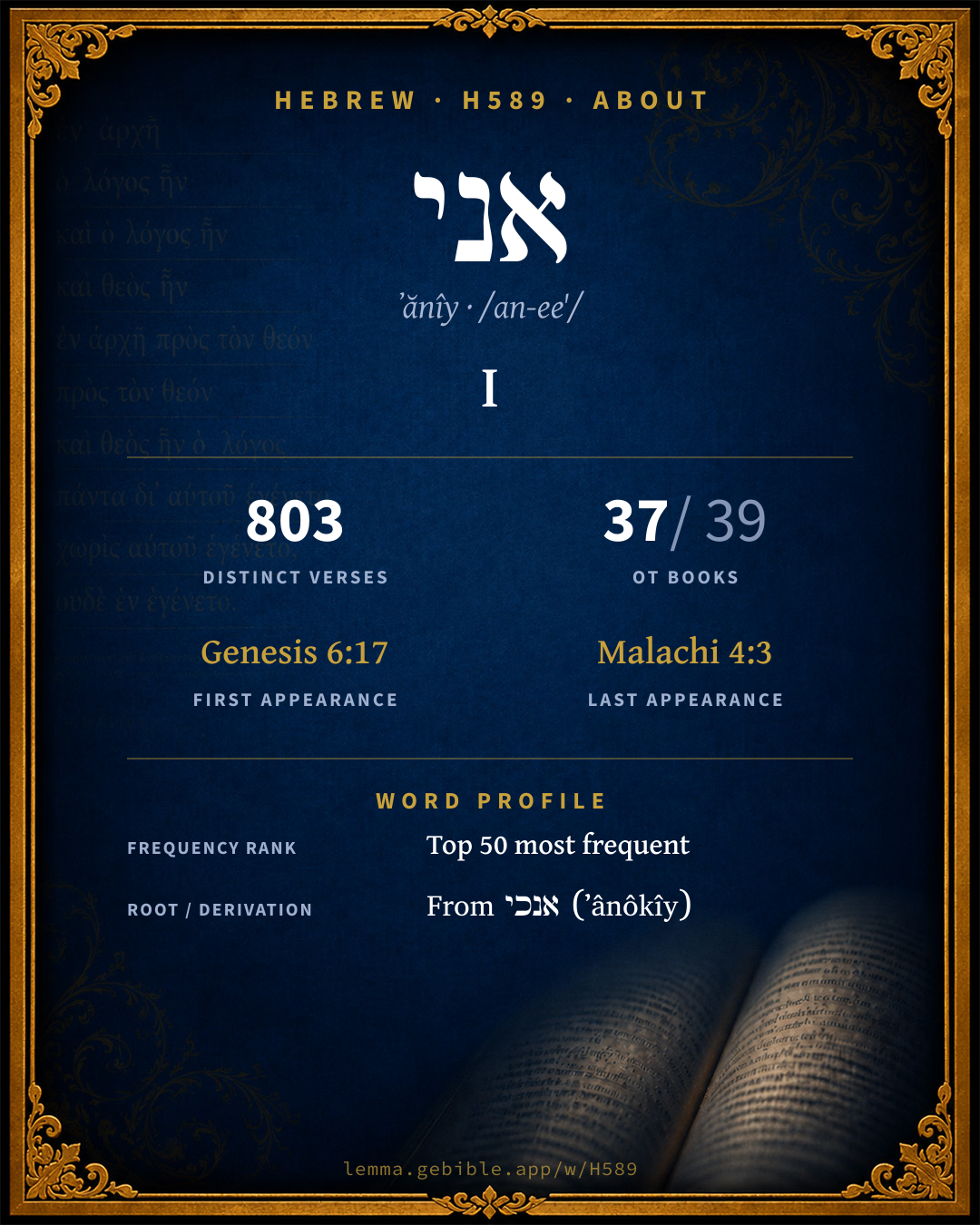
אֲנִי
I
Full lexicon entry — Brown-Driver-Briggs (BDB)
From Brown-Driver-Briggs (BDB)
Where this word appears
Grammar key — what these labels mean
Part of speech
- Pronoun
- A word standing in for a noun (“he,” “this,” “who”).
Person
- 1st Person
- The speaker (“I / we”).
Gender
- Common
- Either gender — not distinguished for this form.
Number
- Singular
- One.
Page 1 of 5 — showing verses 1–200 of 803 distinct verses where H589 appears, across 37 books. Click any verse to open its interlinear word-by-word view. Verse text shown in the World English Bible for context — . Each verse’s Hebrew form is shown with its reference; the English is not keyword-highlighted, since the data carries no word-level English alignment. Use “Compare translations” on any verse to read it across multiple English versions. This concordance covers the Hebrew Bible; Septuagint (Greek Old Testament) occurrences are not indexed here.
Genesis 38 verses
- Genesis 6:17 וַ/אֲנִ֗י conj + pron pers 1cs I, even, I do bring the flood of waters on this earth, to destroy all flesh having the breath of life from under the sky. Everything that is in the earth will die.
- Genesis 9:9 וַ/אֲנִ֕י conj + pron pers 1cs "As for me, behold, I establish my covenant with you, and with your offspring after you,
- Genesis 9:12 אֲנִ֣י pron pers 1cs God said, "This is the token of the covenant which I make between me and you and every living creature that is with you, for perpetual generations:
- Genesis 14:23 אֲנִ֖י pron pers 1cs that I will not take a thread nor a shoe-latchet nor anything that is yours, lest you should say, 'I have made Abram rich.'
- Genesis 15:7 אֲנִ֣י pron pers 1cs He said to him, "I am Yahweh who brought you out of Ur of the Chaldees, to give you this land to inherit it."
- Genesis 17:1 אֲנִי pron pers 1cs When Abram was ninety-nine years old, Yahweh appeared to Abram, and said to him, "I am God Almighty. Walk before me, and be blameless.
- Genesis 17:4 אֲנִ֕י pron pers 1cs "As for me, behold, my covenant is with you. You will be the father of a multitude of nations.
- Genesis 18:13 וַ/אֲנִ֥י conj + pron pers 1cs Yahweh said to Abraham, "Why did Sarah laugh, saying, 'Will I really bear a child, yet I am old?'
- Genesis 18:17 אֲנִי֙ אֲנִ֥י pron pers 1cs pron pers 1cs Yahweh said, "Will I hide from Abraham what I do,
- Genesis 22:5 וַ/אֲנִ֣י conj + pron pers 1cs Abraham said to his young men, "Stay here with the donkey. The boy and I will go yonder. We will worship, and come back to you.
- Genesis 24:45 אֲנִי֩ pron pers 1cs Before I had done speaking in my heart, behold, Rebekah came forth with her pitcher on her shoulder. She went down to the spring, and drew. I said to her, 'Please let me drink.'
- Genesis 27:8 אֲנִ֖י pron pers 1cs Now therefore, my son, obey my voice according to that which I command you.
- Genesis 27:24 אָֽנִי pron pers 1cs He said, "Are you really my son Esau?" He said, "I am."
- Genesis 27:32 אֲנִ֛י pron pers 1cs Isaac his father said to him, "Who are you?" He said, "I am your son, your firstborn, Esau."
- Genesis 27:34 אָ֖נִי pron pers 1cs When Esau heard the words of his father, he cried with an exceeding great and bitter cry, and said to his father, "Bless me, even me also, my father."
- Genesis 27:38 אָ֖נִי pron pers 1cs Esau said to his father, "Have you but one blessing, my father? Bless me, even me also, my father." Esau lifted up his voice, and wept.
- Genesis 28:13 אֲנִ֣י pron pers 1cs Behold, Yahweh stood above it, and said, "I am Yahweh, the God of Abraham your father, and the God of Isaac. The land whereon you lie, to you will I give it, and to your seed.
- Genesis 31:44 אֲנִ֣י pron pers 1cs Now come, let us make a covenant, you and I; and let it be for a witness between me and you."
- Genesis 31:52 אָ֗נִי pron pers 1cs May this heap be a witness, and the pillar be a witness, that I will not pass over this heap to you, and that you will not pass over this heap and this pillar to me, for harm.
- Genesis 33:14 וַ/אֲנִ֞י conj + pron pers 1cs Please let my lord pass over before his servant: and I will lead on gently, according to the pace of the cattle that are before me and according to the pace of the children, until I come to my lord to Seir."
- Genesis 34:30 וַ/אֲנִי֙ אֲנִ֥י conj + pron pers 1cs pron pers 1cs Jacob said to Simeon and Levi, "You have troubled me, to make me odious to the inhabitants of the land, among the Canaanites and the Perizzites. I am few in number. They will gather themselves together against me and strike me, and I will be destroyed, I and my house."
- Genesis 35:11 אֲנִ֨י pron pers 1cs God said to him, "I am God Almighty. Be fruitful and multiply. A nation and a company of nations will be from you, and kings will come out of your loins.
- Genesis 37:10 אֲנִי֙ pron pers 1cs He told it to his father and to his brothers. His father rebuked him, and said to him, "What is this dream that you have dreamed? Will I and your mother and your brothers indeed come to bow ourselves down to you to the earth?"
- Genesis 37:30 וַ/אֲנִ֖י אֲנִי conj + pron pers 1cs pron pers 1cs He returned to his brothers, and said, "The child is no more; and I, where will I go?"
- Genesis 40:16 אֲנִי֙ pron pers 1cs When the chief baker saw that the interpretation was good, he said to Joseph, "I also was in my dream, and, behold, three baskets of white bread were on my head.
- Genesis 41:9 אֲנִ֖י pron pers 1cs Then the chief cupbearer spoke to Pharaoh, saying, "I remember my faults today.
- Genesis 41:11 אֲנִ֣י pron pers 1cs We dreamed a dream in one night, I and he. We dreamed each man according to the interpretation of his dream.
- Genesis 41:15 וַ/אֲנִ֗י conj + pron pers 1cs Pharaoh said to Joseph, "I have dreamed a dream, and there is no one who can interpret it. I have heard it said of you, that when you hear a dream you can interpret it."
- Genesis 41:44 אֲנִ֣י pron pers 1cs Pharaoh said to Joseph, "I am Pharaoh, and without you shall no man lift up his hand or his foot in all the land of Egypt."
- Genesis 42:18 אֲנִ֥י pron pers 1cs Joseph said to them the third day, "Do this, and live, for I fear God.
- Genesis 42:37 וַ/אֲנִ֖י conj + pron pers 1cs Reuben spoke to his father, saying, "Kill my two sons, if I don't bring him to you. Deliver him into my hand, and I will bring him to you again."
- Genesis 43:14 וַ/אֲנִ֕י conj + pron pers 1cs May God Almighty give you mercy before the man, that he may release to you your other brother and Benjamin. If I am bereaved of my children, I am bereaved."
- Genesis 45:3 אֲנִ֣י pron pers 1cs Joseph said to his brothers, "I am Joseph! Does my father still live?" His brothers couldn't answer him; for they were terrified at his presence.
- Genesis 45:4 אֲנִי֙ pron pers 1cs Joseph said to his brothers, "Come near to me, please." They came near. "He said, I am Joseph, your brother, whom you sold into Egypt.
- Genesis 48:7 וַ/אֲנִ֣י conj + pron pers 1cs As for me, when I came from Paddan, Rachel died by me in the land of Canaan in the way, when there was still some distance to come to Ephrath, and I buried her there in the way to Ephrath (the same is Bethlehem)."
- Genesis 48:22 וַ/אֲנִ֞י conj + pron pers 1cs Moreover I have given to you one portion above your brothers, which I took out of the hand of the Amorite with my sword and with my bow."
- Genesis 49:29 אֲנִי֙ pron pers 1cs He charged them, and said to them, "I am to be gathered to my people. Bury me with my fathers in the cave that is in the field of Ephron the Hittite,
- Genesis 50:19 אָֽנִי pron pers 1cs Joseph said to them, "Don't be afraid, for am I in the place of God?
Exodus 36 verses
- Exodus 2:9 וַ/אֲנִ֖י conj + pron pers 1cs Pharaoh's daughter said to her, "Take this child away, and nurse him for me, and I will give you your wages." The woman took the child, and nursed it.
- Exodus 3:19 וַ/אֲנִ֣י conj + pron pers 1cs I know that the king of Egypt won't give you permission to go, no, not by a mighty hand.
- Exodus 4:21 וַ/אֲנִי֙ conj + pron pers 1cs Yahweh said to Moses, "When you go back into Egypt, see that you do before Pharaoh all the wonders which I have put in your hand, but I will harden his heart and he will not let the people go.
- Exodus 6:2 אֲנִ֥י pron pers 1cs God spoke to Moses, and said to him, "I am Yahweh;
- Exodus 6:5 אֲנִ֣י pron pers 1cs Moreover I have heard the groaning of the children of Israel, whom the Egyptians keep in bondage, and I have remembered my covenant.
- Exodus 6:6 אֲנִ֣י pron pers 1cs Therefore tell the children of Israel, 'I am Yahweh, and I will bring you out from under the burdens of the Egyptians, and I will rid you out of their bondage, and I will redeem you with an outstretched arm, and with great judgments:
- Exodus 6:7 אֲנִ֤י pron pers 1cs and I will take you to me for a people, and I will be to you a God; and you shall know that I am Yahweh your God, who brings you out from under the burdens of the Egyptians.
- Exodus 6:8 אֲנִ֥י pron pers 1cs I will bring you into the land which I swore to give to Abraham, to Isaac, and to Jacob; and I will give it to you for a heritage: I am Yahweh.'"
- Exodus 6:12 וַ/אֲנִ֖י conj + pron pers 1cs Moses spoke before Yahweh, saying, "Behold, the children of Israel haven't listened to me. How then shall Pharaoh listen to me, who am of uncircumcised lips?"
- Exodus 6:29 אֲנִ֣י אֲנִ֖י pron pers 1cs pron pers 1cs that Yahweh spoke to Moses, saying, "I am Yahweh. Speak to Pharaoh king of Egypt all that I speak to you."
- Exodus 6:30 אֲנִי֙ pron pers 1cs Moses said before Yahweh, "Behold, I am of uncircumcised lips, and how shall Pharaoh listen to me?"
- Exodus 7:3 וַ/אֲנִ֥י conj + pron pers 1cs I will harden Pharaoh's heart, and multiply my signs and my wonders in the land of Egypt.
- Exodus 7:5 אֲנִ֣י pron pers 1cs The Egyptians shall know that I am Yahweh, when I stretch forth my hand on Egypt, and bring out the children of Israel from among them."
- Exodus 7:17 אֲנִ֣י pron pers 1cs Thus says Yahweh, "In this you shall know that I am Yahweh. Behold, I will strike with the rod that is in my hand on the waters which are in the river, and they shall be turned to blood.
- Exodus 8:22 אֲנִ֥י pron pers 1cs I will set apart in that day the land of Goshen, in which my people dwell, that no swarms of flies shall be there; to the end you may know that I am Yahweh in the midst of the earth.
- Exodus 9:14 אֲנִ֨י pron pers 1cs For this time I will send all my plagues against your heart, against your officials, and against your people; that you may know that there is none like me in all the earth.
- Exodus 9:27 וַ/אֲנִ֥י conj + pron pers 1cs Pharaoh sent, and called for Moses and Aaron, and said to them, "I have sinned this time. Yahweh is righteous, and I and my people are wicked.
- Exodus 10:1 אֲנִ֞י pron pers 1cs Yahweh said to Moses, "Go in to Pharaoh, for I have hardened his heart, and the heart of his servants, that I may show these my signs in the midst of them,
- Exodus 10:2 אֲנִ֥י pron pers 1cs and that you may tell in the hearing of your son, and of your son's son, what things I have done to Egypt, and my signs which I have done among them; that you may know that I am Yahweh."
- Exodus 11:4 אֲנִ֥י pron pers 1cs Moses said, "This is what Yahweh says: 'About midnight I will go out into the midst of Egypt,
- Exodus 12:12 אֲנִ֥י pron pers 1cs For I will go through the land of Egypt in that night, and will strike all the firstborn in the land of Egypt, both man and animal. Against all the gods of Egypt I will execute judgments: I am Yahweh.
- Exodus 13:15 אֲנִ֨י pron pers 1cs and it happened, when Pharaoh would hardly let us go, that Yahweh killed all the firstborn in the land of Egypt, both the firstborn of man, and the firstborn of animal. Therefore I sacrifice to Yahweh all that opens the womb, being males; but all the firstborn of my sons I redeem.'
- Exodus 14:4 אֲנִ֣י pron pers 1cs I will harden Pharaoh's heart, and he will follow after them; and I will get honor over Pharaoh, and over all his host; and the Egyptians shall know that I am Yahweh." They did so.
- Exodus 14:17 וַ/אֲנִ֗י conj + pron pers 1cs I, behold, I will harden the hearts of the Egyptians, and they shall go in after them: and I will get myself honor over Pharaoh, and over all his host, over his chariots, and over his horsemen.
- Exodus 14:18 אֲנִ֣י pron pers 1cs The Egyptians shall know that I am Yahweh, when I have gotten myself honor over Pharaoh, over his chariots, and over his horsemen."
- Exodus 15:26 אֲנִ֥י pron pers 1cs and he said, "If you will diligently listen to the voice of Yahweh your God, and will do that which is right in his eyes, and will pay attention to his commandments, and keep all his statutes, I will put none of the diseases on you, which I have put on the Egyptians; for I am Yahweh who heals you."
- Exodus 16:12 אֲנִ֥י pron pers 1cs "I have heard the murmurings of the children of Israel. Speak to them, saying, 'At evening you shall eat meat, and in the morning you shall be filled with bread: and you shall know that I am Yahweh your God.'"
- Exodus 18:6 אֲנִ֛י pron pers 1cs He said to Moses, I, your father-in-law Jethro, have come to you with your wife, and her two sons with her.
- Exodus 22:27 אָֽנִי pron pers 1cs for that is his only covering, it is his garment for his skin. What would he sleep in? It will happen, when he cries to me, that I will hear, for I am gracious.
- Exodus 25:9 אֲנִי֙ pron pers 1cs According to all that I show you, the pattern of the tent, and the pattern of all of its furniture, even so you shall make it.
- Exodus 29:46 אֲנִ֤י אֲנִ֖י pron pers 1cs pron pers 1cs They shall know that I am Yahweh their God, who brought them forth out of the land of Egypt, that I might dwell among them: I am Yahweh their God.
- Exodus 31:6 וַ/אֲנִ֞י conj + pron pers 1cs I, behold, I have appointed with him Oholiab, the son of Ahisamach, of the tribe of Dan; and in the heart of all who are wise-hearted I have put wisdom, that they may make all that I have commanded you:
- Exodus 31:13 אֲנִ֥י pron pers 1cs "Speak also to the children of Israel, saying, 'Most assuredly you shall keep my Sabbaths: for it is a sign between me and you throughout your generations; that you may know that I am Yahweh who sanctifies you.
- Exodus 33:16 אֲנִ֣י אֲנִ֣י pron pers 1cs pron pers 1cs For how would people know that I have found favor in your sight, I and your people? Isn't it in that you go with us, so that we are separated, I and your people, from all the people who are on the surface of the earth?"
- Exodus 33:19 אֲנִ֨י pron pers 1cs He said, "I will make all my goodness pass before you, and will proclaim the name of Yahweh before you. I will be gracious to whom I will be gracious, and will show mercy on whom I will show mercy."
- Exodus 34:10 אֲנִ֖י pron pers 1cs He said, "Behold, I make a covenant: before all your people I will do marvels, such as have not been worked in all the earth, nor in any nation; and all the people among which you are shall see the work of Yahweh; for it is an awesome thing that I do with you.
Leviticus 67 verses
- Leviticus 11:44 אֲנִ֣י אָ֑נִי pron pers 1cs pron pers 1cs For I am Yahweh your God. Sanctify yourselves therefore, and be holy; for I am holy: neither shall you defile yourselves with any kind of creeping thing that moves on the earth.
- Leviticus 11:45 אֲנִ֣י אָֽנִי pron pers 1cs pron pers 1cs For I am Yahweh who brought you up out of the land of Egypt, to be your God. You shall therefore be holy, for I am holy.
- Leviticus 14:34 אֲנִ֛י pron pers 1cs "When you have come into the land of Canaan, which I give to you for a possession, and I put a spreading mildew in a house in the land of your possession,
- Leviticus 17:11 וַ/אֲנִ֞י conj + pron pers 1cs For the life of the flesh is in the blood; and I have given it to you on the altar to make atonement for your souls: for it is the blood that makes atonement by reason of the life.
- Leviticus 18:2 אֲנִ֖י pron pers 1cs "Speak to the children of Israel, and say to them, 'I am Yahweh your God.
- Leviticus 18:3 אֲנִי֩ pron pers 1cs You shall not do as they do in the land of Egypt, where you lived: and you shall not do as they do in the land of Canaan, where I am bringing you; neither shall you walk in their statutes.
- Leviticus 18:4 אֲנִ֖י pron pers 1cs You shall do my ordinances, and you shall keep my statutes, and walk in them: I am Yahweh your God.
- Leviticus 18:5 אֲנִ֖י pron pers 1cs You shall therefore keep my statutes and my ordinances; which if a man does, he shall live in them: I am Yahweh.
- Leviticus 18:6 אֲנִ֖י pron pers 1cs "'None of you shall approach anyone who are his close relatives, to uncover their nakedness: I am Yahweh.
- Leviticus 18:21 אֲנִ֥י pron pers 1cs "'You shall not give any of your children to sacrifice to Molech; neither shall you profane the name of your God: I am Yahweh.
- Leviticus 18:24 אֲנִ֥י pron pers 1cs "'Don't defile yourselves in any of these things: for in all these the nations which I am casting out before you were defiled.
- Leviticus 18:30 אֲנִ֖י pron pers 1cs Therefore you shall keep my charge, that you do not practice any of these abominable customs, which were practiced before you, and that you do not defile yourselves with them: I am Yahweh your God.'"
- Leviticus 19:2 אֲנִ֖י pron pers 1cs "Speak to all the congregation of the children of Israel, and tell them, 'You shall be holy; for I Yahweh your God am holy.
- Leviticus 19:3 אֲנִ֖י pron pers 1cs "'Each one of you shall respect his mother and his father. You shall keep my Sabbaths. I am Yahweh your God.
- Leviticus 19:4 אֲנִ֖י pron pers 1cs "'Don't turn to idols, nor make molten gods for yourselves. I am Yahweh your God.
- Leviticus 19:10 אֲנִ֖י pron pers 1cs You shall not glean your vineyard, neither shall you gather the fallen grapes of your vineyard; you shall leave them for the poor and for the foreigner. I am Yahweh your God.
- Leviticus 19:12 אֲנִ֥י pron pers 1cs "'You shall not swear by my name falsely, and profane the name of your God. I am Yahweh.
- Leviticus 19:14 אֲנִ֥י pron pers 1cs "'You shall not curse the deaf, nor put a stumbling block before the blind; but you shall fear your God. I am Yahweh.
- Leviticus 19:16 אֲנִ֖י pron pers 1cs "'You shall not go up and down as a slanderer among your people; neither shall you stand against the life of your neighbor. I am Yahweh.
- Leviticus 19:18 אֲנִ֖י pron pers 1cs You shall not take vengeance, nor bear any grudge against the children of your people; but you shall love your neighbor as yourself. I am Yahweh.
- Leviticus 19:25 אֲנִ֖י pron pers 1cs In the fifth year you shall eat its fruit, that it may yield its increase to you. I am Yahweh your God.
- Leviticus 19:28 אֲנִ֖י pron pers 1cs "'You shall not make any cuttings in your flesh for the dead, nor tattoo any marks on you. I am Yahweh.
- Leviticus 19:30 אֲנִ֖י pron pers 1cs "'You shall keep my Sabbaths, and reverence my sanctuary; I am Yahweh.
- Leviticus 19:31 אֲנִ֖י pron pers 1cs "'Don't turn to those who are mediums, nor to the wizards. Don't seek them out, to be defiled by them. I am Yahweh your God.
- Leviticus 19:32 אֲנִ֥י pron pers 1cs You shall rise up before the gray head, and honor the face of an old man, and you shall fear your God. I am Yahweh.
- Leviticus 19:34 אֲנִ֖י pron pers 1cs The stranger who lives as a foreigner with you shall be to you as the native-born among you, and you shall love him as yourself; for you lived as foreigners in the land of Egypt. I am Yahweh your God.
- Leviticus 19:36 אֲנִי֙ pron pers 1cs Just balances, just weights, a just ephah, and a just hin, shall you have. I am Yahweh your God, who brought you out of the land of Egypt.
- Leviticus 19:37 אֲנִ֖י pron pers 1cs You shall observe all my statutes, and all my ordinances, and do them. I am Yahweh.'"
- Leviticus 20:3 וַ/אֲנִ֞י conj + pron pers 1cs I also will set my face against that person, and will cut him off from among his people because he has given of his seed to Molech, to defile my sanctuary, and to profane my holy name.
- Leviticus 20:5 אֲנִ֧י pron pers 1cs then I will set my face against that man, and against his family, and will cut him off, and all who play the prostitute after him, to play the prostitute with Molech, from among their people.
- Leviticus 20:7 אֲנִ֥י pron pers 1cs "'Sanctify yourselves therefore, and be holy; for I am Yahweh your God.
- Leviticus 20:8 אֲנִ֥י pron pers 1cs You shall keep my statutes, and do them. I am Yahweh who sanctifies you.
- Leviticus 20:22 אֲנִ֜י pron pers 1cs "'You shall therefore keep all my statutes, and all my ordinances, and do them; that the land, where I am bringing you to dwell, may not vomit you out.
- Leviticus 20:23 אֲנִ֥י pron pers 1cs You shall not walk in the customs of the nation, which I am casting out before you: for they did all these things, and therefore I abhorred them.
- Leviticus 20:24 וַ/אֲנִ֞י אֲנִי֙ conj + pron pers 1cs pron pers 1cs But I have said to you, "You shall inherit their land, and I will give it to you to possess it, a land flowing with milk and honey." I am Yahweh your God, who has separated you from the peoples.
- Leviticus 20:26 אֲנִ֣י pron pers 1cs You shall be holy to me: for I, Yahweh, am holy, and have set you apart from the peoples, that you should be mine.
- Leviticus 21:8 אֲנִ֥י pron pers 1cs You shall sanctify him therefore; for he offers the bread of your God: he shall be holy to you: for I Yahweh, who sanctify you, am holy.
- Leviticus 21:12 אֲנִ֥י pron pers 1cs neither shall he go out of the sanctuary, nor profane the sanctuary of his God; for the crown of the anointing oil of his God is upon him. I am Yahweh.
- Leviticus 21:15 אֲנִ֥י pron pers 1cs He shall not profane his seed among his people: for I am Yahweh who sanctifies him.'"
- Leviticus 21:23 אֲנִ֥י pron pers 1cs He shall not come near to the veil, nor come near to the altar, because he has a blemish; that he may not profane my sanctuaries, for I am Yahweh who sanctifies them.'"
- Leviticus 22:2 אֲנִ֥י pron pers 1cs "Tell Aaron and his sons to separate themselves from the holy things of the children of Israel, which they make holy to me, and that they not profane my holy name. I am Yahweh.
- Leviticus 22:3 אֲנִ֥י pron pers 1cs Tell them, 'If anyone of all your seed throughout your generations approaches the holy things, which the children of Israel make holy to Yahweh, having his uncleanness on him, that soul shall be cut off from before me. I am Yahweh.
- Leviticus 22:8 אֲנִ֖י pron pers 1cs That which dies of itself, or is torn by animals, he shall not eat, defiling himself by it. I am Yahweh.
- Leviticus 22:9 אֲנִ֥י pron pers 1cs "'They shall therefore keep my charge, lest they bear sin for it, and die therein, if they profane it. I am Yahweh who sanctifies them.
- Leviticus 22:16 אֲנִ֥י pron pers 1cs and so cause them to bear the iniquity that brings guilt, when they eat their holy things: for I am Yahweh who sanctifies them.'"
- Leviticus 22:30 אֲנִ֖י pron pers 1cs It shall be eaten on the same day; you shall leave none of it until the morning. I am Yahweh.
- Leviticus 22:31 אֲנִ֖י pron pers 1cs "Therefore you shall keep my commandments, and do them. I am Yahweh.
- Leviticus 22:32 אֲנִ֥י pron pers 1cs You shall not profane my holy name, but I will be made holy among the children of Israel. I am Yahweh who makes you holy,
- Leviticus 22:33 אֲנִ֖י pron pers 1cs who brought you out of the land of Egypt, to be your God. I am Yahweh."
- Leviticus 23:10 אֲנִי֙ pron pers 1cs "Speak to the children of Israel, and tell them, 'When you have come into the land which I give to you, and shall reap its the harvest, then you shall bring the sheaf of the first fruits of your harvest to the priest:
- Leviticus 23:22 אֲנִ֖י pron pers 1cs "'When you reap the harvest of your land, you shall not wholly reap into the corners of your field, neither shall you gather the gleanings of your harvest: you shall leave them for the poor, and for the foreigner. I am Yahweh your God.'"
- Leviticus 23:43 אֲנִ֖י pron pers 1cs that your generations may know that I made the children of Israel to dwell in booths, when I brought them out of the land of Egypt. I am Yahweh your God.'"
- Leviticus 24:22 אֲנִ֥י pron pers 1cs You shall have one kind of law, for the foreigner as well as the native-born: for I am Yahweh your God.'"
- Leviticus 25:2 אֲנִ֖י pron pers 1cs "Speak to the children of Israel, and tell them, 'When you come into the land which I give you, then the land shall keep a Sabbath to Yahweh.
- Leviticus 25:17 אֲנִ֥י pron pers 1cs You shall not wrong one another; but you shall fear your God: for I am Yahweh your God.
- Leviticus 25:38 אֲנִ֗י pron pers 1cs I am Yahweh your God, who brought you forth out of the land of Egypt, to give you the land of Canaan, and to be your God.
- Leviticus 25:55 אֲנִ֖י pron pers 1cs For to me the children of Israel are servants; they are my servants whom I brought forth out of the land of Egypt. I am Yahweh your God.
- Leviticus 26:1 אֲנִ֥י pron pers 1cs "'You shall make for yourselves no idols, neither shall you raise up an engraved image or a pillar, neither shall you place any figured stone in your land, to bow down to it: for I am Yahweh your God.
- Leviticus 26:2 אֲנִ֖י pron pers 1cs "'You shall keep my Sabbaths, and have reverence for my sanctuary. I am Yahweh.
- Leviticus 26:13 אֲנִ֞י pron pers 1cs I am Yahweh your God, who brought you forth out of the land of Egypt, that you should not be their slaves; and I have broken the bars of your yoke, and made you go upright.
- Leviticus 26:16 אֲנִ֞י pron pers 1cs I also will do this to you: I will appoint terror over you, even consumption and fever, that shall consume the eyes, and make the soul to pine away; and you will sow your seed in vain, for your enemies will eat it.
- Leviticus 26:24 אֲנִ֛י אָ֔נִי pron pers 1cs pron pers 1cs then I will also walk contrary to you; and I will strike you, even I, seven times for your sins.
- Leviticus 26:28 אָ֔נִי pron pers 1cs then I will walk contrary to you in wrath; and I also will chastise you seven times for your sins.
- Leviticus 26:32 אֲנִ֖י pron pers 1cs I will bring the land into desolation; and your enemies that dwell therein will be astonished at it.
- Leviticus 26:41 אֲנִ֗י pron pers 1cs I also walked contrary to them, and brought them into the land of their enemies: if then their uncircumcised heart is humbled, and they then accept the punishment of their iniquity;
- Leviticus 26:44 אֲנִ֥י pron pers 1cs Yet for all that, when they are in the land of their enemies, I will not reject them, neither will I abhor them, to destroy them utterly, and to break my covenant with them; for I am Yahweh their God;
- Leviticus 26:45 אֲנִ֥י pron pers 1cs but I will for their sake remember the covenant of their ancestors, whom I brought forth out of the land of Egypt in the sight of the nations, that I might be their God. I am Yahweh.'"
Numbers 19 verses
- Numbers 3:12 וַ/אֲנִ֞י conj + pron pers 1cs "Behold, I have taken the Levites from among the children of Israel instead of all the firstborn who open the womb among the children of Israel; and the Levites shall be mine:
- Numbers 3:13 אֲנִ֥י pron pers 1cs for all the firstborn are mine. On the day that I struck down all the firstborn in the land of Egypt I made holy to me all the firstborn in Israel, both man and animal. They shall be mine. I am Yahweh."
- Numbers 3:41 אֲנִ֣י pron pers 1cs You shall take the Levites for me (I am Yahweh) instead of all the firstborn among the children of Israel; and the cattle of the Levites instead of all the firstborn among the cattle of the children of Israel."
- Numbers 3:45 אֲנִ֥י pron pers 1cs "Take the Levites instead of all the firstborn among the children of Israel, and the cattle of the Levites instead of their cattle; and the Levites shall be mine. I am Yahweh.
- Numbers 5:3 אֲנִ֖י pron pers 1cs Both male and female shall you put out, outside of the camp shall you put them; that they not defile their camp, in the midst of which I dwell."
- Numbers 6:27 וַ/אֲנִ֖י conj + pron pers 1cs "So they shall put my name on the children of Israel; and I will bless them."
- Numbers 10:10 אֲנִ֖י pron pers 1cs Also in the day of your gladness, and in your set feasts, and in the beginnings of your months, you shall blow the trumpets over your burnt offerings, and over the sacrifices of your peace-offerings; and they shall be to you for a memorial before your God: I am Yahweh your God.
- Numbers 13:2 אֲנִ֥י pron pers 1cs Send you men, that they may spy out the land of Canaan, which I give to the children of Israel: of every tribe of their fathers shall you send a man, everyone a prince among them.
- Numbers 14:21 אָ֑נִי pron pers 1cs but in very deed, as I live, and as all the earth shall be filled with the glory of Yahweh;
- Numbers 14:28 אָ֨נִי֙ pron pers 1cs Tell them, As I live, says Yahweh, surely as you have spoken in my ears, so will I do to you:
- Numbers 14:35 אֲנִ֣י pron pers 1cs I, Yahweh, have spoken, surely this will I do to all this evil congregation, who are gathered together against me: in this wilderness they shall be consumed, and there they shall die.
- Numbers 15:2 אֲנִ֖י pron pers 1cs Speak to the children of Israel, and tell them, When you are come into the land of your habitations, which I give to you,
- Numbers 15:18 אֲנִ֛י pron pers 1cs Speak to the children of Israel, and tell them, When you come into the land where I bring you,
- Numbers 15:41 אֲנִ֞י אֲנִ֖י pron pers 1cs pron pers 1cs I am Yahweh your God, who brought you out of the land of Egypt, to be your God: I am Yahweh your God.
- Numbers 18:6 וַ/אֲנִ֗י conj + pron pers 1cs I, behold, I have taken your brothers the Levites from among the children of Israel: to you they are a gift, given to Yahweh, to do the service of the tent of meeting.
- Numbers 18:8 וַ/אֲנִי֙ conj + pron pers 1cs Yahweh spoke to Aaron, I, behold, I have given you the charge of my heave-offerings, even all the holy things of the children of Israel; to you have I given them by reason of the anointing, and to your sons, as a portion forever.
- Numbers 18:20 אֲנִ֤י pron pers 1cs Yahweh said to Aaron, You shall have no inheritance in their land, neither shall you have any portion among them: I am your portion and your inheritance among the children of Israel.
- Numbers 20:19 אֲנִ֣י pron pers 1cs The children of Israel said to him, We will go up by the highway; and if we drink of your water, I and my cattle, then will I give the price of it: let me only, without [doing] anything [else], pass through on my feet.
- Numbers 35:34 אֲנִ֖י אֲנִ֣י pron pers 1cs pron pers 1cs You shall not defile the land which you inhabit, in the midst of which I dwell: for I, Yahweh, dwell in the midst of the children of Israel.
Deuteronomy 6 verses
- Deuteronomy 12:30 אָֽנִי pron pers 1cs take heed to yourself that you not be ensnared to follow them, after that they are destroyed from before you; and that you not inquire after their gods, saying, How do these nations serve their gods? even so will I do likewise.
- Deuteronomy 29:6 אֲנִ֥י pron pers 1cs You have not eaten bread, neither have you drunk wine or strong drink; that you may know that I am Yahweh your God.
- Deuteronomy 32:21 וַ/אֲנִי֙ conj + pron pers 1cs They have moved me to jealousy with that which is not God; They have provoked me to anger with their vanities: I will move them to jealousy with those who are not a people; I will provoke them to anger with a foolish nation.
- Deuteronomy 32:39 אֲנִ֤י אֲנִי֙ אֲנִ֧י וַ/אֲנִ֣י pron pers 1cs pron pers 1cs pron pers 1cs conj + pron pers 1cs See now that I, even I, am he, There is no god with me: I kill, and I make alive; I wound, and I heal; There is none who can deliver out of my hand.
- Deuteronomy 32:49 אֲנִ֥י pron pers 1cs Go up into this mountain of Abarim, to Mount Nebo, which is in the land of Moab, that is over against Jericho; and see the land of Canaan, which I give to the children of Israel for a possession;
- Deuteronomy 32:52 אֲנִ֥י pron pers 1cs For you shall see the land before you; but you shall not go there into the land which I give the children of Israel.
Joshua 4 verses
- Joshua 5:14 אֲנִ֥י pron pers 1cs He said, No; but [as] prince of the host of Yahweh am I now come. Joshua fell on his face to the earth, and did worship, and said to him, What says my lord to his servant?
- Joshua 8:5 וַ/אֲנִ֗י conj + pron pers 1cs and I, and all the people who are with me, will approach to the city. It shall happen, when they come out against us, as at the first, that we will flee before them;
- Joshua 17:14 וַֽ/אֲנִ֣י conj + pron pers 1cs The children of Joseph spoke to Joshua, saying, Why have you given me but one lot and one part for an inheritance, seeing I am a great people, because hitherto Yahweh has blessed me?
- Joshua 23:2 אֲנִ֣י pron pers 1cs that Joshua called for all Israel, for their elders and for their heads, and for their judges and for their officers, and said to them, I am old and well stricken in years:
Judges 12 verses
- Judges 1:3 אֲנִ֛י pron pers 1cs Judah said to Simeon his brother, Come up with me into my lot, that we may fight against the Canaanites; and I likewise will go with you into your lot. So Simeon went with him.
- Judges 2:21 אֲנִי֙ pron pers 1cs I also will not henceforth drive out any from before them of the nations that Joshua left when he died;
- Judges 6:10 אֲנִי֙ pron pers 1cs and I said to you, I am Yahweh your God; you shall not fear the gods of the Amorites, in whose land you dwell. But you have not listened to my voice.
- Judges 8:23 אֲנִי֙ pron pers 1cs Gideon said to them, I will not rule over you, neither shall my son rule over you: Yahweh shall rule over you.
- Judges 9:2 אָנִֽי pron pers 1cs Please speak in the ears of all the men of Shechem, Whether is better for you, that all the sons of Jerubbaal, who are seventy persons, rule over you, or that one rule over you? Remember also that I am your bone and your flesh.
- Judges 12:2 אֲנִ֛י pron pers 1cs Jephthah said to them, I and my people were at great strife with the children of Ammon; and when I called you, you didn't save me out of their hand.
- Judges 13:11 אָֽנִי pron pers 1cs Manoah arose, and went after his wife, and came to the man, and said to him, Are you the man who spoke to the woman? He said, I am.
- Judges 15:3 אֲנִ֛י pron pers 1cs Samson said to them, This time shall I be blameless in regard of the Philistines, when I do them a mischief.
- Judges 16:17 אֲנִ֖י pron pers 1cs He told her all his heart, and said to her, "No razor has ever come on my head; for I have been a Nazirite to God from my mother's womb. If I am shaved, then my strength will go from me, and I will become weak, and be like any other man."
- Judges 17:2 אֲנִ֣י pron pers 1cs He said to his mother, The eleven hundred [pieces] of silver that were taken from you, about which you did utter a curse, and did also speak it in my ears, behold, the silver is with me; I took it. His mother said, Blessed be my son of Yahweh.
- Judges 19:18 אֲנִ֣י pron pers 1cs He said to him, We are passing from Bethlehem Judah to the farther side of the hill-country of Ephraim; from there am I, and I went to Bethlehem Judah: and I am [now] going to the house of Yahweh; and there is no man who takes me into his house.
- Judges 20:4 אֲנִ֥י pron pers 1cs The Levite, the husband of the woman who was murdered, answered, I came into Gibeah that belongs to Benjamin, I and my concubine, to lodge.
Ruth 2 verses
- Ruth 1:21 אֲנִי֙ pron pers 1cs I went out full, and Yahweh has brought me home again empty; why do you call me Naomi, seeing Yahweh has testified against me, and the Almighty has afflicted me?"
- Ruth 4:4 וַ/אֲנִ֨י conj + pron pers 1cs I thought to disclose it to you, saying, Buy it before those who sit here, and before the elders of my people. If you will redeem it, redeem it: but if you will not redeem it, then tell me, that I may know; for there is none to redeem it besides you; and I am after you. He said, I will redeem it.
1 Samuel 18 verses
- 1 Samuel 1:26 אֲנִ֣י pron pers 1cs She said, Oh, my lord, as your soul lives, my lord, I am the woman who stood by you here, praying to Yahweh.
- 1 Samuel 3:13 אֲנִ֛י pron pers 1cs For I have told him that I will judge his house forever, for the iniquity which he knew, because his sons did bring a curse on themselves, and he didn't restrain them.
- 1 Samuel 4:16 וַ/אֲנִ֕י conj + pron pers 1cs The man said to Eli, I am he who came out of the army, and I fled today out of the army. He said, How went the matter, my son?
- 1 Samuel 12:2 וַ/אֲנִי֙ וַ/אֲנִי֙ conj + pron pers 1cs conj + pron pers 1cs Now, behold, the king walks before you; and I am old and gray-headed; and, behold, my sons are with you: and I have walked before you from my youth to this day.
- 1 Samuel 14:40 וַֽ/אֲנִי֙ conj + pron pers 1cs Then said he to all Israel, Be you on one side, and I and Jonathan my son will be on the other side. The people said to Saul, Do what seems good to you.
- 1 Samuel 16:1 וַ/אֲנִ֣י conj + pron pers 1cs Yahweh said to Samuel, How long will you mourn for Saul, seeing I have rejected him from being king over Israel? fill your horn with oil, and go: I will send you to Jesse the Bethlehemite; for I have provided me a king among his sons.
- 1 Samuel 17:9 אֲנִ֤י pron pers 1cs If he be able to fight with me, and kill me, then will we be your servants; but if I prevail against him, and kill him, then shall you be our servants, and serve us.
- 1 Samuel 17:10 אֲנִ֗י pron pers 1cs The Philistine said, I defy the armies of Israel this day; give me a man, that we may fight together.
- 1 Samuel 17:28 אֲנִ֧י pron pers 1cs Eliab his eldest brother heard when he spoke to the men; and Eliab's anger was kindled against David, and he said, Why are you come down? and with whom have you left those few sheep in the wilderness? I know your pride, and the naughtiness of your heart; for you have come down that you might see the battle.
- 1 Samuel 19:3 וַ/אֲנִ֨י וַ/אֲנִ֕י conj + pron pers 1cs conj + pron pers 1cs and I will go out and stand beside my father in the field where you are, and I will commune with my father of you; and if I see anything, I will tell you.
- 1 Samuel 20:20 וַ/אֲנִ֕י conj + pron pers 1cs I will shoot three arrows on the side of it, as though I shot at a mark.
- 1 Samuel 20:23 אֲנִ֣י pron pers 1cs As touching the matter which you and I have spoken of, behold, Yahweh is between you and me forever.
- 1 Samuel 21:15 אָ֔נִי pron pers 1cs Do I lack madmen, that you have brought this fellow to play the madman in my presence? shall this fellow come into my house?
- 1 Samuel 23:4 אֲנִ֥י pron pers 1cs Then David inquired of Yahweh yet again. Yahweh answered him, and said, Arise, go down to Keilah; for I will deliver the Philistines into your hand.
- 1 Samuel 24:17 וַ/אֲנִ֖י conj + pron pers 1cs He said to David, You are more righteous than I; for you have rendered to me good, whereas I have rendered to you evil.
- 1 Samuel 25:24 אֲנִ֥י pron pers 1cs She fell at his feet, and said, On me, my lord, on me be the iniquity; and please let your handmaid speak in your ears. Hear the words of your handmaid.
About this entry
At a glance — auto-summarized from this page’s data, not written by a person. Every figure links to its source below. This summary describes the numbers; it doesn’t interpret them.
אני (ʼănîy) is a Hebrew name most often rendered “I.” It first appears in Genesis 6:17. The Hebrew Bible uses it across 803 verses — among the most common. For the data behind this summary, explore 803-verse concordance and the renderings breakdown below.
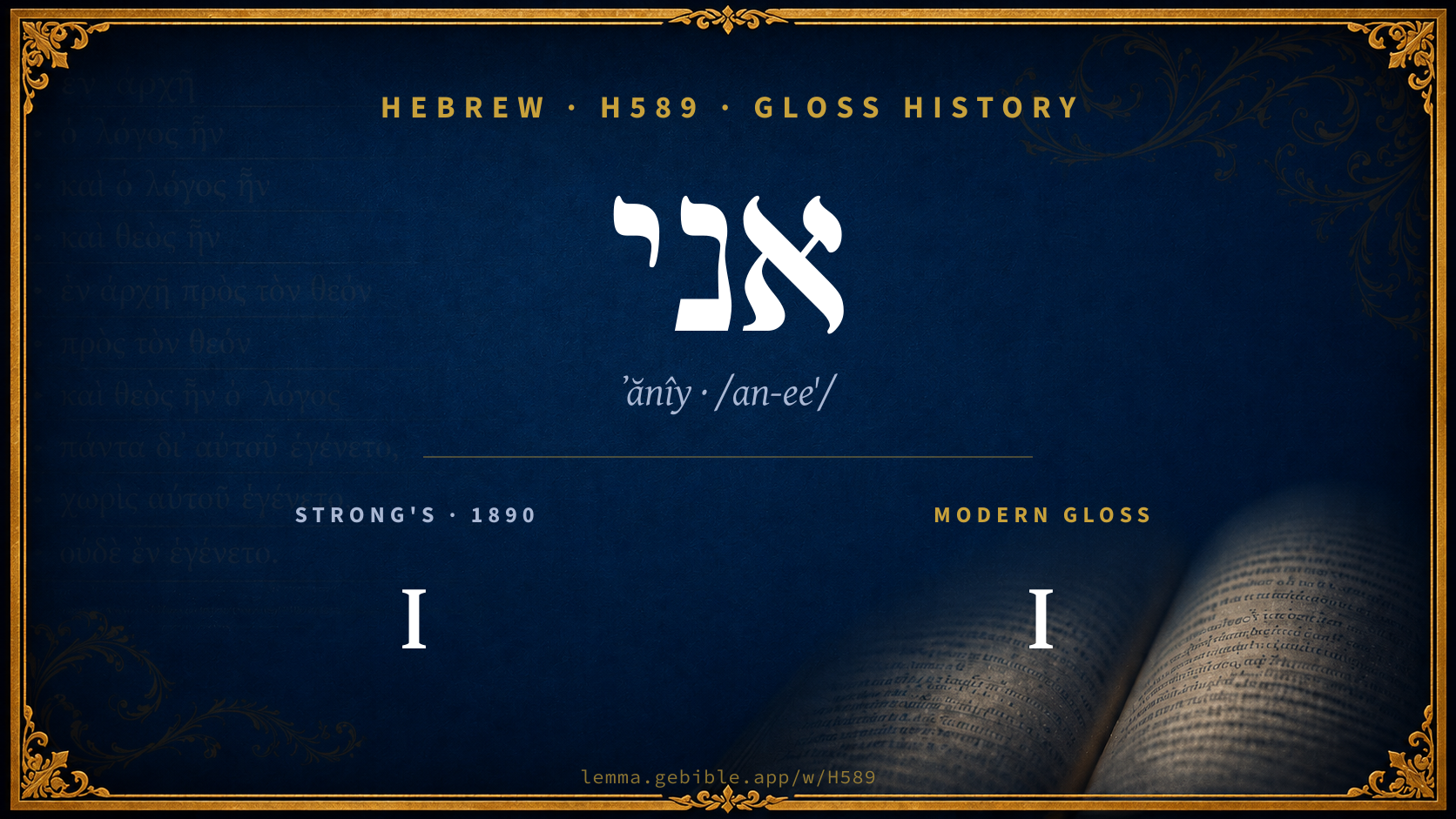
Gloss history
Strong's 1890 vs modern scholarship
About this word
Strong's H589 catalogs a Hebrew word from the Hebrew Old Testament.
These counts are not copied from any lexicon or concordance. They are computed here, from the morphology-tagged Hebrew Old Testament. What Lemma adds →
- 803
- distinct verses
- The word appears in 803 distinct verses.
- 37 / 39
- OT books
- The word appears in 37 of 39 Old Testament books.
- #50
- by frequency
- Top 50 most frequent Hebrew words (rank 50 of 8,640 Hebrew words by occurrence).
View all 803 occurrences in the concordance →
By section of the Old Testament
By traditional corpus
Conventional, traditional groupings — biblical authorship is debated, so this is a traditional corpus grouping, not an authorship claim. Each share is this word’s portion of its verses in that division of the Hebrew canon. Each figure is a share of the word’s 803 distinct verses.
- Prophets (Nevi'im) 420 verses · 52%
- Writings (Ketuvim) 217 verses · 27%
- Torah (Pentateuch) 166 verses · 21%
How translations render this word
Counts come from each version’s own published word-to-Strong’s tagging or interlinear alignment — an approximate guide to how each version renders this word, not a word-level alignment the data otherwise carries. Because each total is that version’s own tagged count, the per-version totals vary from one another and need not match the appearance or distinct-verse counts above. These counts may also differ from a printed concordance because Lemma counts each distinctly tagged rendering and does not collapse phrase taggings into a single head-word total. This is a fixed set of word-tagged versions (KJV, ASV, BSB, ULT) and does not change with the reading translation you choose elsewhere. Each version’s license is shown beside its name below (and on Sources).
- King James Version: I 2×, Me 2×, Shall i 2×
- American Standard Version: I 3×, Me 2×, Shall i 2×
- Berean Standard Bible: I 722×, Surely as i 13×, I am 11×
- unfoldingWord Literal Text: I 654×, Am 96×, I am 56×
King James Version Public Domain
Renders H589 across 13 tagged occurrences — most commonly:
Plus 7 renderings that appear only once — usually multi-word phrases or single function words the recovered tagging swept in, not distinct renderings.
American Standard Version Public Domain
Renders H589 across 14 tagged occurrences — most commonly:
Plus 7 renderings that appear only once — usually multi-word phrases or single function words the recovered tagging swept in, not distinct renderings.
Berean Standard Bible Public Domain
Renders H589 across 854 tagged occurrences — most commonly:
Plus other, less common renderings. Plus 34 renderings that appear only once — usually multi-word phrases or single function words the recovered tagging swept in, not distinct renderings. Not rendered by a distinct English word in 16 further occurrences.
unfoldingWord Literal Text CC BY-SA 4.0
Renders H589 across 975 tagged occurrences — most commonly:
Plus other, less common renderings. Plus 23 renderings that appear only once — usually multi-word phrases or single function words the recovered tagging swept in, not distinct renderings.
Senses in BDB
The 1 sense BDB distinguishes for this word, in lexicon order (not ranked by frequency or importance). The full entry — with sub-senses — is in the Lexicon Entry tab.
- I (first person singular - usually used for emphasis)
Word origin
pron. 1 s. comm. I (أَنَا, אֲנָא, ܐܶܢܳܐ:, አነ ) Gn 6:17; 9:9, 12 + oft. Following a ptcp. as its subj. (to express mostly either a true present or the fut. instans) Gn 18:17 הַמְכַסֶּה אֲנִי Am I hiding from Abraham that which, etc., Ju 15:3 1 S 3:13 Je 1:12; 38:14; 44:29 (v. Dr§ 135, 4). Appended to a verb, it expresses, in early Hebrew, a real emphasis, as Ju 8:23 לֹא אֶמְשֹׁל אֲנִי בָּכֶם I will not rule over you, 2 S 12:28 lest I take the city, 2 S 17:15 thus and thus did Ahitophel counsel, and thus and thus יָעַצְתִּי אָ֑נִי did I counsel; but in later Heb. it is sometimes pleonastic, Ec 2:11–15, 18–20 +. In response to a question, אָ֑נִי alone = I am, It is I, Gn 27:24 Ju 13:11 1 K 18:8 +. With הֲ, הַאֲנִי †Is 66:9. (Syn. אָנֹכִי, q.v.)
— Brown-Driver-Briggs (Oxford 1906, public domain), digitized via Sefaria, supplemented by the OpenScriptures HebrewLexicon (CC BY 4.0). See Sources.
Derived from אנכי (ʼânôkîy) (H595) — I.
Jastrow Dictionary
A second Hebrew/Aramaic lexicon for comparison, covering Aramaic and post-biblical (Talmudic, Targumic, Midrashic) usage that the biblical-Hebrew BDB does not. Matched by lemma rather than by Strong’s number, so a lemma may carry more than one Jastrow headword (shown separately below), and the entries cover usage well beyond the Bible.
אני
- (= b. h. ינה, sec. r. of און, cmp. אָנַן a. b. h. ענה); Pi. (אִנָּה) אִינָּה to press, wrong, oppress; to impose, overreach in dealing, v. אוֹנָאָה. B. Mets. 59ᵇ המְאַנֶּה את הגר he who wounds a stranger’s (proselyte’s) feeling. Ib. 49ᵇ תן לי מה שאִינִּיתָנִי return to me the amount with which thou hast overreached me. Ib. 50ᵃ top מה שאניתני (Ms. R. 1 שנִתְאוֹנַנְתִּי, v. infra). Ib. 51ᵃ שאניתני (Ms. M. שאֲנַנְתָּנִי, fr. אָנַן; Mish. ib. IV, 2 שאוֹנִיתָנִי, v. אוֹנָאָה, Ms. R. 1 שהוֹנִיתָנִי, v. הוֹנָאָה, Ms. R. 2 שאונתני, v. Rabb. D. S. a. l. note).
- to be overreached. Ib. 49ᵇ מי נ׳ which of them has been overreached? Ib. 50ᵇ מי שנ׳ (Ms. M. מִתְאוֹנֶה); a. fr. [Nithpol. of אנן, נִתְאוֹנֵן, v. supra.] [In. Y. אוֹנָה, v. אוֹנָאָה.]
אֲנִי
- , v. אָנֹכִי) I. Succ. 53ᵃ; a. v. fr.—[Ib. IV, 5 אני והו (Y. והוא), reverential transcription of אנא יהוה, to avoid the utterance of the Tetragrammaton.]—Pl. אָנוּ. Keth. I, 6; a. fr.
A Dictionary of the Targumim, the Talmud Babli and Yerushalmi, and the Midrashic Literature (Marcus Jastrow; London, Luzac, 1903) — Public Domain. Digitized via Sefaria. Digitized via Sefaria. Full attribution on Sources.
Forms in the corpus
The 60 distinct written forms H589 takes in the Hebrew Bible, most frequent first — each parse links to that state’s occurrences in the concordance. Hebrew forms include their vowel points and cantillation, so a single lemma takes many written forms.
| Form | Parsing | Example | Uses |
|---|---|---|---|
| אֲנִ֥י | Pronoun, Personal, 1st Person, Common, Singular | Daniel 8:15 | 145 |
| אֲנִ֣י | Pronoun, Personal, 1st Person, Common, Singular | Daniel 8:1 | 126 |
| אֲנִ֖י | Pronoun, Personal, 1st Person, Common, Singular | Ecclesiastes 2:15 | 76 |
| אֲנִי֙ | Pronoun, Personal, 1st Person, Common, Singular | Daniel 1:10 | 57 |
| אֲנִ֤י | Pronoun, Personal, 1st Person, Common, Singular | Daniel 9:20 | 45 |
| וַ/אֲנִ֣י | Pronoun, Personal, 1st Person, Common, Singular | Daniel 8:5 | 33 |
| אֲנִ֛י | Pronoun, Personal, 1st Person, Common, Singular | Ecclesiastes 4:2 | 32 |
| אָֽנִי | Pronoun, Personal, 1st Person, Common, Singular | Deuteronomy 12:30 | 24 |
| אָ֔נִי | Pronoun, Personal, 1st Person, Common, Singular | Ecclesiastes 2:13 | 20 |
| וַ/אֲנִ֖י | Pronoun, Personal, 1st Person, Common, Singular | Exodus 2:9 | 20 |
| וַ/אֲנִ֗י | Pronoun, Personal, 1st Person, Common, Singular | Daniel 10:4 | 19 |
| וַ/אֲנִי֙ | Pronoun, Personal, 1st Person, Common, Singular | Daniel 8:2 | 17 |
| אֲנִ֨י | Pronoun, Personal, 1st Person, Common, Singular | Daniel 10:7 | 16 |
| אָ֑נִי | Pronoun, Personal, 1st Person, Common, Singular | Ezekiel 5:8 | 16 |
| וַ/אֲנִ֥י | Pronoun, Personal, 1st Person, Common, Singular | Daniel 8:2 | 16 |
| וַ/אֲנִ֤י | Pronoun, Personal, 1st Person, Common, Singular | Daniel 10:17 | 15 |
| אָ֗נִי | Pronoun, Personal, 1st Person, Common, Singular | Ecclesiastes 5:18 | 14 |
| אֲנִ֗י | Pronoun, Personal, 1st Person, Common, Singular | Ecclesiastes 1:16 | 13 |
| אֲנִ֧י | Pronoun, Personal, 1st Person, Common, Singular | Deuteronomy 32:39 | 12 |
| וַ/אֲנִ֕י | Pronoun, Personal, 1st Person, Common, Singular | Ezekiel 11:20 | 12 |
| וַ/אֲנִ֞י | Pronoun, Personal, 1st Person, Common, Singular | Exodus 31:6 | 11 |
| אֲ֭נִי | Pronoun, Personal, 1st Person, Common, Singular | Job 5:8 | 10 |
| אֲנִ֞י | Pronoun, Personal, 1st Person, Common, Singular | Exodus 10:1 | 10 |
| אֲנִ֜י | Pronoun, Personal, 1st Person, Common, Singular | Ecclesiastes 2:15 | 9 |
| אֲנִי | Pronoun, Personal, 1st Person, Common, Singular | Genesis 17:1 | 8 |
| אֲ֝נִ֗י | Pronoun, Personal, 1st Person, Common, Singular | Psalms 2:7 | 7 |
| וַֽ/אֲנִי֙ | Pronoun, Personal, 1st Person, Common, Singular | Ezekiel 14:11 | 7 |
| אֲֽנִי | Pronoun, Personal, 1st Person, Common, Singular | Job 5:3 | 6 |
| וַ֭/אֲנִי | Pronoun, Personal, 1st Person, Common, Singular | Psalms 2:6 | 6 |
| אָ֖נִי | Pronoun, Personal, 1st Person, Common, Singular | Genesis 27:34 | 5 |
| אָ֭נִי | Pronoun, Personal, 1st Person, Common, Singular | Job 7:12 | 5 |
| וַ/אֲנִי | Pronoun, Personal, 1st Person, Common, Singular | Daniel 10:12 | 5 |
| וַ֝/אֲנִ֗י | Pronoun, Personal, 1st Person, Common, Singular | Psalms 31:6 | 5 |
| אֲנִֽי | Pronoun, Personal, 1st Person, Common, Singular | Ezekiel 36:32 | 4 |
| אָ֕נִי | Pronoun, Personal, 1st Person, Common, Singular | Ezekiel 18:3 | 4 |
| אָ֨נִי֙ | Pronoun, Personal, 1st Person, Common, Singular | Ezekiel 20:3 | 4 |
| וַ/אֲנִ֛י | Pronoun, Personal, 1st Person, Common, Singular | Ezekiel 20:31 | 4 |
| אֲנִ֕י | Pronoun, Personal, 1st Person, Common, Singular | Genesis 17:4 | 3 |
| אֲנִי֩ | Pronoun, Personal, 1st Person, Common, Singular | Amos 4:6 | 3 |
| אָ֣נִי | Pronoun, Personal, 1st Person, Common, Singular | Ezekiel 33:11 | 3 |
| אָ֥נִי | Pronoun, Personal, 1st Person, Common, Singular | Psalms 6:2 | 3 |
| אֲנִ֔י | Pronoun, Personal, 1st Person, Common, Singular | Ezekiel 9:10 | 2 |
| אֲנִי֮ | Pronoun, Personal, 1st Person, Common, Singular | Job 7:11 | 2 |
| אָנִי֒ | Pronoun, Personal, 1st Person, Common, Singular | Ezekiel 17:19 | 2 |
| וַ/אֲנִ֨י | Pronoun, Personal, 1st Person, Common, Singular | 1 Samuel 19:3 | 2 |
| וַֽ/אֲנִי֙ | Pronoun, Personal, 1st Person, Common, Singular | 1 Kings 18:24 | 2 |
| אֲנִ֪י | Pronoun, Personal, 1st Person, Common, Singular | Psalms 116:16 | 1 |
| אָ֜נִי | Pronoun, Personal, 1st Person, Common, Singular | Ezekiel 34:8 | 1 |
| אָ֝֗נִי | Pronoun, Personal, 1st Person, Common, Singular | Job 9:20 | 1 |
| אָ֡נִי | Pronoun, Personal, 1st Person, Common, Singular | Zephaniah 2:9 | 1 |
| אָנִֽי | Pronoun, Personal, 1st Person, Common, Singular | Judges 9:2 | 1 |
| אָנִי֩ | Pronoun, Personal, 1st Person, Common, Singular | Malachi 1:6 | 1 |
| אָנִי֮ | Pronoun, Personal, 1st Person, Common, Singular | Jeremiah 22:24 | 1 |
| הַ/אֲנִ֥י | Pronoun, Personal, 1st Person, Common, Singular | Isaiah 66:9 | 1 |
| וַ֠/אֲנִי | Pronoun, Personal, 1st Person, Common, Singular | 1 Kings 5:9 | 1 |
| וַֽ/אֲנִ֛י | Pronoun, Personal, 1st Person, Common, Singular | 2 Chronicles 6:2 | 1 |
| וַֽ/אֲנִי | Pronoun, Personal, 1st Person, Common, Singular | Isaiah 43:12 | 1 |
| וַֽ/אֲנִ֣י | Pronoun, Personal, 1st Person, Common, Singular | Joshua 17:14 | 1 |
| שֶׁ/אֲנִ֣י | Pronoun, Personal, 1st Person, Common, Singular | Song of Solomon 1:6 | 1 |
| שֶׁ/אֲנִ֥י | Pronoun, Personal, 1st Person, Common, Singular | Ecclesiastes 2:18 | 1 |
Same root — word family
Other BDB entries built from the same root as H589, grouped by Strong’s listed origin. These share a root / origin per the lexicon — not necessarily a shared meaning. Each links to that word’s own entry.
Derives from
Shares the same root
Proper names from this root
People and places named from this root — a name, not an additional meaning of the word.
Compare all same-root words → 2 of the same-root words are proper names (people or places). They share a root, not necessarily a meaning.
Septuagint verse parallels
This word appears in 744 verses that also exist in the Greek Old Testament (Septuagint), out of the 803 Hebrew verses it occurs in. You can read those verses in Greek by switching the Old Testament edition to the Septuagint.
Read these verses in the Septuagint
- Genesis 6:17
- Exodus 2:9
- Leviticus 11:44
- Numbers 3:12
- Deuteronomy 12:30
- Joshua 5:14
- Judges 1:3
- Ruth 1:21
- 1 Samuel 1:26
- 2 Samuel 3:13
- 1 Kings 1:5
- 2 Kings 1:10
This is a verse-level parallel only — the same verses exist in both the Hebrew and Greek Old Testaments. No word-level Hebrew↔Greek correspondence is claimed: the data carries no such alignment, so no Greek word is shown as this Hebrew word’s translation. Coverage is not total — the Septuagint omits the deuterocanon and renumbers the Psalms, so some Hebrew verses have no direct Greek parallel.