Leviticus 26:28

Hebrew (Westminster Leningrad Codex) Leviticus 26:28 appears in the Hebrew Old Testament. The text above is from the Westminster Leningrad Codex. Each word links to its Strong’s number, a concise gloss, and parsing drawn from the Open Scriptures Hebrew Bible morphology. Click any word for its full Brown-Driver-Briggs (BDB) entry.
Download image
Cite this verse

Leviticus 26:28 (World English Bible). Public Domain. Lemma interlinear Bible study tool, https://lemma.gebible.app/v/leviticus/26/28.

Show BibTeX & RIS
BibTeX
RIS
English Translation
then I will walk contrary to you in wrath; and I also will chastise you seven times for your sins.
World English Bible · Public Domain
Download a study sheet

One document with this verse’s original text, its word-by-word gloss line, the meaning frame, cross-references with their text, attributed commentary, and full source and license credits — printable, and it pastes into notes with its structure intact.

This verse Autodidact and up

Study sheet (.html) Plain text (.txt)

A passage Seminary Student

Up to 50 verses in one chapter. A passage sheet keeps up to 6 commentary sources and 12 cross-references per verse, in the order this page ranks them, and says so on the sheet whenever that leaves anything out. Ask for a single verse and you get the Autodidact verse sheet above.

Everything on this page stays free to read, with no account — the sheet is a download of what is already on screen, not access to it.

Want to remove ads? Support Godless Engineer
Compare translations 3

The same verse in 3 English versions, stacked beneath the original-language interlinear above. Click any original word for its lexicon entry.

Each is an independent rendering of the whole verse — the interlinear is not word-aligned to these translations.

Highlighted words mark where these versions differ — a whole-verse word diff, not a word-by-word alignment.

  • World English Bible Public Domain
    then I will walk contrary to you in wrath; and I also will chastise you seven times for your sins.
  • King James Version Public Domain
    Then I will walk contrary unto you also in fury; and I, even I, will chastise you seven times for your sins.
  • unfoldingWord Literal Text CC BY-SA 4.0
    then I will walk with you in the heat of hostility, and I myself will also discipline you seven for your sins.

unfoldingWord Literal Text — © unfoldingWord, licensed CC BY-SA 4.0. Word-aligned USFM3 via Door43 (git.door43.org/unfoldingWord/en_ult).

Versions to compare (up to 4)

3 of 4 selected

Show all 18 translations

Every available English version of this verse, each an independent rendering of the whole verse.

  • World English Bible Public Domain
    then I will walk contrary to you in wrath; and I also will chastise you seven times for your sins.
  • Berean Standard Bible Public Domain
    then I will walk in fury against you, and I, even I, will punish you sevenfold for your sins.
  • Majority Standard Bible Public Domain
    then I will walk in fury against you, and I, even I, will punish you sevenfold for your sins.
  • King James Version Public Domain
    Then I will walk contrary unto you also in fury; and I, even I, will chastise you seven times for your sins.
  • American Standard Version (1901) Public Domain
    then I will walk contrary unto you in wrath; and I also will chastise you seven times for your sins.
  • Revised Version (1885) Public Domain
    then I will walk contrary unto you in fury; and I also will chastise you seven times for your sins.
  • Geneva Bible (1599) Public Domain
    Then will I walke stubburnly in mine anger against you, and I will also chastice you seuen times more according to your sinnes.
  • Douay-Rheims (1899) Public Domain
    I will also go against you with opposite fury, and I will chastise you with seven plagues for your sins,
  • Young's Literal Translation Public Domain
    then I have walked with you in the fury of opposition, and have chastised you, even I, seven times for your sins.
  • Literal Standard Version CC BY-SA 4.0
    then I have walked with you in the fury of opposition, and have disciplined you, even I, sevenfold for your sins.
  • Unlocked Literal Bible CC BY-SA 4.0
    then I will walk against you in anger, and I will punish you even seven more times as much for your sins.
  • unfoldingWord Literal Text CC BY-SA 4.0
    then I will walk with you in the heat of hostility, and I myself will also discipline you seven for your sins.
  • Darby Bible Public Domain
    then I will walk contrary unto you also in fury; and I, even I, will chastise you seven-fold for your sins.
  • World Messianic Bible Public Domain
    then I will walk contrary to you in wrath. I will also chastise you seven times for your sins.
  • Webster's Bible Public Domain
    Then I will walk contrary to you also in fury; and I, even I, will chastise you seven times for your sins.
  • Free Bible Version CC BY-SA 4.0
    then I will take action against you in a rage of fury, and I will punish you myself seven times over for your sins.
  • Bible in Basic English Public Domain
    Then my wrath will be burning against you, and I will give you punishment, I myself, seven times for your sins.
  • JPS Tanakh (1917) Public Domain
    then I will walk contrary unto you in fury; and I also will chastise you seven times for your sins.

Literal Standard Version (2020), Covenant Press — licensed CC BY-SA 4.0. Text via the HelloAO Bible API (eBible.org). Unlocked Literal Bible (unfoldingWord) — licensed CC BY-SA 4.0. Text via the HelloAO Bible API (eBible.org). unfoldingWord Literal Text — © unfoldingWord, licensed CC BY-SA 4.0. Word-aligned USFM3 via Door43 (git.door43.org/unfoldingWord/en_ult). Free Bible Version, Dr. Jonathan Gallagher — licensed CC BY-SA 4.0. Text via the HelloAO Bible API (eBible.org).

Word by word

More ways to search: Search by grammar → Find every occurrence → Compare this word →

Practice this passage: Drill this verse → Learn its vocabulary →

קֶ֑רִי
qᵉrîy
H7147
“opposition”
Noun, Common, Masculine, Singular, Absolute
Part of Speech
Noun
Type
Common
Gender
Masculine
Number
Singular
State
Absolute
Full BDB Definition

Origin: from H7136

TWOT: 2068b

opposition, contrariness, encounter, contrary or hostile encounter
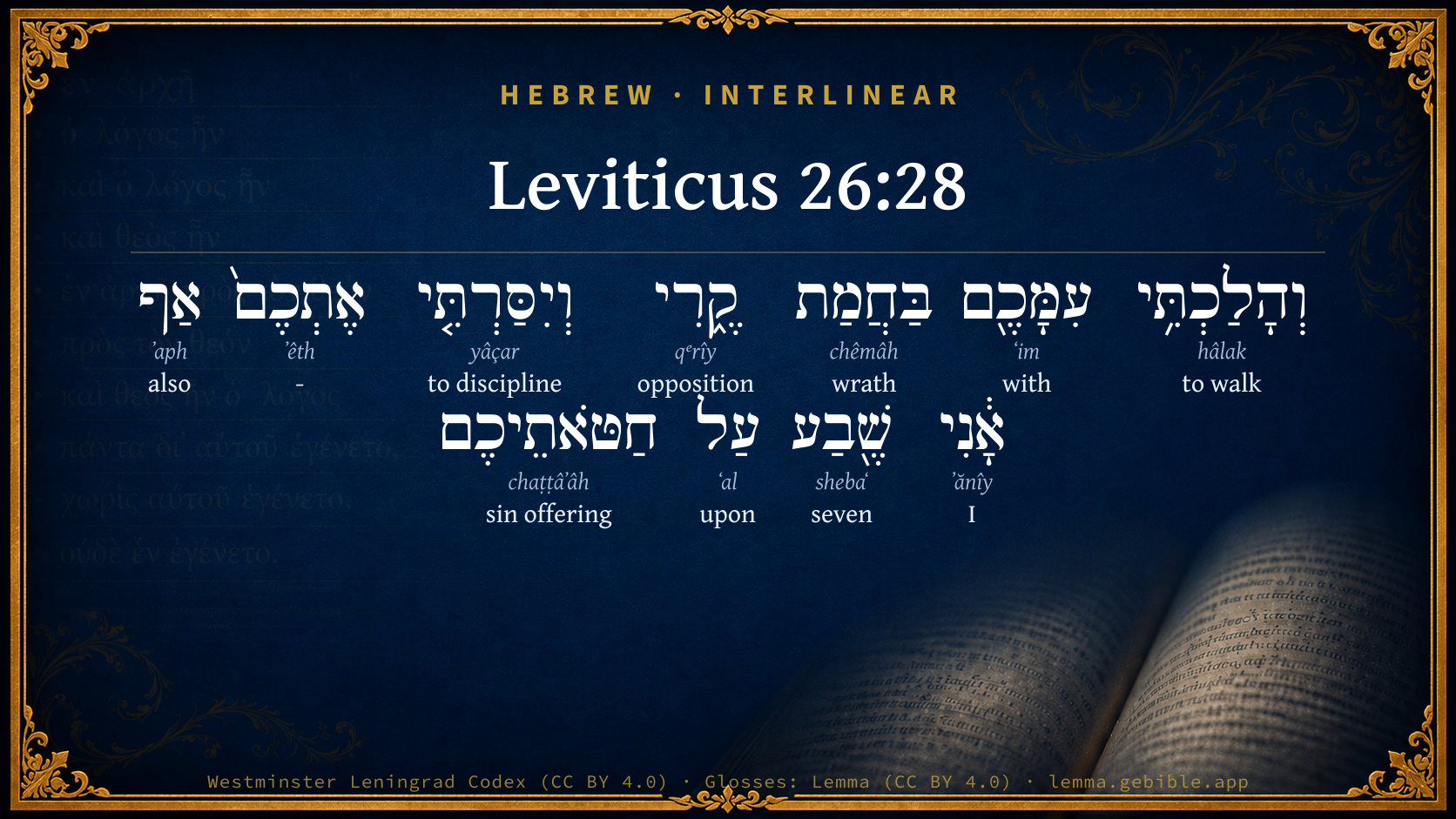
  1. וְהָלַכְתִּ֥י hâlak H1980 “and · to walk” Conjunction + Verb, Qal, Sequential Perfect, 1st Person, Common, Singular
  2. עִמָּכֶ֖ם ʻim H5973 “with · you” Preposition + Suffix, Personal, 2nd Person, Masculine, Plural
  3. בַּחֲמַת chêmâh H2534 “in/at · wrath of” Preposition + Noun, Common, Feminine, Singular, Construct
  4. וְיִסַּרְתִּ֤י yâçar H3256 “and · to discipline” Conjunction + Verb, Piel, Sequential Perfect, 1st Person, Common, Singular
  5. אֶתְכֶם֙ ʼêth H853 “- · you” Particle, Direct Object + Suffix, Personal, 2nd Person, Masculine, Plural
  6. אַף ʼaph H637 “also” Particle, Accusative
  7. אָ֔נִי ʼănîy H589 “I” Pronoun, Personal, 1st Person, Common, Singular
  8. שֶׁ֖בַע shebaʻ H7651 “seven” Adjective, Cardinal number, Feminine, Singular, Absolute
  9. עַל ʻal H5921 “upon” Preposition
  10. חַטֹּאתֵיכֶם chaṭṭâʼâh H2403 “sin offerings · your” Noun, Common, Feminine, Plural, Construct + Suffix, Personal, 2nd Person, Masculine, Plural

About this verse

These counts appear in no published source. They are computed here, from the morphology-tagged text and Lemma’s own curated glosses. What Lemma adds →

11
words
11
distinct lemmas
Pentateuch
section

Notable vocabulary

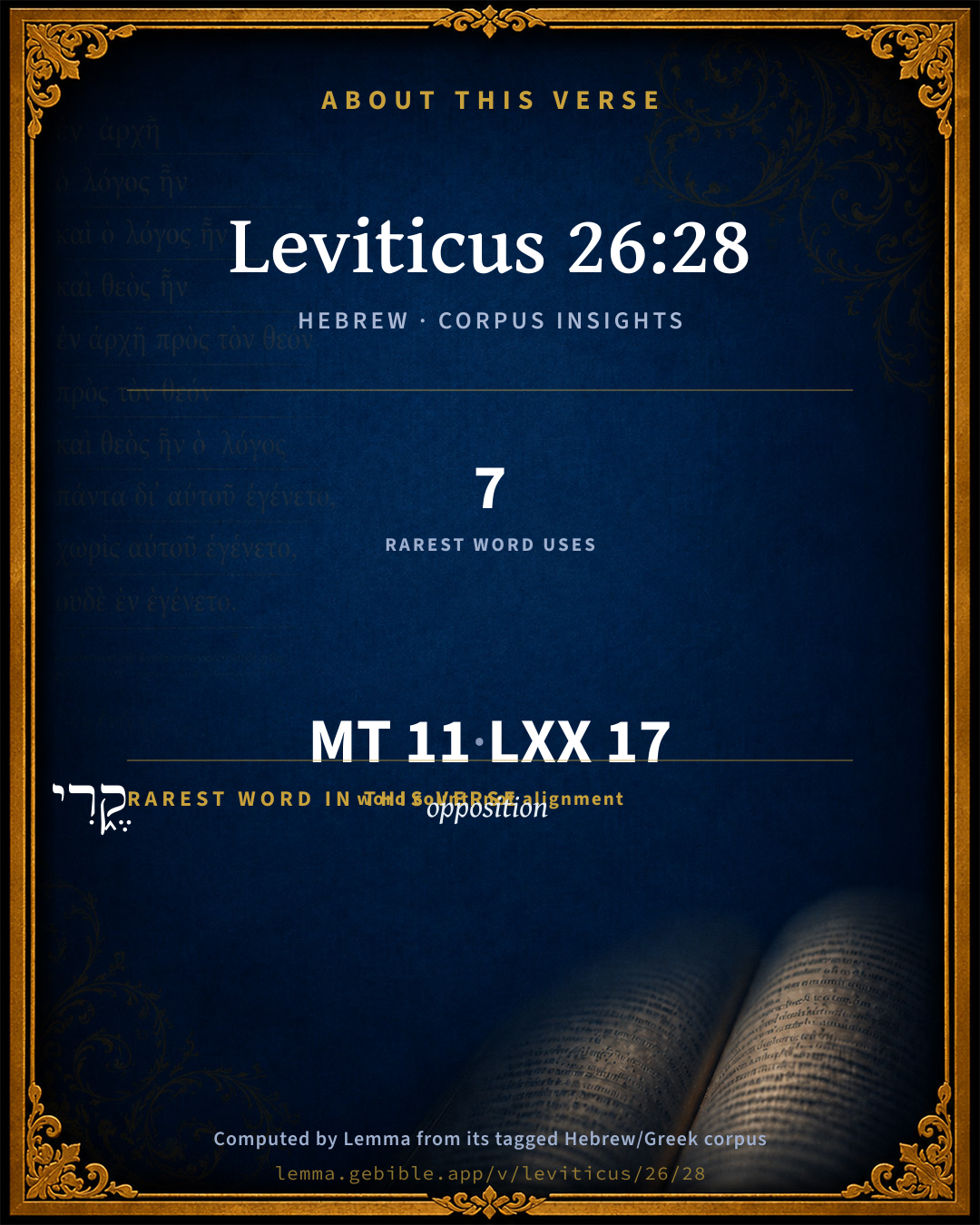
The rarest word here is קֶ֑רִי opposition H7147 — appearing just 7 times in the whole Hebrew Bible.

Shared distinctive vocabulary

קֶ֑רִי opposition H7147 occurs in 7 verses of the Hebrew Bible. Also found in:

Grammatical profile

  • 2 verbs
  • 3 nouns
  • 1 adjective
  • 1 pronoun
  • 2 prepositions
  • 2 particles

Verb forms

  • וְהָלַכְתִּ֥י Qal · Sequential Perfect
  • וְיִסַּרְתִּ֤י Piel · Sequential Perfect

Hebrew & Septuagint length

In English translation the verse runs 20 words from the Hebrew and 20 from the Septuagint (LXX English) — the same length.

A rough comparison of the two English renderings, which tokenize alike — not a word-level alignment.

Word counts can differ between the Hebrew and the Greek without any difference in meaning — e.g. the Hebrew direct-object marker אֵת has no separate Greek word, and Greek often adds the article ὁ.

In the original languages it is 11 Hebrew tokens and 17 Greek tokens — but the two are counted differently (Hebrew bundles its prefixes and suffixes into one token; the Greek is in lemma form), so that isn’t a like-for-like length.

Cross-references

10

Topical passages linked to Leviticus 26:28 in the Treasury of Scripture Knowledge — connected by theme and wording, ordered by reader-vote popularity; previews shown in the World English Bible.

  • Isaiah 59:18 According to their deeds, accordingly he will repay, wrath to his adversaries, recompense to his enemies; to the islands he will repay recompense.
  • Isaiah 63:3 I have trodden the winepress alone; and of the peoples there was no man with me: yes, I trod them in my anger, and trampled them in my wrath; and their lifeblood is sprinkled on my garments, and I have stained all my clothing.
  • Isaiah 66:15 For, behold, Yahweh will come with fire, and his chariots shall be like the whirlwind; to render his anger with fierceness, and his rebuke with flames of fire.
  • Jeremiah 21:5 I myself will fight against you with an outstretched hand and with a strong arm, even in anger, and in wrath, and in great indignation.
  • Ezekiel 5:13 Thus shall my anger be accomplished, and I will cause my wrath toward them to rest, and I shall be comforted; and they shall know that I, Yahweh, have spoken in my zeal, when I have accomplished my wrath on them.
  • Ezekiel 5:15 So it shall be a reproach and a taunt, an instruction and an astonishment, to the nations that are round about you, when I shall execute judgments on you in anger and in wrath, and in wrathful rebukes; (I, Yahweh, have spoken it;)
  • Ezekiel 8:18 Therefore will I also deal in wrath; my eye shall not spare, neither will I have pity; and though they cry in my ears with a loud voice, yet will I not hear them.
  • Isaiah 27:4 Wrath is not in me: would that the briers and thorns were against me in battle! I would march on them, I would burn them together.
  • Nahum 1:2 Yahweh is a jealous God and avenges. Yahweh avenges and is full of wrath. Yahweh takes vengeance on his adversaries, and he maintains wrath against his enemies.
  • Nahum 1:6 Who can stand before his indignation? Who can endure the fierceness of his anger? His wrath is poured out like fire, and the rocks are broken apart by him.

Cross-references courtesy of OpenBible.info (CC BY 4.0).

Hebrew and Greek witnesses Masoretic Hebrew ↔ Greek Septuagint

The same verse in the two great witnesses to the Old Testament, shown verse-for-verse.

These are two independent witnesses, not word-aligned to each other, and the Septuagint is shown in lemma (dictionary) form.

Hebrew Leviticus 26:28 Masoretic · Westminster Leningrad Codex

וְהָלַכְתִּ֥י עִמָּכֶ֖ם בַּחֲמַת קֶ֑רִי וְיִסַּרְתִּ֤י אֶתְכֶם֙ אַף אָ֔נִי שֶׁ֖בַע עַל חַטֹּאתֵיכֶם

then I will walk contrary to you in wrath; and I also will chastise you seven times for your sins.

World English Bible · Public Domain

Greek LXX Leviticus 26:28 Septuagint · lemma form

καί αὐτός πορεύομαι μετά σύ ἐν θυμός πλάγιος καί παιδεύω σύ ἐγώ ἑπτάκις κατά ὁ ἁμαρτία σύ

then will I walk with you with a froward mind, and I will chasten you sevenfold according to your sins.

LXX2012 (modern English Septuagint) · Public Domain

Hebrew: Westminster Leningrad Codex (CC BY 4.0). Greek: Septuagint (public domain); English from LXX2012 (modern English Septuagint) (Public Domain). How the Septuagint differs from the Hebrew →

Targum (Aramaic paraphrase)

2

The Targum is the ancient Jewish Aramaic paraphrase of the Hebrew Scriptures — an interpretive translation, not the Hebrew text itself. Onkelos (literal) and Pseudo-Jonathan (expansive) render the Torah, and Jonathan the Prophets. Coverage is partial: where no permissively-licensed English translation exists for a verse, only the Aramaic is shown. This is verse-level text, not a word-by-word alignment to the Hebrew.

  1. Targum Onkelos Torah (Genesis–Deuteronomy)
    וְאֵהַךְ עִמְכוֹן בִּתְקוֹף רְגַז וְאִרְדֵי יָתְכוֹן אַף אֲנָא שְׁבַע עַל חוֹבֵיכוֹן

    (no public-domain English translation for this verse)

    Targum Onkelos — Aramaic: “Onkelos Genesis” (public domain); “Onkelos Exodus” (public domain); “Onkelos Leviticus” (public domain); “Onkelos Numbers” (public domain); “Onkelos Deuteronomy” (public domain). English: “Sefaria Community Translation” (CC0 1.0 (public-domain dedication)); “J.W. Etheridge. The Targums of Onkelos and Jonathan Ben Uzziel on the Pentateuch. London: Longmans, Green, 1862” (public domain). Text via Sefaria.

  2. Targum Pseudo-Jonathan Torah (Genesis–Deuteronomy)
    וְאִידַבֵּר אוּף אֲנָא יַתְכוֹן בְּעַרְאַי בְּעַלְמָא וְאִירְדֵי יַתְכוֹן לְחוֹד אֲנָא שְׁבַע מְחָן עַל שְׁבַע עֲבֵירָן דִי חֲטֵיתוּן קֳדָמָי

    I will also remember you adversely in the world, and will chastise you, even I, with seven plagues, for the seven transgressions with which ye have sinned before Me.

    Targum Pseudo-Jonathan — Aramaic: “Targum Jonathan on Genesis” (public domain); “Targum Jonathan on Exodus” (public domain); “Targum Jonathan on Leviticus” (public domain); “Targum Jonathan on Numbers” (public domain); “Targum Jonathan on Deuteronomy” (public domain). English: “The Targum of Jonathan ben Uzziel, trans. J. W. Etheridge, London, 1862” (public domain). Text via Sefaria.

Commentary

Notes on Leviticus 26:28 from classic Christian and Jewish commentators (each source and its license shown beneath its notes). The classic Christian expositions comment on the surrounding passage and are grouped to its opening verse, so a note may address several verses; the Jewish commentaries on the Tanakh (Rashi and others) are per-verse, so they appear only where the commentator wrote on this verse.

Lemma curates 59 commentaries, every one of them public domain or Creative Commons licensed, each selected and text-cleaned for this edition rather than reprinted as found. About our sources →

Trapp's Complete Commentary

John Trapp

Lev 26:28 Then I will walk contrary unto you also in fury; and I, even I, will chastise you seven times for your sins.

Ver. 28. Seven times for your sins.] God will not cease pursuing till Sheba’s head be thrown over the wall. Three times in this chapter God raiseth his note of threatening, and he raiseth it by sevens, and those are discords in music. Such sayings will be heavy songs, and their execution heavy pangs to the wicked. In musical notes there are but eight degrees; and then the same returns again. Philosophers, when they distinguish degrees in qualities, do usually make the eighth degree to be the highest. But in the wrath of God against impenitents here in this chapter, Lev 26:18; Lev 26:21; Lev 26:24; Lev 26:28, there are no fewer than twenty-eight degrees threatened, as is well observed. {a}

{a} Dr Rain.

John Trapp, A Commentary or Exposition upon All the Books of the Old and New Testament (1647–1656) — public domain. Text from a community e-Sword module.

Joseph Benson's Commentary

Lev 26:28. I will walk contrary to you in fury, &c. — Your obstinate contempt of my laws shall be punished with new and more grievous plagues; which was fulfilled in their captivity in the days of Manasseh, Jehoiakim, and Zedekiah. For these latter calamities were at least seven times greater, both for extent and duration, than the former which they suffered from the Philistines and neighbouring nations.

Joseph Benson's Commentary on the Old and New Testaments (1811–1818) — public domain. Text from a community e-Sword module.

Ellicott's Commentary for English Readers

(28) Then I will walk contrary unto you also in fury.—Whilst in Lev_26:24 the persistent rebellion is responded to on the part of the defied God in the simple words, “then will I also work contrary unto you,” we have here the addition “in fury” as the provocation is more intense.

And I, even I, will chastise you.—Better, And I also will chastise you. The verb here is different from the one in Lev_26:24.

A Bible Commentary for English Readers, edited by Charles John Ellicott (1878–1897) — public domain. Text from a community e-Sword module.

John Gill's Exposition

And ye shall eat the flesh of your sons,.... Which was fulfilled at the siege of Samaria, in the times of Joram, Kg2 6:29; and at the siege of Jerusalem by Nebuchadnezzar, Lam 4:10; and though there is no instance of it at that time in the sacred records, the Jews (p) tells us of one Doeg ben Joseph, who died and left a little one with his mother, who was very fond of him; but at this siege slew him with her own hands, and ate him, with respect to which they suppose Jeremiah makes the lamentation, Lam 2:2; and of this also there was an instance at the last siege of Jerusalem, by Titus, when a woman, named Mary, of a considerable family, boiled her son, and ate part of him, and the rest was found in her house when the seditious party broke in upon her, as Josephus (q) relates:

and the flesh of your daughters shall ye eat; of which, though no instances are given, it is as reasonable to suppose it was done as the former. Some of the Jewish writers (r) think, that in this prediction is included, that children should eat their parents, as well as parents their children, as in Eze 5:10.

(p) Torat Cohanim in Yalkut, par. 1. fol. 197. 1. (q) De Bello. Jud. l. 6. c. 3. sect. 4. (r) Torat Cohanim, ib.

John Gill's Exposition of the Whole Bible (1746–1763) — public domain (CC PDM 1.0). Text via the HelloAO Bible API.

Haydock's Catholic Bible Commentary

Fury. You will gain nothing by opposing me, but your own destruction. I will treat you, as you would deal with me. (Haydock)

George Leo Haydock (1774–1849), Haydock's Catholic Family Bible and Commentary, 1859 edition — public domain. Excludes Psalms (Douay-Rheims chapter numbering differs from Protestant) and Deuterocanonical books (Catholic canon only).

Matthew Poole's English Annotations

Contrary unto you in fury; or,

in fury of rashness or

carelessness with you or among you, like a raging lion breaking into a multitude of people, and destroying all he meets with promiscuously, or without any distinction, both righteous and wicked together, as is threatened Eze 21:3. Or, in fury of contrariety, or meeting with you, or against you, like a man that meets his enemy in the fury of battle.

Matthew Poole's English Annotations on the Holy Bible (1683–1685) — public domain. Text from a community e-Sword/MySword module.

Whedon's Commentary on the Bible

Daniel D. Whedon

28. In fury — Hebrews, in the heat of encountering. Fury, as implying a perturbed and excited malevolence, is not predicable of Jehovah. Yet as a species of anthropomorphism, to convey in a vivid manner the intense activity of the divine justice against impenitent and defiant Israel, it is admissible.

Even I — This seems to imply the direct interposition of the divine hand without the employment of secondary causes. “It is a fearful thing to fall into the hands of the living God.”

Daniel D. Whedon (gen. ed.), Commentary on the Old and New Testaments (1874–1909) — public domain. Text from a community e-Sword module.

Lesson kit

Teaching starters — assembled from the data on this page, not authored interpretation. Every prompt links to the verse data it draws on. Edit before teaching.

Leviticus, in the Pentateuch, opens this verse with 11 words (11 distinct Hebrew lemmas). Its most distinctive word is qᵉrîy (“opposition”). A historical commentator’s framing appears above. Read the whole chapter for the surrounding context.

Discussion questions

  1. What does “opposition” (qᵉrîy) contribute to the verse as a whole?
  2. Leviticus 26:21 shares the word «opposition» with this verse. How do the two illuminate each other?
  3. These translations render this verse differently; the difference is in the English rendering, not the original. What questions does that raise?
  4. The verb «וְהָלַכְתִּ֥י» is Qal Sequential Perfect. How does its form color the action?
  5. Reading how Trapp's Complete Commentary and Joseph Benson's Commentary read this verse, where do the two commentators agree and where do they part?

Things to notice

Reading settings

Reading text

Shown beneath each verse's original-language words.

Old Testament
Old Testament edition

Read the OT as the Masoretic Hebrew (MT) or the Greek Septuagint (LXX).

English shown for the Greek Septuagint (in the Hebrew ↔ Greek comparison).

Comparing translations? Open the Compare panel on any verse page to stack up to four side by side.