
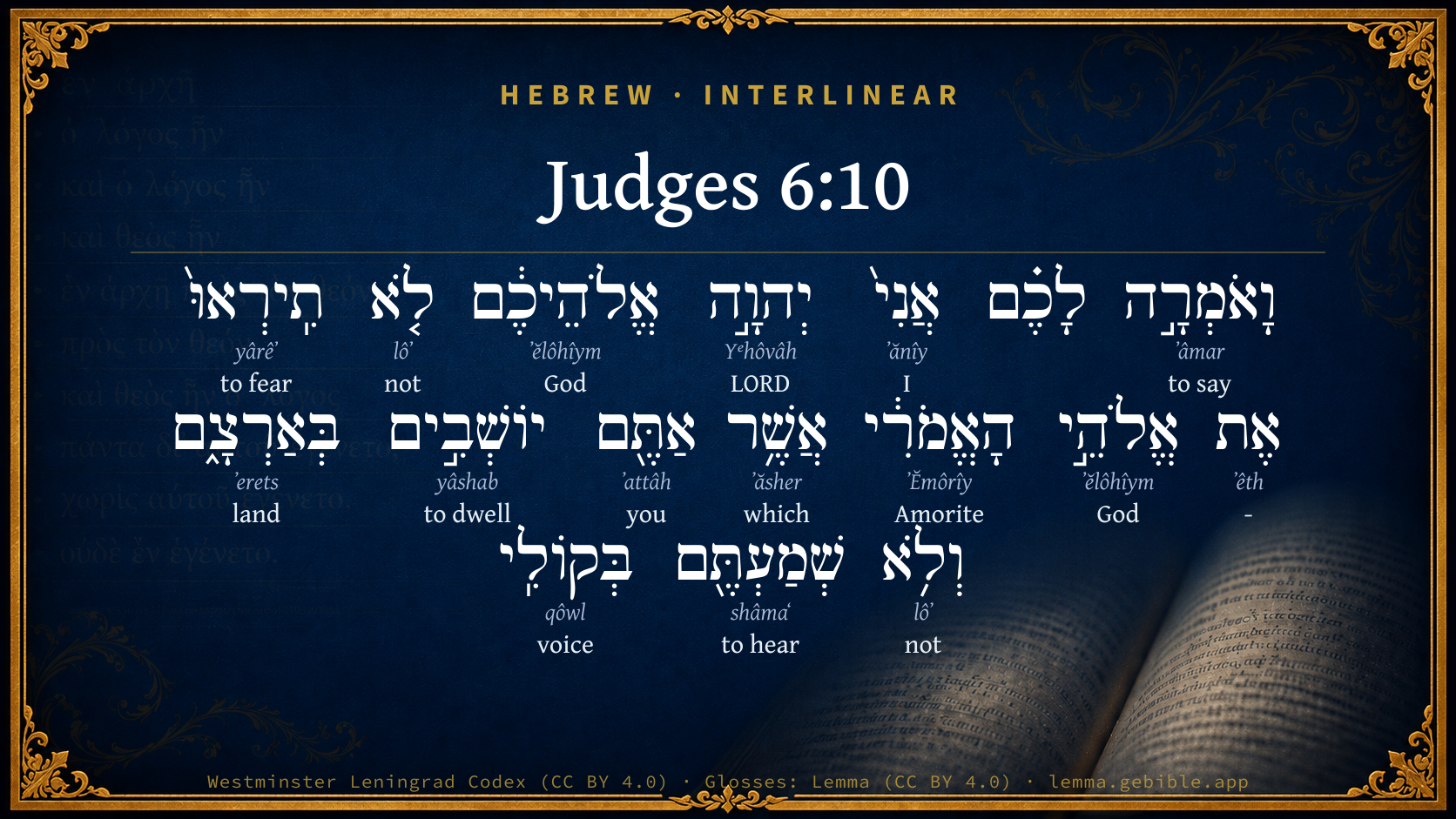
Judges 6:10

Hebrew (Westminster Leningrad Codex) Judges 6:10 appears in the Hebrew Old Testament. The text above is from the Westminster Leningrad Codex. Each word links to its Strong’s number, a concise gloss, and parsing drawn from the Open Scriptures Hebrew Bible morphology. Click any word for its full Brown-Driver-Briggs (BDB) entry.
Download image
Cite this verse

Judges 6:10 (World English Bible). Public Domain. Lemma interlinear Bible study tool, https://lemma.gebible.app/v/judges/6/10.

Show BibTeX & RIS
BibTeX
RIS
English Translation
and I said to you, I am Yahweh your God; you shall not fear the gods of the Amorites, in whose land you dwell. But you have not listened to my voice.
World English Bible · Public Domain
Download a study sheet

One document with this verse’s original text, its word-by-word gloss line, the meaning frame, cross-references with their text, attributed commentary, and full source and license credits — printable, and it pastes into notes with its structure intact.

This verse Autodidact and up

Study sheet (.html) Plain text (.txt)

A passage Seminary Student

Up to 50 verses in one chapter. A passage sheet keeps up to 6 commentary sources and 12 cross-references per verse, in the order this page ranks them, and says so on the sheet whenever that leaves anything out. Ask for a single verse and you get the Autodidact verse sheet above.

Everything on this page stays free to read, with no account — the sheet is a download of what is already on screen, not access to it.

Want to remove ads? Support Godless Engineer
Compare translations 3

The same verse in 3 English versions, stacked beneath the original-language interlinear above. Click any original word for its lexicon entry.

Each is an independent rendering of the whole verse — the interlinear is not word-aligned to these translations.

Highlighted words mark where these versions differ — a whole-verse word diff, not a word-by-word alignment.

  • World English Bible Public Domain
    and I said to you, I am Yahweh your God; you shall not fear the gods of the Amorites, in whose land you dwell. But you have not listened to my voice.
  • King James Version Public Domain
    And I said unto you, I am the LORD your God; fear not the gods of the Amorites, in whose land ye dwell: but ye have not obeyed my voice.
  • unfoldingWord Literal Text CC BY-SA 4.0
    And I said to you, “I Yahweh your God. You shall not fear the gods of the Amorite, when you dwelling in their land.” But you have not heard my voice.’”

unfoldingWord Literal Text — © unfoldingWord, licensed CC BY-SA 4.0. Word-aligned USFM3 via Door43 (git.door43.org/unfoldingWord/en_ult).

Versions to compare (up to 4)

3 of 4 selected

Show all 18 translations

Every available English version of this verse, each an independent rendering of the whole verse.

  • World English Bible Public Domain
    and I said to you, I am Yahweh your God; you shall not fear the gods of the Amorites, in whose land you dwell. But you have not listened to my voice.
  • Berean Standard Bible Public Domain
    And I said to you: ‘I am the LORD your God. You must not fear the gods of the Amorites, in whose land you dwell.’ But you did not obey Me.”
  • Majority Standard Bible Public Domain
    And I said to you: ‘I am the LORD your God. You must not fear the gods of the Amorites, in whose land you dwell.’ But you did not obey Me.”
  • King James Version Public Domain
    And I said unto you, I am the LORD your God; fear not the gods of the Amorites, in whose land ye dwell: but ye have not obeyed my voice.
  • American Standard Version (1901) Public Domain
    and I said unto you, I am Jehovah your God; ye shall not fear the gods of the Amorites, in whose land ye dwell. But ye have not hearkened unto my voice.
  • Revised Version (1885) Public Domain
    and I said unto you, I am the LORD your God; ye shall not fear the gods of the Amorites, in whose land ye dwell: but ye have not hearkened unto my voice.
  • Geneva Bible (1599) Public Domain
    And I sayde vnto you, I am the Lord your God: feare not the gods of the Amorites in whose lande you dwell: but ye haue not obeyed my voyce.
  • Douay-Rheims (1899) Public Domain
    And delivered you out of the hands of the Egyptians, and of all the enemies that afflicted you: and I cast them out at your coming in, and gave you their land.
  • Young's Literal Translation Public Domain
    and I say to you, I `am' Jehovah your God, ye do not fear the gods of the Amorite in whose land ye are dwelling: -- and ye have not hearkened to My voice.'
  • Literal Standard Version CC BY-SA 4.0
    and I say to you, I [am] your God YHWH, you do not fear the gods of the Amorite in whose land you are dwelling—and you have not listened to My voice.”
  • Unlocked Literal Bible CC BY-SA 4.0
    I said to you, “I am Yahweh your God; I commanded you not to worship the gods of the Amorites, in whose land you are living.” But you have not obeyed my voice.'”
  • unfoldingWord Literal Text CC BY-SA 4.0
    And I said to you, “I Yahweh your God. You shall not fear the gods of the Amorite, when you dwelling in their land.” But you have not heard my voice.’”
  • Darby Bible Public Domain
    and I said to you, 'I am the LORD your God; you shall not pay reverence to the gods of the Amorites, in whose land you dwell.' But you have not given heed to my voice."
  • World Messianic Bible Public Domain
    I said to you, “I am the LORD your God. You shall not fear the gods of the Amorites, in whose land you dwell.” But you have not listened to my voice.’”
  • Webster's Bible Public Domain
    And I said to you, I am the LORD your God; fear not the gods of the Amorites, in whose land ye dwell: but ye have not obeyed my voice.
  • Free Bible Version CC BY-SA 4.0
    I warned you: I am the Lord your God. You must not worship the gods of the Amorites, in whose land you're now living.’ But you didn't listen to me.”
  • Bible in Basic English Public Domain
    And I said to you, I am the Lord your God; you are not to give worship to the gods of the Amorites in whose land you are living, but you did not give ear to my voice.
  • JPS Tanakh (1917) Public Domain
    And I said unto you: I am the LORD your God; ye shall not fear the gods of the Amorites, in whose land ye dwell; but ye have not hearkened unto My voice.'

Literal Standard Version (2020), Covenant Press — licensed CC BY-SA 4.0. Text via the HelloAO Bible API (eBible.org). Unlocked Literal Bible (unfoldingWord) — licensed CC BY-SA 4.0. Text via the HelloAO Bible API (eBible.org). unfoldingWord Literal Text — © unfoldingWord, licensed CC BY-SA 4.0. Word-aligned USFM3 via Door43 (git.door43.org/unfoldingWord/en_ult). Free Bible Version, Dr. Jonathan Gallagher — licensed CC BY-SA 4.0. Text via the HelloAO Bible API (eBible.org).

Word by word

More ways to search: Search by grammar → Find every occurrence → Compare this word →

Practice this passage: Drill this verse → Learn its vocabulary →

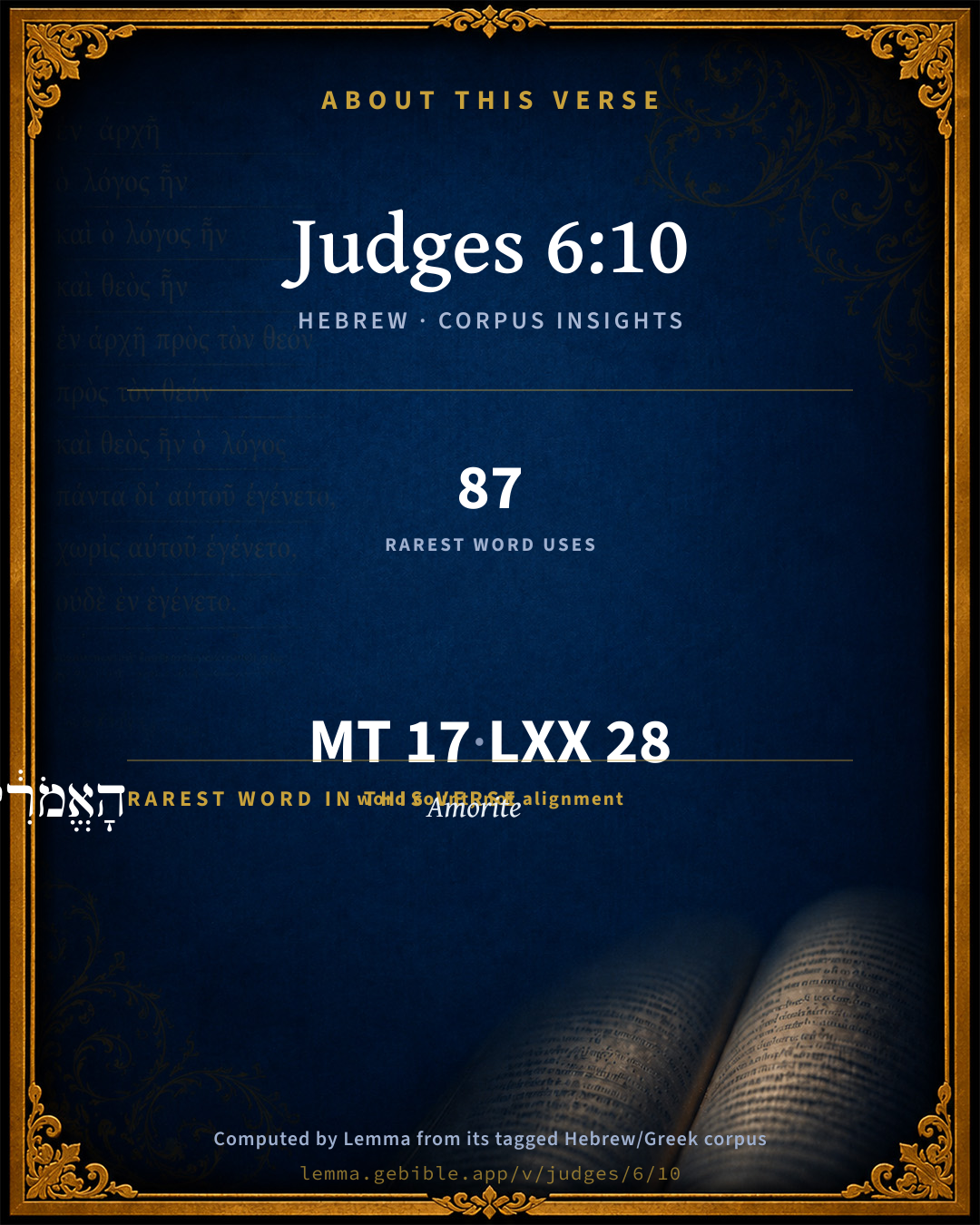
הָאֱמֹרִ֔י
ʼĔmôrîy
H567
“the · Amorite”
Particle, Definite Article + Noun, Gentilic, Masculine, Singular, Absolute
Part of Speech
Particle + Noun
Type
Gentilic
Gender
Masculine
Number
Singular
State
Absolute
Full BDB Definition

Origin: probably a patronymic from an unused name derived from H559 in the sense of publicity, i.e. prominence

TWOT: 119

Amorite = "a sayer" - one of the peoples of east Canaan and beyond the Jordan, dispossessed by the Israelite incursion from Egypt
  1. וָאֹמְרָ֣ה ʼâmar H559 “and · to say” Conjunction + Verb, Qal, Sequential Imperfect, 1st Person, Common, Singular + Suffix, h
  2. אֲנִי֙ ʼănîy H589 “I” Pronoun, Personal, 1st Person, Common, Singular
  3. יְהוָ֣ה Yᵉhôvâh H3068 “LORD” Noun, Proper
  4. אֱלֹהֵיכֶ֔ם ʼĕlôhîym H430 “God(s) · your” Noun, Common, Masculine, Plural, Construct + Suffix, Personal, 2nd Person, Masculine, Plural
  5. לֹ֤א lôʼ H3808 “not” Particle, Negative
  6. תִֽירְאוּ֙ yârêʼ H3372 “to fear” Verb, Qal, Imperfect, 2nd Person, Masculine, Plural
  7. אֶת ʼêth H853 “-” Particle, Direct Object
  8. אֱלֹהֵ֣י ʼĕlôhîym H430 “God(s) of” Noun, Common, Masculine, Plural, Construct
  9. אֲשֶׁ֥ר ʼăsher H834 “which” Particle, Relative
  10. אַתֶּ֖ם ʼattâh H859 “you” Pronoun, Personal, 2nd Person, Masculine, Plural
  11. יוֹשְׁבִ֣ים yâshab H3427 “dwelling” Verb, Qal, Participle Active, Masculine, Plural, Absolute
  12. בְּאַרְצָ֑ם ʼerets H776 “in/at · land · their” Preposition + Noun, Common, Both, Singular, Construct + Suffix, Personal, 3rd Person, Masculine, Plural
  13. וְלֹ֥א lôʼ H3808 “and · not” Conjunction + Particle, Negative
  14. שְׁמַעְתֶּ֖ם shâmaʻ H8085 “to hear” Verb, Qal, Perfect, 2nd Person, Masculine, Plural
  15. בְּקוֹלִֽי qôwl H6963 “in/at · voice · my” Preposition + Noun, Common, Masculine, Singular, Construct + Suffix, Personal, 1st Person, Common, Singular

About this verse

These counts appear in no published source. They are computed here, from the morphology-tagged text and Lemma’s own curated glosses. What Lemma adds →

17
words
14
distinct lemmas
Historical
section

Grammatical profile

  • 4 verbs
  • 6 nouns
  • 2 pronouns
  • 1 preposition
  • 4 particles

Verb forms

  • וָאֹמְרָ֣ה Qal · Sequential Imperfect
  • תִֽירְאוּ֙ Qal · Imperfect
  • יוֹשְׁבִ֣ים Qal · Participle Active
  • שְׁמַעְתֶּ֖ם Qal · Perfect

Repetition

Words recur within this verse — often emphatic in Hebrew:

  • אֱלֹהֵיכֶ֔ם God H430 ×2
  • לֹ֤א not H3808 ×2

Hebrew & Septuagint length

In English translation the verse runs 32 words from the Hebrew and 32 from the Septuagint (LXX English) — the same length.

A rough comparison of the two English renderings, which tokenize alike — not a word-level alignment.

Word counts can differ between the Hebrew and the Greek without any difference in meaning — e.g. the Hebrew direct-object marker אֵת has no separate Greek word, and Greek often adds the article ὁ.

In the original languages it is 17 Hebrew tokens and 28 Greek tokens — but the two are counted differently (Hebrew bundles its prefixes and suffixes into one token; the Greek is in lemma form), so that isn’t a like-for-like length.

Cross-references

15

Topical passages linked to Judges 6:10 in the Treasury of Scripture Knowledge — connected by theme and wording, ordered by reader-vote popularity; previews shown in the World English Bible.

  • Jeremiah 10:2 Thus says Yahweh, "Don't learn the way of the nations, and don't be dismayed at the signs of the sky; for the nations are dismayed at them.
  • 2 Kings 17:35–39 with whom Yahweh had made a covenant, and charged them, saying, You shall not fear other gods, nor bow yourselves to them, nor serve them, nor sacrifice to them:
  • Jeremiah 9:13 Yahweh says, Because they have forsaken my law which I set before them, and have not obeyed my voice, neither walked therein,
  • Exodus 20:2–3 "I am Yahweh your God, who brought you out of the land of Egypt, out of the house of bondage.
  • Judges 2:2 and you shall make no covenant with the inhabitants of this land; you shall break down their altars. But you have not listened to my voice: why have you done this?
  • Jeremiah 3:13 Only acknowledge your iniquity, that you have transgressed against Yahweh your God, and have scattered your ways to the strangers under every green tree, and you have not obeyed my voice, says Yahweh.
  • Jeremiah 3:25 Let us lie down in our shame, and let our confusion cover us; for we have sinned against Yahweh our God, we and our fathers, from our youth even to this day; and we have not obeyed the voice of Yahweh our God.
  • Jeremiah 42:21 and I have this day declared it to you; but you have not obeyed the voice of Yahweh your God in anything for which he has sent me to you.
  • Jeremiah 43:4 So Johanan the son of Kareah, and all the captains of the forces, and all the people, didn't obey the voice of Yahweh, to dwell in the land of Judah.
  • Jeremiah 43:7 and they came into the land of Egypt; for they didn't obey the voice of Yahweh: and they came to Tahpanhes.
  • 2 Kings 17:33 They feared Yahweh, and served their own gods, after the manner of the nations from among whom they had been carried away.
  • Proverbs 5:13 Neither have I obeyed the voice of my teachers, Nor turned my ear to those who instructed me!
  • Zephaniah 3:2 She didn't obey the voice. She didn't receive correction. She didn't trust in Yahweh. She didn't draw near to her God.
  • Romans 10:16 But they didn't all listen to the glad news. For Isaiah says, "Lord, who has believed our report?"
  • Hebrews 5:9 Having been made perfect, he became to all of those who obey him the author of eternal salvation,

Cross-references courtesy of OpenBible.info (CC BY 4.0).

Hebrew and Greek witnesses Masoretic Hebrew ↔ Greek Septuagint

The same verse in the two great witnesses to the Old Testament, shown verse-for-verse.

These are two independent witnesses, not word-aligned to each other, and the Septuagint is shown in lemma (dictionary) form.

Hebrew Judges 6:10 Masoretic · Westminster Leningrad Codex

וָאֹמְרָ֣ה לָכֶ֗ם אֲנִי֙ יְהוָ֣ה אֱלֹהֵיכֶ֔ם לֹ֤א תִֽירְאוּ֙ אֶת אֱלֹהֵ֣י הָאֱמֹרִ֔י אֲשֶׁ֥ר אַתֶּ֖ם יוֹשְׁבִ֣ים בְּאַרְצָ֑ם וְלֹ֥א שְׁמַעְתֶּ֖ם בְּקוֹלִֽי

and I said to you, I am Yahweh your God; you shall not fear the gods of the Amorites, in whose land you dwell. But you have not listened to my voice.

World English Bible · Public Domain

Greek LXX Judges 6:10 Septuagint · lemma form

καί εἶπον σύ ἐγώ κύριος ὁ θεός σύ οὐ φοβέω ὁ θεός ὁ ἀμορραῖος ἐν ὅς σύ καταἵημι ἐν ὁ γῆ αὐτός καί οὐ εἰςἀκούω ὁ φωνή ἐγώ

And I said to you, I am the Lord your God: you⌃ shall not fear the gods of the Amorites, in whose land you⌃ dwell; but you⌃ listened not to my voice.

LXX2012 (modern English Septuagint) · Public Domain

Hebrew: Westminster Leningrad Codex (CC BY 4.0). Greek: Septuagint (public domain); English from LXX2012 (modern English Septuagint) (Public Domain). How the Septuagint differs from the Hebrew →

Targum (Aramaic paraphrase)

1

The Targum is the ancient Jewish Aramaic paraphrase of the Hebrew Scriptures — an interpretive translation, not the Hebrew text itself. Onkelos (literal) and Pseudo-Jonathan (expansive) render the Torah, and Jonathan the Prophets. Coverage is partial: where no permissively-licensed English translation exists for a verse, only the Aramaic is shown. This is verse-level text, not a word-by-word alignment to the Hebrew.

  1. Targum Jonathan Prophets (Joshua–Malachi)
    וַאֲמָרִת לְכוֹן אֲנָא יְיָ אֱלָהָכוֹן לָא תִדְחֲלוּ יַת טַעֲוַת אֱמוֹרָאֵי דְאַתּוּן יַתְבִין בְּאַרְעֲהוֹן וְלָא קַבֵּלְתּוּן לְמֵימְרִי:

    (no public-domain English translation for this verse)

    Targum Jonathan — Aramaic: “Mikraot Gedolot” (public domain). English: “Sefaria Community Translation” (CC0 1.0 (public-domain dedication)); “London "Chaldee Paraphrase," 1871” (public domain). Text via Sefaria.

Commentary

Notes on Judges 6:10 from classic Christian and Jewish commentators (each source and its license shown beneath its notes). The classic Christian expositions comment on the surrounding passage and are grouped to its opening verse, so a note may address several verses; the Jewish commentaries on the Tanakh (Rashi and others) are per-verse, so they appear only where the commentator wrote on this verse.

Lemma curates 59 commentaries, every one of them public domain or Creative Commons licensed, each selected and text-cleaned for this edition rather than reprinted as found. About our sources →

Trapp's Complete Commentary

John Trapp

Jdg 6:10 And I said unto you, I [am] the LORD your God; fear not the gods of the Amorites, in whose land ye dwell: but ye have not obeyed my voice.

Ver. 10. Fear not the gods.] As true religion hath fear of piety for its foundation, so superstition hath its fear of that deity which it faneieth, and is therefore called δεισιδαιμονια.

“Primus in orbe Deos fecit Timor.”

John Trapp, A Commentary or Exposition upon All the Books of the Old and New Testament (1647–1656) — public domain. Text from a community e-Sword module.

Joseph Benson's Commentary

Jdg 6:10. Ye have not obeyed my voice — And therefore all these evils are come upon you. This is said to bring them to repentance. And our repentance is then genuine when the sinfulness of sin, as disobedience to God, is that which we chiefly lament.

Joseph Benson's Commentary on the Old and New Testaments (1811–1818) — public domain. Text from a community e-Sword module.

Ellicott's Commentary for English Readers

(10) The gods of the Amorites.—See Jos_24:15; 1Ki_21:26. As the Amorites seem to have been the highlanders of Palestine, and the most powerful of all the Canaanitish tribes, their name is sometimes used for that of all the Canaanites (Jos_24:15). Thus Heber says:—

“As when five monarchs led to Gibeon’s fight

In rude array the harnessed Amorite.”

No deliverance can be promised till repentance has begun. When the warnings of the prophet are heeded the mission of the deliverer begins.

A Bible Commentary for English Readers, edited by Charles John Ellicott (1878–1897) — public domain. Text from a community e-Sword module.

John Gill's Exposition

And there came an angel of the Lord,.... This was not the prophet before mentioned, as Ben Gersom thinks, but an angel of God, as expressed, and not a created one, but the Angel of Jehovah's presence, the Word and Son of God, and who is expressly called Jehovah himself, Jdg 6:14.

and sat under an oak; or stayed there a while, as Kimchi interprets it, seeing, according to his observation, angels are not said to sit, but stand:

which was in Ophrah, that pertaineth to Joash the Abiezrite; which shows that this Ophrah is different from a city of this name in the tribe of Benjamin, Jos 18:23 for the oak that was in it, under which the angel sat, belonged to Joash an Abiezrite, a descendant of Abiezer, son of the sister of Gilead, who was the son of Machir the son of Manasseh, Jos 17:2, it is called by Josephus (h) Ephra, and by Jerom (i) Ephrata:

and his son Gideon threshed wheat by the winepress, to hide it from the Midianites; lest they should take it away, and bereave his father's family of their sustenance, as they were wont to do, wherever they could find it; and all circumstances attending this affair were on this account; he threshed it himself, this he chose to do, and not trust his servants, lest it should be discovered; and he beat the wheat out with a staff, that it might be more silently done, and not with oxen, which was the usual way of treading out corn, who, bellowing (k), would discover it; and this was done not on a threshing floor, but where a winepress stood, where there could be no suspicion of such work being doing.

(h) Antiqu. l. 5. c. 6. sect. 5, 7. (i) De loc. Heb. fol. 90. K. (k) Vid. Homer. Iliad. 20. ver. 495, 496, 497.

John Gill's Exposition of the Whole Bible (1746–1763) — public domain (CC PDM 1.0). Text via the HelloAO Bible API.

Albert Barnes' Notes on the Bible

A similar use of the name Amorite, instead of the more usual name Canaanite, occurs in Jos 24:15, Jos 24:18. Perhaps a special reason may be found for the use of Amorite, if the prophet was addressing those who dwelt in the mountains, where the Amorites chiefly dwelt. The idolatries of the Amorites seem, too, to have been preeminently abominable (see 2Ki 21:11; 1Ki 21:26). It should be observed that the prophet’s language, as it traces the misery of Israel to their sins, so also intimates the necessity of repentance and of breaking off their sins - especially the sin of idolatry - as preliminary to any deliverance. In exact accordance with this view, Gideon commences his work by throwing down the altar of Baal, and building up the altar of Yahweh Jdg 6:24-25.

Albert Barnes' Notes on the Bible (1834–1885) — public domain. Text from a community e-Sword/MySword module.

Haydock's Catholic Bible Commentary

Fear not. Idols can do you no hurt, if you continue faithful to me. (Haydock) --- Shew them no respect or worship. The fear of Isaac means the God (Calmet) whom Isaac worshipped, Genesis xxxi. 42. Idolatry owed its rise to a groundless fear: primos in orbe deos fecit timor. (Lucretius) The pagans offered sacrifice to Paventia, to fear and paleness, &c., that they might be secure from them. (Lactantius) (Haydock)

George Leo Haydock (1774–1849), Haydock's Catholic Family Bible and Commentary, 1859 edition — public domain. Excludes Psalms (Douay-Rheims chapter numbering differs from Protestant) and Deuterocanonical books (Catholic canon only).

Matthew Poole's English Annotations

Fear not, i.e. do not serve or worship them.

Matthew Poole's English Annotations on the Holy Bible (1683–1685) — public domain. Text from a community e-Sword/MySword module.

Whedon's Commentary on the Bible

Daniel D. Whedon

10. Gods of the Amorites — The word Amorites is here, as in Gen_15:16, and Jos_24:15, put for the whole of the Canaanitish tribes. Their idol gods they were not to fear. “Perhaps in this case a special reason may be found for the use of Amorite, if the prophet was addressing those who dwelt in the mountains where the Amorites chiefly dwelt.” — Hervey.

Daniel D. Whedon (gen. ed.), Commentary on the Old and New Testaments (1874–1909) — public domain. Text from a community e-Sword module.

John Wesley's Explanatory Notes

Not obeyed my voice - He intends to bring them to repentance. And our repentance is then genuine, when he sinfulness of sin, as disobedience to God, is that in it which we chiefly lament.

John Wesley, Explanatory Notes Upon the Whole Bible (1754–1765) — public domain. Text via the GEBible commentary corpus.

Lesson kit

Teaching starters — assembled from the data on this page, not authored interpretation. Every prompt links to the verse data it draws on. Edit before teaching.

Judges, in the Historical, opens this verse with 17 words (14 distinct Hebrew lemmas). Its most distinctive word is ʼĔmôrîy (“Amorite”). A historical commentator’s framing appears above. Read the whole chapter for the surrounding context.

Discussion questions

  1. The word ʼĔmôrîy carries the sense “Amorite.” How does it shape the verse?
  2. How does Jeremiah 10:2, which shares this passage’s theme, read alongside this verse?
  3. What does the repetition of “God” (2× in this one verse) do in this verse?
  4. These translations render this verse differently; the difference is in the English rendering, not the original. What questions does that raise?
  5. «וָאֹמְרָ֣ה» is a Qal Sequential Imperfect verb. How does that grammatical form shape the action described?
  6. Compare how Trapp's Complete Commentary and Joseph Benson's Commentary read this verse. Where do they agree or differ?

Things to notice

Reading settings

Reading text

Shown beneath each verse's original-language words.

Old Testament
Old Testament edition

Read the OT as the Masoretic Hebrew (MT) or the Greek Septuagint (LXX).

English shown for the Greek Septuagint (in the Hebrew ↔ Greek comparison).

Comparing translations? Open the Compare panel on any verse page to stack up to four side by side.