Leviticus 19:14

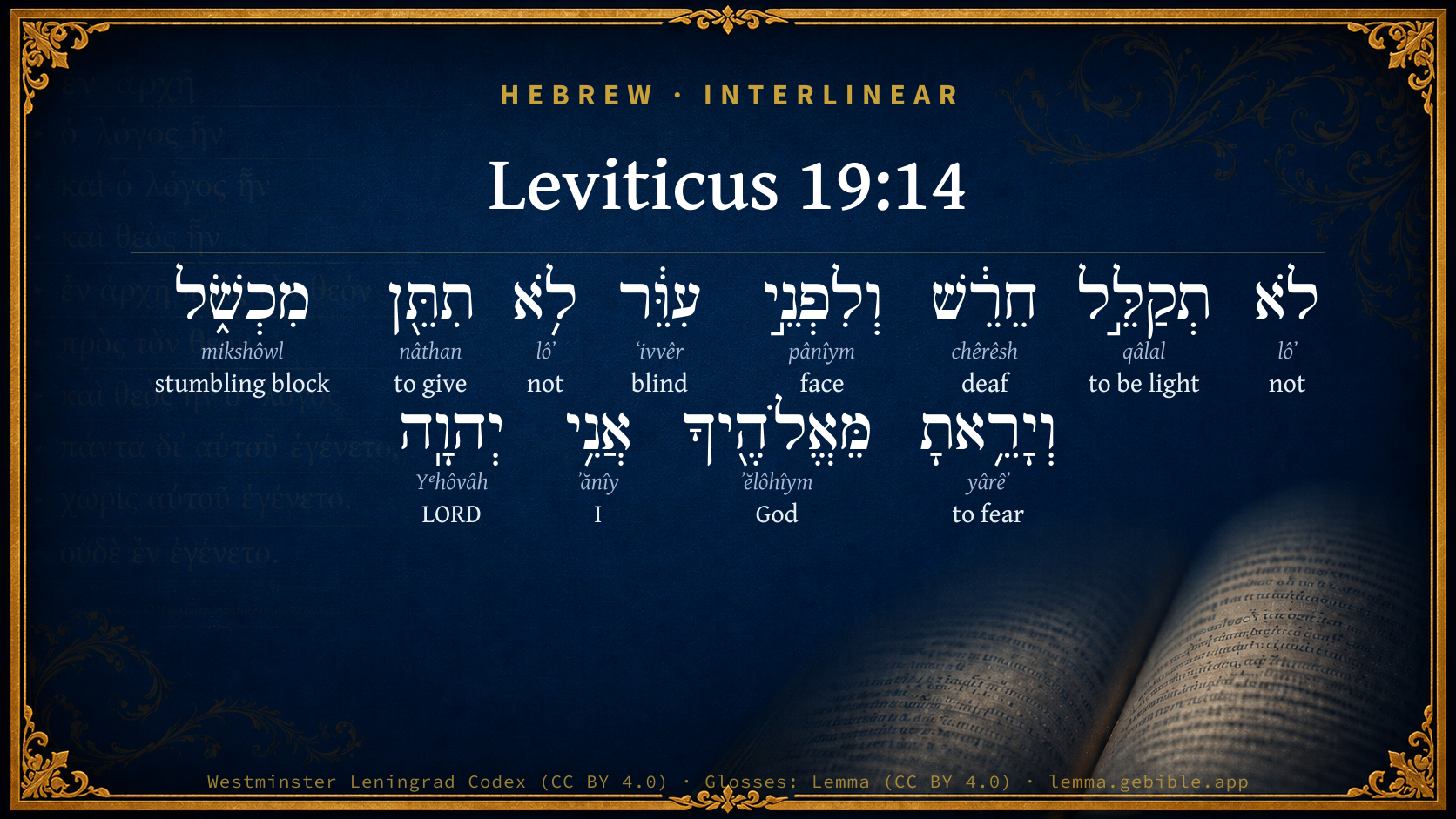
Hebrew (Westminster Leningrad Codex) Leviticus 19:14 appears in the Hebrew Old Testament. The text above is from the Westminster Leningrad Codex. Each word links to its Strong’s number, a concise gloss, and parsing drawn from the Open Scriptures Hebrew Bible morphology. Click any word for its full Brown-Driver-Briggs (BDB) entry.
Download image
Cite this verse

Leviticus 19:14 (World English Bible). Public Domain. Lemma interlinear Bible study tool, https://lemma.gebible.app/v/leviticus/19/14.

Show BibTeX & RIS
BibTeX
RIS
English Translation
"'You shall not curse the deaf, nor put a stumbling block before the blind; but you shall fear your God. I am Yahweh.
World English Bible · Public Domain
Highlights Full analysis ↓
Download a study sheet

One document with this verse’s original text, its word-by-word gloss line, the meaning frame, cross-references with their text, attributed commentary, and full source and license credits — printable, and it pastes into notes with its structure intact.

This verse Autodidact and up

Study sheet (.html) Plain text (.txt)

A passage Seminary Student

Up to 50 verses in one chapter. A passage sheet keeps up to 6 commentary sources and 12 cross-references per verse, in the order this page ranks them, and says so on the sheet whenever that leaves anything out. Ask for a single verse and you get the Autodidact verse sheet above.

Everything on this page stays free to read, with no account — the sheet is a download of what is already on screen, not access to it.

Want to remove ads? Support Godless Engineer
Compare translations 3

The same verse in 3 English versions, stacked beneath the original-language interlinear above. Click any original word for its lexicon entry.

Each is an independent rendering of the whole verse — the interlinear is not word-aligned to these translations.

Highlighted words mark where these versions differ — a whole-verse word diff, not a word-by-word alignment.

  • World English Bible Public Domain
    "'You shall not curse the deaf, nor put a stumbling block before the blind; but you shall fear your God. I am Yahweh.
  • King James Version Public Domain
    Thou shalt not curse the deaf, nor put a stumbling-block before the blind, but shalt fear thy God: I am the LORD.
  • unfoldingWord Literal Text CC BY-SA 4.0
    You shall not curse a deaf, and to the face of a blind, you shall not provide a hindrance. And you shall fear your God. I Yahweh.

unfoldingWord Literal Text — © unfoldingWord, licensed CC BY-SA 4.0. Word-aligned USFM3 via Door43 (git.door43.org/unfoldingWord/en_ult).

Versions to compare (up to 4)

3 of 4 selected

Show all 18 translations

Every available English version of this verse, each an independent rendering of the whole verse.

  • World English Bible Public Domain
    "'You shall not curse the deaf, nor put a stumbling block before the blind; but you shall fear your God. I am Yahweh.
  • Berean Standard Bible Public Domain
    You must not curse the deaf or place a stumbling block before the blind, but you shall fear your God. I am the LORD.
  • Majority Standard Bible Public Domain
    You must not curse the deaf or place a stumbling block before the blind, but you shall fear your God. I am the LORD.
  • King James Version Public Domain
    Thou shalt not curse the deaf, nor put a stumbling-block before the blind, but shalt fear thy God: I am the LORD.
  • American Standard Version (1901) Public Domain
    Thou shalt not curse the deaf, nor put a stumblingblock before the blind; but thou shalt fear thy God: I am Jehovah.
  • Revised Version (1885) Public Domain
    Thou shalt not curse the deaf, nor put a stumblingblock before the blind, but thou shalt fear thy God: I am the LORD.
  • Geneva Bible (1599) Public Domain
    Thou shalt not curse the deafe, neither put a stumbling blocke before the blinde, but shalt feare thy God: I am the Lord.
  • Douay-Rheims (1899) Public Domain
    Thou shalt not speak evil of the deaf, nor put a stumblingblock before the blind: but thou shalt fear the Lord thy God, because I am the Lord.
  • Young's Literal Translation Public Domain
    `Thou dost not revile the deaf; and before the blind thou dost not put a stumbling block; and thou hast been afraid of thy God; I `am' Jehovah.
  • Literal Standard Version CC BY-SA 4.0
    You do not revile the deaf; and you do not put a stumbling block before the blind; and you have been afraid of your God; I [am] YHWH.
  • Unlocked Literal Bible CC BY-SA 4.0
    Do not curse the deaf or put a stumbling block before the blind. Instead, you must fear your God. I am Yahweh.
  • unfoldingWord Literal Text CC BY-SA 4.0
    You shall not curse a deaf, and to the face of a blind, you shall not provide a hindrance. And you shall fear your God. I Yahweh.
  • Darby Bible Public Domain
    Thou shalt not revile a deaf person, and thou shalt not put a stumbling-block before a blind one; but thou shalt fear thy God: I am Jehovah.
  • World Messianic Bible Public Domain
    “‘You shall not curse the deaf, nor put a stumbling block before the blind; but you shall fear your God. I am the LORD.
  • Webster's Bible Public Domain
    Thou shalt not curse the deaf, nor put a stumbling-block before the blind, but shalt fear thy God: I am the LORD.
  • Free Bible Version CC BY-SA 4.0
    Don't speak badly about deaf people. Don't put objects in the way of blind people to trip them up. Instead show respect to your God. I am the Lord.
  • Bible in Basic English Public Domain
    Do not put a curse on those who have no hearing, or put a cause of falling in the way of the blind, but keep the fear of your God before you: I am the Lord.
  • JPS Tanakh (1917) Public Domain
    Thou shalt not curse the deaf, nor put a stumbling-block before the blind, but thou shalt fear thy God: I am the LORD.

Literal Standard Version (2020), Covenant Press — licensed CC BY-SA 4.0. Text via the HelloAO Bible API (eBible.org). Unlocked Literal Bible (unfoldingWord) — licensed CC BY-SA 4.0. Text via the HelloAO Bible API (eBible.org). unfoldingWord Literal Text — © unfoldingWord, licensed CC BY-SA 4.0. Word-aligned USFM3 via Door43 (git.door43.org/unfoldingWord/en_ult). Free Bible Version, Dr. Jonathan Gallagher — licensed CC BY-SA 4.0. Text via the HelloAO Bible API (eBible.org).

Word by word

More ways to search: Search by grammar → Find every occurrence → Compare this word →

Practice this passage: Drill this verse → Learn its vocabulary →

חֵרֵ֔שׁ
chêrêsh
H2795
“deaf”
Adjective, Adjective, Masculine, Singular, Absolute
Part of Speech
Adjective
Type
Adjective
Gender
Masculine
Number
Singular
State
Absolute
Full BDB Definition

Origin: from H2790

TWOT: 761a

deaf
  1. לֹא lôʼ H3808 “not” Particle, Negative
  2. תְקַלֵּ֣ל qâlal H7043 “to be light” Verb, Piel, Imperfect, 2nd Person, Masculine, Singular
  3. וְלִפְנֵ֣י pânîym H6440 “and · to/for · face(s) of” Conjunction + Preposition + Noun, Common, Both, Plural, Construct
  4. עִוֵּ֔ר ʻivvêr H5787 “blind” Adjective, Adjective, Masculine, Singular, Absolute
  5. לֹ֥א lôʼ H3808 “not” Particle, Negative
  6. תִתֵּ֖ן nâthan H5414 “to give” Verb, Qal, Imperfect, 2nd Person, Masculine, Singular
  7. מִכְשֹׁ֑ל mikshôwl H4383 “stumbling block” Noun, Common, Masculine, Singular, Absolute
  8. וְיָרֵ֥אתָ yârêʼ H3372 “and · to fear” Conjunction + Verb, Qal, Sequential Perfect, 2nd Person, Masculine, Singular
  9. מֵּאֱלֹהֶ֖יךָ ʼĕlôhîym H430 “from · God(s) · your” Preposition + Noun, Common, Masculine, Plural, Construct + Suffix, Personal, 2nd Person, Masculine, Singular
  10. אֲנִ֥י ʼănîy H589 “I” Pronoun, Personal, 1st Person, Common, Singular
  11. יְהוָֽה Yᵉhôvâh H3068 “LORD” Noun, Proper

About this verse

These counts appear in no published source. They are computed here, from the morphology-tagged text and Lemma’s own curated glosses. What Lemma adds →

12
words
11
distinct lemmas
Pentateuch
section

Notable vocabulary

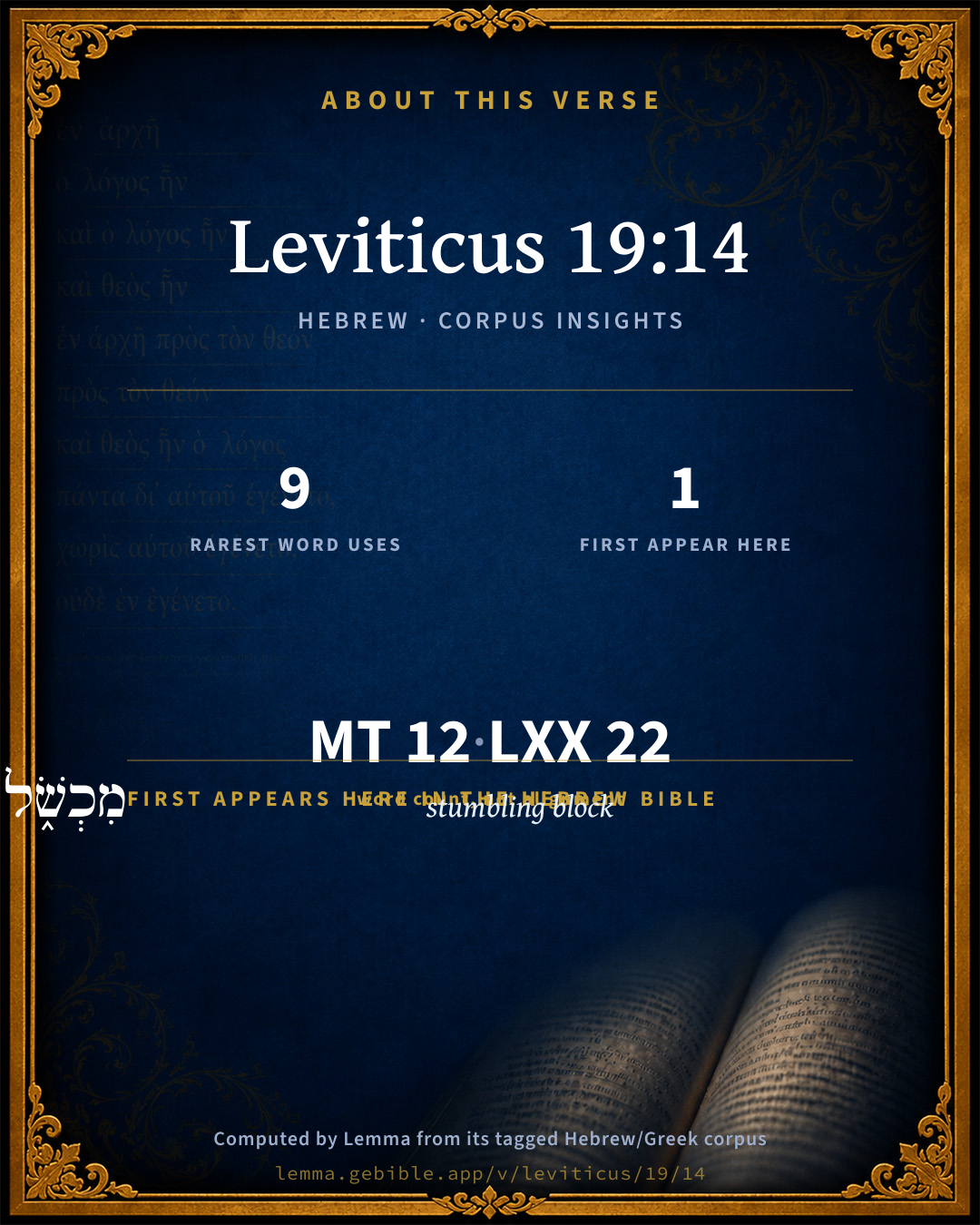
The rarest word here is חֵרֵ֔שׁ deaf H2795 — appearing just 9 times in the whole Hebrew Bible.

First appearance in Scripture

This word makes its first canonical appearance in the Hebrew Bible here:

  • מִכְשֹׁ֑ל stumbling block H4383

Shared distinctive vocabulary

חֵרֵ֔שׁ deaf H2795 occurs in 9 verses of the Hebrew Bible. Also found in:

Grammatical profile

  • 3 verbs
  • 4 nouns
  • 2 adjectives
  • 1 pronoun
  • 2 particles

Verb forms

  • תְקַלֵּ֣ל Piel · Imperfect
  • תִתֵּ֖ן Qal · Imperfect
  • וְיָרֵ֥אתָ Qal · Sequential Perfect

Repetition

A word recurs within this verse — often emphatic in Hebrew:

Hebrew & Septuagint length

In English translation the verse runs 23 words from the Hebrew and 33 from the Septuagint (LXX English) — the Septuagint runs noticeably longer here. See the side-by-side →

A rough comparison of the two English renderings, which tokenize alike — not a word-level alignment.

Word counts can differ between the Hebrew and the Greek without any difference in meaning — e.g. the Hebrew direct-object marker אֵת has no separate Greek word, and Greek often adds the article ὁ.

In the original languages it is 12 Hebrew tokens and 22 Greek tokens — but the two are counted differently (Hebrew bundles its prefixes and suffixes into one token; the Greek is in lemma form), so that isn’t a like-for-like length.

Cross-references

12

Topical passages linked to Leviticus 19:14 in the Treasury of Scripture Knowledge — connected by theme and wording, ordered by reader-vote popularity; previews shown in the World English Bible.

  • Deuteronomy 27:18 Cursed be he who makes the blind to wander out of the way. All the people shall say, Amen.
  • Leviticus 19:32 You shall rise up before the gray head, and honor the face of an old man, and you shall fear your God. I am Yahweh.
  • Leviticus 25:17 You shall not wrong one another; but you shall fear your God: for I am Yahweh your God.
  • Romans 14:13 Therefore let's not judge one another any more, but judge this rather, that no man put a stumbling block in his brother's way, or an occasion for falling.
  • 1 Peter 2:17 Honor all men. Love the brotherhood. Fear God. Honor the king.
  • Nehemiah 5:15 But the former governors who were before me were chargeable to the people, and took of them bread and wine, besides forty shekels of silver; yes, even their servants bore rule over the people: but I didn't do so, because of the fear of God.
  • 1 Corinthians 8:8–13 But food will not commend us to God. For neither, if we don't eat, are we the worse; nor, if we eat, are we the better.
  • Revelation 2:14 But I have a few things against you, because you have there some who hold the teaching of Balaam, who taught Balak to throw a stumbling block before the children of Israel, to eat things sacrificed to idols, and to commit sexual immorality.
  • Genesis 42:18 Joseph said to them the third day, "Do this, and live, for I fear God.
  • Romans 12:14 Bless those who persecute you; bless, and don't curse.
  • 1 Corinthians 10:32 Give no occasions for stumbling, either to Jews, or to Greeks, or to the assembly of God;
  • 1 Peter 1:17 If you call on him as Father, who without respect of persons judges according to each man's work, pass the time of your living as strangers here in reverent fear:

Cross-references courtesy of OpenBible.info (CC BY 4.0).

Hebrew and Greek witnesses Masoretic Hebrew ↔ Greek Septuagint

The same verse in the two great witnesses to the Old Testament, shown verse-for-verse.

Here the Septuagint runs noticeably longer than the Hebrew — LXX2012 (modern English Septuagint) 33 words vs World English Bible 23. A rough length comparison of the two English translations, not a word-level alignment — read both below.

These are two independent witnesses, not word-aligned to each other, and the Septuagint is shown in lemma (dictionary) form.

Hebrew Leviticus 19:14 Masoretic · Westminster Leningrad Codex

לֹא תְקַלֵּ֣ל חֵרֵ֔שׁ וְלִפְנֵ֣י עִוֵּ֔ר לֹ֥א תִתֵּ֖ן מִכְשֹׁ֑ל וְיָרֵ֥אתָ מֵּאֱלֹהֶ֖יךָ אֲנִ֥י יְהוָֽה

"'You shall not curse the deaf, nor put a stumbling block before the blind; but you shall fear your God. I am Yahweh.

World English Bible · Public Domain

Greek LXX Leviticus 19:14 Septuagint · lemma form

οὐ κακῶς εἶπον κωφός καί ἀπέναντι τυφλός οὐ προςτίθημι σκάνδαλον καί φοβέω κύριος ὁ θεός σύ ἐγώ εἰμί κύριος ὁ θεός σύ

You shall not revile the deaf, neither shall you put a stumbling block in the way of the blind; and you shall fear the Lord your God: I am the Lord your God.

LXX2012 (modern English Septuagint) · Public Domain

On this verse, Haydock's Catholic Bible Commentary discusses the Septuagint’s reading. Read the note in Commentary ↓

Hebrew: Westminster Leningrad Codex (CC BY 4.0). Greek: Septuagint (public domain); English from LXX2012 (modern English Septuagint) (Public Domain). How the Septuagint differs from the Hebrew →

Targum (Aramaic paraphrase)

2

The Targum is the ancient Jewish Aramaic paraphrase of the Hebrew Scriptures — an interpretive translation, not the Hebrew text itself. Onkelos (literal) and Pseudo-Jonathan (expansive) render the Torah, and Jonathan the Prophets. Coverage is partial: where no permissively-licensed English translation exists for a verse, only the Aramaic is shown. This is verse-level text, not a word-by-word alignment to the Hebrew.

  1. Targum Onkelos Torah (Genesis–Deuteronomy)
    לָא תְלוּטּ דְלָא שָׁמַע וְקֳדָם דְלָא חָזֵי לָא תְשִׂים תַּקְלָא וְתִדְחַל מֵאֱלָהָךְ אֲנָא יְיָ

    (no public-domain English translation for this verse)

    Targum Onkelos — Aramaic: “Onkelos Genesis” (public domain); “Onkelos Exodus” (public domain); “Onkelos Leviticus” (public domain); “Onkelos Numbers” (public domain); “Onkelos Deuteronomy” (public domain). English: “Sefaria Community Translation” (CC0 1.0 (public-domain dedication)); “J.W. Etheridge. The Targums of Onkelos and Jonathan Ben Uzziel on the Pentateuch. London: Longmans, Green, 1862” (public domain). Text via Sefaria.

  2. Targum Pseudo-Jonathan Torah (Genesis–Deuteronomy)
    לָא תְלוּטוּן מַן דְלָא שְׁמַע וּקֳדָם סוּמַיָא לָא תְשַׁווּן תּוֹקְלָא וְתִדְחַל מֵאֱלָהָךְ אֲנָא יְיָ

    Thou shalt not curse one who heareth not, nor set a stumbling-block before the blind, but shalt fear thy God: I am the Lord.

    Targum Pseudo-Jonathan — Aramaic: “Targum Jonathan on Genesis” (public domain); “Targum Jonathan on Exodus” (public domain); “Targum Jonathan on Leviticus” (public domain); “Targum Jonathan on Numbers” (public domain); “Targum Jonathan on Deuteronomy” (public domain). English: “The Targum of Jonathan ben Uzziel, trans. J. W. Etheridge, London, 1862” (public domain). Text via Sefaria.

Commentary

Notes on Leviticus 19:14 from classic Christian and Jewish commentators (each source and its license shown beneath its notes). The classic Christian expositions comment on the surrounding passage and are grouped to its opening verse, so a note may address several verses; the Jewish commentaries on the Tanakh (Rashi and others) are per-verse, so they appear only where the commentator wrote on this verse.

Lemma curates 59 commentaries, every one of them public domain or Creative Commons licensed, each selected and text-cleaned for this edition rather than reprinted as found. About our sources →

Trapp's Complete Commentary

John Trapp

Lev 19:14 Thou shalt not curse the deaf, nor put a stumblingblock before the blind, but shalt fear thy God: I [am] the LORD.

Ver. 14. Thou shalt not curse the deaf.] So by analogy, the absent that cannot speak for themselves, or the dead. Of all fowl we most hate and detest the crows; and of all beasts the jackals, a kind of foxes in Barbary; because the one digs up the graves and devours the flesh, the other picks out the eyes of the dead.

But shalt fear thy God.] Who both hears and sees all thy miscarriages, and will reckon with thee for all. Deo obscura clarent, muta respondent, silentium confitetur, saith an ancient. Night will convert itself into noon before God, and silence prove a speaking evidence.

John Trapp, A Commentary or Exposition upon All the Books of the Old and New Testament (1647–1656) — public domain. Text from a community e-Sword module.

The Biblical Illustrator

Joseph S. Exell

Lev_19:14

Thou shalt not curse the deaf.

The weak protected

I. The meanness of the conduct here rebuked. Dishonourable dealing, commercial sharp-practice, trading upon the defects of others, issuing delusive prospectuses to entrap the unwary, traducing our fellows behind their backs so that they cannot learn and answer the charges brought against them--all such action deserves our reprobation and avoidance. The natural ills of humanity call for commiseration and help, rather than for ridicule and maltreatment. Where weakness has been self-incurred, where ignorance is wilful, there is less need of sympathy. Let our young people be early imbued with the feeling that it is wrong to trample upon the defenceless.

II. The way to guard against invasion of the rights of others. But shalt fear thy God.

1. Reverence for Jehovah is the best security against violation of His statutes. Remember, that to transgress is to grieve our heavenly Father, to show ourselves unmindful of His claims.

2. The omniscience of Jehovah should restrain from the commission of unfair deeds. He hears every word and sees every act, though the deaf and the blind cannot. Let not mean, cowardly performances expect to pass unnoticed, unpunished.

III. The comfort the weak may derive from the knowledge that they are under the protection of god. He is seen to cherish them, to make provision for their need; He puts His strong right arm around them, shelters them under His wing. We cannot believe that His fostering care is denied to any class of the infirm, in body, mind, or spirit. (S. R. Aldridge, B. A.)

Protection of the infirm

Persons stricken with some defect which renders them helpless, stand under Gods special protection; it would be heartless and impious to curse the deaf, who is unaware of the attacks made upon him, which may involve calumnies, and which he is unable to rebut; and it would be cruel indeed to put a stumbling-block before the blind, to whom every right-minded man should be eager to serve as eyes; a crime like the latter was publicly cursed on Mount Ebal; and in both eases the law warns the offender, Thou shalt fear thy God, who hears if there is no other ear to listen, who sees if there is no other eye to see, and who, to punish thy wickedness, can strike thee with the same afflictions: hence the same menace, Thou shalt fear thy God, is repeated with respect to the treatment of old and infirm men, of poor persons, of dependents, and servants. Philo inveighs vehemently against the inhumanity here forbidden, and observes that those who are guilty of it, would not spare even the dead, in the excess of their cruelty, but according to a common proverb, would slay the slain again. Jewish tradition applies the second command of our verse figuratively to insidious advice or false information given to a man who is in ignorance or perplexity, whether on some question of learning or on some matter of business. The law of Man inflicts a pecuniary fine upon any one who taunts a person with being one-eyed or lame or deformed. (M. M. Kalisch, Ph. D.)

No advantage to be taken of incapacity

This base action of reviling or cursing a deaf person is here condemned. But that is not all; there is something more forbidden by this law; for it seems to be of a proverbial nature, and the general meaning is, Thou shalt not take the sordid advantage of a mans incapacity to defend himself, and hurt him either in his body, his fortunes, or his reputation. To abuse an absent person, to calumniate people in secret, to attack anothers reputation in the dark and in disguise, to defame those who are dead, to hurt in any manner those who are unable to help and redress themselves, all this may be called, To curse the deaf. (J. Jortin, D. D.)

The absent not to be slandered

So did St. Augustine, that worthy father, abhor this vice, that over his table where he dined he wrote two verses, to tell all them that sat with him, if they carped at any person absent, that table was not for them, nor the guests welcome to him. (Bp. Babington.)

The Biblical Illustrator, edited by Joseph S. Exell (c. 1880s–1900s) — public domain. Text from a community e-Sword module.

Joseph Benson's Commentary

Lev 19:14. Before the blind — To make them fall. Under these two particulars are manifestly forbidden all injuries done to such as are unable to right or defend themselves; of whom God here takes the more care, because they are not able to secure themselves. Fear thy God — Who both can and will avenge them.

Joseph Benson's Commentary on the Old and New Testaments (1811–1818) — public domain. Text from a community e-Sword module.

Tyndale Open Study Notes

Tyndale Open Resources

19:14 The deaf and blind were helpless people, easy to belittle and exploit. The Israelites were not to take advantage of them.

Tyndale Open Study Notes — © Tyndale Open Resources, licensed CC BY-SA 4.0. Text via the HelloAO Bible API.

Adam Clarke's Commentary

Verse 14. Thou shalt not curse the deaf] Or speak evil of him, because he cannot hear, and so cannot vindicate his own character.

Nor put a stumbling-block before the blind] He who is capable of doing this, must have a heart cased with cruelty. The spirit and design of these precepts are, that no man shall in any case take advantage of the ignorance, simplicity, or inexperience of his neighbour, but in all things do to his neighbour as he would, on a change of circumstances, that his neighbour should do to him.

Adam Clarke's Commentary on the Bible (1810–1826) — public domain. Text from a community e-Sword/MySword module.

Ellicott's Commentary for English Readers

(14) Thou shalt not curse the deaf.—To revile one who cannot hear, and is therefore unable to vindicate himself, is both inexpressibly mean and wicked. The term deaf also includes the absent, and hence out of hearing (Psa_38:14-15). According to the administrators of the law during the second Temple, this prohibition was directed against all cursing whatsoever. For, said they, if to curse one who cannot hear, and whom, therefore, it cannot grieve, is prohibited, how much more is it forbidden to curse one who hears it, and who is both enraged and grieved by it.

Nor put a stumblingblock before the blind.—In Deu_27:18 a curse is pronounced upon those who lead the blind astray. To help those who were thus afflicted was always regarded as a meritorious act. Hence among the benevolent services which Job rendered to his neighbours, he says “I was eyes to the blind” (Job_29:15). According to the interpretation which obtained in the time of Christ, this is to be understood figuratively. It forbids imposition upon the ignorant, and misdirecting those who seek advice, thus causing them to fall. Similar tenderness to the weak is enjoined by the Apostle: “That no man put a stumblingblock or an occasion to fall in his brother’s way” (Rom_14:13).

But shalt fear thy God.—Deafness and blindness may prevent the sufferers from detecting the offender, and bringing him to justice before an earthly tribunal, but God on high hears it when the human ear is stopped up, and sees it when the human eye is extinct. Hence the prohibition against injustice to the infirm and the poor is enforced by an appeal to fear the Lord. (See Lev_19:32.)

A Bible Commentary for English Readers, edited by Charles John Ellicott (1878–1897) — public domain. Text from a community e-Sword module.

John Gill's Exposition

Thou shalt not curse the deaf,.... Who are naturally so, born deaf, or become so through some accident, and cannot hear what is objected to them, and they are cursed for; and so cannot reply in their own defence, and remove the calumny cast upon them, if it be such which is the cause of their being cursed; and therefore there is something mean and base as well as wicked in cursing such: the Targums of Onkelos and Jonathan render it, "him that heareth not", and respects any absent person who is not within the hearing of the curse, and so equally incapable of answering for himself as a deaf man: Gersom observes, that this is a caution not to curse any Israelite; for if we are cautioned, says he, not to curse a deaf man who hears not, and therefore cannot be moved at it, much less should we curse him that is not deaf, from whence quarrels and fightings arise:

nor put a stumblingblock before the blind: to cause him to fall; and in this negative is implied, that a man should be serviceable and helpful to the blind as much as may be; as to lead, and guide, and direct them in the way, and not put them out of it, as well as not do anything to cause them to stumble in it; Jarchi and Ben Gersom interpret this figuratively, of ignorant persons imposed upon by the bad advice of others: on the other hand, agreeably to this sense, Job says, he was "eyes to the blind", Job 29:15; gave good advice to the ignorant, instructed them what ways and methods to take to do themselves justice, or obtain it, which otherwise they knew not:

but shalt fear thy God: who, as Aben Ezra observes, can punish thee by making thee deaf and blind also; by striking them with deafness and blindness at once; wherefore the awe and fear of God should be on persons, and make them cautious and fearful how they abused those in such circumstances:

I am the Lord; the Lord God, omnipresent and omniscient, that hears when the deaf are cursed, though they do not; and sees the stumblingblocks laid before the blind, and knows who laid them, though they do not, and will revenge such abuses and injuries: the apostle seems to have respect to this law in Rom 14:13.

John Gill's Exposition of the Whole Bible (1746–1763) — public domain (CC PDM 1.0). Text via the HelloAO Bible API.

Albert Barnes' Notes on the Bible

The meaning appears to be, “Thou shalt not utter curses to the deaf because he cannot hear thee, neither shalt thou put a stumbling-block in the way of the blind because he cannot see thee (compare Deu 27:18), but thou shalt remember that though the weak and poor cannot resist, nor the deaf hear, nor the blind see, God is strong, and sees and hears all that thou doest.” Compare Job 29:15.

Albert Barnes' Notes on the Bible (1834–1885) — public domain. Text from a community e-Sword/MySword module.

Haydock's Catholic Bible Commentary

Deaf. The word Kophos, used by the Septuagint, means also the dumb, as these defects are generally found in the same person. Nothing can be more base, than to attack those who are unable to defend themselves. Solon forbids anyone "to speak ill of the dead," though he may receive an injury from his children. Those who undermine and ruin the reputation of the absent, are no less to be condemned.

George Leo Haydock (1774–1849), Haydock's Catholic Family Bible and Commentary, 1859 edition — public domain. Excludes Psalms (Douay-Rheims chapter numbering differs from Protestant) and Deuterocanonical books (Catholic canon only).

Matthew Poole's English Annotations

Nor put a stumbling-block before the blind, to make them fall. Under these two particulars are manifestly and especially forbidden all injuries done to such as are unable to right or defend themselves; of whom God here takes the more care, because they are not able to secure themselves; who both discerns the injuries you do them, and can avenge them, though the blind and deaf cannot.

Matthew Poole's English Annotations on the Holy Bible (1683–1685) — public domain. Text from a community e-Sword/MySword module.

Whedon's Commentary on the Bible

Daniel D. Whedon

14. Not curse the deaf — This prohibits the cowardly practice of reviling and vilifying persons who cannot hear or reply or defend themselves against such abuse.

Stumblingblock before the blind — The fact that acts so dastardly are expressly forbidden demonstrates the fiendish dispositions of depraved men, and the exceeding compassion of God for those who are deprived of any special sense. He will avenge them together with the stranger, the poor, the widow, and the fatherless.

Daniel D. Whedon (gen. ed.), Commentary on the Old and New Testaments (1874–1909) — public domain. Text from a community e-Sword module.

The Pulpit Commentary

Thou shalt not curse the deaf. The sin of cursing another is in itself complete, whether the curse be heard by that other or not, because it is the outcome of sin in the speaker"s heart. The suffering caused to one who hears the curse creates a further sin by adding an injury to the person addressed. Strangely in contrast with this is not only the practice of irreligious men, who care little how they curse a man in his absence, but the teaching which is regarded by a large body of Christians as incontrovertible. "No harm is done to reverence but by an open manifestation of insult. How, then, can a son sin gravely when he curses his father without the latter"s knowing it, or mocks at him behind his back, inasmuch as in that case there is neither insult nor irreverence? And I think that the same is to be said, even though he does this before others. It must be altogether understood that he does not sin gravely if he curses his parents, whether they are alive or dead, unless the curses are uttered with malevolent meaning." This is the decision of one that is called not only a saint, but a "doctor of the Church" (Liguori, "Theol. Moral.," 4:334). "Whoso curseth his father or his mother, his lamp shall be put ant in obscure darkness," says the Word of God. (Pro_20:20) Nor put a stumbling block before the blind, but shalt fear thy God. By the last clause the eye is directed to God, who can see and punish, however little the blind man is able to help himself. (Cf. Job_29:15, "I was eyes to the blind, and feet was I to the lame.

The Pulpit Commentary (1880–1919), ed. H.D.M. Spence-Jones & Joseph S. Exell — public domain. Text from a community e-Sword module.

John Wesley's Explanatory Notes

Before the blind - To make them fall. Under these two particulars are manifestly forbidden all injuries done to such as are unable to right or defend themselves; of whom God here takes the more care, because they are not able to secure themselves. Fear thy God - Who both can and will avenge them.

John Wesley, Explanatory Notes Upon the Whole Bible (1754–1765) — public domain. Text via the GEBible commentary corpus.

Scofield Reference Notes

C. I. Scofield

fear

(See Scofield "Psa 19:9").

The Scofield Reference Bible (1917 edition), notes by C. I. Scofield — public domain. Text from a community e-Sword module.

Rashi

Rabbi Shlomo Yitzchaki (Rashi)

לא תקלל חרש THOU SHALT NOT CURSE THE DEAF — I have here only the law that one must not curse the deaf: whence do I know that any person is included in this prohibition and that the meaning is, Thou shalt not curse even the deaf? Because Scripture states (Exodus 22:27) "Thou shalt not curse בעמך, anyone among thy people". But if this be so why does Scripture say חרש and does not use some more general expression? It does so in order to offer an analogy: What is the case with the חרש? He is one who cannot hear your curse and therefore cannot feel aggrieved, but he has the characteristic of being a living person! The same applies to all living, thus excluding a dead person, who though he cannot hear and feel aggrieved, is not living (Sifra, Kedoshim, Section 2 13; cf. also Sanhedrin 66a).

ולפני עור לא תתן מכשל THOU SHALT NOT PUT A STUMBLING BLOCK BEFORE THE BLIND — This implies: "Give not a person who is "blind" in a matter an advice which is improper for him. Do not say to him: "Sell your field and buy from the proceeds of the sale an ass", the fact being that you are endeavouring to circumvent him and to take it (the field) from him (Sifra, Kedoshim, Section 2 14).

ויראת מאלהיך BUT THOU SHALT BE AFRAID OF THY GOD — Because in this case it is not given to human beings to know whether the intention of this man (the offender) was for the advantage or the disadvantage of the person whom he advised, and he thus might be able to evade the responsibility by saying: "I meant it for the best", Scripture therefore states with reference to him: "But thou shall be afraid of thy God" Who is cognizant of thy secret thoughts. Similarly in all actions where it is given only to the heart of him who does it to know the motive that prompts him and where other people have no insight into it, Scripture states, "But be afraid of thy God!" (Sifra, Kedoshim, Section 2 14; Bava Metzia 58b).

Rashi on the Tanakh — English translations: “The Judaica Press complete Tanach with Rashi, translated by A. J. Rosenberg” (CC BY 4.0); “Pentateuch with Rashi's commentary by M. Rosenbaum and A.M. Silbermann, 1929-1934” (public domain); “The Metsudah Tanach series, Lakewood, N.J” (CC BY 4.0); and “The Book of Joshua, Metsudah Publications, 1997” (CC BY 4.0). Text via Sefaria.

Ramban (Nachmanides)

Rabbi Moshe ben Nachman (Ramban / Nachmanides)

THOU SHALT NOT CURSE THE DEAF. “From this verse I know only [that one may not curse] the deaf. Whence do I know that one may not curse anybody? From the words of Scripture: Of thy people thou shalt not curse. If so, why does it state [here] ‘the deaf’? It is to teach us that ‘the deaf’ has been singled out by Scripture [here] because [although he is unable to hear and feel hurt], he has the characteristic of being alive, thus exluding [from the scope of this prohibition] the dead [who, though they are like the deaf in their inability to hear and feel hurt], are unlike them in being no longer alive.” This is Rashi’s language, and so it is taught in the Torath Kohanim. 2:13. But the interpretation of the Gemara is not so. Rather, Scripture first warned against [cursing] the dignitaries of the people, the judge or ruler, saying, Thou shalt not curse ‘elohim’ (the judges) nor curse a ruler of thy people. Then it gave another admonition [here] against cursing the unfortunate ones of the people, like the deaf, and from them [i.e., from both classes of people, the distinguished and the unfortunate] we learn by a general proposition that we must not curse anyone of the rest of the people, since from beginning to end [from “the ruler” to “the deaf”] they are all included in this prohibition., but is rather based on the two prohibitions against cursing a ruler and the deaf, which include the highest stratum of the people as well as the unfortunate ones, and everyone else is naturally included in between these two categories. And the word b’amcha (of thy people — a ruler ‘of thy people’) is interpreted [by the Gemara] to mean only those who conduct themselves in the manner of thy people, thus excluding the wicked.According to the plain meaning of Scripture, the verse mentions cursing the deaf [in order that we may deduce] that if in the case of one who cannot hear and will not become incensed by the curse, the Torah nonetheless admonished against cursing him, how much more so [is it prohibited to curse] one who hears and feels the insult, and will become hot-tempered because of it! Moreover, Scripture always admonishes against doing that which is frequent, for a person is inclined to curse the deaf and put a stumbling-block before the blind since he does not fear them, because they know not, neither do they understand. Therefore [it states here], and thou shalt fear thy G-d, Who sees the secret things. And He added another prohibition against cursing rulers, the prince and the judge, because it is usual for people to curse them in their bed-chamber when in judging him he lets him go forth condemned, and there are many harms that are caused by cursing a prince or a judge, for the masses of people in their foolishness will hate them and will thus be stirred to rise up against them, while in truth the prince and judge establish the land by their justice..

Ramban (Nachmanides) on the Tanakh — English translation: “Commentary on the Torah by Ramban (Nachmanides). Translated and annotated by Charles B. Chavel. New York, Shilo Pub. House, 1971-1976” (CC BY 4.0). Text via Sefaria.

Lesson kit

Teaching starters — assembled from the data on this page, not authored interpretation. Every prompt links to the verse data it draws on. Edit before teaching.

Leviticus, in the Pentateuch, opens this verse with 12 words (11 distinct Hebrew lemmas). Its most distinctive word is chêrêsh (“deaf”). The Greek Septuagint runs longer here. A historical commentator’s framing appears above. Read the whole chapter for the surrounding context.

Discussion questions

  1. What does “deaf” (chêrêsh) contribute to the verse as a whole?
  2. This is the first place “stumbling block” appears in Scripture (first appears here). What does its debut here establish?
  3. How does Exodus 4:11, which shares the word «deaf», read alongside this verse?
  4. What does the repetition of “not” (2× in this one verse) do in this verse?
  5. The Septuagint runs longer here than the Hebrew. What might account for the difference?
  6. These translations render this verse differently; the difference is in the English rendering, not the original. What questions does that raise?
  7. «תְקַלֵּ֣ל» is a Piel Imperfect verb. How does that grammatical form shape the action described?
  8. Compare how Trapp's Complete Commentary and The Biblical Illustrator read this verse. Where do they agree or differ?

Things to notice

Reading settings

Reading text

Shown beneath each verse's original-language words.

Old Testament
Old Testament edition

Read the OT as the Masoretic Hebrew (MT) or the Greek Septuagint (LXX).

English shown for the Greek Septuagint (in the Hebrew ↔ Greek comparison).

Comparing translations? Open the Compare panel on any verse page to stack up to four side by side.