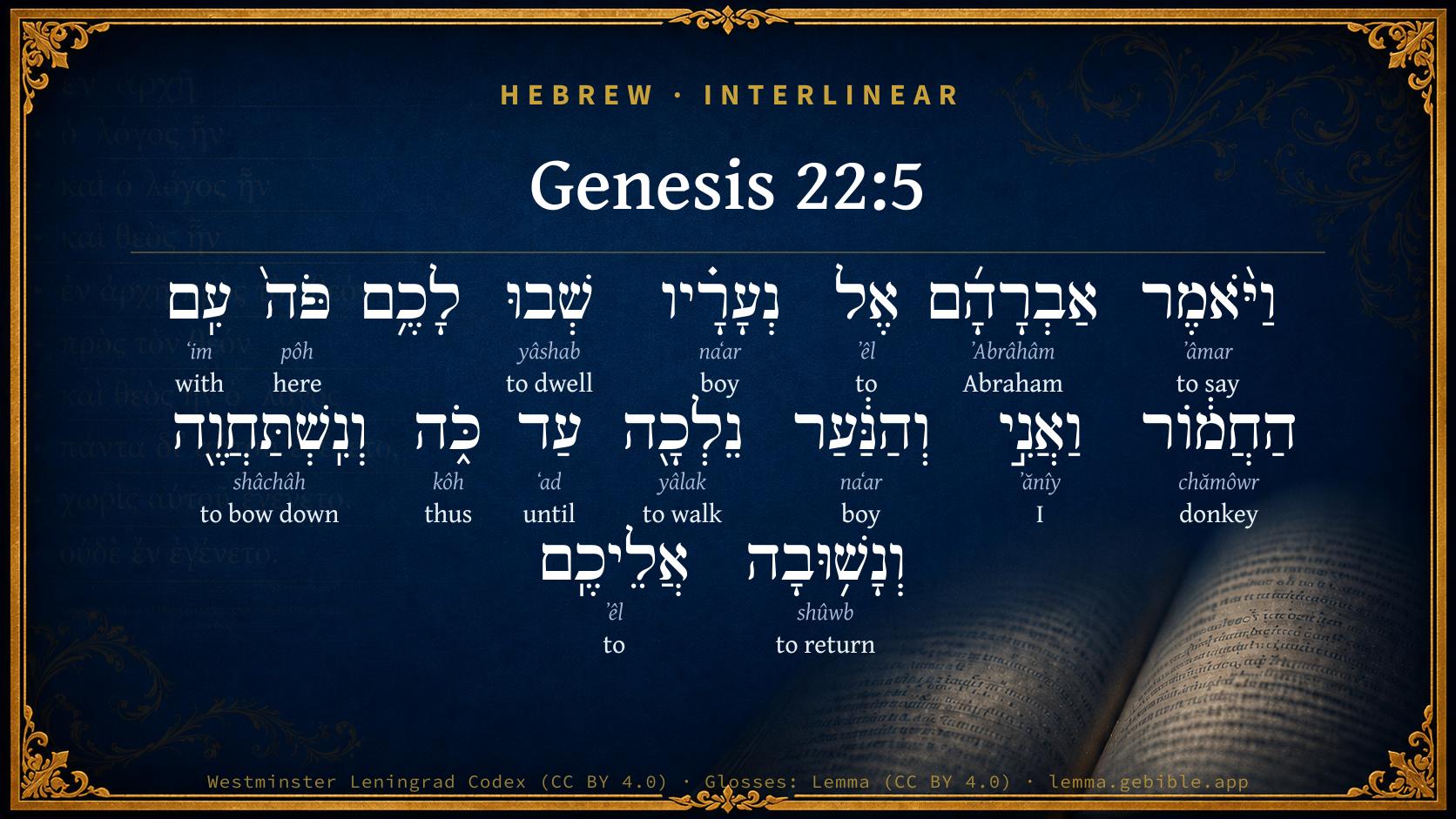
Genesis 22:5

Hebrew (Westminster Leningrad Codex) Genesis 22:5 appears in the Hebrew Old Testament. The text above is from the Westminster Leningrad Codex. Each word links to its Strong’s number, a concise gloss, and parsing drawn from the Open Scriptures Hebrew Bible morphology. Click any word for its full Brown-Driver-Briggs (BDB) entry.
Download image
Cite this verse

Genesis 22:5 (World English Bible). Public Domain. Lemma interlinear Bible study tool, https://lemma.gebible.app/v/genesis/22/5.

Show BibTeX & RIS
BibTeX
RIS
English Translation
Abraham said to his young men, "Stay here with the donkey. The boy and I will go yonder. We will worship, and come back to you.
World English Bible · Public Domain
Download a study sheet

One document with this verse’s original text, its word-by-word gloss line, the meaning frame, cross-references with their text, attributed commentary, and full source and license credits — printable, and it pastes into notes with its structure intact.

This verse Autodidact and up

Study sheet (.html) Plain text (.txt)

A passage Seminary Student

Up to 50 verses in one chapter. A passage sheet keeps up to 6 commentary sources and 12 cross-references per verse, in the order this page ranks them, and says so on the sheet whenever that leaves anything out. Ask for a single verse and you get the Autodidact verse sheet above.

Everything on this page stays free to read, with no account — the sheet is a download of what is already on screen, not access to it.

Want to remove ads? Support Godless Engineer
Compare translations 3

The same verse in 3 English versions, stacked beneath the original-language interlinear above. Click any original word for its lexicon entry.

Each is an independent rendering of the whole verse — the interlinear is not word-aligned to these translations.

Highlighted words mark where these versions differ — a whole-verse word diff, not a word-by-word alignment.

  • World English Bible Public Domain
    Abraham said to his young men, "Stay here with the donkey. The boy and I will go yonder. We will worship, and come back to you.
  • King James Version Public Domain
    And Abraham said unto his young men, Abide ye here with the ass; and I and the lad will go yonder and worship, and come again to you.
  • unfoldingWord Literal Text CC BY-SA 4.0
    Then Abraham said to his young men, “Stay here by yourselves with the donkey, and I and the boy will go over there and bow down. Then we will come back to you.”

unfoldingWord Literal Text — © unfoldingWord, licensed CC BY-SA 4.0. Word-aligned USFM3 via Door43 (git.door43.org/unfoldingWord/en_ult).

Versions to compare (up to 4)

3 of 4 selected

Show all 18 translations

Every available English version of this verse, each an independent rendering of the whole verse.

  • World English Bible Public Domain
    Abraham said to his young men, "Stay here with the donkey. The boy and I will go yonder. We will worship, and come back to you.
  • Berean Standard Bible Public Domain
    “Stay here with the donkey,” Abraham told his servants. “The boy and I will go over there to worship, and then we will return to you.”
  • Majority Standard Bible Public Domain
    “Stay here with the donkey,” Abraham told his servants. “The boy and I will go over there to worship, and then we will return to you.”
  • King James Version Public Domain
    And Abraham said unto his young men, Abide ye here with the ass; and I and the lad will go yonder and worship, and come again to you.
  • American Standard Version (1901) Public Domain
    And Abraham said unto his young men, Abide ye here with the ass, and I and the lad will go yonder; and we will worship, and come again to you.
  • Revised Version (1885) Public Domain
    And Abraham said unto his young men, Abide ye here with the ass, and I and the lad will go yonder; and we will worship, and come again to you.
  • Geneva Bible (1599) Public Domain
    And said vnto his seruants, Abide you here with the asse: for I and the childe will go yonder and worship, and come againe vnto you.
  • Douay-Rheims (1899) Public Domain
    And he said to his young men: Stay you here with the ass: I and the boy will go with speed as far as yonder, and after we have worshipped, will return to you.
  • Young's Literal Translation Public Domain
    and Abraham saith unto his young men, `Remain by yourselves here with the ass, and I and the youth go yonder and worship, and turn back unto you.'
  • Literal Standard Version CC BY-SA 4.0
    and Abraham says to his young men, “Remain by yourselves here with the donkey, and I and the youth go over there and worship, and return to you.”
  • Unlocked Literal Bible CC BY-SA 4.0
    Abraham said to his young men, “Stay here with the donkey, and I and the lad will go over there. We will worship and come again to you.”
  • unfoldingWord Literal Text CC BY-SA 4.0
    Then Abraham said to his young men, “Stay here by yourselves with the donkey, and I and the boy will go over there and bow down. Then we will come back to you.”
  • Darby Bible Public Domain
    And Abraham said to his young men, Abide ye here with the ass; and I and the lad will go yonder and worship, and come again to you.
  • World Messianic Bible Public Domain
    Abraham said to his young men, “Stay here with the donkey. The boy and I will go over there. We will worship, and come back to you.”
  • Webster's Bible Public Domain
    And Abraham said to his young men, Abide you here with the ass, and I and the lad will go yonder and worship, and return to you.
  • Free Bible Version CC BY-SA 4.0
    He told his servants, “Wait here with the donkey while I go with the boy and worship God. Then we'll return.”
  • Bible in Basic English Public Domain
    Then he said to his young men, Keep here with the ass; and I and the boy will go on and give worship and come back again to you.
  • JPS Tanakh (1917) Public Domain
    And Abraham said unto his young men: 'Abide ye here with the ass, and I and the lad will go yonder; and we will worship, and come back to you.'

Literal Standard Version (2020), Covenant Press — licensed CC BY-SA 4.0. Text via the HelloAO Bible API (eBible.org). Unlocked Literal Bible (unfoldingWord) — licensed CC BY-SA 4.0. Text via the HelloAO Bible API (eBible.org). unfoldingWord Literal Text — © unfoldingWord, licensed CC BY-SA 4.0. Word-aligned USFM3 via Door43 (git.door43.org/unfoldingWord/en_ult). Free Bible Version, Dr. Jonathan Gallagher — licensed CC BY-SA 4.0. Text via the HelloAO Bible API (eBible.org).

Word by word

More ways to search: Search by grammar → Find every occurrence → Compare this word →

Practice this passage: Drill this verse → Learn its vocabulary →

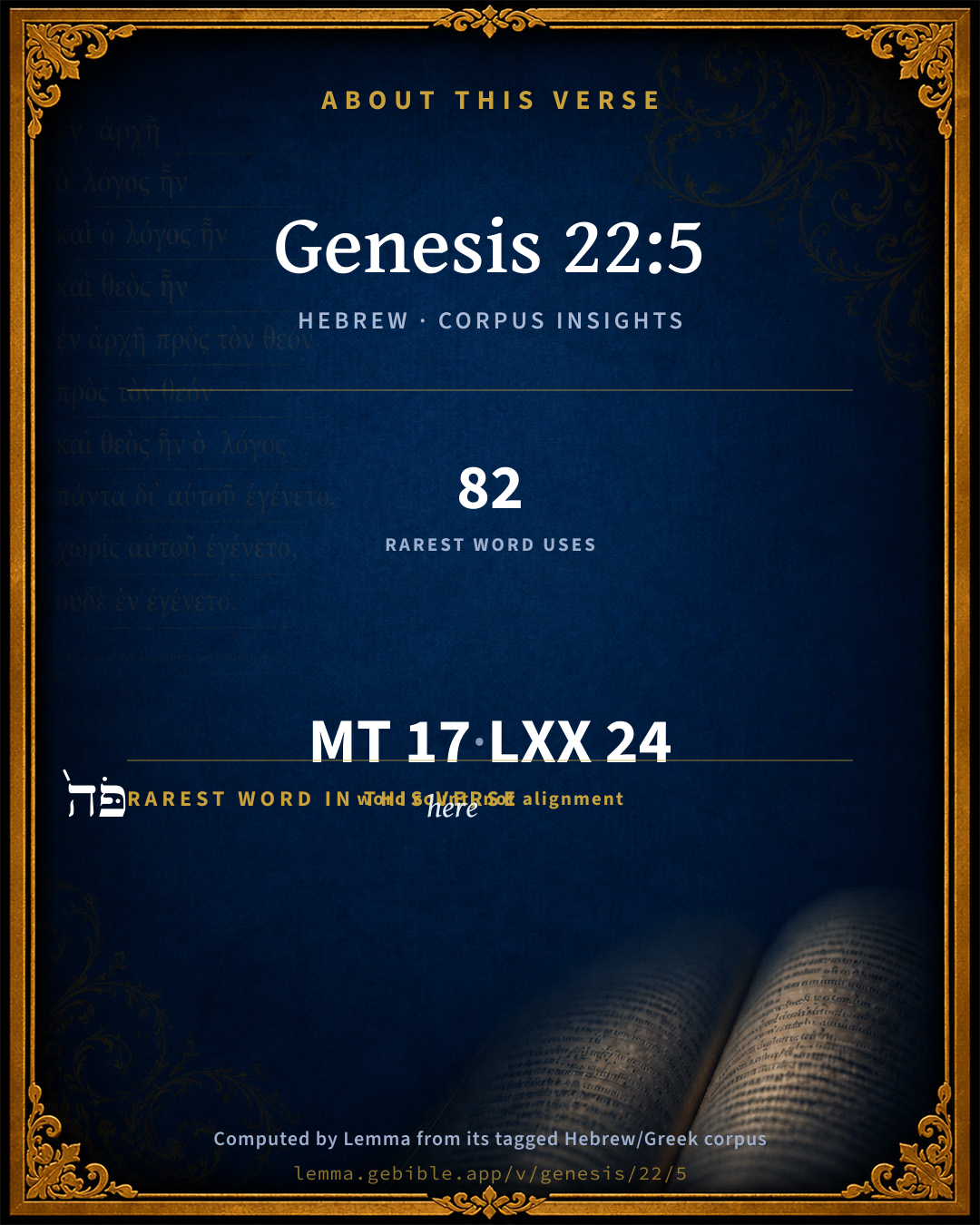
פֹּה֙
pôh
H6311
“here”
Adverb
Part of Speech
Adverb
Full BDB Definition

Origin: probably from a primitive inseparable particle "p" (of demonstrative force) and H1931

TWOT: 1739

here, from here, hither - here - hither
  1. וַיֹּ֨אמֶר ʼâmar H559 “and · to say” Conjunction + Verb, Qal, Sequential Imperfect, 3rd Person, Masculine, Singular
  2. אַבְרָהָ֜ם ʼAbrâhâm H85 “Abraham” Noun, Proper
  3. אֶל ʼêl H413 “to” Preposition
  4. נְעָרָ֗יו naʻar H5288 “boys · his” Noun, Common, Masculine, Plural, Construct + Suffix, Personal, 3rd Person, Masculine, Singular
  5. שְׁבוּ yâshab H3427 “dwell” Verb, Qal, Imperative, 2nd Person, Masculine, Plural
  6. עִֽם ʻim H5973 “with” Preposition
  7. הַחֲמ֔וֹר chămôwr H2543 “the · donkey” Particle, Definite Article + Noun, Common, Both, Singular, Absolute
  8. וַאֲנִ֣י ʼănîy H589 “and · I” Conjunction + Pronoun, Personal, 1st Person, Common, Singular
  9. וְהַנַּ֔עַר naʻar H5288 “and · the · boy” Conjunction + Particle, Definite Article + Noun, Common, Masculine, Singular, Absolute
  10. נֵלְכָ֖ה yâlak H3212 “to walk” Verb, Qal, Cohortative, 1st Person, Common, Plural
  11. עַד ʻad H5704 “until” Preposition
  12. כֹּ֑ה kôh H3541 “thus” Adverb
  13. וְנִֽשְׁתַּחֲוֶ֖ה shâchâh H7812 “and · to bow down” Conjunction + Verb, Hishtaphel, Imperfect, 1st Person, Common, Plural
  14. וְנָשׁ֥וּבָה shûwb H7725 “and · to return” Conjunction + Verb, Qal, Cohortative, 1st Person, Common, Plural
  15. אֲלֵיכֶֽם ʼêl H413 “to · you” Preposition + Suffix, Personal, 2nd Person, Masculine, Plural

About this verse

These counts appear in no published source. They are computed here, from the morphology-tagged text and Lemma’s own curated glosses. What Lemma adds →

17
words
14
distinct lemmas
Pentateuch
section

Grammatical profile

  • 5 verbs
  • 4 nouns
  • 1 pronoun
  • 5 prepositions
  • 2 adverbs

Verb forms

  • וַיֹּ֨אמֶר Qal · Sequential Imperfect
  • שְׁבוּ Qal · Imperative
  • נֵלְכָ֖ה Qal · Cohortative
  • וְנִֽשְׁתַּחֲוֶ֖ה Hishtaphel · Imperfect
  • וְנָשׁ֥וּבָה Qal · Cohortative

Repetition

Words recur within this verse — often emphatic in Hebrew:

  • נְעָרָ֗יו boy H5288 ×2
  • אֶל to H413 ×2

Hebrew & Septuagint length

In English translation the verse runs 26 words from the Hebrew and 29 from the Septuagint (LXX English) — closely comparable.

A rough comparison of the two English renderings, which tokenize alike — not a word-level alignment.

Word counts can differ between the Hebrew and the Greek without any difference in meaning — e.g. the Hebrew direct-object marker אֵת has no separate Greek word, and Greek often adds the article ὁ.

In the original languages it is 17 Hebrew tokens and 24 Greek tokens — but the two are counted differently (Hebrew bundles its prefixes and suffixes into one token; the Greek is in lemma form), so that isn’t a like-for-like length.

Cross-references

1

Topical passages linked to Genesis 22:5 in the Treasury of Scripture Knowledge — connected by theme and wording, ordered by reader-vote popularity; previews shown in the World English Bible.

  • Hebrews 11:19 accounting that God is able to raise up even from the dead. Figuratively speaking, he also did receive him back from the dead.

Cross-references courtesy of OpenBible.info (CC BY 4.0).

Hebrew and Greek witnesses Masoretic Hebrew ↔ Greek Septuagint

The same verse in the two great witnesses to the Old Testament, shown verse-for-verse.

These are two independent witnesses, not word-aligned to each other, and the Septuagint is shown in lemma (dictionary) form.

Hebrew Genesis 22:5 Masoretic · Westminster Leningrad Codex

וַיֹּ֨אמֶר אַבְרָהָ֜ם אֶל נְעָרָ֗יו שְׁבוּ לָכֶ֥ם פֹּה֙ עִֽם הַחֲמ֔וֹר וַאֲנִ֣י וְהַנַּ֔עַר נֵלְכָ֖ה עַד כֹּ֑ה וְנִֽשְׁתַּחֲוֶ֖ה וְנָשׁ֥וּבָה אֲלֵיכֶֽם

Abraham said to his young men, "Stay here with the donkey. The boy and I will go yonder. We will worship, and come back to you.

World English Bible · Public Domain

Greek LXX Genesis 22:5 Septuagint · lemma form

καί εἶπον αβρααμ ὁ παῖς αὐτός καταἵζω αὐτός μετά ὁ ὄνος ἐγώ δέ καί ὁ παιδάριον διαἔρχομαι ἕως ὧδε καί προςκυνέω ἀναστρέφω πρός σύ

And Abraam said to his servants, Sit you⌃ here with the ass, and I and the lad will proceed thus far, and having worshipped we will return to you.

LXX2012 (modern English Septuagint) · Public Domain

Hebrew: Westminster Leningrad Codex (CC BY 4.0). Greek: Septuagint (public domain); English from LXX2012 (modern English Septuagint) (Public Domain). How the Septuagint differs from the Hebrew →

Targum (Aramaic paraphrase)

2

The Targum is the ancient Jewish Aramaic paraphrase of the Hebrew Scriptures — an interpretive translation, not the Hebrew text itself. Onkelos (literal) and Pseudo-Jonathan (expansive) render the Torah, and Jonathan the Prophets. Coverage is partial: where no permissively-licensed English translation exists for a verse, only the Aramaic is shown. This is verse-level text, not a word-by-word alignment to the Hebrew.

  1. Targum Onkelos Torah (Genesis–Deuteronomy)
    וַאֲמַר אַבְרָהָם לְעוּלֵימוֹהִי אוֹרִיכוּ לְכוֹן הָכָא עִם חֲמָרָא וַאֲנָא וְעוּלֵימָא נִתְמְטֵי עַד כָּא וְנִסְגּוּד וּנְתוּב לְוַתְכוֹן

    (no public-domain English translation for this verse)

    Targum Onkelos — Aramaic: “Onkelos Genesis” (public domain); “Onkelos Exodus” (public domain); “Onkelos Leviticus” (public domain); “Onkelos Numbers” (public domain); “Onkelos Deuteronomy” (public domain). English: “Sefaria Community Translation” (CC0 1.0 (public-domain dedication)); “J.W. Etheridge. The Targums of Onkelos and Jonathan Ben Uzziel on the Pentateuch. London: Longmans, Green, 1862” (public domain). Text via Sefaria.

  2. Targum Pseudo-Jonathan Torah (Genesis–Deuteronomy)
    וַאֲמַר אַבְרָהָם לְעוּלֵימוֹי אוֹרִיכוּ לְכוֹן הָכָא עִם חַמְרָא וַאֲנָא וְעוּלֵימָא נִתְמְטֵי עַד כָּא לִבְּחוּנֵי אִין יִתְקַיֵים מַה דְאִתְבַּשְרִית כְּדֵין יְהוֹן בְּנָךְ וְנִסְגוֹד לְמָרֵי עַלְמָא וְנָתוּב לְוַתְכוֹן

    And Abraham said to his young men, Wait you here with the ass, and I and the young man will proceed yonder, to prove if that which was promised shall be established:--So shall be thy sons:--and we will worship the Lord of the world, and return to you.

    Targum Pseudo-Jonathan — Aramaic: “Targum Jonathan on Genesis” (public domain); “Targum Jonathan on Exodus” (public domain); “Targum Jonathan on Leviticus” (public domain); “Targum Jonathan on Numbers” (public domain); “Targum Jonathan on Deuteronomy” (public domain). English: “The Targum of Jonathan ben Uzziel, trans. J. W. Etheridge, London, 1862” (public domain). Text via Sefaria.

Commentary

Notes on Genesis 22:5 from classic Christian and Jewish commentators (each source and its license shown beneath its notes). The classic Christian expositions comment on the surrounding passage and are grouped to its opening verse, so a note may address several verses; the Jewish commentaries on the Tanakh (Rashi and others) are per-verse, so they appear only where the commentator wrote on this verse.

Lemma curates 59 commentaries, every one of them public domain or Creative Commons licensed, each selected and text-cleaned for this edition rather than reprinted as found. About our sources →

Trapp's Complete Commentary

John Trapp

Gen 22:5 And Abraham said unto his young men, Abide ye here with the ass; and I and the lad will go yonder and worship, and come again to you.

Ver. 5. Abide ye here with the ass.] This, the Hebrews use for a proverb, against such as are dull and uncapable. Zophar saith, that "man is born as a wild ass’s colt". {Job 11:12} As an "ass’s foal" for rudeness, and "a wild ass’s" for unruliness. It imports that he is untamed and untractable, till a new heart be put into him. Agur had not the understanding of a man, till he spake to Ithiel and Ucal for it. {Pro 30:1-2} He wants the whole man, totum hominis , that doth not fear God and keep his commandments. {Ecc 12:13} Tu et asinus unum estote , will not do it; which was the counsel given to a young novice entering a monastery {a}

And come again to you.] Nesciens formam rei futurae, prophetavit sciens de eventu, prophetavit quod ignoravit , saith Ambrose. {b}

{a} Alex. Cook’s Abatement of Popish Brags.

{b} Epist.

John Trapp, A Commentary or Exposition upon All the Books of the Old and New Testament (1647–1656) — public domain. Text from a community e-Sword module.

The Biblical Illustrator

Joseph S. Exell

Gen_22:5

Abide ye here with the ass; and I and the lad will go yonder and worship

Helps and hindrances of a Christian life

I.

In the path of faith, HUMAN HELP IS PROFITABLE.

II. In the path of faith, HUMAN HELP IS LIMITED.

III. In the path of faith, HUMAN HELP MUST RECEIVE A TIMELY DISMISSAL.

IV. In the path of faith, THE GRANDEST TRIUMPHS HAVE BEEN ACHIEVED ALONE. (H. T. Miller.)

Lessons

1. Saints bent to the work of God will turn anything back that may trouble them in it.

2. Inferior things may and must be inhibited by souls above them in case of hindering from God.

3. Saints freed from incumbrances do speed to duties.

4. Humble submission to the hardest part of worship will Gods servants readily yield. Both Abraham and Isaac.

5. Return to relations, and relation duties is just after the worship of God.

6. Better events come after believing worship sometimes than saints are aware of. (G. Hughes, B. D.)

The Biblical Illustrator, edited by Joseph S. Exell (c. 1880s–1900s) — public domain. Text from a community e-Sword module.

Tyndale Open Study Notes

Tyndale Open Resources

22:5 We will worship there, and then we will come (or We will worship there so that we may come back): Abraham’s amazing statement makes us wonder what he was thinking. Abraham knew that God had planned the future of the covenant around Isaac and that God wanted him to sacrifice Isaac. He could not reconcile these things in his mind; he could only do what God commanded him to do, and leave the future to God (cp. Heb 11:17-19).

Tyndale Open Study Notes — © Tyndale Open Resources, licensed CC BY-SA 4.0. Text via the HelloAO Bible API.

Geneva Bible (1599)

Geneva Bible translators

He doubted not, but God would accomplish his promise, though he should sacrifice his son.

Geneva Bible (1599) marginal notes — public domain. Text via Bolls.life.

Adam Clarke's Commentary

Verse 5. I and the lad will go and come again] How could Abraham consistently with truth say this, when he knew he was going to make his son a burnt-offering? The apostle answers for him: By faith Abraham, when he was tried, offered up Isaac - accounting that God was able to raise him up even from the dead, from whence also he received him in a figure, Heb 11:17; Heb 11:19. He knew that previously to the birth of Isaac both he and his wife were dead to all the purposes of procreation; that his birth was a kind of life from the dead; that the promise of God was most positive, In Isaac shall thy seed be called, Ge 21:12; that this promise could not fail; that it was his duty to obey the command of his Maker; and that it was as easy for God to restore him to life after he had been a burnt-offering, as it was for him to give him life in the beginning. Therefore he went fully purposed to offer his son, and yet confidently expecting to have him restored to life again. We will go yonder and worship - perform a solemn act of devotion which God requires, and come again to you.

Adam Clarke's Commentary on the Bible (1810–1826) — public domain. Text from a community e-Sword/MySword module.

Ellicott's Commentary for English Readers

(5) I and the lad will . . . come again to you.—In these words Abraham gives utterance to the hope ascribed to him in Heb_11:19. The belief in the resurrection of the body was no new thing with Abraham, as it was part of the creed both of Chaldea and Egypt (Tomkins, Studies, p. 127).

God will provide himself a lamb.—Heb., the lamb. We learn from Heb_11:17-19, that Abraham expected that he was to consummate the sacrifice, but that Isaac would be restored to him from the dead, and the promise that his seed was to be born of him so fulfilled. The bestowal of Isaac had been so extraordinary, that Abraham would not feel staggered at what otherwise would have seemed incredible. Apparently, therefore, he meant Isaac by the lamb, thus showing that it was not he who chose the victim, but God. The few words that passed between father and son, the notice by the latter that amid such careful preparation no victim had been provided, the father’s answer that that matter was left to God, the resolute faith of the one, and the trusting submission of the other, as “they went both of them together,” form a picture full not merely of interest, but even of tragical pathos.

A Bible Commentary for English Readers, edited by Charles John Ellicott (1878–1897) — public domain. Text from a community e-Sword module.

The Cambridge Bible for Schools and Colleges

gen. ed. J. J. S. Perowne

5. I and the lad] Abraham’s words are either intended to conceal his intention; or they imply hope, against all hope. “Come again,” i.e. come back to the young men. He will not let the servants know the nature of the expedition.

The Cambridge Bible for Schools and Colleges (gen. ed. J. J. S. Perowne; Cambridge University Press, 1878–1918) — public domain. Text from a community e-Sword module.

John Gill's Exposition

And Abraham said unto the young men, abide you here with the ass,.... At the place from whence he had his first sight of Mount Moriah: he chose not to take his two servants with him, lest when they saw him binding his son, and going about to sacrifice him, they should lay hold upon him, and restrain him from doing it; and to prevent this he takes this precaution, which shows how fully intent he was to yield obedience to the divine precept:

and I and the lad will go yonder and worship; pointing to the place where the signal was, but whether they saw it or no is not certain: the Jews say (z) Isaac did see it, but they did not; however, Abraham made them to understand that he was going to one of the mountains which were in sight, and there worship God by offering sacrifice to him. Isaac is here called a "lad"; of what age he was at this time; see Gill on Gen 22:2; and he might be at the largest number of years there mentioned, and yet be so called, since Joshua the son of Nun has this appellation when he was fifty six years of age, Exo 33:11,

and come again to you, both he and Isaac; this he said under a spirit of prophecy, as Jarchi thinks, or in the faith of Isaac's resurrection from the dead, Heb 11:19.

(z) Bereshit Rabba (sect. 56. fol. 49. 2, 3.) and Pirke Eliezer, ut supra. (c. 31.)

John Gill's Exposition of the Whole Bible (1746–1763) — public domain (CC PDM 1.0). Text via the HelloAO Bible API.

Haydock's Catholic Bible Commentary

Will return. He hoped, perhaps, that God would restore Isaac to life: (Hebrews xi. 19.) and he could not well express himself otherwise to the men, who were not acquainted with the divine decree. (Calmet)

George Leo Haydock (1774–1849), Haydock's Catholic Family Bible and Commentary, 1859 edition — public domain. Excludes Psalms (Douay-Rheims chapter numbering differs from Protestant) and Deuterocanonical books (Catholic canon only).

Matthew Poole's English Annotations

Abraham said this, lest they should hinder him in the execution of his design.

I and the lad will come again to you; for he knew that God both could and would for his promise sake, either preserve Isaac from being sacrificed, or afterward raise him from the dead, as it is intimated, Heb 11:19.

Matthew Poole's English Annotations on the Holy Bible (1683–1685) — public domain. Text from a community e-Sword/MySword module.

Whedon's Commentary on the Bible

Daniel D. Whedon

5. I and the lad will go yonder — Abraham doubtless took the ass and his servants to the foot of the mountain, so as to carry the wood and the fire no unnecessary distance. From the junction of the valleys Hinnon and Kedron the heights of Moriah would seem afar off, and be properly spoken of as yonder.

And come again to you — These words may have been designed to conceal from his servants the purpose of his heart; but according to Heb_11:17, he had confidence that God would raise up his son from the dead. By faith he spoke, in this verse and Gen_22:8, more wisely than he knew, and his words were a true prophecy.

Daniel D. Whedon (gen. ed.), Commentary on the Old and New Testaments (1874–1909) — public domain. Text from a community e-Sword module.

The Pulpit Commentary

And Abraham said unto his young men, Abide ye (for similar forms of expression (cf. Gen_12:1 Gen_21:6 Gen_22:2) here with the ass; partly because the beast required watching, though chiefly because the contemplated sacrifice was too solemn for any eyes but God"s to witnessand I and the lad will go yonder and worship, and come again to you. An act of dissimulation on the part of Abraham (Knobel, Kalisch, Murphy); an unconscious prophecy (Lyra, Junius, Rashi); the expression of a hopeful wish (Lange); a somewhat confused utterance (Calvin, Keil); the voice of his all-conquering faith (Augustine, Calvin, Wordsworth, Bush, "Speaker"s Commentary," Inglis), which last seems the teaching of Heb_11:19.

The Pulpit Commentary (1880–1919), ed. H.D.M. Spence-Jones & Joseph S. Exell — public domain. Text from a community e-Sword module.

Keil & Delitzsch

C. F. Keil & F. Delitzsch

When in sight of the distant mountain, Abraham left the servants behind with the ass, that he might perform the last and hardest part of the journey alone with Isaac, and, as he said to the servants, "worship yonder and then return." The servants were not to see what would take place there; for they could not understand this "worship," and the issue even to him, notwithstanding his saying "we will come again to you," was still involved in the deepest obscurity. This last part of the journey is circumstantially described in Gen 22:6-8, to show how strong a conflict every step produced in the paternal heart of the patriarch. They go both together, he with the fire and the knife in his hand, and his son with the wood for the sacrifice upon his shoulder. Isaac asks his father, where is the lamb for the burnt-offering; and the father replies, not "Thou wilt be it, my son," but "God (Elohim without the article - God as the all-pervading supreme power) will provide it;" for he will not and cannot yet communicate the divine command to his son. Non vult filium macerare longa cruce et tentatione (Luther).

Keil & Delitzsch — Biblical Commentary on the Old Testament (1861–1891) — public domain (CC PDM 1.0). Text via the HelloAO Bible API. (Old Testament only.)

Rashi

Rabbi Shlomo Yitzchaki (Rashi)

עד כה YONDER — meaning a short distance: to the place in front of us. The Midrashic explanation (based upon the meaning of כה “thus”) is: I will see where will be (i.e. what will happen to) the promise which God made to me, (Genesis 15:5) “Thus (כה) shall thy seed be” (Genesis Rabbah 56:2).

ונשובה AND WE WILL COME BACK — He prophesied that they would both return (Midrash Tanchuma, Vayera 22).

Rashi on the Tanakh — English translations: “The Judaica Press complete Tanach with Rashi, translated by A. J. Rosenberg” (CC BY 4.0); “Pentateuch with Rashi's commentary by M. Rosenbaum and A.M. Silbermann, 1929-1934” (public domain); “The Metsudah Tanach series, Lakewood, N.J” (CC BY 4.0); and “The Book of Joshua, Metsudah Publications, 1997” (CC BY 4.0). Text via Sefaria.

Radak

Rabbi David Kimhi (Radak)

ויאמר...ונשתחוה, from these words the lads understood that Avraham would not only prostrate himself there in prayer but would offer an animal as part of such prayer. They reasoned this way, having observed that Avraham took kindling and a knife when going up the mountain. Normally, a reference to השתחויה includes slaughtering a sacrificial animal, as we know from Samuel I 1.3, describing Elkanah’s habits.

Radak on the Tanakh — English translations: “Sefaria Community Translation” (CC0 1.0 (public-domain dedication)); “Eliyahu Munk, HaChut Hameshulash” (CC BY 4.0); “Rabbi Mike Feuer, Jerusalem Anthology” (CC BY 4.0); and “R. David Kimhi on the first book of Psalms, Translated by R.G. Finch, London, 1919” (public domain). Text via Sefaria.

Lesson kit

Teaching starters — assembled from the data on this page, not authored interpretation. Every prompt links to the verse data it draws on. Edit before teaching.

Genesis, in the Pentateuch, opens this verse with 17 words (14 distinct Hebrew lemmas). Its most distinctive word is pôh (“here”). A historical commentator’s framing appears above. Read the whole chapter for the surrounding context.

Discussion questions

  1. How does “here” (pôh) shape what this verse is saying?
  2. How does Hebrews 11:19, which shares this passage’s theme, read alongside this verse?
  3. What does the repetition of “boy” (2× in this one verse) do in this verse?
  4. The translations on this page render this verse differently — a whole-verse word diff, not a word-by-word alignment. What might account for the different wordings?
  5. «וַיֹּ֨אמֶר» is a Qal Sequential Imperfect verb. How does that grammatical form shape the action described?
  6. Compare how Trapp's Complete Commentary and The Biblical Illustrator read this verse. Where do they agree or differ?

Things to notice

Reading settings

Reading text

Shown beneath each verse's original-language words.

Old Testament
Old Testament edition

Read the OT as the Masoretic Hebrew (MT) or the Greek Septuagint (LXX).

English shown for the Greek Septuagint (in the Hebrew ↔ Greek comparison).

Comparing translations? Open the Compare panel on any verse page to stack up to four side by side.