
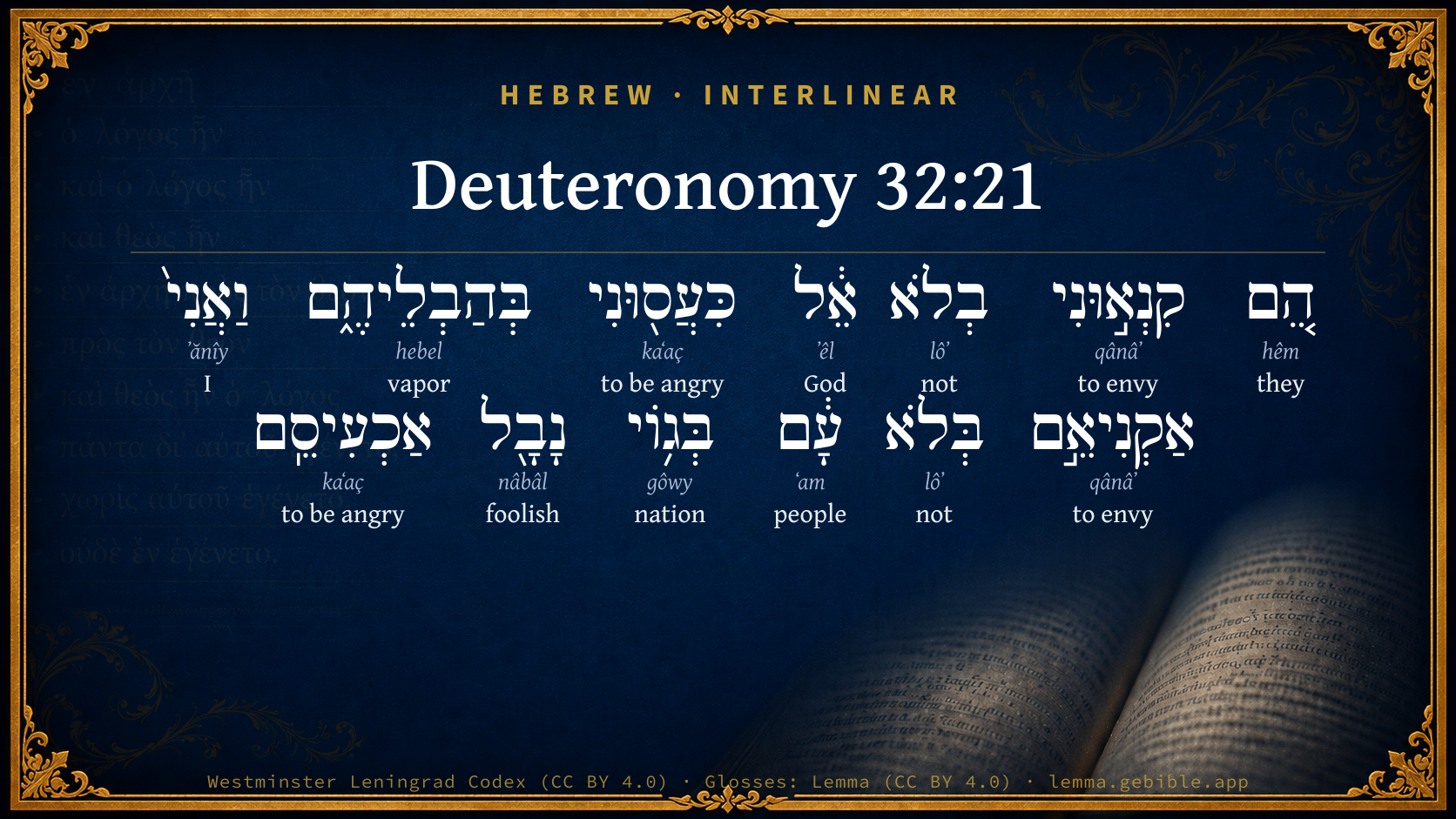
Deuteronomy 32:21

Hebrew (Westminster Leningrad Codex) Deuteronomy 32:21 appears in the Hebrew Old Testament. The text above is from the Westminster Leningrad Codex. Each word links to its Strong’s number, a concise gloss, and parsing drawn from the Open Scriptures Hebrew Bible morphology. Click any word for its full Brown-Driver-Briggs (BDB) entry.
Download image
Cite this verse

Deuteronomy 32:21 (World English Bible). Public Domain. Lemma interlinear Bible study tool, https://lemma.gebible.app/v/deuteronomy/32/21.

Show BibTeX & RIS
BibTeX
RIS
English Translation
They have moved me to jealousy with that which is not God; They have provoked me to anger with their vanities: I will move them to jealousy with those who are not a people; I will provoke them to anger with a foolish nation.
World English Bible · Public Domain
Highlights
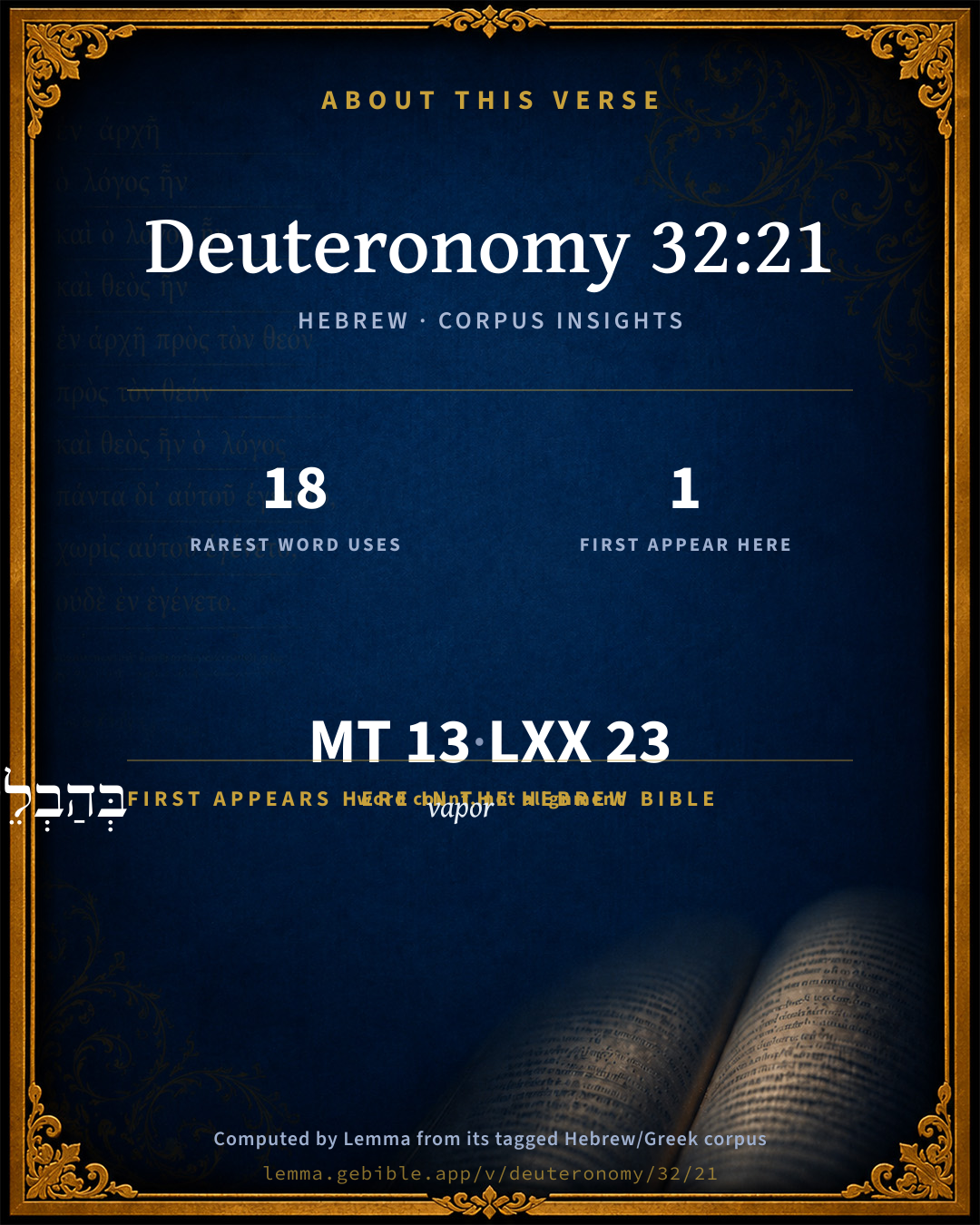
  • 1 first appearance in the Hebrew Bible
Full analysis ↓
Download a study sheet

One document with this verse’s original text, its word-by-word gloss line, the meaning frame, cross-references with their text, attributed commentary, and full source and license credits — printable, and it pastes into notes with its structure intact.

This verse Autodidact and up

Study sheet (.html) Plain text (.txt)

A passage Seminary Student

Up to 50 verses in one chapter. A passage sheet keeps up to 6 commentary sources and 12 cross-references per verse, in the order this page ranks them, and says so on the sheet whenever that leaves anything out. Ask for a single verse and you get the Autodidact verse sheet above.

Everything on this page stays free to read, with no account — the sheet is a download of what is already on screen, not access to it.

Want to remove ads? Support Godless Engineer
Compare translations 3

The same verse in 3 English versions, stacked beneath the original-language interlinear above. Click any original word for its lexicon entry.

Each is an independent rendering of the whole verse — the interlinear is not word-aligned to these translations.

Highlighted words mark where these versions differ — a whole-verse word diff, not a word-by-word alignment.

  • World English Bible Public Domain
    They have moved me to jealousy with that which is not God; They have provoked me to anger with their vanities: I will move them to jealousy with those who are not a people; I will provoke them to anger with a foolish nation.
  • King James Version Public Domain
    They have moved me to jealousy with that which is not God; they have provoked me to anger with their vanities: and I will move them to jealousy with those which are not a people; I will provoke them to anger with a foolish nation.
  • unfoldingWord Literal Text CC BY-SA 4.0
    They made me jealous with a not-god; angered me by their worthless things, so I will make them jealous with a not-people; by a foolish nation I will anger them,

unfoldingWord Literal Text — © unfoldingWord, licensed CC BY-SA 4.0. Word-aligned USFM3 via Door43 (git.door43.org/unfoldingWord/en_ult).

Versions to compare (up to 4)

3 of 4 selected

Show all 18 translations

Every available English version of this verse, each an independent rendering of the whole verse.

  • World English Bible Public Domain
    They have moved me to jealousy with that which is not God; They have provoked me to anger with their vanities: I will move them to jealousy with those who are not a people; I will provoke them to anger with a foolish nation.
  • Berean Standard Bible Public Domain
    They have provoked My jealousy by that which is not God; they have enraged Me with their worthless idols. So I will make them jealous by those who are not a people; I will make them angry by a nation without understanding.
  • Majority Standard Bible Public Domain
    They have provoked My jealousy by that which is not God; they have enraged Me with their worthless idols. So I will make them jealous by those who are not a people; I will make them angry by a nation without understanding.
  • King James Version Public Domain
    They have moved me to jealousy with that which is not God; they have provoked me to anger with their vanities: and I will move them to jealousy with those which are not a people; I will provoke them to anger with a foolish nation.
  • American Standard Version (1901) Public Domain
    They have moved me to jealousy with that which is not God; They have provoked me to anger with their vanities: And I will move them to jealousy with those that are not a people; I will provoke them to anger with a foolish nation.
  • Revised Version (1885) Public Domain
    They have moved me to jealousy with that which is not God; They have provoked me to anger with their vanities: And I will move them to jealousy with those which are not a people; I will provoke them to anger with a foolish nation.
  • Geneva Bible (1599) Public Domain
    They haue moued me to ielousie with that which is not God: they haue prouoked me to anger with their vanities: and I will moue them to ielousie with those which are no people: I wil prouoke them to anger with a foolish nation.
  • Douay-Rheims (1899) Public Domain
    They have provoked me with that which was no god, and have angered me with their vanities: and I will provoke them with that which is no people, and will vex them with a foolish nation.
  • Young's Literal Translation Public Domain
    They have made Me zealous by `no-god,' They made Me angry by their vanities; And I make them zealous by `no-people,' By a foolish nation I make them angry.
  • Literal Standard Version CC BY-SA 4.0
    They have made Me jealous by [what is] not God, || They made Me angry by their vanities; And I make them jealous by [what is] not a people, || I make them angry by a foolish nation.
  • Unlocked Literal Bible CC BY-SA 4.0
    They have made me jealous by what is not god and angered me by their worthless things. I will make them envious by those who are not a people; by a foolish nation I will make them angry.
  • unfoldingWord Literal Text CC BY-SA 4.0
    They made me jealous with a not-god; angered me by their worthless things, so I will make them jealous with a not-people; by a foolish nation I will anger them,
  • Darby Bible Public Domain
    They have moved me to jealousy with that which is no ùGod; They have exasperated me with their vanities; And I will move them to jealousy with that which is not a people; With a foolish nation will I provoke them to anger.
  • World Messianic Bible Public Domain
    They have moved me to jealousy with that which is not God. They have provoked me to anger with their vanities. I will move them to jealousy with those who are not a people. I will provoke them to anger with a foolish nation.
  • Webster's Bible Public Domain
    They have moved me to jealousy with that which is not God; they have provoked me to anger with their vanities: and I will move them to jealousy with those who are not a people; I will provoke them to anger with a foolish nation.
  • Free Bible Version CC BY-SA 4.0
    They have made me jealous by worshiping things that are not God; they have made me angry with their useless idols. So I will make them jealous using a people that aren't really a nation; I will make them angry using ignorant foreigners.
  • Bible in Basic English Public Domain
    They have given my honour to that which is not God, moving me to wrath with their false worship: I will give their honour to those who are not a people, moving them to wrath by a foolish nation,
  • JPS Tanakh (1917) Public Domain
    They have roused Me to jealousy with a no-god; they have provoked Me with their vanities; and I will rouse them to jealousy with a no-people; I will provoke them with a vile nation.

Literal Standard Version (2020), Covenant Press — licensed CC BY-SA 4.0. Text via the HelloAO Bible API (eBible.org). Unlocked Literal Bible (unfoldingWord) — licensed CC BY-SA 4.0. Text via the HelloAO Bible API (eBible.org). unfoldingWord Literal Text — © unfoldingWord, licensed CC BY-SA 4.0. Word-aligned USFM3 via Door43 (git.door43.org/unfoldingWord/en_ult). Free Bible Version, Dr. Jonathan Gallagher — licensed CC BY-SA 4.0. Text via the HelloAO Bible API (eBible.org).

Word by word

More ways to search: Search by grammar → Find every occurrence → Compare this word →

Practice this passage: Drill this verse → Learn its vocabulary →

נָבָ֖ל
nâbâl
H5036
“foolish”
Adjective, Adjective, Masculine, Singular, Absolute
Part of Speech
Adjective
Type
Adjective
Gender
Masculine
Number
Singular
State
Absolute
Full BDB Definition

Origin: from H5034

TWOT: 1285a

foolish, senseless, fool
  1. הֵ֚ם hêm H1992 “they” Pronoun, Personal, 3rd Person, Masculine, Plural
  2. קִנְא֣וּנִי qânâʼ H7065 “to envy · me” Verb, Piel, Perfect, 3rd Person, Common, Plural + Suffix, Personal, 1st Person, Common, Singular
  3. בְלֹא lôʼ H3808 “in/at · not” Preposition + Particle, Negative
  4. אֵ֔ל ʼêl H410 “God” Noun, Common, Masculine, Singular, Absolute
  5. כִּעֲס֖וּנִי kaʻaç H3707 “to be angry · me” Verb, Piel, Perfect, 3rd Person, Common, Plural + Suffix, Personal, 1st Person, Common, Singular
  6. בְּהַבְלֵיהֶ֑ם hebel H1892 “in/at · vanities · their” Preposition + Noun, Common, Masculine, Plural, Construct + Suffix, Personal, 3rd Person, Masculine, Plural
  7. וַאֲנִי֙ ʼănîy H589 “and · I” Conjunction + Pronoun, Personal, 1st Person, Common, Singular
  8. אַקְנִיאֵ֣ם qânâʼ H7065 “to envy · them” Verb, Hiphil, Imperfect, 1st Person, Common, Singular + Suffix, Personal, 3rd Person, Masculine, Plural
  9. בְּלֹא lôʼ H3808 “in/at · not” Preposition + Particle, Negative
  10. עָ֔ם ʻam H5971 “people” Noun, Common, Masculine, Singular, Absolute
  11. בְּג֥וֹי gôwy H1471 “in/at · nation” Preposition + Noun, Common, Masculine, Singular, Absolute
  12. אַכְעִיסֵֽם kaʻaç H3707 “to be angry · them” Verb, Hiphil, Imperfect, 1st Person, Common, Singular + Suffix, Personal, 3rd Person, Masculine, Plural

About this verse

These counts appear in no published source. They are computed here, from the morphology-tagged text and Lemma’s own curated glosses. What Lemma adds →

13
words
10
distinct lemmas
Pentateuch
section

Notable vocabulary

The rarest word here is נָבָ֖ל foolish H5036 — appearing just 18 times in the whole Hebrew Bible.

First appearance in Scripture

This word makes its first canonical appearance in the Hebrew Bible here:

  • בְּהַבְלֵיהֶ֑ם vapor H1892

Shared distinctive vocabulary

נָבָ֖ל foolish H5036 occurs in 18 verses of the Hebrew Bible. Also found in:

Grammatical profile

  • 4 verbs
  • 4 nouns
  • 1 adjective
  • 2 pronouns
  • 2 particles

Verb forms

  • קִנְא֣וּנִי Piel · Perfect
  • כִּעֲס֖וּנִי Piel · Perfect
  • אַקְנִיאֵ֣ם Hiphil · Imperfect
  • אַכְעִיסֵֽם Hiphil · Imperfect

Repetition

Words recur within this verse — often emphatic in Hebrew:

  • קִנְא֣וּנִי to envy H7065 ×2
  • כִּעֲס֖וּנִי to be angry H3707 ×2
  • בְלֹא not H3808 ×2

Hebrew & Septuagint length

In English translation the verse runs 44 words from the Hebrew and 42 from the Septuagint (LXX English) — closely comparable.

A rough comparison of the two English renderings, which tokenize alike — not a word-level alignment.

Word counts can differ between the Hebrew and the Greek without any difference in meaning — e.g. the Hebrew direct-object marker אֵת has no separate Greek word, and Greek often adds the article ὁ.

In the original languages it is 13 Hebrew tokens and 23 Greek tokens — but the two are counted differently (Hebrew bundles its prefixes and suffixes into one token; the Greek is in lemma form), so that isn’t a like-for-like length.

Cross-references

17

Topical passages linked to Deuteronomy 32:21 in the Treasury of Scripture Knowledge — connected by theme and wording, ordered by reader-vote popularity; previews shown in the World English Bible.

  • Romans 10:19 But I ask, didn't Israel know? First Moses says, "I will provoke you to jealousy with that which is no nation, With a nation void of understanding I will make you angry."
  • Romans 9:25 As he says also in Hosea, "I will call them 'my people,' which were not my people; And her 'beloved,' who was not beloved."
  • Romans 11:11–14 I ask then, did they stumble that they might fall? May it never be! But by their fall salvation has come to the Gentiles, to provoke them to jealousy.
  • 1 Kings 16:26 For he walked in all the way of Jeroboam the son of Nebat, and in his sins with which he made Israel to sin, to provoke Yahweh, the God of Israel, to anger with their vanities.
  • 1 Kings 16:13 for all the sins of Baasha, and the sins of Elah his son, which they sinned, and with which they made Israel to sin, to provoke Yahweh, the God of Israel, to anger with their vanities.
  • Deuteronomy 32:16 They moved him to jealousy with strange [gods]; With abominations provoked they him to anger.
  • Psalms 78:58 For they provoked him to anger with their high places, And moved him to jealousy with their engraved images.
  • Jonah 2:8 Those who regard lying vanities forsake their own mercy.
  • Psalms 31:6 I hate those who regard lying vanities, But I trust in Yahweh.
  • Jeremiah 14:22 Are there any among the vanities of the nations that can cause rain? or can the sky give showers? Aren't you he, Yahweh our God? therefore we will wait for you; for you have made all these things.
  • Hosea 1:10 Yet the number of the children of Israel will be as the sand of the sea, which can't be measured nor numbered; and it will come to pass that, in the place where it was said to them, 'You are not my people,' they will be called 'sons of the living God.'
  • 1 Samuel 12:21 and don't turn aside; for [then would you go] after vain things which can't profit nor deliver, for they are vain.
  • Jeremiah 8:19 Behold, the voice of the cry of the daughter of my people from a land that is very far off: isn't Yahweh in Zion? Isn't her King in her? Why have they provoked me to anger with their engraved images, and with foreign vanities?
  • Acts 11:15 As I began to speak, the Holy Spirit fell on them, even as on us at the beginning.
  • 1 Corinthians 10:22 Or do we provoke the Lord to jealousy? Are we stronger than he?
  • Jeremiah 10:8 But they are together brutish and foolish: the instruction of idols! it is but a stock.
  • 1 Peter 2:9–10 But you are a chosen race, a royal priesthood, a holy nation, a people for God's own possession, that you may show forth the excellencies of him who called you out of darkness into his marvelous light:

Cross-references courtesy of OpenBible.info (CC BY 4.0).

Hebrew and Greek witnesses Masoretic Hebrew ↔ Greek Septuagint

The same verse in the two great witnesses to the Old Testament, shown verse-for-verse.

These are two independent witnesses, not word-aligned to each other, and the Septuagint is shown in lemma (dictionary) form.

Hebrew Deuteronomy 32:21 Masoretic · Westminster Leningrad Codex

הֵ֚ם קִנְא֣וּנִי בְלֹא אֵ֔ל כִּעֲס֖וּנִי בְּהַבְלֵיהֶ֑ם וַאֲנִי֙ אַקְנִיאֵ֣ם בְּלֹא עָ֔ם בְּג֥וֹי נָבָ֖ל אַכְעִיסֵֽם

They have moved me to jealousy with that which is not God; They have provoked me to anger with their vanities: I will move them to jealousy with those who are not a people; I will provoke them to anger with a foolish nation.

World English Bible · Public Domain

Greek LXX Deuteronomy 32:21 Septuagint · lemma form

αὐτός παραζηλόω ἐγώ ἐπί οὐ θεός παραὀργίζω ἐγώ ἐν ὁ εἴδωλον αὐτός καΐἐγώ παραζηλόω αὐτός ἐπί οὐ ἔθνος ἐπί ἔθνος ἀσύνετος παραὀργίζω αὐτός

They have provoked me to jealousy with that which is not God, they have exasperated me with their idols; and I will provoke them to jealousy with them that are no nation, I will anger them with a nation void of understanding.

LXX2012 (modern English Septuagint) · Public Domain

On this verse, Haydock's Catholic Bible Commentary discusses the Septuagint’s reading. Read the note in Commentary ↓

Hebrew: Westminster Leningrad Codex (CC BY 4.0). Greek: Septuagint (public domain); English from LXX2012 (modern English Septuagint) (Public Domain). How the Septuagint differs from the Hebrew →

Targum (Aramaic paraphrase)

2

The Targum is the ancient Jewish Aramaic paraphrase of the Hebrew Scriptures — an interpretive translation, not the Hebrew text itself. Onkelos (literal) and Pseudo-Jonathan (expansive) render the Torah, and Jonathan the Prophets. Coverage is partial: where no permissively-licensed English translation exists for a verse, only the Aramaic is shown. This is verse-level text, not a word-by-word alignment to the Hebrew.

  1. Targum Onkelos Torah (Genesis–Deuteronomy)
    אִנוּן אַקְנִיאוּ קֳדָמַי בְּלָא דַחֲלָא אַרְגִיזוּ קֳדָמַי בְּפָלְחַן טַעֲוָן וַאֲנָא אַקְנִנוּן בְּלָא עַם בְּעַמָא טַּפְּשָׁא אַרְגֵזִנוּן

    (no public-domain English translation for this verse)

    Targum Onkelos — Aramaic: “Onkelos Genesis” (public domain); “Onkelos Exodus” (public domain); “Onkelos Leviticus” (public domain); “Onkelos Numbers” (public domain); “Onkelos Deuteronomy” (public domain). English: “Sefaria Community Translation” (CC0 1.0 (public-domain dedication)); “J.W. Etheridge. The Targums of Onkelos and Jonathan Ben Uzziel on the Pentateuch. London: Longmans, Green, 1862” (public domain). Text via Sefaria.

  2. Targum Pseudo-Jonathan Torah (Genesis–Deuteronomy)
    הִינוּן אַקְנוּן קֳדָמוֹי בִּדְלָא אֱלָהָא אַרְגִיזוּ קֳדָמוֹי בְּהַבְלֵיהוֹן וַאֲנָא אַקְנִינוּן בְּאוּמָא דְלָא אוּמָא בְּבַּבְלָאֵי עַמָא טַפְּשָׁא נִרְגוֹז יַתְהוֹן

    They have made Me jealous by that which is not God, they have angered Me by their vanities: I also will provoke them to jealousy by a people which hath not been a people, by the foolish Babylonian people will I provoke them.

    Targum Pseudo-Jonathan — Aramaic: “Targum Jonathan on Genesis” (public domain); “Targum Jonathan on Exodus” (public domain); “Targum Jonathan on Leviticus” (public domain); “Targum Jonathan on Numbers” (public domain); “Targum Jonathan on Deuteronomy” (public domain). English: “The Targum of Jonathan ben Uzziel, trans. J. W. Etheridge, London, 1862” (public domain). Text via Sefaria.

Commentary

Notes on Deuteronomy 32:21 from classic Christian and Jewish commentators (each source and its license shown beneath its notes). The classic Christian expositions comment on the surrounding passage and are grouped to its opening verse, so a note may address several verses; the Jewish commentaries on the Tanakh (Rashi and others) are per-verse, so they appear only where the commentator wrote on this verse.

Lemma curates 59 commentaries, every one of them public domain or Creative Commons licensed, each selected and text-cleaned for this edition rather than reprinted as found. About our sources →

Trapp's Complete Commentary

John Trapp

Deu 32:21 They have moved me to jealousy with [that which is] not God; they have provoked me to anger with their vanities: and I will move them to jealousy with [those which are] not a people; I will provoke them to anger with a foolish nation.

Ver. 21. And I will move them to jealousy.] Thus God delights to retaliate and proportion jealousy to jealousy, provocation to provocation; so frowardness to frowardness, {Psa 18:26} contrariety to contrariety. {Deu 28:18; Deu 28:21, &c.}

With a foolish nation.] With the conversion of the Gentiles, {Rom 10:19} which the good Jews could not easily yield to at first. {Act 11:2-3} And the rest could never endure to hear of it. See 1Th 2:15-16. At this day they solemnly curse the Christians thrice a day in their synagogues, with a Maledic, Domine, Nazarais. They have a saying in their Talmud, Optimus qui inter gentes est, dignus cui caput conteratur tanquam serpenti; The best among the Gentiles is worthy to have his head broke as the serpent had. Yea, they think they may kill any idolater. Therefore Tacitus saith of them, There was Misericordia in promptu apud suos, sed contra omnes alios hostile odium, mercy enough toward their own, but against all others they bare a deadly hatred.

John Trapp, A Commentary or Exposition upon All the Books of the Old and New Testament (1647–1656) — public domain. Text from a community e-Sword module.

Joseph Benson's Commentary

Deu 32:21. They have provoked me to anger with their vanities — By vanities here are meant the fictitious deities of the nations with whose worship the Israelites corrupted themselves: see Jer 8:19; Jer 14:22. I will move them to jealousy, &c. — God here threatens to repay their frequent revolts from him in their own kind, in a way most mortifying to their proud spirits; by causing the very Gentile nations, whom they much despised, not only to become their masters and conquerors, but also to be taken into his covenant, while they themselves were excluded from it. See Mat 21:43-44; Rom 10:19. With those that are not a people — With the heathen nations, who were none of God’s people, who scarce deserved the flame of a people, as being without the knowledge and fear of God, which is the foundation of all true policy and government, and many of them destitute of all government, laws, and order. And yet these people God declares he will take in their stead, receive them, and reject the Israelites, which when it came to pass, how desperately did it provoke the Jews to jealousy! A foolish nation — So the Gentiles were, both in the opinion of the Jews, and in truth and in reality, notwithstanding all their pretences to wisdom, there being nothing more foolish or brutish than the worship of idols.

Joseph Benson's Commentary on the Old and New Testaments (1811–1818) — public domain. Text from a community e-Sword module.

Tyndale Open Study Notes

Tyndale Open Resources

32:21 roused my jealousy: The Lord was not petulant because of attention paid to false gods. Rather, Israel had broken their covenant with him by worshiping other gods, demonstrating their disdain for him and his sovereignty (see 32:16). • people who are not even a people: God’s purpose for Israel was not just to redeem them, but through them to redeem all nations of the earth. In Israel’s eyes, other peoples were worthless, but through God’s attention to other nations, Israel would be drawn back to obedience (see Hos 1:9; 2:23; Rom 9:25; 10:19).

Tyndale Open Study Notes — © Tyndale Open Resources, licensed CC BY-SA 4.0. Text via the HelloAO Bible API.

Geneva Bible (1599)

Geneva Bible translators

Which I have not favored, nor given my law unto them.

Geneva Bible (1599) marginal notes — public domain. Text via Bolls.life.

Jamieson, Fausset & Brown

Robert Jamieson, A. R. Fausset & David Brown

those which are not a people--that is, not favored with such great and peculiar privileges as the Israelites (or, rather poor, despised heathens). The language points to the future calling of the Gentiles.

Jamieson, Fausset & Brown — Commentary Critical and Explanatory on the Whole Bible (1871) — public domain (CC PDM 1.0). Text via the HelloAO Bible API.

Adam Clarke's Commentary

Verse 21. They have moved me to jealousy] This verse contains a very pointed promise of the calling of the Gentiles, in consequence of the rejection of the Jews, threatened De 32:19; and to this great event it is applied by St. Paul, Ro 10:19.

Adam Clarke's Commentary on the Bible (1810–1826) — public domain. Text from a community e-Sword/MySword module.

Ellicott's Commentary for English Readers

(21) “They have made me jealous with a no-god;

They have provoked me with their vanities:

And I will make them jealous with a no-people;

With a foolish nation will I provoke them.”

St. Paul comments on this in Romans 10, as proving that Israel was informed of the calling of the Gentiles, and compares Isa_65:1, “I was found of them that sought me not. I made myself manifest unto those that inquired not after me.”

Rashi quotes, perhaps not quite inappropriately Isa_23:13, and gives this explanation, “A no-people,” i.e., a nation without a name; as it is said, “Behold the land of the Chaldseans: this people was not.”

A Bible Commentary for English Readers, edited by Charles John Ellicott (1878–1897) — public domain. Text from a community e-Sword module.

The Cambridge Bible for Schools and Colleges

gen. ed. J. J. S. Perowne

21. moved … to jealousy] See on Deu_32:16. Mark the antitheses: no-god (lo’-’el), no-people (lo’-‘am, as hitherto outside the nations known and to be reckoned with, by Israel, as unfit to serve any Divine purpose); and vanities (lit. breaths, or as we should say, bubbles, so in Jer. of the heathen gods, Deu_8:19, etc.) and foolish (nabal, chosen perhaps both because of its probable root-meaning fading, worthless, parallel to vanities, and because it was used in a religious sense, godless, infidel). See Paul’s application of the v. in Rom_10:19.

22 For a fire has flared from my wrath,

And burned to the lowest Shĕ’ól,

It devours earth and her increase,

It flames round the roots of the hills.

23 I will sweep up evils upon them,

Against them exhaust mine arrows.

24 Drained by famine, devoured by fever (?)

And poisonous pestilence (?),

The teeth of brute beasts will I send them,

With venom of things that crawl in the dust.

25 Abroad shall the sword bereave,

And terror be in the chambers—

As well the youth as the maiden,

The suckling and gray-headed man.

The Cambridge Bible for Schools and Colleges (gen. ed. J. J. S. Perowne; Cambridge University Press, 1878–1918) — public domain. Text from a community e-Sword module.

John Gill's Exposition

For a fire is kindled in mine anger,.... Here begins the account of temporal and corporeal judgments inflicted on the Jews for their disbelief and rejection of the Messiah, their contempt of his Gospel, and ill treatment of his followers; and this here respects the destruction of the land of Judea in general, and the burning of the city and temple of Jerusalem in particular, as the effect of the wrath and anger of God like fire kindled against them:

and shall burn unto the lowest hell; which denotes an entire destruction, like that of the burning of Sodom and Gomorrah with fire and brimstone from heaven; which issued in a sulphurous lake, and which sulphureous matter sunk to the bottom of the Dead Sea; and to that destruction is this of the land of Judea compared, Deu 29:23,

and shall consume the earth with her increase: the land of Judea, with the cities and towns in it, and buildings on it, and the fruits of the earth; which were either gathered into their barns and storehouses, or were growing in their fields, and vineyards, and oliveyards; all were destroyed and consumed at or before the destruction of Jerusalem, or quickly after it:

and set on fire the foundations of the mountains; the city of Jerusalem, as Jarchi himself interprets it, whose foundations were by the mountains, according to Psa 125:2; and the temple of Jerusalem particularly was built on Mount Moriah, and that as well as the city was utterly consumed by fire: and it is remarkable that when Julian the apostate attempted to rebuild it, as is related even by an Heathen historian (a), that flames of fire burst out from the foundations, and burnt the workmen; so that he was obliged to desist from his rash undertaking.

(a) Ammian. Marcellin. l. 23. in initio.

John Gill's Exposition of the Whole Bible (1746–1763) — public domain (CC PDM 1.0). Text via the HelloAO Bible API.

Haydock's Catholic Bible Commentary

Vanities. Septuagint, "idols." (Haydock) --- Nation. The Gentiles were of this description, when they were called to the true faith. This excited the indignation of the Jews, as they would neither enter heaven themselves, nor suffer others to obtain that happiness, Romans i. 19. (Theodoret, q. 41.) "An association bound together by law, constitutes a nation. A multitude which has no laws, or bad ones, is unworthy of the name." (Grotius) --- The Jews looked upon all others with sovereign contempt. (Calmet) --- Now, in their turn, they are despised. (Worthington)

George Leo Haydock (1774–1849), Haydock's Catholic Family Bible and Commentary, 1859 edition — public domain. Excludes Psalms (Douay-Rheims chapter numbering differs from Protestant) and Deuterocanonical books (Catholic canon only).

Matthew Poole's English Annotations

With those which are not a people, i.e. with the Gentile or heathenish nations, who are none of my people, who scarce deserve the name of a people, as being without yoke, without the knowledge and fear of God, which is the foundation of all true policy and government, and without righteous and necessary laws; and many of them are destitute of all government, and laws, and order, barbarous and rude, and savage, and brutish in their manners. And yet these people I will prefer before you, and take in your stead; receive them, and reject you; which, when it came to pass, how desperately it provoked the Jews to jealousy, may be gathered from Mat 21:43; Act 11:2,3; 22:21-23; 1Th 2:15,16.

A foolish nation; so the Gentiles were both in the opinion of the Jews, and in truth and reality, notwithstanding all their pretences to wisdom, Rom 1:22, there being nothing more foolish or brutish than the worship of idols. See Jer 10:8; 1Co 12:2.

Matthew Poole's English Annotations on the Holy Bible (1683–1685) — public domain. Text from a community e-Sword/MySword module.

Whedon's Commentary on the Bible

Daniel D. Whedon

21. In strong terms Moses represents Jehovah as rejecting disobedient Israel, and bringing upon them terrible retribution. Israel is to be punished. Paul, Rom_10:19, quotes this verse to indicate the adoption of the Gentiles. In the Hebrew there is a striking antithesis. They have moved me to jealousy with a no god. I will therefore provoke them to jealousy with a no nation.

Daniel D. Whedon (gen. ed.), Commentary on the Old and New Testaments (1874–1909) — public domain. Text from a community e-Sword module.

The Pulpit Commentary

cf. Deu_5:16. Because they had moved God to jealousy and provoked him to anger by their vanities, their nothingnesses, mere vapors and empty exhalations ( cf. Jer_10:6; Joh_2:8; 1Co_8:4) as they had forsaken him for a no-God, he would send retribution on them by adopting as his a no-people, and giving to a foolish nation, i.e. a nation not before possessed of that true wisdom the beginning of which is the fear of the Lord, the privileges and blessings which Israel had forfeited by their apostasy. By "a no-people" is not to be understood a savage tribe not yet formed into a community, but a people without God, and not recognized by him as in covenant union with him. (cf. Rom_10:19; Eph_2:12; 1Pe_2:10)

The Pulpit Commentary (1880–1919), ed. H.D.M. Spence-Jones & Joseph S. Exell — public domain. Text from a community e-Sword module.

John Wesley's Explanatory Notes

I will move them to jealousy with those that are not a people - With the Heathen nations, who are none of my people, who scarce deserve the name of a people, as being without the knowledge and fear of God, which is the foundation of all true policy and government, and many of them destitute of all government, laws and order. And yet these people I will take in your stead, receive them and reject you; which, when it came to pass how desperately did it provoke the Jews to jealousy? A foolish nation - So the Gentiles were both in the opinion of the Jews and in truth and reality, notwithstanding all their pretenses to wisdom, there being nothing more foolish or brutish than the worship of idols.

John Wesley, Explanatory Notes Upon the Whole Bible (1754–1765) — public domain. Text via the GEBible commentary corpus.

unfoldingWord translationNotes

Door43 World Missions Community

General Information:

Moses speaks a poetic song to the people of Israel. He continues to quote Yahweh's words. (See: Parallelism)

They have made me jealous

Here "me" refers to Yahweh.

what is not god

"what are false gods"

worthless things

You may need to make explicit what the "things" are. AT: "worthless idols" (See: Assumed Knowledge and Implicit Information)

those who are not a people

"people who do not belong to one people group"

foolish nation

Translate "foolish" as in Deuteronomy 32:6.

translationWords

jealous

false god

anger

false god

envy

people group

nation

understand

unfoldingWord translationNotes — © Distant Shores Media and the Door43 World Missions Community, licensed CC BY-SA 4.0. Source: git.door43.org/Door43/en_tn.

Rashi

Rabbi Shlomo Yitzchaki (Rashi)

קנאוני means, they made My anger glow (cf. Rashi on v. 16).

בלא אל means, with something that is not a god.

בלא עם [I WILL MOVE THEM TO JEALOUSY] WITH THOSE WHO ARE NOT A PEOPLE — i.e. with a nation that has no reputation, as it states e.g. of the Chaldeans (Isaiah 23:13), “Behold, the land of the Chaldeans, this people was not; [the Assyrians founded it …]”, and of Esau it states (Obadia 1:2) “Thou art greatly despicable”.

בגוי נבל אכעיסם I WILL PROVOKE THEM TO ANGER WITH A DEBASED NATION — these are the “Minim”, the heretics. So indeed, it states, (Psalms 14:1) “The heretic (נבל) hath said in his heart “There is no God” (Sifrei Devarim 320:10; Yevamot 63b).

Rashi on the Tanakh — English translations: “The Judaica Press complete Tanach with Rashi, translated by A. J. Rosenberg” (CC BY 4.0); “Pentateuch with Rashi's commentary by M. Rosenbaum and A.M. Silbermann, 1929-1934” (public domain); “The Metsudah Tanach series, Lakewood, N.J” (CC BY 4.0); and “The Book of Joshua, Metsudah Publications, 1997” (CC BY 4.0). Text via Sefaria.

Ramban (Nachmanides)

Rabbi Moshe ben Nachman (Ramban / Nachmanides)

THEY HAVE ROUSED ME TO JEALOUSY WITH A NO-GOD — “with something that is not a god.” This is Rashi’s language. And if so, He alludes to the demons mentioned earlier., Verse 17. The correct interpretation is that He is stating: “They have roused Me to jealousy with an untrue god, for there is no G-d save the Eternal, and beside Him there is no savior,” similar to what is stated, Now for long seasons Israel was without the true G-d.

THEY HAVE PROVOKED ME WITH THEIR VANITIES — [their vain belief in] the demons. AND I WILL ROUSE THEM TO JEALOUSY WITH A NO-PEOPLE — the Chaldeans, of whom it is said, Behold, the land of the Chaldeans, this is the people that was not, meaning the people that were not esteemed as a nation, and the Holy One, blessed be He, raised them to subjugate His world through them, as He said, Thou art My maul and weapons of war. I WILL PROVOKE THEM WITH A ‘NAVAL’ (VILE) NATION — with Esau who is vile, and he remembered not the brotherly covenant. He thus alludes to both exiles [by the hands of the Chaldeans, i.e., the Babylonians; and by the Edomites, the Romans].

Ramban (Nachmanides) on the Tanakh — English translation: “Commentary on the Torah by Ramban (Nachmanides). Translated and annotated by Charles B. Chavel. New York, Shilo Pub. House, 1971-1976” (CC BY 4.0). Text via Sefaria.

Lesson kit

Teaching starters — assembled from the data on this page, not authored interpretation. Every prompt links to the verse data it draws on. Edit before teaching.

Deuteronomy, in the Pentateuch, opens this verse with 13 words (10 distinct Hebrew lemmas). Its most distinctive word is nâbâl (“foolish”). A historical commentator’s framing appears above. Read the whole chapter for the surrounding context.

Discussion questions

  1. How does “foolish” (nâbâl) shape what this verse is saying?
  2. This is the first place “vapor” appears in Scripture (first appears here). What does its debut here establish?
  3. How does Deuteronomy 32:6, which shares the word «foolish», read alongside this verse?
  4. What does the repetition of “to envy” (2× in this one verse) do in this verse?
  5. These translations render this verse differently. What is at stake in choosing one wording over another?
  6. «קִנְא֣וּנִי» is a Piel Perfect verb. How does that grammatical form shape the action described?
  7. Compare how Trapp's Complete Commentary and Joseph Benson's Commentary read this verse. Where do they agree or differ?

Things to notice

Reading settings

Reading text

Shown beneath each verse's original-language words.

Old Testament
Old Testament edition

Read the OT as the Masoretic Hebrew (MT) or the Greek Septuagint (LXX).

English shown for the Greek Septuagint (in the Hebrew ↔ Greek comparison).

Comparing translations? Open the Compare panel on any verse page to stack up to four side by side.